Tag: proposed constitutional amendment

  • Ohio servers and bartenders oppose potential ballot measure to raise minimum wage, survey says

    Ohio servers and bartenders oppose potential ballot measure to raise minimum wage, survey says

    BY:  – Ohio Capital Journal

    A new survey shows 93% of Ohio servers and bartenders want to keep the current tipping system with a base wage and tips.

    The Ohio Restaurant & Hospitality Alliance released the results of the survey earlier this week, which received 990 responses from tipped employees working at full-service restaurants across Ohio. The online survey was conducted in April by national research and consulting firm CorCom Inc. and had a 3% margin of error.

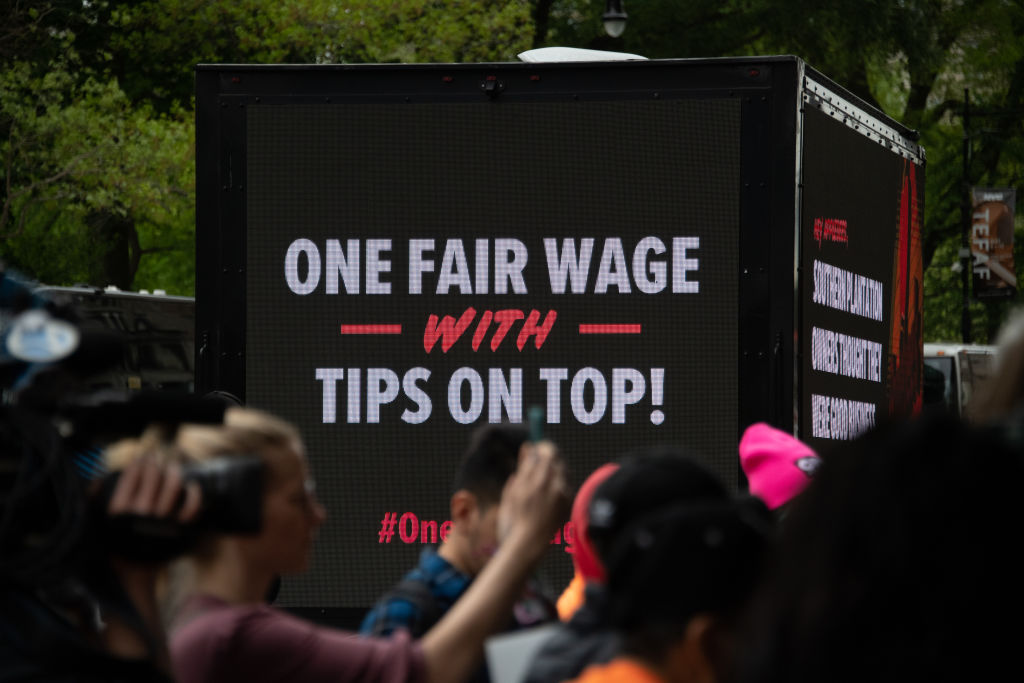
    The survey comes as Raise the Wage Ohio is collecting signatures to put a proposed constitutional amendment on Ohio’s ballot that would raise the minimum wage to $12.75 an hour starting Jan. 1, 2025 and would eliminate Ohio’s tipped wage. Minimum wage would go up to $15 an hour starting on Jan. 1, 2026. Raise the Wage is part of a national campaign run by One Fair Wage.

    “We believe it would really devastate the third largest industry in our state, which employs about 550,000 Ohioans and is still trying to recover from the pandemic,” said John Barker, president and CEO of the Ohio Restaurant and Hospitality Alliance. “Our industry is currently trying to weather the cumulative effect of record high inflation over the last three years.”

    Raise the Wage Ohio needs to collect more than 413,000 signatures by July and they currently have more than 410,000 signatures, said Mariah Ross, the executive director of One Fair Wage.

    Ohio’s current minimum wage is $10.45 an hour for non-tipped employees and $5.25 for tipped employees. An employer in Ohio can pay tipped employees half the starting wage, so tipped employees are guaranteed to receive the full minimum wage, but most earn a lot more through tipping.

    “Zero restaurant workers make less than minimum wage by law. This has always been true,” said Todd Bowen, ORHA’s managing director of external affairs and government relations.

    The median income for tipped workers in Ohio is $27 an hour, according to ORHA.

    “The current system works well, but this proposal would force servers and bartenders to live on an hourly wage, which we know would lower their income, and it would nearly triple labor costs for restaurants and bars and other businesses employ tip workers,” Barker said.

    Raising the minimum wage would force restaurant operators to raise their menu prices by about 20-30%, he said.

    The survey also revealed 83% of tipped employees are earning $20 per hour or more and 64% of tipped employees are earning anywhere between $25 to more than $40 per hour.

    Nearly 70% said they make more now than they could in a job in a different industry and 64% like having a flexible schedule.

    “You might have a mom, you may have a student in college who can work when they want and they can make good money while they’re doing it,” said Lloyd Corder, a professor at Carnegie Mellon University who leads the consulting firm.

    If tipped wages are eliminated, 91% worry tipped employees would earn less money and 85% think customers would not tip on top of a mandatory service charge.

    One Fair Wage called the results misleading.

    “This is a mischaracterization of One Fair Wage’s proposal, which advocates for a full minimum wage plus tips, not one in place of the other,” One Fair Wage said in a statement. “The survey employs questions that skew the true nature of the policy and is part of an ongoing strategy to mislead workers.”

    Workers speak out against raising minimum wage

    Laurie Torres, owner & operator of Mallorca Restaurant in Cleveland, worries raising minimum wage could potentially close her restaurant. She said she would have to raise her prices more than 22% if the minimum wage ballot measure passed — something she has shared with her customers.

    “Time and time again customers say they would visit less often,” Torres said. “And tip less dollars. If the ballot initiative passes my guests would pay more. My servers would make less and there is a real chance I would have to close my restaurant and the doors to a place so many call home. … My restaurant is just like your favorite restaurant. Are you ready to say goodbye to it?”

    Lindsay Odell, a bartender at Submarine House in Huber Heights, said she easily makes more than $30 an hour — more than her engineer husband.

    “If this did pass, this would change my life,” she said. “This would be terrible. I would never be a bartender and I love being a bartender. That’s all I’ve ever done. It’s all I ever want to do.”

    The potential ballot measure could have a “devastating impact” on communities, Bowen said.

    “It’s often a cool restaurant or a cool brewery that makes a neighborhood or development or a small community vibrant and anything that negatively impacts hospitality negatively impacts those communities,” he said.

    Senate Bill 256

    State Sen. Bill Blessing, R-Colerain Township, recently introduced a bill as a way to stop the proposed constitutional amendment.

    Senate Bill 256 would raise the minimum wage for non-tipped workers to $15 and tipped to $7.50 by 2028.

    “We think Senator Blessing’s approach has a slower, thoughtful, measured approach to $15 that gets there over a number of years … but do so without devastating Ohio’s businesses and the communities that they rely on,” Bowen said.

    Follow OCJ Reporter Megan Henry on X.


    Megan Henry
    MEGAN HENRY

    Megan Henry is a reporter for the Ohio Capital Journal and has spent the past five years reporting in Ohio on various topics including education, healthcare, business and crime. She previously worked at The Columbus Dispatch, part of the USA Today Network.

    Ohio Capital Journal is part of States Newsroom, the nation’s largest state-focused nonprofit news organization.

    MORE FROM AUTHOR


  • Ohio business leaders support redistricting reform amendment

    Ohio business leaders support redistricting reform amendment

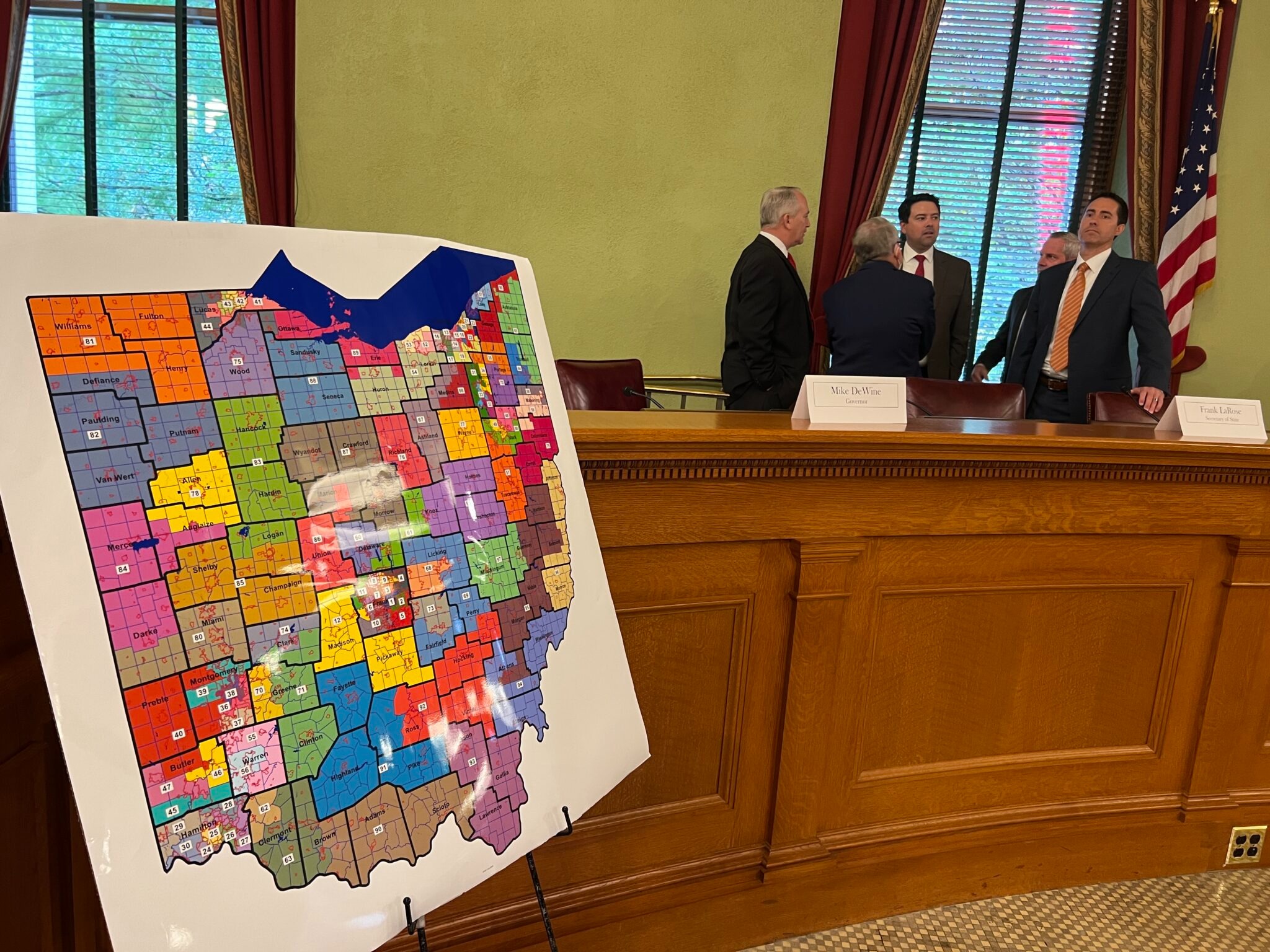
    The Republican members of the Ohio Redistricting Commission talk before a 2023 public hearing on Statehouse district maps. (Photo by Susan Tebben, Ohio Capital Journal.)

    BY:  Ohio Capital Journal

    Business leaders from Ohio are standing in support of a proposed constitutional amendment that would change the way redistricting occurs in the state by removing politicians from the process in favor of a citizen commission.

    “One crucial aspect of ensuring a robust representative democracy are legislative districts that ensure fair representation of the voting population,” an open letter from 67 Ohio business leaders stated. “The sad reality in Ohio is that political leaders of both parties have abused the system.”

    The letter was released via the Leadership Now Project, a national group of business leaders, and organized by a senior advisor to the project, Ohio Business Roundtable co-founder Richard Stoff.

    “Extreme gerrymandering reflects poorly on this great state of ours,” Stoff said in a statement announcing the letter, in conjunction with Citizens Not Politicians, the group leading the effort to get redistricting reform on the ballot.

    Citizens Not Policians is working to get a proposed constitutional amendment on the November 2024 ballot that would eliminate the Ohio Redistricting Commission as it stands now, made up of seven elected officials including the Ohio governor, secretary of state, and auditor, as well as one Republican and one Democratic lawmaker from both the Ohio House and Ohio Senate.

    Instead, if the amendment is approved by voters, a 15-member commission made up of public citizens would be empaneled to choose Ohio Statehouse and U.S. congressional voting districts.

    Over the last two years, the ORC has received staunch criticism for its process, with the adoption of six Statehouse district maps and two congressional maps, all but one of which (the most recent Statehouse maps) were rejected by the Ohio Supreme Court as unconstitutional and unduly partisan.

    The maps came about with behind-the-scenes map drawing that ignored racial demographics, rejected the work of taxpayer-funded independent map-drawers brought in at the behest of the state supreme court, and with redistricting commissioners refusing to go back to the drawing board as ordered by the court, based on legislative leaders’ interpretation of the law and their authority on redistricting.

    The newest constitutional amendment on redistricting would “empower a truly independent citizen-led process to draw congressional and state legislative maps,” according to the letter.

    “Building on successful best practices from other states, the Ohio proposal would ban gerrymandering, prohibit consideration of individual incumbents or candidates when drawing maps, and ensure an open and transparent redistricting process with extensive and meaningful public input,” the business leaders wrote.

    As of Wednesday, individuals who signed the letter included former CEOs and leaders from the banking, energy, insurance, retail, small business and academic worlds. Recognizable names like Dr. Amy Acton, Jeni Britton, and Yvette McGee Brown appear alongside Doug Ulman of Pelotonia, former Procter & Gamble chair and CEO John Pepper, and Robert Schottenstein, chairman and CEO of M/I Homes.

    Citizens Not Politicians and supporters of the proposed amendment are currently collecting signatures to bring the measure to the ballot box. The deadline to collect signatures for the 2024 General Election ballot is July 3.


    Susan Tebben
    SUSAN TEBBEN

    Susan Tebben is an award-winning journalist with a decade of experience covering Ohio news, including courts and crime, Appalachian social issues, government, education, diversity and culture. She has worked for The Newark Advocate, The Glasgow (KY) Daily Times, The Athens Messenger, and WOUB Public Media. She has also had work featured on National Public Radio.

    MORE FROM AUTHOR

  • Judge Jerry R. McBride: Why Issue One should be opposed

    Judge Jerry R. McBride: Why Issue One should be opposed

    by Judge Jerry R. McBride

    If you are concerned about neighborhood safety, then you should NOT support Issue One on the ballot this fall. It will hinder law enforcement, prosecutors, and judges in their ability to deal with the biggest drug crisis in this state’s history.As a result, it will result in more drugs on the streets, more crime, more deaths from overdoses, and more costs to local communities and taxpayers.

    Jerry R. McBride is a Clermont County, Ohio, Common Pleas Court Judge

    Judges have the ability to comment on issues that affect the administration of justice. Issue One will have a devastating effect on the administration of justice on Ohio. As one trial judge, this is my take on Issue One:

    ISSUE ONE DOES NOT BELONG IN THE STATE CONSTITUTION

    A state constitution should set forth the powers and functions of the branches of government, certain general values and principles upon which the citizens of the state generally agree, and the basic rights which are afforded to the citizens of the state. It should set forth matters which are so fundamental and important that they will not be subject to change over time. This proposed constitutional amendment does not in any way belong in a state constitution. It seeks to change sentencing law as it exists in the state of Ohio based on an assumption that change needs to be made. If change does need to be made, then it should be made through the process of enacting legislation, as is done on a regular basis in this state, and not through a constitutional amendment.

    ISSUE ONE DIRECTLY CONTRADICTS THE CONCEPT OF TRUTH IN SENTENCING AND IGNORES THE RIGHTS OF VICTIMS.

    There should be truth in sentencing, not lip service to truth in sentencing. Issue One allows a credit to be given by the Department of Rehabilitation and Correction for participation in rehabilitative, work, or educational programming of up to 25% of a sentence plus 30 days. While this may sound good at first glance, it is contrary to the concept of truth in sentencing. When a victim is told what a sentence will be, he/she should be able to rely on that being the sentence unless a hearing is scheduled on a possible reduction in the sentence. Why should a sentence be reduced just because an inmate “participates” in programming? Isn’t that the bare minimum that should be expected from an inmate? Why should an inmate be rewarded for doing the bare minimum? If a sentence is to be reduced, it should be reduced by the sentencing judge based upon an assessment that the risk of recidivism has been reduced, not because somebody has shown up to work. And if the judge makes the assessment that the sentence should be reduced, a hearing will be required and the victim will have an opportunity to be present and to be heard, which is the way it should be. Additionally, what does it mean to “participate” in these activities? This essentially allows the prison authorities to reduce a judge’s sentence,and it should be the judge who imposed a sentence who determines whether that sentence should be reduced.

    ISSUE ONE IS DANGEROUS IN THAT IT INTERFERES WITH THE JUSTICE SYSTEM’S ABILITY TO DEAL WITH THE DRUG CRISIS

    It is highly inappropriate in the midst of the biggest crisis in this state in terms of drug abuse for the possession and use of dangerous drugs to be treated essentially the same as minor traffic and criminal offenses. Possession of dangerous drugs leads to overdoses, to more serious criminal offenses, to deaths. The possession and use of dangerous drugs are not minor offenses to the persons who are addicted to drugs, to the victims of crime involving persons under the influence of drugs, to the parents and family members who are praying that their loved ones will not overdose and die. To suggest that we need to include treatment in our approach to this drug crisis is highly appropriate, and in fact it is already being done routinely across this state. However, to suggest that we should reduce the level of these offenses so that they are no longer classified as serious offenses is highly inappropriate.

    ISSUE ONE TREATS USE OF DANGEROUS DRUGS AS LESS SERIOUS THAN JUST ABOUT EVERY OTHER CRIME

    The proponents of the constitutional amendment, in saying that a jail sentence cannot be imposed, are saying that possession and use of such drugs as heroin, methamphetamine, and cocaine should be treated more lightly than reckless driving, shoplifting, lying to a police officer, gambling, and persistent disorderly conduct, all of which can result in the imposition of jail sentences. Is this really the message that we should be sending to drug addicted adults who represent a risk of committing more serious offenses as long as they persist in the use of dangerous drugs?

    ISSUE ONE ELIMINATES THE ABILITY OF A JUDGE TO IMPOSE A JAIL SENTECE FOR A FIRST OR SECOND POSSESSION OFFENSE, EVEN IF THE DRUG IS HEROIN, METHAMPHETAMINE, OR COCAINE

    In all likelihood, probation will be appropriate for a person who commits a drug possession offense which is the first or second within a 24-month period. However, that will not always be the case. For instance, probation may not be appropriate at all if the offense is committed at the same time as a more serious offense such as a burglary or an assault. Similarly, probation may not serve the purpose of protecting the public if the drug possession or use offense is committed by a convicted sex offender for whom use of a dangerous drug or alcohol represents a significant risk of reoffending and for whom intermediate sanctions may provide no real protection to the community. As for the term probation, does that include treatment in a halfway house or in a lock-down community based correctional facility?

    If it doesn’t include residential treatment, including lockdown residential treatment, ittakes away some of the most effective tools which can be used in trying to rehabilitate an offender. Needless to say, the problem with creating an absolute standard that requires that a person who uses or possesses drugs receive the lowest level of sanction available is that applying that standard under the facts of given case may not be consistent with the seriousness of the offense or the likelihood of recidivism.

    ISSUE ONE PUTS HANDCUFFS ON JUDGES IN THEIR ABILITY TO GET OFFENDERS TO STOP USING DRUGS

    The proposed amendment would eliminate the possibility of imposing a jail sentence at all for a violator on a first or second drug possession or use offense within 24 months and would eliminate the possibility of a court imposing a prison sentence for a felony violator unless the violator commits a new criminal offense. However, this leads to some very real dilemmas. If that is to be the law, what is a court to do with someone who simply refuses to attend treatment or to comply with any of the intermediate sanctions or who simply says that he/she will not comply with anything that the court orders? What is a court to do with someone who says he/she will comply with community control sanctions but then refuses to do anything which is ordered? Under the language of the proposed constitutional amendment, a felony offender could simply tell a judge at the time of the sentencing hearing that he/she will comply with the community control sanctions that are ordered, and then after being placed on community control, refuse to do anything that the court orders. At that point, a prison sentence could not be imposed. What is the possible sense in that? How does that serve to protect the public? The probation department has a statutory duty to report violations to the court, but if the offender continually absconds or fails to comply with the sanctions that are ordered, how can the probation department perform that function? The answer is very simple- it can’t.

    ISSUE ONE JUST GIVES LIP SERVICE TO THE CONCEPT OF GRADUATED SANCTIONS

    Issue One strips away the full range of tools which enable a judge or probation department to be effective in not only rehabilitating an offender, but also in protecting the public. It is difficult to argue with the concept of graduated responses, and the use of intermediate sanctions, by courts and probation departments. It is consistent with the use of evidence-based practices. However, the application of graduated responses or intermediate sanctions to a violator in a given case will depend on the seriousness of the original offense, the risk of recidivism, and the nature of the violation. In this regard, a graduated response policy will typically include probation (monitored or with conditions), intermediate sanctions (which may include such things as house arrest, residential or outpatient treatment, day reporting, a short jail term, or other requirements), and jail or prison. Issue One, however, arbitrarily takes away the option of jail or prison even for someone who thumbs his or her nose at the system and who refuses to undergo treatment or to make other changes that are necessary to reduce the likelihood of recidivism. It also arbitrarily takes away the option of jail or prison for someone for whom lesser sanctions are simply not appropriate.

    ISSUE ONE CONTRADICTS THE IMPORTANT CONCEPT OF SEPARATION OF POWERS

    The proposed amendment provides that each court must prepare guidelines for graduated responses that may be imposed in sentencing offenders and that the guidelines must be approved by the Department of Rehabilitation and Correction, which is part of the executive branch. Such a provision, which is proposed to be part of the state constitution, violates an already existing constitutional principle, which is the separation of powers. Additionally, there is no reason to believe that the Department of Rehabilitation and Correction has any expertise in deciding what factors a court should consider in determining which graduated response should be applied in a given case in sentencing an individual. That is pure and simple a judicial function.

    UNDER ISSUE ONE, THERE WILL BE LESS, NOT MORE, MONEY FOR TREATMENT

    The proponents of this constitutional amendment assume that the costs of their proposal will be covered by a substantial reduction in the number of prison beds. However, since the cost of housing fourth and fifth degree felons in the prison system is a very small part of the overall prison cost, since the projections as to cost reductions by the Department of Rehabilitation and Corrections have been inaccurate in the past, and since the increase in prison population has primarily resulted from longer sentences, and that is not addressed at all by the constitutional amendment, there is no real reason to believe that the assumptions of the proponents in this regard are correct.

    ISSUE ONE WILL RESULT IN GREATER COSTS TO LOCAL COMMUNTIES WITH WORSE RESULTS

    In the unlikely possibility that the proponents of Issue One are correct that there will be more money for treatment, and that appears to be fool’s gold, the most significant costs of this proposed constitutional amendment are the following- it undermines the efforts being made by courts and the law enforcement community to deal with the drug crisis, it undermines the ability of courts to effectively sentence offenders, and worst of all, it will not make the public any safer at all, and given the problems identified above, will likely lead to the public being more at risk. The cost of the proponents of Issue One pursuing their ill-conceived political agenda will be to put more people at risk of being victims, will not result in more or better treatment for drug users, and will result in greater cost- both human and monetary- to local communities. That is the reason that law enforcement, prosecutors, and judges throughout Ohio are opposing Issue One as being both ill-conceived and dangerous.


      Relaxed atmosphere and friendly service welcomes you back time and time again! Located in the heart of the Historic Loveland District Just outside Cincinnati, Ohio.