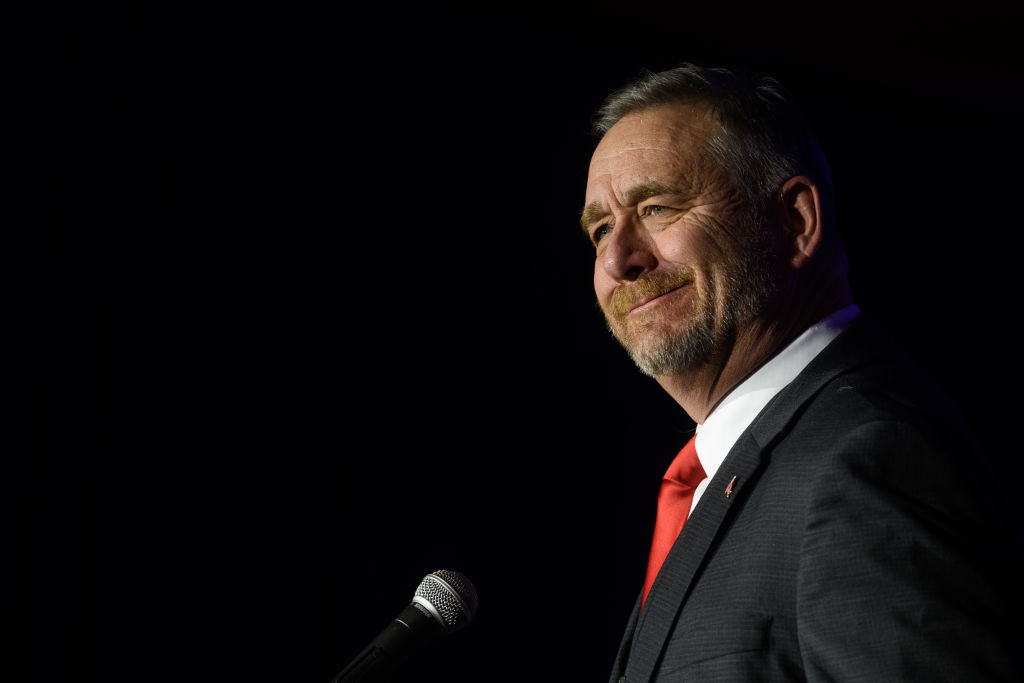
Ohio Attorney General Dave Yost. (Photo by Justin Merriman/Getty Images)
Question hinges around whether local prosecutors can be removed for saying they won’t bring charges under abortion bans
Ohio Attorney General Dave Yost and 14 other attorneys general are arguing in federal court that Florida Gov. Ron DeSantis was within his powers when he removed a local prosecutor who had spoken out against the state’s restrictive new abortion law.
But the group that represents Ohio’s local prosecutors doesn’t seem comfortable with that claim, expressing worries that the Florida case threatens the principle of “prosecutorial discretion” — that faced with many possible crimes and limited time and resources, prosecutors need great latitude to decide which cases are most wisely brought.
Yost said his friend-of-the-court brief doesn’t violate that principle. He said that he doesn’t want to impinge on prosecutors’ decisions about individual cases, but only to allow for their removal when they make blanket statements that they won’t enforce laws they don’t agree with.
“This case is about a ‘prosecutor’s veto’ — the nullification of a democratically passed law by the act of an executive,” Yost said in an email Thursday. “The application of discretion to a single case is proper; the application of discretion to every case arising under a statute eliminates the legislative act itself, the core function of a democratically elected government.”
Sunshine State spat
Yost on Wednesday led the Republican attorneys general in filing a friend-of-the-court brief with the 11th U.S. Circuit Court of Appeals in Atlanta. It argues that DeSantis — who is widely thought to be seeking the Republican presidential nomination — had the power to remove Hillsborough County prosecutor Andrew Warren last August over positions Warren took regarding the state’s new abortion law and other matters.
Warren, whose jurisdiction includes Tampa, signed declarations by a group of progressive prosecutors opposing charging people under laws restricting abortion and transgender care, the Florida Phoenix reported. DeSantis also objected to a Warren policy that his office usually would not bring low-level cases arising from bike or pedestrian stops in which a disproportionate number of minorities have historically been prosecuted, the Phoenix reported.
Warren sued DeSantis in U.S. district court in an attempt to be reinstated.
Judge Robert Hinkle found that DeSantis violated Warren’s First Amendment rights and separate provisions in the Florida Constitution by removing Warren. But, the judge ruled, the 11th Amendment to the U.S. Constitution barred him from reversing the removal because it was based solely on state law. In making the ruling, the judge looked past the First Amendment violation, saying DeSantis would have removed Warren even if he hadn’t violated the prosecutor’s free-speech rights.
Warren appealed to the 11th Circuit, arguing that Judge Hinkle’s reasoning was “perverse.”
“DeSantis’s violation of one (of Warren’s rights) cannot be permitted to excuse the violation of the other,” said a friend-of-the-court brief signed by Warren’s attorney. “The district court erred by ignoring the deeply intertwined nature of these protections. The decision below contributed to the disenfranchisement of Hillsborough County voters and allowed the governor to censor the speech of another duly elected official.”
Separation of powers
In their brief, Yost and the other Republican AGs argued that Warren and prosecutors like him jeopardize another constitutional principle when they say they’re not interested in bringing cases under laws with which they don’t agree — the separation of powers between the legislative and judicial branches of government. As part of the executive branch, it’s not a prosecutor’s job to decide which laws have force and which don’t, they said.
The attorneys general of Alabama, Arkansas, Georgia, Kentucky, Louisiana, Mississippi, Missouri, Montana, Nebraska, South Carolina, South Dakota, Texas, Utah and West Virginia joined Yost in signing the brief. All of the states have some abortion restrictions on the books and most have laws that the Guttmacher Institute rates as “very restrictive” or “most restrictive.”
Local prosecutors can’t unilaterally decide not to enforce those or other laws, the amicus brief said.
“Those prosecutors have considerable discretion to decide whether to prosecute violations in particular cases,” the brief said. “They do not have the power to effectively repeal laws by categorically suspending enforcement.”
It added, “The states can properly remove from office prosecutors who make non-prosecution pledges. These pledges violate the traditional separation of powers between government branches.”
However, there are some devilish details involved. For example, how do you define “pledge” and how do you reconcile removing prosecutors for signing such documents with their right to free speech?
Lou Tobin, executive director of the Ohio Prosecuting Attorneys Association, slammed prosecutors who make such pledges.
He singled out Philadelphia District Attorney Larry Krasner, who survived an impeachment attempt after Krasner said the office would no longer prosecute marijuana possession, would slash prosecutions of sex workers, sought reduced sentences for other crimes and called to abolish Pennsylvania’s death penalty. Tobin also slammed Los Angeles County District Attorney George Gascon, who survived a recall attempt that started just when he took office. Like Krasner, Gascon did things like slash marijuana prosecutions and worked to end cash bail.
But perhaps tellingly, Tobin didn’t mention the Florida prosecutor DeSantis removed and he said such an action is exceedingly grave.
“Ohio has processes in place for the removal of public officers who refuse or willfully neglect to enforce the laws or to perform any official duty imposed by law,” Tobin said in an email Thursday. “It is a process that has been in place since before the General Code became the Revised Code in 1953, it does not involve the attorney general, it should not involve the attorney general, and it is a process that should be used rarely and with extreme caution.”
Tobin also seemed to call out DeSantis for acting out of political motives.
“Threats to unilaterally and summarily remove prosecutors from office are just as damaging to the justice system as people like Larry Krasner and George Gascon,” Tobin said. “We’re heading down a very dangerous road when those threats are made to score political points.”
More than abortion
In entering the dispute, Yost is again wading into national abortion politics. Last year, just after rushing to enact Ohio’s strict six-week abortion ban, the attorney general went on Fox News to question the existence of a 10-year-old rape victim who reportedly had to go to Indiana for an abortion. Days later, her existence was confirmed when Columbus police made an arrest in the case.
While the Ohio law was in effect, obstetricians and maternal fetal medicine doctors said that aspects of it sometimes conflicted with what was in the best interest of their patients. DeSantis signed a similar law in Florida earlier this month.
But Yost said that in filing the brief in the Florida case he wasn’t trying push local prosecutors to charge doctors every time they think abortion laws might have been violated. He was asked if he thought prosecutors should be able to bring a strong violent-crime or public-corruption case over a weak abortion case if they don’t have the resources to bring both.
“Of course,” Yost replied. “… this is a case about one politician’s arrogance to cancel an entire category of criminal prohibition that was enacted by the elected Legislature. If you don’t see the danger in that, imagine your own most hated politician — whomever that might be — vowing that they will not prosecute Clean Water Act violations because it’s a violation of private property rights. Should such arrogance be without redress? Of course not.”
Yost and his colleagues are arguing that prosecutors who say they won’t enforce abortion restrictions and other laws are abusing their power. But some critics argue that many of the post-Dobbs restrictions are themselves abuses of power. A majority of Americans don’t support them and many — such as Ohio’s six-week ban — were passed by gerrymandered legislatures.
But Yost said his effort isn’t solely about enforcement of Ohio’s abortion law, under which doctors could be charged with felonies.
“This is not an argument about abortion, although that was the individual motivation of the prosecutor who was removed,” he said. “But this same principle applies to prosecutors (who) would refuse to prosecute all thefts under a $1,000, or those who refuse to prosecute any firearms offense. Prosecutors do not get to make up the law, or revoke it — they only get to enforce it.”
____________________
 MARTY SCHLADEN