

Tag: public education

  • Ohio Republicans start the year by throwing public education under the school bus

    Ohio Republicans start the year by throwing public education under the school bus

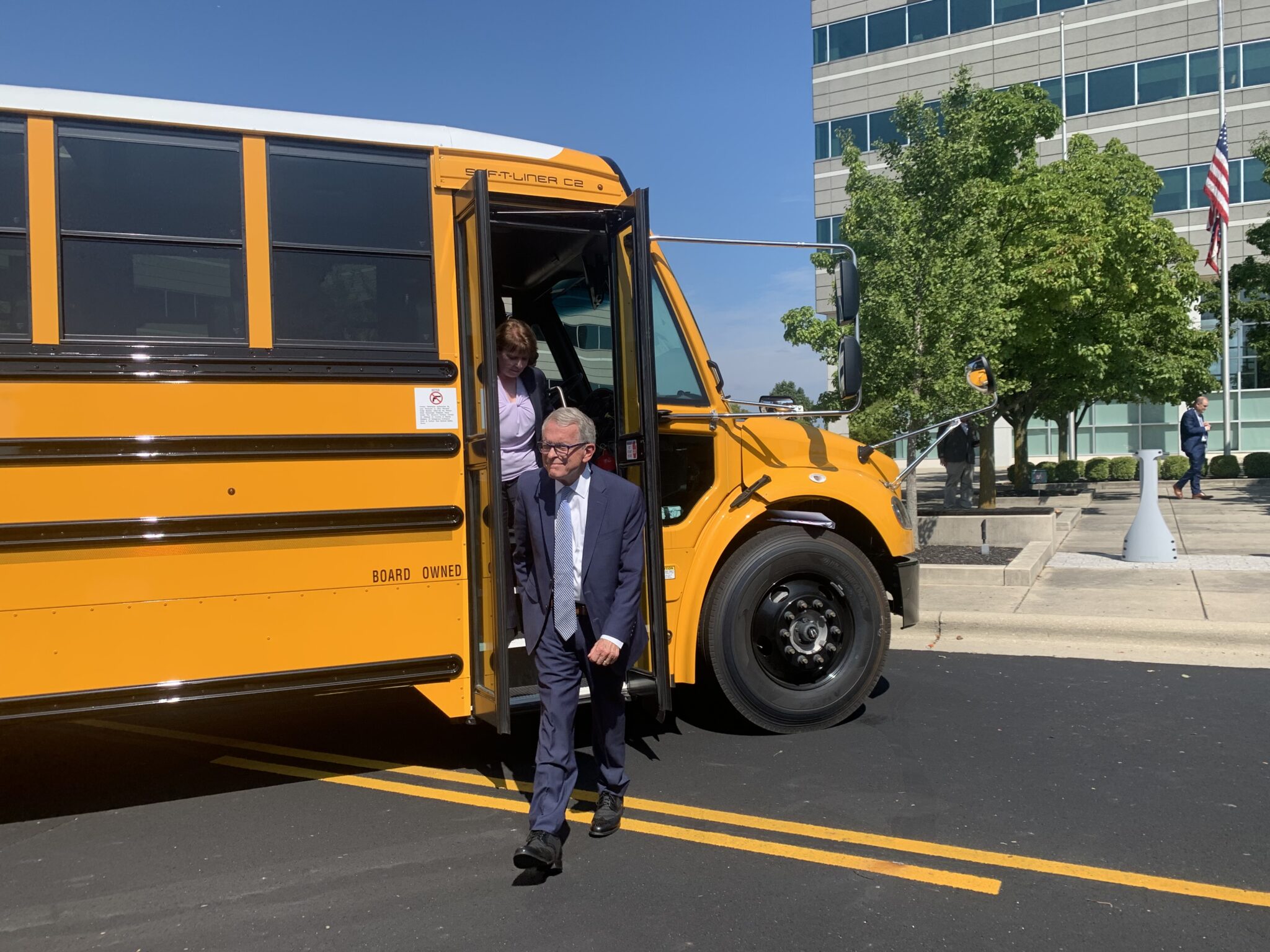
    Ohio Gov. Mike DeWine gets off a school bus as part of the first Ohio School Bus Safety Working Group meeting at the Ohio Department of Public Safety Atrium on Sept. 11, 2023. (Photo by Megan Henry, Ohio Capital Journal).

    Commentary

    by Marilou Johanek – Ohio Capital Journal

    It didn’t take long. The new legislative session began in Columbus with Republican chieftains in the state throwing the future of public education in Ohio under the school bus.

    First it was the billion-dollar voucher king, Ohio House Speaker Matt Huffman, to hedge his bets on giving Ohio’s 611 school districts what they need to provide a quality education to the 1.7 million students they serve.

    Then it was Huffman’s patsy in the executive branch, Ohio Gov. Mike DeWine, who added his two cents worth of wishy-washy about how a leaner state budget ahead means something’s gotta give — like fully funding the education system used by the vast majority of Ohio families and their children. “Sometimes these are very, very difficult, difficult choices,” said the gutless wonder. What leadership.

    Educating future generations of Ohioans with high-quality public schools is your job, governor. It’s the No. 1 responsibility of the state to ensure a thorough and efficient system of funding for public schools. ‘Says so right in the Ohio Constitution. It also says, “no religious or other sect, or sects, shall ever have any exclusive right to, control of, any part of the school funds of this state.” But DeWine and his puppet master in the Ohio House ignored that part years ago when the state began diverting hundreds of millions of education funds to private and mostly religious schools.

    Clearly, the politicians calling the shots in state government have no regard for the state constitution. Adhering to the rule of law is optional when political power is absolute. Huffman, who thumbed his nose at the Ohio Constitution on fair redistricting (to pull off even more egregious gerrymandering in legislative and congressional districts) is doing the same thing on adequately funding public education.

    He’s looking to cut revenue to public schools while spending a ton of tax dollars on private school vouchers — with aspirations to fund more private school facilities to increase demand for those vouchers. Call it the Great GOP Phase-out of Public Education. Last week, Huffman dropped a calculated bombshell to prepare Ohio’s public-school districts for another financial hit from the state.

    YOU MAKE OUR WORK POSSIBLE.


    The Lima Republican said the state couldn’t afford to fully fund public schools or finally fix a school funding formula ruled unconstitutional nearly three decades ago. The Ohio Supreme Court’s 1997 ruling said the state’s failure to provide and distribute sufficient resources for public education and its over-reliance on local property taxes to cover that shortcoming violated the law.

    Yet Ohio lawmakers never remedied the problem. School districts had to keep going back to voters just to maintain and operate local schools. Homeowners carried the weight of school funding, not the state. They were/are understandably tapped out on school levies, especially as changes in property evaluations jack up tax bills.

    But in 2021, after years of collaboration between former Republican Ohio House Speaker Bob Cupp, former Democratic state Rep. John Patterson and scores of public education stakeholders, Ohio came close to meeting its constitutional obligation of ensuring a thorough and efficient system of funding for public schools. “What we really wanted to do was figure out what it really costs to educate a student and then what a district can really do to support its fair share, and then the state would compensate with the rest,” said Patterson.

    The Cupp-Patterson spending formula, known as the Fair School Funding Plan, was enacted as part of the 2021-23 state budget. The new system weighed a district’s expenses to come up with the base per-pupil funding amount — instead of a blanket amount of state funding for all schools — and changed the way the local community’s share was measured depending on property tax value and the income of local residents.

    That was a big deal and a significant step forward to address the long-running inequities of an unconstitutional school funding system that had failed generations of K-12 students. The quality of their education often depended on where they lived. Wealthy school districts in Ohio had every advantage over high poverty districts that struggled to pay for even basics in the classroom.

    The Fair School Funding Plan initiated a level of fairness and reliability in state support that past spending programs lacked. Complete state funding of the FSFP (around $2 billion altogether) was to be phased in over a six-year period through two-year budget cycles. The goal was to continue expanding state funding for districts in successive biennial state budgets until the Fair School Funding Plan was fully funded.

    The last installation, or third phase, was to be paid in full in the upcoming 2026-2027 operating budget. But that expectation hit a wall when Huffman nixed increased spending to public schools as “unsustainable.”

    His excuses for not making good on fully funding Cupp-Patterson — less state revenue to work with, less federal pandemic relief money, more scrutiny needed for school money already allocate — don’t apply to his expansive voucher outlays to religious schools that reached $966.2 million for the 2023-2024 school year. Enough to fully fund Fair School Funding Plan.

    But Huffman is laying the ground to shave more off the FSFP and showing his utter indifference to the acute financial challenges facing countless districts. Tough luck for the nearly 90% of Ohio students who attend public schools with slashed opportunities. It didn’t take long.

    GET THE MORNING HEADLINES.

    __________
    Marilou Johanek
    Marilou Johanek

    Marilou Johanek is a veteran Ohio print and broadcast journalist who has covered state and national politics as a longtime newspaper editorial writer and columnist.

    MORE FROM AUTHOR

  • ‘Legacy of neglect’ showcased in Ohio schools report

    ‘Legacy of neglect’ showcased in Ohio schools report

    Stock image from Pixabay.

    BY:  – Ohio Capital Journal

    A report from an Ohio think tank examined the new budget changes and private school voucher impacts on public schools over the last year.

    Research from Policy Matters Ohio said divestments from public schools at the state level “hurt public school students everywhere – especially those in rural counties.”

    Furthering study of the impact the COVID-19 pandemic had on education, Policy Matters’ Tanisha Pruitt and Cassie Mohr said those pandemic effects combined with “Ohio’s legacy of inadequate, inequitable funding” have “weakened the role school plays as a foundational public institution.”

    Ohio was ranked 21st in a U.S. News & World Report on K-12 education and 46th in an EdWeek ranking of equitable distribution of education funding, both of which were cited as part of the 2023 report.

    “Ohio’s students deserve a world-class education, including safe and well-resourced schools that are staffed by teachers who are well trained and fairly paid,” Pruitt and Mohr wrote.

    The new report also confirmed what advocates have repeatedly noted over the years that the public school funding model has been debated — that the vast majority of Ohio students are enrolled in public schools.

    Of the nearly 2 million students enrolled in K-12 education in Ohio, 88.6% are in public schools, and 8.8% are in private schools, while 2.7% are home-schooled.

    Private school vouchers saw a significant change in Ohio’s most recent two-year budget this summer, when legislators opened the state-paid subsidies to 450% of the federal poverty level, nearly universal eligibility.

    But also included in the budget was another phase-in of the Fair School Funding Plan, a six-year effort to dive into the real cost of funding public school students, and fund the schools on an individual basis based on their needs.

    “When fully implemented, the six-year FSFP will correct the over-reliance on local property taxes, eliminate funding caps on districts, and base funding on per-pupil cost estimates that more accurately reflect what it takes to educate a diverse student population,” the report stated.

    Policy Matters’ report focused largely on public schools, where they found a student population that is “somewhat more racially diverse than the state overall” with a makeup that is 16.4% Black versus the 13.3% population in the state overall, and serving a large population of more than 800,000 who are considered economically disadvantaged.

    Pruitt and Mohr remained skeptical of the ultimate success of the FSFP, however, as legislators have “only incrementally moved funding through the formula.”

    “If legislators follow through on their promise to fully realize the FSFP by 2026, they will be helping every public school in the state to be equitably funded, and helping ensure that we live in a state where every child has what they need to succeed in school and after graduation,” the report stated.

    Senate President Matt Huffman has commented in the past that he wouldn’t support funding more than two years at a time, to avoid saddling future General Assemblies with budget items with which they may not agree.

    Teachers

     Source: Policy Matters Ohio 

    The constraints of COVID had their effect on teachers as well, but even outside of the pandemic education methods, educators still face pressures, according to the 2023 report.

    “Teachers recently have experienced a rash of targeted political campaigns to stoke division by denying the identities of trans and nonbinary students, as well as censoring what teachers are allowed to teach in the classroom,” Pruitt and Mohr wrote.

    Beyond that, compensation levels have not kept up over the years, with the Ohio Department of Education showing an average annual salary of $69,130 for an Ohio teacher in the 2022-2023 school year. That amounts to a decrease of more than 6% from the 2018-2019 school year, according to the new Policy Matters research.

    “These factors contribute to one of the most significant problems facing Ohio schools today: too many have too few teachers to give our kids the education they deserve,” according to Pruitt and Mohr.

    The state has also seen a dip in newly licensed teachers as well, with more than 9,000 teachers leaving their jobs in 2021, but only 5,388 earning a new license.

    “Recruitment declines can be attributed to low pay, poor working conditions and other economic factors,” researchers found. New teachers are paid less, and face mounting student loans on top of a salary that is often less than fellow graduates in other professions, they said.

    But licensure was addressed in the budget, with a clause allowing substitutes to have one-year temporary substitute teaching license which could increase the number of subs, and some members of the military could obtain a “military educator license.”

    “While these changes have the potential to boost our educators workforce, they weaken teacher training requirements, which could negatively affect the quality of classroom education, especially in high-poverty schools that already grapple with recruiting and retaining highly qualified educators,” Policy Matters researchers argued.

    The state needs to improve the recruitment methods, according to the report. It could use models like the one pursued by Cincinnati Public Schools superintendent Iranetta Wright, who pledged to recruit more teachers who matched the demographics of her school, but also keep teachers from being saddled with debt by increasing funding for grant programs and teacher residency programs.

    State testing

    For the teachers who are in schools, state testing can be a significant part of the school year, and despite their best efforts, inequities can shine through in even the standardized assessments for subjects like math and reading.

    A 2022 National Assessment of Educational Progress showed fourth and eighth graders in the state “were not statistically different from the national average,” according to Pruitt and Mohr, and Ohio was ranked 21st in a U.S. News & World Report ranking on pre-K-12 education.

    “However, these statewide metrics can mask a high degree of variability among districts, schools and student populations, with predictable disparities,” Policy Matters stated in their 2023 report.

    Disparities among English Language Arts and math scores, for example, don’t have a single cause, researchers found, but “inequities in school funding track closely with gaps in academic achievement.”

     Source: Policy Matters Ohio 

    An analysis of test scores and categories from the Ohio Department of Education showed disparities among student races, but also showed a universal trend that economically disadvantaged students “are more likely to live in school districts with concentrations of poverty – including in rural and Appalachian counties – where property-value-based school funding shortchanges them,” the researchers found.

    In terms of kindergarten readiness, COVID had a negative impact, and in the 2022-23 school year, Ohio’s kindergarten-bound students showed the lowest rate of readiness since 2014, when the state began using a Kindergarten Readiness Assessment.

    “A dropoff in kindergarten readiness was likely inevitable after COVID; Ohio needs to make significant investments in early childhood education to begin recovery,” Pruitt and Mohr said in their analysis.

    The researchers criticized legislative priorities like restructuring the Ohio Department of Education, something that is now being fought over in court. But other curricular level efforts, like one to change the social studies lessons in schools and another that would bar teachers from teaching “any oral or written instruction, presentation, image or description of sexual concepts or gender ideology,” don’t fall under improvements, according to Pruitt and Mohr’s analysis.

    The recommendations they do hope will be implemented include the full implementation of the Fair School Funding Plan, elimination of the private school vouchers at universal eligibility levels, better pay for teachers and the creation of a “pathway to becoming an educator” that helps recruit teachers of diverse backgrounds.

    “More funding should be dedicated to attracting new educators, especially from underrepresented populations, while ensuring the teachers coming out of these programs are fully qualified and prepared to give our kids the best education possible,” the researchers concluded.


    Susan Tebben
    SUSAN TEBBEN

    Susan Tebben is an award-winning journalist with a decade of experience covering Ohio news, including courts and crime, Appalachian social issues, government, education, diversity and culture. She has worked for The Newark Advocate, The Glasgow (KY) Daily Times, The Athens Messenger, and WOUB Public Media. She has also had work featured on National Public Radio.

    MORE FROM AUTHOR

  • Our ability to get out our clipboards and defend the rights of everyday Ohioans is at risk!

    Our ability to get out our clipboards and defend the rights of everyday Ohioans is at risk!

    An Emergency Appeal from the

    League of Women Voters of Ohio

    Ohioans have had the right to direct democracy since 1912, but now lawmakers and Secretary LaRose are going after the power of the people. Because of gerrymandering and dark money, Ohioans have faced years of unpopular and unjust legislation related to democracy, women’s reproductive rights, public education, and so much more. 

    Yesterday,  Rep Brian Stewart and Secretary of State LaRose proposed a bill that would require a 60% yes vote to pass a citizen initiated constitutional amendment, while maintaining that constitutional amendments referred by the Legislature would still only require a simple majority vote to pass. 

    LaRose claims that this measure is necessary to protect the Ohio Constitution, and that the time is right. We say ABSOLUTELY NOT!

    • Ohio citizens must already overcome extreme challenges to placing an issue on the ballot. The process requires hundreds of thousands of verified signatures and a strict geographical distribution across at least half of Ohio’s 88 counties. 
    • The process is not overused. In fact, since 1950, only ten out of 44 ballot measures have passed (23%). If so few citizen initiated amendments pass, what problem are we looking to solve?
    • If this measure passes the Ohio Legislature, it will be on the ballot in May 2023; primary elections in odd numbered years have always historically had very low voter turnout. As little as 10% of the electorate will likely decide how Ohio citizens can practice direct democracy and affect change. 

    Send a message to your elected leaders and demand that they stop this threat to democracy!


    More about the proposal to restrict access to Ohio Voters…

    Ohio Republicans launch effort to make citizen-led amendments harder to pass…

    Loveland Magazine – Nov 22, 2022