Tag: public health orders

  • Ohio Republicans go full Calhoun on nullification. Never go full Calhoun

    Ohio Republicans go full Calhoun on nullification. Never go full Calhoun

    Commentary by David C. DeWitt from Ohio Capital Journal


    Ohio Republicans in the state legislature have apparently decided to go full Calhoun with a proposed bill attempting to nullify not only any federal gun laws they don’t like but also any court rulings related to gun laws with which they disagree.

    They do not possess the power to do this under the U.S. Constitution, the Ohio Constitution, or precedent set by the U.S. Supreme Court, the highest court in the land that some Ohio Republicans seemingly believe they have the power to flout. Again, they do not.

    As they’ve spent much of the COVID-19 pandemic wailing ignorantly in misunderstanding about the separation of powers in the Constitution and the checks and balances among government branches, they’ve turned most recently to proposing and passing laws defying these elemental aspects of American civics.

    Take first Ohio Senate Bill 22, which bestowed upon the state legislature veto authority over executive branch emergency and public health orders by concurrent resolution. Statehouse Republicans declared this was a response to the executive branch allegedly overstepping its authority — the authority the legislative branch itself gave the executive branch through law more than a hundred years ago — and their solution was to overstep their own authority.

    You see, the Ohio Constitution requires the General Assembly to actually pass law to exercise the power of law, not resolution. Laws must be signed by a governor, or a governor’s veto overridden by the legislature, in order to be enacted. This is an intentionally cumbersome process. A resolution requires neither. So simply ignoring the Ohio Constitution relieves them of this constitutional burden. The non-partisan Legislative Services Commission warned Republicans of the unconstitutionality of their proposal, and they ignored the LSC too.

    This middle finger in the face of the Ohio Constitution was even shepherded through the Ohio House by current speaker and former Ohio Supreme Court Justice Bob Cupp, who should definitely know better.

    Why did they do this? They do have the authority to rewrite law if they so wish. They could rewrite Ohio Revised Code and override the governor’s veto in doing so just as well. But apparently ignoring constitutionality was easier. This middle finger in the face of the Ohio Constitution was even shepherded through the Ohio House by current speaker and former Ohio Supreme Court Justice Bob Cupp, who should definitely know better.

    Now comes House Bill 62 that seeks to declare any federal law, executive order, administrative action, or court ruling to be “null, void, and of no effect in this state” if it infringes upon the Second Amendment. This attempt by a state legislature to overrule federal law and courts is called nullification, and as a concept, it has never once been upheld in federal court in American history. Its most ignominious test came when the state of South Carolina attempted to nullify federal tariff law in 1832-33, led by slaver and slavery advocate John C. Calhoun.

    Courts at the state and federal level, including the U.S. Supreme Court, repeatedly have declared that under the Supremacy Clause of the U.S. Constitution, federal law is superior to state law, and that under Article III of the U.S. Constitution, the federal judiciary has the final power to interpret the Constitution. Ohio even lost its own fight over nullification in a battle against the Bank of the United States in 1824.

    But Ohio Statehouse Republicans’ self-contradictory views of home rule and local control appear to be based exclusively on their own political whims and no discernable standards or principles for the exercise of self-government.

    Plastic bags? According to the General Assembly, local government has no right to home rule or local control in regulating them. Nor, say Ohio Republicans, can locals decide against allowing the fossil fuel industry to run amok in their communities, injecting waste into their land while these fracking wells provide zero economic benefit to the area affected. But sustainable energy is a severe threat to home rule, the foulest tyranny, according to the Ohio General Assembly and its blissful lack of self-awareness.

    And how can we forget the gun issue itself? Ohio Statehouse Republicans appear to believe that the state can trump federal laws relating to guns and ignore any and all courts, but Ohio cities have stepped high above their station indeed for attempting to regulate guns themselves without the General Assembly’s approval.

    Power for me and not for thee appears to be Statehouse Republicans’ only real governmental operating ethos.

    Power for me and not for thee appears to be Statehouse Republicans’ only real governmental operating ethos.

    While the self-contradictions on the roles of levels of government show a political agenda with no consistent civic principles behind it, the real failure here is to take any sort of thoughtful long-view. I can only imagine their caterwauling if Statehouse Republicans were the victims of this kind of power grab instead of the perpetrators. I don’t even have to imagine it. Former Ohio Gov. John Kasich ate Statehouse Republicans’ lunch by using executive power to expand Medicaid in Ohio under the Affordable Care Act against their wishes.

    But let’s say Ohio Republicans don’t manage a permanent supermajority in the Statehouse, and that some day, perhaps decades from now, a Democratic General Assembly declares itself above the authority of the courts to decide issues of religious freedom, or abortion rights, or LGBTQ rights, or gun rights. Do you think Ohio Republicans would humbly accept the consequences of the path they’ve endorsed and chosen, or do you think they’d play the shameless hypocrite and contradict themselves entirely? I know my bet.

    It’s hard to take people seriously who do not take themselves nor the basics of American civics seriously.

    Due to extreme gerrymandering and the extremist and corrupt politics it breeds, however, Ohioans will be forced to continue to endure for some time longer a General Assembly that sees a radical faction of one political party and high-dollar donor special interests as their only true constituencies.

    The rest of us and our pesky constitutions, judicial precedents, rule of law, checks and balances, and separation of powers be damned.
  • Inside Ohio Republicans’ 10-month war on the state health department over COVID-19

    Inside Ohio Republicans’ 10-month war on the state health department over COVID-19

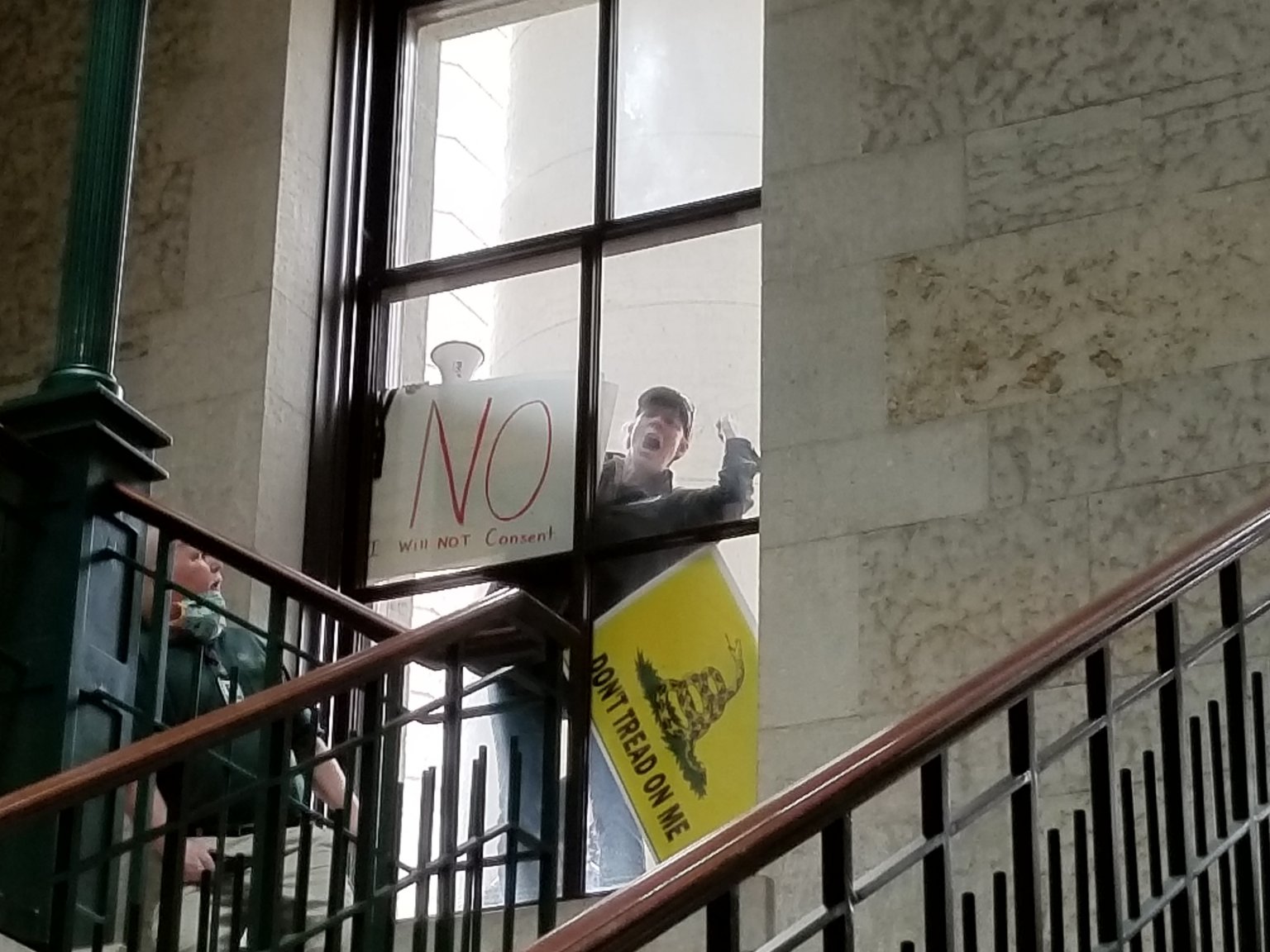
    A man protesting Ohio’s health orders at the state Capitol on May 1. Gov. Mike DeWine later repealed most of them only to start reimposing orders on Tuesday as coronavirus cases continued to surge. Capital Journal photo by Marty Schladen

    By Jake Zuckerman and Ohio Capital Journal

    Ohioans were living with the coronavirus for about two months before GOP lawmakers initiated what would be a nearly yearlong effort to squash the state health department’s ability to issue public health orders.

    The earliest version of the idea was to limit any order issued by the Ohio Department of Health to a two-week window. After that, a small panel of lawmakers would need to approve the order for it to stay in effect any further.

    “We are clearly on the downside of the curve, there is no longer a risk of overwhelming the health care system,” said now-former Rep. John Becker to the House State and Local Government Committee, setting one of the first legislative attacks on the health department in motion via Senate Bill 1.

    “I’m not sure there ever was, but that argument did make sense to me initially.”

    Ten months, three gubernatorial vetoes, and more than 520,000 Americans dead from COVID-19 later, little has changed. The Senate passed a similar version of the idea last month on a party-line vote.

    A review of emails obtained by public records requests, committee hearings, interviews and contemporaneous media reports highlight just how absent public health was from efforts to wrest power from the health department during a pandemic.

    In several instances, abortion politics, coronavirus infections among lawmakers, and overly rosy assessments of the pandemic from Republican leaders played a larger role in the legislation than the coronavirus itself.

    SB 1 died an unusual death last May when every state Senator — even the bill’s sponsors — voted it down. Its supporters gave varying explanations from the Senate floor. They said it didn’t have an emergency clause, meaning it wouldn’t take effect for 90 days; and it was clumsily drafted.

    Then-Senate President Senate President Larry Obhof, one of the most powerful Republicans in the state, later told constituents that Senators killed the bill, in part, because it could have expanded women’s access to abortion.

    “A prominent Right to Life organization pointed out that the language, as written, could allow lawsuits challenging health orders that regulate or close abortion clinics,” he said in an email obtained in a public records request.

    “Thus, the language could have been used to protect abortion clinics.”

    The concern came from a letter the Greater Columbus Right to Life sent to lawmakers. Ohio Right to Life, which operates independently of the Columbus organization, disagreed, according to its director, Michael Gonidakis. However, he tried to stay out of it.

    “We had no desire to be involved in that debate,” he said in a recent interview.

    Sen. Tim Schaffer, R-Lancaster, later wrote on Facebook that the bill would have limited the state’s ability to “shut down illegal abortion clinics.” Then-Speaker of the House Larry Householder, R-Glenford, prior to being indicted in an alleged racketeering scheme, commented on the post. He told the senator to “grow a pair” and called his rationale “bullshit.”

  • YouTube censors Ohio House hearing video for COVID-19 misinformation

    YouTube censors Ohio House hearing video for COVID-19 misinformation

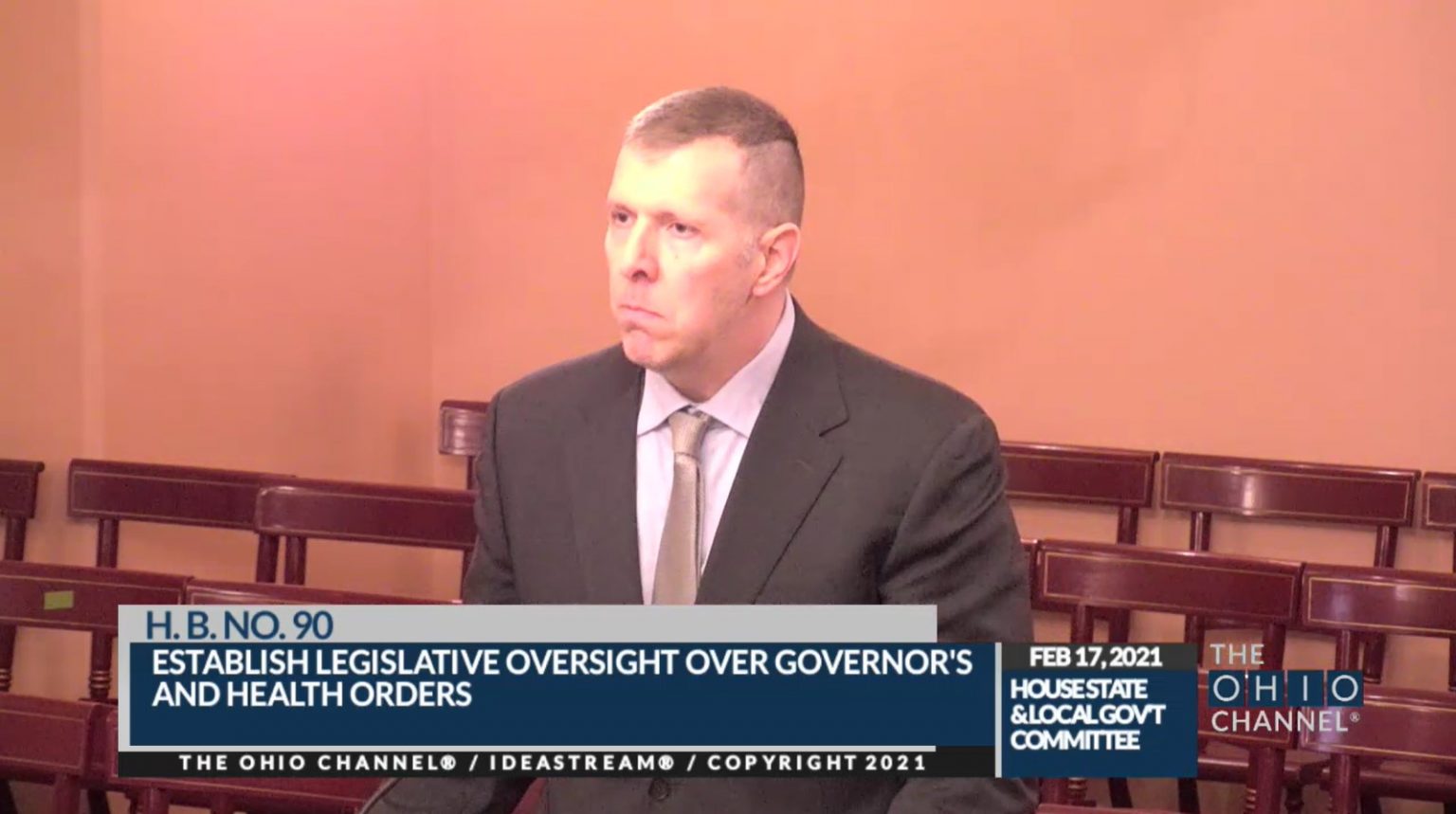
    Tom Renz speaks to the House State and Local government Committee Feb. 17. Source: Ohio Channel.

    By Jake Zuckerman and Ohio Capital Journal

    Columbus, Ohio – The opening testimony Wednesday in support of a legislative effort to allow lawmakers to vote down public health orders went far enough off the rails for YouTube to remove footage of the speaker.

    Tom Renz, an attorney for Ohio Stands Up, filed a lawsuit in federal court in September seeking to overturn any and all health orders related to the COVID-19 pandemic. A federal judge last week deemed the arguments nearly “incomprehensible” and ordered Renz to show cause for why he shouldn’t dismiss the suit for procedural errors.

    The Ohio Advocates for Medical Freedom, an anti-vaccine activism group aligned with Renz, posted to YouTube footage of Renz’s 35-minute, oftentimes rambling testimony to the House State and Local Government Committee.

    The video was soon taken down for violating YouTube’s terms of service.

    “We have clear Community Guidelines that govern what videos may stay on YouTube, which we enforce consistently, regardless of speaker,” said Ivy Choi, a spokeswoman for Google, which owns YouTube.

    “We removed this video in accordance with our COVID-19 misinformation policy, which prohibits content that claims a certain age group cannot transmit the virus. We do allow material with sufficient educational, documentary, scientific or artistic (EDSA) value.”

    The policy states videos cannot spread medical misinformation that contradicts local health authorities’ or the World Health Organization’s medical information about COVID-19.

    In his testimony, Renz baselessly claimed no Ohioans under the age of 19 have died of COVID-19. Data from the Ohio Department of Health shows 10 children in the age group have died of the disease during the pandemic.

    Similarly, Renz said children can neither contract nor spread COVID-19. He even claimed the CDC says this as well, which is untrue. CDC guidance states children can contract and spread the coronavirus.

    While it’s unclear which specific COVID-19 misinformation from Renz sparked YouTube’s decision, there’s a lot to choose from.

    Renz’s testimony was a firehose of COVID-19 conspiracy theorizing: He said unspecified entities “provide funding for people to find a COVID-19 death;” the ODH “whitewashes” its coronavirus data; that PCR testing, which public health officials consider to be a premier diagnostic, is “garbage” or “absolutely useless.”

    He claimed the lockdown orders of the spring to be “the most drastic curtailment of rights ever taken in American history.” The statement was made without acknowledgement to the enslavement of Black Americans, the mass detention of Japanese Americans to internment camps during World War II, the forced relocation of Native Americans, or any number of national atrocities through American history.

    While YouTube removed the footage, Ohio Republican lawmakers praised Renz for the testimony.

    Chairman Scott Wiggam, who has falsely proclaimed that Donald Trump won the 2020 presidential election, praised Renz for bringing “the other side of the data” to the table.

    Rep. Diane Grendell, who without evidence accused ODH of publishing “corrupted” data to a panel of state senators in November, also praised Renz.

    Footage of the hearing is still publicly available on the Ohio Channel, and OAMF has since re-uploaded it to Rumble, which has looser content guidelines.

    Renz made the statement supporting House Bill 90, which would allow lawmakers to vote down public health orders related to the pandemic. A similar version of the proposal passed the Senate earlier this week.

    The lawsuit against ODH was Renz first filing in federal court after passing the bar on his fifth attempt, according to records from the Ohio Supreme Court.

    His “about me” page for his website claims lists no prior legal experience besides serving as a clerk on the Indian Supreme Court. However, in a prior interview, he said he did not remember when he served on the court and said he did not speak Hindi.

    Renz declined to answer questions about his testimony.”

    “This should not be right and left and we should not be fighting over facts,” Renz told lawmakers. “The question I would ask to the people who are saying that I’m incorrect or lying, is who are you working for and how much are you getting paid? Because inevitably, I’m finding they typically are working for someone or getting paid somewhere.”