Ohio House Speaker Matt Huffman. (Photo by Morgan Trau, WEWS.)
by Marilou Johanek – Ohio Capital Journal
Just as Elon Musk’s so-called Department of Government Efficiency (DOGE) was never really about improving government efficiency – quite the opposite, in fact – the 5,000-plus page biennial budget rewrite the Ohio House slapped together and sent to the Ohio Senate was never really about improving the common good of everyday Ohioans.
It was about advancing the hard-right priorities of powerful politicians who answer to big money – not constituents in gerrymandered voting districts.
Yet even for the supremely arrogant kingpin of state government, Ohio House Speaker Matt Huffman, the budget bill passed out of the General Assembly’s lower chamber on April 9 was beyond the pale in cruelty and cunning.
It is the Ohio version of Project 2025 with all the unsparing, exacting hallmarks of the Trumpian blueprint, recklessly destroying federal institutions and agencies that, however imperfectly, protect, serve and promote the welfare of we, the people.
But that’s the MAGA nihilistic way and Ohio Republicans are doing their part in tearing down what made Ohio great. Huffman, the Lima Republican who runs the state under the one party rule he rigged with unconstitutional redistricting, is in the catbird seat calling the shots. The speaker (and former Ohio Senate president) lords over the GOP supermajority in the Ohio House while his political protégé, Ohio Senate President Rob McColley, accommodates the boss.
Huffman, who once said the quiet part out loud about GOP gerrymandering (“We can kind of do what we want”), now has a straight runway to enact his blueprint on Ohioans whether they like it or not. I suspect his budget proposal will survive, largely intact, with the House caucus he controls and the one he led with an iron fist for four years in the Senate.
Local public schools, public libraries, clean drinking initiatives, lead poisoning prevention, pediatric cancer funding, home visits for new mothers, food assistance programs and health care coverage for the poor are all on the chopping block in Huffman’s House Bill 96.
What wasn’t on his slash-and-burn budget list were government handouts (taxpayer-funded vouchers) to upper-income private school families. But doling out unlimited government subsidies to the affluent, whose darlings are already attending and affording elite high schools and religious institutions, is Huffman’s thing.
He is on a crusade to shower hundreds of millions of public education dollars on unaccountable private and predominantly religious schools – despite clear prohibitions against such a diversion of public money in the Ohio Constitution.
“No religious or other sect, or sects, shall ever have any exclusive right to, or control of, any part of the school funds of this state,” the state constitution reads.
But Huffman has defied the state constitution before with impunity (on gerrymandering) and did so again by ramrodding his universal voucher bonanza through the legislature for everyone, regardless of income. Never mind that the giant state giveaway – to offset private school costs for the well-off – blew a $1 billion dollar hole in the general revenue budget its first year.
Never mind that public schools in the state, forever cash-strapped and dependent on tapped out property owners, labored under an unequal, inadequate school funding formula (ruled unconstitutional by the Ohio Supreme Court) for 26 years before a bipartisan coalition agreed to a phased-in funding solution over six years. The final two-year phase was expected to be fully funded in the current biennial budget negotiations.
Not under Huffman. Not in a state where the Republican lock on power is absolute and the Statehouse heavyweight has free, unchecked rein to flout the law and grossly defund the public schools that educate the vast majority of Ohio students (approximately 1.6 million) while greatly expanding appropriations for private school tuitions, homeschooling expenses and even unchartered, nonpublic schools with deeply held religious beliefs that are virtually unregulated by the state!
Funding for the “thorough and efficient system of common schools” state government is constitutionally obligated to secure – and that would have been secured under the Fair School Funding Plan from 2021 – shrank by over $400 million. House Republicans added insult to injury by robbing fiscally prudent school districts of surplus revenue for future planning to give uneven, one-time property tax relief in some districts and not others. They also ensured that property tax owners will face more school levies from local districts forced to deplete that surplus operating revenue. Sound policymaking (or genuine property tax relief) this is not.
But it is a gut punch to public schools, just as a $100 million reduction in funding to Ohio’s public libraries is, or cutting over $22 million from the Help Me Grow program is for in-home visits to newborn babies to mitigate the state’s infant mortality problem. But Matt Huffman’s Ohio-centric Project 2025 is also a kick in the teeth to democratic self-governance.
Last budget go-around Republican lawmakers stripped the Ohio Board of Education of most of its power and gave it to the governor. This two-year budget proposes cutting all 11 elected members of the board and shrinking the gubernatorial appointments from nine to five. This is Matt Huffman removing voters entirely from state education policy as he engineers total opaque privatization of Ohio schools.
How is silencing the electorate improving the common good?
Marilou Johanek is a veteran Ohio print and broadcast journalist who has covered state and national politics as a longtime newspaper editorial writer and columnist.
Ohio lawmakers seem committed to delivering property tax relief in the current session, but they’re still zeroing in on their approach. They’ve introduced at least seven measures tweaking the homestead exemption — for disabled vets, military spouses, the elderly — and a handful more changing how counties calculate what homeowners owe.
Most notably, however, House lawmakers have proposed an automatic rollback in the state budget that triggers if a school district carries over any more than 30% of their operating revenue.
An organization backed by realtors, county auditors, and the Ohio Chamber of Commerce is wading into that debate. The Ohio Taxpayer Protection Coalition is urging lawmakers to avoid “unvoted” property tax increases.
“Our point isn’t to take away revenue from school districts,” coalition chair and former state tax commissioner Tom Zaino explained. “Our point is to reduce the rate of increase of revenue without a vote of school district residents.”
House Bill 920
Zaino argued that state lawmakers need to revisit a measure passed in the 1970s meant to insulate homeowners from rising home values. Property taxes are calculated in mills — one mill is one thousandth of a dollar, or one tenth of a percent.
In every county, taxing authorities like local governments, schools, and parks, can levy a total of 10 mills that will grow as home values increase. Any share beyond those 10 mills has to get approval from voters. Meanwhile, to receive state funding, school districts must levy at least 20 mills, or 2% of assessed property value.
House Bill 920 placed a check on those voted levies to ensure rising home prices don’t result in a taxing authority raising extra money. In effect, if your home value goes up, that slice of your property tax rate would decrease to keep your tax bill steady.
“What’s happened, though, over the last 50 years,” Zaino said, “is that these protections have been eroded by many changes made by the General Assembly, which has effectively created loopholes.”
The tax reductions in HB 920 apply to most levies beyond a school district’s 20 mill floor. So, school districts have been resourceful and looked to other sources of funding like emergency levies or local income taxes. That way they can meet immediate funding needs and still benefit from rising property values.
Zaino argued that amounts to an increase in taxes that voters didn’t approve, and lawmakers should prevent that strategy. To that end, the Ohio Taxpayer Protection Coalition is supporting legislation that would recalculate the 20 mill floor to include those other funding sources.
Bailey Williams, from the liberal think tank Policy Matters Ohio argued Zaino’s coalition is blowing the problem out of proportion. “While property values across the state have seen significant growth coming out of the pandemic,” he argued, “property tax revenues have only grown at a fraction of that rate.”
Making the changes Zaino wants “will harm schools, put more levies on the ballot, and will not fix the fact residential taxpayers are overburdened,” Williams argued.
School districts’ view
School leaders argue the problem isn’t just districts making clever use of the system. As property values rise, HB 920 will reduce a homeowner’s rate — but there’s a hard stop at 20 mills. That means if property values rise high enough, the reductions stop working.
Paul Imhoff from the Buckeye Association of School Administrators told lawmakers in 2019, there were 168 districts at the 20 mill floor. By 2023, that figure had ballooned to 409.
“Eighty-nine percent of the new floor districts went through reappraisal or update in 2023,” he explained, “which indicates that the driving force in 20 mill floor districts clearly is rising property values.”
He warned adding new levies to the calculation to generate more reductions won’t help homeowners in the 203 districts that don’t have those extra levies. In the end the bill would “force the affected school districts to either cut essential services or place more levies on the ballot in response, or both,” he argued.
In a written statement, Jennifer Hogue from the Ohio School Boards Association explained the group supports “thoughtful, targeted property tax relief that helps those most in need without undermining the essential funding public schools rely on.” She argued any property tax discussion relies on a “clear recognition of the vital role local taxes play” in funding public schools.
“While we are open to reform, we cannot support measures that limit local control or compromise a district’s ability to meet the needs of their students,” Hogue added. “Any changes must protect the stability and predictability of school funding.”
A different proposal would allow revenue increases from rising property values, but they wouldn’t be able to exceed the general inflation rate over the past three years. In his testimony, Imhoff noted his organization is still reviewing the bill.
Zaino allowed that it would be an improvement and address some of the school funding concerns. Still, he grumbled districts “can’t rely on unvoted tax increases,” and insisted lawmakers shouldn’t give up on closing the loopholes districts have been taking advantage of for years. “There’s not any one bill that is the silver bullet here,” he said.
Other legislation
Zaino offered a tempered response to the various homestead and other property tax exemptions lawmakers have proposed. Those changes are relatively easy to understand and offer immediate relief, but that targeted approach usually winds up shifting the tax burden to others.
“Somebody’s paying for this, Zaino said, “so it’s not like taxpayers are completely saving on that.”
Williams argued instead of rejiggering the property tax calculation or providing new exemptions, lawmakers should employ a circuit breaker, like the one proposed by state Sen. Louis Blessing, R-Colerain Twp. That approach makes tax reductions based on a share of the homeowner’s income rather than the amount of funding a school district is expecting.
Williams explained one group regularly cited for property tax exemptions is seniors.
“There are some seniors who do not need property tax relief,” he said. “The best way to tell is by how much of their income is consumed by property taxes, not looking at their age. The circuit breaker is targeted enough to get those seniors who need the most help, while asking those who can afford it to pay their fair share.”
As for the budget proposal capping school district carryover balances, Zaino said they’re still considering their position. He noted it might encourage districts to allocate that funding or just spend it down to avoid the reduction.
Follow Ohio Capital Journal Reporter Nick Evans on X or on Bluesky.
Nick Evans
Nick Evans has spent the past seven years reporting for NPR member stations in Florida and Ohio. He got his start in Tallahassee, covering issues like redistricting, same sex marriage and medical marijuana. Since arriving in Columbus in 2018, he has covered everything from city council to football. His work on Ohio politics and local policing have been featured numerous times on NPR.
Ohio Capital Journal is part of States Newsroom, the nation’s largest state-focused nonprofit news organization.
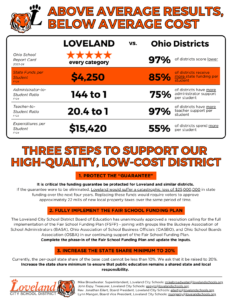
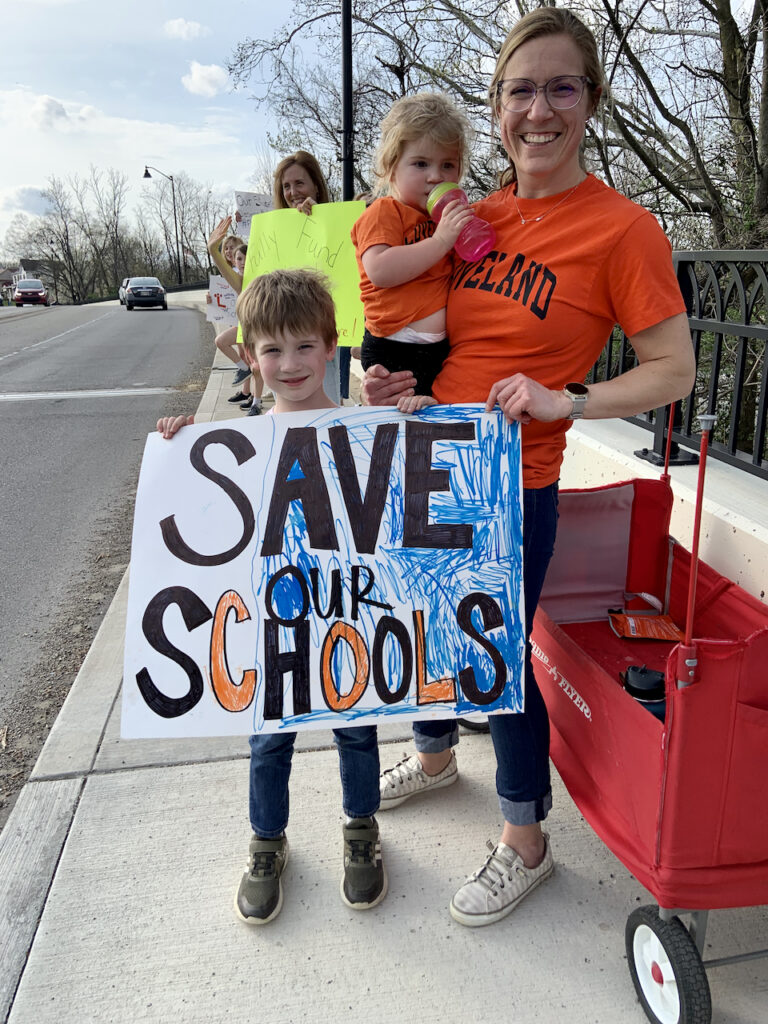
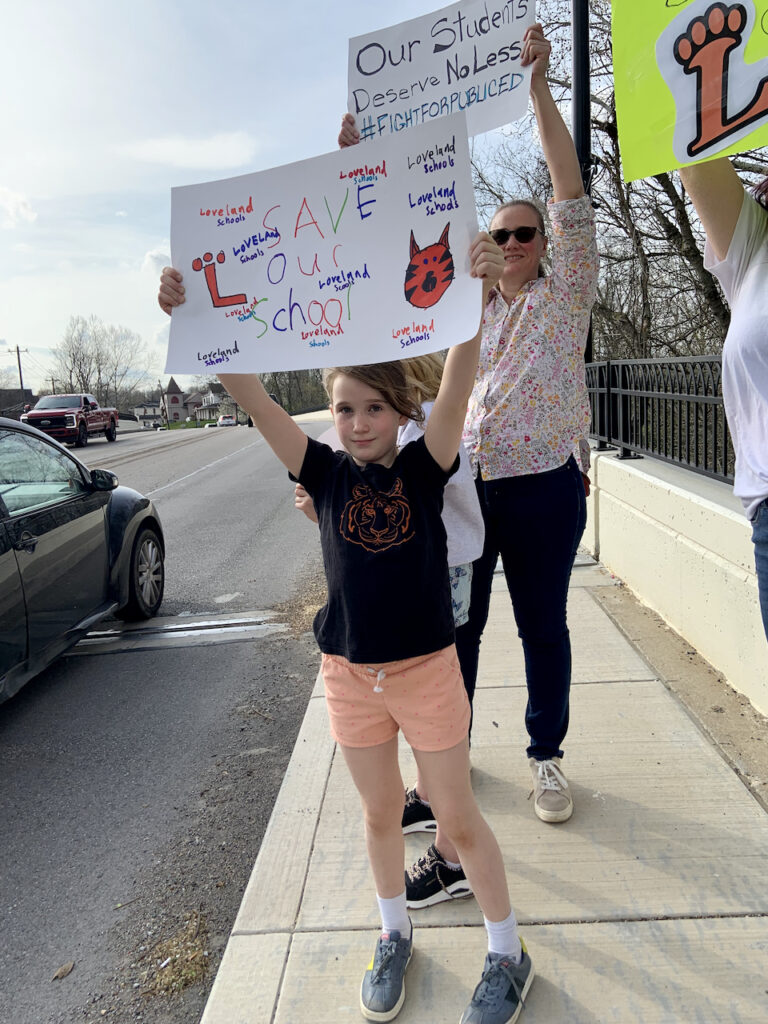
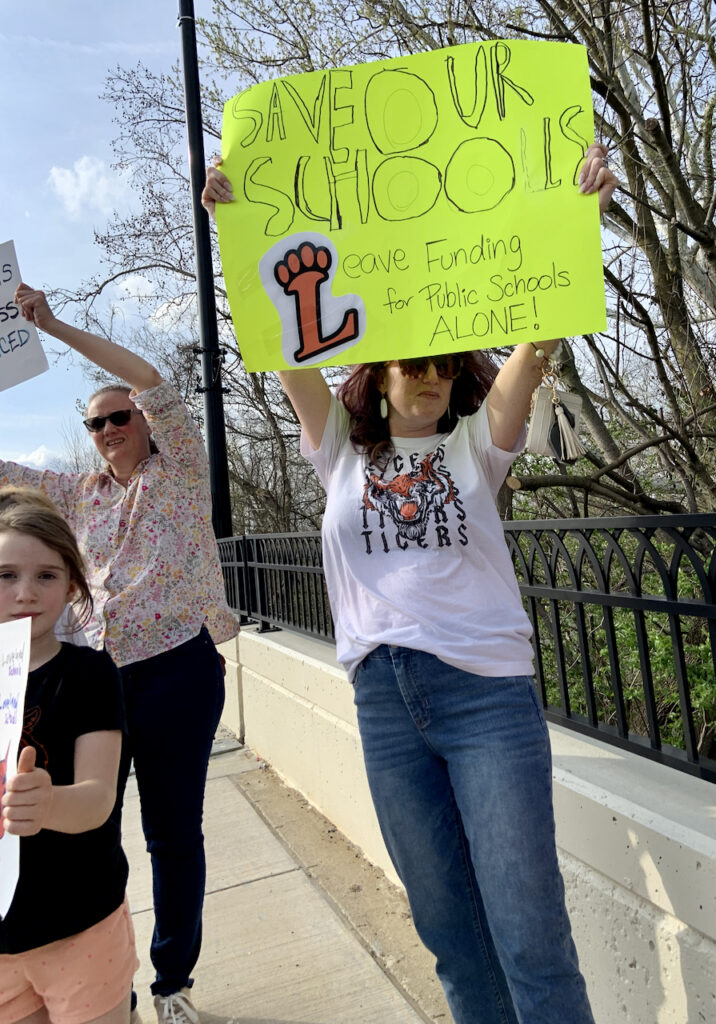
Loveland, Ohio – Becca Moates and Cindy Daumeyer were on Loveland’s Col. Thomas Paxton bridge Wednesday evening along with many supports to send a message to Ohio Governor Mike DeWine and State legislators. The message was to urge the lawmakers to fully fund Ohio’s Fair School Funding Plan (FSFP) for public schools. They say that if the plan isn’t fully funded, the Loveland City School District may lose $2.5 million over the next five years. The FSFP is commonly referred to as the Cupp-Patterson plan. Backers are urging the full completion of its phase-in.
Scott DiMauro, president of the Ohio Education Association, pointed out the potential effect on public schools, which he said serve 95% of Ohio students. He told the Public News Service in late March, “The governor has proposed a budget that would cut public schools by over $100 million, while at the same time increasing funding for vouchers for private schools and charter schools by $500 million. We know that is just absolutely unfair.”
Becca Moates said on March 18 in a guest column published in Loveland Magazine, “The current budget proposal from Governor DeWine leads to lost funds for Loveland schools which will undoubtedly lead to additional revenue requests from the school district. Let’s continue to build the unity we have as community members to support the students who are the heart of our vibrant community.”
In 2021, Governor DeWine signed the Fair School Funding Plan, which was supposed to be implemented three phases to support public school funding in Ohio. Over 90% of children in the State attend public schools. Only 66.67% of the planned funding levels have been implemented. The phase-in was set to reach full funding by fiscal year 2027. Once fully phased in, the FSFP is supposed to provide constitutionally appropriate funding levels for traditional school districts, Career Tech Centers, and Education Service Centers.
Moates also said in her column, “It is time for our legislators to hear from all of us. We need Governor DeWine to endorse a bill that benefits our schools. We need to come together. Write letters, call legislators, and call the Governor.”
DiMauro said that he worries such major shifts in funding could lead to larger class sizes and reduced services in public schools, placing additional burdens on local taxpayers to fill the gaps. He emphasized now is the time for Ohioans who are concerned about the issue and how it might affect their communities to contact their representatives in Columbus.
Here are Moates’ suggestions for what to include in your phone calls, emails, and letters to state lawmakers:
Your name
Your role (parent, student, staff member, community member) in the Loveland City School District.
Your story (explain why you support Loveland City Schools, your family’s experience with Loveland City Schools, and why you are concerned about funding cuts for our district. Make it clear that decisions about funding impact children and communities.)
Your request (for example: protect the “guarantee” because reducing it would hurt funding for our district, fully implement the Fair School Funding Plan with updated inputs, and increase the state share minimum to 20%)
Your appreciation (thank them for their work in Columbus and their attention to this issue that is important to you and our community.)
We suggest you write an email message to lawmaker, then use that message as a script for a phone call. The message can then be printed and mailed to lawmakers for an additional contact point.
[pdf-embedder url=”https://lovelandmagazine.com/wp-content/uploads/2025/03/Loveland-State-Legislators-136th-General-Assembly-2025.pdf” title=”Loveland State Legislators – 136th General Assembly 2025″]
President Donald Trump reportedly plans to fulfill a campaign promise aimed at sweeping changes for public schools: closing the Department of Education.
An executive order from the White House outlining this goal is expected imminently, sources close to the matter told news organizations including NBC News, The Washington Post and The Wall Street Journal this week. The placement of multiple Department of Education employees on administrative leave and a probe of the agency by the Elon Musk-led Department of Government Efficiency have lent credibility to the claims. So has Trump.
Asked by a reporter Tuesday why he was nominating Linda McMahon education secretary if he plans to scrap the department, the president said, “I told Linda — ‘Linda, I hope you do a great job and put yourself out of a job.’ I want her to put herself out of a job [in the] Education Department.”
In a 2023 campaign video, Trump shared his vision for education, expressing his intention for local school boards and parents to control their children’s education, incorporate prayer into schools and expand school choice — or options for families to choose the public, private or religious school they prefer.
“One other thing I’ll be doing very early in the administration is closing up the Department of Education in Washington, D.C., and sending all education and education work and needs back to the states,” he said, disregarding that states and school districts already run public schools.
The prospect of the agency closing has sparked outcry from education leaders, elected officials and families with vulnerable children. Eliminating the Department of Education, they say, could have a ripple effect across the country — with particular consequences for children with disabilities, youth from low-income households and student loan borrowers, most of whom are women.
“Students across the country benefit from programs run by the Department of Education, especially lower-income students in rural, suburban and urban communities, students who qualify for federal grants or loans to receive career training or attend 2- and 4-year colleges, and students with disabilities,” Becky Pringle, president of the National Education Association (NEA), said in a statement Monday. The nation’s largest labor union, the NEA represents over 3 million educators and other school stakeholders.
Shuttering the Department of Education would adversely affect nearly all of the nation’s students, Pringle said, as 90 percent of students overall and 95 percent of students with disabilities are educated in public schools. “Trump’s power grab would steal resources for our most vulnerable students, explode class sizes, cut job training programs, make higher education more expensive and out of reach for middle class families, take away special education services for students with disabilities, and gut student civil rights protections.”
As alarm grows over the Department of Education’s possible elimination, questions are also mounting — namely if an executive order is all it takes to axe the federal agency.
Can a president shut down the Department of Education?
The president cannot close a federal agency with an executive order lawfully.
“But what I think is important to remember here is that you don’t have to dismantle the Department of Education to really, really limit its reach and its effectiveness,” said Jasmine Bolton, who served as senior counsel in the Department of Education’s Office for Civil Rights from 2021 to 2023. “Although it is less likely that they are able to fully dismantle the Department of Education, they could very easily limit its ability to do a lot of things. They could also really take a look at its grant making, its funding — who it’s funding, what it’s funding and really strike at the heart of some of those provisions.”
Bolton said that it’s not inconceivable that the Trump administration would dial back some of the large funding grants that school districts in blue and red states rely on to serve their students.
“We have to be vigilant and aware of all possibilities,” she said.
The Department of Education dates back to former President Jimmy Carter’s administration. In 1979, Congress passed legislation to create the agency. To dismantle the Department of Education, Congress would have to approve its abolishment. Rep. Thomas Massie of Kentucky on January 31 reintroduced legislation to dissolve the agency, a goal shared by the Republican Party and conservative think tank the Heritage Foundation, which wrote Project 2025, its blueprint for Trump’s return to the White House. But the chance of such a bill surviving is a long shot, experts say, especially in the Senate.
“I think it’d be very challenging to do because you’d have to overcome the filibuster in the Senate,” said Wil Del Pilar, senior vice president of the Education Trust, a nonprofit advocating for equity in education. “They don’t have 60 votes in the Senate unless they disband the filibuster. So, it’s possible, but I think it’s highly unlikely.”
Most of Congress, including 60 House Republicans, opposed legislation to eliminate the department last session. Del Pilar said that abolishing the agency would prevent Republicans from pursuing some of their objectives.
“Given all the things that they want to do in terms of what I would call a deregulatory agenda, what I expect them to come in and want to do is undo all of the Biden-era regulations that were put in place through negotiated rule making,” he said.
Pedro Noguera, dean of the Rossier School of Education at the University of Southern California, said the Trump administration needs the Department of Education to carry out goals like withholding funding from education institutions that practice DEI (diversity, equity and inclusion) or teach critical race theory.
“I don’t know how he does that without using the powers of the Department of Education,” Noguera said. “On the other hand, if he wants to redistribute the duties that are present in the Department of Education into other departments, that’s kind of a rebranding. I could see them doing that.”
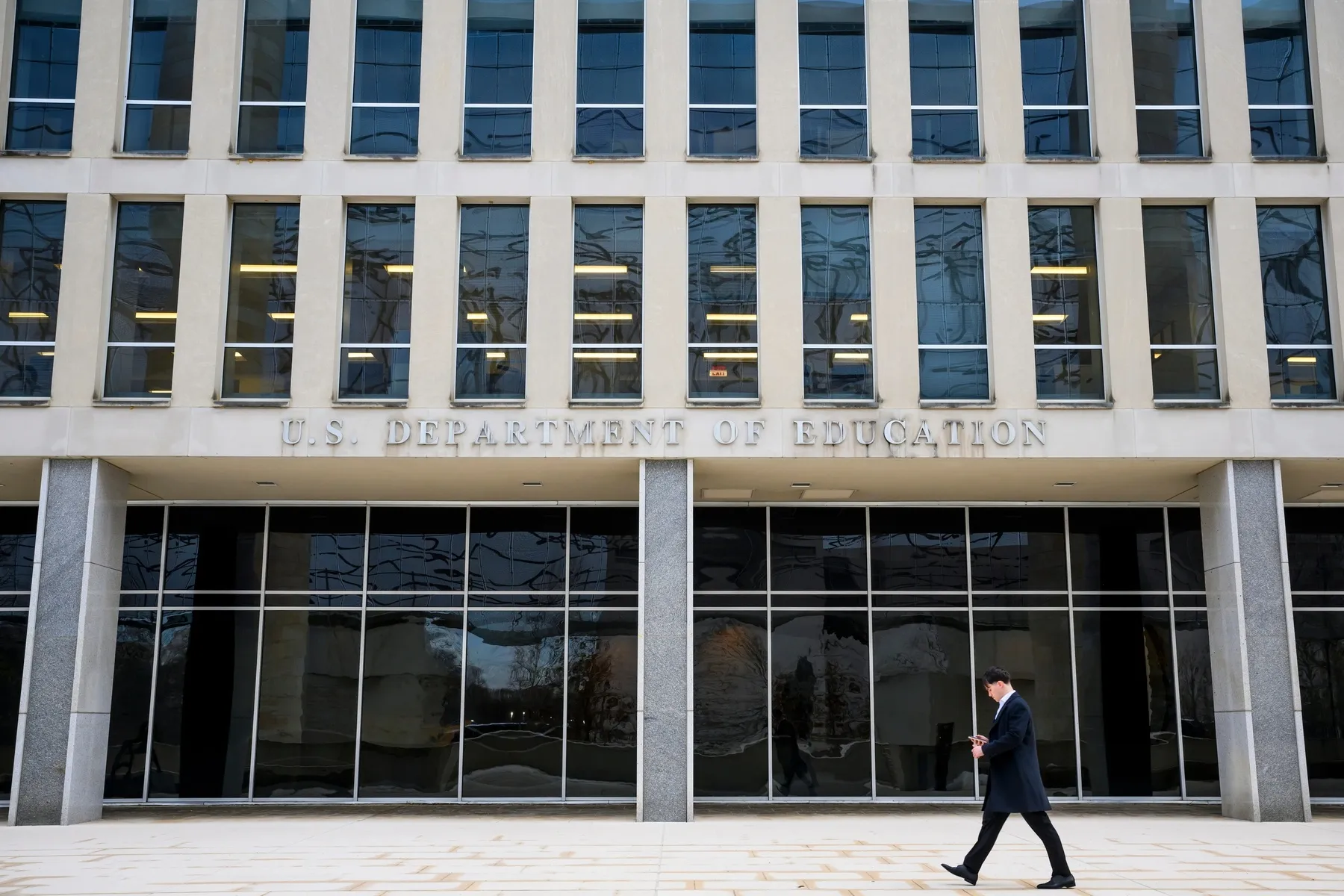
A pedestrian walks by The Lyndon Baines Johnson Department of Education Building on February 3, 2025 in Washington, DC.
(Pete Kiehart/The Washington Post/Getty Images
What does the Department of Education do?
Ensuring that all students have equal access to education is the agency’s overarching responsibility. It includes a civil rights division that investigates allegations of discrimination related to factors such as sex, race and disability.
Trump can’t close the Department of Education with the sweep of a pen, but he can drive out its senior personnel or issue an executive order instructing the agency to severely reorganize, both of which would render it largely ineffectual. Placing dozens of the department’s employees on unexplained leave on Friday has already prompted a letter from a lawyer representing some of the staffers; it accuses the agency of retaliating against them for attending a DEI training. Should it be dismantled, the Department of Education’s key functions are expected to go to other federal agencies. Congressional approval, though, would be needed to transfer many of those duties.
While states, by far, provide most of the money public schools need to operate, the Department of Education, which has a $79 billion annual budget, disperses billions of dollars in federal funding. This includes to the Title I program, which gives supplemental funding to schools that primarily serve economically disadvantaged students. The agency also directs funding toward students with disabilities in line with the Individuals with Disabilities Education Act (IDEA), federal legislation that guarantees this population an education appropriate for their needs. Both IDEA and Title I, created in 1975 and 1965, respectively, predate the Department of Education and can be dissolved only by an act of Congress.
“I’m not sure what it accomplishes if they try to go after programs like Title I,” Noguera said. “They’re going to get a lot of opposition, not just from blue areas, but from red areas as well, and from Congress, because people tend to support the public schools.”
Like Title I and IDEA, the National Assessment of Educational Progress (NAEP) also predates the agency, which administers the test today. Known as the “Nation’s Report Card,” the results of the assessment provide the department with a baseline of how well students are doing in reading, math and other areas.
Upon last week’s release of NAEP scores showing that students’ reading scores had worsened and math scores had stalled, the Department of Education issued a statement unveiling the Trump administration’s plans to upend public schools and give states more control, a deceptive remark since states and school districts already have authority over what students learn. The federal government does not shape local curriculum.
But the Department of Education does track the academic progress of K-12 and college students. At the higher education level, the agency monitors how well institutions serve students by compiling data about admissions numbers and graduation rates. It also oversees funding for the federal student loan program and the Free Application for Federal Student Aid (FAFSA), which students complete to receive financial assistance for college. This aid includes the Pell Grants that supplement higher education costs for students from low-income households.
Braxton Brewington, a spokesperson for the Debt Collective, which works to abolish debt and transform how public goods and services are distributed, said that he’s concerned about how marginalized students will fare under an Education Department run by the Trump administration, though the Debt Collective also criticized Biden officials for not overhauling the student loan system.
“We are expecting the Trump administration to carry out a deeply catastrophic agenda,” Brewington said. “So that will look like privatizing education — K-12 to higher education — incentivizing private loans to pay for college, rolling back repayment plans like Public Service Loan Forgiveness and other types of safety nets. These plans are not ideal, but to the extent that they’ve helped borrowers, we’re expecting a Trump administration to roll those back.”
Does the public support closing the department?
Surveys of the public have found different attitudes about the Department of Education. A new poll released Tuesday by Data for Progress, a progressive think tank and polling firm, found that likely voters oppose eliminating the federal agency by about a two-to-one margin. Data for Progress conducted the poll of 1,294 likely voters from January 31 to February 2 on behalf of the Student Borrower Protection Center, which works to improve the student loan system, and Groundwork Collaborative, which advocates for an equitable economy.
Fifty-two percent of likely voters under age 45 strongly oppose closing the agency compared with 13 percent of this demographic who strongly support such a move. Forty-six percent of likely voters over 45 strongly oppose elimination, while 19 percent strongly support it. College-educated likely voters object to slashing the agency the most, with 55 percent strongly opposing this effort and 14 percent strongly supporting it.
A 2024 survey of Americans by the Pew Research Center found that partisanship shaped opinions about the federal agency, with 64 percent of Republican and Republican-leaning respondents holding an unfavorable view of the department. Just 26 percent of Democrats and Democratic-leaning voters felt the same. Overall, 44 percent of respondents had a favorable opinion of the agency and 45 percent had the opposite view.
Beyond partisanship, attitudes about the Department of Education may depend on whether people feel the agency plays a key role in their lives. Advocates for students with disabilities and student loan borrowers are among the loudest raising concerns about its potential dismantling or diminishment.
“The last time Trump was in office, he significantly understaffed the Office for Civil Rights,” Del Pilar said. “So I do think we should be concerned about what this potentially means for students with disabilities, for English language learners, for immigrant students, because if they don’t staff up and investigate, then we’re not going to see institutions, schools and districts’ feet held to the fire around the inequities that are being placed on our students.”
Why do Republicans want to kill this federal agency?
Republicans have wanted to eliminate the federal agency since its launch.
“Some of it was the old Republican focus on smaller government,” Noguera said. “They’re just shrinking the size of government and seeing the department as largely regulatory, but what they don’t understand is that many of the functions that are now within the U.S. Department of Education, such as funding Pell Grants, are essential to higher ed and access to higher ed for all kinds of Americans across the country. You can’t just get rid of that without a lot of resistance.”
Without congressional support, Noguera continued, the Trump administration will find it difficult to achieve its goals for the nation’s schools. Many of them, such as implementing school prayer, expanding voucher programs and limiting what students can learn and read in class, directly clash with the public education system.
On January 29, the White House issued an executive order asking the Department of Education to spend the next two months developing guidance to help states apply federal funding to school choice initiatives, mirroring a trend that’s been unfolding at the state level. For years, billionaires have collaborated with conservative lawmakers to route funding away from public schools and send it to private schools through voucher programs, according to a 2024 report by the Senate Committee on Health, Education, Labor and Pensions (HELP). Billionaires have funneled their financial resources into the School Freedom Fund, a political action committee that attempts to remove state lawmakers who oppose private school vouchers from office.
Billionaires have a vested interest in privatized education because they can cash in on it through voucher tax credits and federal business expense deductions, the HELP report posits. For example, over 20 states provide voucher tax credits to companies that make contributions to pay students’ private school tuition. Moreover, vouchers overwhelmingly benefit students from high-income families since they typically cover just part of tuition costs. Lower-income families can’t afford to make up the difference. The effort to defund the nation’s public schools, the study contends, is ultimately one to make the elite class even wealthier.
Vouchers harm communities that are already vulnerable due to systemic underfunding and disinvestment, Bolton said.
“By pulling out this money and constantly pulling the rug out under schools, folks who support vouchers, particularly in this administration, are really intentionally undermining the schools that will continue to serve the majority of our students,” said Bolton, who is now policy director at the Partnership for the Future of Learning, a network of organizations fighting for high-quality public schools. “It’s incredibly frustrating that this administration seems to want to pour into a federal voucher program that doesn’t serve us and isn’t really responsive to what people are telling our leadership.”
Ohio spent nearly a billion dollars on private school scholarship programs for the 2024 fiscal year, the first full year with near-universal school vouchers.
The total scholarship amount for Ohio’s five private school scholarship programs was $970.7 million, according to final data from the Ohio Department of Education and Workforce. Well more than a third that money ($406.7 million) was from Education Choice Expansion scholarships.
“I think this does have potentially a negative impact on students, on public schools around the margins, as you see those enrollment trends, but then in the big picture, when you have close to a billion dollars in public money that’s going to private schools, that means a billion dollars in state money that’s not available to meet the needs of the nearly 90% of kids that attend our public schools,” said Ohio Education Association President Scott DiMauro.
The five private school scholarship programs are the Autism Scholarship Program, the Jon Peterson Special Needs Scholarship Program, the Cleveland Scholarship, the Education Choice Scholarship and the Educational Choice Expansion Scholarship Program.
Students on the autism spectrum are eligible to receive vouchers up to $32,455 for the Autism Scholarship Program. Students who have an Individualized Education Program (IEP) from their district are eligible for the Jon Peterson Special Needs Scholarship. The Cleveland Scholarship is for all students living in the boundaries of Cleveland Metropolitan School District. Students living in the boundaries of a low-performing school district are eligible for Education Choice scholarships.
Lawmakers expanded the Education Choice-Expansion eligibility to 450% of the poverty line last year through the state budget — creating near-universal school vouchers. This means a family of four above the $135,000 income threshold can still be eligible for at least 10% of the maximum scholarship.
K-8 students can receive a $6,165 scholarship and high schoolers can receive a $8,407 scholarship in state funding under the expansion.
There were 93,159 applicants for the EdChoice Expansion scholarships and 89,794 were awarded scholarships, according to ODEW data. The amount of EdChoice-Expansion scholarship payments more than tripled from fiscal year 2023 to fiscal year 2024.
For the traditional EdChoice scholarships, there were 44,020 applicants and 42,779 were awarded scholarships — totaling $273.1 million, according to ODEW data.
During this time, nonpublic school enrollment increased about 2%, going from 169,807 in fiscal year 2023 to 173,156 in fiscal year 2024, according to ODEW data.
Public school enrollment declined slightly — dropping about 6,000 students from the 2022-23 school year to the 2023-24 school year.
Most of these new EdChoice Expansion scholarships are students who were already attending private schools, DiMauro said. Ohio’s voucher program started with the Cleveland Scholarships back in 1996.
“This was intended to help students who didn’t have the resources to have options outside of public schools,” DiMauro said. “(The EdChoice Expansion) is clearly intended to benefit people that had long ago made the decision to send their kids to private schools.”
In some cases, the universal vouchers have allowed private schools to increase tuition, he said.
GET THE MORNING HEADLINES.
“The increased revenue comes at the expense of the state,” DiMauro said. “It’s the private schools themselves that are directly being subsidized through this program, even more than families are.”
If private schools are going to accept vouchers, DiMauro wishes there was more transparency when it comes to private school tuition.
The OLSC predicts the five scholarship programs’ payment total will exceed a billion dollars next year.
Aaron Churchill, Ohio’s research director for the Thomas B. Fordham Institute, thinks these scholarship payment figures are sustainable year-to-year.
“I do think we can walk and chew gum at the same time,” he said. “We can support great public schools. We can provide the resources for them. … We can also empower families with greater choice. And I think that’s the direction that Ohio is moving.”
Total payments for the five scholarship programs for the past five fiscal years, according to ODEW data:
$610.2 million in fiscal year 2023
$554.5 million in fiscal year 2022
$444.5 million in fiscal year 2021
$394.2 million in fiscal year 2020
$346.6 million In fiscal year 2019
Remaining scholarships
For the Cleveland Scholarship this fiscal year, there were 8,626 applicants and 8,361 scholarships were given — totaling $53.6 million, according to ODEW data.
There were 5,610 applicants for the Autism Scholarship and 5,385 were awarded for $141.7 million, according to ODEW data.
For the Jon Peterson Scholarship, there were 9,439 applicants and 9,082 scholarships were awarded, totaling $95.6 million, according to ODEW data.
Megan Henry is a reporter for the Ohio Capital Journal and has spent the past five years reporting in Ohio on various topics including education, healthcare, business and crime. She previously worked at The Columbus Dispatch, part of the USA Today Network.
Ohio Capital Journal is part of States Newsroom, the nation’s largest state-focused nonprofit news organization.
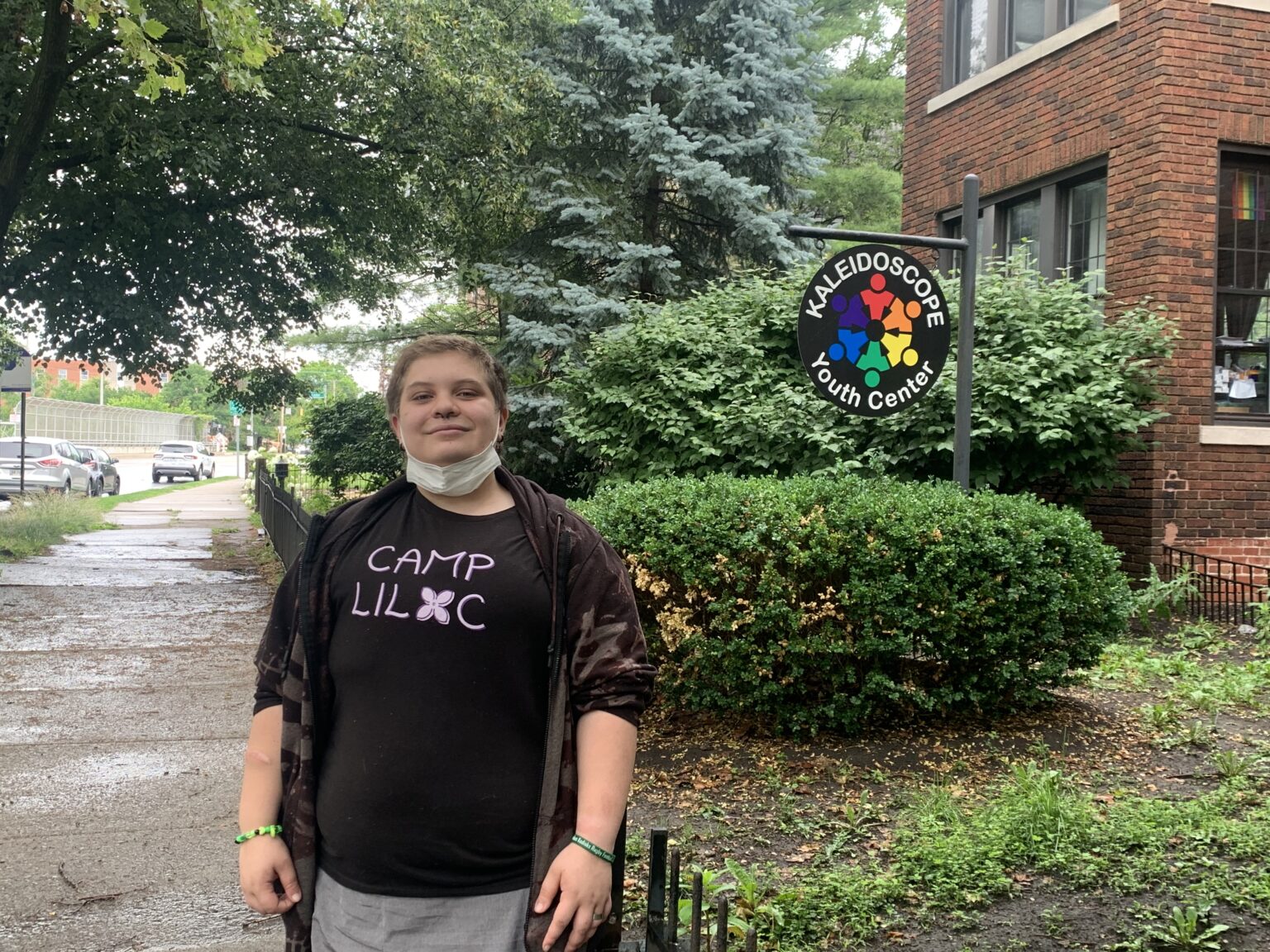
Nathan Alvarez, 15, stands outside Kaleidoscope Youth Center on June 23. He is worried about a bill that would require K-12 schools and colleges to mandate that students could only use the bathroom or locker room that matches their sex assigned at birth. (Photo by Megan Henry, Ohio Capital Journal) Ohio Capital Journal talked to three transgender youths who are concerned about these bills and their potential implications.
Nathan Alvarez is used to people laughing or snickering at him when he uses the men’s bathroom.
Despite that, the 15-year-old says his high school is one place he doesn’t have to worry about that happening because they have a couple of gender neutral bathrooms and anyone can use the men and women’s restroom.
State Reps. Beth Lear, R-Galena, and Adam Bird, R-New Richmond, recently introduced House Bill 183 which would require K-12 schools and colleges to mandate that students could only use the bathroom or locker room that matches their sex assigned at birth. HB 183 is still in House committee, awaiting sponsor testimony.
“It would be hell (if the bill were to pass),” Alvarez said, who uses he/him pronouns. “Hearing about it disgusted me. Like it violently disgusted me.”
HB 183 is one of a handful of anti-trans bills that have been introduced so far in the Ohio General Assembly.
Doctors wouldn’t be able to give puberty blockers and hormone therapy to trans youth, trans athletes wouldn’t be able to participate in women’s sports, educators would be forced to out students to their parents and require public schools to give parental notification before teaching “sexuality content” if these various anti-trans bills pass through the Republican-controlled Ohio Statehouse.
OCJ talked to three transgender youths who are concerned about these bills and their potential implications.
“It’s an attack on all trans people,” said Ko Rupert, who uses she/it pronouns. “They are all uniquely bad, but their uniqueness is important.”
Fifteen laws have been enacted banning gender affirming care for transgender youth and four additional laws have been passed that censor school curriculum like books, according to HRC.
“It’s very hard to see what’s been already happening in other states and how the bills that they are trying to pass here in Ohio are not even that different,” Jaylah Hollins, 19 said. “I feel like it’s not really in the interest of Ohioans, but only in the interest of anti-trans lobbyists from out of state.”
House Bill 8
Hollins is going to start attending Columbus State Community College this fall for social work and hopes to one day work for an organization that helps transgender people.
“Hopefully if these bills don’t pass, we can try and make Ohio a place where it can be a refuge for trans kids and trans adults,” Hollins, said, who uses she/her pronouns. “Ensuring that trans kids have access to medical care and that adults have access to the facilities that align with their gender identity shouldn’t be politicized in the first place.”
An advocate for the rights of trans children and their parents holds up a sign. Photo by Morgan Trau, WEWS.
While she said all the anti-trans bills are harmful, House Bill 8 stands out to her as the most damning.
“I feel like they don’t see it as putting children in harm’s way when it most likely is because you can’t expect a parent to be able to deal with knowing that their child is within an LGBT umbrella and not have to try and resort to what they may not see at the time as harmful approaches to their child’s identity,” Hollins said.
She said these bills would prevent children from learning more about themselves and make them feel as though they deserved to be punished because of how they identify.
“It won’t allow children to be able to understand others who are maybe different from them,” Hollins said. “It will encourage isolation and I think the most devastating would be suicidal ideation, especially with trans and non-binaries who already know that they are coming from families who are unaccepting of those identities.”
She’s said she’s still debating if she’ll stay in Ohio after college.
“It’s still hard for me to think about, but for me, I think I would want to stay in Ohio and fight for trans youth,” Hollins said.
Rupert, a 20-year-old Ohio State University graduate student, is also worried about HB 8 and the stripping away of youth rights.
“Young people can make decisions, can know their bodies and understand and have a deep relationship with their gender and sexuality and romantic orientations,” Rupert said.
“It’s upsetting to know that there are adults making choices for people to make choices about me. And I don’t have a choice,” Alvarez, of Reynoldsburg, said. “It’s scary.”
He hopes to move out of Ohio one day and relocate to Washington.
Anti-trans and anti-LGBTQ bills
House Bill 68, also known as the Save Adolescents from Experimentation Act (SAFE Act), would prevent doctors from giving puberty blockers and hormone therapy to trans youth. It would also ban physicians from performing gender reassignment surgery on a minor.
Megan Henry is a reporter for the Ohio Capital Journal and has spent the past five years reporting in Ohio on various topics including education, healthcare, business and crime. She previously worked at The Columbus Dispatch, part of the USA Today Network.
Many things about school funding and finance are made to be more complicated than they should be. When 86% of your Public School District’s budget is comprised of employee compensation and benefits (of which the majority is teacher pay) it pays to be informed (no pun intended). We constantly need new levies because the union-negotiated salary schedule is designed to perpetuate substantial and ever-increasing teacher costs. No one is denying that we have good teachers at Loveland. They should be paid decently but they are clearly not underpaid. The Loveland district has been generous in compensating teachers for years. It would be a benefit to the Loveland Community to address this issue openly in terms of ever rising costs and the ability of our community to reasonably afford them. To that end, here is a deeper look at how the teacher pay scale is structured and compares to the top schools in our area.
WHO OR WHAT GOVERNS TEACHER PAY
The LCSD Master Contract (available publicly) governs teacher pay and is typically negotiated every 1-3 years. Teachers are called “certified staff’ but the union who bargains for their contract refers to them as “bargaining unit members”. The current Master Contract is 87 pages long, but bargaining unit members sign a single sheet of paper which designates their individual compensation package. Pay is negotiated by the Loveland Education Association, the local union, which is an affiliate of the Southwestern Ohio Education Association (SWOEA), the Ohio Education Association (OEA) and the National Education Association (NEA).
HOW PAY IS CALCULATED
Appendix I of the Master Contract is a single page dedicated to the Loveland City Schools Teacher Pay Scale for years 2021-2022 & 2022-2023. Think of the Pay Scale as a grid. Across the top of the grid are six column headings designating increasing education levels from a bachelor (Group I) to a Master’s degree plus 30 semester hours (Group VI). Down the side in rows are the numbers 1-35 designating years of teaching (also called “steps”).
Group I
Group II
Group III
Group IV
Group V
Group VI
1-35 – Years of teaching experience (“steps”)
Bachelor (BA)
BA with 150 semester hours
Master’s (MA)
MA + 10 semester hours
MA + 20 semester hours
MA + 30 semester hours
A bargaining unit member’s pay is determined by 3 things:
1) the base salary (everything hinges on this),
2) education level (graduate semester hours or degree) a teacher has earned, and
3) years of teaching or number of steps.
Each contract year Bargaining unit members may receive up to three different kinds of increases:
1) a negotiated increase in the base salary, which is not limited and may be different for each year of the contract,
2) an education level increase of a pre-calculated percentage amount based on the new Group (see chart above), and
3) a percentage increase for the number of years of teaching or steps.
There are 20 raises in the current Master Contract up until a teacher has been teaching for 27 years. There are no new increases between 27 and 35 years of teaching, but if the base pay is increased at any time, all years up to year 27 are increased proportionally.
To determine the yearly total pay for a teacher, the equation would be:
Salary = Base Pay + Education Level increase + Number of Years Teaching increase (steps).
The value of teacher pay is determined automatically by years of teaching and education level. Classroom performance, class size, subject matter, grade level, and student needs have no bearing on teacher pay.
DID LOVELAND TEACHERS RECEIVE ZERO PAY RAISES?
The School District’s statement on its website that there has been “0% increase in the pay scale for teachers” should be clarified. This does not mean that teachers are being paid no more this year than they were paid last year, as one might naturally suppose. The current LCSD Pay Scale has remained the same for the two-year contract period of 2021-2023. During this current period there have been no increases in the base salary of $44,167 (what a first-year teacher with a Bachelor’s Degree would receive).
However, the current Master Contract which was negotiated in 2021 modified the years of teaching experience or steps. To align Loveland more closely with other districts, LCSD expanded the steps so that it now takes a teacher 26 years to reach the top salary level, whereas previously only 20 years were required. In the previous contract’s pay scale a teacher could receive 17 raises to reach the top salary for years of teaching. In the current contract’s pay scale a teacher can receive 20 raises to reach the top salary for 27 years of teaching. As a consequence, every teacher with more than 20 years’ teaching experience received one or more of these new raises. Moreover, in transferring teachers from the previous 20-year schedule to the new pay scale according to their salaries at the time of the change (so that no teacher would receive a pay cut), a number of teachers were reassigned to a level higher than their actual years of teaching would indicate. In the first year of the new contract everyteacher received a boost to their pay due to these administrative adjustments. Finally, any teacher achieving the next milestone of educational level received the usual related salary increase. So clearly, even in a year when the “pay scale has not increased,” the cost of teacher compensation increased substantially.
Teachers who have reached the top of the pay scale (maxed out both education levels and years’ experience) can receive a raise only when an increase in the base salary is negotiated. When the base salary is raised (as a percentage in the contract), it then raises every other category on the pay scale, amplifying the increase to all salaries. Although some teachers did not see any salary increase in the current or second year of the Master Contract, year-to-year 0% increases in the pay scale still result in pay increases for the majority of teachers who received an increase for another year of teaching.
FAST TRACK TO A MASTER’S DEGREE
Individual school districts vary in the way they compensate teachers for educational level. Whereas Loveland’s top salary group is a Master’s Degree plus 30 semester hours, Indian Hill’s and Forest Hills’ top salary level is a Doctorate. Sycamore tops out at a Master’s Degree plus 45 semester hours. In every top performing district other than Loveland it takes longer for teachers to achieve the highest educational level.
Moreover, there is a “multiplier” between each of the education levels which determines the increase in pay for that level. On Loveland’s pay scale the cumulative percentage increase in the base salary between the lowest education level attained and the highest education level is equivalent to 27.25%. Of the top performing schools in southwest Ohio only Indian Hill comes close to Loveland with a 22.5% cumulative education level increase. Sycamore Schools hand out a cumulative education level increase of only 11.35% from a bachelor to a doctorate.
By obtaining one’s Master’s Degree a teacher can increase his or her salary and move up the pay scale more quickly. In fact, many Loveland teachers do so. The District assists in this, as the Master Contract attests. It states: The Board will provide 100% tuition reimbursement to bargaining unit members, up to a maximum of three (3) credit hours each and up to a total Board contribution of $60,000 during a contract year. So teachers not only increase their salaries by obtaining a Master’s Degree but also can obtain semester hours at the school’s expense. This also assists a teacher in obtaining a “Continuing Contract” (job for life) which the majority of Loveland’s teachers possess.
The following chart demonstrates the high percentage of Master’s Degrees in the Loveland District compared to the top performing schools in our area even though research cannot conclude that an advanced degree makes one a better teacher or improves classroom performance.
PERCENTAGE OF TEACHERS WITH MASTER’S DEGREES (with local rankings)
LOVELAND
SYCAMORE
INDIAN HILL
WYOMING
FOREST HILLS
MADEIRA
2022
86.9% (2)
68.1%(6)
93.2% (1)
70.5%(5)
78.6%(3)
74.6%(4)
2021
90.2%(2)
67.7%(6)
91.6%(1)
71.0%(5)
78.5%(3)
77.0%(4)
2020
86.2%(2)
70.5%(6)
91.7%(1)
74.2%(5)
76.0%(4)
77.7%(3)
2019
86.5%(2)
69.4%(6)
91.3%(1)
75.0%(4)
73.8%(5)
76.5%(3)
2018
84.9%(2)
69.8%(6)
91.4%(1)
75.1%(4)
74.6%(5)
78.7%(3)
COMPARING AVERAGE PAY AND YEARS EXPERIENCE
In Fiscal Year 2021 Loveland ranked 20 out of all 607 districts in the state of Ohio for highest average teacher pay (96th percentile) and was ranked 4th out of the 49 districts in southwest Ohio. Currently Loveland ranks 39 out of 607 districts for average teacher pay putting us in the 93rd percentile. This ranking is in spite of having both a lower base pay and a lower top salary than these same schools. Here is how Loveland compares to the other top performing districts in our area:
AVERAGE TEACHER SALARY (with local rankings)
LOVELAND
SYCAMORE
INDIAN HILL
WYOMING
FOREST HILLS
MADEIRA
2022
$81,511(5)
$73,726(6)
$85,758(1)
$82,733(3)
$81,946(4)
$84,757(2)
2021
$82,624(3)
$73,804(6)
$83,647(1)
$81,094(4)
$80,039(5)
$83,097(2)
2020
$82,156(3)
$74,359(6)
$82,234(2)
$80,136(4)
$76,742(5)
$82,388(1)
2019
$78,248(3)
$72,714(6)
$79,884(2)
$78,242(4)
$73,582(5)
$80,131(1)
2018
$74,224(4)
$71,577(5)
$77,872(2)
$76,930(3)
$70,299(6)
$78,079(1)
The reason Loveland ranks high for average pay is that we have a larger number of teachers at the higher level of the pay scale than other schools, with the majority of our teachers possessing a Master’s Degree (Indian Hill being the only local district higher than Loveland). Interestingly enough, we have on average fewer years teaching experience than most of the other top schools except for Sycamore. Sycamore, however, has far fewer Master’s Degrees and has a much lower average teacher salary. No other district in the State of Ohio has the percentage of teacher’s with Master’s Degrees that Loveland has for the comparably low years of teaching experience.
AVERAGE YEARS TEACHING EXPERIENCE
LOVELAND
SYCAMORE
INDIAN HILL
WYOMING
FOREST HILLS
MADEIRA
2022
13
13
18
17
18
15
2021
14
14
18
17
18
15
2020
14
14
18
18
17
15
2019
14
14
12
18
15
18
2018
13
12
12
17
15
14
OBSERVATIONS
Loveland compares favorably with other top local districts in our area for base salary. Even when the base salary itself is not increased, most teachers receive a salary increase from either years of teaching (steps) or advanced education levels or both. Loveland is exceptionally generous with its raises related to education level and subsidizes a portion of that advanced education. Loveland ranks in the 93rd percentile in Ohio for average teacher pay, even though its teachers have on average fewer years of teaching experience than is true in other districts.
While it is good that our Board re-negotiated to expand the teaching years (steps) in the pay scale they did not address the short time frame to rise through the educational levels. In the end they just “kicked the can” down the road. Although it will take a bargaining unit member longer to reach the top salary he or she will go through an additional series of increases and if and when the base pay rises all other education level and step increases will go up accordingly.
How long can the Loveland community sustain the expenses of our current educational system? When 86% of the budget is personnel and 60% of that 86% is a pay scale with both negotiated and built-in automatic raises, it can only become more and more difficult for the community to pony up the ever-increasing amounts of money needed to pay the cost.
Resources: All data in this analysis was derived from the Loveland Teacher’s Master Contract, The Ohio Department of Education, the State Employment Relations Board and interviews with local teachers.
After what sponsors say was a year of work to “find the right approach,” a new version of a bill that would attach school funding to each student was introduced Tuesday in the Ohio House.
The Ohio House Finance Committee heard about House Bill 290, which would create an “opt-in” approach to private school scholarship funding, and allow students to take funding that would normally go to the public school districts with them as they opt for a private school option.
“The primary education option would remain the local assigned public school,” state Rep. Riordan McClain, R-Upper Sandusky, told the committee.
Under the bill, if a family chooses to go the private school route, an educational savings account would be created for the child, and the state’s share of educational funding would be deposited there “for the parents to find the right educational path for their child,” according to McClain.
The program would have an annual disbursement of $5,500 for K-8 students, and $7,500 for high school students, identical to the funding model of the EdChoice private school voucher program in the state.
Private school groups, along with the religious freedom lobby the Center for Christian Virtue, have put their support behind the bill saying it allows parents to choose the education they want for their children.
The so-called “backpack bill” has been criticized by public education officials as yet another siphoning of funds away from public schools, which they say does not create the “thorough and efficient” system of schooling required of the state by the constitution.
“HB 290 would force local communities to rely even more heavily on local property taxes to fund schools for the 90% of Ohio children who attend public schools,” said Ohio Education Association president Scott DiMauro.
Federal education dollars and individual school district levy dollars would not be attached to the child under the bill, only the state share of instruction, typically shelled out to districts as a blanket sum.
Bill sponsors McClain and state Rep. Marilyn John, R-Richland County, acknowledged financial analysis of the bill is still ongoing, but said the bill shouldn’t be considered anti-public schools legislation.
“Rather, it is a pro-child, pro-parent, pro-family bill which empowers parents and families to make a choice that is in the best interest of their child,” John said.
Representatives who led the most recent charge for the Fair School Funding plan, the new overhaul of the state educational funding system, wondered why the bill was introduced before the impact of the overhaul could be assessed.
“When we have not fully fixed our public school funding, and we’ve known that we’ve had over 26 years of not constitutionally funding it … to open up a process to take more money out of the public schools without even giving them a chance,” said state Rep. Bride Rose Sweeney, D-Cleveland. “Let’s get to that six-year phase-in, really see if that system works.”
McClain said they don’t expect a mass exodus to private schools if their funding plan is passed, and even see it as a plan that could work alongside the public school funding overhaul.
Still, having the option to move to private schools could “create a competitive market” for children and parents to make educational decisions.
The committee will hear opponent and proponent testimony in future hearings on the bill.
A new bill specifying “blended learning” for the 2021-2022 school year has been approved by an Ohio Senate committee.
Senate Bill 229 is yet another bill meant to address the impact of the COVID-19 pandemic on student success and education, and was favorably passed in Senate Primary & Secondary Education Committee on Tuesday.
In the bill, school districts, including traditional public schools, STEM schools and community and charter schools, would have to have approval by the Ohio Department of Education to implement or discontinue a “blended learning model” by April 20, 2022. This is an extension of current law, which required the approval through July 1 of this year.
The blended learning model requires a school district to provide internet access and devices to each student using the model, and monitor and assess student achievement and progress while also communicating with parents or guardians about the progress.
A report must be submitted to the ODE by March 15 showing each school district’s total number of students in blended learning in 2021-22.
The bill also resets a measure passed through the budget bill, House Bill 110, which discounted standardized testing because of the pandemic’s disruption to education. Under current law, e-schools are required to disenroll a student who fails to take a state assessment for two consecutive years.
Under H.B. 110, that standardized testing rule was set aside and under the new bill, the exception would be extended through the 2022-2023 school year. This applies to any school who has an online school component.
Sen. Theresa Fedor, D-Toledo, accused legislators of creating the standardized testing amendment for e-schools as “problematic double-standard e-school favoritism.”
“If we’re going to provide flexibility and exemptions from standardized testing, it must be for all students no matter where they attend school,” Fedor said.
She brought up the latest court ruling requiring the defunct Electronic Classroom of Tomorrow (ECOT) to pay back $60 million in state funding it received after an investigation showed student engagement amounted to about an hour a day.
Fedor was the leader of a bill that attempted to change education laws in response to the pandemic, but her bill didn’t make it past the Ohio Senate.
She also attempted to add a provision to the blended learning bill on Tuesday that would allow public bodies, including school boards, to meet virtually if they chose to, but that measure was quickly tabled by the committee.
“I think people should be meeting in person,” state Sen. Andrew Brenner, R-Powell, the committee’s chair said. “I think that is pretty much what we’ve had conversations internally about, so I think we should leave it as it is.”
The amendment was tabled along party lines, but the bill itself was passed unanimously.
On Feb. 1, as Black History Month began in Ohio’s classrooms and virtual classrooms, Gov. Mike DeWine unveiled his proposed budget for the next two years, which continues the education funding policies that systematically underfund public schools that educate Black students and even shift some of that funding away toward unaccountable, for-profit private schools.
Black History Month is an important time for our nation’s educators to focus their curriculum around the contributions that African Americans have made in government, industry, art, science, literature, and every field of human endeavor. However, we do a disservice to our students if we don’t also teach about the harder, more painful history of slavery, segregation, disenfranchisement, and racist violence, and if we do not weave it into our everyday curriculum as deeply as it is woven into the fabric of our country.
Even then, we are not telling the full story if we teach about these topics as relics of the past, as dark chapters of our country’s past that have ended. Racist structures in our society didn’t cease to exist when the Thirteenth, Fourteenth and Fifteenth Amendments were ratified following the Civil War, or after Brown vs. the Board of Education desegregated schools, or after the 1964 Civil Rights Act, or even after Barack Obama’s historic election.
Each of those events has been an important step along the way, but as we are reminded all too often, the vestiges of white supremacy live on in our current institutions. We see it in the over-policing and incarceration of Black, brown, and immigrant communities, we see it in our city neighborhoods that were shaped by redlining, and we see it in Ohio’s school funding system.
When we teach Black history, educators can make the connections about how the racial injustices of the past have turned into the systemic racial disparities of the present, and how we can demolish the underpinnings of injustice. There is no better place to start than with our broken school funding policies which underfund and segregate schools with large populations of Black students.
In Ohio, we underfund schools in Black communities with a school funding formula that was found unconstitutional by the Ohio Supreme Court more than 20 years ago because it relied so heavily on local property taxes that it denied an equitable and adequate education to students in low-income areas.
We segregate schools in Black communities with voucher and charter policies that divert students and drain funding from local public schools. Often cloaked in the language of racial justice, vouchers and charter schools have the opposite effect when put into practice. The NAACP has often opposed these policies because they “divert much needed funding for public education to private or charter schools, thereby further dismantling the viability of the public education system and limiting the number of children who would be afforded the opportunity of an adequate and effective education.”
This vicious cycle of underfunding schools in communities of color, and then punishing them for not being able to meet their students’ needs by underfunding them further, must end. We must stop pitting parents and communities against one another, and instead renew our commitment for high quality public schools for all Ohio students.
Last year, the Ohio House passed the Fair School Funding Plan with an overwhelming bipartisan majority, yet the Senate refused to take the issue up. The Plan would have put Ohio on a six-year path toward equitable funding of public schools in Ohio, and would have immediately ended punitive and harmful deductions for vouchers and charter schools from local public school funds.
This would ensure that public school districts receive money only for the students who are enrolled to attend but without the added penalty of deducting money due to students opting for private or charter schools. These changes would strengthen schools in Ohio’s cities and in our rural areas, giving students from all backgrounds increased opportunities. Despite the Fair School Funding Plan receiving an 84-8 vote in the House, the Ohio Senate allowed the bill to die without even receiving a vote.
DeWine had the opportunity to take the hard work and bipartisan agreement for this new school funding formula and insert it as a framework into his budget proposal. Instead, his proposal continues the status quo which is actively undermining our ability to provide an equitable education.
As educators, we can not teach Black History without also being activists in our own realm, fighting for an education system that gives every child, no matter their race or where they live, equal access to a high quality, free public education.





![[VIDEO] Loveland parents and children rally on Col. Thomas Paxton bridge for fair school funding](https://lovelandmagazine.com/wp-content/uploads/2025/04/school-funds-rally.jpg)