

Tag: racketeering conspiracy

  • Multiple signs that federal corruption investigation in Columbus heating up — again

    Multiple signs that federal corruption investigation in Columbus heating up — again

    Getty Images

    BY: Ohio Capital Journal

    After two former Republican officials in June were sentenced for their roles in a massive racketeering conspiracy, U.S. Attorney Kenneth Parker said the investigation was continuing. At least two signs emerged last week that the proceedings might be intensifying.

    Former Ohio House Speaker Larry Householder was sentenced to 20 years in federal prison on June 29 and former state GOP Chairman Matt Borges was sentenced to five years a day later. Both played roles in a scandal in which Akron-based FirstEnergy and other utilities paid more than $61 million to pass a $1.3 billion ratepayer bailout that was mostly intended for a subsidiary that FirstEnergy was spinning off that owned two Northern Ohio nuclear plants.

    In addition to Householder and Borges, two others who were arrested in July 2020 have pleaded guilty and a third died by suicide.

    But on March 10, just after a jury convicted Householder and Borges, a reporter asked Parker an obvious question: What about the people who paid the bribes? Would they be charged? Parker would only say that the investigation was continuing.

    Attorneys for the men who were FirstEnergy’s top executives at the time of the conspiracy — former CEO Chuck Jones and former Vice President Michael Dowling — have already said in court filings that they believe federal investigators are looking at their clients.

    This month brought two more pieces of evidence that federal investigators are considering further prosecutions in the bribery and money laundering scandal.

    On Aug. 4, Hilary M. Williams, who is representing FirstEnergy, submitted a filing in a massive class-action case against the company over the bailout scandal. She informed the scores of lawyers for the pension and investment funds suing the company that they’re not the only ones who want to see the emails and text messages the FirstEnergy executives sent as the bribery scheme was taking place.

    “Counsel… we confirmed this morning that we may disclose to the parties that certain governmental authorities have requested the production of the entire contents of iPad and iPhone devices used by Mr. Jones or Mr. Dowling from January 1, 2016 through December 31, 2020,” Williams wrote. “In keeping with the protocol in this matter, those documents will be produced to all parties, and we expect to do so at approximately the same time that production is made to the requesting governmental authorities.”

    She added. “Mr. Dowling and Mr. Jones used more than a dozen devices during the relevant time period, and processing and reviewing the contents of those devices requires substantial processing time and then time to review for confidentiality and privilege. We are working to complete the review as quickly as possible, and expect to make these productions on or about September 15, 2023.”

    A spokeswoman for the U.S. attorney’s office didn’t comment on whether the “governmental authorities” Williams referred to worked for Parker, whose office prosecuted Householder and Borges.

    However, Parker last week sent a letter to the Public Utility Commission of Ohio asking the regulator to further postpone its investigation into the racketeering scandal.

    “The PUCO proceedings involve issues related to the U.S. Department of Justice of the United States’ investigation, and the United States believes that continued discovery in the PUCO proceedings may directly interfere with or impede the United States’ ongoing investigation,” the letter said. “For that reason, the United States respectfully requests that PUCO stay the PUCO proceedings for a period of six months from the date of this letter. The United States reserves the right to request that the stay be extended beyond this time.”

    Among those the feds may be investigating are Jones, Dowling and Sam Randazzo, whom Gov. Mike DeWine nominated to chair the PUCO in early 2019.

    In a deferred prosecution agreement, FirstEnergy said it paid Randazzo a $4.3 million bribe just before his nomination in exchange for favors the ostensible regulator did for the company. Randazzo denies wrongdoing, but in the Householder trial, witnesses testified that Randazzo played a key role in drafting the corrupt bailout legislation.

    Plaintiffs in the class-action suit earlier this month filed texts and emails between Jones, Dowling and Randazzo. They indicate that the three met in Randazzo’s Columbus condo in December 2018 and arranged to pay the soon-to-be regulator $4.3 million and made it clear that they expected something in return. They also appear to indicate that in addition to his work on the the bailout, Randazzo helped exempt FirstEnergy from a 2024 rate review it had been required to undergo.

    The class-action plaintiffs are accusing FirstEnergy of violating securities law by concealing its illegal conduct from investors. Last week, they filed a transcript of an earnings call from July 23, 2020 — days after Householder, Borges and three others were arrested in the racketeering conspiracy. In it, Jones appeared to mislead analysts about his and his company’s role in it.

    “I believe that FirstEnergy acted properly in this matter, and we intend to cooperate fully with the investigation to, among other things, ensure our company and our role in supporting House Bill 6 is understood as accurately as possible,” said Jones, who would be fired months later. “In the meantime, we wanted to share our preliminary perspective on this issue and reinforce the values with which we operate our company.”

    Jones also claimed that he and his subordinates followed “the highest standards of conduct.”

    “This is a serious and disturbing situation,” he said. “Ethical behavior and upholding the highest standards of conduct are foundational values for the entire FirstEnergy family and me personally. These high standards have fostered the trust of our employees, our customers and the financial community. We strive to apply these standards in all business dealings including our participation in the political process.”

    Jones sat for a sworn deposition in the class-action case in July. Last week, U.S. Magistrate Judge Kimberly Jolson ordered Dowling to sit for one in October.

    Marty Schladen
    MARTY SCHLADEN

    Marty Schladen has been a reporter for decades, working in Indiana, Texas and other places before returning to his native Ohio to work at The Columbus Dispatch in 2017. He’s won state and national journalism awards for investigations into utility regulation, public corruption, the environment, prescription drug spending and other matters.

    MORE FROM AUTHOR

  • Former GOP Chair Borges chair sentenced to five years in massive corruption case

    Former GOP Chair Borges chair sentenced to five years in massive corruption case

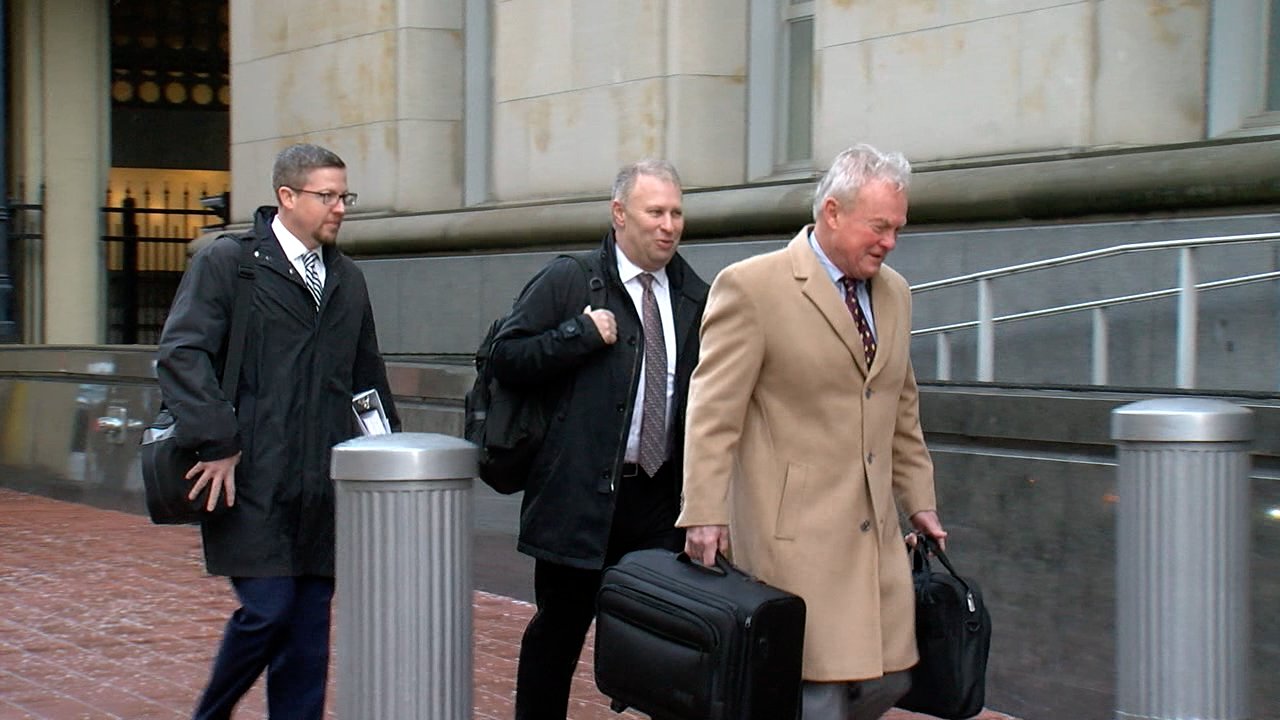
     Center, former Ohio Republican Party chair, and statehouse lobbyist, Matt Borges with his attorneys outside of the federal courthouse. Photo courtesy of WEWS.

    BY:  Ohio Capital Journal

    CINCINNATI — It was Matt Borges, the former chairman of the Ohio Republican Party, who was handcuffed by U.S. Marshals Friday after being sentenced to five years in prison for his participation in the biggest corruption scandal in state history.

    But federal prosecutors made clear that they were trying to send a message to other state leaders who played roles in the scandal and are now trying to pretend they didn’t.

    The sentencing of Borges, 51, follows the 20-year sentence U.S. District Judge Timothy Black meted out a day earlier to former Ohio House Speaker Larry Householder for masterminding the scheme. Akron-based FirstEnergy and other Ohio utilities ponied up more than $60 million between 2017 and 2020 to pass and protect a $1.3 billion ratepayer bailout that was mostly intended to benefit FirstEnergy.

    Borges received a lesser sentence because he was only involved in 2019, when FirstEnergy funneled $38 million into a dark-money group that funded an ugly, falsehood-strewn campaign to defeat a citizen-initiated repeal of the unpopular bailout. Because those voices were squelched — and because Ohio’s Republican legislature refuses to repeal the corrupt bailout — Ohioans continue to be harmed by the racketeering conspiracy, said Assistant U.S. Attorney Matthew Singer.

    The bulk of the subsidies — those going to two nuclear plants in Northern Ohio and a fee to “recession-proof” FirstEnergy — have been suspended. But Ohio ratepayers continue to pay hundreds of millions to prop two coal plants owned by AEP and other utilities, including one that’s in Indiana.

    The effort to gather enough voter signatures to put a repeal of the bailout — House Bill 6 — failed after Borges bribed a worker with the petition drive $15,000 for inside information and opened lines of communication with Republican officeholders.

    At the same time, teams of “blockers” harassed and allegedly assaulted petition gatherers and Householder’s minions flooded the airways with ads falsely claiming that the repeal effort was really China’s bid to take over the Ohio energy grid.

    The scheme Borges participated in was meant to “prevent Ohio voters from exercising their right to reject this corruption,” Singer said. “Ohioans never had the opportunity to vote up or down on this legislation.”

    Singer also pointed the finger at people only speaking out about Householder now and not earlier.

    “It’s interesting that some people are piling on (Householder) after the fact,” he said. “So many knew what was happening in real time and did nothing about it. Not only did they do nothing about it, they helped facilitate it.”

    Ohio Secretary of State Frank LaRose in a Tuesday appearance on Cincinnati’s 700WLW claimed that everybody who knew Householder knew he was “a crook” at the time the mammoth conspiracy was taking place. However, LaRose never spoke out against the deal at the time. And in text messages presented to the jury, FirstEnergy CEO Chuck Jones said that LaRose — who also heads up the Ohio Ballot Board — was giving him “private” updates about the signature-gathering effort.

    LaRose has refused to explain whether he was in communication with Jones or what he might have told him, but Singer, the prosecutor, seemed to refer to the state’s top elections official on Friday.

    Not only did Householder, Borges and their Republican allies squelch a citizen-initiated attempt to repeal the corrupt utility bailout, the gerrymandered legislature is now putting Issue 1 on the Aug. 8 ballot. It would make it virtually impossible for citizens to initiate amendments to the state Constitution. LaRose, a major supporter of the move, claims it will reduce corruption in Ohio.

    During Borges’ sentencing Friday, Singer decried the fact that many of the uncharged players in the racketeering scandal continue to thrive on Capitol Square. They include mega-lobbyist Robert Klaffkey, whom co-defendant Juan Cespedes testified slid a check for $400,000 in FirstEnergy dark money across a table to Householder during a 2018 meeting. Klaffkey denied sliding the check, but he didn’t deny being present.

    Singer said that it was remarkable that Klaffkey was “comfortable sitting in a room and sliding a $400,000 check to a public official.”

    Klaffkey is hardly alone.

    Megan Fitzmartin was paid hundreds of thousands as she aided Householder and co-defendant Jeffrey Longstreth in creating a Householder-friendly Republican majority in the state House. Now she’s policy director for the Republican supermajority in Ohio’s gerrymandered House.

    Corruption — and tolerance of it — corrodes our political foundation, Singer said.

    “Once corruption takes hold democracy itself becomes a charade,” he said.

    Cespedes and Longstreth are yet to be sentenced and U.S. Attorney Kenneth L. Parker on Thursday hinted that others might yet be charged in the scandal.


    Marty Schladen
    MARTY SCHLADEN

    Marty Schladen has been a reporter for decades, working in Indiana, Texas and other places before returning to his native Ohio to work at The Columbus Dispatch in 2017. He’s won state and national journalism awards for investigations into utility regulation, public corruption, the environment, prescription drug spending and other matters.

    MORE FROM AUTHOR