Tag: rape and incest

  • What if anti-abortion activists really wanted to reduce abortion rates?

    What if anti-abortion activists really wanted to reduce abortion rates?

    Birth control pills. Getty Images.

    Countries with more restrictions on abortion do not have lower rates of abortion

    A Guest Column by Rob Moore

    The U.S. Supreme Court’s landmark decision to strike down the right to family privacy around abortion care has cleared the way for Ohio’s six-week ban on legal abortion.

    Since about 1 in 3 women do not realize they are pregnant until six weeks or later, this bill effectively bans legal abortion care for a large number of pregnant women. 

    Ohio lawmakers are not stopping there, either. Boldly saying that pregnancies resulting from rape and incest should be required by the government to be carried to term, legislative leaders are pushing to ban legal abortion care in its entirety.

    This approach may come off as extreme in the face of its tepid support among the general public. According to the Pew Research Center, more Ohioans think abortion should be legal in all or most cases than those who think that it should be illegal in all or most cases. One in four women will have an abortion in their lifetime and most do not believe the extreme ontological claims about moral standing pushed by legislative leaders.

    A tragedy of legislative leaders’ efforts on abortion is how ineffective they will be at achieving their own goals. A 2017 cross-country analysis of abortion restrictions found that countries with more restrictions on the practice of abortion do not have lower rates of abortion. Believe it or not, interference with the private medical decisions of citizens is not only frowned upon in liberal democracies and beyond, it is also extremely difficult to do.

    Perplexing is legislative leaders’ ignorance of the decline of abortion over the past few decades. According to both the Guttmacher Institute and the CDC, the number of abortions in the United States have declined from a peak of about a million and a half in 1990 to less than a million in 2020.

    So what can legislative leaders do if they want to actually reduce abortion? There is one tool that has led to the reduction of abortion over the past decades that legislators could use that also do not infringe on personal medical decisions. That is improvement of access to contraceptives.

    Washington University of St. Louis researchers found that providing access to no-cost contraceptives cuts abortion rates by 62% to 78% among those who receive the contraceptives. Researchers at the Guttmacher Institute have found reductions in abortions are driven particularly by increase of use of long-acting reversible contraceptives such as intrauterine devices (IUDs), which have high success rates in reducing pregnancies and give women the ability to control when they want to become pregnant.

    A high-profile Colorado program providing long-acting reversal contraceptives to low-income women reduced teen births and abortions by 50% according to the Colorado Department of Public Health & Environment. In my graduate studies I worked with a team to conduct a cost-benefit analysis on a national version of this program, finding such a program would have benefits that would far outweigh its costs.

    Abortion is not going away. Even families that plan well find themselves in tragic situations where a fetus is unviable or the mother will die. Police state intervention is unlikely to be tolerated by families or effective in reducing abortion rates. But anti-abortion activists can reduce abortions if they want to: by increasing access to contraceptives that give families control over their reproductive health.

  • DeWine: No comment on abortion ban that forced a child to Indiana

    DeWine: No comment on abortion ban that forced a child to Indiana

    BY: MARTY SCHLADEN – Ohio Capital Journal

    t appears that a 10-year-old rape victim had to leave Ohio for an abortion. But Ohio Gov. Mike DeWine isn’t commenting on the fact that a law he signed making that necessary if she didn’t want to become a mother.

    Shortly after the U.S. Supreme Court overturned Roe v Wade and cleared the way for the law to take effect, the child was on her way to Indiana for an abortion because she couldn’t get one in Ohio, an Indianapolis OB-GYN told the Indianapolis Star. The doctor, Caitlin Bernard, told the paper that an Ohio child-abuse doctor had called, saying the child was six weeks and three days pregnant and needed help.

    That was three days after the six-week limit the DeWine-signed law places on abortion in Ohio. It makes no exceptions for women and children who are victims of rape and incest.

    The story has made national news. But DeWine seemed unprepared Wednesday to discuss whether legislation he championed is forcing children out of state if they don’t want to have their rapists’ babies.

    “Yeah, first of all, I have no more information than you do or anybody does. Reading in the in the paper, it came came as you know, from a story out of out of Indiana from from a doctor over there,” he said as part of a rambling answer to a question from the Cincinnati Enquirer, according to a transcript.

    DeWine went on to say it was “gut-wrenching” as a father and grandfather to think about a 10-year-old being raped, and that he hoped the doctors caring for her reported the assault to law enforcement. But he didn’t address the fact that a law he signed put girls like her in such an onerous situation.

    In a follow-up on Thursday, DeWine Press Secretary Dan Tierney was asked whether the governor thinks juvenile rape victims who become pregnant should be able to get abortions, or whether he believes they should be forced to carry their pregnancies to term. Tierney didn’t answer directly.

    “You have access to Governor DeWine’s recent comments on these issues, including that the only information available on the Indiana matter was from Indiana media reports,” Tierney said in an email. “I do not have further comment for you beyond yesterday’s remarks and the Governor’s numerous and extensive comments since the” Supreme Court decision overturning Roe v Wade.

    While DeWine and his spokesman underscored that media reports were all they knew about the incident involving the Ohio 10-year-old, there have been warnings that something like this was likely to happen.

    Shortly after DeWine signed the six-week ban in 2019, CBS News reported on an Ohio 11-year-old who was repeatedly raped by a 26-year-old, impregnating her. If the Ohio law was cleared by the Supreme Court, the story said, the girl could be left with few options after six weeks of pregnancy. 

    The story also describes victim-blaming the child experienced at a “pregnancy care center.” It cited a police report quoting an employee describing the 11-year-old rape victim as “rebellious” and that she “refuses to listen to her mother and runs away from home all the time.”

    At six weeks, as many as a third of women don’t know they’re pregnant, and it’s a safe bet that even fewer girls do. And while statistics on pregnancies resulting from rape are sparse, it seems likely that Ohio and other states that don’t allow abortions in cases of rape or incest are going to force more children into the most difficult of situations.

    The U.S. Centers for Disease Control and Prevention estimates that about 18 million women experience vaginal rape in their lifetimes and that almost 3 million become pregnant from it. The 2018 research from which those statistics were drawn said it was “the first in over 20 years to offer a nationally representative prevalence estimate of (rape-related pregnancy) of U.S. women…”

    That’s an apparent reference to a 1996 paper published in the American Journal of Obstetrics and Gynecology. It was based on a three-year survey of 4,008 women that sought to determine “the prevalence and incidence of rape and related physical and mental health outcomes.”

    Its findings relating to young rape victims are not reassuring.

    “Among 34 cases of rape-related pregnancy, the majority occurred among adolescents and resulted from assault by a known, often related perpetrator,” an abstract of the study said. “Only 11.7% of these victims received immediate medical attention after the assault, and 47.1% received no medical attention related to the rape.” 

    It added that almost a third of adolescent rape victims didn’t know they were pregnant for 12 weeks — more than double the point at which their abortions would now be illegal in Ohio.

    “A total 32.4% of these victims did not discover they were pregnant until they had already entered the second trimester; 32.2% opted to keep the infant whereas 50% underwent abortion and 5.9% placed the infant for adoption; an additional 11.8% had spontaneous abortion,” the paper said.

    DeWine and his spokesman were reluctant this week to say whether he thinks young rape victims should be forced to carry pregnancies to term. But his office earlier this month confirmed his support of a bill restricting abortion in Ohio even further — and also making no exceptions for rape and incest.

    For Aileen Day, communications director for Planned Parenthood Advocates of Ohio, DeWine owns the consequences of the abortion bills he signs — whether he addresses them directly or not.

    “DeWine signed the six-week ban into law and he is the reason the 10-year-old Ohioan had (to) jump through repeated obstacles to get the health care she needed,” Day said in an email. “It is truly disgusting that he’s not being held accountable for all the harm he has caused Ohio. DeWine’s team has bragged that he is the most anti-abortion governor in Ohio’s history and his history backs that up by signing 10 dangerous abortion restrictions and bans into law.” 

    Follow OCJ Reporter Marty Schladen on Twitter.

  • U.S. Senate to try again on abortion rights after bombshell disclosure of draft opinion

    U.S. Senate to try again on abortion rights after bombshell disclosure of draft opinion

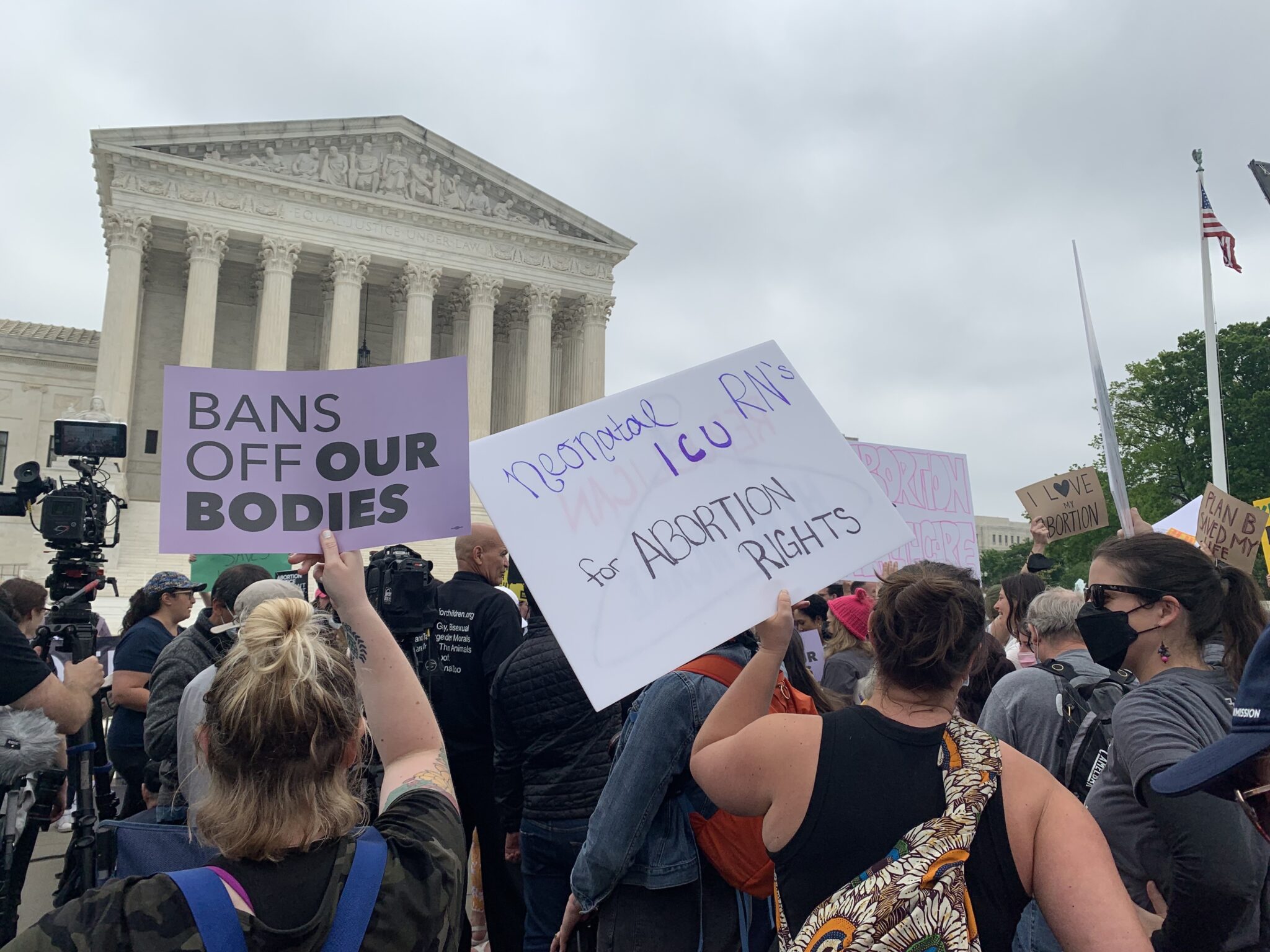
    Abortion rights activists protest outside the U.S. Supreme Court Tuesday. Photo by Jane Norman, States Newsroom.

    BY: JENNIFER SHUTT – Ohio Capital Journal

    WASHINGTON — U.S. Senate Democrats on Tuesday pledged a new vote codifying the right to an abortion after publication of a draft court ruling that showed the Supreme Court on track to overturn the landmark Roe v. Wade abortion decision.

    Democrats, who likely won’t have the votes to advance that bill, also predicted that abortion will emerge as a major issue in the upcoming midterm elections for members of Congress.

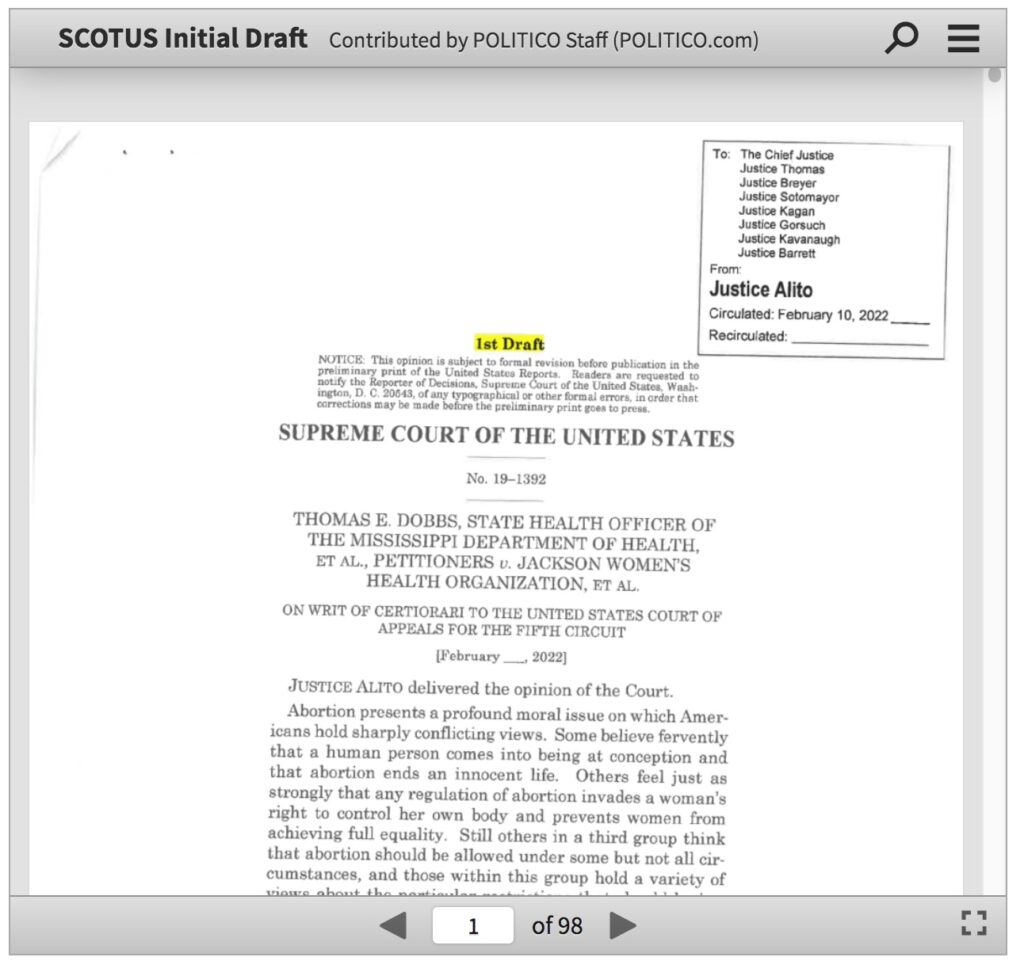
    Their comments came as abortion rights supporters across the United States reeled in reaction to the disclosure of the initial draft U.S. Supreme Court opinion, led by Justice Samuel Alito and leaked to Politico. While the court ruling is not final until published, the draft states that earlier abortion decisions “must be overruled.”

    Senate Majority Leader Chuck Schumer, a New York Democrat, said Tuesday he plans to release a new bill this week that senators will vote on next week to codify Roe v. Wade.

    But in the evenly divided Senate, it will run into problems getting past a legislative filibuster that requires 60 votes for legislation to advance.

    Were Roe v. Wade to be struck down by the court, which is dominated 6-3 by conservatives, the question would be left up to states, and more than two dozen Republican-led states have been racing to enact abortion bans and restrictions.

    Supreme Court Chief Justice John Roberts said the draft, published on Monday night, was authentic, though he cautioned it wasn’t the final opinion, and said he’d directed the Marshal of the Court to investigate the leak.

    Republicans called for the Justice Department to also investigate how the draft made its way to two journalists, saying the leak was a violation of the court’s judicial process.

    Roberts said the leak of the document was wrong.

    “Court employees have an exemplary and important tradition of respecting the confidentiality of the judicial process and upholding the trust of the Court,” Roberts said in the statement. “This was a singular and egregious breach of that trust that is an affront to the Court and the community of public servants who work here.”

    The court is expected to release its official ruling in the case, Dobbs v. Jackson Women’s Health Organization, within the next two months, though many organizations have long expected the six conservative justices to at least pare back the constitutional right to an abortion.

    Democratic senators on Tuesday said a final decision undoing the constitutional right to an abortion the Supreme Court established five decades ago would be unacceptable and harmful to women.

    Montana Democratic Sen. Jon Tester said letting each state, once again, set its own abortion laws would be a “step in the wrong direction.”

    “I think that a woman’s right to choose, a woman’s right to make their own health care decisions is really fundamental to who we are as a nation,” Tester said.

    Washington Democratic Sen. Patty Murray criticized the conservative justices for moving to undo nationwide protections for people seeking to terminate a pregnancy.

    “We do not want this to become a country where women are forced to remain pregnant no matter their personal circumstances and yes, we are talking about situations like rape and incest,” Murray said.

    “A country where extreme politicians will control patients’ most private decisions. A country where for the very first time ever the next generation of women will have fewer rights than their mothers.”

    Michigan Sen. Gary Peters, chair of the Democratic Senatorial Campaign Committee, said abortion rights will become a “major issue” in November’s midterms elections.

    “We’ve seen legislation being passed in state legislatures across the country to limit reproductive freedom for women. But there was always the belief that Roe versus Wade was there,” Peters said. “If Roe versus Wade is overturned, it’s a completely different ballgame.”

    60 votes needed

    In the Senate, Democrats would need 60 senators to vote to get past the legislative filibuster and actually pass legislation codifying abortion access throughout the country. Those votes would be required to end debate and move on to final passage, which is a simple majority vote.

    Peters, asked if Democrats could somehow get to a 60-seat majority in the midterm elections, said “it would be pretty difficult to get there.”

    While the entire U.S. House — an increasing number of whom represent gerrymandered districts — will be up for reelection in November, just one-third of the U.S. Senate will face voters.

    This year that will be 35 seats, with 14 occupied by Democrats and 21 filled by Republicans.

    The Cook Political Report with Amy Walter rates five of those races — Arizona, Georgia, Nevada, Pennsylvania and Wisconsin – as “toss up.” Florida, North Carolina and Ohio are classified as “lean Republican.”

    Senators’ positions 

    Georgia Sen. Raphael Warnock said he’s going to “do everything” he can to “support reproductive rights.”

    He’s one of many Senate Democrats who support eliminating the filibuster.

    “No Senate procedure should get in the way of basic civil rights — voting rights, reproductive rights,” Warnock said.

    Arizona Democratic Sen. Mark Kelly isn’t as convinced that the Senate should change its procedures, but didn’t rule out backing a change to how bills are processed.

    “If there is a proposal to change the rules, I will make a decision on what is in the best interest of the country and the folks I represent in Arizona,” Kelly said.

    Fellow Arizona Democratic Sen. Kyrsten Sinema doesn’t back such a change and neither does West Virginia Democratic Sen. Joe Manchin III.

    That means Senate Democrats don’t have the votes during this Congress to codify abortion rights or change the rules to make it easier to pass abortion rights legislation.

    If Democrats lose control of the Senate following the midterm elections, Republicans are expected to keep the filibuster in place.

    Minority Leader Mitch McConnell, a Kentucky Republican, said Tuesday he would “absolutely” commit to keeping it intact.

    “We don’t want to break the Senate and that’s breaking the Senate,” he said.

    McConnell declined to answer questions on how a final Supreme Court decision overturning Roe v. Wade would affect women throughout the country or whether he’d bring legislation to the floor to address federal abortion laws.

    “All of this puts the cart before the horse,” he said.

    National Republican Senatorial Committee Chairman Rick Scott, a Florida Republican senator, declined to say if the Supreme Court overturning abortion as a fundamental right would affect the election.

    “I think this is an important issue to many people, but so is inflation, so is crime, so is the border,” Scott said. “So, these are important to people and people are gonna be passionate about this. And we ought to be passionate about what we believe in.”

    Scott — who infuriated many fellow GOP senators earlier this year when he released an 11-point plan without leadership approval — declined to say if the GOP would try to pass a bill banning abortion nationwide if they gain control of the Senate in the midterms.

    “We’ll worry about that next year,” Scott said.

    ‘Inconsistent’ justices

    While many Senate Republicans oppose abortion rights and would support the Supreme Court overturning Roe v. Wade, two expressed frustration with the possibility.

    Maine Republican Sen. Susan Collins — who voted to confirm Neil Gorsuch and Brett Kavanaugh, but not Amy Coney Barrett— said in a statement that “If this leaked draft opinion is the final decision and this reporting is accurate, it would be completely inconsistent with what Justice Gorsuch and Justice Kavanaugh said in their hearings and in our meetings in my office.”

    Collins declined to answer reporters’ questions throughout the morning, simply saying she’d released a statement.

    Alaska GOP Sen. Lisa Murkowski — who supported Gorsuch and Barrett, but not Kavanaugh — told reporters that certain justices voting to overturn precedent would erode her confidence in the court.

    “If in fact this draft is where the Court ends up being, it has rocked my confidence in the court. That is because I think there were some representations made with regards to precedent and settled,” said Murkowski. “Comments were made to me and to others about Roe being settled and being precedent.”

    When the Senate took a procedural vote in February on a House-passed bill that would codify the right to an abortion, Collins, Murkowski and Manchin all voted against moving to final passage.

    Schumer said he expects a new vote could be different from the one taken just over two months ago.

    “It’s a different world now, the tectonic plates of our politics on women’s choice and on rights in general are changing,” Schumer said.

    “Every senator, now under the real glare of Roe v. Wade being repealed by the courts, is going to have to show which side they’re on. And we will find the best way to go forward after that. But don’t think that what happened two (months) ago will be exactly the same.”