Tag: redistricting process

  • Ohio politicians used redistricting for gerrymandered horse-trading. Kick them out of the process

    Ohio politicians used redistricting for gerrymandered horse-trading. Kick them out of the process

    COMMENTARY

    by David DeWitt

    It should be abundantly clear to all fair-minded Ohioans at this point that politicians have no business being involved in the redistricting process after lawmakers used the latest round of Ohio House and Senate district mapmaking to strike a bipartisan deal that amounts to little more than gerrymandered horse-trading.

    Fittingly under the cover of darkness late Tuesday night, Ohio Republican and Democratic politicians conducted a shrewd, self-serving negotiation to once again gerrymander Ohio’s Statehouse maps in behalf of their own short-term political power interests, instead of all working earnestly toward fair, representative maps.

    Ohio Democratic commissioners had a choice of whether to get whatever they could for now and hope voters pass reform, or to get raked by Republicans on the commission with worse maps than we have now, but this time likely destined to be rubber-stamped by a partisan right-wing Ohio Supreme Court. They chose the former.

    The Ohio Redistricting Commission’s bipartisan agreement among politicians show a Republican advantage of 61 to 38 in the Ohio House under the new map, with eight competitive Democratic toss-up seats and three competitive GOP toss-ups.

    In the Ohio Senate, the new map shows a 23 to 10 Republican advantage, with three competitive Republican toss-up seats and one competitive Democratic toss-up seat.

    Compare this to Ohio’s current unconstitutionally gerrymandered maps forced upon voters in 2022. Before the 2022 Election, the current gerrymandered districts showed a Republican advantage in 56 House seats. In the Ohio House, all 19 competitive districts under the current maps were Democratic, with zero competitive Republican districts.

    That meant that Democrats had to spend money and resources in 19 House districts and win every single one in order to maximize their House seats. Republicans didn’t have to “defend” a single seat, and could focus all of their money and resources on “pick-ups” — taking seats that lean Democratic on-paper.

    The Republicans’ unconstitutionally partisan mapmaking paid off. The 2022 Election saw Ohio Republicans winning 67 state House seats.

    In the Ohio Senate under the current maps, Republicans before the election looked to hold an edge in 18 Senate seats, and there were seven competitive toss-ups. Republicans ended up winning 26 Senate seats last November, while Democrats won seven seats total.

    So what are we looking at here with Tuesday night’s agreement among the bipartisan politicians?

    Democrats don’t have to spend the money and resources to defend nearly as many seats in the Ohio House. Instead of defending 19 seats, they will be defending eight seats and targeting three GOP seats. Essentially, their political resource management and allocation will be easier. Same thing in the Senate. They will be able to focus their resources on attempting to defend one seat and to pick up three GOP seats.

    Best case scenario for Democrats under the new maps: They pick-up six Senate seats total over their current number of seven, for a 20-13 Republican chamber; and/or they pick up nine seats total in the Ohio House over their current 32 seats by protecting their eight competitive seats and winning three GOP-leaning targets, for a 58-41 Republican chamber.

    That best case scenario for Democrats would break the GOP’s supermajorities; however, if Democrats were to not win the competitive Republican-leaning seats, the GOP would retain supermajorities of 61-38 in the Ohio House and 23-10 in the Ohio Senate.

    The best case scenario for Republicans would be not only to hold on to their supermajorities, but to win as many competitive Democratic-leaning districts as possible. If they were to defend their three competitive seats and win six out of the eight Dem-leaning competitive districts in the House, for instance, they would retain their current 67-32 advantage. Keep in mind that in 2022, they won 11 Dem-leaning competitive House seats.

    So by striking this deal on more gerrymandered maps, Democratic politicians gave themselves an easier time with money and resource allocation in 2024 and a very difficult but still possible shot to take away GOP supermajorities, and the GOP gave themselves a good chance to retain their supermajorities in both chambers while still having the opportunity to possibly expand them even further than the maps suggest now on-paper.

    But there’s more.

    Beyond this gerrymandered horse-trading on the Ohio House and Senate numbers, Democrats are indicating they are putting faith in the idea that the impact of gerrymandering lessens over time as the data used to draw the maps become outdated — so this deal prevents the GOP from both punishing Democrats severely right now, and from coming back for another redraw with fresh data to more efficiently gerrymander the maps again. Democrats also advocated Tuesday night for 2024 anti-gerrymandering reform, indicating they see this deal as a stop-gap measure before real reforms can take place thanks to voters.

    Republicans meanwhile have obtained a strong political cudgel to wield against that very effort to replace the Ohio Redistricting Commission made up of politicians with an Ohio Citizens Redistricting Commission that kicks the politicians out of the process. Republicans will say that the process worked, they obtained bipartisan agreement just as voters in 2015 intended with redistricting reform, that these maps are not gerrymandered, and in 2024, they’ll say something along the lines of, “Far-left special interests want to hijack the constitution and put power in the hands of unelected bureaucrats.”

    This process did not work.

    Redistricting in Ohio has been a two-year travesty with an ignominious conclusion for everyone involved, Republican and Democratic politicians alike.

    The prevailing motivation of every politician Tuesday night was shrewd political self-interest, not sacred obligation and duty to the public.

    No matter what anybody thinks of the advantages or disadvantages of the deal that was struck, it’s clear that these incentives for political horse-trading must be removed.

    The only incentive for mapmakers should be fair and representative maps that evenly maximize competitiveness.

    The way to remove these bad incentives to make these kind of damned-if-you-do, damned-if-you-don’t deals is to kick all of these politicians out of the process.

    Whether it’s partisan or bipartisan, gerrymandering must end. On Tuesday night in Ohio, it did not.


    David DeWitt
    DAVID DEWITT

    Ohio Capital Journal Editor-in-Chief and Columnist David DeWitt has been covering government, politics, and policy in Ohio since 2007, including education, health care, crime and courts, poverty, state and local government, business, labor, energy, environment, and social issues. He has worked for the National Journal, The New York Observer, The Athens NEWS, and Plunderbund.com. He holds a bachelor’s degree from Ohio University’s E.W. Scripps School of Journalism and is a board member of the E.W. Scripps Society of Alumni and Friends. He can be found on Twitter @DC_DeWitt

    MORE FROM AUTHOR

  • Redistricting changes shifted state school board districts before being struck down

    Redistricting changes shifted state school board districts before being struck down

    Melissa Cropper, executive director of the Ohio Federation of Teachers said the decisions DeWine made appear to be pushing out members and candidates who supporters of public education and topics like diversity and inclusion. The lines as established under the unconstitutional maps would impact candidates focused on topics important to the OFT, like diversity and inclusion in education.

    BY: SUSAN TEBBEN – Ohio Capital Journal

    Amid the chaos and uncertainty of the redistricting process, a deadline loomed that would decide representation on the Ohio State Board of Education. It depended on having district lines to reference.

    Legislative and congressional maps are both in limbo after the Ohio Supreme Court rejected both maps, the legislative maps getting sent back for a second time last week.

    Gov. Mike DeWine was forced to assign the Ohio State Board of Education districts himself because the deadline for establishing districts for the board was January 31. Using the state senate map adopted by the Ohio Redistricting Commission on Jan. 22, DeWine signed the letter notifying board members of their districts on the day of the deadline.

    Ohio Revised Code states the board of education districts must be established by Jan. 31 in a redistricting year, and if the General Assembly doesn’t create those districts themselves, the governor must take on the job.

    Each board district has to makeup three contiguous state senate districts.

    “Each state board of education district shall be as compact as practicable,” the state law reads.

     The Ohio State Board of Education districts as they have been prior to redistricting efforts this year.
    Source: Ohio Department of Education

    Many of those districts didn’t change, but the most significant changes seemed to be in four particular districts; the districts represented by Dr. Christina Collins, Dr. Antoinette Miranda, Michelle Newman and Meryl Johnson.

    Collins’ new district would have stretched from Union County through Holmes County, and includes parts of Franklin County in between.

    Being a resident of Medina County, this plan would push her out of her district, and though the board of education races are considered non-partisan, Collins said it put her in a district that voted “overwhelmingly for significantly right-leaning state board candidates,” namely District 1 board member Diana Fessler and two candidates who unsuccessfully ran against Miranda and Newman.

    “The distance presents its own challenges given I do try to be involved in the counties I represent, but I also question my philosophical appeal as a representative to what appear to be this territory’s political preferences,” Collins wrote in an email to the OCJ.

    Newman’s three senate districts would have included her Newark residence in the 31st District, along with the 33rd district that brings her representation all the way to the Pennsylvania border. She would also represent the rural 30th district, that rolls from Jefferson County down the state line to Meigs County.

    Newman said she’s going to continue to serve kids and support public schools whatever her district lines.

    “However, when I saw my new district jump from 13 to 18 counties, lost the compactness of its previous state and also shifted to nearly all rural vs the urban/rural mix I had before, my eyebrows definitely raised,” Newman told the OCJ. “The fact that the Ohio Supreme Court just ruled the new maps unconstitutional proves my wariness was correct.”

    Miranda’s districts were set to go from the Columbus area near Ohio State University to Nelsonville near Ohio University.

     State Senate districts in Northeast Ohio, as shown on the most recently struck down legislative map. State board of education member Meryl Johnson would have represented districts 22, 23 and 24 under this plan, districts separated by another board member’s area in Senate district 27.
    Source: Dave’s Redistricting App

    Johnson’s 11th district would be broken by a peninsula of the 27th Senate district, covered by board member Tim Miller. That break separates the 22nd Senate district, which includes Ashland, Wayne and Medina counties, from the 23rd and 24th, which include pieces of Cleveland proper and Cuyahoga County.

    Only 11 members of the state board are elected, with the other eight appointed by the governor.

    Education officials don’t see the changes as coincidental. They see a connection between the changes made to the districts, and the four board members choices on the board, most importantly, their decision to support (and refuse to rescind) a resolution that condemned racism in state schools.

    “The governor certainly signaled an intent in terms of who they seem to be trying to protect on the board and who they seem to be drawing into competitive districts,” said Scott DiMauro, president of the Ohio Education Association.

    A spokesperson for DeWine corroborated state law that said it was his job to assign districts if the legislature fails to do so, but did not answer questions as to how DeWine decided on the district lines or whether he contacted incumbent members about the changes before making them official.

    Some incumbent members of the legislature were told as the map-drawing process went along what changes would be made to their districts, and were asked for input before the maps were officially presented to the public.

    DiMauro said the state board of education is an important entity to watch because of the power they hold over curriculum decisions, licensure law enforcement and even the hiring/firing process for teachers.

    The message the state board sends in Ohio is important, and curriculum messages some board members have made regarding education on race in schools have a “destructive” effect, according to DiMauro.

    “There’s a sense that you want a state board that is above politics,” DiMauro said.

    Melissa Cropper, executive director of the Ohio Federation of Teachers said the decisions DeWine made appear to be pushing out members and candidates who supporters of public education and topics like diversity and inclusion. The lines as established under the unconstitutional maps would impact candidates focused on topics important to the OFT, like diversity and inclusion in education.

    “I think ideally we wouldn’t even be talking about what the school board lines are until we have fair districts drawn,” Cropper said.

    With the senate maps among the three maps struck down by the Ohio Supreme Court, the education districts are at the mercy of the new redistricting plan, which the court has asked for by Feb. 17.

  • Explainer: The proposals to keep Ohio’s redistricting process on track

    Explainer: The proposals to keep Ohio’s redistricting process on track

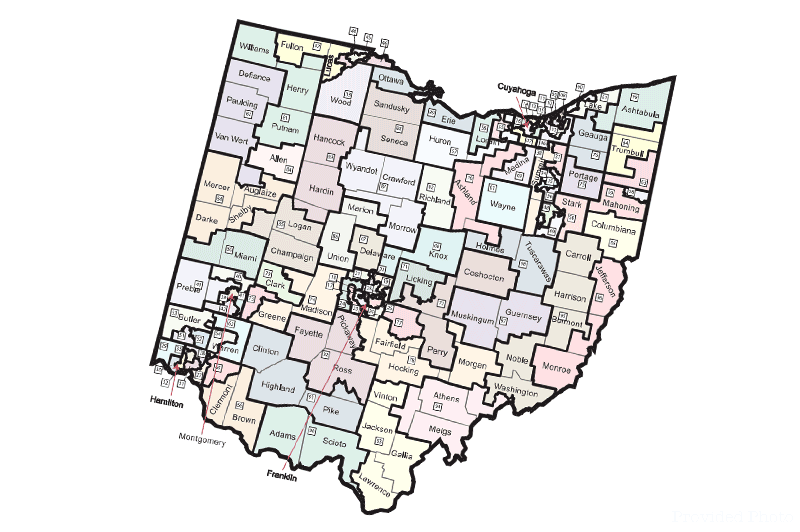
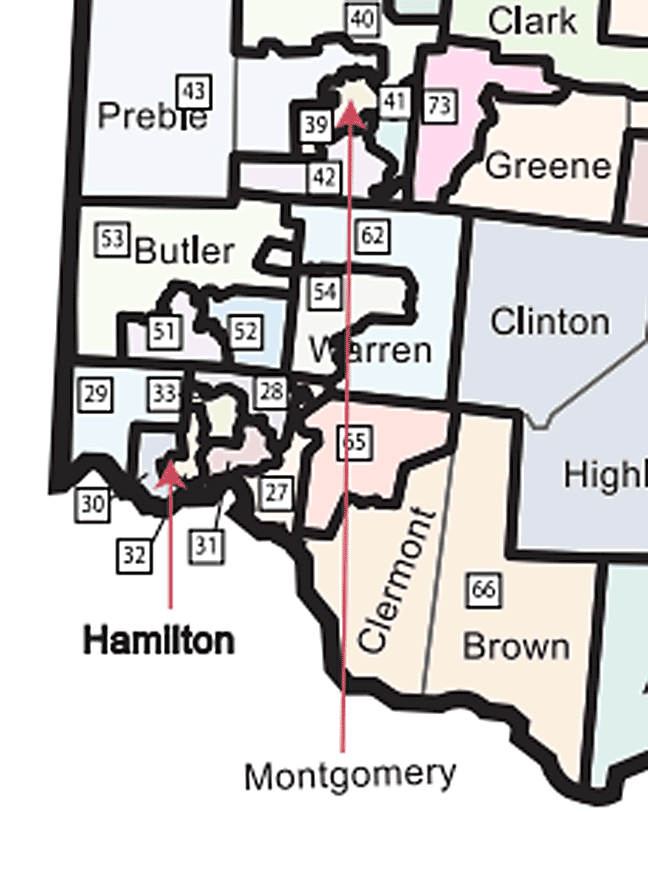
    The current district map for the Ohio House of Representatives. Map courtesy the Ohio Secretary of State.

    (See a complete list of Maps below this article)

    By Tyler Buchanan and Ohio Capital Journal

    Ohio’s redistricting process is in a state of turmoil, with a delay in Census data leading the state to worry about there not being enough time to adequately draw new legislative maps.

    Republicans and Democrats have both presented plans for how Ohio can deal with these delays. In essence, legislative leaders from both parties want to push back the deadline for completing the new maps that will be in place starting in the 2022 elections.

    But the sides propose two very different ways to achieve that goal.

    The next few days will be critical as Ohio lawmakers determine the preferred way of moving forward. The results from this week could have lasting implications for Ohio’s legislative government over the coming decade.

    The current district map for the Ohio House of Representatives.

    Not how Ohio voters drew it up

    Each decade, Ohio redraws its federal legislative seats in the U.S. House of Representatives and state legislative seats in both the Ohio Senate and Ohio House of Representatives. 

    This is done to reflect changes in population and coincides with the U.S. Census, which is also conducted every 10 years.

    After the last redistricting effort a decade ago, Ohio voters chose to reform the process for this year and the decades to follow. In short, voters approved a new system which puts a greater emphasis on transparency and bipartisanship. 

    These new plans — for federal and state maps —  were approved via constitutional amendments on the 2018 and 2015 ballots, respectively. 

    These plans set specific deadlines to meet during the redistricting process.

    Ohio voters could not have anticipated a global pandemic would occur at the same time the U.S. Census Bureau conducted its decennial count of American residents. The pandemic not only made the count more difficult, but has led to delays in processing and distributing census data used by officials to draw new legislative districts.

    The Census Bureau announced this redistricting data will be provided to states by Sept. 30.

    That’s a major problem — Ohio would therefore miss its redistricting deadlines:

    This flow chart shows the new process for redrawing Statehouse districts. Circled is the deadline in question due to the delay in U.S. Census data.
    This flow chart shows the new process for redrawing congressional districts in Ohio. Circled is the deadline in question due to the U.S. Census data delay.

    Plan A involved a federal lawsuit from Attorney General Dave Yost seeking to get the redistricting data released earlier. The case was quickly dismissed. Now the two parties are offering some ideas for Plan B.

    Back to the drawing board

    If the government won’t release data early enough to match Ohio’s deadlines, officials here propose shifting the deadlines back to account for the late data.

    This is not an easy fix. The 2021 deadlines were approved by voters and are thus embedded in the Ohio Constitution.

    Senate President Matt Huffman, R-Lima, suggests the state get approval from voters to move back the deadlines as part of a one-time fix for this unique circumstance.

    State Sen. Matt Huffman, R-Lima. Screenshot courtesy the Ohio Channel.

    The next opportunity to get a constitutional amendment before Ohio voters would be the Aug. 3 special election.

    Both chambers of the Ohio General Assembly (House and Senate) would have to pass a joint resolution to place the constitutional amendment on the August ballot. A three-fifths majority is required in each chamber for passage.

    The deadline for filing this joint resolution with the Ohio Secretary of State’s Office is 90 days before the August election — that’s this Wednesday, May 5. 

    It’s possible, but the Republican leadership would need to work quickly. As of Monday morning a joint resolution has not yet been formally introduced. 

    An amendment requires a majority statewide vote to pass.

    House Democratic Minority Leader Emilia Strong Sykes. Source: Ohio General Assembly.

    Democratic leaders in the General Assembly say there are better options for handling the census delays than a hurried constitutional amendment attempt.

    House Minority Leader Emilia Strong Sykes, D-Akron, and Senate Minority Leader Kenny Yuko, D-Richmond Heights, outlined their party’s own take on Friday for how to move forward.

    “Constitutional amendments should be our final options,” Sykes argued, “not our first.”

    The Democrats believe the best option is to ask the Ohio Supreme Court for an extension of the deadlines as other states, including Michigan, have done. 

    Senate Minority Leader Kenny Yuko is pictured at the Ohio Statehouse in 2018. Source: The Ohio General Assembly.

    “I think (the Supreme Court) could understand that the people have spoken loud and clear, twice already, asking us to put an end to gerrymandering,” Yuko said. “What we’re proposing will do just that.”

    While both plans call for extending the redistricting deadlines, neither party is suggesting to push back the 2022 primary election day to keep the full timeline intact.

    All On The Line Ohio, a left-leaning organization which advocates for a fair mapmaking process, is calling for the primary election to get pushed back by a few weeks.

    Sykes and Yuko said the Democrats would be introducing a plan to ensure the public has an adequate chance to provide input during what could be a truncated redistricting timeline.

    DISTRICT MAPS

    Every 10 years, following the decennial census, Ohio General Assembly and Congressional districts are redrawn to reflect changes in the state’s population in two parallel, but separate processes. The goal of each is to preserve the important one person-one vote principle – that all citizens are equally represented at the Statehouse and in the United States Capitol.

    These maps were drawn based on data from the 2010 U.S. Census and are in effect from 2012-2022.

    The PDF files below contain visual representations of Ohio legislative, judicial and education districts. For more information about what districts you reside in, click here to visit Check My Voter Registration(opens in a new window).

    STATE GENERAL ASSEMBLY DISTRICTS

    FEDERAL CONGRESSIONAL DISTRICTS

    *Equivalency Files are compressed DBF files that can be opened in Excel. 

    EDUCATIONAL & JUDICIAL DISTRICTS

     DISTRICT MAPS BY COUNTY

    The Secretary of State’s office provides by-county breakdown maps of Ohio Legislative Districts. Click here to request a ZIP file of these maps(opens in a new window). For up-to-date county district information, contact your county Board of Elections.

    HISTORICAL DISTRICT MAPS

    The Secretary of State’s office provides, for reference purposes, historical district maps dating back to 1972. Click here to request a ZIP file of these maps(opens in a new window). The file will be e-mailed to you. For up-to-date county district information, contact your county Board of Elections.