Tag: Rep. Jean Schmidt

  • Despite reports of harm, DeWine refuses comment on abortion ban law

    Despite reports of harm, DeWine refuses comment on abortion ban law

    BY: MARTY SCHLADEN – Ohio Capital Journal

    With Gov. Mike DeWine’s blessing, Ohio is in court, fighting to reimpose strict abortion regulations under a law he signed in 2019. But he’s refusing to publicly comment on the numerous stories of suffering it caused during the 11 weeks it was enforced.

    The law DeWine signed, Senate Bill 23, bans abortion after fetal cardiac activity can be detected. That’s about five or six weeks into a pregnancy — a point so early that many women and girls don’t yet know they’re pregnant.

    The law makes no exceptions for rape and incest. It includes some protections for the life and health of the mother, but doctors — who can be charged with felonies under the law — say they’re too vague to be workable.

    SB 23 was unenforceable until June 24 because it violated the 1973 U.S.  Supreme Court decision in Roe v Wade. But then the U.S. Supreme Court conservative majority handed down its decision in Dobbs v Jackson Women’s Health, overturning Roe and its protections of the right to an abortion.

    Almost immediately, SB 23 went into effect and just a week later, the Indianapolis Star reported that the law had forced a 10-year-old rape victim from Columbus to travel there for an abortion. The incident made for international news, but DeWine refused to comment on it, other than to say child rape is “gut wrenching.”

    After that, more horror stories came in the form of sworn affidavits filed by doctors and other workers in Ohio abortion clinics. 

    They included two more minors who had been impregnated by rapists and cancer patients who couldn’t get abortions needed for treatment because their doctors were afraid of being charged with crimes and losing their medical licenses. 

    Other women were diagnosed with fetal abnormalities so severe that their pregnancies couldn’t be successful. Under SB 23 they had to leave Ohio for abortions if they didn’t want to carry those fetuses for months.

    On Sept. 14, enforcement of SB 23 was paused when a Cincinnati judge granted a temporary restraining order against it and then later issued a preliminary injunction. The case is expected to make its way to the Ohio Supreme Court, on which DeWine’s son, Pat, sits as a justice.

    In the face of news of medical and emotional problems caused by SB 23, Gov. DeWine has been steadfastly silent. 

    “Our office has no new comments on the issue or the ongoing litigation at this time,” Press Secretary Dan Tierney said in an email Monday. He said something similar 10 days earlier.

    Also, some of the governor’s recent conduct might be seen partly as an attempt to avoid questions about the impact the abortion law he signed is having on some women and girls. 

    He has refused to debate his Democratic challenger in the Nov. 8 election, Nan Whaley. Also in recent weeks, DeWine has made few appearances in central Ohio, where he’d be likely to face the Capitol press corps.

    At the same time, he may be quietly signaling his support for even more sweeping abortion measures.

    After the Dobbs decision, state Rep. Jean Schmidt, R-Cincinnati, introduced a bill that would ban abortions at any point in a pregnancy with only narrow exceptions to protect the life and health of the mother. She said she had the governor’s support.

    DeWine apparently hasn’t spoken publicly about the measure, House Bill 598. But a spokesman didn’t dispute Schmidt’s claims.

    Follow Marty Schladen on Twitter.

  • Ohio HB 616: This type of legislation and mentality must be met head-on and forcefully resisted and debunked

    Ohio HB 616: This type of legislation and mentality must be met head-on and forcefully resisted and debunked

    Aaron West

    by Aaron West

    At the beginning of each school year, I teach my students how to annotate. I want them to pay close attention to what they read, and I encourage them to ask questions about it. Today, I had to practice what I teach. I grabbed a highlighter and every teacher’s friend (a felt-tipped pen) all because of one proposed bill: Ohio HB 616.

    If you aren’t familiar, this bill copies and pastes direct lines from both Florida’s recently-passed ‘Don’t Say Gay’ bill and a litany of other bills passed by certain legislatures attacking Critical Race Theory (which doesn’t exist in K-12 classrooms), “divisive” concepts, and anything that might make anyone feel “guilty.” 

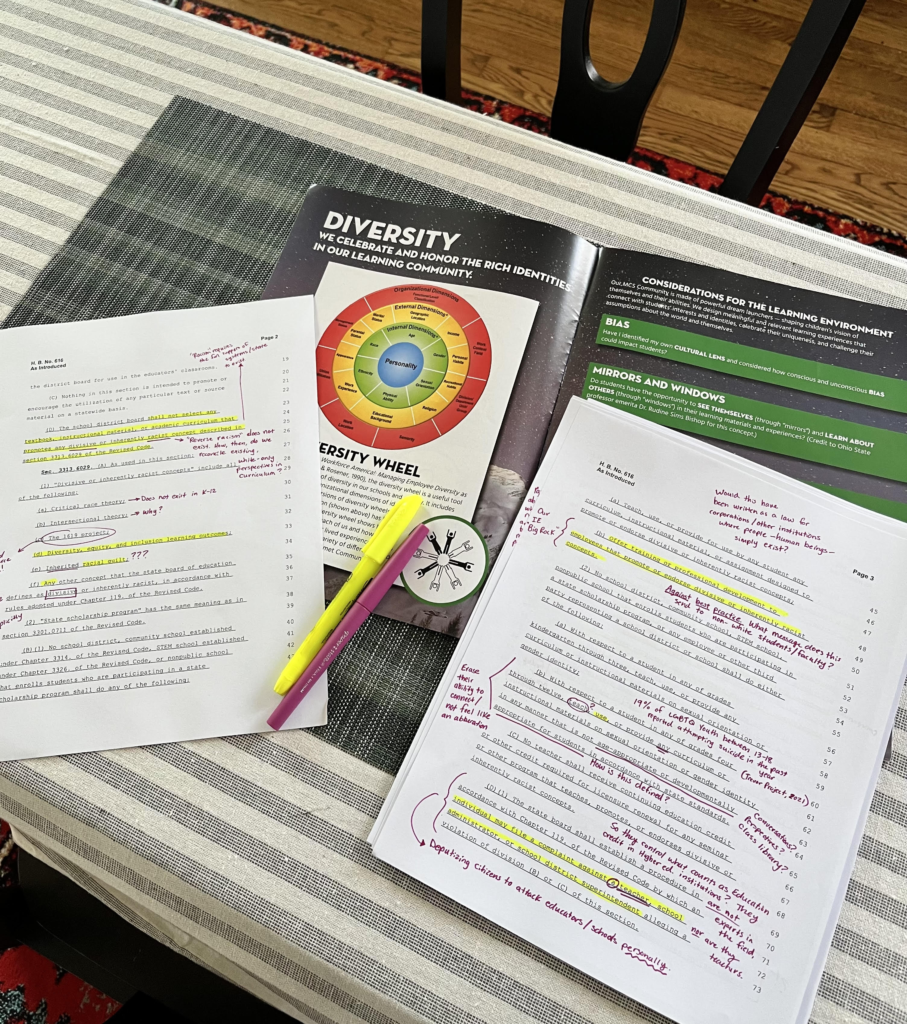
    I have read all 18 pages of this bill and placed here for you two particular ones next to an open copy of my district’s Inclusion guide. I want to show you, firsthand, just how antithetical this is to the field of education. Culturally-responsive education that acknowledges students’ identities is best practice—and we will be at risk of losing our licenses and funding for it should this bill—or any similar form of it—pass. We will be targeted and discharged for doing what is actually right by the professional standards in our field.

    We will be targeted and discharged for doing what is actually right by the professional standards in our field.

    In this bill, you’ll find vague language that isn’t defined; the enabling of any citizen to personally report teachers, administrators, and superintendents for discipline; the threat of punishment for including diversity/equity/inclusion training for staff or students; and consequences for using any curriculum (including my own classroom library) that includes any “divisive” or “racist” (here meaning “non-white”) perspectives or concepts.

    Most personal to me, this bill needlessly includes language whose intention is to further alienate and marginalize LGBTQ+ youth. For the first twenty-six years of my life, I was afraid to admit that I was gay. Had my experience in school (and elsewhere) been different, more representative, that may have been different. I may have been healthier and felt like there was a place for me, my identity—as I was.

    I don’t know if this bill will make it through a committee or whether it will ultimately be passed, but here’s what I do know.

    • 19% of LGBTQ+ youth ages 13-18 reported attempting suicide at least once in 2021 (The Trevor Project)

    • Some form of this bill, and more of the like, will continue to crop up—in Ohio and elsewhere across the U.S.

    • This type of legislation, and really, these mentalities, must be met head-on and forcefully resisted and debunked.

    • We must continue to vote en masse. In every election—locally and otherwise. Vote for people who will not make a culture war of the most vulnerable lived experiences. Vote for your teachers, your medical professionals, your neighbors who are Black or gay or some other “divisive” subset. Inclusion at the elected level is an antidote to the misguided assumption that this is desirable or even acceptable to most.

    • It’s important to remember that one of the noblest goals of quality public education is to make space for all; it is about more seats at the proverbial table. This bill seeks to send a chilling reminder that—still, in 2022—so many must raise their voices as though to ask permission to simply exist or belong.

    If you live in Ohio, you can make your voice heard on this bill by contacting the following:

    House Speaker Robert Cupp (R): (614) 466-9624

    Caucus Minority Leader Allison Russo (D): (614) 466-8012

    Other Ohio House Representatives

    Rep. Jean Schmidt (R-Loveland) Co-introduced HB 616 with Rep. Mike Loychik

    Rep. Mike Loychik (R-Bazetta) Co-introduced HB 616 with Rep. Jean Schmidt