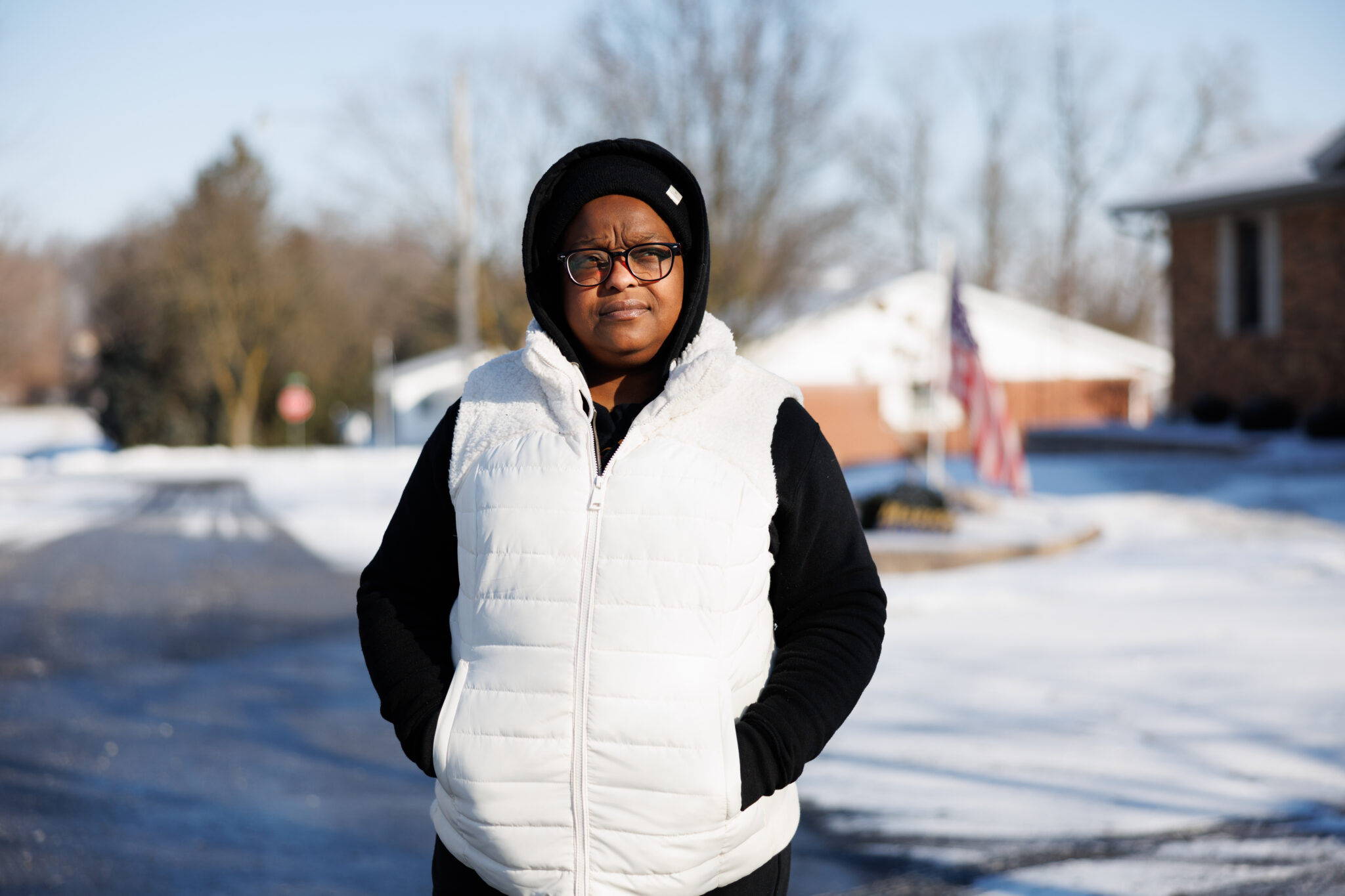
CHICKASAW, OH — JANUARY 24: Seventh-generation Randolph Freepeople descendant Paisha Thomas, January 24, 2025, on Virginia Street in Chickasaw, Ohio. (Photo by Graham Stokes for Ohio Capital Journal. Republish photo only with original article.)
This story is the second in a two-part series on mapping land denied the Randolph Freedpeople and state efforts to make amends. You can read the first part here.
CHICKASAW — “So, this could’ve been my neighborhood,” Paisha Thomas said, trudging down a snowy street in Chickasaw, Ohio. “That’s infuriating.”
The Mercer County village sits about six miles west the heart of New Bremen, the Miami and Erie Canal stop where Thomas’ ancestors were turned away from their land by a white mob almost 180 years ago.
The Randolph Freedpeople were a group of roughly 400 men and women released from slavery in their former owner’s will. John Randolph was a prominent Virginia politician and landowner, but state laws prohibited freed slaves from remaining in the state. Randolph’s will not only freed his slaves but set aside money with which his executor, William Leigh, could purchase land on their behalf.
GET THE MORNING HEADLINES.
Leigh was drawn to western Ohio. Although the state had harsh “Black codes” of its own, requiring employers post a $200 bond against a Black employee becoming a public charge, those laws were rarely enforced. Instead, Leigh saw a sparsely populated and agrarian region with a small but thriving Black community called Carthagena not far from New Bremen.
Leigh bought roughly 3,200 acres for the freedpeople, but when they arrived white men armed with muskets turned them back and even marched along the canal until they crossed the county line.
The Randolph Freedpeople eventually settled in several towns, like Rossville outside of Piqua, but they were never able to get the land purchased on their behalf. Instead of homesteading, many found work as laborers or domestic servants. In the early 1900s, a group of descendants petitioned Ohio courts to return their land, but the case was dismissed under the statute of limitations.
Although the deeds for that land didn’t disappear, the specific location of the parcels wasn’t well understood until a group of Miami University students took the story on as a class project. Late last year they produced a map of the Randolph parcels for the first time, encompassing 3,140 of the total acreage purchased.
But while that makes the loss more tangible, the question of how to atone is still very much up in the air. One state lawmaker wants Ohio to officially acknowledge the mob incident and formally apologize.
The lawmaker who represents the area, however, seems more inclined to leave it in the past. Meanwhile, descendants like Thomas want to see far more than just an apology — they want some form of compensation for what was lost.
What could be
Today, the Randolph Freedpeople’s land makes up about 200 parcels scattered south and west of Grand Lake St. Marys. Nearly all of it is still dedicated to agriculture, but there are a handful of commercial or industrial parcels and in the northeast corner of what is now Chickasaw, several residential parcels.
Thomas chuckled at the irony of the street names that sprung up on a plot of land meant for the Randolph Freedpeople — Liberty Street, curving smoothly into Virginia Street. The homes are nice but not extravagant; a tiny neighborhood of 1970s ranch-style homes with broad front lawns and no fences. She described growing up in Piqua with her family spread throughout the city.
“Here could have been just like a neighborhood of people, you know, walking, yelling across the yard,” Thomas said. “That’s frustrating.”
She was particularly struck by the large grain silos a couple hundred yards from the street.
“When we came around that corner over there and saw the farm and the grain storage right next to a residential home, it just felt very in your face, like I asked for it because I came here, but it just felt very like now there’s no denying or guessing. There’s actual evidence of what could be, because it is — but it’s for somebody else.”

What amount?
Thomas thinks about what was lost in generational terms. To her, the Randolph Freedpeople didn’t just miss out on the roughly five square miles worth of land that has appreciated in value over the years, they missed out on nearly two centuries of income that farmland could’ve produced.
It’s likely impossible to put a dollar figure on that, but she wants the state to try.
Thomas has started a nonprofit called Land of the Freed to raise awareness and advocate on behalf of descendants. The group has taken the lead on renovating African Jackson Cemetery in Rossville — a settlement just outside Piqua where several Randolph Freedpeople families landed after being turned away in Mercer County.
Butch Hamilton grew up with Thomas and is a member of the Land of the Freed board. Like Thomas, he’s taking a long view.
“What amount of money has Paisha’s family been denied by not being able to settle and claim that land? That’s the thought that comes to my mind,” he said. “And then the then the second thought is, well, what is going to be done to make the make the whole situation right?”
His wife Sherri Hamilton sits on the board as well, and she acknowledged the seeming impossibility of the task.
“There, quite literally, is probably no way to give back what was stolen so many generations later,” she said. “But something needs to be done.”
The Miami University study tallied the current assessed value of the Randolph plots at roughly $14 million. But with much of the acreage valued for its agricultural use, that’s likely far lower than what the land would fetch on the open market. At $14 million, the land students identified would be worth about $4,500 an acre. An Ohio State University survey put agricultural land in the Western region of Ohio at more like $11,500 an acre, and a handful of recent Mercer County agricultural land sales listed on Zillow range from $16,500 to $21,600 an acre.
Although the question of value is tricky, Butch Hamilton argued it’s unavoidable.
“We keep saying something has to be done,” he said. “The thing that needs to be done is the family needs to be compensated with money. I mean, there needs to be a payout.”
Regardless of what you call it, it amounts to reparations — a political third rail, particularly among Republicans. Compensating descendants, the argument goes, rewards people who weren’t directly harmed by taking from those who did no wrong.
That said, there are notable historical precedents. In the 1980s, President Ronald Reagan signed off on payments to Japanese Americans interned during World War II. In the 1990s, Florida Gov. Lawton Chiles approved a $2.1 million measure to compensate residents of Rosewood, a Black town razed by a white mob in 1923.

State repsonse
While Thomas and the Hamiltons are thinking in terms of generations, state Rep. Donatvius Jarrells, D-Columbus, has to think in terms of votes. His long-term ambitions are nearly as high, but in a General Assembly controlled by Republicans he’s conscious of what is and isn’t possible.
He wants to begin with a resolution formally apologizing for what happened to the Randolph Freedpeople. Jarrells is expecting to introduce that proposal sometime in February to align with Black History Month.
“I think that resolution is kind of the first step,” he explained, because many of his colleagues aren’t aware of what occurred.
“And so, it gives us an opportunity to, one, have a baseline of knowledge across our chamber on what happened to these Ohioans, and then opens the door for conversations about what we can do.”
Jarrells floated the idea of a museum or a scholarship fund as ways the state might make amends to Randolph Freedpeople descendants, and he said Thomas and the Hamiltons have a point when it comes to money. Jarrells said many of the struggles he’s heard about from descendants trace their way back to “this one point of time where they could have built wealth, and then that wealth was taken away from them.”
But Jarrells may face headwinds simply getting the General Assembly to take up an apology resolution.
He wants to co-sponsor the measure with state Rep. Angie King, R-Celina, whose district covers the entirety of Mercer County. But speaking after a recent session, King said she didn’t know what Jarrells was working on. Although King said she’s “familiar” with the Randolph Freedpeople story, she did not answer questions about what, if anything, the state should do now.
“That’s my comment,” she said. “As a county recorder, I’m familiar with it because we digitized the records.”
Ohio Capital Journal sent King’s office a follow up email seeking additional comment. She did not reply.

What’s possible
The Mercer County Historical Society is based at the Riley House Museum in Celina, Ohio. The organization has a small mountain of documents related to the Randolph Freedpeople as part of its collection. But museum Director Cait Clark, acknowledges even in Mercer County the event is largely forgotten.
“I’d say the broader population probably doesn’t know, and they definitely should,” she said.
When it comes to how public officials should make amends, Clark is quick to note that’s a decision outside her purview. But drawing a comparison to how native Americans were pushed off their land, she argued, “if there’s nothing that can be done to fix the past directly, the minimum you can do for these people is to acknowledge what happened. If nothing else, acknowledge it.”
Clark expressed doubts about the possibility of compensating descendants in the current political climate, but added, “if it was my family, I would definitely want acknowledgement and some form of compensation, because this was highly disruptive to a group of people.”
As for what her organization can do, Clark emphasized education through articles, public displays, or historical markers.
“Our role in it could be small or large,” she said, “it just depends on how far we get.”
Meanwhile, Thomas and the Hamiltons aren’t exactly impressed with an apology resolution.
“That’s an example of crumbs,” Butch Hamilton said. “And we’re in a day and age where that’s not acceptable anymore.”
Even if it’s a first step, he insisted that there need to be further steps, and fast — “This case has been going on since 1846,” he argued.
If the state acts, whether through direct payments to descendants or something more diffuse like a scholarship program, there will likely be those who see it as a misguided response to a historical wrong. Sherri Hamilton acknowledged how wary people become when reparations become part of the conversation. But she argued that’s not an excuse to sweep past-wrongs under the rug.
“Take the African American experience out of it. Take the Blackness out of it,” she said. “Just say these are human beings who had land stolen from them. Now, if they were whomever, the German immigrants that settled in New Bremen, what would be done for them? And then that’s the answer.”
Follow Ohio Capital Journal Reporter Nick Evans on X or on Bluesky.
YOU MAKE OUR WORK POSSIBLE.