Tag: reproductive decisions

  • Abortion amendment ballot language submitted, Ballot Board set to meet Thursday

    Abortion amendment ballot language submitted, Ballot Board set to meet Thursday

    Abortion rights groups request full text on November ballots

    BY:  Ohio Capital Journal

    Gearing up for an Ohio Ballot Board meeting where constitutional amendment language regarding reproductive health will be considered, groups pushing for the measure want to see the entire text of the amendment on November ballots.

    In a letter received by the Ohio Secretary of State on Monday, attorney Donald McTigue represented petitioners for the constitutional amendment in asking the board to use full text of the proposed amendment or a condensed version, so that voters can read the entire thing on their ballots in the general election this year.

    “By using the full text, voters will see for themselves the language they are being asked to approve and can make a free and independent decision on this fundamental question,” McTigue wrote.

    The abortion rights groups also argued that, in using the full text, “there can be no dispute about whether legal standards have been satisfied or whether the condensed text misleads, deceives or defrauds voters,” according to the letter.

    The ballot measure’s title, as submitted by the groups for approval by the ballot board, is “To Establish the Right to Reproductive Freedom with Protections for Health and Safety.”

    Because of the rejection of Issue 1 earlier this month at the polls, which would have raised the threshold to approve a constitutional amendment, a simple majority is needed to pass the measure.

    In the language of the amendment, it specifies that “every individual has a right to make and carry out one’s own reproductive decisions, including but not limited to” contraception, fertility treatments, pregnancy, miscarriage care and abortion.

    It prohibits the state from doing anything to “directly or indirectly burden, penalize, prohibit, interfere with or discriminate against” the exercise of the rights in the amendment, or those who assist in the exercise of the rights.

    The amendment makes exceptions in terms of abortion, in which it would be “prohibited after fetal viability.”

    “But in no case may such an abortion be prohibited if in the professional judgment of the pregnant patient’s treating physician it is necessary to protect the pregnant patient’s life or health,” the amendment states.

    “Any attempt to alter wording away from the text of the amendment should be seen for what it is: an attempt to confuse and mislead voters,” said Lauren Blauvelt, of Ohioans United for Reproductive Rights, in a statement announcing the submission of the ballot language.

    Opposition groups have claimed the amendment would impact parental rights and allow “late-term abortion,” neither of which are included in the language submitted to the ballot board. “Late-term abortion” is not considered a legitimate medical term.

    Two different lawsuits attempting to keep the amendment from going before voters have been rejected by the Ohio Supreme Court.

    Most recently, a former state legislator and a Catholic Ohio resident asked that the measure be blocked because it was unclear what laws it sought to change. A separate previous lawsuit argued the Ohio Ballot Board abused its power by improperly considering, and thus moving the ballot measure forward so that signatures could be collected in support of it.

    That signature collection amounted to nearly 500,000 valid Ohio voter signatures, which allowed the measure to head to the ballot.

    Another abortion-related lawsuit is still in the process of making it through the state’s highest court. That lawsuit was filed by Ohio Attorney General Dave Yost, challenging a Hamilton County court’s right to pause a six-week abortion ban implemented almost immediately after the Dobbs decision overturned Roe v. Wade.

    That law was passed in 2019, but has since been entangled in court cases. It bans abortion after six weeks gestation and was in place for several months following the Dobbs decision before being halted by the courts.

    The Ohio Ballot Board is scheduled to consider and vote on the language on Thursday, where they will also consider language regarding a proposed statute for recreational marijuana.


    Susan Tebben
    SUSAN TEBBEN

    Susan Tebben is an award-winning journalist with a decade of experience covering Ohio news, including courts and crime, Appalachian social issues, government, education, diversity and culture. She has worked for The Newark Advocate, The Glasgow (KY) Daily Times, The Athens Messenger, and WOUB Public Media. She has also had work featured on National Public Radio.

    MORE FROM AUTHOR

    ___________________
    [pdf-embedder url=”https://lovelandmagazine.com/wp-content/uploads/2023/08/The-Right-to-Reproductive-Freedom-with-Protections-for-Health-and-Safety.pdf”]
  • Ohio abortion rights supporters submit signatures, gunning for November ballot

    Ohio abortion rights supporters submit signatures, gunning for November ballot

    BY:  Ohio Capital Journal

    Two trucks loaded with more than 400 boxes rolled into the Ohio Secretary of State’s Office Wednesday. In those boxes were 710,000 signatures abortions rights advocates say prove they have the support they need to bring a ballot measure asking voters to put abortion care in the Ohio Constitution.

    “Those (402) boxes are filled with hope, and love, and freedom of bodily autonomy … of being able to say ‘we decide what happens to us,’” said Kellie Copeland, executive director of Pro-Choice Ohio.

    In the last 12 weeks, advocates from groups including Ohioans for Reproductive Freedom and Ohio Physicians for Reproductive Rights have gone to farmer’s markets, held drive-through signing events, and reached across the state to collect the nearly 414,000 signatures required of them to place a measure on an Ohio voting ballot. Signature-gatherers collect far more than that minimum in an attempt to make sure enough signatures are correct and valid to meet the threshold.

     COLUMBUS, Ohio — JULY 05: Field staffer for Ohioans United for Reproductive Rights, Carlos Ortiz unloads the first of 402 boxes of petitions with over 700,000 signatures being delivered to Ohio Secretary of State Frank LaRose, July 5, 2023, at the loading dock of the Office of the Ohio Secretary of State, downtown Columbus, Ohio. (Photo by Graham Stokes for Ohio Capital Journal. Republish photo only with original article.) 

    Bill Wood was one of many collecting signatures, and he said he was overwhelmed by the support he saw the past three months.

    “What amazed me is that even late in this process, there were people who were coming up to us and saying, ‘I have been looking forward to signing this, thank you for being here,’” Wood said. “The number of thank-you’s and compliments and wonderful support that we got from people at every stage was amazing.”

    As part of the Westerville Progressive Alliance, he said he has participated in many signature drives and campaigns over the years.

    “I will tell you when we brought this to our people, we have never seen an outpouring of interest and commitment like we’ve seen this year,” Wood said.

    He said the Westerville group alone collected 9,000 signatures.

    The measure would allow abortion in the state via an amendment to the Ohio Constitution, that states “every individual has a right to make and carry out one’s own reproductive decisions, including but not limited to decisions on contraception, fertility treatment, continuing one’s own pregnancy, miscarriage care and abortion.”

    “Ultimately, this is about giving my patients, our patients, our friends, our families, their power back,” said Dr. Marcela Azevedo, co-founder of OPRR.

    If approved, the amendment would bar the state from doing anything to “directly or indirectly burden, penalize, prohibit, interfere with, or discriminate against either an individual’s voluntary exercise of this right or a person or entity that assists an individual exercising this right, unless the state demonstrates that it is using the least restrictive means to advance the individual’s health in accordance with widely accepted and evidence-based standards of care,” according to the ballot language certified by the Ohio Ballot Board.

    Abortion can, however, be prohibited “after fetal viability,” defined in the proposed amendment as “the point in pregnancy when, in the professional judgment of the pregnant patient’s treating physician, the fetus has a significant likelihood of survival outside the uterus with reasonable measures.”

    Pro-abortion rights groups say signatures were collected in every Ohio county, something that may come in handy with another constitutional amendment, Issue 1, on the ballot in August that would require 60% of Ohio voters to approve of a measure, and require signatures to come from all 88 counties, rather than just the 44 of 88 required in current law.

    Now, the Secretary of State’s Office will have until July 25 to verify the signatures and determine whether the measure has enough valid Ohio voter support to move forward.

    If the number falls short of the required amount, advocates have 10 days to file a supplementary petition with more signatures, which must be from registered Ohio voters who didn’t sign the previous petition.

    The groups working to get the measure on the ballot estimate the campaign to do it may cost approximately $35 million.

    A spokesperson for Secretary of State Frank LaRose did not respond to requests for comment.


    Susan Tebben
    SUSAN TEBBEN

    Susan Tebben is an award-winning journalist with a decade of experience covering Ohio news, including courts and crime, Appalachian social issues, government, education, diversity and culture. She has worked for The Newark Advocate, The Glasgow (KY) Daily Times, The Athens Messenger, and WOUB Public Media. She has also had work featured on National Public Radio.

    MORE FROM AUTHOR

  • Ohio Ballot Board moves abortion amendment initiative forward

    Ohio Ballot Board moves abortion amendment initiative forward

    Supporters now set sights on collecting enough signatures by July to put the measure to Ohio voters in November

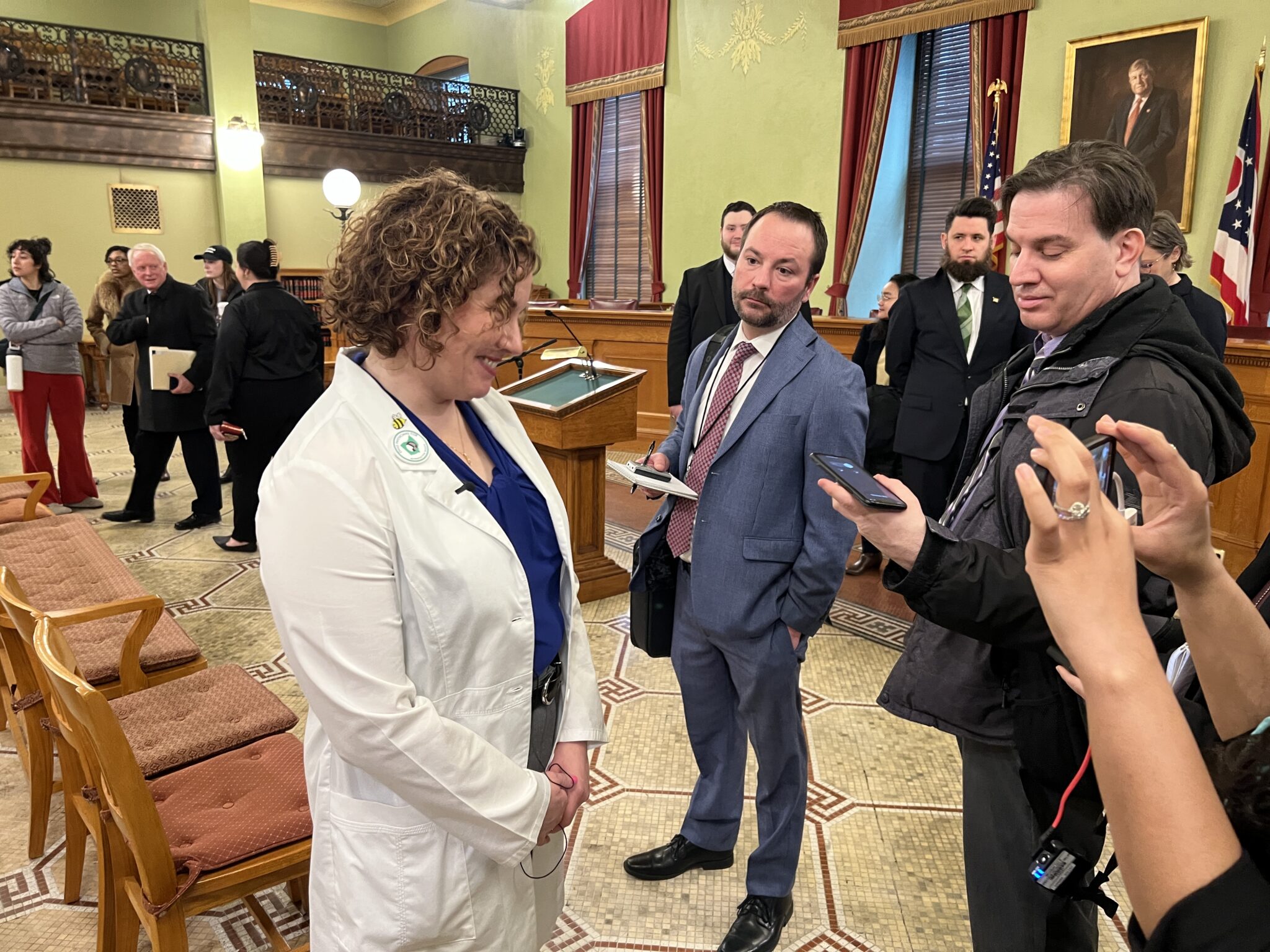
    Dr. Amy Burkett, OB/GYN and member of Ohio Physicians for Reproductive Rights, speaks to media Monday following the Ohio Ballot Board’s vote to verify the language of a proposed constitutional amendment on abortion. Photo: Susan Tebben, OCJ

    This article has been updated to include the proposed constitutional amendment (bottom)

    BY: SUSAN TEBBEN – Ohio Capital Journal

    The Ohio Ballot Board verified Monday that a proposed amendment for the November ballot to cement abortion rights in the Ohio Constitution can now move forward to the full signature-gathering stage.

    In a short Monday meeting, the board, composed of Secretary of State Frank LaRose; Republican state Sen. Theresa Gavarone, Democratic state Sen. Paula Hicks-Hudson, Democratic state Rep. Elliot Forhan, and Bill Morgan, voted unanimously that the proposed ballot initiative only involved one constitutional issue.

    The board only heard from two people outside of the board after LaRose insisted that content be kept away from the merits of the amendment or opinions about abortion itself.

    John Grove, of Cincinnati Right to Life, still took time to try to discredit the amendment itself, called it “intentionally unjust and misleading.”

    Attorney Don McTigue spoke on behalf of the groups proposing the amendment, choosing not to dive into the legal aspects of the amendment, instead saying the “common purpose of the amendment” was individuals having control of one’s own reproductive decisions.

    Gavarone acknowledged that the purpose of the Ballot Board business was “procedural,” but still input her opinion before the unanimous vote was recorded.

     COLUMBUS, OH — FEBRUARY 22: State Sen. Theresa Gavarone, R-Bowling Green, during the Ohio Senate session, February 22, 2023, at the Statehouse in Columbus, Ohio. (Photo by Graham Stokes for Ohio Capital Journal. Republish photo only with original story.)

    “I am horrified at the thought of this amendment, I mean, the right to kill babies being put into Ohio’s constitution,” Gavarone said.

    Now that the proposal has been certified by the Ohio Attorney General and verified by the Ohio Ballot Board, groups attempting to get the measure on the ballot can move forward with collecting the more than 400,000 valid signatures needed to officially get the measure to statewide voters.

    Laura Strietmann, executive director for Cincinnati Right to Life, said pro-life organizations throughout the state have joined together as well, with a full strategy to fight against the measure.

    “We are unified in protecting women in Ohio, in stopping this bill from becoming law,” Strietmann said after the vote.

    Abortion rights groups say they are prepared to go forward with field planning, volunteers and petition circulators as early as the end of this week, according to Jordyn Close, deputy director for the Ohio Women’s Alliance and board president for Abortion Fund of Ohio.

    The organizations are planning to hit the ground running to get more than enough signatures in a short amount of time. The deadline to submit signatures so the proposal can appear on the November ballot is July.

    Part of the plan to bring support to the measure includes informing voters about the true aims of the constitutional amendment on which they would be voting. Claims have already been made by opposition groups that the amendment would bar all abortions, including for baby’s who have reached full term, something supporters of the amendment say won’t happen.

    “We are not interested in doing full-term abortion,” said Dr. Amy Burkett, board-certified OB/GYN in northeast Ohio, and member of Ohio Physicians for Reproductive Rights. “This is about protecting the rights to reproductive health care including abortion, up to viability.”

    Viability, Burkett said, should be determined by the physician and patient “based on the technology that is available at the time.”

    Amendment supporters aren’t shying away from their pro-abortion stance, despite the trend toward using “pro-choice” as a way of including all options.

    “When we talk about reproductive freedom and bodily autonomy, we have to be really specific about what (opposition groups) are attacking,” Close said. “And that is abortion access.”

    ————————-

    Amendment Summary and Text:

    TITLE: The Right to Reproductive Freedom with Protections for Health and Safety

    SUMMARY
    The Amendment would amend Article I of the Ohio Constitution by adding Section 22, titled “The Right to Reproductive Freedom with Protections for Health and Safety.”

    The Amendment provides that:
    1. Every individual has a right to make and carry out one’s own reproductive decisions, including but not limited to decisions on contraception, fertility treatment, continuing one’s own pregnancy, miscarriage care, and abortion.
    2. The State shall not, directly or indirectly, burden, penalize, prohibit, interfere with, or discriminate against either an individual’s voluntary exercise of this right or a person or entity that assists an individual exercising this right, unless the State demonstrates that it is using the least restrictive means to advance the individual’s health in accordance with widely accepted and evidence-based standards of care.
    3. However, abortion may be prohibited after fetal viability. But in no case may such an abortion be prohibited if in the professional judgment of the pregnant patient’s treating physician it is necessary to protect the pregnant patient’s life or health.
    4. As used in this Section, “Fetal viability” means “the point in a pregnancy when, in the professional judgment of the pregnant patient’s treating physician, the fetus has a significant likelihood of survival outside the uterus with reasonable measures. This is determined on a case-by-case basis”; and “State” includes any governmental entity and political subdivision.
    5. This Section is self-executing.

    FULL TEXT OF PROPOSED AMENDMENT

    Be it Resolved by the People of the State of Ohio that Article I of the Ohio Constitution is amended to add the following Section: Article I, Section 22. The Right to Reproductive Freedom with Protections for Health and Safety

    A. Every individual has a right to make and carry out one’s own reproductive decisions, including but not limited to decisions on:

    1. contraception;
    2. fertility treatment;
    3. continuing one’s own pregnancy;
    4. miscarriage care; and
    5. abortion.

    B. The State shall not, directly or indirectly, burden, penalize, prohibit, interfere with, or discriminate against either:

    1. An individual’s voluntary exercise of this right or
    2. A person or entity that assists an individual exercising this right, unless the State demonstrates that it is using the least restrictive means to advance the individual’s health in accordance with widely accepted and evidence-based standards of care. However, abortion may be prohibited after fetal viability. But in no case may such an abortion be prohibited if in the professional judgment of the pregnant patient’s treating physician it is necessary to protect the pregnant patient’s life or health.

    C. As used in this Section:

    1. “Fetal viability” means “the point in a pregnancy when, in the professional judgment of the pregnant patient’s treating physician, the fetus has a significant likelihood of survival outside the uterus with reasonable measures. This is determined on a case-by-case basis.”
    2. “State” includes any governmental entity and any political subdivision.

    D. This Section is self-executing.