Tag: reproductive freedom

  • Ohio’s six-week abortion ban overturned by Hamilton County judge

    Ohio’s six-week abortion ban overturned by Hamilton County judge

    The U.S. Supreme Court ruling in Dobbs v. Jackson Women’s Health Organization in June 2022 ended federal abortion rights. (Photo by Sofia Resnick/States Newsroom.)

    By:  Ohio Capital Journal

    The Ohio Attorney General’s Office says state has 30 days to “determine next steps.” The law will remain struck down unless Attorney General Dave Yost appeals the decision

    A Hamilton County judge has permanently overturned Ohio’s six-week abortion ban that had been tied up in court since its inception in 2019, but was put into effect for several months after Roe. v. Wade was overturned.

    Hamilton County Judge Christian A. Jenkins had already temporarily stopped enforcement of the law when the case entered his courtroom in the fall of 2022 several months after the Dobbs decision overturning national abortion rights established in Roe.

    Thursday’s decision means the law is struck down unless the Ohio Attorney General decides to appeal the decision.

    In November 2023, Ohio voters passed a reproductive rights amendment with 57% support.

    “Ohio’s Attorney General evidently didn’t get the memo,” Jenkins wrote. “For even after a large majority of Ohio’s voters … presumably both women and men — approved an amendment to the Ohio Constitution protecting the right to pre-viability abortion on November 8, 2023, the Attorney General urges this court to leave ‘untouched’ all but one provision of the so-called ‘Heartbeat Act’ clearly rejected by Ohio voters.”

    Hours after the Dobbs decision came down in June 2022, Ohio Attorney General Dave Yost asked a federal court reinstate the six-week abortion ban law, which was approved by the court quickly after the request was made. The ban included no exceptions for rape or incest.

    GET THE OHIO CAPITAL JOURNAL MORNING HEADLINES.


    Just as quickly, though, the law was then shoved back into court by abortion rights advocates. At first, advocates asked the Ohio Supreme Court to rule on the case, but after a period of inaction by the state’s high court, they chose to challenge the law locally, specifically in Hamilton County.

    A separate Hamilton County judge in September eliminated restrictions on telehealth abortion treatment.

    With the approval of the reproductive rights amendment in Ohio, attorneys had a new avenue to challenge the six-week ban. They used the language — which allowed abortion to the point of fetal viability, a determination to be made by the pregnant person’s physician, rather than at a point determined by state law — as a tipping point for arguments that the six-week ban was now unconstitutional. Fetal viability typically comes in a range between 24 to 26 weeks.

    Yost pushed back, saying the reproductive rights amendment could not be used to negate any law or provision that was remotely related to abortion rights.

    However, he also acknowledged it would be quite a battle to argue that the six-week ban did not violate the new constitutional amendment.

    In a legal analysis on the reproductive rights amendment before the vote, that has often been used against him in the year since, Yost said the amendment “will make it harder for Ohio to maintain the kinds of law already upheld as valid prior to last year’s decision in Dobbs.”

    “In other words, the Amendment would give greater protection to abortion to be free from regulation than at any time in Ohio’s history,” Yost wrote.

    He went on to say that “many Ohio laws would probably be invalidated,” and that “others might be at risk to varying degrees.”

    That included the so-called Heartbeat Act, according to him.

    “Ohio would no longer have the ability to limit abortions at any time before a fetus is viable,” he wrote. “Passage of Issue 1 would invalidate the Heartbeat Act, which restricts abortions (with health and other exceptions) after a fetal heartbeat is detected, which is usually at about six weeks.”

    Even so, Yost attempted to argue in the case that certain provisions included in the law should be allowed to stand.

    Jenkins disagreed, saying the state constitution “now unequivocally protects the right to abortion” and that “to give meaning to the voice of Ohio’s voters, the Amendment must be given full effect, and laws such as those enacted by (Senate Bill) 23 must be permanently enjoined.”

    He said that if Ohio courts adopted the state’s arguments, Ohio doctors who provide abortion care would continue to be at risk of felony criminal charges, $20,000 fines, medical license suspensions and renovations, and civil claims for wrongful death.

    “Patients seeking abortion-care would still be required to make two in-person visits to their provider, wait twenty-four hours to receive abortion care, receive state-mandated information designed to discourage abortion and have the reason for their abortion recorded and reprinted,” Jenkins wrote. “Unlike the Ohio Attorney General, this Court will uphold the Ohio Constitution’s protection of abortion rights. The will of the people of Ohio will be given effect.”

    ACLU of Ohio cooperating attorney Jessie Hill, who led the legal challenge in the case, called the ruling “momentous” and a show of “the power of Ohio’s new Reproductive Freedom Amendment in practice.”

    Dr. Sharon Liner, medical director for Planned Parenthood Southwest Ohio Region and one of the parties in the case, said the ruling was “an important step in the right direction for access.”

    “The permanent blocking of the six-week ban brings us one step closer to getting our patients the access they deserve,” Liner wrote in a statement.

    A spokesperson for Yost’s office said in a Friday morning statement that the state has up to 30 days to “determine next steps.”

    “This is a very long, complicated decision covering many issues, many of which are issues of first impression,” spokesperson Hannah Hundley told the Capital Journal.

    Ohio Right to Life and the Center for Christian Virtue were contacted and have not yet provided a response.

    Asked if Gov. Mike DeWine had any comment on the ruling, a spokesperson stated, “No.”


    Susan Tebben
    Susan Tebben

    Susan Tebben is an award-winning journalist with a decade of experience covering Ohio news, including courts and crime, Appalachian social issues, government, education, diversity and culture. She has worked for The Newark Advocate, The Glasgow (KY) Daily Times, The Athens Messenger, and WOUB Public Media. She has also had work featured on National Public Radio.

    Ohio Capital Journal is part of States Newsroom, the nation’s largest state-focused nonprofit news organization.

    MORE FROM AUTHOR

  • Ohio’s 24-hour waiting period abortion law paused by judge

    Ohio’s 24-hour waiting period abortion law paused by judge

    (Getty Images)

    By:  Ohio Capital Journal

    An Ohio law requiring a 24-hour waiting period before abortion services will not be enforced as a lawsuit seeking to eliminate the law entirely sees its way through court, a judge ruled on Friday.

    Franklin County Court of Common Pleas Judge David C. Young not only put a temporary pause on the 24-hour waiting period, but also a minimum of two in-person visits and certain information about abortion that the state required doctors to provide before an abortion.

    That information includes the “probable gestational age of the zygote, blastocyte, embryo or fetus” and “nature and purpose of the particular abortion procedure to be used,” according to state law.

    Young cited the newest amendment to the state constitution as reason to rule in favor of the clinics and physicians.

    “The plain language of the amendment clearly sets forth the applicable legal standard,” Young wrote. “This language is easily understood and clear.”

    The decision comes following an oral argument hearing last week, in which Young heard from the Ohio Attorney General’s Office representing the state, and an attorney for abortion clinics and a physician party in the case.

    The state said by legal definition, the “status quo” should be maintained in a preliminary injunction, and according to the AG’s office’s arguments, that would leave state law as it is and the regulations in place. The office of Ohio Attorney General Dave Yost issues a release Friday saying they plan to appeal the ruling and that they disagree with the judge that the waiting period and extra appointments constitute a burden.

    According to Jessie Hill, attorney for the parties attempting to eliminate the laws, the status quo is now the constitutional amendment that placed reproductive rights including abortion into the Ohio Constitution after being passed by 57% of Ohio voters last November.

    The amendment bars any state laws that “burden, penalize, prohibit, interfere with or discriminate” against abortion care and abortion providers.

    The state also argued that the Dr. Catharine Romanos didn’t have standing to sue because there were no specific patients under Romanos’ care connected to the lawsuit.

    Young ruled that the new reproductive rights amendment “confers rights” to Romanos “because she is a person assisting individuals exercising their reproductive rights.”

    “The challenged statutes interfere with Dr. Romanos’s ability to provide high quality, trauma informed abortion care, they negatively impact Dr. Romanos’s relationship with pregnant patients and cause emotional distress,” the ruling wrote.

    The judge also cited Attorney General Dave Yost’s legal analysis of the amendment, written before the measure’s passage as an effort to explain the impact of the amendment on abortion regulation in the state.

    “Prior to the amendment passing, Attorney Yost agreed with Plaintiffs’ argument as to the applicable legal standard,” Young wrote. “Now, instead of following the plain language of the amendment, defendants argue that the pre-Dobbs legal standard applies.”

    But Young said the “pre-Dobbs standard” – referring to abortion standards prior to the U.S. Supreme Court’s decision to undo national abortion legalization and return the decision to the states – is “unpersuasive.”

    “Defendants attempt to create ambiguity where it does not exist,” the judge wrote. “The people of Ohio voted to enshrine their reproductive freedom in the constitution through the clear language of the amendment. Doing so followed the path set forth by the (U.S.) Supreme Court in Dobbs.

    Hill called the Franklin County decision “an historic victory for abortion patients and for all Ohio voters who voiced support for the constitutional amendment to protect reproductive freedom and bodily autonomy.”

    “This decision is the first step in removing unnecessary barriers to care,” Hill wrote in a statement with the ACLU of Ohio.


    Susan Tebben
    Susan Tebben

    Susan Tebben is an award-winning journalist with a decade of experience covering Ohio news, including courts and crime, Appalachian social issues, government, education, diversity and culture. She has worked for The Newark Advocate, The Glasgow (KY) Daily Times, The Athens Messenger, and WOUB Public Media. She has also had work featured on National Public Radio.

    Ohio Capital Journal is part of States Newsroom, the nation’s largest state-focused nonprofit news organization.

    MORE FROM AUTHOR

  • Access to expensive fertility treatment in Ohio varies but the Issue 1 amendment seeks to protect it

    Access to expensive fertility treatment in Ohio varies but the Issue 1 amendment seeks to protect it

    BY:  Ohio Capital Journal

    Editor’s Note: This article is part of a series looking at the language of Ohio Issue 1 and the reproductive rights it would impact. The full language of the amendment can be found here.

    When Roe v. Wade was overturned in June 2022, the physicians at Ohio Reproductive Medicine took to their website, hoping to reassure patients that their care would still be available.

    “It is truly hard to fathom that in 2022, our reproductive freedom, a fundamental human right, is now at risk,” the statement on the website read.

    Though the Columbus business said it strongly opposed the overturning of Roe as a whole, the focus of their statement was on those undergoing or considering fertility treatments.

    “We ardently stand alongside our current and past patients — as well as anyone who wishes to build a family in the future with the help of fertility treatments,” according to the statement.

    The effects that repealing nationwide abortion access would have on fertility treatments like in-vitro fertilization (IVF) weren’t clearly spelled out by the U.S. Supreme Court in its Dobbs decision, but physicians have worried about what various bans mean when it comes to fertilized embryos and the definition of the start of life.

    A hard-fought battle

    Infertility can happen for 10% to 15% of couples, according to the American Society for Reproductive Medicine, and CDC data found 1 in 5 women in the U.S. couldn’t get pregnant after a year of trying.

    For those who have insurance and/or can afford fertility treatments, the process is long, arduous, and often involves disappointment along the way if an implanted embryo fails to turn into a pregnancy, or becomes a medical complication.

    Ohioans have expressed worry that they won’t be able to utilize fertility treatments in the same way if abortion is banned in the state, whether that be at six-weeks under current law (though that law is held up in court and not currently being enforced), or if other regulations fall into place keeping physicians from treating life-threatening ectopic pregnancies or miscarriages, which are considered “spontaneous abortions” by the medical community.

    After the Dobbs v. Jackson Women’s Health Organization ruling from the U.S. Supreme Court overturning nationwide abortion rights, the fears regarding fertility treatments came closer to home, as state Rep. Gary Click, R-Vickery, introduced a bill that would have considered the start of “personhood” to be the moment of conception.

    That, physicians said, could include fertilized embryos sitting in cryogenic chambers at their facilities.

    The “life begins at conception” message has been used by anti-abortion groups nationwide for many years, though the medical community does not universally agree on the beginning of life, or if there’s one certain point when cardiac activity begins in a fetus.

    At a rally one year ago to support anti-abortion causes, state Rep. Jena Powell, R-Arcanum, spoke of ways to “abolish abortion” in the state, making the claim that the “science is crystal clear” that “life begins at conception.”

    Powell urged support for the “personhood” bill.

    “The shackles are no longer holding us back as state legislators, and we can and we must be a voice for the unborn child in Ohio,” Powell said at the time.

    The cost of access

    Fertility treatments and the freezing of embryos has become a common practice, but that doesn’t mean it’s available to everyone, because it’s a costly endeavor with complicated insurance regulations.

    The Center for Reproductive Rights says barriers to access include “limited information, restrictive laws and policies, stigma, high costs and more.”

    “Issues surrounding assisted reproduction implicate core human rights — including the rights to health, sexual and reproductive health, decision making about reproductive life (such as if and when to have children), benefit from scientific progress, equality and non-discrimination and informed consent,” the center said in a statement.

    The center’s research on infertility and IVF access in the United States showed that in 2020, clinical infertility impacted about 12% of women ages 15-44, but only 24% of people in the U.S. seeking care for infertility could access it.

    “The limited number of private insurance markets and public programs covering infertility services, combined with high out-of-pocket expenses, result in significant economic barriers to needed infertility treatment,” the CRR stated in the report.

    Self-pay packages at the University Hospitals Fertility Center in Northeast Ohio, for example, price IVF, including lab work and one embryo transfer at $12,775.

    An egg donor package runs $14,030 for self-pay patients, and a surrogate (also called a “gestational carrier”) is priced at more than $15,000.

    Ohio law mandates that private health insurance cover basic services, including “medically necessary” services that could fall under fertility treatment. The Ohio Revised Code includes “infertility services” under “preventative health care services.”

    Though this could include the diagnosis of infertility and treatment of reproductive system problems, other services involved in the process may not be included.

    “Many procedures fall into a gray zone, including IVF, which leaves much interpretation and denial of claims,” according to Ohio Reproductive Medicine.

    In 2021, Ohio added “reproductive health services” into the Ohio Administrative Code, allowing Medicaid-eligible individuals access to “pregnancy prevention services,” including “contraceptive management,” pregnancy testing and “fertility awareness.”

    What is not covered under Medicaid is infertility treatment, including IVF, “assisted reproductive technologies,” artificial insemination, or surgery to “promote or restore fertility.”

    Ohio is not alone in keeping Medicaid recipients out of the fertility treatment landscape, as very few states nationally extend those services through Medicaid.


    Read Part 1:


    Susan Tebben
    SUSAN TEBBEN

    Susan Tebben is an award-winning journalist with a decade of experience covering Ohio news, including courts and crime, Appalachian social issues, government, education, diversity and culture. She has worked for The Newark Advocate, The Glasgow (KY) Daily Times, The Athens Messenger, and WOUB Public Media. She has also had work featured on National Public Radio.

    MORE FROM AUTHOR

  • LaRose pushes unfair, inaccurate language for voters on November Ohio reproductive rights amendment

    LaRose pushes unfair, inaccurate language for voters on November Ohio reproductive rights amendment

    COMMENTARY

    by Marilou Johanek

    Play fair or play dirty. Issue 1 showed Ohio voters how state Republicans play when they can’t persuade. Extremists know most Ohioans support the right to abortion within limits. The outright ban on abortion gerrymandered pols seek is wildly unpopular. Convincing rational minds otherwise is pointless. So Ohio’s GOP overlords cheat to win.

    Lawmakers rushed a game-changing ballot amendment to an August election (in violation of state law) to sabotage the abortion rights amendment in November. Ohio Secretary of State Frank LaRose spearheaded the shady maneuver to cancel self-governance by majority vote — just to keep a majority of Ohio voters from having their say on abortion access as a constitutional right.

    The state’s elections chief actively campaigned to end the only enduring recourse of ordinary citizens to circumvent a crooked government because he didn’t want an abortion rights amendment to pass. Sit with that for a minute. The guy who administers the electoral system in Ohio tried to undercut the electorate.

    That’s how amoral LaRose has become as he angles for attention as the greatest MAGA candidate in the U.S. Senate race. Burnishing his anti-abortion bona fides with the pro-Issue 1 crowd, in partnership with a leading anti-abortion lobbyist, was more important than upholding majoritarian democracy. Stumping for minority rule on the hollow pretense of “protecting” the constitution was a new low for LaRose.

    But the integrity-is-overrated elections boss and Republican kingpins in the Statehouse badly mistook the masses for rubes. All the misleading, fear-mongering, coming-after-your-children TV ads (out-of-state money could buy) didn’t fool an overriding majority of ticked-off Ohio voters who showed up in record numbers to beat back an egregious political power grab on Aug. 8.

    The beaten cheerleader for Issue 1 refused to concede the people had spoken (a Trumpian reflex?) and last week rolled out another snow job to derail the abortion rights amendment through ballot language subterfuge. LaRose chairs the Republican-dominated Ohio Ballot Board that voted along party lines Thursday to approve the summary language voters will read on their November ballot about the proposed abortion amendment.

    Under state law, LaRose could have used the full text of the amendment as written, and attorneys for Ohioans United for Reproductive Rights urged him to so “there can be no dispute about whether legal standards have been satisfied, or whether the condensed text misleads, deceives, or defrauds voters.” Instead, LaRose recast the amendment to purposely mislead and deceive.

    His draft is slanted with such routinely deployed anti-abortion propaganda it could have been dictated, word for word, by Ohio Right to Life President Mike Gonidakis. LaRose’s specious interpretation of the proposed amendment to enshrine reproductive freedom in the state constitution is deliberately deceptive with provocative wording to unfairly prejudice outcome.

    The revisions he engineered on an amendment he campaigned against are so beyond the pale of “fair and accurate,” as the secretary ludicrously declared, that stunned amendment backers filed suit Monday with the state supreme court for fairness and accuracy. LaRose omitted actual provisions of the original amendment.

    He deleted a description of reproductive choices an individual should have the “right to make and carry out” such as “decisions on contraception, fertility treatment, continuing one’s own pregnancy, miscarriage care, and abortion.” LaRose’s altered the language stipulating an individual right to “one’s own reproductive decisions” to just “a right to one’s own reproductive medical treatment, including but not limited to abortion.”

    Perhaps most blatant was the secretary of state’s pointed replacement of the medical term “fetus” throughout the amendment with “unborn child,” employing the same weighted rhetoric seeded over decades by the anti-abortion movement. He also curiously substituted “the citizens of the State of Ohio” for amendment prohibitions specifically targeting “The State,” defined in the language “as any governmental entity and political subdivision.”

    So what was originally worded “The State shall not, directly or indirectly, burden, penalize, prohibit, interfere with, or otherwise discriminate against” Ohioans exercising their reproductive rights became “the citizens of the State of Ohio” prohibited for doing the same. Different meaning. Why?

    Original language allows that “abortion may be prohibited after fetal viability” or when the fetus can survive outside the womb — a standard restriction for decades under Roe. With a six-week ban on hold by the courts, abortion is currently legal in Ohio up to 22 weeks of pregnancy, a measured limitation widely acceptable.

    LaRose flipped that reasonable allowance upside-down with inflammatory assertions that the amendment would “always allow an unborn child to be aborted at any stage of pregnancy, regardless of viability, if, in the treating physician’s determination” the applicable life and health exceptions are met. The glaring prejudicial language and selective editing of the fall abortion amendment to intentionally distort an initiative petition so it fails should infuriate every Ohioan — regardless of their beliefs about abortion.

    Frank LaRose, the public servant responsible for conducting free and fair elections in Ohio is playing dirty to win. It’s wrong. But it’s only the beginning. Issue 1 was a preview of the depths Ohio Republicans will go to when they can’t persuade. They cheat.

    The devious battle to deny abortion access in Ohio, despite the wishes of a majority of voters, will be epic.


    Marilou Johanek
    MARILOU JOHANEK

    Marilou Johanek is a veteran Ohio print and broadcast journalist who has covered state and national politics as a longtime newspaper editorial writer and columnist.

    MORE FROM AUTHOR

  • Abortion amendment ballot language submitted, Ballot Board set to meet Thursday

    Abortion amendment ballot language submitted, Ballot Board set to meet Thursday

    Abortion rights groups request full text on November ballots

    BY:  Ohio Capital Journal

    Gearing up for an Ohio Ballot Board meeting where constitutional amendment language regarding reproductive health will be considered, groups pushing for the measure want to see the entire text of the amendment on November ballots.

    In a letter received by the Ohio Secretary of State on Monday, attorney Donald McTigue represented petitioners for the constitutional amendment in asking the board to use full text of the proposed amendment or a condensed version, so that voters can read the entire thing on their ballots in the general election this year.

    “By using the full text, voters will see for themselves the language they are being asked to approve and can make a free and independent decision on this fundamental question,” McTigue wrote.

    The abortion rights groups also argued that, in using the full text, “there can be no dispute about whether legal standards have been satisfied or whether the condensed text misleads, deceives or defrauds voters,” according to the letter.

    The ballot measure’s title, as submitted by the groups for approval by the ballot board, is “To Establish the Right to Reproductive Freedom with Protections for Health and Safety.”

    Because of the rejection of Issue 1 earlier this month at the polls, which would have raised the threshold to approve a constitutional amendment, a simple majority is needed to pass the measure.

    In the language of the amendment, it specifies that “every individual has a right to make and carry out one’s own reproductive decisions, including but not limited to” contraception, fertility treatments, pregnancy, miscarriage care and abortion.

    It prohibits the state from doing anything to “directly or indirectly burden, penalize, prohibit, interfere with or discriminate against” the exercise of the rights in the amendment, or those who assist in the exercise of the rights.

    The amendment makes exceptions in terms of abortion, in which it would be “prohibited after fetal viability.”

    “But in no case may such an abortion be prohibited if in the professional judgment of the pregnant patient’s treating physician it is necessary to protect the pregnant patient’s life or health,” the amendment states.

    “Any attempt to alter wording away from the text of the amendment should be seen for what it is: an attempt to confuse and mislead voters,” said Lauren Blauvelt, of Ohioans United for Reproductive Rights, in a statement announcing the submission of the ballot language.

    Opposition groups have claimed the amendment would impact parental rights and allow “late-term abortion,” neither of which are included in the language submitted to the ballot board. “Late-term abortion” is not considered a legitimate medical term.

    Two different lawsuits attempting to keep the amendment from going before voters have been rejected by the Ohio Supreme Court.

    Most recently, a former state legislator and a Catholic Ohio resident asked that the measure be blocked because it was unclear what laws it sought to change. A separate previous lawsuit argued the Ohio Ballot Board abused its power by improperly considering, and thus moving the ballot measure forward so that signatures could be collected in support of it.

    That signature collection amounted to nearly 500,000 valid Ohio voter signatures, which allowed the measure to head to the ballot.

    Another abortion-related lawsuit is still in the process of making it through the state’s highest court. That lawsuit was filed by Ohio Attorney General Dave Yost, challenging a Hamilton County court’s right to pause a six-week abortion ban implemented almost immediately after the Dobbs decision overturned Roe v. Wade.

    That law was passed in 2019, but has since been entangled in court cases. It bans abortion after six weeks gestation and was in place for several months following the Dobbs decision before being halted by the courts.

    The Ohio Ballot Board is scheduled to consider and vote on the language on Thursday, where they will also consider language regarding a proposed statute for recreational marijuana.


    Susan Tebben
    SUSAN TEBBEN

    Susan Tebben is an award-winning journalist with a decade of experience covering Ohio news, including courts and crime, Appalachian social issues, government, education, diversity and culture. She has worked for The Newark Advocate, The Glasgow (KY) Daily Times, The Athens Messenger, and WOUB Public Media. She has also had work featured on National Public Radio.

    MORE FROM AUTHOR

    ___________________
    [pdf-embedder url=”https://lovelandmagazine.com/wp-content/uploads/2023/08/The-Right-to-Reproductive-Freedom-with-Protections-for-Health-and-Safety.pdf”]
  • Ohio citizen-led abortion rights amendment takes next step after petition language certified

    Ohio citizen-led abortion rights amendment takes next step after petition language certified

    Getty Image

    BY: OHIO CAPITAL JOURNAL STAFF 

    The Ohio Attorney General’s Office has certified petition summary language for a proposed amendment to protect abortion rights in the state constitution, which organizers hope to place on the November ballot.

    The Ohio Ballot Board will now determine whether or not the initiative only involves changing only one amendment, as required. If approved by the Ballot Board, it gets sent back to the Attorney General, who turns it in to the Ohio Secretary of State’s Office, at which point full signature-gathering can begin.

    Advocates must collect signatures from 44 out of 88 counties equal to at least 5% of the total vote cast for the office of governor in that county at the last gubernatorial election. Overall, the petition must gather at least 10% of the total vote cast statewide for the office of governor at the last gubernatorial election. This math means that the group needs at least 442,958 valid signatures.

    The drive to protect access to abortion care in Ohio is being spearheaded by Ohioans for Reproductive Freedom and Ohio Physicians for Reproductive Rights.

    Right now, Ohio’s six-week abortion ban is unenforceable due to a Hamilton County judge blocking it indefinitely as the lawsuit against it continues. The bill does not have an exception for rape or incest.

    However, once it gets out of court, it will likely head to the Ohio Supreme Court. An OCJ/WEWS investigation revealed how those justices already told Right to Life groups that abortion isn’t a Constitutional right.

    If the proposed amendment gets to the ballot and is approved by voters, this amendment wouldn’t change existing laws automatically, but it would be the law that applies in all of the pending litigation.

    If passed by voters, Article 1 of the Ohio Constitution would be amended to allow “the right to reproductive freedom,” in a change similar to one approved by Michigan voters last year.

    The groups supporting the ballot initiative are racing to bring the issue before voters before any changes can be made to the threshold needed to place a measure on the ballot. A GOP effort to raise the bar from 50% plus one to 60% plus one has been ongoing, though it’s unclear how long that might take.

    Michigan’s amendment passed with 56.6% of the vote.

    Percentage abortion was protected in other states last year:

    • Kentucky — 52.3%
    • Montana — 52.5%
    • Michigan — 56.6%
    • Kansas — 59%
    • California — 66%
    • Vermont — 76.7%

    Reporting from OCJ’s Susan Tebben and WEWS’ Morgan Trau contributed to this article.

  • Ohio coalition moves forward with plans for abortion ballot measure

    Ohio coalition moves forward with plans for abortion ballot measure

    BY: SUSAN TEBBEN – Ohio Capital Journal

    A coalition of reproductive rights groups, along with the ACLU of Ohio say they plan to have a pro-abortion ballot initiative on the Ohio Attorney General’s desk by February.

    Ohioans for Reproductive Freedom announced the plan to do this with the help of a recently hired “general consultant” with experience boosting ballot initiatives on the topic in two other states.

    The coalition – made up of Planned Parenthood Advocates of Ohio, Abortion Fund of Ohio, New Voices for Reproductive Justice, the Ohio Women’s Alliance, Preterm-Cleveland, Pro-Choice Ohio and Unite for Reproductive & Gender Equity (URGE), along with the ACLU of Ohio – said the amendment would “explicitly protect reproductive freedom for all Ohioans.”

    “We are working expeditiously and prudently because we know that skipping steps or rushing the process would be a reckless approach when stakes are so high,” said Erin Scott, co-founder and director of the Ohio Women’s Alliance, in a joint statement of ORP members.

    Mission Control, Inc., was hired by the group to help with the effort, after previously working on ballot initiative campaigns in Kansas and Kentucky, both of which showed voters in support of abortion rights. The company has offices in Washington, D.C., Connecticut, Colorado and California.

    ORP said it has “completed initial language drafting and is now moving into comprehensive qualitative and quantitative research and message testing.”

    Anti-abortion groups were quick to criticize the effort, saying support for the measure wouldn’t come in Ohio.

    “Any attempt to change Ohio’s constitution by these large out-of-state abortion groups will ultimately fail here in Ohio,” said Peter Range, Ohio Right to Life CEO, in a statement.

    The religious lobby group Center for Christian Virtue acknowledged Mission Control’s success in other states, but also said the Ohio effort is “doomed to fail.”

    CCV president Aaron Baer used his statement against the measure to support a joint resolution that would make it harder for the state constitution to be amended by raising the voting threshold to 60%. The measure was HJR 6 in the last General Assembly, and is now being led by state Rep. Brian Stewart, R-Ashville, and state Rep. Derrick Merrin, R-Monclova.

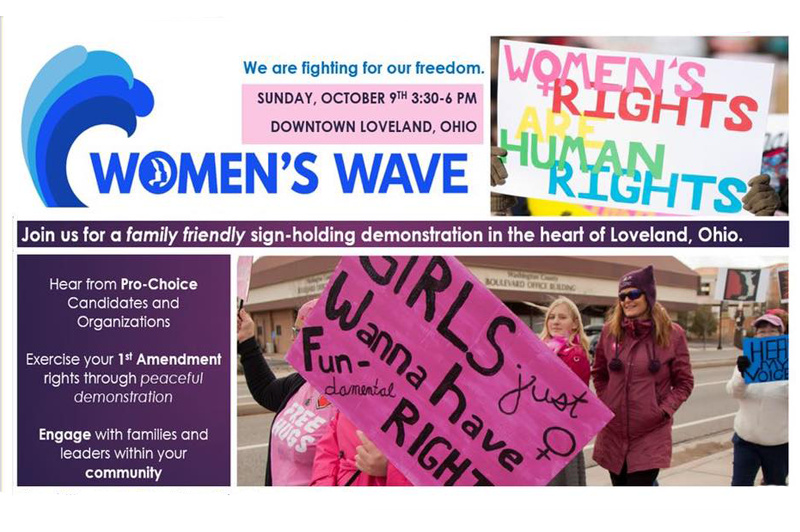
  • Women’s Wave March – coming to Loveland, Ohio

    Women’s Wave March – coming to Loveland, Ohio

    The event is in partnership with the Women’s marches being held across the country the weekend of October 8-9th. 

    by David Miller

    Loveland, Ohio – Bailey Moak asks you to join her on Sunday, October 9th for a day of action to help her and others send the message: “Women demand our rights and families demand reproductive freedom.”

    Moak said, “Women all around the country are uniting for a fall of reckoning. We will not sit back and accept the attacks on our families, future, and our freedom.” 

    This event is being held in Loveland because Jean Schmidt is the State Representative for the 65th Ohio house district, which includes northwestern Clermont County, specifically parts of Loveland. Schmidt is currently running for a seat in the 62nd District under the new Ohio maps. Moak says that Schmidt is the primary sponsor of HB 598, Ohio’s total abortion ban with no exceptions. “Women in the surrounding communities and across the state are more fired up than ever to elect more women and pro-choice candidates around the country. We’re ready for the Women’s Wave,” said Moak.

    Women’s Wave March – Loveland, Ohio

    October 9th

    3:30-6:00 PM

    Nisbet Park

    If you attend this “family friendly demonstration” in support of women’s rights and reproductive freedom you will hear from an array of Pro-Choice speakers. Moak encourages you to create signs before demonstrating along the sidewalks of downtown Loveland.

    Confirmed speakers include Brian Flick an Ohio State House candidate, and representatives from Ohio Physicians for Reproductive Rights, Ohio Red Wine & Blue, and Ohio ACLU, with several more commitments in progress. 

    “The organizers have been in communication with the City of Loveland Parks Department and Police Department to ensure a safe and successful event this community can be proud of,” said Moak.

    Further inquiries can be made to event organizer Bailey Moak at 513-532-7860 or Baileymoak@gmail.com.