Tag: reproductive rights

  • Ohio’s pro-abortion rights groups plan fights against total abortion ban bill

    Ohio’s pro-abortion rights groups plan fights against total abortion ban bill

    By:  Ohio Capital Journal

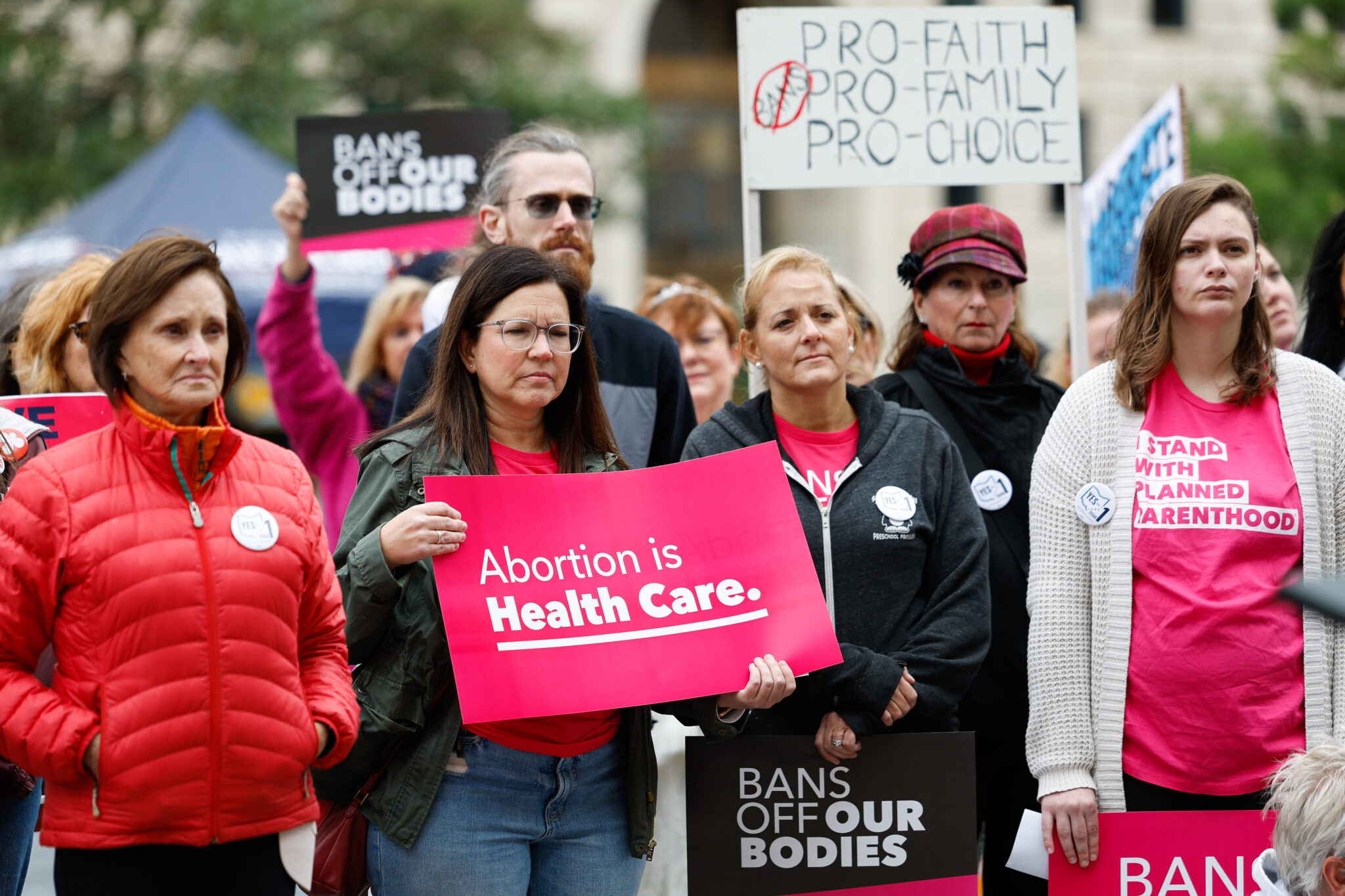
    Pro-abortion rights advocates are taking a proposed total abortion ban in Ohio to heart. Noting the celebration of Juneteenth and Black emancipation, they say the use of the 14th Amendment to try to exert state control over individual freedom and bodily autonomy is vile.

    The new bill a pair of freshman Republican House lawmakers are planning to introduce would ban abortion and criminalize it, along with in-vitro fertilization and certain types of contraception. The measure’s filing was first reported by WEWS.

    The bill is meant as a direct challenge to the state reproductive rights amendment passed by 57% of Ohio voters in 2023.

    Bill supporters say the current constitutional amendment that enshrined reproductive rights into the Ohio Constitution “should be treated as null and void” because, they claim, it violates the equal protection clause of the 14th Amendment “by denying pre-born persons the right to life.”

    The 14th Amendment of the U.S. Constitution protects citizenship and due process, along with equal protection under the law.

    “In appealing to the 14th Amendment, the Ohio Prenatal Equal Protection Act appeals to a higher law; the U.S. Constitution,” the anti-abortion group End Abortion Ohio, who is leading the charge on the bill, said in a statement.

    Austin Biegel, a member of End Abortion Ohio, argued that yes, the bill would go against the majority public opinion of Ohioans, but he justified it by arguing that slavery was once also supported and legal in the U.S.

    Lexi Dotson-Dufault, executive director of the resource and referral service Abortion Fund Ohio, called the use of the 14th Amendment as part of an abortion ban bill “vile.”

    “A bill that bans abortion while citing the 14th Amendment misuses a civil rights protection to justify state control over our marginalized community members, especially Black people,” Dotson-Dufault said.

    A report from the National Partnership for Women & Families in May of last year found that state abortion bans “exacerbate the existing Black maternal mortality crisis,” and “threaten” 7 million Black women nationwide.

    The study found that mothers who can’t access abortion care see negative impacts to their “economic security and development of their existing children.”

    ‘Canary in the coal mine’

    Dotson-Dufault and Ohio Women’s Alliance Deputy Director Jordyn Close believe Republican legislators are emboldened to attempt anti-abortion measures in part because of a Missouri Supreme Court ruling that reinstated a “de facto abortion ban” in May, lifting an injunction that had blocked abortion restrictions.

     Lexi Dotson-Dufault, executive director of Abortion Fund Ohio. Photo courtesy of Lexi Doston-Dufault. 

    The decision came months after that state also approved an amendment to its constitution that protected reproductive rights.

    The pro-abortion rights advocates see no legal standing for the new abortion ban bill, but they also see abortion rights as “the canary in the coal mine when it comes to … rights being stripped away from people.”

    “I don’t think that this bill has any legs to stand on, but I do think that it’s very important to highlight just how gross it is that they would even try it,” Close said. “Because if it’s not this bill, it will be another one introduced in the next session … it just continues because they do not respect Ohioans.”

    Ohio’s constitutional amendment, passed in 2023, protects abortion and other types of reproductive health like fertility treatments and miscarriage care, but more than 30 other regulations still sit on the books in Ohio law.

    Those statutes would have to be undone one by one, even though state courts have blocked some of the laws, as well as a six-week abortion ban that was on the books before Roe v. Wade was overturned by the U.S. Supreme Court.

    But Republicans in the state legislature are also trying to double-down on such regulations.

    State Reps. Mike Odioso and Josh Williams have already filed House Bill 347, a bill which targets informed consent, requiring that 24 hours before an abortion doctors provide not only “medically accurate information that a reasonable patient would consider material to the decision of whether to undergo the elective abortion” — which abortion providers have said they are already required to do — but also “alternatives to abortion, including adoption and parenting.”

    H.B. 347 also puts into law medically controversial and unproven language that “it may be possible to reverse the effects of the abortion-inducing drug” if a medication abortion is taking place.

    This isn’t the first time Ohio lawmakers have attempted to include this language in state law.

    The bill also requires a physician to notify the pregnant person, except in the case of rape or incest, “that the unborn child’s father has a child support obligation, even if the father has offered to pay for the elective abortion.”

    According to a recent midyear analysis from the Guttmacher Institute, 13 states have total abortion bans on the books, with another 28 that have bans between six weeks of gestation and “viability.”

    Ohio’s constitutional amendment places abortion legality at viability, as determined by an individual’s physician.

    The institute’s report also said the first half of 2025 has given rise to anti-abortion state lawmakers who “have continued to push the envelope toward pregnancy criminalization, restrictions on bodily autonomy and laws that recognize fetal and embryonic personhood,” while also reducing funding for resources like sex education.

     Jordyn Close, deputy director of Ohio Women’s Alliance. (Photo by Graham Stokes for Ohio Capital Journal. Republish photo only with original article.) 

    The state-level action comes as the Trump administration spent its first few months in office revoking Biden-era executive orders on abortion, including patient privacy protections, and rolling back guidance on access to emergency abortion care under the federal Emergency Medical Treatment and Labor Act.

    President Donald Trump also pardoned nearly two dozen people convicted under a federal law that bans threats, physical obstruction or force at the entrances to reproductive health clinics.

    The language of that federal law for which Trump issued pardons also bars interference, injury or intimidation for any exercise of First Amendment religious freedom, including at places of worship.

    Efforts to slash federal funding have also touched reproductive health, with cuts to Title X, which funds “family planning” grants and other reproductive health services for low-income individuals, including many services in Ohio.

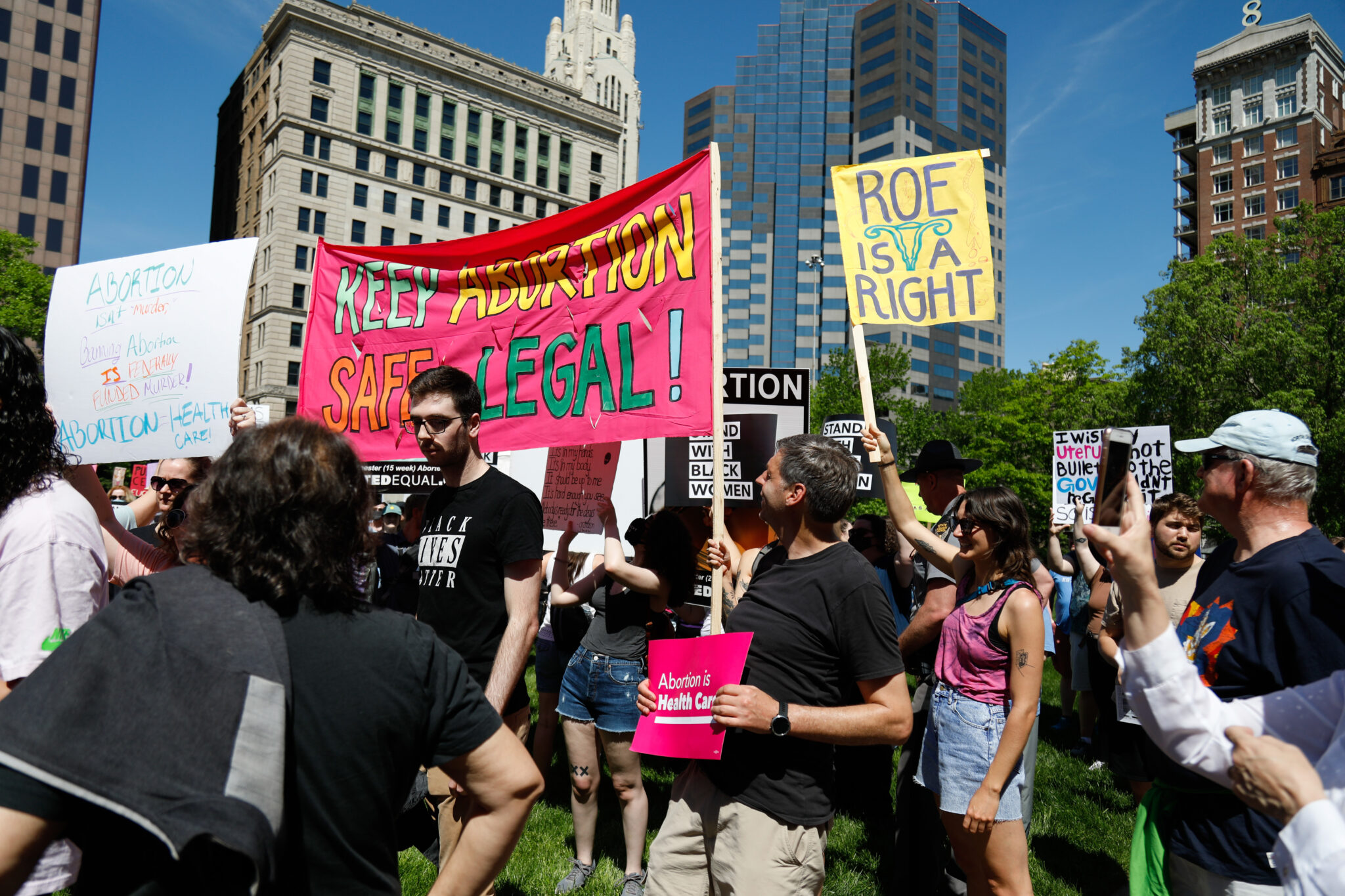
    Pro-abortion rights groups have already started their fight against the total abortion ban bill with a demonstration on Wednesday that interrupted an anti-abortion gathering in the Statehouse.

    They want to spend more time not only raising their voices in the halls of the legislature, but also educating the voters going into 2026 elections.

    “Even though we had a moment of victory in 2023, the fight is far from over,” Close said. “We have to look toward the next electoral (cycle) to protect our courts, because inevitably when we have these showdowns in the state legislature, the courts is where everything ends up.”

    A spokesperson for Oho House Speaker Matt Huffman said Huffman’s focus remains on the state operating budget until its July 1 deadline, and had no other information on the bill’s introduction or timeline.

    A request for comment from Senate President Rob McColley on whether he would consider such a bill went unanswered on Wednesday.

    Back in November 2024, just before he began his tenure as Senate president, McColley told the Capital Journal “the inaction on the issue kind of speaks for itself,” referring to any effort to undermine the constitutional amendment. He also said since the issue had passed the year before, “there really hasn’t been a lot of discussion about it.”

    “I think, by and large, people realize Ohioans spoke, and that’s the way it is right now,” McColley said then.

    The Ohio Democratic Party said they were staunchly against the abortion ban measure, questioning the priorities of state Republicans, and saying the party with the Statehouse supermajority is attempting to “drag our state into the past.”

    “Ohio women would die under this cruel, disastrous legislation,” said Ohio Democratic Party Chair Kathleen Clyde.


    Susan Tebben
    Susan Tebben

    Susan Tebben is an award-winning journalist with a decade of experience covering Ohio news, including courts and crime, Appalachian social issues, government, education, diversity and culture. She has worked for The Newark Advocate, The Glasgow (KY) Daily Times, The Athens Messenger, and WOUB Public Media. She has also had work featured on National Public Radio.

    Ohio Capital Journal is part of States Newsroom, the nation’s largest state-focused nonprofit news organization.

    MORE FROM AUTHOR

  • Ohio’s STORK Act: Tax relief for parents or a push against abortion rights?

    Ohio’s STORK Act: Tax relief for parents or a push against abortion rights?

    (Adobe Stock Photo)

    If the STORK Act is passed, Ohio would join states such as Georgia, which already allow tax deductions for unborn children, a policy enacted in 2022. By Vanessa Davidson / Broadcast version by Farah Siddiqi reporting for the Kent State NewsLab-Ohio News Connection Collaboration.


    __________

    Listen to this story:


    Ohio Rep. Gary Click (R-Vickery) in August proposed the STORK Act, which would allow expecting families to claim their unborn children as dependents on their income taxes starting the year the child is conceived.

    Click says every dollar makes a difference for expecting families.

    “You start planning and preparing ahead of time,” he said. “The hospital won’t even let you take them home without a car seat. So, you have to get that car seat, you get a crib, you get a bassinet, you get a pack-and-play, and you get all the little toys for a newborn, and you just stock up before they’re born to get ready for that child.”

    However, some raise concern that the proposal could lead toward the recognition of fetal personhood, which could affect abortion rights within Ohio.

    Danielle Firsich, director of public policy for Planned Parenthood Advocates of Ohio, said Click’s proposal acts as a continued attempt to attack abortion rights following the passage of Issue 1 in 2023.

    Firsich said there have been several other proposals that have tested fences and sought out loopholes to get around state codifications of reproductive rights, including similar bills proposed in Wisconsin, Florida, Kansas and Kentucky.

    “We know that this argument – that someone can have tax credits for an unborn child – directly correlates with the concept that if you’re receiving some sort of tax benefit, or tax credit, you are thereby able to be recognized as a person and be granted rights as such,” Firsich said. “This is a movement that has come, largely, especially after the Dobbs decision.”

    Given Click’s extensive history of pro-life advocacy – with one of his past proposals declaring fetal personhood from conception – Firsich believes the STORK Act could have possible ulterior motives.

    Click denied such claims and called such rhetoric an “extremist attack.”

    “This bill recognizes the expenses that parents put out,” said Click. “It doesn’t say anything about the baby… this tax credit has no power to overturn a constitutional amendment.”

    Jessie Hill, a law professor at Case Western Reserve University who specializes in reproductive rights in Ohio, believes the proposal will have little impact on abortion rights.

    “I just don’t think that this is something that is going to really, in the end, make a big difference in light of Issue 1 still being there,” Hill said. Issue 1 is “part of our constitution, and our constitution is supreme over state law,” she added.

    However, Hill believes concerns about the proposal aren’t baseless. She pointed out that it’s not clear whether parents would still be able to receive tax benefits for an unborn child even if the pregnancy isn’t carried to term.

    Firsich argues that Click should demonstrate his commitment to Ohio families by expanding paid family leave and offering affordable childcare.

    “That would mean real change for pregnant people and for parents in the state of Ohio, not something like this,” Firsich said.

    The STORK Act is currently being reviewed by the Ohio House Ways and Means Committee.

    This collaboration is produced in association with Media in the Public Interest and funded in part by the George Gund Foundation.

  • Ohio Dems try to repeal laws conflicting with reproductive rights amendment during lame duck

    Ohio Dems try to repeal laws conflicting with reproductive rights amendment during lame duck

    By:  Ohio Capital Journal

    Ohio Democratic lawmakers are asking the state legislature to undo laws on the books that they say conflict with the reproductive rights amendment passed by voters in 2023 that’s now part of the Ohio Constitution.

    Several of those laws have been struck down by judges, either temporarily as a lawsuit continues or in official court rulings, but the laws remain part of the Ohio Revised Code.

    Sponsors of the bills say the constitutional amendment passed last year negates these laws, therefore necessitating the repeal of regulations that require 24-hour waiting periods for abortions and transfer agreements of certain distances for physicians and hospitals who work with abortion clinics, for example.

    “We, the legislature, should not be making choices for all women in the state,” said state Rep. Beth Liston, D-Dublin. “The people of Ohio have said they want these decisions for themselves.”

    Republicans hold a 67-32 majority in the Ohio House and a 25-7 majority in the Ohio Senate, and state Republican leaders opposed the amendment.

     State Rep. Beth Liston, D-Dublin, speaks at a rally to protect abortion rights. (Photo from General Assembly website.) 

    Liston and fellow state Rep. Anita Somani, D-Dublin, both of whom are physicians, brought House Bill 343 to the House Public Health Policy Committee in hopes of “simply ensuring that all of our state laws are now in agreement with that amendment.”

    “Removing these barriers to care will reduce delays in care and actually allow health care providers to serve their patients properly,” Somani told the committee on Wednesday. “We have a health care access problem in Ohio and restrictive laws like these are part of the problem.”

    H.B. 343 wasn’t the only bill Somani presented to the Public Health Policy Committee in an effort to protect reproductive rights.

    House Bill 502, which also saw its first hearing in the committee on Wednesday, would protect access to “assistive reproductive technology,” which includes in-vitro fertilization. Fertility treatments were also listed as one of the rights covered by the constitutional amendment approved by 57% of Ohio voters last year.

    But an Alabama Supreme Court case from this year has caused nationwide concerns about the future of IVF and embryos saved by individuals going through fertility treatments. State supreme court justices in that case ruled that frozen embryos could still be considered children, an issue that has come to be known as “personhood” as federal and state-level entities debate fetal viability and regulation as a whole.

    The “personhood” issue is not foreign to Ohio, which saw a 2022 bill in which state Rep. Gary Click, R-Vickery, said “the unborn” is a “class of people” who have “erroneously been denied their constitutional rights.”

    Click said his legislation would consider a “zygote, embryo or whichever depersonalizing term you choose” a “human with potential” from the moment of fertilization.

    That bill died in the previous General Assembly, though Click has not ruled out bringing the idea back in a future GA.

    Back in March, after the Alabama decision came about, Senate President Matt Huffman, who will soon become Ohio’s House Speaker, said there hadn’t been “any discussion by any member of my caucus or anybody else as far as in the state of Ohio as far as I know” regarding “personhood” or IVF regulations.

    GET THE MORNING HEADLINES.


    But Somani said protection of the technology around IVF “should be explicitly stated in state law so that there is no confusion about the legality of the practice.”

    “We don’t want to make the same mistakes as other states,” she told the committee on Wednesday. “Equating embryos with people confuses those who practice evidence-based medicine and the reproductive care that they can provide.”

    The sponsors cited CDC statistics which showed 2,226 births in Ohio in which IVF was used in 2021. In that same year, more than 86,000 births nationally were attributed to IVF, with 42% of adults saying they have used fertility treatments or know someone who has, according to the CDC.

    “Experiencing infertility can be a mentally, emotionally and physically exhausting journey and we as lawmakers should not be doing anything to increase that stress,” Somani said.

    H.B. 502 would also prevent health care providers from “being compelled to release patient records to third parties, including out-of-state entities or law enforcement,’ and allow lawsuits from individuals who feel their privacy rights are violate with regard to medical information.

    The bill’s co-sponsor, state Rep. Beryl Brown Piccolantonio, D-Gahanna, acknowledged the tight timeline the bill is now under with less than a month before the current General Assembly ends, and all unapproved bills must be reintroduced in the new year. But, she said she hoped the committee would allow supporters of the bill to speak on IVF’s importance, especially with the possible impact of the Alabama Supreme Court ruling.

    “This decision has significant implications for reproductive rights and the legal status of embryos, influencing legislation and public policy across multiple states, including Ohio,” Piccolantonio said.

    YOU MAKE OUR WORK POSSIBLE.

    ____________
    Susan Tebben
    Susan Tebben

    Susan Tebben is an award-winning journalist with a decade of experience covering Ohio news, including courts and crime, Appalachian social issues, government, education, diversity and culture. She has worked for The Newark Advocate, The Glasgow (KY) Daily Times, The Athens Messenger, and WOUB Public Media. She has also had work featured on National Public Radio.

    Ohio Capital Journal is part of States Newsroom, the nation’s largest state-focused nonprofit news organization.

    MORE FROM AUTHOR

  • Three Ohio Supreme Court races on the November ballot will have a huge impact in the coming years

    Three Ohio Supreme Court races on the November ballot will have a huge impact in the coming years

    The Gavel outside the Supreme Court of the State of Ohio, September 20, 2023, at 65 S. Front Street, Columbus, Ohio. (Photo by Graham Stokes for Ohio Capital Journal. Republish photo only with original article.)

    Ohio’s highest court currently has a 4-3 Republican majority

    By:  Ohio Capital Journal

    Three Ohio Supreme Court seats will be up for grabs during the November election. The outcomes will decide the balance of the court and have major impacts on a wide variety of issues that affect the lives of Ohioans, from education and environmental issues to gerrymandering and elections to civil and reproductive rights.

    Partisan labels were added to the previously-nonpartisan races by the state legislature in 2021.

    This year, incumbent Democratic Justice Michael P. Donnelly is being challenged by Republican Hamilton County Court of Common Pleas Judge Megan Shanahan.

    Incumbent Democrat Justice Melody Stewart is being challenged by incumbent Republican Justice Joseph Deters, who opted not to run for his current seat and decided to go up against Stewart.

    Vying for Deters’ open seat is Democratic candidate Lisa Forbes, of the Eighth District Court of Appeals, and Republican candidate Dan Hawkins, of the Franklin County Court of Common Pleas.

    Deters decided to run for a full-term seat by challenging Stewart, rather than a partial term for the seat Ohio Gov. Mike DeWine appointed him to on Jan. 7, 2023. Because of this, whichever candidate wins Deters’ current seat will have to run again in 2026 for a full six-year term.

    Ohio’s highest court currently has a 4-3 Republican majority. If all three Republicans are elected, the Republicans would hold all but one seat on the bench, for a 6-1 majority. On the flip side, if all three Democrats win their elections, the Democrats would hold a 4-3 majority. The Ohio Supreme Court has been under Republican control since 1986.

    Democratic Justice Jennifer Brunner’s seat will be up in 2026. Republican Chief Justice Sharon Kennedy, Republican Justice Pat DeWine and Republican Justice Pat Fischer’s seats will be up in 2028.

    The Ohio Supreme Court could make decisions on a plethora of critical issues: reproductive rights, gerrymandering, school vouchers, home rule, and environmental issues, among others.

    “If there’s a law around it, it could end up in the Supreme Court and have a real, tangible impact on each of our lives,” said Elisabeth Warner, spokesperson for the League of Women Voters of Ohio.

    Even though 57% of Ohio voters approved an amendment last year to enshrine reproductive rights in the state’s constitution, the court will inevitably rule on abortion access.

    “There are still a lot of anti-abortion laws on the books, so that’s something that the Supreme Court is going to be ruling on,” Warner said.

    Ohio’s anti-abortion laws were not automatically nullified when last year’s amendment passed, so abortion advocates are working to undo those laws.

    Franklin County Court of Common Pleas recently issued a temporary pause on Ohio’s 24-hour waiting period and the minimum two in-person visits required before an abortion.

    Another lawsuit is currently pending in Hamilton County Court of Common Pleas over whether Ohio’s six-week abortion ban is unconstitutional after voters passed last year’s amendment.

    Those lawsuits will likely make their way to the Ohio Supreme Court — meaning the seven justices will end up deciding to what extent reproductive rights are protected.

    “At the end of the day, the Ohio Supreme Court will determine whatever’s in the Ohio Constitution that voters put into the Ohio Constitution,” said Catherine Turcer, Common Cause Ohio’s executive director. “It is interpreted by the Ohio Supreme Court.”

    The Ohio Supreme Court has made many rulings on redistricting before and it will likely come before the court again — especially with the amendment on this year’s ballot to create a citizen commission to redraw districts.

    A lawsuit against school vouchers is making its way through the court system and will likely go before the state’s high court.

    Even boneless chicken wings wound up in front of Ohio’s seven justices. The court recently made national headlines with their 4-3 ruling that boneless chicken wings can have bones in them — appearing in a bit on “The Late Show with Stephen Colbert.”

    Turcer and Warner both criticized the 2021 law that requires party affiliation listed on the ballot for Ohio Supreme Court candidates. More than 1 million Ohio voters left the two Supreme Court races blank during the 2020 election.

    “We shouldn’t actually be thinking Democrats and Republicans because at the end of the day, what you want is a referee who’s independent and impartial,” Turcer said.

    Follow OCJ Reporter Megan Henry on X.


    Megan Henry
    Megan Henry

    Megan Henry is a reporter for the Ohio Capital Journal and has spent the past five years reporting in Ohio on various topics including education, healthcare, business and crime. She previously worked at The Columbus Dispatch, part of the USA Today Network.

    Ohio Capital Journal is part of States Newsroom, the nation’s largest state-focused nonprofit news organization.

    MORE FROM AUTHOR

  • Ohio Issue 1: Attacks on parental rights do not appear in amendment

    Ohio Issue 1: Attacks on parental rights do not appear in amendment

    BY:  Ohio Capital Journal

    Editor’s Note: This article is part of a series looking at the language of Ohio Issue 1 and the reproductive rights it would impact. The full language of the amendment can be found here.

    __________

    The topic of parental rights does not appear in Ohio Issue 1 on the ballot Nov. 7.

    There is no mention of denying any rights to parents in the process of enshrining reproductive rights like abortion, contraception, miscarriage care and infertility treatment into the Ohio Constitution.

    “I don’t think Issue 1 would affect parent’s rights at all,” said Tracy Thomas, the Seiberling Chair for Constitutional Law and director of the University of Akron’s Center for Constitutional Law.

    Having studied reproductive rights cases in Ohio and nationwide, including the Dobbs case that overturned Roe v. Wade, Thomas said historically, “parental rights have consistently been retained.”

    “I would expect that those (rights) can all stay consistent,” Thomas told the Capital Journal.

    Ohio Attorney General Dave Yost also acknowledged that previous abortion rights court cases have upheld parental consent in a legal analysis of Issue 1 he released in early October.

    Yost went on to say “the amendment does not specifically address parental consent.”

    But, Yost argued, that consent “would certainly be challenged on the basis that Issue 1 gives abortion rights to any pregnant ‘individual,’ not just to a ‘woman.’”

    The term “individual” is currently used 36 times in the Ohio Constitution, including in the definition of “health care system,” the eligibility of officeholders, and clauses on temporary housing and corporate property.

    Only one use of the word “individual” is connected to a gender specifier: the constitutional language on marriage status “only one man and one woman” can be in a marriage “valid or recognized by this state,” and “relationships of unmarried individuals” can not hold the same legal status.

     COLUMBUS, Ohio — OCTOBER 06: Sister Amor of the Bridgettine Sisters of Columbus holds a sign on High Street during the Ohio March for Life against November’s Issue 1 reproductive rights amendment, October 6, 2023, outside the Statehouse in Columbus, Ohio. (Photo by Graham Stokes for Ohio Capital Journal. Republish photo only with original article.) 

    Still, Religious lobbies and anti-abortion rights groups that oppose the amendment have used that message as one of their primary arguments against the measure since the effort to get it on the ballot began.

    In a new ad for the Issue 1 opposition group Protect Women Ohio, a coalition including Ohio Right to Life and other anti-abortion rights groups, Gov. Mike DeWine and First Lady Fran DeWine feature as leaders against the measure.

    Fran DeWine is shown in the ad saying Issue 1 “would deny parents the right to be involved when their daughter is making the most important decision of her life.”

    Gov. DeWine admits in the ad that Ohioans “are divided on the issue of abortion,” but calls Issue 1 “not right for Ohio.”

    The Catholic Conference of Ohio pointed to the first line of the proposed amendment and the word “individual,” saying the use of the word would allow anyone under age 18 to “have an abortion, or make any reproductive decision without their parents’ consent or notification.”

    State Sen. Kristina Roegner, R-Hudson, the sponsor of the six-week abortion ban law that is currently on hold as court cases determine its fate, co-sponsored a resolution in the Ohio Senate on Oct. 11 officially standing against Issue 1.

    In opposing Issue 1, she said the measure was “extreme, nefarious” and would “harm women and take away parental rights.”

    The resolution passed with the GOP majority unanimously approving it. The seven Democratic senators all voted against the measure.

    The resolution itself proclaims “parents are the ultimate arbiter of what is best for their children.”

    In one paragraph of the resolution, sponsors Roegner and state Sen. Michele Reynolds, R-Canal Winchester, write that Issue 1 “will eliminate many, if not all, state laws regarding abortion,” including “parental notification requirements.”

    In the next paragraph, the resolution states Issue 1 “may” eliminate parental rights.

    Senate Minority Leader Nickie Antonio, D-Lakewood, pushed back against the resolution by bringing up a decade-old legal process present in Ohio called “judicial bypass.”

    Judicial bypass, as it stands now, has been around since 2012 in the state, after then-Gov. John Kasich signed a law that prohibits forcing a minor to have an abortion, but leaves in place a legal way for minors to petition juvenile court to bypass parental consent.

    The Ohio Supreme Court explained the process in Rule 23 of a 2015 amendment to its “rules of superintendence,” an internal operations document for all Ohio courts.

    The legal method uses the court system to allow underage individuals to make decisions for themselves where parental consent would typically be necessary, such as in cases of abuse.

    “If the court finds by clear and convincing evidence that the minor is sufficiently mature and well enough informed to decide intelligently whether to have an abortion, the court shall grant the petition and permit the minor to consent to the abortion,” the law states.


    Read Part 1 and 2…


    Susan Tebben
    SUSAN TEBBEN

    Susan Tebben is an award-winning journalist with a decade of experience covering Ohio news, including courts and crime, Appalachian social issues, government, education, diversity and culture. She has worked for The Newark Advocate, The Glasgow (KY) Daily Times, The Athens Messenger, and WOUB Public Media. She has also had work featured on National Public Radio.

    MORE FROM AUTHOR

  • Access to expensive fertility treatment in Ohio varies but the Issue 1 amendment seeks to protect it

    Access to expensive fertility treatment in Ohio varies but the Issue 1 amendment seeks to protect it

    BY:  Ohio Capital Journal

    Editor’s Note: This article is part of a series looking at the language of Ohio Issue 1 and the reproductive rights it would impact. The full language of the amendment can be found here.

    When Roe v. Wade was overturned in June 2022, the physicians at Ohio Reproductive Medicine took to their website, hoping to reassure patients that their care would still be available.

    “It is truly hard to fathom that in 2022, our reproductive freedom, a fundamental human right, is now at risk,” the statement on the website read.

    Though the Columbus business said it strongly opposed the overturning of Roe as a whole, the focus of their statement was on those undergoing or considering fertility treatments.

    “We ardently stand alongside our current and past patients — as well as anyone who wishes to build a family in the future with the help of fertility treatments,” according to the statement.

    The effects that repealing nationwide abortion access would have on fertility treatments like in-vitro fertilization (IVF) weren’t clearly spelled out by the U.S. Supreme Court in its Dobbs decision, but physicians have worried about what various bans mean when it comes to fertilized embryos and the definition of the start of life.

    A hard-fought battle

    Infertility can happen for 10% to 15% of couples, according to the American Society for Reproductive Medicine, and CDC data found 1 in 5 women in the U.S. couldn’t get pregnant after a year of trying.

    For those who have insurance and/or can afford fertility treatments, the process is long, arduous, and often involves disappointment along the way if an implanted embryo fails to turn into a pregnancy, or becomes a medical complication.

    Ohioans have expressed worry that they won’t be able to utilize fertility treatments in the same way if abortion is banned in the state, whether that be at six-weeks under current law (though that law is held up in court and not currently being enforced), or if other regulations fall into place keeping physicians from treating life-threatening ectopic pregnancies or miscarriages, which are considered “spontaneous abortions” by the medical community.

    After the Dobbs v. Jackson Women’s Health Organization ruling from the U.S. Supreme Court overturning nationwide abortion rights, the fears regarding fertility treatments came closer to home, as state Rep. Gary Click, R-Vickery, introduced a bill that would have considered the start of “personhood” to be the moment of conception.

    That, physicians said, could include fertilized embryos sitting in cryogenic chambers at their facilities.

    The “life begins at conception” message has been used by anti-abortion groups nationwide for many years, though the medical community does not universally agree on the beginning of life, or if there’s one certain point when cardiac activity begins in a fetus.

    At a rally one year ago to support anti-abortion causes, state Rep. Jena Powell, R-Arcanum, spoke of ways to “abolish abortion” in the state, making the claim that the “science is crystal clear” that “life begins at conception.”

    Powell urged support for the “personhood” bill.

    “The shackles are no longer holding us back as state legislators, and we can and we must be a voice for the unborn child in Ohio,” Powell said at the time.

    The cost of access

    Fertility treatments and the freezing of embryos has become a common practice, but that doesn’t mean it’s available to everyone, because it’s a costly endeavor with complicated insurance regulations.

    The Center for Reproductive Rights says barriers to access include “limited information, restrictive laws and policies, stigma, high costs and more.”

    “Issues surrounding assisted reproduction implicate core human rights — including the rights to health, sexual and reproductive health, decision making about reproductive life (such as if and when to have children), benefit from scientific progress, equality and non-discrimination and informed consent,” the center said in a statement.

    The center’s research on infertility and IVF access in the United States showed that in 2020, clinical infertility impacted about 12% of women ages 15-44, but only 24% of people in the U.S. seeking care for infertility could access it.

    “The limited number of private insurance markets and public programs covering infertility services, combined with high out-of-pocket expenses, result in significant economic barriers to needed infertility treatment,” the CRR stated in the report.

    Self-pay packages at the University Hospitals Fertility Center in Northeast Ohio, for example, price IVF, including lab work and one embryo transfer at $12,775.

    An egg donor package runs $14,030 for self-pay patients, and a surrogate (also called a “gestational carrier”) is priced at more than $15,000.

    Ohio law mandates that private health insurance cover basic services, including “medically necessary” services that could fall under fertility treatment. The Ohio Revised Code includes “infertility services” under “preventative health care services.”

    Though this could include the diagnosis of infertility and treatment of reproductive system problems, other services involved in the process may not be included.

    “Many procedures fall into a gray zone, including IVF, which leaves much interpretation and denial of claims,” according to Ohio Reproductive Medicine.

    In 2021, Ohio added “reproductive health services” into the Ohio Administrative Code, allowing Medicaid-eligible individuals access to “pregnancy prevention services,” including “contraceptive management,” pregnancy testing and “fertility awareness.”

    What is not covered under Medicaid is infertility treatment, including IVF, “assisted reproductive technologies,” artificial insemination, or surgery to “promote or restore fertility.”

    Ohio is not alone in keeping Medicaid recipients out of the fertility treatment landscape, as very few states nationally extend those services through Medicaid.


    Read Part 1:


    Susan Tebben
    SUSAN TEBBEN

    Susan Tebben is an award-winning journalist with a decade of experience covering Ohio news, including courts and crime, Appalachian social issues, government, education, diversity and culture. She has worked for The Newark Advocate, The Glasgow (KY) Daily Times, The Athens Messenger, and WOUB Public Media. She has also had work featured on National Public Radio.

    MORE FROM AUTHOR

  • Abortion rights groups ask Ohio Supreme Court to order full amendment text for November ballots

    Abortion rights groups ask Ohio Supreme Court to order full amendment text for November ballots

    “Gavel,” a sculpture by Andrew F. Scott, outside the Supreme Court of Ohio. Credit: Sam Howzit/Creative Commons.

    BY:  Ohio Capital Journal

    In the fight against Ohio Ballot Board language that reproductive rights groups say is deceptive, an attorney has asked the Ohio Supreme Court to order the full text of the proposed amendment to be used on November ballots.

    The Ohio Ballot Board approved language last month for voters to see on their ballots that took out specific details of the amendment, such as protections for miscarriage care and contraception.

    The language was ostensibly meant to summarize Issue 1, a proposed amendment that would add abortion and reproductive rights into the state constitution, but those who created the proposed amendment say the summary approved by the ballot board in a 3-2 vote misleads voters and adds biased terms like “unborn child” instead of the medically accurate term “fetus.”

    In a filing this week, attorney Don McTigue asked the Ohio Supreme Court to send the Ohio Ballot Board back to the drawing board, specifically to “prescribe that the amendment’s full text be used as the ballot language.”

    “The Ballot Board’s prescribed language misleads the voters about ‘what they are being asked to vote on’ and engages in improper ‘persuasive argument … against’ the Amendment,” McTigue wrote, citing previous Ohio Supreme Court languages.

    The summary language has various defects, according to the abortion rights groups, including misleading voters about “what right the amendment would create,” what restrictions the amendment would create, “whether and to what degree” the proposal would continue a pregnancy, a physician’s discretion regarding fetal viability, and “how the amendment would limit state regulation.”

    “Each of these defects violates the constitution and laws of the state of Ohio, and cannot survive under this court’s precedents,” McTigue wrote.

    Along with the alleged defects, the brief says the ballot board’s summary changes language enough to alter the meaning of the amendment and give false information to voters.

    The summary language states that the amendment would “always allow an unborn child to be aborted at any stage of pregnancy, regardless of viability if, in the treating physician’s determination, the abortion is necessary to protect the pregnant woman’s life or health.”

    “To the contrary, if the amendment were adopted, such an abortion would not be allowed insofar as the pregnant patient objected to it,” McTigue wrote. “In that case, the pregnant person would have an individual right to decide to continue [their] own pregnancy.”

    He also argued that the majority that voted for the summary language included two people who have been working against the measure. One of which, state Sen. Theresa Gavarone, took time during the board meeting in which the summary language was considered, to call the amendment “dangerous” and commit to campaigning against the measure.

    “Gavarone attacked the substance of the amendment itself as ‘an abomination,’ and asserted that the amendment entailed an ‘assault on parental rights,” the court filing noted.

    Ohio Secretary of State Frank LaRose, who leads the ballot board, has also been a vocal opponent of the proposed amendment, posting on social media with anti-abortion groups, and working on a failed constitutional amendment to raise the threshold to approve amendments specifically to block the abortion rights measure.

    “This context, together with the ballot language’s length and many defects, makes clear that the board majority’s personal opposition to the amendment infected the ballot board’s exercise of authority,” McTigue told the court.

    The Ohio Attorney General’s Office, who represents the ballot board in legal proceedings, denied wrongdoing by the board in response to the lawsuit.

    Susan Tebben
    SUSAN TEBBEN

    Susan Tebben is an award-winning journalist with a decade of experience covering Ohio news, including courts and crime, Appalachian social issues, government, education, diversity and culture. She has worked for The Newark Advocate, The Glasgow (KY) Daily Times, The Athens Messenger, and WOUB Public Media. She has also had work featured on National Public Radio.

    MORE FROM AUTHOR

  • [Video Interview] Jane Gonzales and Patty Lawrence talk about reproductive and voting rights ballot issues

    [Video Interview] Jane Gonzales and Patty Lawrence talk about reproductive and voting rights ballot issues

    David Miller is the Managing Editor of Loveland Magazine

    by David Miller

    Loveland, OhioJane Gonzales from Loveland and Patty Lawrence from Miami Township sat with me this morning in the LOVELAND MAGAZINE TV studio to talk about current politics and the activities they have been engaged in in recent months in the community.

    Both have circulated petitions to place a constitutional amendment on the Ohio ballot that they say if passed would protect women’s reproductive rights and health. The petitions they asked local residents to sign were earlier in the week delivered to the Ohio Secretary of State where it will be determined if the petitions contain enough valid signatures to place the amendment before voters in the November general election. (Ohio abortion rights supporters submit signatures for November ballot)

    After Ohio citizens began collecting signatures, the Ohio legislature passed their own legislation, Issue 1, which will be before voters in a special election in August that directly affects the amendment both Lawrence and Gonzales have collected signatures for. 

    Issue 1 will be the only issue on the August special election ballot.


  • Issue 1 is designed to protect the Ohio Constitution from the will of Ohio voters

    Issue 1 is designed to protect the Ohio Constitution from the will of Ohio voters

    Issue 1 does not “protect our constitution;” it does the opposite.

    Jennifer Ginder is a writing consultant, wife and mother of two college-aged daughters in Loveland, Ohio.

    by Jennifer Ginder

    I voted no last week on Issue 1 because it would end simple majority rule, making my vote matter less.

    The language on the actual ballot is confusing, so it’s important to know the facts. Issue 1 would make it harder for citizen groups to change the Ohio Constitution by raising the percentage of people who have to vote “yes” to future proposed amendments from 50% +1 (majority) to 60% (super majority). It would also require that petition signatures be obtained from all of Ohio’s 88 counties rather than the current 44. This means a single county without enough signatures could kill an entire initiative. Issue 1 also eliminates the 10-day “cure” period, during which amendment campaigns can collect additional signatures if needed due to invalid signatures being tossed out.

    The “Vote Yes” campaign rhetoric is misleading and designed to divide and create fear. While proponents initially insisted Issue 1 was only about protecting the integrity of the constitution, they now say the quiet part out loud: they want to stop the popular reproductive rights amendment from passing.

    So, Issue 1 is designed to protect the Ohio Constitution from the will of Ohio voters.

    ●  Issue 1 does not “protect our constitution;” it does the opposite. The campaign itself is funded by an Illinois billionaire and supported by a handful of powerful interest groups. Issue 1’s onerous requirements would make it nearly impossible for citizen groups to get an amendment on the ballot and passed. This would invite more – not less – influence by wealthy, out-of-state interests because they will be the only forces that can afford to participate in the process. The current citizen-led amendment process is ambitious and comprehensive.

    ●  Rather than wait for the general election in November, where we typically vote on important, statewide questions, we are having a special election on August 8 for this proposal only. Lawmakers voted for this even though it will cost taxpayers $20 million, and even though they passed a law last December prohibiting special elections in August.

    ●  Some say the constitution has been amended too many times already. But most of those changes were initiated by the legislature, not citizen groups. Over the last 111 years, only 19 of 71 citizen-initiated amendments have been adopted.

    ●  Opposition to Issue 1 is widespread and bipartisan. It includes all of Ohio’s living former governors and five attorneys general, mayors and local leaders, as well as more than 200 hundred organizations.

    Issue 1 is not about reproductive rights or any other, single issue. It’s about control, and would effectively eliminate citizen-led amendments in Ohio, regardless of their objective. When legislators are not responsive on issues important to us – like school funding, responsible gun ownership, minimum wage, or gerrymandering – we will have no recourse if Issue 1 passes. No checks and balances. Please join me in voting no on Issue 1.

  • [Video Interview] Jane Gonzales and Patty Lawrence talk about reproductive and voting rights ballot issues

    [Video Interview] Jane Gonzales and Patty Lawrence talk about reproductive and voting rights ballot issues

    David Miller is the Managing Editor of Loveland Magazine

    by David Miller

    Loveland, OhioJane Gonzales from Loveland and Patty Lawrence from Miami Township sat with me this morning in the LOVELAND MAGAZINE TV studio to talk about current politics and the activities they have been engaged in in recent months in the community.

    Both have circulated petitions to place a constitutional amendment on the Ohio ballot that they say if passed would protect women’s reproductive rights and health. The petitions they asked local residents to sign were earlier in the week delivered to the Ohio Secretary of State where it will be determined if the petitions contain enough valid signatures to place the amendment before voters in the November general election. (Ohio abortion rights supporters submit signatures for November ballot)

    After Ohio citizens began collecting signatures, the Ohio legislature passed their own legislation, Issue 1, which will be before voters in a special election in August that directly affects the amendment both Lawrence and Gonzales have collected signatures for. 

    Issue 1 will be the only issue on the August special election ballot.