“What you’re going to see in the lame duck session is going to be a tornado from hell.”
– Former state Sen. and now State School Board Member, Teresa Fedor, D-Toledo.
Former Ohio state Sen. Teresa Fedor, D-Toledo, who won a seat on the State Board of Education in the Nov. 8, 2022 election. Official Statehouse photo.
Former state Sen. Teresa Fedor got out of the Statehouse before the last vestiges of democratic governance were flattened by a power-hungry party on steroids.
She knew a cyclone of destructive GOP legislation, super-charged by an unstoppable Republican juggernaut in the General Assembly, would be devastating. It is already bearing down fast on voting rights, citizen ballot initiatives, transgender protections, and Ohio women.
But as Fedor bid a bittersweet farewell to a 22-year legislative career after being elected to the State Board of Education, Republican colleagues sent her a parting gift of disrespect.
It was an audacious power grab by Republican lawmakers to wrest authority from the state education board on the heels of an election in which voters spoke about what they wanted for their children in education.
“We’re essentially removing most of the education duties out of the control of the state school board and putting them in the governor’s office,” declared Senate President Matt Huffman, R-Lima, as he unilaterally moved to nullify a democratic election.
With the super-super Republican majorities Huffman deviously engineered through lawless gerrymandering, he can drop any pretense of honoring the will of the people. Voters don’t matter. Hoarding power does. Sharing power with state board of education members who defeated Republican-backed anti-trans, anti-vax, anti-CRT, anti-anti-racism resolution clowns was nixed even before new members were sworn in.
Huffman’s plan is to ram through a bill in the next few weeks that removes all the board’s decision-making on educational matters, from curriculum and textbooks to academic development and planning, and gives that consequential stewardship to a political appointee who answers to the governor who answers to Huffman. See how it works?
Senate Bill 178 shrinks the influence of the Ohio Board of Education to a handful of administrative issues outside the classroom. Sponsor state Sen. Bill Reinke, R-Tiffin, stressed the need “for systemic change at the state level (after the Nov. 8 election) to our education system to ensure accountability to taxpayers and for our kids.”
Fedor rolled her eyes.
“They’ve been beating that drum for over 30 years. ‘Public schools are failing. We need accountability.’ And where are we on public education? They (Ohio Republicans) have been in control the whole time, except for four years under Strickland. If there’s a failure, it’s a failure on their part,” she said.
“This is the 25th year of an unconstitutional school funding formula in the state. Republicans failed to the provide equitable and adequate education for the common schools in Ohio for 25 years. They set up a failed charter school system (remember ECOT?) in which tax dollars go into a black hole never to be seen again. They expanded vouchers, the privatization of our public dollars, a bigger black hole. Legally taxpayers don’t have a right to see how that tax money is being spent.”
Fedor is outraged that Huffman and Co. are subverting the voice of Ohio voters with Senate Bill 178.
“This just shifts power from the people to an unaccountable cabinet member in the executive branch,” she fumed. “Republicans are creating another level of bureaucracy away from the public” to steamroll their goal of privatizing public institutions without transparency or accountability.
The incoming state school board member is resigned to what comes next. The Republican storm whipping through the legislature will weaken the Ohio State Board of Education by giving its power to the governor.
“They’ll have their hearing, maybe two,”Fedor explained. “They may get interested parties into a room and say how can we tweak this so you’ll accept it even if you don’t like it and we can say we worked with you.”
“They’ll put the language into a substitute bill that no one will see until the last minute before it gets voted on or fold it into a lame duck Christmas tree bill and say they did the public bidding and boast about it. But everyone will know it was a sham. That’s what abuse of power will do.”
After over two decades in the legislative trenches, Fedor recognizes ruthless.
“Ohio Republicans have been waiting in the wings to roll out their extreme agenda because now they have unlimited power in the legislature. Senate Bill 178 cues up the budget debate. If it becomes law, Republicans are then going to pour money into their bureaucratic schemes to privatize public institutions — including the most important one to secure democracy, public education. The select few will benefit but 90% of our children will be left behind.”
Fedor, who spent 17 years in the classroom, conceded, “I have no power other than my voice and experience and heart.”
But she is a formidable force in her own right and will fight to be heard over the tornado from hell roaring through the lame duck.
“I am never going to give up,” promised the state school board member under siege. “You have to have hope. There’s no other choice.”
In committee hearings Wednesday, Republican lawmakers in the House and Senate unveiled their plans for new congressional districts.
In both cases Democrats complained the maps were shared at the eleventh hour, leaving members unable to properly analyze the proposals before them. Procedural votes along partisan lines and unanswered questions about the drafters’ intent seem to presage a bitter fight more likely to produce a lengthy court battle than a 10 year congressional map.
Consequences
Pictured is Ohio’s congressional delegation as it has looked after the 2012, ’14, ’16, ’18, ’20, and ’21 elections. (Click to view larger map)
Ohio Republicans have had a 12-4 advantage in congressional districts since the maps were last drawn in 2011, with no congressional seats flipping parties in any election since that time. Ohio lost one district in the 2020 U.S. Census, going from 16 down to 15.
Both the House and Senate GOP maps would incorporate large swaths of Republican territory into Toledo Democratic U.S. Rep. Marcy Kaptur’s district effectively rendering it a Republican district. Kaptur said in a statement that fair districts are a foundational requirement of the American Republic, assuring that the voices of all people are able to influence government.
“Lawmakers should not be able to insulate themselves from the views of their constituents through a rigged system of gerrymandering,” she said. “The proposals unveiled today are a clear violation of this most basic principle.”
The House map splits Hamilton, Franklin, Cuyahoga and Summit counties all into three districts. In Summit, one stretches up to Lake Erie communities such as Ashtabula, and another stretches down to the Hocking Hills area of Southeastern Ohio. In Franklin County, the city of Westerville is moved into the district currently occupied by Republican U.S. Rep. Jim Jordan, and in Hamilton County, Democratic Cincinnati is slimly connected to the entirety of Republican Warren County.
The Senate map also splits Hamilton, Franklin and Cuyahoga counties into three districts, with Democrats holding the advantage in the city centers and Republicans having the advantage in the respective other two districts including parts of each county. This map also moves a significant portion of Franklin County into Jim Jordan’s district. The Senate GOP map also includes most of Montgomery County, home of Dayton, and Republican Warren County in the same district.
The House proposal
The guiding principle behind the House map appeared to be plausible deniability. North Canton Republican Scott Oelslager delivered pre-drafted remarks describing how his map complied with new constitutional demands, but he balked at almost every question about his proposal.
The Ohio House Republican proposed U.S. Congressional District map. From the Ohio House of Representatives. (Click to view larger map)
He affably ducked questions from Democratic members as too “technical”, and acknowledged House staffer Blake Springhetti handled the actual drafting of the map. Speaking after the hearing, he admitted even his remarks weren’t all his own — Springhetti helped come up with those, too.
Pressed by Rep. Tavia Galonski, D-Akron, about whether he’d object to Springhetti testifying about the proposal, Oelslager dodged.
“That’s a decision that will be made by leadership above me and counsel,” he said.
Asked more generally by Rep. Richard Brown, D-Canal Winchester, whether his party is even seeking a ten year map, which would require the support of at least a third of Democrats, Oelslager again deflected.
“That’s actually a decision that I’m not involved with; I have not had any discussions with anybody, and I believe that will be a decision made above my pay grade in this process,” Oelslager said.
Every member of the House leadership team, save the speaker, serves on the Government Oversight committee where Oelslager presented his proposal.
Democrats raised objections early, noting the 300 page substitute amendment and Oelslager’s testimony were posted less than 20 minutes before the committee began. Once the documents were shared, the maps were presented in a format that made rapid analysis difficult.
But Democrats did voice concerns about the most obvious potential problems such as the four counties — Hamilton, Franklin, Cuyahoga and Summit — being split among three different districts. Another district runs from Ohio’s southernmost county along the eastern border all the way past Youngstown in the northeast corner of the state.
Despite sidestepping questions on how borders were determined, Oelslager did share a rundown of partisan performance. He described the breakdown as 8-5-2, where Republicans would have eight safe seats, Democrats would have two and five would be a “toss-up.” That toss up range is broad, though, with the majority party having as much as 55% of the likely vote share and the minority having at least 45%.
But outside observers dispute Oelslager’s analysis. The partisan lean metrics in Dave’s Redistricting App suggest the House Proposal would give Republicans a strong advantage in 9 districts, not 8. Four of the remaining districts would be considered competitive based on a 45-55% split, and two would be safe Democratic seats.
Shortly after the committee, Ohio League of Women Voters executive director Jen Miller criticized a lack of transparency in the process. Without maps available ahead of time, she said, it’s impossible to know how good or bad the lines might be.
“We want to think about voters in all 88 counties and how they’re represented and what they need. We can’t do that yet. It’s going to take us quite some time,” Miller explained. “But we certainly are concerned that we could not get the map in a timely fashion, and we are concerned that we are once again maybe running out the clock. Estimates do look as though it is not partisan balanced, which is one of the things I think voters really wanted.”
The Senate proposals
The Senate Local Government and Elections Committee heard about one map that’s been out since the end of September, and another that made its debut during the committee meeting.
State Sen. Rob McColley, R-Napoleon, presents the Senate GOP map in Local Government & Elections Committee on Wednesday. Photo by Susan Tebben, OCJ.
Premiering Wednesday was the Senate GOP’s congressional map, presented by state Sen. Rob McColley, R-Napoleon.
“We wanted to be sure that we put out a map that we were comfortable standing behind and that we felt gave us an opportunity with the minority party to meet and discuss that,” McColley said after presenting his map.
McColley said he was the lead on the map “concepts,” but Ray DiRossi, senate budget director and legislative map-drawer, was the one to insert the concepts into mapping software.
In the Senate Republican map, McColley said 14 counties are split, with the three biggest counties — Cuyahoga, Franklin and Hamilton — split twice.
The Senate GOP map proposal has six Republican-leaning districts, 2 Democrat-leaning and seven that would be competitive, which McColley also defined as being within the 45-55% range.
Statewide election data and constitutionally required data was used in the maps, however McColley said racial data was skipped in the GOP map, something Republicans were criticized for in the legislative map-drawing process.
The Ohio Senate GOP’s proposed U.S. Congressional district map. From the Ohio Senate. (Click to view larger map)
DiRossi told the Ohio Redistricting Commission during his presentation of those maps that racial and demographic data was skipped deliberately at the direction of “legislative leaders.”
Criticism of the maps was limited, mostly because of the abrupt timeline in receiving the GOP map, but an overarching look at the maps gave University of Cincinnati politics professor David Niven a look into political strategy, he said.
“It is an astonishing work of defiance of the constitution, an astonishing defiance of voter will,” Niven said.
Niven said the splitting of counties is at times confusing, which he thinks is a political strategy as part of the maps.
“The effect of this is (voter) confusion and dampened representation,” Niven said.
Collin Marozzi of the ACLU of Ohio said he was still reviewing the Senate effort, but from a brief look during the committee meeting, it didn’t surprise him to see Republicans making the decisions they made, but he wanted to hear more about why.
“It’s deliberate choices, they made their choices and I think the people of Ohio deserve to have an explanation as to why they made them, not just the fact that they did or didn’t make them,” Marozzi said.
State Senate Minority Leader Kenny Yuko and state Sen. Vernon Sykes presented the Senate Democratic Caucus map officially to the commission, with policy advisor Randall Routt jumping in with breakdowns directly from the map.
“As elected leaders, we owe it to our constituents to produce fair maps,” Yuko said. “Let’s work together, and let’s get this mission accomplished.”
The Democratic map came just before the Oct. 1 deadline for the legislature to approve congressional redistricting maps the first time, which blew by without any significant action from either General Assembly body.
The deadline passed, and the process moved to the Ohio Redistricting Commission, on which Sykes sat as co-chair, and their Oct. 31 deadline came and went without any map approval.
In Wednesday’s committee meeting, Routt said the map was “merely a starting proposal” but a proposal they felt complied with not only the Ohio constitution, but the salvaging of communities across Ohio.
The Ohio Senate Dems proposed congressional district map. (Click to view larger map)
In explaining the map, Routt said only 11 counties were split, with the splits only occurring once in each county. No counties were split more than once.
“We attempt to keep communities together in our map, and we think that’s an overriding state objective,” Routt told the committee.
Committee member state Sen. Tina Maharath, D-Canal Winchester, took time to ask if Democratic bill sponsors felt the redistricting process had met expectations. Yuko and Sykes both said no, and Sykes said with no GOP map to consider until Wednesday, it’s been difficult to negotiate a ten-year plan with bipartisan agreement.
“We’re at this third stage of this process and fortunately it looks like today … we’re starting out hopefully with a plan, and maybe we’ll be better able to negotiate a bipartisan deal,” Sykes said.
McColley said concerns about transparency are not necessarily well-placed, and likened the process to creating a piece of legislation, in that some preparatory conversations “don’t happen in the public.”
“Usually there’s a public proposal … and then we’ll have a proposal and a process going forward to work off of, and that’ll inform much of the public dialogue that occurs with this map,” McColley said.
All three maps are the subject of scheduled public hearings Thursday morning in Senate Local Government and Elections and House Government Oversight.
Since passing a bill in March to give themselves power to rescind public health orders, Republican lawmakers in Ohio have been counting the days until that power went into effect.
They may not need to use it.
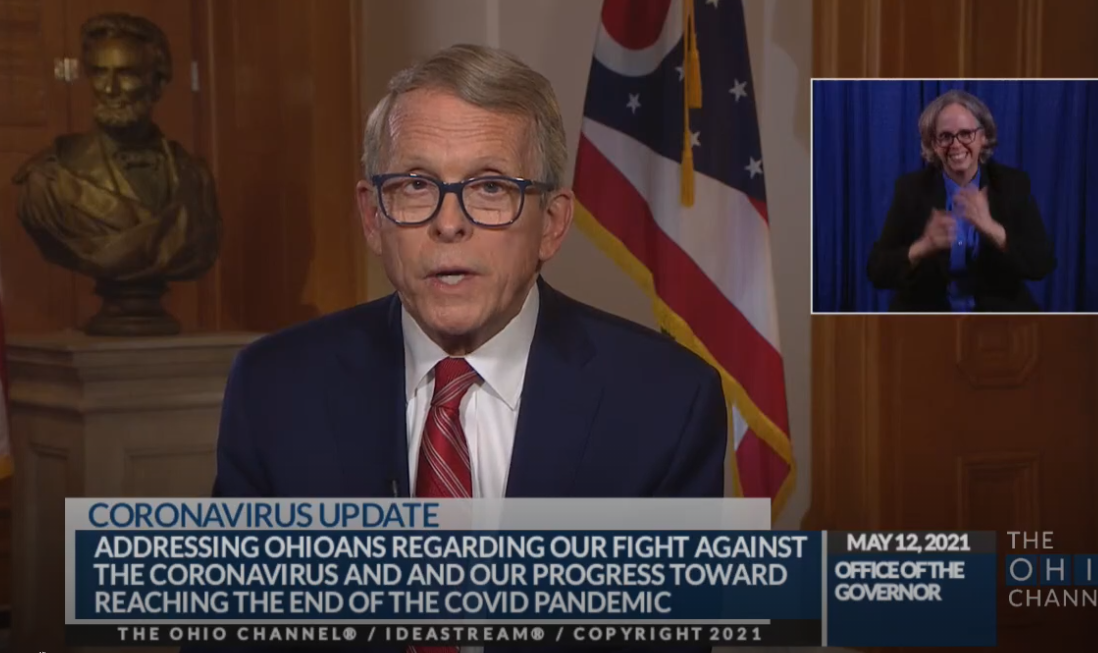
In a Wednesday evening address outlining Ohio’s next steps in handling the pandemic, Gov. Mike DeWine announced “it is time” to remove those health orders.
DeWine said all pandemic orders would be removed on June 2, except for those involving nursing homes and assisted living facilities.
Republican legislators, who have battled with the DeWine administration since the early months of the pandemic, effectively gave the governor little choice. He had until late June to remove the health orders — or else they would remove them.
DeWine had already committed to removing the orders once Ohio reached a low threshold of new cases: an average of 50 cases per 100,000 residents over the course of a two-week time frame. While the state has made progress toward that goal in recent weeks, it’s remained unclear when exactly the target figure would be hit.
Amid pressure from the legislature, DeWine said the positive impact of the COVID-19 vaccines meant Ohio could remove the health orders even without having reached the target.
“There comes a time when individual responsibility simply must take over,” he said.
Senate Bill 22 goes into effect on June 23. It will give lawmakers the ability to rescind health orders and the state of emergency declaration through passing a concurrent resolution.
Hours before DeWine was set to speak, state Rep. Scott Wiggam, R-Wooster, announced plans to introduce a resolution to remove all of Ohio’s existing COVID-19 health mandates.
“The issue of removing the health orders is a very important one for our caucus,” House Speaker Bob Cupp, R-Lima, told reporters on Wednesday before the governor’s speech.
“There’s a strong sentiment that the health orders need to be dissolved,” he added.
Cupp declined to answer questions as to whether he’s spoken with the governor recently about the health order situation.
Throughout the pandemic, Republicans have accused the executive branch of overstepping its legal bounds in enforcing various COVID-19 health restrictions. Members have bristled at the governor for not adequately considering the inputs of lawmakers. DeWine has defended his administration’s aggressive stance as being necessary to combat a pandemic that, to date, has led to more than 19,400 deaths across the state.
The Republican supermajorities within the Ohio General Assembly have repeatedly attempted to curb the authority of the state health department.
Only a few of those bills have made it to the governor’s desk, each time leading to a DeWine veto.
While the GOP caucuses could not muster a veto override in 2020, things looked more favorable for this term when the party gained several seats in last November’s elections.
The legislature moved quickly to pass SB 22. A day after the governor vetoed it, members met again on March 24 to override that veto. The bill was passed without an emergency clause, meaning it would take 90 days for it to go into effect. Senate President Matt Huffman, R-Lima, telegraphed plans that day to use the powers of SB 22 as early as possible.
Columbus, Ohio – The coronavirus is raging in Ohio, but the state’s Republican leaders seem disinclined to enforce rules intended to protect against it. (How does Hamilton County avoid Level 4 Alert)
Attorney General Dave Yost won’t say whether he’ll support enforcement of new orders to wear masks in the state’s hardest-hit counties. And the official who issued them, Gov. Mike DeWine, has made several statements indicating that he doesn’t want to see anybody punished for not following measures intended to slow the spread of the deadly disease.
Mike Samet the Public Information Officer for Hamilton County Public Health told Loveland Magazine on Friday that from an enforcement perspective, as a county agency, the Health Department is not able to issue citations. “Nobody wants to be the mask police. This is education over enforcement, he said. Samet added that he wants people to understand why masks are important now, not punish them for non-compliance.
Ohio set a record for new cases Friday — 1,525 — after seeing them trend sharply upward over the past few weeks. The case count was nearly triplethe three-week average of 531.
Gov. Mike DeWine, has made several statements indicating that he doesn’t want to see anybody punished for not following measures intended to slow the spread of the deadly disease.
The news comes as six other states — Alabama, Idaho, Missouri, Montana, Oregon and Texas — set new single-day records of their own on Thursday. It also was the sixth day out of the past 10 in which the United States set one-day records for new cases of the coronavirus, which now has killed more than 3,000 in Ohio and more than 130,000 nationwide.
Also last week, a New York Times data analysis showed that the disease in the United States is taking on a disturbing racial dimension, with Blacks and Latinos around three times as likely as whites to get the new coronavirus.
The World Health Organization and the U.S. Centers for Disease Control both have said that widespread mask wearing would reduce the spread of the disease. One study indicated that if 80% of people wore them, the spread would plummet to one twelfth what it would be if nobody did.
Yet Yost, the state’s top law-enforcement officer, last week didn’t respond to questions about whether he supports enforcement of last week’s orders that people in Ohio’s 12 hardest-hit counties must wear masks inside public buildings.
In late March, Yost ordered that many abortions be halted in Ohio, arguing that the move was intended to conserve healthcare resources in the face of the coronavirus pandemic.
In June, he urged a municipal court to drop charges against a couple accused of opening their Cambridge-area restaurant in defiance of an earlier, DeWine-issued health order that it remain closed.
Then earlier this week, Yost said that the Columbus city government doesn’t have the power to enforce mask orders in state buildings — places where many Republican lawmakers have refused to wear them.
On Monday, a spokeswoman for Yost explained that the attorney general can’t have any official involvement in cases relating to health orders unless asked by local prosecutors. “We don’t have the authority,” the spokeswoman, Bethany McCorkle, said in a text message.
She added, however, that Yost has worn a mask since before there was a health order and encourages others to do the same.
The attorney general and his staff haven’t responded to subsequent questions about the order DeWine issued on Wednesday evening requiring masks in the worst-hit counties.
David Pepper (Photo from Ballotpedia)
Ohio Democrats are already up in arms about Republican legislative leaders’ refusal to share details about the spread of coronavirus in the Statehouse and surrounding office towers. David Pepper, the party chairman, on Friday slammed the attorney general for his apparent reluctance to support the enforcement of mask orders.
“As far as Dave Yost is concerned, refusing to enforce health orders is just one more example that the Ohio GOP has become the party of Donald Trump, Nino Vitale and John Becker,” Pepper said in a text message. “Sadly Ohio COVID cases are spiking because of it.”
“Even though initially it appeared that Mike DeWine was being guided by scientists and public health experts, it seems that politics and the desires of the business community are driving more of the governor’s decision making now,” party chairman David Pepper said.
President Donald Trump has repeatedly downplayed the pandemic, floated unproven cures for it and refused to appear in public wearing a mask. Among his other statements, Ohio Rep. Nino Vitale, R-Urbana, last Tuesday took to Facebook to urge Ohioans to stop even getting tested for coronavirus. And Ohio Rep. John Becker, R-Union Township, has introduced legislation that would strip state officials of the power to enforce any health order.
Meanwhile, in the absence of much support from his party, DeWine has said he doesn’t plan to use his authority under his mask order to arrest people for not following it.
Ohio Governor Mike DeWine
“We’re not talking about throwing people in jail,” DeWine said during a press conference Thursday. “This is a law to advise people what to do.”
DeWine has enjoyed overwhelming, bipartisan support over his handling of the coronavirus. But at least for Ohio’s top Democrat, patience might be wearing thin.
“Even though initially it appeared that Mike DeWine was being guided by scientists and public health experts, it seems that politics and the desires of the business community are driving more of the governor’s decision making now,” Pepper said. “Even with fewer cases, even West Virginia and Kentucky are being more proactive in addressing the pandemic.”
The Ohio Capital Journal is a hard-hitting, independent, nonprofit news organization dedicated to connecting Ohioans to their state government and its impact on their lives. The Capital Journal combines Ohio state government coverage with relentless investigative journalism, deep dives into the consequences of policy, political insight and principled commentary.









 The
The