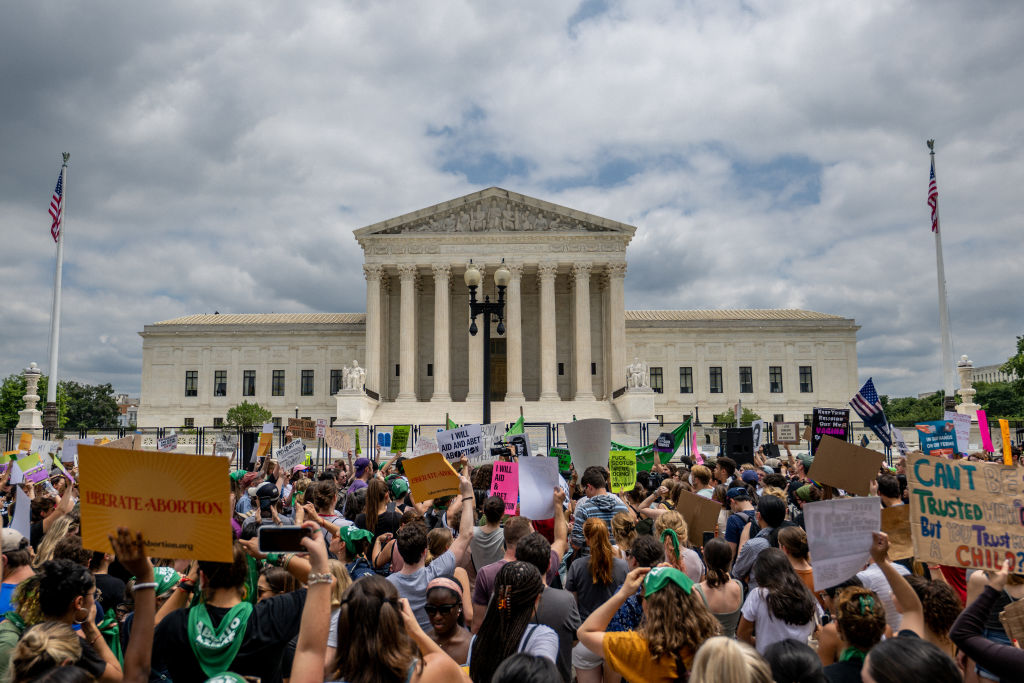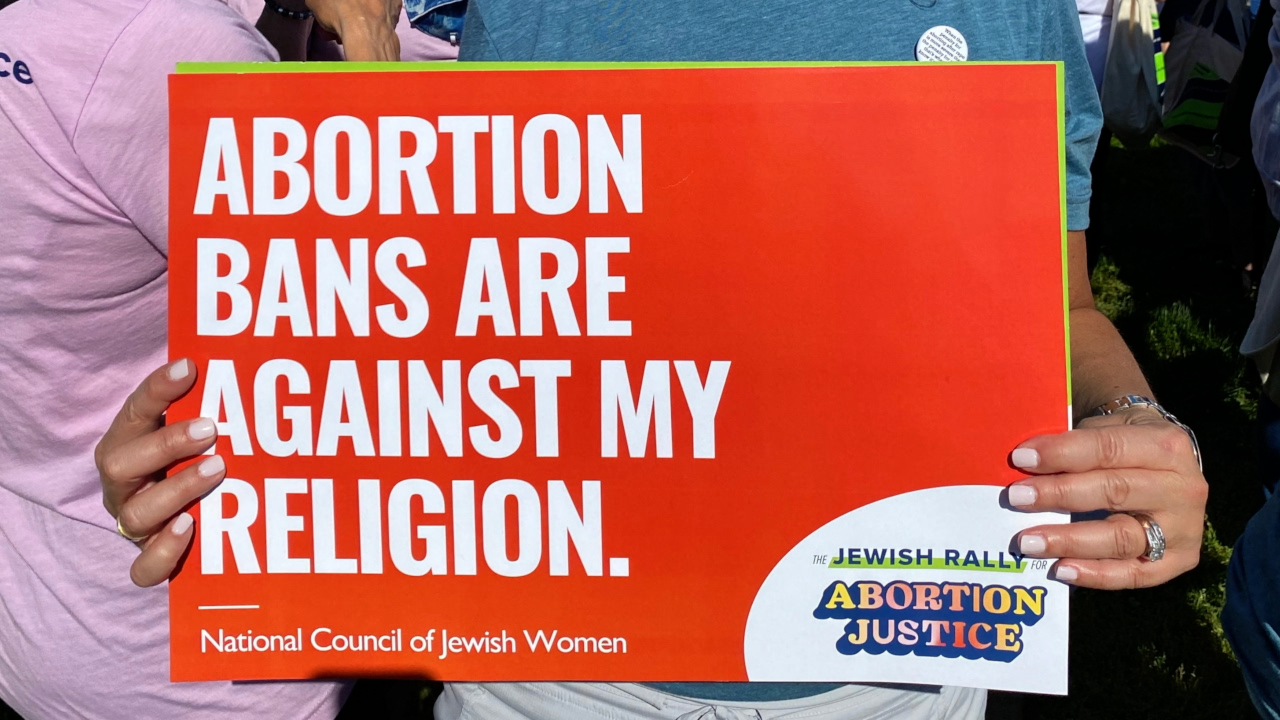
Members of the Jewish community have spoken out against abortion bans in Ohio, saying it infringes on their religious freedom. Photo by Morgan Trau, WEWS.
BY: ARIANA FIGUEROA – Ohio Capital Journal
WASHINGTON — Thousands of years of Jewish scripture make it clear that access to abortion care is a requirement of Jewish law and practice, according to Rabbi Karen Bogard.
“We preserve life at all costs,” she said in an interview with States Newsroom. “But there is a difference between that which is living, and that which is not yet living.”
Bogard is a rabbi at Central Reform Congregation in St. Louis, which is in the progressive tradition of Reform Judaism. She said that whether it’s the Torah — the first five books of the Old Testament in the Hebrew Bible — or the Talmud — the central text of Rabbinic Judaism and the primary source of Jewish religious law and theology — those pieces of Jewish literature “really draw the difference between life and potential life.”
But with the fall of Roe v. Wade in late June, some members of the Jewish faith as well as other religious groups find their beliefs in deep conflict with state laws that ban or greatly restrict abortion — especially if a pregnant patient’s life is in danger.
Since the Supreme Court’s Dobbs v. Jackson Women’s Health Organization decision, states now are permitted to craft their own laws regarding abortion, and in Bogard’s home state of Missouri, the procedure is banned.
“Our congregants are heartbroken,” she said. “It’s really violating to be told what you can and can’t do with your own self.”
Legal challenges are resulting. The enactment of state laws that ban or restrict access to abortion has already sparked a lawsuit in Florida from a liberal Jewish congregation in the Sunshine State. In Ohio, another liberal Jewish congregation is joining the American Civil Liberties Union in a lawsuit against the state’s six-week abortion ban.
A coalition of three dozen rabbis also filed a brief on a separate lawsuit in the Buckeye State, where physicians are challenging the new abortion law in the Supreme Court of Ohio.
Similar lawsuits are anticipated, not only from liberal Jewish congregations, but other religious groups as well.
There’s currently a lawsuit in the U.S. District Court for the Southern District of Texas Houston Division filed by the Satanic Temple — not to be confused with the Church of Satan — on behalf of a member who argues the state’s abortion ban violates that temple member’s religious beliefs allowing access to an abortion ritual.
The ritual involves members repeating verses in a mirror to affirm body autonomy and repel any guilt, shame or discomfort that can surface when undergoing an abortion.
“There’s going to be a wave of religious freedom lawsuits,” Rabbi Daniel Bogard, who’s married to Rabbi Karen Bogard, said. “We’re going to find out if this country really believes in religious freedom, or whether this country believes in the freedom of a small minority to impose its will on the rest of us.”
But it’s unclear if these religious-based lawsuits challenging state abortion laws can win in court.
“We’re very much in the wild, wild west of abortion law and religious law,” said Candace Bond-Theriault, the director of racial justice policy and strategy at Columbia Law School’s Center for Gender and Sexuality Law.
Jewish law
According to Jewish law, a fetus is not considered a full human being and the biblical foundation for this is found in Exodus 21:22 of the Torah, Rabbi Daniel Bogard said.
The translation reads: “When men fight, and one of them pushes a pregnant woman and a miscarriage results, but no other damage ensues, the one responsible shall be fined according as the woman’s husband may exact from him, the payment to be based on reckoning. But if other damage ensues, the penalty shall be life for life, eye for eye, tooth for tooth, hand for hand, foot for foot, burn for burn, wound for wound, bruise for bruise.…”
Rabbi Daniel Bogard said that the Jewish legal interpretation of these passages states that a fetus is not a person, because the miscarriage results in only monetary compensation, rather than the “life for life” punishment.
There are several other passages in Jewish literature that make the distinction that the life of the person who is pregnant is prioritized.
“If we’re going to live in a religiously free society, we are each allowed to interpret these verses on our own for our own traditions and a minority in this country can’t impose their conservative white Christian religiosity on the rest of us,” Rabbi Daniel Bogard said.
The lawsuits challenging abortion laws are predominately filed by congregations that practice Reform Judaism, but Conservative Judaism also supports access to abortion.
The question of access to abortion gets more restrictive when it comes to Orthodox Judaism, but access to the medical procedure isn’t barred, says Yedida Eisenstat, a fellow at the Center for the Study of Law and Religion at Emory University in Atlanta.
“Abortion in Judaism absolutely does have a place, and within Jewish law, there absolutely is a place for abortion,” she said. “Judaism is not anti-abortion, like Christianity is, so it absolutely does make sense for Jewish congregations to be saying, ‘Hey, this is a violation of our religious rights.’”
Eisenstat specializes in Jewish biblical interpretation and also works as an editorial associate at the Posen Library of Jewish Culture and Civilization.
“Judaism doesn’t have one voice or one opinion or one ruling about everything,” she said, adding that every situation is different and “there’s all this other gray area,” when it comes to theoretical cases in Jewish law pertaining to abortion.
And interpretations on abortion in Jewish law, or Halacha, vary across American Jewish denominations.
“We use the theoretical cases to illuminate other cases — just like in American law — so there isn’t one blanket answer for every situation, every situation has its own nuances,” she said. “And again, that’s why this is a decision, a very personal decision, not one that the government should be making.”
The Rabbinical Assembly, a major institution of Conservative Judaism, condemned the Supreme Court’s ruling in Dobbs.
“Denying individuals access to the complete spectrum of reproductive healthcare, including contraception, abortion-inducing devices and medications, and abortions, among others, on religious grounds, deprives those who need medical care of their Constitutional right to religious freedom,” the organization said in a statement.
Orthodox Judaism is typically more aligned with Christian conservative views on religious liberty issues, Eisenstat said, but differs on the belief that life begins at conception.
Following the Dobbs decision, the Rabbinical Council of America and Agudath Israel, large organizations that represent Orthodox Jewish communities, urged states to consider exceptions to expand abortion access.
“As the debate over abortion rights enters this new phase, we encourage states to craft policies that will simultaneously express the great value we place on life as well as protecting the rights to abortion when warranted by Jewish law,” the Rabbinical Council of America said in a statement.
Florida lawsuits
Rabbi Barry Silver is a self-proclaimed “rabbi-rouser.”
He’s an attorney, a social activist, a former Democratic legislator in the Florida House of Representative and the leader of the Congregation L’Dor va-Dor, a synagogue practicing progressive Judaism in Palm Beach, Florida.
Silver, along with three rabbis, a United Church of Christ reverend, a Unitarian Universalist minister, an Episcopal Church priest and a Buddhist lama, each have filed separate lawsuits challenging the state’s 15-week abortion ban that went into effect July 1. Those suits argue that the new abortion law violates Florida’s state constitution, as well as U.S. constitutional protections for freedom of speech and religion.
The suits also claim the law creates “substantial” burdens on individuals’ ability to practice their faith, and creates a “potential” burden on religious leaders to advise their members. Because of the vagueness of the law, Silver said, rabbis or other religious leaders who counsel their clergy members on abortion could face criminal charges.
“It criminalizes the practice of Judaism as well as all the other religions that are not aligned with fundamentalist Christianity, which is pretty much everybody,” Silver said of Florida’s new abortion law.
Silver’s Congregation L’Dor Va-Dor also filed a separate suit in June in state court that argues the 15-week abortion ban violates the right to privacy guaranteed by the Florida state constitution.
“For Jews, all life is precious and thus the decision to bring new life into the world is not taken lightly or determined by state fiat,” according to the lawsuit. “As such, the act prohibits Jewish women from practicing their faith free of government intrusion and this violates their privacy rights and religious freedom.”
Silver said he still plans to counsel his congregants who need or are considering abortion care, despite Florida’s new law.
“We do the right thing and if they want to come after us, they can make our day, we’re not going to stop saying what we need to say. We’re not gonna stop practicing Jewish law,” he said.
A spokesperson with GOP Gov. Ron DeSantis’ office did not answer questions from States Newsroom about whether the newly passed abortion law prevents Jewish people from practicing their faith.
“Governor DeSantis is pro-life, and we believe HB 5 will ultimately withstand all legal challenges,” a spokesperson with DeSantis’ office wrote in an email to States Newsroom, referring to the abortion law. “The struggle for life is not over.”
Congregation L’Dor Va-Dor’s suit claiming Florida’s constitution has an explicit right to privacy is “fairly straightforward, and would generally be unremarkable,” said Caroline Mala Corbin, a law professor at the University of Miami School of Law.
“Under the existing law, it’s a no-brainer challenge,” Corbin said.
She added that the Florida Supreme Court has interpreted that language to cover abortion.
“Except that, like the U.S. Supreme Court, the Florida Supreme Court has taken a sharp turn to the right, so just as you have the U.S. Supreme Court completely remake abortion law, it’s a possibility the Florida Supreme Court will as well,” she said.
Corbin said the court could rule several ways in the congregation’s case.
“They might argue, ‘We question your sincerity,’ which would be shocking given how deferential they are to other claims of religious liberty,” she said.
The court could also rule that the congregation did not prove Florida’s abortion law created a substantial burden, or that even if the law prevents someone from practicing their religion, “the state has a compelling reason for its law, and therefore, the state must prevail,” she said.
“So the state might respond, even if this does affect your ability to live your religious truth, the state has a compelling interest in saving lives and therefore the state still prevails,” Corbin said.
Future cases
Micah Schwartzman, the director of the University of Virginia School of Law’s Karsh Center for Law and Democracy, and the Hardy Cross Dillard professor of law, said lawsuits brought on behalf of a group of people, like the one from Silver’s congregation in Florida, rather than a particular individual, will have more procedural hurdles to prove the group has standing to sue under state and federal law.
“I’m not terribly confident about these early lawsuits,” Schwartzman said.
He pointed to the case in Texas, the one by the Satanic Temple, which the religious organization filed in federal court on behalf of one of its members, and said he expects to see similar cases.
“I think in the future, we’re going to see cases that are brought on behalf of particular individuals who are burdened by abortion restrictions or prohibitions,” he said. “And those types (of cases) will have a stronger chance of surviving the preliminary stages of litigation.”
Schwartzman said there’s also the question of religious exemptions, particularly in states that have enacted trigger law bans or near total bans on abortion, and whether those laws impose a burden on people trying to practice their religion.
State abortion laws are going to have some exemptions for abortion, he said, such as in cases of rape and incest and to protect the life and health of the mother.
“And in those circumstances, courts are going to face the question if these laws have certain secular exceptions, why shouldn’t they also grant exceptions on religious grounds?” he said. “And I think that will be the structure of many challenges that we will see in the future.”
Elizabeth Sepper, a religious liberty, health law and equality scholar at the University of Texas School of Law, said that over the last couple of decades the Supreme Court has “reduced the establishment clause to rubble,” which under the First Amendment prohibits the government from establishing a religion.
When Roe v. Wade was initially issued, Congress passed the Hyde Amendment, which prohibits the use of federal funds to cover the cost of abortions, with some limited exceptions.
Sepper said Congress’ decision to pass a restriction related to abortion in the case of the Hyde Amendment, is an example of “an establishment of religion because when legislators pass abortion bans that say ‘Well, human beings come into life at the moment of conception,’ that’s a doctrine — is a theological stance — that’s rooted in a particular religious faith, and we all know religious faith that is.”
“I think some large segment of the population on both sides of the abortion issue understands (that) to be the truth, which is that many abortion bans require religious reasoning,” Sepper said.