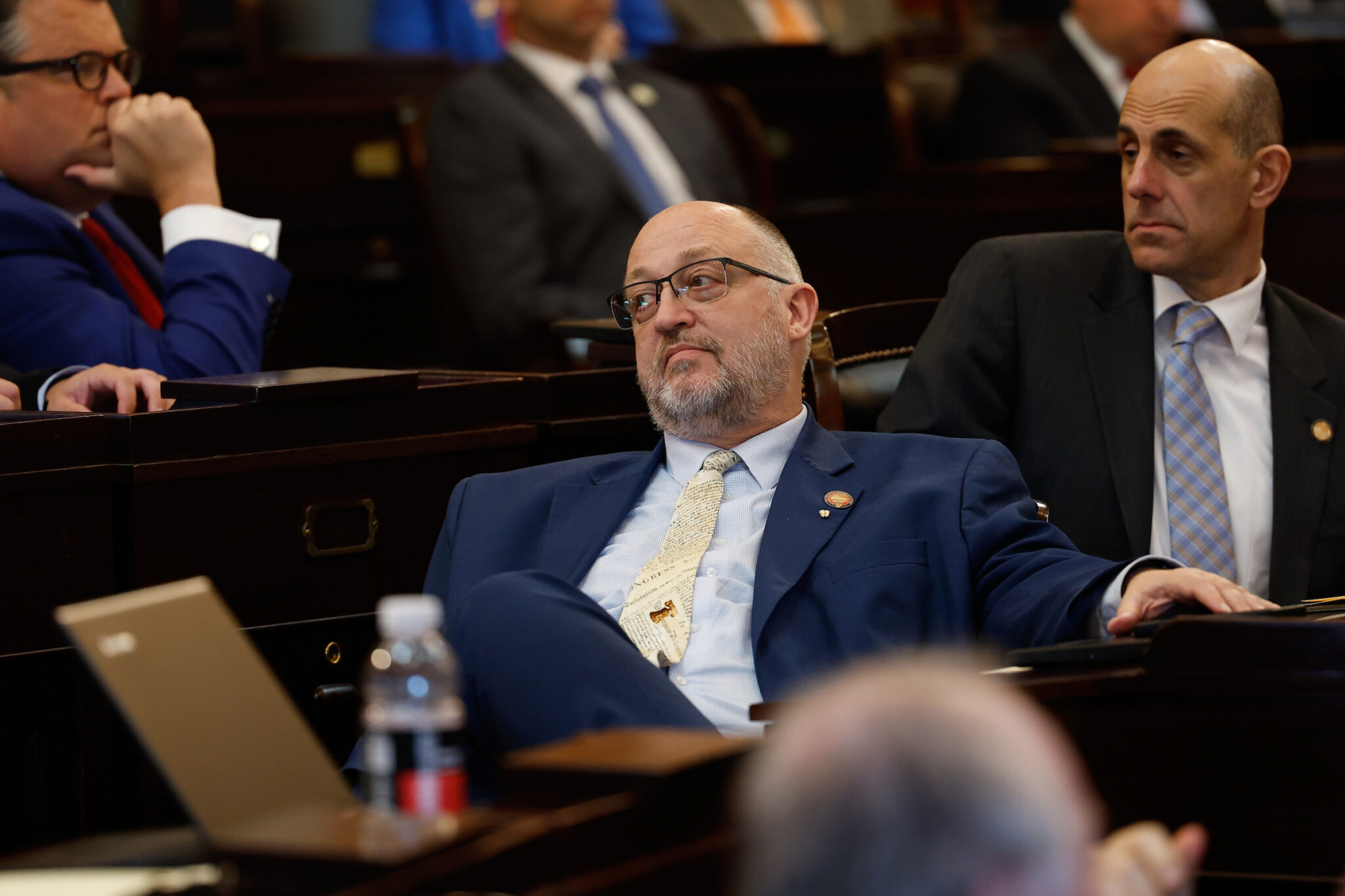
Tag: SAFE Act

  • “An attack on all trans people,” transgender youth speak out against Ohio legislation

    “An attack on all trans people,” transgender youth speak out against Ohio legislation

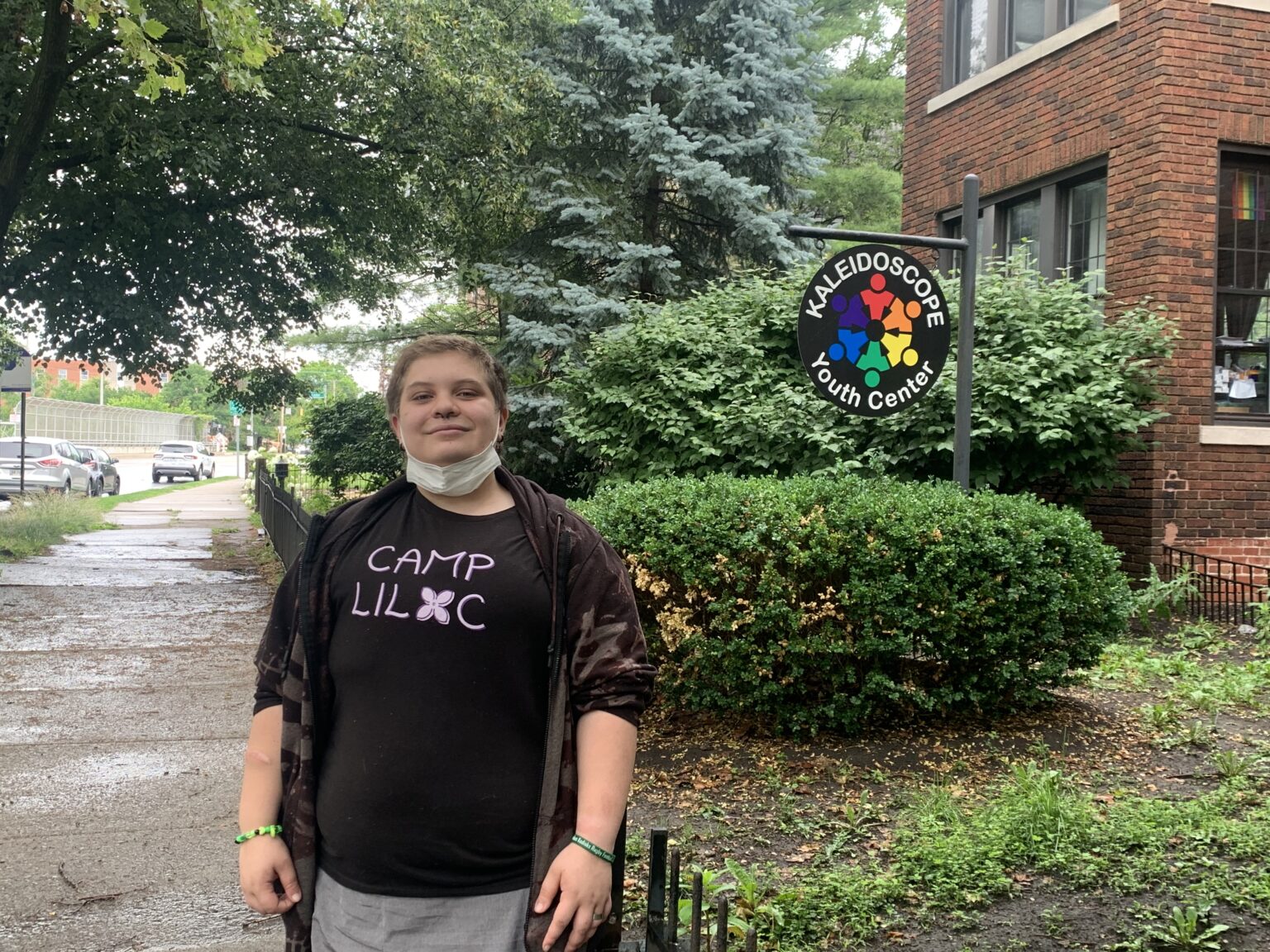
    Nathan Alvarez, 15, stands outside Kaleidoscope Youth Center on June 23. He is worried about a bill that would require K-12 schools and colleges to mandate that students could only use the bathroom or locker room that matches their sex assigned at birth. (Photo by Megan Henry, Ohio Capital Journal) Ohio Capital Journal talked to three transgender youths who are concerned about these bills and their potential implications.

    BY:  – Ohio Capital Journal

    Nathan Alvarez is used to people laughing or snickering at him when he uses the men’s bathroom.

    Despite that, the 15-year-old says his high school is one place he doesn’t have to worry about that happening because they have a couple of gender neutral bathrooms and anyone can use the men and women’s restroom.

    But a bill banning transgender students from being able to use the bathroom and locker room that aligns with their gender identity would change all that.

    State Reps. Beth Lear, R-Galena, and Adam Bird, R-New Richmond, recently introduced House Bill 183 which would require K-12 schools and colleges to mandate that students could only use the bathroom or locker room that matches their sex assigned at birth. HB 183 is still in House committee, awaiting sponsor testimony.

    “It would be hell (if the bill were to pass),” Alvarez said, who uses he/him pronouns. “Hearing about it disgusted me. Like it violently disgusted me.”

    HB 183 is one of a handful of anti-trans bills that have been introduced so far in the Ohio General Assembly.

    Doctors wouldn’t be able to give puberty blockers and hormone therapy to trans youth, trans athletes wouldn’t be able to participate in women’s sports, educators would be forced to out students to their parents and require public schools to give parental notification before teaching “sexuality content” if these various anti-trans bills pass through the Republican-controlled Ohio Statehouse.

    OCJ talked to three transgender youths who are concerned about these bills and their potential implications.

    “It’s an attack on all trans people,” said Ko Rupert, who uses she/it pronouns. “They are all uniquely bad, but their uniqueness is important.”

    And it’s not just happening in Ohio.

    There have been more than 220 bills introduced nationwide specifically targeting transgender and non-binary people, according to the Human Rights Campaign year-to-date snapshot from May 23.

    Fifteen laws have been enacted banning gender affirming care for transgender youth and four additional laws have been passed that censor school curriculum like books, according to HRC.

    “It’s very hard to see what’s been already happening in other states and how the bills that they are trying to pass here in Ohio are not even that different,” Jaylah Hollins, 19 said. “I feel like it’s not really in the interest of Ohioans, but only in the interest of anti-trans lobbyists from out of state.”

    House Bill 8

    Hollins is going to start attending Columbus State Community College this fall for social work and hopes to one day work for an organization that helps transgender people.

    “Hopefully if these bills don’t pass, we can try and make Ohio a place where it can be a refuge for trans kids and trans adults,” Hollins, said, who uses she/her pronouns. “Ensuring that trans kids have access to medical care and that adults have access to the facilities that align with their gender identity shouldn’t be politicized in the first place.”

     An advocate for the rights of trans children and their parents holds up a sign. Photo by Morgan Trau, WEWS. 

    While she said all the anti-trans bills are harmful, House Bill 8 stands out to her as the most damning.

    State Reps. D.J. Swearingen, R-Huron, and Sara Carruthers, R-Hamilton, introduced HB 8 which would require public schools to give parents a heads up before teaching “sexuality content” and school staff would have to out students to their parents. HB 8 recently passed the Ohio House.

    “I feel like they don’t see it as putting children in harm’s way when it most likely is because you can’t expect a parent to be able to deal with knowing that their child is within an LGBT umbrella and not have to try and resort to what they may not see at the time as harmful approaches to their child’s identity,” Hollins said.

    She said these bills would prevent children from learning more about themselves and make them feel as though they deserved to be punished because of how they identify.

    “It won’t allow children to be able to understand others who are maybe different from them,” Hollins said. “It will encourage isolation and I think the most devastating would be suicidal ideation, especially with trans and non-binaries who already know that they are coming from families who are unaccepting of those identities.”

    She’s said she’s still debating if she’ll stay in Ohio after college.

    “It’s still hard for me to think about, but for me, I think I would want to stay in Ohio and fight for trans youth,” Hollins said.

    Rupert, a 20-year-old Ohio State University graduate student, is also worried about HB 8 and the stripping away of youth rights.

    “Young people can make decisions, can know their bodies and understand and have a deep relationship with their gender and sexuality and romantic orientations,” Rupert said.

    Alvarez tries to speak out against the anti-trans bills when he gets the chance and even recently appeared on Good Morning America. But he’s not old enough to vote.

    “It’s upsetting to know that there are adults making choices for people to make choices about me. And I don’t have a choice,” Alvarez, of Reynoldsburg, said. “It’s scary.”

    He hopes to move out of Ohio one day and relocate to Washington.

    Anti-trans and anti-LGBTQ bills

    House Bill 68, also known as the  Save Adolescents from Experimentation Act (SAFE Act), would prevent doctors from giving puberty blockers and hormone therapy to trans youth. It would also ban physicians from performing gender reassignment surgery on a minor.

    Many opponents, however, have testified that no Ohio children’s hospital currently performs gender-affirming surgery on those under 18.

    House Bill 6 would prevent trans athletes from participating in Ohio women’s sports and was woven into HB 68, which recently passed the House and now awaits Senate committee consideration.

    Follow OCJ Reporter Megan Henry on Twitter.

    ______________________

    Megan Henry
    MEGAN HENRY

    Megan Henry is a reporter for the Ohio Capital Journal and has spent the past five years reporting in Ohio on various topics including education, healthcare, business and crime. She previously worked at The Columbus Dispatch, part of the USA Today Network.

    MORE FROM AUTHOR

  • Sponsor of Ohio trans youth health care ban claims no religious motive. Sermon suggests otherwise.

    Sponsor of Ohio trans youth health care ban claims no religious motive. Sermon suggests otherwise.

    BY:  Ohio Capital Journal

    A four-year-old recorded sermon given by Ohio state Rep. Gary Click, R-Vickery, may shine a light on the religious motivations behind Ohio’s proposed health care ban for trans youth.

    The sermon, which was posted on the YouTube channel of Fremont Baptist Church, where Click is a pastor, shows Click defending conversion therapy and suggesting that homosexuality and the idea that one can be trans are pushed by Satan in order to undermine the family.

    Throughout the sermon, Click emphasizes his view that God provided a specific plan for the family. Click suggests that homosexuality, trans people, and single-parent homes all break from this plan. He claims that Satan works to stray individuals away from the plan, which he says leads to the “crumbling” of society.

    Click is the sponsor of HB 68, also known as the Save Adolescents from Experimentation Act or SAFE Act. The SAFE Act would prohibit physicians from providing gender-affirming care, including puberty blockers and hormone therapy, to trans youth. Gender-affirming care is supported by every major medical organization in the United States.

    Click denies that his bill has religious motivations, but his sermon suggests otherwise.

    “You’re not born that way,” Click says about trans people during the sermon. “God’s not going to curse you in the wrong body. He’s not going to curse you with desires that cannot be adequately and appropriately and biologically fulfilled correctly.”

    At one point, Click appears to admit to having helped with attempted conversion. After condemning a California bill that sought to ban the practice as “an assault on the First Amendment,” Click describes conversion therapy as counseling “someone who struggles with those same-sex attractions, or struggles with their gender identity,” by showing them “what the bible says” and how to be “at one with the body God gave them.” Following this, he says, “I’ve helped people overcome that before.”

    During his recent sponsor testimony for HB 68, Click said that he has never practiced conversion therapy and does not know anyone who has, following a question on the topic by state Rep. Rachel Baker, D-Cincinnati.

    Conversion therapy has been condemned by several medical associations and human rights groups, including the American Academy of Pediatrics, the American Medical Association, the National Association of Social Workers, the United Nations, and more.

    When asked by OCJ for comment, Click said that it is “inaccurate” to say that he has promoted or practiced conversion therapy. He said that “conversion therapy requires force or at minimum an act of trying to change someone into something that they do not wish to be… When an individual is struggling with unwanted feelings and they approach me or someone else, it is entirely ethical to listen to them, pray with them, and provide encouragement and strength, and reinforcement as they determine for themselves how they wish to live.”

    Towards the end of the sermon, Click shows a picture of himself with Tony Perkins. Perkins is the president of the Family Research Council (FRC), a right-wing Christian organization that is labeled as an anti-LGBTQ hate group by the Southern Poverty Law Center.

    Click finishes by discussing a trip he took to the U.S. Holocaust Memorial Museum in Washington D.C. While displaying a picture of himself standing next to a wall featuring the famous poem “First they came”, which is about the human rights atrocities of Nazi Germany, he further discusses what he deems as an attempt to “undermine our values.”

    “When the family crumbles, society crumbles,” Click says. “If the church is silent, then the church will be held responsible. We can’t afford to be silent.”

    In addition to the sermon, Click’s affiliation with the missionary group Baptist International Outreach (BIO) raises similar questions. A doctrinal statement posted on BIO’s website states that “homosexuality is an abomination to God and a scourge to any society.” It also calls homosexuality a “sin” that occurs due to people “giving into the perverseness that is in his or her heart.” The statement further claims that the Bible “condemns cross-dressing and effeminacy.”

    Click’s biography on Fremont Baptist Temple’s website states that he “currently serves in an advisory capacity for Baptist International Outreach.” In his response to OCJ’s request for comment, Click clarified that he is “no longer serving [in an advisory capacity] with BIO.” He said that BIO is “a good organization” and that he is “not familiar with what their doctrinal statement currently says.”

    In his response, Click also said that his role as a pastor and his role as a representative do not conflict. In bold letters, he wrote “the fact that science and the Scripture harmonize is not a conspiracy, it is a reality.” Click did not specify what science he was referring to.

    While Click claims that his role as a pastor and as a representative do not conflict, he spends the final section of his sermon discussing the role of Christian conservatives in politics and encourages his audience to become politically involved. He discusses his role as a lobbyist for an international Christian school association and says the goal of his lobbying was to “reclaim our values.”

    While encouraging his audience to get involved politically, Click lists several right-wing Christian political organizations and discusses being personal friends with the organization’s leaders. One of these organizations is Citizens for Community Values, now called Center for Christian Virtue (CCV). CCV approached Click in the spring of 2021 to put forth the SAFE Act.

    ________________________

    Riley Roliff
    RILEY ROLIFF

    Riley Roliff is a freelance journalist and a student at Cleveland State University. Her reporting focuses on LGBTQ+ issues and the role of money in politics.

    MORE FROM AUTHOR