
Tag: school levy

  • Urgent! Loveland Community Needs School Levy Passed

    Urgent! Loveland Community Needs School Levy Passed

    Ellen Main, is a stay-at-home mom of two boys in Loveland Schools: one kindergartener and one first grader. Her family lives in the Belle Meade subdivision.

    by Ellen Main

    Loveland City School District has an operating levy on the May 2 ballot this year. Because Loveland has not passed a school levy in nine years, they are in desperate need of these funds to maintain their current high quality of education. If the levy is not passed, they will move towards State minimum services. Our students and future students deserve better than this. As a mom of two young Loveland students, I am witness to the outstanding and dedicated faculty, staff, and administration in our community. My experience at a recent school event illustrates this perfectly.

    Waiting anxiously for the show to begin, I looked around at all the other parents, siblings, grandparents, and other family members sitting in the Loveland Primary School gym and thought how grateful I am to live in this community. After the heartwarming show, during which the look of pride on my son’s face almost made me tear up, we walked through a gallery of children’s art—vibrant paintings, oil pastel drawings, and construction paper weavings covered the hallways from floor to ceiling. My son showed such confidence in finding his art on the walls and explaining it to his family. Then, he led us to his classroom (Ms. Miller, Room 9), where he showed us two beautiful books, one created by him (about koalas) and one created by his classmate, a biography about what makes my son special (my son created one about his classmate too). He proudly showed us all his work, which had an Australian theme (each class had a different country). All of this thanks to the hard work, energy and creativity of Lauren Alten (music teacher) and Kayla McClary (art teacher) as well as the classroom teachers, custodians, administration—too many people to mention.

    The “Around the World” Showcase is an example of what makes Loveland Schools such a special place to be. Music, theatre, art, athletics, physical education, robotics and so many other programs we may take for granted won’t be possible much longer if we don’t pass a school levy. Think about the most memorable and important moments of your elementary and secondary education—most likely they were made possible because of school levies being passed.

    I was lucky enough to have some extraordinary teachers in the Perrysburg School District in Northwest Ohio. My most memorable experiences had to do with music and theatre, which would not have been available without teachers having the freedom to use their creativity to benefit students both in the classroom and through extracurricular activities. Maybe yours have to do with sports, science club, art, student government, none of which would be possible without our talented educators, who would slowly be cut due to lack of funds. We cannot deny future generations these experiences.

    Right now, the employees at Loveland Schools are doing amazing work despite not having the money—92 percent of all Ohio school districts receive more money per student yet we are in the top 2 percent in the state on the Ohio Department of Education scorecard. We cannot keep the talented and hard-working people we have in Loveland Schools now if they feel stressed that they may lose their jobs or if the class sizes are so big they are spending all of their time managing student behavior rather than teaching.

    With the passing of the levy on May 2, we can keep not only our schools strong but our community as well. Voting yes for Loveland Schools on May 2 is a vote for our students and future students and also for the well-being of our entire community.

    _________________________

  • Marcia Neumann: Reason to vote no on school operating levy

    Marcia Neumann: Reason to vote no on school operating levy

    by Marcia Neumann

    Marcia Neumann resides within the school district and the City of Loveland limits in Hamilton County.

  • Why we need to support Loveland students this election season

    Why we need to support Loveland students this election season

    by Allison Kiehl

    Since the failure of the 2020 tax levy in support of Loveland City Schools, it’s no secret that there has been a divide in the Loveland community. Through that election and for weeks after, vote yes and vote no signs dotted homeowners’ front lawns and businesses as if a symbol of pride for people on both sides of the issue.

    This divisive spirit was reinvigorated back in August of 2022 when the district once again announced that a school levy tax would be displayed on this year’s midterm ballot.

    Make no mistake, there were problems with the levy when it was presented back in 2020 that led to its doomful demise led to its failure rate of over 60%.

    Recognizing that voters were not ready to build a new campus at Grailville, the Board placed a 6.95 mill operating-only levy on the March 2020 ballot, however, it also failed by a wide margin.

    The school district has faced the repercussions of budget constraints. This most noticeably led to the loss of staff members and revoking of bussing for high school students, among other consequences.

    However, the past failures then need to pave a pathway to success for this year’s initiative: a 4.9 mill operating levy for Loveland City Schools.

    This initiative is about the school’s current operational funding. It is about the individual students and teachers who would face the repercussions of further budget cuts including the looming potential of even more courses and staffing cuts within the district.

    “The state of Ohio is the only state without any inflationary adjustment for education funding. In order to maintain local control, we must either ask our community for additional funding or make substantial cuts,” reads the school’s website. “Before making cuts, and eliminating programs, we feel it is important to give the voters an opportunity to approve additional funding.”

    While the district has confirmed that if the levy does not pass, it will be “eliminating programs,” there is no confirmation as to what those programs will be. However, based on national trends, the possibility of the loss of music education within Loveland City Schools is a real, yet alarming prospect.

    According to the Arts Education Data Project, only 83% percent of schools in their area of research, which includes Ohio, have music programs offered to students. Nationally, the project projects there are over 2 million students without access to arts education.

    This number of students and schools without access to music education is expected to only go up, as The Trinity Voice reports that there has been a steady decline in music programs nationwide.

    After the fall of the 2020 levy, the music department suffered, by losing staff members and the remaining educators being burdened with additional responsibilities. Classes were cut, and students lost out on opportunities that have previously been offered.

    For example, guitar classes are one of the music electives that fell victim to budget cuts. Neither beginning or advanced guitar opportunities are available to students.

    Voters should not and cannot let this happen again because the students of Loveland deserve the very best education that the community can offer. They deserve to participate in music classes if not for the experience, then to gain the proven benefits of social-emotional learning, improved mental health, and increased test scores.

    According to the Journal of Research in Music Education, students ages who are involved with music are also better students. They generate higher standardized testing in studies conducted in both elementary school and secondary schools.

    More importantly, student participation in music is proven to make students happy. Research conducted by California State University San Marcos with middle and high school choir students at a mid-sized suburban school district.

    Students reported they liked the accepting class climate, the community and connections made between their classmates and teacher, and the subject matter’s activities that improve the student’s mood by making them happy and decreasing their stress, all aspects that increased their mood and success in school.

    According to the research, the independent variable of whether students joined the choir positively affected the dependent variable of whether students experienced an impact in their success in school.

    Whatever opinions the community holds about the levy, it is important to understand the ballot language and what the initiative requires of the community. The ballot language of Issue four for 2022 reads as follows:

    “An additional tax for the benefit of the Loveland City School District for the purpose of current operating expenses at a rate not exceeding 4.9 mills for each one dollar of valuation, which amounts to $0.49 for each one hundred dollars of valuation, for a continuing period of time, commencing in 2022, first due in the calendar year 2023.”

    The levy is asking 4.9 mills for each dollar of valuation from the community, which is the smallest school levy that voters in Hamilton County will decide on this season. The money goes primarily toward staff salaries and benefits, along with various operating costs, according to Loveland City Schools.

    That cost varies depending on the household within the Loveland District, however, according to Redfin, the average home value within Loveland is around $300,000. Based on that average, the levy would cost the homeowner a little over $500 per year.

    The opposition to the levy speaks of issues with transparency, trust, and timing. However, if this levy does not pass, the students will be facing real consequences of “substantial budget cuts” as soon as the upcoming school year.

    For more information on what will be on your ballot this November or to find an in-person voting location nearest to you, please HERE for Hamilton County, HERE for Warren County, and HERE for Clermont County.

    This Election Day, November 8, at the polls, vote with students in mind. Your vote is one more ballot to help support music education and supports the students of Loveland City Schools because, we as a community, cannot sit back and watch further repercussions of failed-levy budget cuts.

  • What’s The Cost of proposed Loveland School levy?

    What’s The Cost of proposed Loveland School levy?

    by Linda Holtkamp

    By now, the people of Loveland Schools should know about the proposed Loveland School levy, and how the cost of this proposed increase will affect your property taxes.

    Currently, 1 Mill is equal to almost exactly $1,000,000, and the school is asking us for 4.9 Mills, additional. The formula to calculate what this proposed levy will cost you is simple. Superintendent Mike Broadwater has a video on the school website with an explanation and many thanks to him for providing that.

    Find your property on your County Auditor’s website. Look for “property search” on both Hamilton and Clermont County sites. There you will find both the Appraised Market Value (full appraised value of your home) and also the Assessed Value (the amount that is taxable). Then grab your calculator and use this:

    Appraised Market Value (full home or house value) x .35 x .0049 = $$$$

    OR, use your Assessed Value (taxable amount) x .0049 = $$$$

    With either math formula, the amount you will owe will be the same $$$$.

    The .0049 represents the amount of this levy ask… 4.9 Mills, generating a total of close to $4.9 Million Dollars, each year, continuously (permanently), as an operating levy for the schools. 

    A Google search for current home values in Loveland lists that properties in Loveland range from $40,000 to $2.9 Million. The Grail was going to sell land to the school district for $7.7 Million, so yes, there are some high-value properties that exist here.

    The LCSD treasurer used the Zillow website in his presentation at a recent board meeting. Zillow lists the average house value in Loveland, at the end of July, to be $377,047.

    Using the average house value that the treasurer listed, $377,047, the calculated increase for an average value home in Loveland, for this school levy, will be about $650 per year. This is a permanent tax, which will be piled on top of the existing 18 continuous (permanent) levies, two permanent inside millage taxes, as well as a 26-year bond levy (which will be paid off in a few years).

    69% of homes in Loveland are lived in by the homeowner, while 31% are rental properties, according to RentCafe, a marketing website that tracks these trends.

    Homeowners will have to pay the extra costs of this levy, and other recent property taxes that have passed but not yet been billed, starting in January 2023. Landlords can be expected to raise rents to cover the 13% increase in Loveland School taxes, and those other taxes as well. Rentals in Loveland are pricy, average $1,361 for 959 sq. ft., only surpassed locally by rentals in Blue Ash.

    Information from the recent Census lists that 6.1% of people in Loveland are under 5 years old, and that 26.3% are under 18 years of age. This would indicate that, out of Loveland’s population, about 20% are school-age children. A good number of those school-age children do not attend Loveland Schools, but opt for private, parochial, charter, or homeschooling.

    Residents over 65 years old, seniors, again according to Census numbers, comprise 15.9% of the population of Loveland. It seems there are close to as many senior citizens in Loveland as there are school-age children.

    According to the school website, the District serves a population of 50,000, when including those who live both inside and outside of Loveland City proper. Student enrollment in LCSD is approximately 4,000. That works out to 8% of Loveland-at-large residents are students of LCSD.  That means 92% of Lovelanders sacrifice monetarily via property taxes, to educate 8% of the Loveland district population.

    Though many residents strongly insist this 13% increase in school property taxes is for the good of the 4,000 current students of Loveland, is there ever any emphasis on how a 13% increase might harm the considerable number of senior citizens in Loveland? The Homestead tax reduction, (aimed at helping seniors) has effectively disappeared, so relief on property taxes is essentially nonexistent. 

    For those who feel that not passing this levy will hurt property values… that depends on your outlook. Of all the people who live in Loveland now, according to the Census, 69% were born in Ohio. As a life-long resident myself, I know that many, many of these 69% are “long-term” residents of Loveland. Think of those you know who have made their home here for at least 15 years, as well as those who have lived here for decades. Do we like seeing our property values rise? Of course, we do. But do these permanent levies, which burden us forever, give us a good return on our investment? Or are higher property values more likely to aid those who live here only for a short time? We’ve spent tens upon tens of thousands of dollars to support the schools. Our schools… LCSD. Proudly. Will property value increases repay any of that? Will some residents eventually be forced out of their homes because continual taxation is part of the homeownership costs that are skyrocketing? Admittedly you can’t monetize the value of education. You can’t accurately assess the harm of passing on the cost of these school levies to those who truly can’t afford them, either.

    Remember that 2/3 of our community does not have children attending Loveland Schools. But a tax like this, if passed, places a burden on every single resident.. homeowner or renter, school parent or senior. The importance of voting cannot be overstated, and absentee or early in-person voting makes it easy for us all.

    Many of us complain about how much is sent to schools already, but these taxes are firmly entrenched, school enrollment numbers continue to drop, and LCSD has been making everything work pretty well with the over $50 Million Dollars per year that they already get (some $35 Million of that from local property taxes… us). They use these funds to educate 4,000 students out of a district population of 50,000… 8% of our community at large.

    These funds cannot be taken back, so use them with our blessing.

    Don’t ask for more.

  • Should Loveland school taxes increase while residents Lose their livelihoods?

    Should Loveland school taxes increase while residents Lose their livelihoods?

    by Kim and Rick Donaldson

    While many in Loveland are losing their jobs and their businesses, our school board persists in asking us to raise our taxes. As it stands today, they may very well get their way simply by virtue of low voter turnout. So, if you

    Kim and Rick Donaldson live on Paxton Road in Miami Township

    haven’t already done so, apply for an absentee ballot now. The primary election originally scheduled for March 17th is now by mail only. Completed ballots must be postmarked no later than midnight, April 27th or dropped off at your county board of elections by 7:00 PM April 28th. Since you will first need to apply to have a ballot mailed to you, there is no time to lose.

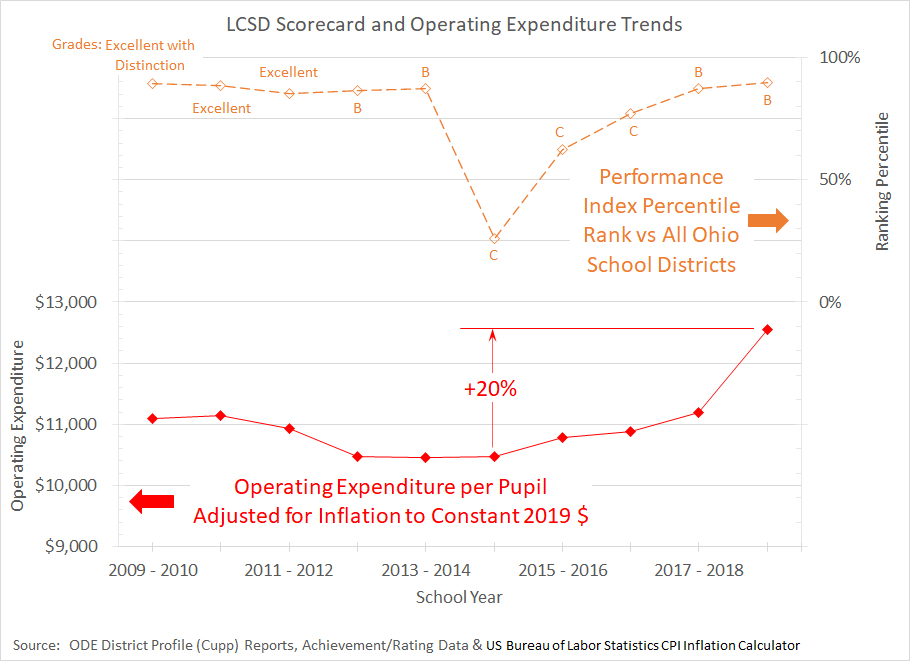
    Now back to the original question: should our school taxes be increased? We are told that additional funding is needed to “protect our progress”. This would imply that past increases have improved district performance. However, according to Ohio Department of Education data, Loveland’s overall performance index score ranked in the top 15% of Ohio schools from 2010 through 2014, with correspondingly high overall grades. In 2015, Loveland’s performance dropped precipitously, nearly to the bottom 25%. Various explanations have been floated for this drop: Common Core implementation, testing changes, students opting out of testing, etc. Available data do not definitively show what the explanation is, but it does show what it isn’t: spending. Referring to the first chart, note that Loveland’s 2019 overall performance is virtually identical to its 2010 to 2014 performance, but expenditure per pupil is as much as 20% higher after adjusting for inflation.  Also note that Loveland’s performance had already recovered to pre-2015 levels by 2018, before the big ramp-up in expenditure.

    Graph provided by Kim and Rick Donaldson

    Since increased funding doesn’t seem to be improving our district’s rating, it is difficult to see exactly what progress we are protecting. Moreover, if we are to invest more of our hard-earned and increasingly scarce money in the schools, we expect to reap some benefit as a community. So far, our children don’t seem to have reaped the benefit of a better education and our property owners haven’t reaped the benefit of the appreciation that should result from a better-rated school system. However, there is one segment of the community who has reaped the benefit: teachers.

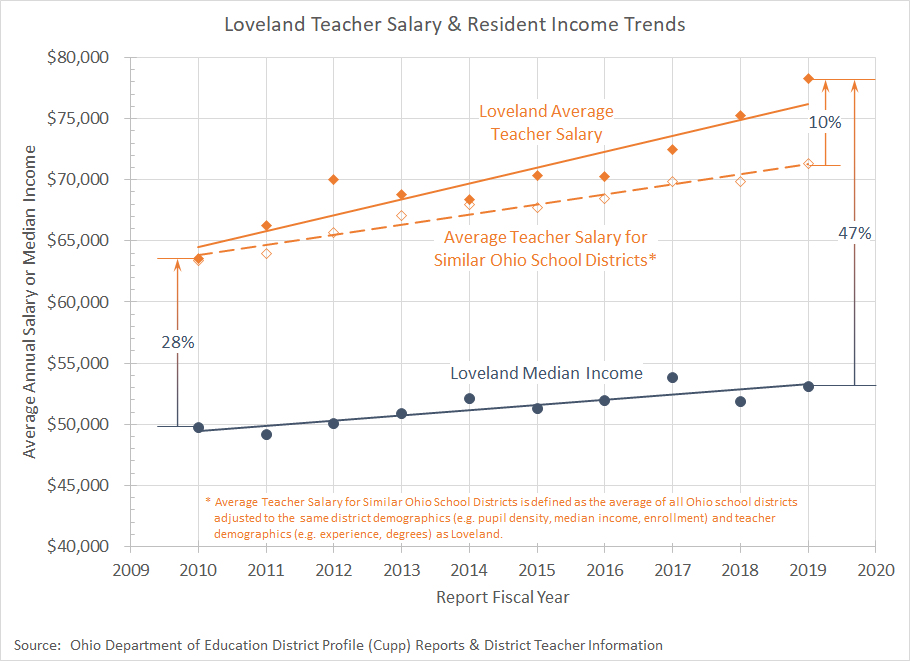
    According to Ohio Department of Education data, presented in the second chart, Loveland’s average teacher salary was $63,566 in 2010, which was about average for an Ohio school district with similar demographics among both the community and the teachers. In 2019, Loveland’s average teacher salary had increased to $78,248, 10% above the comparable Ohio district average. Loveland’s average teacher salary has also risen faster than median income. In 2010, the average teacher salary was 28% above median income. By 2019 it had risen to 47% above median income. While some might argue that paying teachers more improves educational quality, Loveland’s teacher salary and performance trends do not support that claim. Statistical analysis of statewide trends also shows no practical benefit for paying teachers above-market salaries.

    Graph provided by Kim and Rick Donaldson

    We do not question the quality, dedication or professionalism of Loveland teachers. Nor do we fault them for negotiating the most favorable compensation package they can. It is the responsibility of the board of education and administration to negotiate effectively on behalf of the Loveland community at large to deliver a high-quality education at a cost we can afford. Sadly, they do not seem to be doing an adequate job of cost control at a time when residents cannot afford to pay more.

    While no one knows how severe the current economic downturn will be or how long it will last, we do know the proposed levy will cost property owners an additional $20 per month for each $100,000 of appraised value, forever. Under the circumstances, it would be appropriate for the Loveland School Board to withdraw the levy, and we wholeheartedly agree with those who have already called on them to do so. However, the board’s past behavior indicates they are unlikely to heed those calls. The only way we can stop this levy and impose fiscally responsibility is to get an absentee ballot and vote no.

    References:

    1. Elections and Voting in Ohio, Ohio Secretary of State website:  https://www.sos.state.oh.us/elections/voters
    2. Ohio Department of Education District Profile (Cupp) Reports:  http://education.ohio.gov/Topics/Finance-and-Funding/School-Payment-Reports/District-Profile-Reports
    3. Ohio Department of Education District Achievement/Rating Data:  https://reportcard.education.ohio.gov/download
    4. US Bureau of Labor Statistics CPI Inflation Calculator:
      https://www.bls.gov/data/inflation_calculator.htm
    5. Ohio Department of Education District Teacher Information:  https://reportcard.education.ohio.gov/download
  • Most read Loveland Magazine stories of 2019

    Most read Loveland Magazine stories of 2019

    David Miller is the Publisher and Editor in Chief of Loveland Magazine

    by David Miller

    We will almost certainly never surpass the 1.3 million readers we had in 2017 (combined on lovelandmagazine.com, Facebook, and Twitter) on the day and the day after the fire in the Historic District. And, we quite frankly never want to surpass that record unless it’s much better news. (Early morning fire destroys 2/3 block in Historic Downtown Loveland)


    #1

    The most-read story by a wide margin in 2019 involved the levy the school district put on the ballot. Actually, we only published a few stories that were informational, the Five Ws (Who, What, When, Where, Why) of the levy vote. We provided public documents, notices of public meetings, etc.

    Interesting is what drove readership… we let our readers tell the story through Guest Columns and Letters to the Editor.

    Letting our readers, and District staff tell the story in balanced thought-provoking columns proved that we had no need to publish “she said-he said” stories filtered through our eyes and we are extremely grateful to those who submitted columns and the reflective social media comments that followed. We published each and every opinion piece we received and only occasionally felt the need to delete some of the social media comments that were inappropriate.

    Topping all of the levy stories was a Guest Column by Juliet Tissot, “We should not thumb our noses at the less fortunate just because we want nice stuff.” We did nothing special to promote Tissot’s column, however, are extremely proud of the Loveland community taking such interest in the subject she raised, because the plight of the “less fortunate” is rarely if ever discussed here in the Loveland area. I hope in 2020 this subject is revisited often inside the institutional framework of school board meetings, city buildings, and township halls.

    LOVELAND MAGAZINE TV also produced several videos of school board meetings where the District and local residents discussed the levy which added to making the levy by far the most looked at topic of 2019.

    #2

    Public Advised Not to Enter Little Miami River South of Old 3C Highway Until Further Notice” and “Canoe liveries warn of dangerous river conditions this weekend“.

    #3[VIDEO] Parking garage coming to Historic Downtown and Council executes purchase agreement for 1.15406 acres of land on First Street in Historic Downtown

    #4 Buy the original White Pillars home


    #5 Loveland Magazine “Local Voter Guide” to issues and candidates


    #6 Loveland’s Rails Trails & Ales Festival is Sept. 6 thru 8


    #7 Beloved Loveland High School educator: Charles R. Schmidt passes


    #8 It only took 8 minutes a story about flash flooding on Loveland Maderia Road.

    #9 Arrest made for scattering screws and nails on the roadway at SR 131 & Betty Lane

    #10 [Breaking] W. Loveland/Loveland Madeira area is being evacuated (Crews are investigating a natural gas leak at the intersection of W. Loveland/Loveland Madeira. The area is being evacuated and Duke is on scene.) Exact source of natural gas leak still not pinpointed – evacuation still in place


  • Brock Kinser: What better way can we show Tiger Care?

    Brock Kinser: What better way can we show Tiger Care?

    by Brock Kinser

    I feel compelled to ask for your support on November 5th for the Loveland Schools levy request. The District has done a great job of seeking community input and providing detail after detail about the specific request.

    Brock Kinser lives in the Loveland School District on Enyart Road

    While there are many reasons to support the request, as an educator who lives in Loveland and works in another district, I am particularly sensitive to and supportive of the significant need to upgrade the safety and security of our buildings. We, unfortunately, live in a very different world than we did ten years ago, not to mention 50-80 years ago, when the Early Childhood Center, Primary School, and Elementary School were built. Safety requirements are different today, and the current infrastructure places limitations on the upgrades and enhancements that can be made. We have to do everything in our power to protect our children while they are at school.

    The District has been prudent and sought feedback from the Department of Homeland Security and other experts in the realm of safety. Many of the recommendations have been implemented, but others are not possible until new facilities are built.

    While there are many reasons to support the levy request on November 5th, we have to address the need to upgrade safety and security to protect our children and staff for the circumstances of the modern world. My second-grade son talks about Tiger Care. What better way can we show Tiger Care than providing our youngest students and their educators with a safe and secure environment in which to learn and lead? If you are in doubt, please go take a tour of the campuses and ask yourself if we should do better for the children of our community. Please join me in voting FOR the levy request on November 5th.


  • The City of Loveland educates through the mail!

    The City of Loveland educates through the mail!

    Loveland Magazine writer Cassie Mattia lives in Historic Downtown

    Loveland, Ohio As election day quickly approaches the City of Loveland wants to be sure that all Loveland voters are not only aware but educated on the issues they will be voting on come November 5th!

    If you are a Loveland resident and you haven’t yet seen a packet from the City of Loveland addressing the proposed changes to the City’s Charter, well Loveland Magazine has it all right here! Below is a short description of what you will see in the packet of proposed changes to the City Charter, how the changes came about, and why these changes are being proposed.

    The 411 from City Hall:

    “On the November 5 ballot, you will be asked to consider amendments to the Loveland City Charter. The Charter is our City’s constitution. It defines how the City of Loveland is organized and how it functions and can only be changed by a vote of Loveland citizens. Loveland’s first Charter was approved by the voters in 1961, and throughout the years, revisions have been made, with the last round of revisions being approved by the voters in 2003. In 2018, Loveland City Council determined that our Charter needed to be reviewed, as most communities review their charters at least every ten years. City Council appointed a Charter Review Commission on February 27, 2018, and the members met twice a month for over a year to review each section of the charter. Additional background on the proposed amendments is available on the City’s website within the Commission’s meeting minutes. The Commission accepted public comments at every meeting and held a formal public hearing on May 22, 2019, to receive public input before submitting the proposed Charter Amendments to City Council for consideration. On July 9, 2019, the Charter Amendments were presented to City Council and a second public hearing was held to receive public comments. Following the public hearing, City Council adopted Ordinance 2019-61, which approved the submission of the proposed Charter Amendments to electors on the November 5 general election ballot. The proposed Charter Amendments are presented in a format that allows you to easily see the current charter language in the left column and the proposed changes within the right column. Many sections were not subject to changes. These proposed changes are being mailed to all registered voters in the City as required by Article XVIII Section 9 of the Ohio Constitution. All Loveland citizens are encouraged to vote in the November 5, 2019, general election which will include these proposed changes to our Charter.”


    Councilman Ted Phelps chaired the Charter Review Commission and we asked him to tell our readers the major changes that people should pay attention to when they review the proposal:

    First, the Charter was last amended in 2003.  One of the major things appearing in this year’s changes, is a requirement that at least once every 10 years, the City appoint a Charter Review Commission to review and recommend changes to Council (12.09).  This way, we will hopefully avoid long periods of time passing, like the 16 years since the last revision, which tends to give rise to a back-log of changes and the inefficiencies which accompany not doing so sooner.  Similarly, another change now being proposed is to require at least every 10 years, the City review its Master Plan (2.10).  This too will avoid City planning becoming stale or obsolete and will help Loveland to assess and reassess its direction in a more timely and productive manner.

    Another substantive change on the ballot this year seeks to address what happens when there is a vacancy in the office of Mayor.  This situation arose just a few years back and the City was without a Mayor for multiple months until the general election.  Under the revisions proposed to Section 2.06, that won’t happen as again as the revision makes clear that the Vice-Mayor becomes the Mayor for the unexpired term, unless the Vice-Mayor declines to do so and then Council by majority vote will select the new Mayor.

    There are also proposed changes to the Director of Finance position as currently the Director of Finance is chosen by Council.  The revisions (5.02, 5.06 and 9.06) will allow for the City Manager to choose the Finance Director subject to approval by Council.  Removal of the Finance Director will also be subject to Council approval.  These proposed changes seek to streamline matters and make more efficient not only the selection process for the Finance Director position but the changes also seek to align the Charter with the reality that the City Manager has and must continue to have a close and highly functional relationship with the Finance Director.  Council maintains a checks and balances role as again, both the actual selection and any removal of the Finance Director can only be done with Council approval.

    Finally, other important revisions seek to conform current roles and responsibilities of the Clerk of Council (2.08), clarify how the City is to publish ordinances and resolutions allowing for utilization of the City’s website to do so (3.04) and remove the residency requirement for the City Manager in conformity with current Ohio law (4.01).  One other beneficial change is to clarify when Council begins its term of office (2.04).  As you know, every two years when there is a general election, Council is to hold its organization meeting to elect the Mayor and Vice-Mayor and under the current Charter that meeting has to take place on the first Monday in December even if the recount winner has not yet been determined by the Board of Elections.  The changes to 2.04 make sure that Council’s first organization meeting following the general election takes place only after the recount process is finalized.


    Click on the link below to read through the proposed changes to the City’s Charter.

    https://lovelandoh.gov/DocumentCenter/View/1313/Proposed-Charter-Amendments-2019


    If you find this story useful and helpful in your daily life…


  • Pat Ahr: A new candidate vies for Loveland City Council seat

    Pat Ahr: A new candidate vies for Loveland City Council seat

    by Bill and Cyndi Gillings,

    Changes in the City of Loveland are happening rapid-fire. After recovering from a devastating fire in its downtown in 2017, Loveland has reinvigorated its charming historic core by expanding

    Bill and Cyndi Gillings live in the Paxton Woods neighborhood of Miami Township.

    recreation, shopping, and restaurant/bar options. By anyone’s estimation, the city’s growth is on a steep trajectory with its ambitious city master plan, creation of a historic preservation district, and the addition of new venues and events. Loveland is dreaming big.

    “Pat Ahr enters the Loveland City Council race with a “Breath of Fresh Air” campaign that promises better city-citizen communication, equal focus outside the historic core, and fiscal responsibility.”

    Into this exciting phase steps Pat Ahr. A new face on the Loveland political scene, Ahr is a 15-year Loveland resident and retired registered nurse. She is running for a city council seat in the November 5 election, prompted to do so by a few key issues.

    More Conversation, More Kindness

    “I believe that as a city we are not communicating as well as we should,” Ahr says, laying out one of the pillars of her campaign. “I want to include all of Loveland in city discussions.” Ahr believes the current makeup of the city council has lent itself to block voting, and that the city would be better served by having a wider variety of viewpoints represented by elected officials.

    “We need different voices on the council and not just people who agree on every point and push things through,” she emphasizes. “While I think that the council has done a lot to move Loveland forward, they are viewed–as a group–by many in the city as unkind. I want to bring kindness back to the council. We need to treat each other with respect. And I want the community to be involved in this transition to civility.”

    If elected, Ahr will lean on her expertise as a communicator to make sure the public has a seat at the discussion table. This is second nature to her. “As a nurse, you must communicate at multiple levels–dealing with doctors, nurses, patients, patients’ families, and insurance,” she lists. “The communication is endless.”

    Ahr will institute office hours for the public so all citizens can share their opinions and ideas outside the only current outlet for doing so: the monthly city council meeting. “Twice a month, I will hold meetings so the community can talk to me about what is going on in Loveland,” she says. “We’ll meet at a local restaurant or coffee shop, and I will encourage people of all ages to come. We must connect on a different level than just through the information put on the city website or by attendance at council meetings where you have to sign in to talk and where you can’t rebut as you would in a normal conversation. I want to give–and receive–more information than what you can get from that format.”   

    But it’s not just how city council communicates, it’s also what they are communicating about that concerns Ahr. “To date, all the focus of the city has been on the downtown district, but we are outgrowing what we can do there. We need to be bringing in new businesses with taxable revenue comparable to other towns in Cincinnati. And we need to address the unique needs of all areas of Loveland.”

    Ahr points to the Loveland-Madeira Road Corridor as an obvious focal point. “I attended community meetings for the city’s master plan, and I listened to parents talk about how they have to drive to Anderson and Milford to get to places that kids really enjoy–like Jump Zone and entertainment venues like that,” she says. “Could we have a year-round pool? Or a Loveland workout center, like the Y that was planned years ago, to keep people in Loveland? We invite all these people from outside to enjoy our downtown, but we need to look at what people who live here would enjoy.”

    Soothing Municipal Headaches

    After improving communication with the public, Ahr’s second mission will be to address the city’s parking issue. “The city’s third-party master plan designers said we have enough parking in the city and that we just need to educate the public about where it is,” she says. “But now the city has put out an RFP (request for proposal) for a parking garage with $7 to $8 million price tag. And they are guessing at costs. They should have done a preliminary RFP and then put the idea of the garage out to the public as an idea with an accurate price tag on it,” she says.

    “Pat Ahr has lived in Loveland for over 15 Years

    Retired Registered Nurse for 43 years

    Expertise in Brand Management and Marketing

    Regional Marketing Director across the Midwest

    Managed Direct Sales for Multiple Businesses and Organizations

    Understands Government Regulations having Assisted with Buyouts and Takeovers”

    Considering the amount of money a garage could cost taxpayers, it is worth looking at alternatives first, Ahr says. “Let’s follow what the master planners suggested and educate the public on where to park. Maybe create a map we put in restaurants and in holders on the bike trail that would help people navigate the town and figure out where to park,” she suggests. “Try things first and build on the ideas before spending taxpayer money.”

    The fiscal responsibility that colors Ahr’s opinion on the parking garage flows through her opinions on everything with which the city gets involved. This attention to management, processes, and regulation comes from her experience participating in acquisitions and takeovers of healthcare entities during her 43-year nursing career.

    Take the school levy as an example. While not a city financial issue on the face of it, the school levy concerns Ahr. “Right now, the number-one thing everybody is talking about is the school levy and what is going in where and why we are being asked for so much money. People support schools for different reasons, both emotional and intellectual. I believe in education, but at what cost? I think every family needs to make the decision to support or reject the levy for themselves.”

    That said, she has an eagle eye on what this school decision could mean for the taxpayers of Loveland. “The city must look at infrastructure to support the school,” she reminds. “The City is saying the schools are separate from us, but we need to be working together with them or we will blindside the taxpayers down the road on infrastructure costs, such as road improvements, after and on top of the tax for the schools.”

    On a Personal Note … And An Invitation

    Politics is in Ahr’s DNA. She is the great-great-granddaughter of our nation’s 12th president, Zachary Taylor (1784-1850). A Kentucky native, Taylor was a full-fledged war hero through his service in the Mexican War. He was in office for only 16 months before he died. “He was a president against slavery,” Ahr says proudly.

    As important as her illustrious roots are her present-day kin. She and her husband, Barry, have four children and nine grandsons. That’s right–all boys. “I love them so much,” she says. “And we have one more on the way.” No word on the gender of the new addition, which is okay with Ahr. “I look forward to two surprises in November,” she says.


  • Lynn Mangan: Why I am a yes on the school levy

    Lynn Mangan: Why I am a yes on the school levy

    Lynn Mangan, a resident of the Loveland School District lives in the Eagles Point subdivision in Miami Township.

    by Lynn Mangan

    After listening to the community meeting last Thursday night at the high school, I felt very compelled to write out why I am a yes on the levy.

    First, let me introduce myself. We have lived in Loveland City Schools for almost 23 years. We moved to Loveland when I was expecting our oldest son. My husband, Pat and I have four boys (two are in college) and the younger two are in 10th and 8th grade. I am a wife, mother, family/community member, and business executive. When I look at whether I want to vote yes or no to the levy I try to think about it from all of the angles of who I am.

    As a mom:

    • I am grateful that we are focusing on the total child. We are creating problem solvers, continuous learners, preparing students for their next steps (trades, military or college), and challenging them to try as many new things as possible. We are creating well rounded young adults. And the district is not ignoring the increase of mental health disease. I have numerous examples over the years of teachers who believed in and advocated for my boys to be their best selves.
    • I am grateful for a school district that keeps my children safe and is calling in the experts to keep it that way (I was happy to hear we have engaged the Department of Homeland Security to make recommendations on how to do this). And I’m extremely sad that the safety of our children even has to be on the list.

    As a business executive and community member:

    • I am grateful that the school district is fiscally responsible. Keeping healthcare rates at only 2.2% is unheard of (can my business hire whoever is in charge of this at the district?). Making sure that as many dollars as possible can be put towards the staff serving our children vs on extraneous expenses. The people are what make it happen in every organization and schools are no exception. I appreciate that the district is also reducing energy costs wherever possible too.
    • The curriculum is expanding to prepare children for the real world. I’ve seen firsthand the expansion of so many programs: computer science, robotics, life skills, music, etc. A focus on continuous improvement is an absolute must.
    • Our district leaders are being creative problem solvers and passing on savings when possible (ex. change in the levy structure).
    • I appreciate the balance in the focus on improved learning spaces for our children, increasing our curriculum, making the spaces safer and a focus on the whole student. As a business executive, we have to focus on employee engagement – that means we have facilities that are not 100% about work – just like the school has to improve the facilities for arts and athletics. And the auditorium move is the best use of space to expand the learning areas first. And at the middle school, the track and bleachers are atrocious and unsafe. I don’t really think the baseball fields are necessary but that is okay. At work, we always debate the best choices. It is an 80%/20%. I am happy and confident with 80% of the choices in this plan and that feedback and experts have been engaged to come up with a solid plan.

    I’ll be candid…at first, I was a no. My kids are going to graduate before most of this will be in place. Then I asked myself: If this was a non-profit would I donate to them? Would I want to spend my time helping improve the schools? Does it benefit my family if we say yes even without children in the district?

    How does it impact our family budget?

    • I recognize not everyone is in the same situation as our family. When my kids graduate, the money that we’re currently paying for their extracurricular activities will now go to the schools when the levy passes. This might seem like a strange way to justify it as obviously we’ll be helping with college tuition. It provides me with perspective that even over 37 years this is worth it so that other children and our entire community can benefit.
    • My family has already benefited from increasing home values. We moved within the district three years ago so that my mom could move in with us. Our home sold in one day and it was over asking price. My hope is that when we downsize after our kids graduate, we’ll have the same experience that our home values continue to increase for the benefit of our entire community. I want Loveland students to be known as solid citizens and our continued investment in our schools does this.

    I believe in the leadership of the district

    • And most importantly, I believe in the leadership of the district. Is every decision they make the right one? Nope…and who am I to hold them to that unreasonable standard? I give them a lot of credit for their composure and well thought out plan. It is extremely hard to go in front of 1000s of people to present a plan like this.
    • Does it stink that we have to pay this much property tax? Yes, it does, and I made the choice to live in a community where there aren’t businesses to fund the school system. I grew up in Sycamore and my husband went to Catholic schools. We believe in public schools and didn’t want to pay the huge home prices in Sycamore schools. Of course, I would love to have less taxes due to all the businesses in Sycamore schools. It’s a tradeoff. I’ll take the tradeoff and pay for the increase to invest in our children and our community.

    Overall, no plan will ever be without ways to make it better. I appreciate that the district has asked for feedback, been transparent and is continuing to strive for what is best for our students. I am thankful for teachers that advocate for my children and want to see them succeed in their class and in life. I am a yes.

    If you haven’t already done so, I’d encourage you to listen to the latest presentation here and the corresponding slide deck here.