
Tag: school safety programs

  • Loveland area students can apply now for Ohio Student Safety Advisory Council

    Loveland area students can apply now for Ohio Student Safety Advisory Council

    David Miller is the Editor and Publisher of Loveland Magazine
    by David Miller

    Ohio Governor Mike DeWine today announced the creation of the new Ohio Student Safety Advisory Council within the Ohio School Safety Center (OSSC). The student-led Council will work to identify school safety concerns and develop innovative solutions to address them. “School safety programs are designed to protect students, so it’s important that students are given the opportunity to be a part of the conversation,” said Governor DeWine. “Involving them in the process of identifying safety concerns and creating solutions will provide Ohioans with a new and important perspective for violence prevention.”  Findings from the student-based council meetings will be delivered to the Governor’s Ohio School Safety Working Group to generate statewide solutions and supports.

    “Being a member of this statewide council will enable students to ensure their voice is heard when it comes to school safety,” Ohio Department of Public Safety Director Tom Stickrath said. “They will learn more about student safety-related issues and help devise effective peer-driven solutions.”

    To be eligible for the Council, students must:

    • Be entering grade 11 for the 2022-2023 school year.
    • Submit a completed application and nomination letter, which must be submitted together to OhioSchoolSafetyCenter@dps.ohio.gov prior to the May 6, 2022 deadline to be considered.  
    • Agree to serve a one-year term and attend monthly virtual meetings and one in-person meeting in Columbus.

    Two students from each of the five school safety center regions will be selected for the Council.

    Students will have the opportunity to be involved in additional events both in-person and remotely throughout their term. Those selected should plan on spending no fewer than 10 hours per month on group activities/work. 
    Council members will develop strategies to encourage their peers to actively engage in maintaining a safe school environment and will be an advocate for students’ overall well-being. Students will work directly with the regional school safety liaisons from the OSSC to organize events, focus groups, and trainings in their regions to help highlight student success and safety best practices at various schools. These members will also act as a sounding board for the Governor’s Ohio School Safety Working Group and OSSC on student marketing campaigns and projects to ensure a student voice is represented.  

    Candidates chosen to move forward with the process will be asked to attend a virtual interview. The OSSC plans to announce the student council member selections at the end
    of May. 

    Additional information can be found on the OSSC website.

  • School safety training grants available for schools in Ohio

    School safety training grants available for schools in Ohio

    Schools will have the flexibility to use these grants for things like training for school resource officers, safety and security materials, and programs to identify and help students who may be struggling with their mental health.

    Ohio Attorney General Mike DeWine has announced that he is awarding $12 million in grants to help enhance safety and security at schools across the state.

    All of Ohio’s public schools, chartered nonpublic schools, and schools operated by county boards of developmental disabilities will receive the greater of $2,500 or $5.65 per student to spend toward school safety programs and training.

    “Schools will have the flexibility to use these grants for things like training for school resource officers, safety and security materials, and programs to identify and help students who may be struggling with their mental health,” said DeWine

    The grants are funded with appropriations made by the Ohio legislature as part of House Bill 318. The bill, which was sponsored by state representatives Sarah LaTourette (R-Chesterland) and John Patterson (D-Jefferson), appointed the Ohio Attorney General’s Office to develop the school safety training grant program in consultation with the Ohio Department of Education and the Ohio Department of Mental Health and Addiction Services.

    The law requires that participating schools and county boards work with law enforcement in their jurisdictions to determine the best use of the grant funding.

    A full list of grant awards can be found on the Ohio Attorney General’s website.

    Other Resourses

    • Active Shooter Response: An Educator’s Guide: This 25-part video series was produced by the Attorney General’s Ohio Peace Officer Training Academy (OPOTA) to aid educators in preparing for and reacting to a potentially violent school incident, such as a school shooting. The brief videos are an update to the training offered by OPOTA beginning in 2013 that provided guidance to nearly 15,000 educators on how to intervene with students who could pose a danger and how to respond in a crisis situation.
    • Emergency Management Plan Aerial Photographs: Special agents with the Attorney General’s Ohio Bureau of Criminal Investigation (BCI) are available to take free aerial photographs of school buildings for inclusion in school emergency management plans. BCI currently has six drones that are used primarily to document crime scenes and assist in missing persons cases, but BCI is offering to use its drones to take aerial photos of school campuses to help law enforcement plan for and respond to an emergency. School administrators, in coordination with local law enforcement, can request photographs by calling 855-BCI-OHIO (855-224-6446).

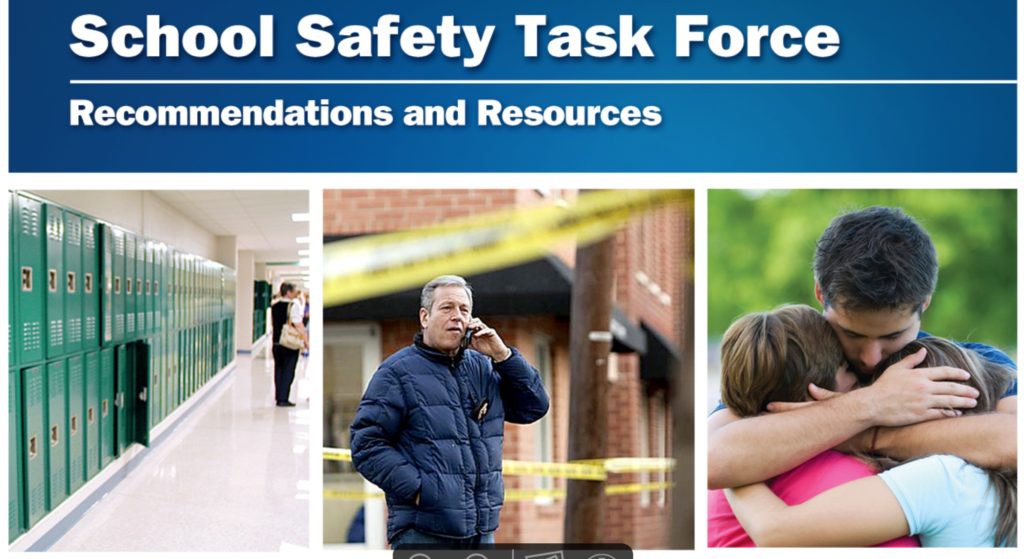
    Attorney General DeWine also worked with schools across the state to achieve greater compliance on school safety plans and convened a School Safety Task Force that issued dozens of school safety recommendations. The task force recognized that mental health awareness was essential for schools to identify and intervene with students who may be at risk.