Tag: science of reading

  • Ohio House begins discussions of state education budget proposed by governor

    Ohio House begins discussions of state education budget proposed by governor

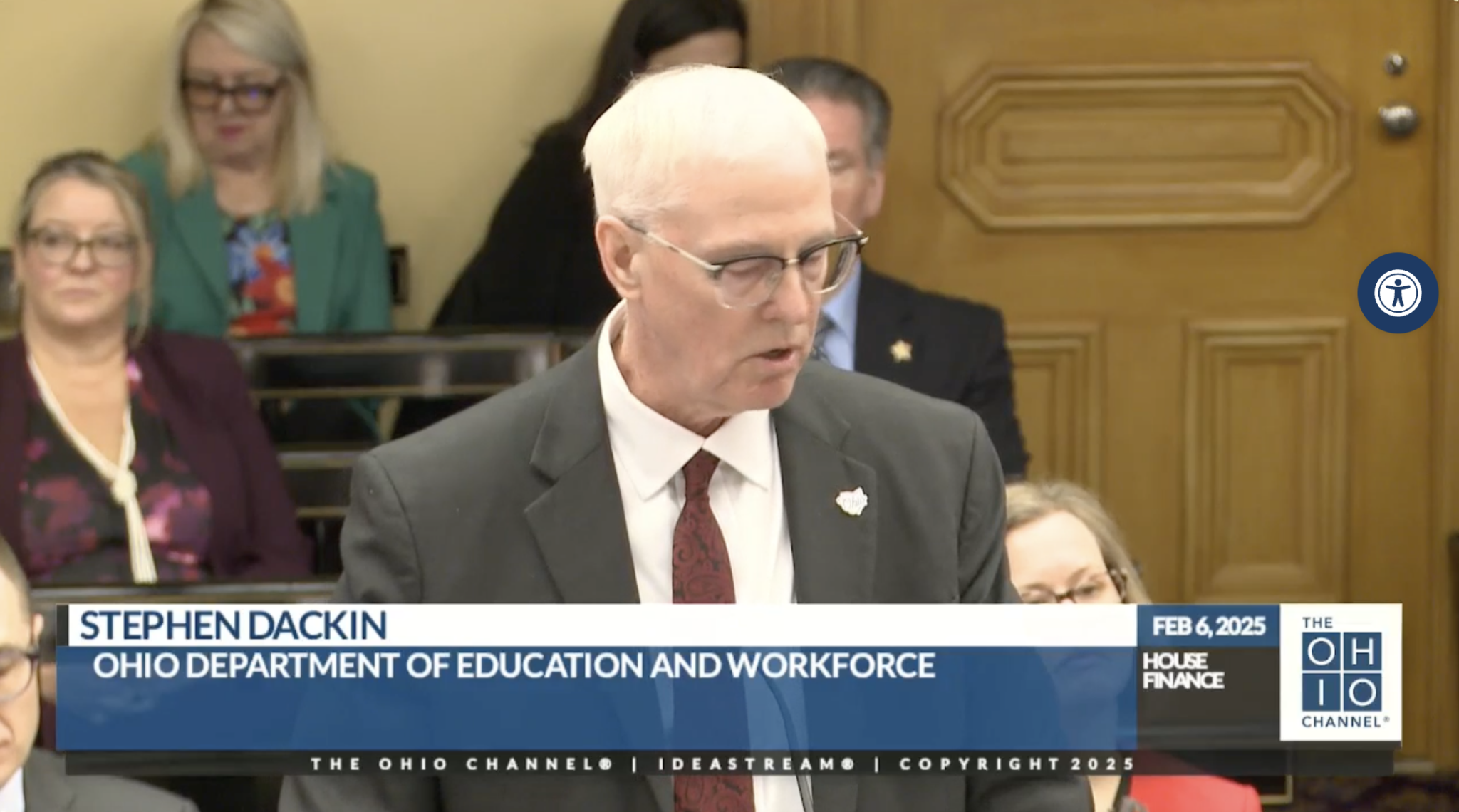
     Ohio Department of Education and Workforce Director Stephen Dackin speaks to the Ohio House Finance Committee on a new education operating budget. Photo courtesy of Ideastream/The Ohio Channel

    By:  Ohio Capital Journal

    Hearings have begun in the Ohio House Finance Committee to dissect Gov. Mike DeWine’s executive budget proposal, including a lengthy discussion on Thursday with regard to the education provisions included in it.

    “This budget takes the next steps toward fulfilling our key policy priorities,” said Ohio Department of Education and Workforce Director Stephen Dackin.

    DeWine’s proposal recommends $12.4 billion in funding to state schools in fiscal year 2026, and another $12.6 billion in 2027. That recommendation includes the final two years of a public school full fair funding formula that has been a point of contention for legislative leaders, particularly House Speaker Matt Huffman, who has called the funding model “unsustainable.”

    The governor’s proposal also gives community schools an increase in per-pupil funding and “continues access to Ohio’s five scholarship programs,” including the state’s private school voucher program.

    Many members of the House Finance Committee asked about the foundational funding for state school districts, for which the executive budget recommends a state share of 35%, with no adjustment for inflation to the “inputs” of the education costs in the formula.

    Some Republicans on the committee questioned the continued use of the Cupp-Patterson funding formula (also called the Fair School Funding Plan), along with the burden of property taxes in their districts used to pay for schools.

    “The school funding formula is inadequate and it’s inequitable,” claimed state Rep. Tom Young, R-Washington Twp. “We do not award the merit of outcomes in the funding formula.”

    While Dackin said he is “a fan of performance-based funding,” he reemphasized comments DeWine made about the overall budget when he introduced it: that the document was a starting point from which to build the final budget, with room for adjustments.

    Dackin also pushed back on concerns from Democratic members about a lack of oversight for private schools receiving significant state monies compared with the oversight public schools receive.

    “The concern for a lot of people is, what are we getting for those dollars, because we have very little oversight in how that money is being used at these schools,” said House Minority Leader Allison Russo, D-Upper Arlington.

    Dackin said there is “some measure” for schools accepting scholarship money, but he has a higher measure that he takes into account.

    “Every day, parents make a decision where to send their kids, and parents make decisions based on a variety of issues,” Dackin told the committee. “The ultimate accountability is where the parents send their kids.”

    Literacy

    Literacy is a main tenet of the governor’s education proposal, with objectives that included continuing the ReadOhio program and implementation of an Ohio Literacy Coaching Model by the Department of Education and Workforce, and further training on the Science of Reading model.

    “The department supports the use of high-quality core and intervention instructional materials, provides educator professional development and supports literary coaches who provide targeted support to schools and districts,” the budget document states.

    GET THE MORNING HEADLINES.


    The executive budget notes nearly 72,000 teachers and administrators have completed one of six “Science of Reading Professional Development pathways” as of Jan. 15 of this year, and 84 “literary coaches” were used during the 2024-2025 school year in 93 school districts in Ohio.

    Dackin told the finance committee reading is a “lynchpin skill” that is vital to successful outcomes for Ohio’s students.

    “I feel like that is our moral obligation as adults, to make sure that (bad outcomes don’t) happen in Ohio,” Dackin said. “I see no reason why Ohio can’t lead the country in literacy rates, zero.”

    The science of reading is also a priority in executive budget proposals for the Ohio Department of Children and Youth. DeWine noted a goal to improve state kindergarten readiness through a 40% increase in the number of children in licensed early care and education settings “with a curriculum aligned to the science of reading and early learning and development standards,” according to the budget document.

    Included in the plans from the governor to increase the numbers is the expansion of the Childcare Choice Voucher Program.

    A spokesperson for the governor did not elaborate on what would be expanded about the program, but a representative of the Department of Children and Youth said the program currently uses monthly payments directly to approved licensed child care providers. Families apply for the voucher through their local county Job and Family Services Department, and eligibility for the program is determined by income, family size, and job or education status.

    Families with children enrolled in licensed child care programs and monthly incomes between 146% and 200% of the federal poverty level are eligible for the voucher program, according to Kari Akins, of the children and youth department. For a family of four, that’s between $45,552 and $62,400 a year.

    Federal education uncertainty

    The Lyndon Baines Johnson Department of Education Building pictured on Nov. 25, 2024. (Photo by Shauneen Miranda/States Newsroom)  

     The Lyndon Baines Johnson Department of Education Building pictured on Nov. 25, 2024. (Photo by Shauneen Miranda/States Newsroom)

    Legislators brought up a possible federal issue during the discussions of the executive budget: whether the U.S. Department of Education will be able to provide the usual funding, or whether the department will even exist in the near future, based on President Donald Trump’s potential executive order and comments that he plans to dismantle the department.

    “We hear occasionally, from time to time in the news that there might be consideration in Washington, D.C., to change the (U.S.) Department of Education,” said state Rep. Adam Bird, R-New Richmond. “I’m curious as to whether you’ve heard whether any changes to the U.S. Department of Education might come with changes to funding for Ohio schools.”

    Dackin had a simple answer to the committee.

    “We don’t know, to be honest,” Dackin said. “We’ve received no guidance at this point, no direction from the US DOE on anything related to funding.”

    Prior to the budget discussion, Dackin joined education administrators from 10 other states in a Jan. 28 letter to “Administrator McMahon,” seemingly the currently-unconfirmed Trump nominee for Secretary of Education, Linda McMahon, asking the new administration to “prioritize … policies that trust and empower state educational agencies to shape education systems that meet the unique needs of their students.”

    Those priorities include state control of education funds and “guidance aligned with congressional intent that defers to state law and policy,” according to the letter, provided by the the Department of Education and Workforce.

    “We know that the department must work with Congress to achieve many of these changes to (the Elementary and Secondary Education Act) but, in the meantime, please defer to state and local decision-making as much as possible in your actions,” stated the letter, signed by Dackin and administrators from North Dakota, Alaska, Idaho, Wyoming, Florida, Utah, Mississippi, Indiana, Arkansas, Iowa and South Carolina.

    The executive budget will continue through hearings in education and finance committees within the Ohio House before a legislative budget document is created, and the Ohio Senate begins its own consideration. A final budget is due by July.

    YOU MAKE OUR WORK POSSIBLE.

    _________________
    Susan Tebben
    Susan Tebben

    Susan Tebben is an award-winning journalist with a decade of experience covering Ohio news, including courts and crime, Appalachian social issues, government, education, diversity and culture. She has worked for The Newark Advocate, The Glasgow (KY) Daily Times, The Athens Messenger, and WOUB Public Media. She has also had work featured on National Public Radio.

    Ohio Capital Journal is part of States Newsroom, the nation’s largest state-focused nonprofit news organization.

    MORE FROM AUTHOR

  • Reading Recovery lawsuit trying to prevent science of reading implementation in Ohio schools

    Reading Recovery lawsuit trying to prevent science of reading implementation in Ohio schools

    BY:  Ohio Capital Journal

    A lawsuit is trying to prevent a new law from changing how Ohio students learn how to read.

    Reading Recovery Council of North America, located in Worthington, filed a lawsuit on Oct. 3 in the Franklin County Court of Common Pleas to block the science of reading from being implemented in schools across the state.

    The science of reading is based on decades of research that shows how the human brain learns to read and incorporates phonemic awareness, phonics, fluency, vocabulary, and comprehension.

    Reading Recovery Council of North America’s reading intervention programs would be banned under the new law.

    The association has seen a decline in Ohio school district memberships since the state budget was signed into law and a major portion of its operating revenue comes from annual membership fees paid by Ohio members, according to the lawsuit.

    “The unconstitutional, improper and unlawful teaching, instructional and educational policy directives of the Ohio Legislature … directly and significantly impact RRCNA’s mission and outreach,” wrote David Yeagley, an attorney with Ulmer & Berne that filed the lawsuit.

    DeWine’s press secretary Dan Tierney said the governor is disappointed this lawsuit has been filed.

    “I truly believe there’s nothing more important than the science of reading, and making sure that every single child in the state of Ohio, as they are learning to read, has the benefit of the science,” DeWine said at a March 23 event. He has visited several schools to learn about how the science of reading method has been implemented in lessons.

    State budget

    A chunk of the state’s two-year operating budget goes towards implementing the science of reading — $86 million for educator professional development, $64 million for curriculum and instructional materials, and $18 million for literacy coaches.

    DeWine, who first began advocating for the science of reading during his state of the state address back in January, signed the state budget in July. He originally put the science of reading in his proposed state budget and it remained, with some tweaks, as it went through the budget process.

    “If permitted to take effect, it will allow the General Assembly to disguise a policy-based law in a must-pass appropriations bill,” the lawsuit said.  “The literacy curriculum statute intrudes on classroom teaching and learning programs, models, methodologies and materials.”

    The lawsuit argues the General Assembly is trying to set education policy and curriculum, infringing on the Ohio State Board of Education’s authority to oversee the Ohio education system.

    Three-cueing

    The budget bans teachers from using the “three-cueing approach” in lessons unless a district or a school receives a waiver from the education department or a student has an individualized education program that specifically includes the “three-cueing approach.”

    However, the lawsuit argues the budget fails to clearly articulate “a clear standard for assessing what teaching models or methods might be categorized under the “three-cueing” approach.”

    The budget defines the “three-cueing approach” as any model of teaching students to read based on meaning, structure and syntax, and visual cues. The three-cueing method encourages children to read words by asking three questions: Does it make sense? Does it sound right? Does it look right?

    Reading recovery is “often referred to or perceived as a “three-cueing” approach, and therefore is targeted as being anti-science of reading,” according to the lawsuit. “There are no recognized or established teaching, instructional or educational approaches that strictly and exclusively fall within either the “science of reading” or the “three-cueing approach.”

    Louisiana, Arkansas and Virginia have laws that ban curriculum that includes three-cueing.

    Other education lawsuit

    This is the second education lawsuit filed against DeWine that relates back to the budget bill. Seven members of the Ohio State Board of Education filed a lawsuit against DeWine on Sept. 19 to block the transfer of power over Ohio K-12 education from the board to the governor’s office.

    On Sept. 21,Franklin County Judge Karen Held Phipps issued a temporary restraining order that currently remains in place and is set to expire on Friday.

    The lawsuit is trying to prevent the Ohio Department of Education from transitioning to the Ohio Department of Education and Workforce, which would create a cabinet-level director position and puts the department under the governor’s office. These changes would also limit the State Board of Education’s power to teacher disciplinary and licensure cases and territory disputes.

    Follow OCJ Reporter Megan Henry on Twitter.


    Megan Henry
    MEGAN HENRY

    Megan Henry is a reporter for the Ohio Capital Journal and has spent the past five years reporting in Ohio on various topics including education, healthcare, business and crime. She previously worked at The Columbus Dispatch, part of the USA Today Network.

    MORE FROM AUTHOR

  • Gov. DeWine highlights science of reading provisions in the new state budget

    Gov. DeWine highlights science of reading provisions in the new state budget

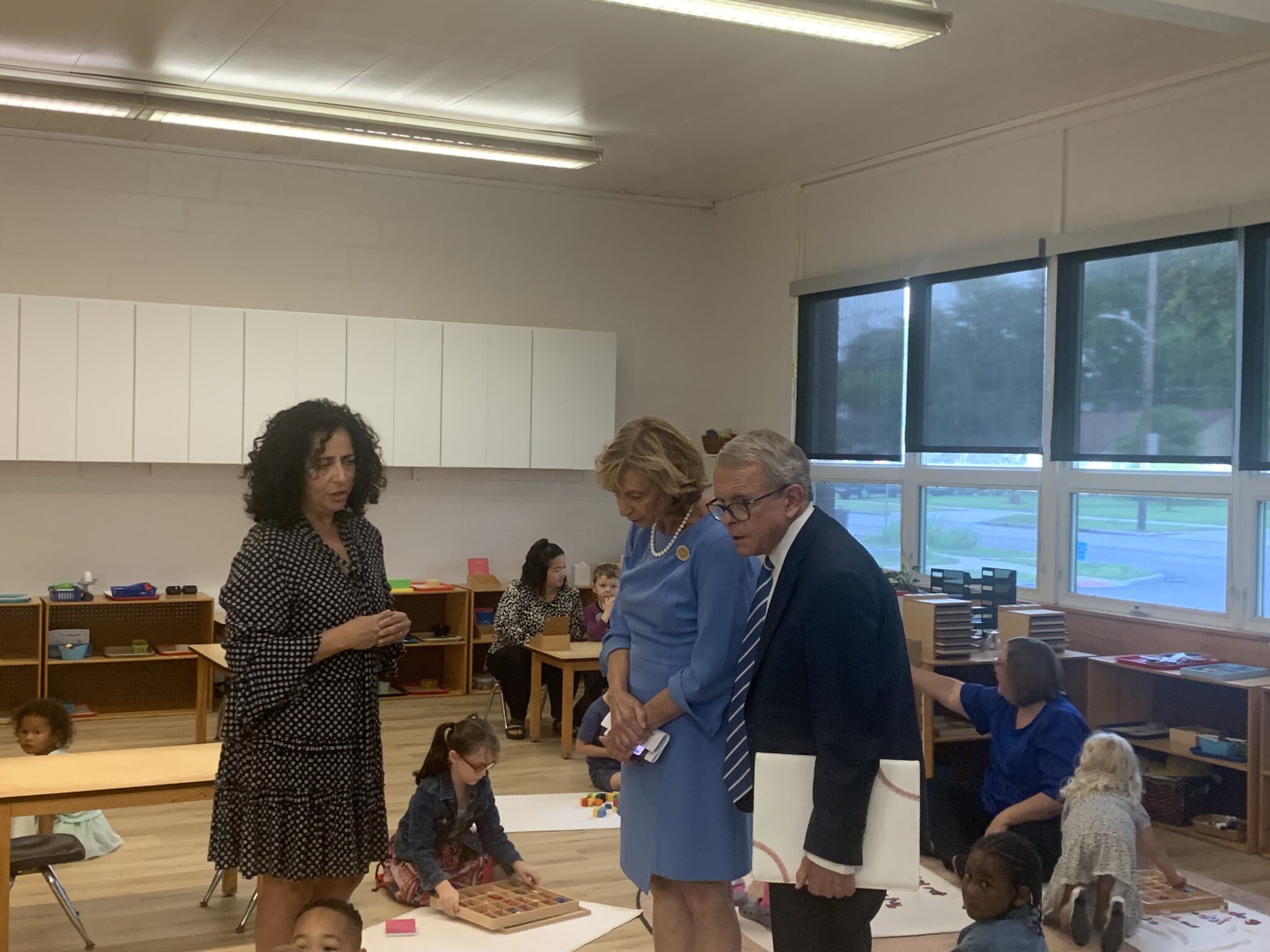
    Rekha Kohli, director of student and family services at Columbus Montessori Education Center, talks with Ohio Gov. Mike DeWine and First Lady Fran DeWine during a classroom visit about the science of reading on Aug. 10. (Photo by Megan Henry, Ohio Capital Journal.)

    A chunk of Ohio’s two-year operating budget is going toward implementing the science of reading — $86 million for educator professional development, $64 million for curriculum and instructional materials, and $18 million for literacy coaches.

    BY:  Ohio Capital Journal

    Students arranged red and blue letters to spell various words such as “lip,” “twin,” and “keys.”

    Ohio Gov. Mike DeWine and first lady Fran DeWine observed about two dozen children, ages 3-6, spelling words at Columbus Montessori Education Center Thursday morning.

    The schools aligns with the science of reading, which is based on decades of research that shows how the human brain learns to read and incorporates phonemic awareness, phonics, fluency, vocabulary, and comprehension.

    Soon all Ohio schools will align with the science of reading as a chunk of Ohio’s two-year operating budget goes towards implementation — $86 million for educator professional development, $64 million for curriculum and instructional materials, and $18 million for literacy coaches.

    “There are many instructional methods out there, but the proven best way to teach reading is through the science of reading instruction,” DeWine said. “Reading is certainly the key that unlocks the door to so many, many things.”

    DeWine said Ohio has committed $26 million in federal COVID related funding to pay for various materials and literacy coaches for non-public schools to align with the science of reading.

    “Every student in the state should have the ability to follow the science of reading,” he said. “We want to make sure that no matter where a student goes to school, they have the best opportunity to learn to read.”

    Next steps of implementation

     Photo by Megan Henry, Ohio Capital Journal. 

    It’s not clear what each Ohio school district currently uses for their reading curriculum, so the Ohio Department of Education will soon be sending out a survey to school districts to gather information that information, said Chris Woolard, interim superintendent of public instruction.

    “Any Ohio school that is not already using a curriculum that is aligned with this proven method will begin aligning to it this school year,” DeWine said.

    ODE will also come up with a list of curriculum and instructional materials that line up with the science of reading. Under the budget, Ohio schools have to start using those learning materials by the 2024-25 school year.

    The budget funds 100 literacy coaches who will help public schools with the lowest level of proficiency in literacy based on their performance in the state’s English language arts assessment. While the coaches are going to be under the direction of ODE, they won’t be employed by the department.

    “I don’t know that 100 is enough, candidly,” DeWine said. “From what we’ve seen as we’ve traveled around the state, coaches are just vitally important in the area of literacy.”

    Teacher prep programs

    The science of reading budget goes beyond K-12 schools. It also requires the Ohio Department of Higher Education Chancellor to create an audit process that documents how every educator training program aligns with teaching the science of reading instruction. The audit must be completed with summaries publicly released by March 31.

    The Chancellor will also be able to rescind the approval of educator training programs that don’t align with teaching the science of reading instruction a year after the initial audit, and programs would be evaluated every four years.

    “The challenge is many teachers were not taught this way through no fault of their own they were not taught that way. This is a big chance for many teachers, classrooms and schools. It’s not going to be done overnight,” DeWine said.

    Statewide tour

    DeWine visited about a dozen Ohio schools in the spring that align with the science of reading and often touted these statistics during the budget process — 40% of Ohio’s third-graders are not proficient in reading and 33% of third graders were not proficient in reading before COVID-19.

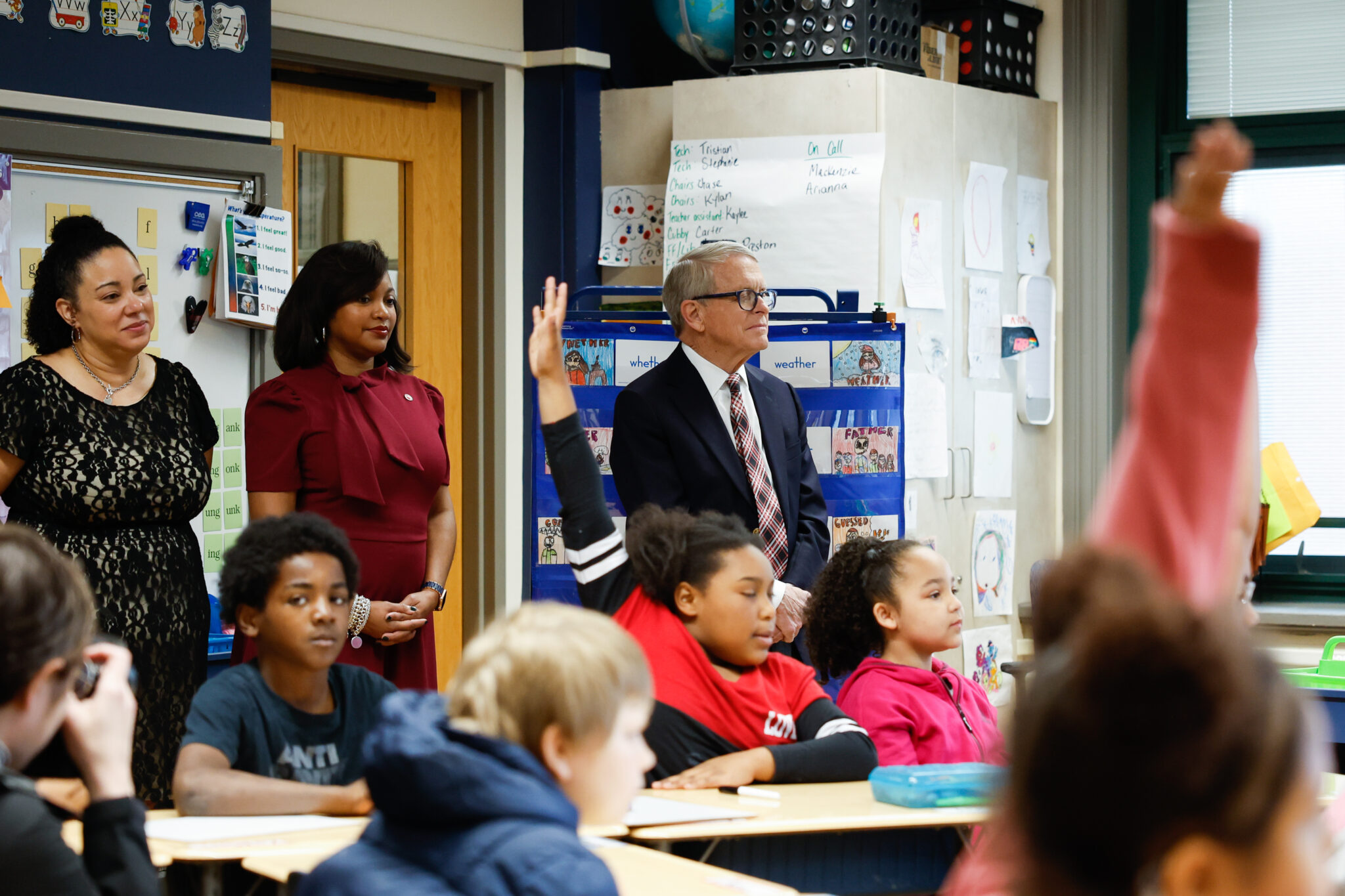
     COLUMBUS, Ohio — APRIL 06: Second grade teacher Bernadette Monroe talks to her students during a visit by Ohio Governor Mike DeWine, Principal Miracle Reynolds (left), and Interim Superintendent/CEO of Columbus City Schools, Dr. Angela Chapman, to observe the implementation of the Science of Reading program, April 6, 2023, at Southwood Elementary School in Columbus, Ohio. (Photo by Graham Stokes for Ohio Capital Journal. Republish photo only with original article.) 

    During those tours, a conversation with a particular high school student stood out to him the most.

    “The student basically said, ‘They gave up on me. I didn’t think I could ever read, but the interventional specialist started working with me and started using the science of reading and I can now read’,” DeWine said.

    An 8-minute video on ODE’s website shows highlights from DeWine’s tour.

    “It’s proven that (the science of reading) works and that it produces better readers. It’s literally like a road map to reading,” Arnita Washington, a kindergarten teacher at Warrensville Heights Elementary in Cuyahoga County said in the video.

    Students said during the video they feel confident to break down new words.

    “Your brain is putting this into your working memory, so you can apply this later when you come to words that you don’t know,” Ohio Department of Education Literacy Chief Melissa Weber-Mayrer said during the video.

    Follow OCJ Reporter Megan Henry on Twitter.


    Megan Henry
    MEGAN HENRY

    Megan Henry is a reporter for the Ohio Capital Journal and has spent the past five years reporting in Ohio on various topics including education, healthcare, business and crime. She previously worked at The Columbus Dispatch, part of the USA Today Network.

    MORE FROM AUTHOR