Tag: Secretary of State

  • LaRose uses state newsletter to promote Senate campaign

    LaRose uses state newsletter to promote Senate campaign

    Loveland, Ohio via Ohio Capital Journal

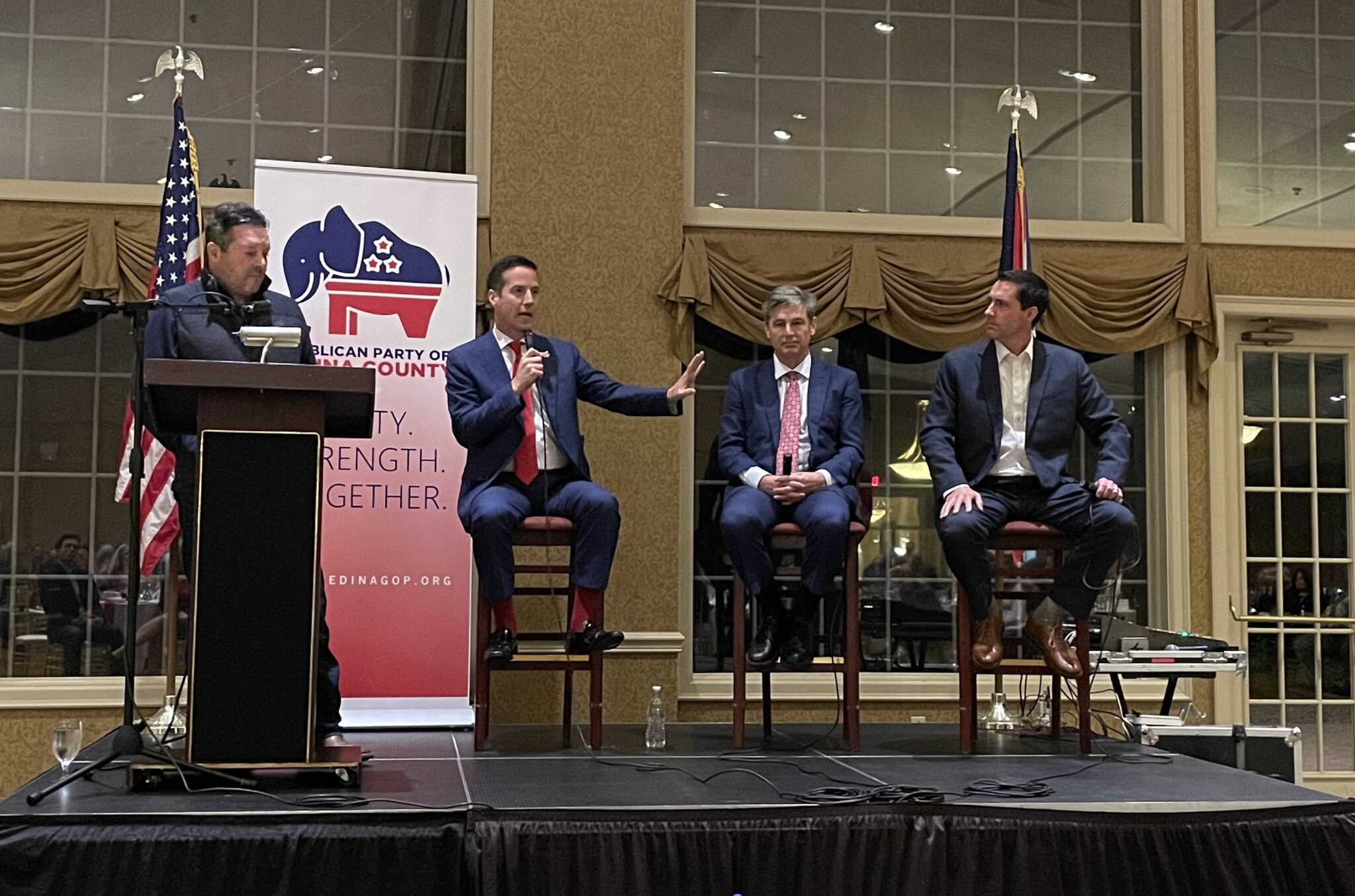
    Left to right, forum moderator, Bloomdaddy from WTAM Radio, Bernie Moreno, Sen. Matt Dolan, R-Chagrin Falls, OH Sec. of State Frank LaRose. (Photo by Nick Evans, Ohio Capital Journal.)

    BY:  

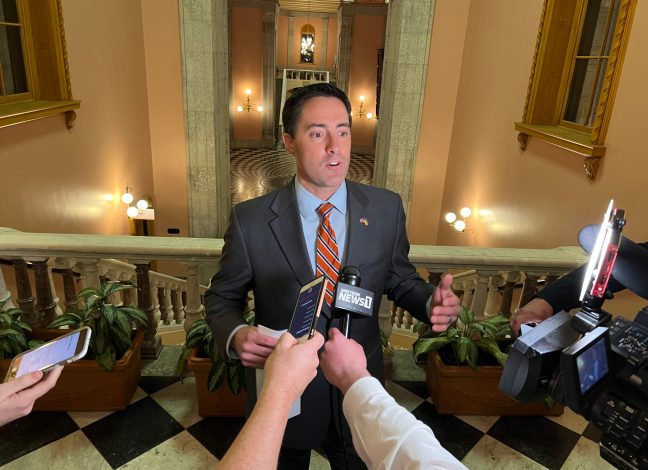
    Frustrated former employees told the press that in their office “everything revolved around” Secretary of State Frank LaRose’s run for U.S. Senate. Now LaRose appears to be using the taxpayer-funded office’s newsletter in that campaign.

    As a state official, LaRose isn’t supposed to use state resources in his political campaigns. And as secretary of state, it’s especially important that he wall off politics from his official duties because LaRose administers elections — including those in which he’s running.

    However, as he seeks the Republican nomination to take on Democratic U.S. Sen. Sherrod Brown next year, LaRose has become an increasingly hard-edged partisan as he seeks the endorsement of former President Donald Trump, who continues to attack the underpinnings of democracy itself.

    In addition to ignoring state Supreme Court orders regarding partisan gerrymandering, LaRose championed a measure in an August special election that would have made it almost impossible for citizen-initiated amendments to make it onto the ballot, much less into the Ohio Constitution. The measure failed badly, but LaRose and his allies tried to force it through ahead of a vote on an amendment protecting abortion rights that takes place a week from tomorrow, and an anti-gerrymandering amendment that is expected to be on the ballot in 2024.

    Substantial ethical questions also have arisen as LaRose juggles his senatorial ambitions with his duty to conduct secure, fair elections in Ohio.

    The Columbus Dispatch earlier this month reported on high staff turnover, with one former staffer telling the paper “Everything (in the secretary of state’s office) revolved around the Senate run.”

    Last month, NBC4 reported that LaRose was moving the secretary of state’s office from its location of 20 years and into a building where he had also registered his campaign with the Federal Election Commission.

    Then earlier this month, the Capital Journal reported that LaRose almost certainly recorded a campaign interview with election denier and conspiracy theorist Steve Bannon from the same building.

    LaRose refuses to answer questions about such activities. But he claims to have no campaign headquarters while he soon will be running his state office from the building where his campaign is registered.

    If LaRose uses people working on state time or uses state offices in his campaign, it could violate a section of Ohio law prohibiting the use of state resources to raise funds for a campaign.

    Paul Nick, executive director of the Ohio Ethics Commission, this week said his agency needs to know more about LaRose’s new office arrangements.

    “The Commission doesn’t pass judgment without first gathering and evaluating all of the facts,” Nick said in an email. “Determining whether a public official’s agency may relocate to the same office building as that official’s campaign headquarters requires deeper inquiry. We would encourage the Secretary of State to contact us for guidance on such questions.”

    Philip Richter, executive director of the Ohio Elections Commission, said his agency would have to be asked in order to look into the matter.

    “The only way for the Commission to take action on the statute is if an affidavit of complaint is filed with the Commission that would start the Commission’s processes on addressing those types of allegations,” Richter said in an email Thursday.  “The Commission cannot simply commence an investigation without the filing of a complaint.”

    Now LaRose appears to have used his office’s newsletter to promote his campaign.

    The Oct. 20 edition of the Secretary of State’s “Week in Review” offers updates about the coming election and it notes that October is Domestic Violence Awareness Month. There are also blurbs about LaRose’s travels and activities during the week.

    But the newsletter also has an “In Case You Missed It” section. It contained the top of an article by The Marietta Times that prominently featured the political message LaRose wants to convey to people who will be voting in the GOP Senate Primary.

    The second paragraph said LaRose “also confirmed his credentials as a conservative Republican who wants to make Sherrod Brown a former U.S. Senator, not the incumbent. Brown has been Ohio’s senior U.S. senator for a dozen years and the only Democratic statewide elected official in Ohio, with the exception of a few nonpartisan judicial races.”

    The newsletter then linked to the full story, which quoted LaRose bashing Brown for allegedly helping to make the country “weaker, poorer and less secure,” and the Biden administration over the economy and border security.

    LaRose’s office didn’t respond to questions about the newsletter.

    The state auditor is responsible for policing misuse of state resources. A spokesman said Thursday that a law regarding politicking in taxpayer-funded newsletters applies only to officials with “political subdivisions” such as counties. The law prohibits them from publishing a newsletter that “supports or opposes the nomination or election of a candidate for public office.”


    Marty Schladen
    MARTY SCHLADEN

    Marty Schladen has been a reporter for decades, working in Indiana, Texas and other places before returning to his native Ohio to work at The Columbus Dispatch in 2017. He’s won state and national journalism awards for investigations into utility regulation, public corruption, the environment, prescription drug spending and other matters.

    MORE FROM AUTHOR


  • Ohio Secretary of State says he didn’t call for Supreme Court chief’s ouster

    Ohio Secretary of State says he didn’t call for Supreme Court chief’s ouster

    (Photo by Susan Tebben, OCJ.) 

    BY: MARTY SCHLADEN – Ohio Capital Journal

    Ohio Secretary of State Frank LaRose on Tuesday denied that he had called for the impeachment of Ohio Supreme Court Chief Justice Maureen O’Connor after she had repeatedly ruled against LaRose and the rest of her fellow Republicans on the Ohio Redistricting Commission.

    LaRose’s comments come four days  after he told a group of Union County Republicans that Justice O’Connor had “violated her oath of office” and that for the legislature to impeach her  “may be the right thing to do”.

    Audio obtained by the OCJ of Secretary Frank LaRose speaking at a Union County Republicans breakfast last week.

    The state’s top elections official was at the Franklin County Board of Elections on Tuesday as he kicked off early voting for most of this year’s primaries. It won’t include ballots for state legislative candidates because of a dispute over gerrymandering — a fracas over the boundaries of the districts in which members of the state House and Senate will run. 

    Tired, apparently, of partisan gerrymandering, Ohio voters in 2015 overwhelmingly approved a constitutional amendment that requires districts be drawn so that the partisan makeup of the legislature resembles the partisan breakdown in recent statewide elections. 

    That’s not how things stand now. Republicans have won recent elections with about 54% of the vote, but they control 65% of the seats in the state House and 78% of the state Senate.

    This year, using the new system for the first time, the five Republicans on the seven-member redistricting commission have passed four sets of maps that O’Connor and the three Democrats on the Supreme Court have ruled are too partisan.

    Republican Justice Pat DeWine has continued to sit in the case even though several ethics experts have said he has a clear conflict because his father, Gov. Mike DeWine, is a member of the redistricting commission. Justice DeWine has voted in favor of upholding the maps that his father and the other Republicans have passed.

    Meanwhile, Republican frustration with O’Connor, who will leave the court at the end of the year, has been boiling over. Some Republican members of the legislature last month floated the idea of impeachment.

    Gov. DeWine called the notion “extraordinary” and said it’s a bad idea to talk about removing judges whenever one disagrees with their decisions. But LaRose, the secretary of state, wasn’t so reticent on Friday when asked at a Union County Republican breakfast if O’Connor should be impeached.

    “I think that she has not upheld her oath of office, and that to me is a basic test of a public servant,” he said. “That’s up to the state legislature, whether they want to impeach the chief justice or not. I certainly wouldn’t oppose it.”

    LaRose stipulated that any impeachment would take so long that “it may feel really good, and it may be the right thing to do because she’s violated her oath of office by making up what she wants the law to say instead of interpreting what it actually says. But I don’t know if it would accomplish much, but I’d be fine with it if they did.”

    At Tuesday’s event, LaRose tried to draw a distinction between saying impeachment may be the right thing to do and actually calling for it.  

    “The thing that I did was not call for anybody to be impeached,” he said. “I answered a question that was asked at a little breakfast gathering where I was with a group of supporters in Union County and what I said was, ‘It’s up to the state legislature.’ There are 33 senators and 99 representatives. If they gather evidence and hold that trial for an impeachment, if they decide as the people’s representatives to do that, then I don’t oppose that.”

    LaRose and some legislative Republicans are not alone in being frustrated by the redistricting battle. For the second time, the Supreme Court has ordered members of the commission to show why they shouldn’t be held in contempt for failing to pass maps that comply with the court’s interpretation of the state Constitution. Responses were submitted on Monday.

    Some members have argued that they shouldn’t be held individually liable for the actions of a seven-member body they don’t control. And some have argued for the court to simply impose maps on the commission would overstep its powers as a judicial body.

    LaRose on Tuesday said holding contempt proceedings is another overreach.

    “It’s a ridiculous idea that a co-equal branch of government would be held in contempt for doing our job in a way that the court doesn’t like,” he said. “What we have attempted to do all throughout this process is follow the rules that are set out in the Constitution — and not just the one part of the Constitution that the court seems to be focusing on, but all of the line-drawing rules in the Ohio Constitution.”

    LaRose was asked if he was attacking a co-equal body by publicly saying that he, a statewide official, was OK with the impeachment of a Supreme Court justice who had ruled against him.

    “Certainly not,” he said. “The Constitution lays out the process for impeaching and removing a justice from the Ohio Supreme Court or other elected officials. That’s not a power I have. I can express my opinion as a citizen just like any of us can and what I was telling this group of supporters in Union County a couple days ago is that if the state legislature found evidence and carried out that process, then I wouldn’t stand in the way of that.

    “And I certainly have concerns that the court has delved into really the politics of this more than they should have. But that’s a choice up to the General Assembly and certainly not a choice I get to make. I was simply expressing my opinion,” he said.

    Democratic Secretary of State candidate Chelsea Clark said LaRose’s comments about O’Connor make him unfit for his office.

    “It’s now obvious to anyone that Frank LaRose can’t be trusted to administer organized elections and now when he’s called out for the chaos, he wants to blame the referees,” she said in an email. “To claim ‘it would feel good’ to impeach the chief justice because he disagrees with the court’s rendering is pathetic. For someone who claims to believe in separation of powers, Secretary LaRose has no problem trying to overturn the will of the people.”

    LaRose on Tuesday said primary elections for legislative seats most likely will take place in August.

  • Early voting starts today. Here are the basics

    Early voting starts today. Here are the basics

    Getty Images photo of voters in line.

    BY: JAKE ZUCKERMAN – Ohio Capital Journal

    Despite drawn out legal battles over district lines for state legislative and U.S. House seats, yes, there’s still a May 3 primary in Ohio.

    Monday was the final day to register to vote in time to participate in the May 3 primary. Early voting starts Tuesday. Here are some of the basics from there.

    What are we voting on?

    May’s election will finalize who will represent the Democratic and Republican political parties in the 2022 elections. That includes:

    • Governor
    • Statewide offices (attorney general, auditor, treasurer, secretary of state)
    • U.S. House and Senate
    • Ohio Supreme Court

    Some races, like the Republican primary for the U.S. Senate or Democratic gubernatorial primary, are hotly contested. Some, like the Supreme Court races, are uncontested. Depending on where you live, various political subdivisions have local judicial and municipal candidates and ballot issues like school levies on the ticket as well.

    What aren’t we voting on?

    Ohio House and Senate races. Those district lines, which form 99 state House seats and 33 Senate seats, are typically reconfigured every 10 years. However, in the maiden voyage of an anti-gerrymandering amendment added by voters into the state Constitution, the Ohio Supreme Court has rejected three maps proposed by the Ohio Redistricting Commission along party lines. State Central Committee elections for both parties missed the May 3 ballot as well.  Last week, Ohio Secretary of State Frank LaRose issued a directive calling for elections to proceed, minus the races caught in the redistricting quagmire.

    State lawmakers, who control when primary elections occur, have yet to set a date for the legislative primary contests.

    Read about the third rejection here and the latest fallout here.

    How can I vote absentee?

    Complete an absentee ballot request form by April 30 and mail it to your county board of elections. The board should then provide absentee ballots. The ballot can be sent by mail by May 2 but must be received by no later than 10 days after the election, so the earlier the better.

    Voters should ensure they fill their applications out accurately and thoroughly, include their email and phone number, and track their ballot online, to ensure it’s counted, according to Secretary of State Frank LaRose.

    It can also be delivered to the board in person.

    And early voting?

    Early, in-person voting in Ohio starts April 5. It runs weekdays from 8 a.m. until 5 p.m. in the first three weeks of April and for an extra two hours in the final week of the month. It is also available the Saturday and Sunday (April 30 and May 1) before the primary.

    Do I need identification to vote?

    Yes. Acceptable forms of identification include a current, federal or Ohio government-issued photo identification card; a military identification card; a utility bill; a bank statement; a government check; or a paycheck. The Ohio Secretary of State offers further guidance and specifics on its website. Identification issued by non-Ohio states, passports, insurance cards, birth certificates and social security cards do not suffice.

    People who vote at their precincts without such identification can vote provisionally. Their vote will be counted if they return within seven days to provide qualifying identification.

  • Federal redistricting lawsuit filed as notice of impasse hits Ohio Supreme Court

    Federal redistricting lawsuit filed as notice of impasse hits Ohio Supreme Court

    Photo by Getty Image

    BY: SUSAN TEBBEN – Ohio Capital Journal

    Update: The ACLU filed a request with the Ohio Supreme Court to ask for the Ohio Redistricting Commission’s reasoning behind deciding not to file new legislative redistricting maps by the February 17 deadline. Details below:

    The leader of an anti-abortion lobby and other Ohio citizens are suing the Ohio Redistricting Commission and the Secretary of State, accusing them of depriving them of rights under the U.S. Constitution.

    Attorneys from the Columbus firm of Isaac Wiles & Burkholder, LLC, asked the U.S. District Court for the Southern District of Ohio to declare current legislative districts “or lack thereof” in violation of the U.S. Constitution, and to adopt the last plan the ORC approved. That plan, a revision of the first plan struck down by the Ohio Supreme Court, was also struck down by the high court.

    Though not members of the lawsuit in their official capacities, several of the plaintiffs are leaders or staff at Ohio Right to Life, a lobby group who works on anti-abortion measures throughout the state.

    Mike Gonidakis, president of Ohio Right to Life, is the lead plaintiff in the case, along with Mary Parker, OR2L’s director of legislative affairs. Also listed in the lawsuit is Margaret Conditt, who is on the lobby’s website as a “member trustee.”

    Beth Vanderkooi, another plaintiff in the case, is the executive director of Greater Columbus Right to Life, and Ducia Hamm was previously listed as associate director of affiliate services for Heartbeat International, and religious anti-abortion organization.

    After declaring two rounds of previous maps unconstitutional gerrymanders, the state supreme court sent the commission back to work with a Feb. 17 deadline, which the ORC passed by without adopting new maps.

    Ohio’s state legislative districts are not “substantially similar in population,” according to the lawsuit.

    With Thursday’s “impasse” of the Ohio Redistricting Commission members, the plaintiffs in the lawsuit say they “are cut out of the political process.”

    “Either the 2010 legislative districts apply and their votes are diluted by the population growth reflected in the 2020 U.S. Census data,” the lawsuit stated. “Or alternatively, they are not members of any state legislative district and cannot vote for state house of representatives or senate candidates.”

    The commission filed their notice of impasse on Friday, laying out the commission’s actions and non-actions from Feb. 7, when the supreme court invalidated the ORC revised General Assembly plan, until Thursday, when no map was approved.

    “Among other discussion, (Senate) President (Matt) Huffman stated that the commission was at an impasse, as the commission is unable to ascertain and determine a plan that complies with the court’s order and the Ohio Constitution,” the notice, written by the Ohio Attorney General’s Office, informed the supreme court.

    The federal lawsuit filed late Thursday cites the 2020 census, which showed a net gain of more than 250,000 Ohioans over the last 10 years.

    Because “valid redistricting” has yet to occur, the plaintiffs say they can’t decide on candidates to support, make a decision to run for office or “educate themselves or others on the positions of candidates in their districts and prepare to hold those candidates responsible.”

    Gonidakis and the other Ohioans acknowledged that a nearly five-month legal battle on legislative redistricting is unlikely to have a resolution before the voter registration deadline of April 4 for the May primary, which is why they requested the use of a previous map for the primary.

    The parties in the lawsuit said they chose the previously submitted maps, maps adopted without bipartisan support and called unconstitutional by the supreme court, because they “properly distribute voting power and are based on 2020 census data.”

    They worry if elections were allowed to take place before the redistricting process is resulted, overpopulated districts could see vote dilution, and thus a “deprivation of political power and resources.”

    A lack of districts deprives Ohioans of the right to vote, in violation of the U.S. Constitution and fundamental rights of Americans, the lawsuit states.

    “There is no harm in the Redistricting Commission following the U.S. Constitution and plaintiffs receiving the right to vote,” according to the lawsuit.

    The court challengers ask that a three-judge panel be assigned to the case to keep the ORC and the Secretary of State from “acting on their behalf” and implementing, enforcing or conducting elections under the current state of redistricting.

    The lawsuit also asks the court to establish a schedule “to adopt a timely enacted and lawful plan and implement the new plan for Ohio’s state legislative districts.”

    The lawsuit does not allege racial gerrymandering or any vote dilution based on racial discrimination, which the U.S. Supreme Court has set as a standard for taking any redistricting cases.

    Senate President Matt Huffman, a member of the Ohio Redistricting Commission, accused Democrats of drawing maps to favor Dems while using racial gerrymandering. The Dems were the only ones to propose a map at Thursday’s meeting of the commission, and it was voted down along party lines after a lengthy dissection, mainly by Huffman.

    This is the second federal lawsuit to be filed regarding redistricting in Ohio. In December, a pair of Mahoning County residents sued accusing the ORC of discriminating against Black voters in legislative and congressional district lines.

    That lawsuit was put on hold after district lines were invalidated, and is still awaiting court decisions on maps before proceeding.

    Court challengers asks for impasse reasoning

    On Friday, attorneys for the League of Women Voters and other court challengers asked the court to order the commission to explain their “bald refusal” to abide by the February 7 court order.

    “What steps the commission itself undertook to comply with the court’s order – and why there could be no possible plan to comply with the (state) constitution – remain shrouded in generalities,” wrote Freda Levenson, attorney for the ACLU, in a Friday filing with the supreme court.

    Levenson called out Governor Mike DeWine’s comments after the commission adjourned without a map, in which he said it was a “mistake for this commission to stop and basically say that we’re at an impasse,” and that the choice was “not an option that the law gives us.”

    The notice of impasse “provides no concrete statement of any reason why a more proportionate plan could not be enacted,” according to court challengers, and provides no no explanation of steps taken to draw a compliant plan.

    “It provides a bare conclusion, as if it were sufficient to justify the refusal to comply with this court’s order,” the court document stated.

    Levenson asked that the court order the commission to file evidence by February 22 that “must concretely identify why a compliant plan could not be drawn” and specific reasons why the commission did not consider other plans. The court document also asked for a position from the court on whether it can order an extension of the candidate filing deadline for the May primary.

  • Where Ohio’s GOP leaders are on the outcome of the election

    Where Ohio’s GOP leaders are on the outcome of the election

    By Marty Schladen – November 9, 2020 (Ohio Capital Journal)

    Some, but not all, Ohio Republican officials on Monday appeared to be distancing themselves from Donald Trump’s unsubstantiated claims that the Nov. 3 election is being stolen from him.

    Trump racked up early leads — particularly in some battleground states where Republican lawmakers refused to allow early processing of mail-in votes. A massive portion of the electorate was expected to take advantage of mail-in voting because of the coronavirus pandemic and some states, such as Ohio, were ready to start processing them weeks before Election Day.

    Also, Trump for months has been discouraging his supporters from voting by mail. So it was widely expected in states like Pennsylvania, Michigan and Wisconsin that most of the early results to come in would be from Election Day voting and would heavily favor Trump. Those would be followed by mail-in ballots heavily favoring former Vice President Joe Biden and would take days to count.

    That’s just what happened, and by late Saturday morning all major U.S. news organizations judged that Biden had built an insurmountable lead in Pennsylvania and projected him to be the winner of the election.

    By Monday afternoon Trump’s allies were talking about legal challenges to the vote in several states, but the Washington Post reported that there appeared to be no central strategy. Meanwhile, many others called on Trump to stop undermining the public faith in the electoral process and concede.

    “We all knew the counting process was going to take longer than usual this year because of the once-in-a-lifetime pandemic and higher voter turnout,” U.S. Sen Sherrod Brown, a Democrat, said over the weekend. “Counting votes and making sure every voice is heard is not fraud — it’s democracy at work. The President’s attacks on our democratic process are dangerous, but we will count every single vote.”

    U.S. Sen Sherrod Brown

    On Sunday, former President George W. Bush became the most prominent Republican to essentially declare the election over when he congratulated Biden.

    Early Monday afternoon, Ohio Gov. Mike DeWine, also a Republican, congratulated Biden, although he said Trump has every right to go to court if he wishes.

    “I congratulate Vice-President Biden,” DeWine said in a statement. “It would appear that President Trump’s legal team will be filing legal actions. The President’s lawyers have every right to present evidence in court on any legal issues or irregularities involving the election, and the courts are the proper place to hear evidence on these issues.  When lawsuits have concluded and election results are certified, it is important for all Americans to honor the outcome.”

    The office of Ohio’s top elections official, Secretary of State Frank LaRose, was more direct when asked if LaRose believed Biden had won.

    “Yes, he does,” his spokeswoman, Maggie Sheehan, said in an email.

    She pointed to an Oct. 6 statement LaRose had made on Fox News.

    “When the results on election night say one thing and then when the results change over the ensuing several weeks, that’s not a sign that something nefarious is happening,” he said. “In fact, quite the contrary. It’s a sign that the legal process is being allowed to play itself out so that every legally cast vote can be tabulated. That’s exactly what we need to do.”

    Meanwhile another Ohio Republican, Attorney General Dave Yost, is following Trump into court. Politico reported Monday that Yost’s office had filed a friend-of-the-court brief with the U.S. Supreme Court challenging a three-day extension for ballots to be received in Pennsylvania. That is one of the matters Trump and his allies are litigating.

    Attorney General Dave Yost

    Yost’s office didn’t respond when asked if the attorney general believed Biden had won the election. But Georgetown University Law Professor Josh Chafetz tweeted that the Supreme Court effort was pointless.

    Yost released a statement saying that the legal action transcends pollitics.

    “This constitutional question will come up again in future elections,” it quoted him as saying. “It is in the best interest of all Ohioans — all of America — to gain a definitive answer, regardless of politics.”

    The office of U.S. Sen. Rob Portman didn’t immediately respond when asked if he believed that Biden had won the election. But over the weekend, Portman refused to criticize Trump for appearing in the White House East Room early Wednesday morning to declare himself the winner.

    U.S. Sen. Rob Portman

    His office referenced a series of tweets posted on Friday that didn’t address whether it was right for a president to call himself the winner of an election in which vast numbers of votes hadn’t been counted.

    The office of Ohio Auditor Keith Faber, an ardent Trump supporter, didn’t respond when asked if he believed Biden had won the election.

    Ohio Treasurer Robert Sprague didn’t answer whether he thought Biden had won, but he urged patience.

    “While news organizations make projections, they do not determine the winner of the Presidential election — the people do,” he said in a statement issued by his office. “That’s why it’s important to allow the elections departments of all 50 states to continue completing their certification processes so the 2020 election can be finalized properly and in accordance with the states’ laws. This process takes time, and it’s in the best interest of our republic to ensure it’s done right, rather than done fast.”


    Marty Schladen

    Marty Schladen has been a reporter for decades, working in Indiana, Texas and other places before returning to his native Ohio to work at The Columbus Dispatch in 2017. He’s won state and national journalism awards for investigations into utility regulation, public corruption, the environment, prescription drug spending and other matters.

  • Deadline to register to vote in Ohio’s General Election is next Tuesday

    Deadline to register to vote in Ohio’s General Election is next Tuesday

    November 6 is the General Election

    The deadline to register to vote in the 2018 General Election is next Tuesday, October 9. The full, detailed and interactive 2018 elections calendar is available on the Secretary of State’s website.

    In November, voters will decide a statewide ballot initiative, as well as races for both state and federal offices. There will also be 1,661 local issues and a number of local races, which voters can obtain additional information on by contacting their county board of elections.

    Register to Vote/Update Your Address

    The deadline to register to vote or update an existing registration ahead of the November 6 General Election is October 9 (30 days before the election). Voters may go to MyOhioVote.com/VoterRegistrationto register online or update an existing registration. Voter registration forms can also be printed from MyOhioVote.com or obtained from a local library or board of elections office.

    Absentee Voting by Mail and In-Person

    All voters may begin voting on October 10 (first day after the close of registration) via in-person and by mail-in absentee ballot. For more information, visit MyOhioVote.com.

    Military & Overseas Voting

    Military voters who have not yet registered to vote or submitted a request for an absentee ballot may do so by visiting OhioMilitaryVotes.com, while overseas voters can visit OhioVoterPassport.com. There they can download the Federal Post Card Application, register to vote and request an absentee ballot, read through frequently asked questions, track the status of their mailed ballot, and sign up for election reminders via email and social media.
    Says Voter Toolkit on the top half and underneath says What would you like to do Bottom half has 4 boxes. Box1 says Track Your Ballot Box 2 says Find Your Polling Location Box 3 says View Your Sample Ballot and Box 4 says Check Your Voter Registration
  • Husted calls for replacement of Ohio’s Aging voting equipment

    Husted calls for replacement of Ohio’s Aging voting equipment

    Ohio Secretary of State Jon Husted

    Columbus, Ohio – Ohio Secretary of State Jon Husted is asking the Kasich Administration and Ohio General Assembly to include, as part of the upcoming capital appropriations bill, funding to cover the full replacement of Ohio’s aging voting machines. The majority of Ohio’s current voting equipment was purchased more than a decade ago using one-time federal funds made available through the Help America Vote Act (HAVA).

    “It is time for the state’s leaders to step forward and approve a funding plan to replace Ohio’s aging voting technology,” said Husted. “Any plan must ensure that updated voting systems are implemented in advance of the 2019 general election so that elections officials and voters alike are not using new voting equipment for the first time in the 2020 presidential election cycle.”
     
    In a letter sent to Governor John R. Kasich, Ohio Budget Director Timothy S. Keen, and leaders of the four legislative caucuses, Husted expressed the importance of updating the state’s voting machines in time for the 2020 presidential election.

    “The last time Ohio replaced its voting machines the iPhone hadn’t been released.”

     
    “The last time Ohio replaced its voting machines the iPhone hadn’t been released, people still rented movies from Blockbuster, and social media platforms like Twitter, Instagram and Snapchat didn’t exist,” Husted said. “It’s time to make updating our voting equipment a priority.”
     

    “Estimates for a statewide acquisition of new voting equipment is approximately $118 million.”

    The Department of Administrative Services (DAS) has already started exploring costs associated with the implementation of a new system. Based on that research, estimates for a statewide acquisition of new voting equipment is approximately $118 million.
     
    Husted said that since 2011 he as consistently highlighted the need to upgrade voting technology. While Secretary Husted said that he is confident that the current maintenance and operating procedures used by the local boards of elections will provide for a smooth 2018 election cycle. “The approval of funding in the upcoming capital bill will ensure continued efficiency in Ohio’s elections for years to come,” said Husted.


    Wards Corner Chiropractic & Sports Rehab

      Loveland chiropractor Douglas Portmann, DC at Wards Corner Chiropractic & Sports Rehab is one of the best chiropractors in the Loveland area
  • Ohio Ballot Board certifies proposed constitutional amendments as single ballot issues

    Ohio Ballot Board certifies proposed constitutional amendments as single ballot issues

    “Ohio communities today are saying, We don’t have a fracking, pipeline, or development problem. We have a democracy problem!” – Tish O’Dell
     
    Columbus, Ohio – The Ohio Ballot Board today certified two proposed constitutional amendments, one regarding Ohio Community Rights and the other regarding Initiative and Referendum for Counties and Townships, as single ballot issues. Both respective amendments had previously been certified by the Ohio Attorney General’s Office.
     
    Petitioners will now need to collect 305,591 signatures, which is equal to 10 percent of the total vote cast for governor in 2014, for each issue in order to place the issues on the ballot.
     
    As state government and industry attempt to strip local self-governing authority from communities across the state, residents refuse to surrender their democratic and environmental rights. Working through the Ohio Community Rights Network (OHCRN), they submitted the two proposed state constitutional amendments.
     
    It also secures the authority of communities to put in place stronger environmental rights and protections than those recognized at the state, federal, or international level, according to a statement from OHCRN.
     
    After submitting initial petitions to the State, Greg Pace, a member of the OHCRN said, “For years we have tried to protect our communities from harmful corporate projects. Today, we understand why we can’t get what we want: We are blocked by a system designed to force the harms in against our will. It is a system that refuses to recognize our right to govern our own communities. The Community Rights Amendment is the people’s way to change that.”
     
    Today, only city and village residents can exercise their inalienable right to propose and repeal laws, which is recognized under Article 2, Section 1b of the Ohio Constitution. However, nearly 39% of Ohio’s population resides in townships and counties. They do not have the same constitutional right to legislate. This amendment extends equal rights to local self-government to all Ohio residents, regardless of jurisdiction within the state.
     
    As part of the total number of signatures needed to place the measure on the ballot, petitioners must collect signatures from at least 44 of Ohio’s 88 counties, and within each of those counties, collect enough signatures equal to five percent of the total vote cast for governor in the most recent gubernatorial election, 2014.
     

    “This goes beyond fossil fuel industries,” stated Tish O’Dell, CELDF’s Ohio organizer. “The right to pass local laws regarding fracking, gun control, predatory lending, minimum wage, and more, are thwarted by state preemptive laws. And those laws are often written by industry.”

    She continued, “Ohio communities today are saying, ‘We don’t have a fracking, pipeline, or development problem. We have a democracy problem!’

  • Husted announces 100 percent of business filings now available online

    Husted announces 100 percent of business filings now available online

    Prior to 2013, no forms required to start or maintain a business were available online

    Columbus, Ohio – Secretary of State Jon Husted today announced that 100 percent of all filings needed to start or maintain a business in Ohio may now be submitted online. Additionally, business owners may now submit all Uniform Commercial Code (UCC) statements and certified search requests online. The announcement completes an effort that began in 2013, when Secretary Husted launched Ohio Business Central to modernize operations and better serve business owners.   
     
    “Since day one, our office has committed itself to working on behalf of job creators and entrepreneurs to make it easier to start and maintain a business in Ohio,” said Secretary Husted. “By improving the way our office does business, we are helping companies cut costs, save time, and reduce administrative burden so they can focus on providing quality services and products, as well as create jobs.” 
     
    Three out of four Ohio businesses are now started using Ohio Business Central, and 274,196 filings have been processed online since 2013 according to Husted. “The expanded use of online filings has helped to boost overall filings in recent years. So far, 71,979 new entities have filed to do business in Ohio this year – up by 9,500 over the same time-frame last year. Additionally, March 2017 marked the best month in Ohio history for new businesses with the filings of 12,827 entities.”    
     
    “In this day and age, everything is technology-based,” said Andrew E. Doehrel, President and CEO of the Ohio Chamber of Commerce. “Businesses need to operate at the ‘speed of business,’ which means they need government to operate at the speed of business.” 


    Accounting Plus LLC

     
    Accounting Plus–Bingaman Accounting and Tax Service, LLC is a tax preparation, payroll and bookkeeping company locally based in Loveland, OH.