

Tag: Sen. Jerry Cirino

  • ‘The bill is very racist.’ Ohio House Democrats question Republican senator on his higher ed bill

    ‘The bill is very racist.’ Ohio House Democrats question Republican senator on his higher ed bill

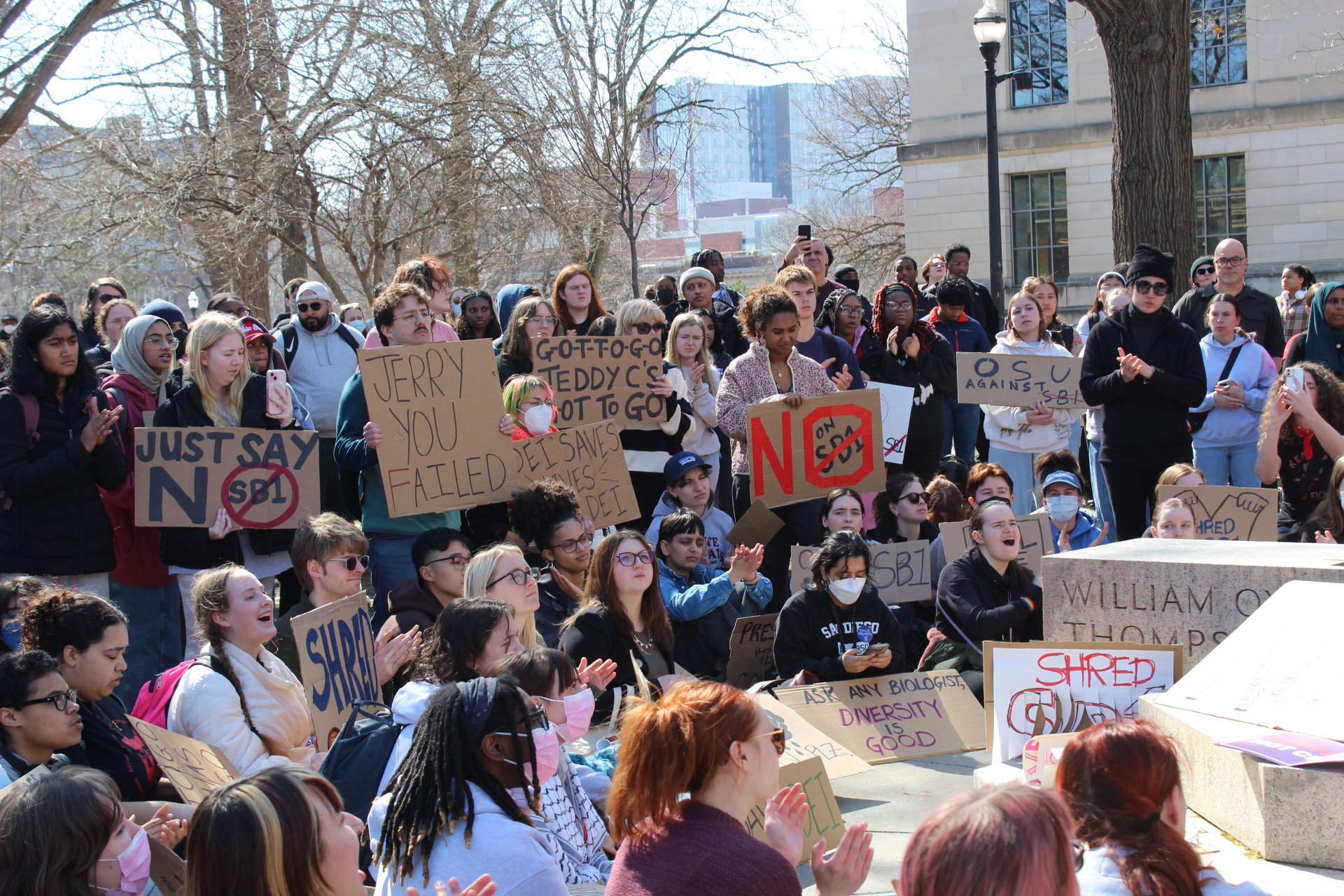
     Hundreds of students protested against Senate Bill 1 on Ohio State’s campus on March 4, 2025. (Photo by Megan Henry, Ohio Capital Journal).

    By:  Ohio Capital Journal

    Ohio Democrats peppered Republican state Sen. Jerry Cirino with questions over his higher education overhaul bill this week. The bill would ban faculty strikes and diversity efforts on campus, as well as set rules around classroom discussion.

    One Democratic lawmaker called the bill racist.

    Cirino gave sponsor testimony on Senate Bill 1 Tuesday afternoon during the Ohio House Higher Education and Workforce Committee meeting.

     State Sen. Jerry C. Cirino, R-Lake County. (Photo from Ohio Senate website.) 

    “S.B. 1 is about more speech, not less,” he said. “It is about creating an environment of continuous improvement. It is about the core value that students come first; they are the customers of these institutions.”

    Senate Bill 1 would ban diversity and inclusion efforts, block faculty from striking, set rules around classroom discussion, put diversity scholarships at risk, shorten university board of trustees terms from nine years to six, and require students take an American history course, among other things.

    Regarding classroom discussion, it would set rules around topics involving “controversial beliefs” such as climate policies, electoral politics, foreign policy, diversity and inclusion programs, immigration policy, marriage, or abortion.

    S.B. 1, which only applies to public colleges, stipulates classroom discussion allows students to “reach their own conclusions about all controversial beliefs or policies and shall not seek to indoctrinate any social, political, or religious point of view.”

     State Rep. Desiree Tims, D-Dayton. (Photo from Ballotpedia.) 

    “I think the bill is very racist,” state Rep. Desiree Tims, D-Dayton, said during Tuesday’s committee meeting.

    The Ohio Senate passed S.B. 1 last month and hundreds of students, faculty and staff protested S.B.1 at Ohio State University as Cirino gave his sponsor testimony Tuesday afternoon.

    Tims asked Cirino why he was interested in getting rid of diversity scholarships and Cirino responded by saying Ohio Attorney General Dave Yost addressed race-based scholarships last year.

    “We have guidance from the attorney general that we cannot do those,” Cirino said. “Our institutions may not do those things based on race.”

    In 2023, the U.S. Supreme Court ruled that Harvard and the University of North Carolina violated the Equal Protection clause of the 14th Amendment by using race as a factor in applications. The days after the ruling, Yost sent a letter to Ohio colleges and universities saying his office won’t legally protect someone at a college or university who uses race as a factor.

    “How is it that you want diversity of thought, but not diversity of people at these public institutions that would bring that diversity?” state Rep. Joe Miller, D-Amherst, asked.

    Cirino responded by saying diversity of thought and programs that promote diversity and inclusion are not comparable.

    “You cannot discriminate against one group to make up for discrimination of another group,” Cirino said.

    Miller also asked about whether limiting speech through legislation, such as this bill, is a slippery slope.

    “There’s absolutely not one limitation of what can be talked about in the classroom,” Cirino said in his response. “What we say very specifically and explicitly in the bill is that there has to be an openness to looking at other opinions and welcoming diverse opinions as well.”

    State Rep. Beryl Brown Piccolantonio, D-Gahanna, asked about the retrenchment and collective bargaining parts of the bill.

    GET THE MORNING HEADLINES.


    “We need to treat our institutions of higher learning a little bit more like a business,” Cirino said. “If we don’t help (university presidents and boards of trustees) with these management tools, we’re going to find a real disadvantage for the state of Ohio.”

    Piccolantonio questioned if this bill is giving lawmakers more control over public universities.

    “It is clearly not the legislature trying to step in and operate the college or university,” Cirino said. “It’s about empowering the boards of trustees, the governing board and the presidents.”

    Piccolantonio also asked if Cirino would be open to making any changes to the bill and he said no, reminding committee members that this bill went through 11 revisions in the last General Assembly.

    “This bill is matured and it’s ready to go,” Cirino said. In the version of the bill passed last month by the Ohio Senate, most of the changes made in the last General Assembly were rolled back.

    More than 800 people submitted opponent testimony against the bill — significantly outweighing the amount of supporter testimony the bill has received. Several students have said they would leave Ohio if this bill passed.

    When state Rep. Munira Abdullahi, D-Columbus, asked about so many students opposing the bill, Cirino said legislation is not developed based on how many people come to testify.

    “If we started doing that, it would be a popularity contest, and we should all take a huge pay cut because we’re getting paid, in my view, to make policies sometimes, whether it’s popular or not, if we think it is the right thing to do and good for the state of Ohio,” Cirino said.

    Abdullahi also asked why the bill would ban higher education faculty from striking.

    “Simply because higher education, all postsecondary education, is absolutely critical to us in Ohio if we’re going to maintain a strong economy in the future and meet the workforce requirements that we need to meet in order to employ people and to provide the workers that our companies are looking for,” Cirino said.

    Follow Capital Journal Reporter Megan Henry on Bluesky.

    YOU MAKE OUR WORK POSSIBLE.

    ________________
    Megan Henry
    Megan Henry

    Megan Henry is a reporter for the Ohio Capital Journal and has spent the past five years reporting in Ohio on various topics including education, healthcare, business and crime. She previously worked at The Columbus Dispatch, part of the USA Today Network.

    Ohio Capital Journal is part of States Newsroom, the nation’s largest state-focused nonprofit news organization.

    MORE FROM AUTHOR

  • Ohio GOP lawmaker again proposes to overhaul higher ed, ban diversity efforts and labor strikes

    Ohio GOP lawmaker again proposes to overhaul higher ed, ban diversity efforts and labor strikes

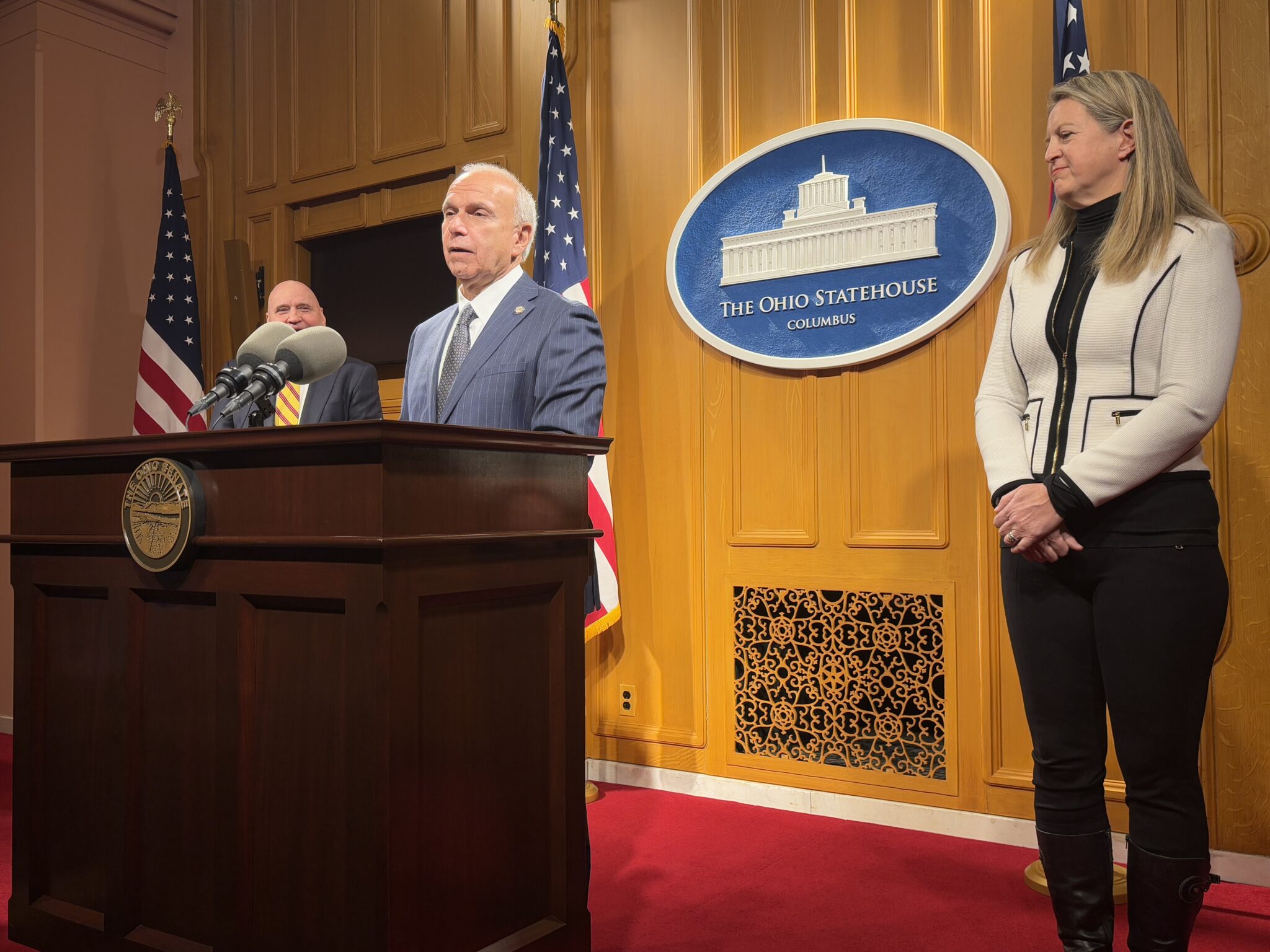
     Ohio State Sen. Jerry Cirino, R-Kirtland, introduced Senate Bill 1 on Jan. 22, 2025. (Photo by Megan Henry, Ohio Capital Journal).

    Cirino’s proposed overhaul failed to move forward under previous Ohio House Speaker Jason Stephens, but has new potential life under Speaker Matt Huffman

    By:  Ohio Capital Journal

    A Republican state senator has reintroduced a controversial proposal to massively overhaul higher education in Ohio, including a ban on diversity and inclusion efforts as well as a ban on labor strikes by faculty and staff.

    Kirtland Republican state Sen. Jerry Cirino’s proposed Senate Bill 1 — the Advance Ohio Higher Education Act — was introduced during a press conference Wednesday and is similar to the bill Cirino introduced during the last General Assembly, with some additions.

    “It’s called Senate Bill 1 for a reason,” Cirino said. “It is our top priority, and we’re going to move this along quickly. … We’ve already had a lot of hearings on Senate Bill 83.”

    He said the bill is going to be on a fast track and Senate Higher Education Committee Chair Kristina Roegner said hearings on the bill will likely start next week.

    “We are promoting more speech, not less speech, as some of our opponents have said, more discussion and debate on all topics, less indoctrination, institutional support by trustee actions and policy moves that we’re requiring the trustees to make, to support an environment of diversity of thought,” Cirino claimed.

    S.B. 1 includes “virtually everything from Senate Bill 83,” said Cirino, who is the vice chair of the Ohio Senate Higher Education Committee.

    GET THE MORNING HEADLINES.


    Cirino’s former higher education bill, Senate Bill 83, was unable to make it across the finish line during the previous General Assembly. It passed in the Senate and in the House committee, but former Ohio House Speaker Jason Stephens, R-Kitt Hill, never brought it to the House floor for a vote. The previous bill underwent 11 revisions.

    Cirino made good on his promise to reintroduce a similar bill in January and the bill could have an easier time in the House now that Matt Huffman, R-Lima, is the House Speaker.  Lawmakers in the Ohio House plan on introducing a companion bill.

    What is in S.B. 1?

    S.B. 1 has yet to be posted online, but Cirino said the bill includes a post-tenure review, annual performance reviews of faculty, a retrenchment provision that would block unions from negotiating on tenure and public syllabuses. The bill would prohibit political and ideological litmus tests in hiring, promotion, and admissions decisions.

    A big change with S.B. 1 is banning diversity, equity and inclusion courses in addition to the trainings. The former bill would have banned mandatory diversity, equity and inclusion training unless it is required to comply with state and federal law, professional licensure requirements or receiving accreditation or grants.

    “(DEI) has become institutionalized discrimination paid for by the taxpayers,” Cirino said.

    Ohio House Rep. Bob Young, R-Dayton, said the focus of the bill shouldn’t be the DEI ban.

    “Let’s truly focus on why we’re here and who we are in higher education, and that is to educate a workforce to compete globally and grow Ohio and jobs and families and attract more people to come in,” Young said.

    The on faculty and staff’s ability to strike is back in the bill, something Cirino claimed was not an anti-labor issue.

    “When a student signs up for instruction for a semester, they pay in advance, or they can’t go into the class,” Cirino said. “That represents a contract between the students and the institution, and because there are public institutions, therefore a contract with the state, they have to deliver that instruction and trade for the dollars per pen.”

    Youngstown State University workers went on strike for a few days in 2020 over pay disputes, and Wright State University went on strike for almost three weeks in January 2019 over pay disputes and health care.

    “The threat of (a strike) is what is used, and the students are being used as pawns in order to get better working hours, a better dental plan, or whatever the case may be,” Cirino said. “If we value higher education the way we do, we should also value the fact that that contract needs to be fulfilled, and nothing except force majeure should ever get in the way of students getting what they have paid in advance for.”

    S.B. 1 would shorten university board of trustees terms from nine years down to six years.

    “It’s been difficult to find trustees willing to make nine year commitments and the governor agrees with this,” Cirino said. “We’re talking about not just changing their terms, but also requiring new trustee training programs that would be adjudicated through the Chancellor’s Office.”

    Requiring students to take an American history course is also back in the bill.

    “I have become more and more convinced of that necessity over time now, since we first wrote the bill, as I’ve talked with more and more young people who have no clue about so many important things about our history and our founding documents and so on,” Cirino said.

    Opposition to S.B. 1

    Cirino acknowledged there will be lots of opposition with S.B. 1, just as there was with his previous bill.

    “Senate Bill 1 is a misguided attempt to micromanage higher education in Ohio, imposing unnecessary restrictions on our universities, faculty, and students,” state Sen. Casey Weinstein, D-Hudson, said in a statement.

    More than a dozen students from the Ohio Student Association protested S.B. 1 with chants of “When Black studies are under attack, what do we do? Stand up, fight,” and “Higher ed will be dead,” among others.

    “The students that were out here protesting are probably getting extra credit for being here,” Cirino said. “I don’t believe that they have studied the bill and all the implications of this legislation and the impact on higher education in Ohio. I believe that they were asked to be here by their professors.”

     Brielle Shorter, a 20-year-old Ohio State University student, protests against Senate Bill 1 on Jan. 22, 2025. (Photo by Megan Henry, Ohio Capital Journal). 

    Brielle Shorter, a 20-year-old Ohio State University student, was among the students who protested against the bill Wednesday.

    “No, we are not here for extra credit,” she said. “That’s not how this works. I believe that this bill is being pushed very fast and very rapidly.”

    Pranav Jani, president of the Ohio State University chapter of the American Association of University Professors and an English professor, said Cirino’s quip about students protesting for extra credit is “one of the most insulting things I’ve ever heard said about students.”

    “It shows how out of touch he is with what happens in the classroom,” Jani said.

    If this bill is signed into law, Shorter — who is from Cincinnati and wants to be a psychiatrist — said she would go out-of-state to continue her education.

    “I fear that I can no longer call Ohio my home,” Shorter said. “It feels like students are being pushed out, and it feels like I might be one of them.”

    Many college students have said they would move out of Ohio if this bill was signed into law, but Cirino called that “a red herring” during Wednesday’s press conference.

    Education organizations were quick to oppose S.B. 1.

    “(S.B. 1) uses culture war politics to attack workers’ rights and turn campuses into hostile environments for people of color, immigrants, and other marginalized communities,” Ohio Federation of Teachers President Melissa Cropper said in a statement.

    Ohio Conference of the American Association of University Professors Executive Director Sara Kilpatrick hopes Cirino will listen to the students’ concerns with this bill.

    “He’s not interested in hearing opposing views, which shows that this bill isn’t about intellectual diversity, but is actually about pushing a partisan agenda,” Kilpatrick said in a statement.

    Follow OCJ Reporter Megan Henry on Bluesky.

    YOU MAKE OUR WORK POSSIBLE.
    ________________
    Megan Henry
    Megan Henry

    Megan Henry is a reporter for the Ohio Capital Journal and has spent the past five years reporting in Ohio on various topics including education, healthcare, business and crime. She previously worked at The Columbus Dispatch, part of the USA Today Network.

    Ohio Capital Journal is part of States Newsroom, the nation’s largest state-focused nonprofit news organization.

    MORE FROM AUTHOR