Tag: Sen. Matt Dolan

  • A clean sweep: How Bernie Moreno became Ohio’s Republican U.S. Senate nominee

    A clean sweep: How Bernie Moreno became Ohio’s Republican U.S. Senate nominee

    BY:  Ohio Capital Journal

    Tuesday night went about as well as Ohio’s Republican U.S. Senate nominee Bernie Moreno could’ve dreamed. Despite a three-person race, Moreno was able to secure a majority of GOP voters and won in all 88 of Ohio’s counties. And it’s a victory that cements former President’s Donald Trump’s influence in the state. In two elections in a row, Trump’s favored candidates have been able to fend off challengers from the party’s establishment conservative wings.

    Turnout

    But the primary also offered an interesting test: with Trump’s own nomination in the bag, would his backing still drive MAGA voters to the polls?

    The answer was a qualified yes. Tuesday’s primary election brought out 22% of registered voters. That’s far lower than 2016’s still-hotly contested presidential primary in Ohio, but it falls right between the two most recent primaries in 2020 and 2022. When it comes the raw figures, GOP voters cast a nearly identical number of ballots as they did in 2022 and about 200,000 more than they did in 2020.

    “I think most experts were expecting a drop off,” University of Akron political scientist David Cohen said. “I think the (Matt) Dolan and (Frank) LaRose campaigns were hoping for a drop off, but obviously that didn’t happen.”

    “The numbers for Moreno are really kind of surprising,” he added, calling it “a clean sweep.”

    “Most people including myself were expecting a Moreno win, but I wasn’t expecting (a margin of) almost 18% — that’s crazy. A three-person race where he wins a majority of the Republican vote? That is really unexpected,” Cohen said.

    Meanwhile, political scientist David Niven from the University of Cincinnati turned the question of turnout back on the Democrats.

    “The lowest turnout in the state was Hamilton County. The second lowest turnout in the state was Franklin County,” Niven said. “Democrats obviously didn’t have a competitive Senate race, but oh my — I mean, the 87 and 88th counties for turnout were two of the absolute lynchpins of any kind of Democratic path to success.”

    Niven downplayed the overall turnout figures, though, as reflecting “an overall dearth of energy.” Even if it didn’t crater, he said, matching an off-cycle primary and a by-then uncontested presidential primary, during a pandemic no less, isn’t that high a bar.

    Still, Niven said, “It is really notable that more than twice as many Republicans showed up as Democrats. Even with a competitive Senate primary, that is a major red flag for Democrats.”

    Trump effect

    Former president Donald Trump cast a long shadow over Ohio’s GOP Senate primary. While Moreno and Ohio Secretary of State Frank LaRose jockeyed for his endorsement, state Sen. Matt Dolan, R-Chagrin Falls, argued his legislative record best mirrored Trump’s platform. All three built their pitch to voters around issues like immigration and border enforcement that Trump has made the centerpiece of his campaign.

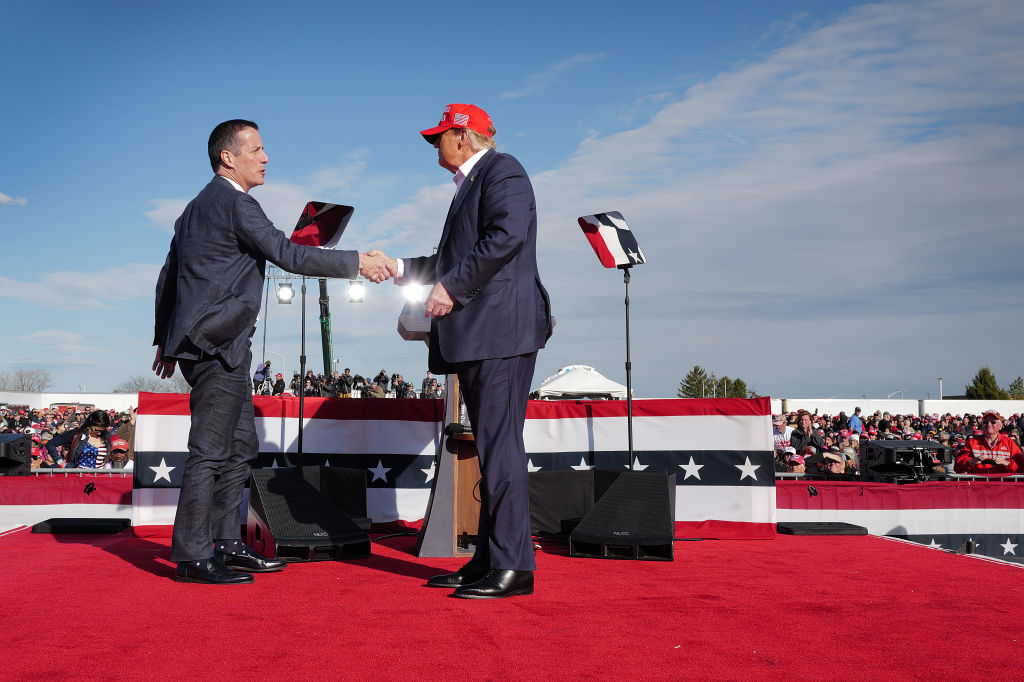
    But nowhere was Trump’s influence more apparent than in his last-minute rally in Dayton.

    “It sure looks like Donald Trump was really able to motivate his base to vote yesterday,” Cohen said.

    “I just think that the results yesterday show that the Ohio Republican Party is now Trump’s party,” Cohen continued, “the Republican base in Ohio is Trump’s base, and there doesn’t really seem to be any going back.”

    He argued that’s not necessarily a recipe for long-term success but it’s still pretty hard to ignore.

    As Election Day drew nearer, polls had indicated the race was close and Dolan might even have an advantage. More establishment-leaning GOP figures like Gov. Mike DeWine former U.S. Sen. Rob Portman, broke for Dolan before Trump announced his visit.

    “I don’t think it would be a shock to anybody to realize that the country club, polite-mannered (Republican) party in Ohio is no more,” Niven said. “I do think it’s notable that Portman and DeWine thought they could ride in and save Dolan. I do think that’s the very last gasp of that sort of thing in Ohio politics —their day has passed.”

    Wednesday, DeWine said he would support Moreno and Trump in the general election.

    Niven as well pointed to the rally as an important factor in Moreno’s success. It created a “saturation point,” he said, reminding Ohioans who’d begun tuning out election ads that Moreno is Trump’s pick.

    “If every Republican in Ohio knows who the endorsed candidate is,” he explained, “Bernie Moreno wins the primary, and the rally went a long way toward that.”

    One mission

    In the final weeks of the primary campaign the attacks grew personal and bitter. It was clear during his victory speech that Moreno was still smarting, but he brushed off the campaign season hostility.

    “One of the things that we do as Republicans is we have spirited debates,” Moreno said, “Now maybe it’s like a little too spirited, could’ve been a little less spirited, right? But we have spirited debates and that’s okay.”

    “What we have to do now is, as a fully united party, understand we have one mission which is to get rid of Sherrod Brown,” Moreno said.


    In a social media post conceding the race, LaRose struck a similar note, saying, “The family disagreements that define partisan primaries are behind us.”

    Moreno could get a boost from having Donald Trump at the top of the ticket. The former president has twice won Ohio by eight points. But that track record could cut the other way, too. A cash-strapped Trump campaign may focus its efforts on states that are in play rather than a state it’s likely to win.

    Despite recent polling that shows Trump with an even bigger advantage, Cohen predicted the race will tighten before November. Given an improving economy and Republicans taking the losing side on a 2023 reproductive rights ballot measure, he doubts Trump will be able to match his previous showings in the state. Cohen also pointed to former South Carolina Gov. Nikki Haley collecting 14% of Ohio’s Republican presidential votes despite exiting the race about two weeks before the election.

    Ohio’s recent history of split-ticket could also present an opening for Brown even if Trump carries the state. Brown benefitted from voters backing candidates from both parties in 2018, but Niven noted the state has shifted to the right in the past six years.

    “The bottom line here is if Sherrod Brown’s campaign can make this a choice between two people, he can still win this thing,” Niven said. “If this campaign boils down to a choice between two parties, he cannot win this thing, the gulf is too large.”

    “So, if it’s a question of people, I think the Brown campaign looks at this as an ideal outcome,” he added. “If it’s a question of party, he’s swimming against a tide that’s just getting bigger and stronger.”

    Follow OCJ Reporter Nick Evans on Twitter.


    Nick Evans
    NICK EVANS

    Nick Evans has spent the past seven years reporting for NPR member stations in Florida and Ohio. He got his start in Tallahassee, covering issues like redistricting, same sex marriage and medical marijuana. Since arriving in Columbus in 2018, he has covered everything from city council to football. His work on Ohio politics and local policing have been featured numerous times on NPR.

    Ohio Capital Journal is part of States Newsroom, the nation’s largest state-focused nonprofit news organization.

    MORE FROM AUTHOR

  • Ohio Republican Senate candidate forum devolves into near fight

    Ohio Republican Senate candidate forum devolves into near fight

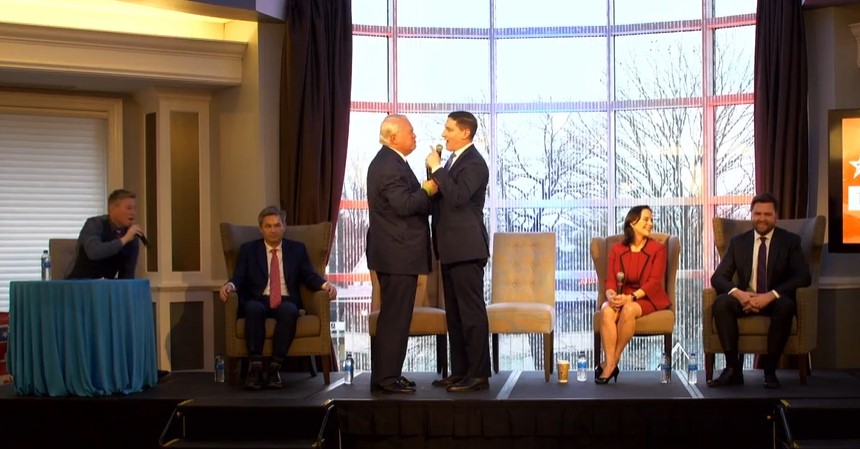
    Mike Gibbons, left, and Josh Mandel, right, have a heated exchange. Photo by Nick Evans, OCJ.

    BY: NICK EVANS – Ohio Capital Journal

    The leading candidates for the Ohio Republican U.S. Senate nomination met in Gahanna Friday. Two of them nearly came to blows.

    The candidate forum hosted by FreedomWorks didn’t make it through opening statements before former Ohio Treasurer Josh Mandel began attacking investment banker Mike Gibbons. The other candidates, state Sen. Matt Dolan, former GOP chair Jane Timken and author J.D. Vance did their best to avoid the fracas.

    The substance

    The moderator took candidates through foreign policy, big tech “censorship” (twice), critical race theory, the opioid crisis and their feelings on Donald Trump’s presidency. The candidates largely agreed on support for Ukraine, but complained about how Congress approved a nearly $14 billion support package.

    “You can not just put, in the dark of night, all of these spending provisions into a bill, plop it on peoples’ desks and say you’ve got 12 hours to vote for this,” Dolan argued.

    Vance has argued against engaging the Ukraine war — raising eyebrows by saying he didn’t really care what happened. His position hasn’t really changed, but the framing has. Instead of emphasizing neglect, he uses the conflict to criticize establishment Republicans who couldn’t fund Trump’s border wall and to warn against American adventurism.

    “The only thing that will salvage Joe Biden’s presidency is if a bunch of stupid, weak-willed Republicans let this guy bumble us into a war that we have no business fighting,” he told the crowd.

    Biden has, from the outset and repeatedly since, insisted that American troops will not be sent to fight in Ukraine.

    Timken decried big tech as, “the weapon of the cancel culture and the woke left.”

    But beneath the red meat rhetoric, their arguments weren’t that dissimilar from what many on the left have demanded. Break them up, don’t let companies profit on your data, reform or eliminate section 230, the candidates argued.

    “There is no reason that Facebook or Meta as it’s called should be as powerful as it is, and also, meddling in our elections,” Timken said.

    The confrontation

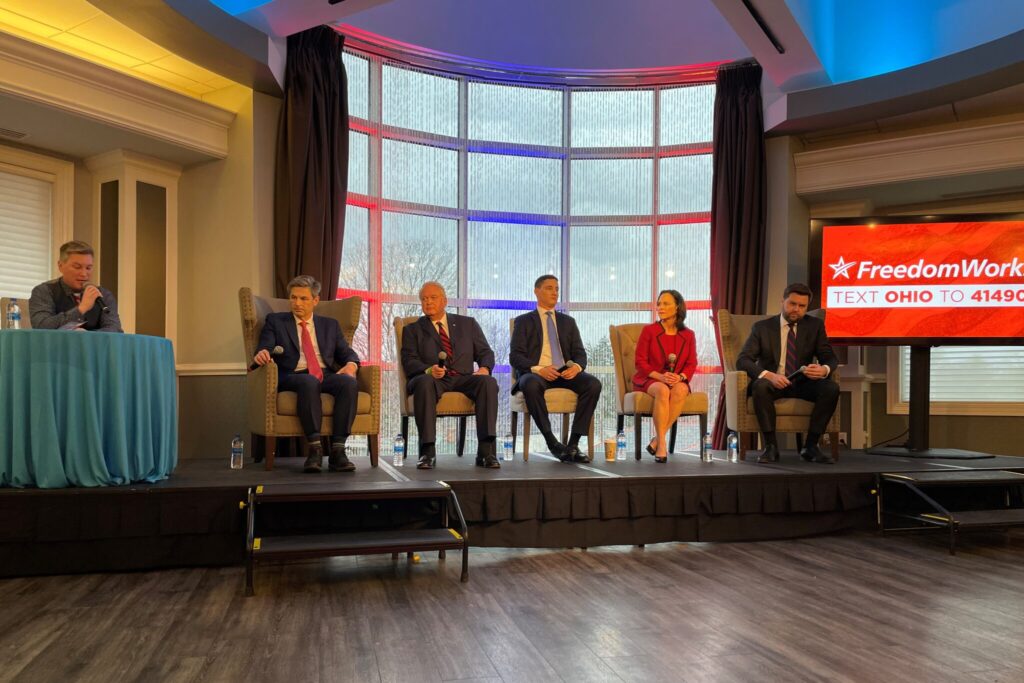
     From left, moderator Brandon Boxer, Matt Dolan, Mike Gibbons, Josh Mandel, Jane Timken and J.D. Vance. Photo by Nick Evans, OCJ.

    Almost immediately, it became clear that Mandel would use the forum to attack Gibbons. In his opening statements Mandel argued the fight for the “soul of the Republican Party” was even more important than the fight against Democrats.

    “Here’s the fork in the roads,” he argued. “Down one path goes these squishy, RINO Republicans many of whom have been pro-China over the years.”

    He rattled off the list of excommunicated Republicans — Liz Cheney, Adam Kinzinger, Mitt Romney — before turning to Gibbons.

    “(He) had all these companies here in America and made money selling them to China,” Mandel said. “That is not the path that we should be taking in this country.”

    Mandel repeatedly steered his answers into Gibbons’ investment holdings criticizing him for shipping Ohio jobs overseas, selling companies “to China,” or simply holding stock in Chinese firms. By the third time he tried it, Mandel’s tactic was met with sustained boos from the crowd.

    “Again Josh is showing his ignorance,” Gibbons said after one critique tied to Lordstown Motors. He then turned to the former state treasurer and asked, “Josh, do you know anything about economics or finance at all?”

    Gibbons also made a dig he uses regularly on the campaign trail — Mandel has “zero” experience in the private sector.

    That’s incorrect. Mandel has served on corporate boards and advised payday lenders since leaving office in 2019. He also served in the military.

    The confrontation between the two became more heated, with Mandel jumping out of his seat after Gibbons told Mandel, “You might not understand this,” about a stock trade.

    “You’ve never been in the private sector in your entire life,” Gibbons insisted. “You don’t know squat.”

    “Two tours in Iraq,” Mandel growled, “don’t tell me I haven’t worked.”

    The other candidates traded uncomfortable laughs as the moderator broke up the incident while the crowd booed.

    “You’re dealing with the wrong guy,” Mandel said returning to his seat. “You watch what happens, p—-, you watch what happens.”

    The incident is in keeping with Mandel’s increasingly belligerent campaign. He’s taken to ending campaign ads with the tag line “send in the marine.”

    A few minutes after the confrontation, Vance, who is also a marine corps veteran, chastised Mandel.

    “I think the way you use the U.S. Marine Corps, Josh, is disgraceful,” Vance said. “It’s not a political football for you to toss around.”

    After the event ended, Gibbons waded out into the crowd to shake hands with attendees, but refused to talk to reporters. Instead, his campaign sent out a press release after the fact calling Mandel “unhinged, unfit and flailing.”

    Mandel handled things differently.

    When the forum concluded, he shook hands with his opponents and rushed off stage. He weaved through attendees and made a beeline for the service kitchen.

    In a straw poll, Mandel got just 4.6%, dead last among the candidates on stage. The winner was J.D. Vance with about 43% of votes.

    Speaking after the event Vance called Mandel’s conduct “embarrassing,” but he didn’t want to belabor it, instead focusing on how the crowd had reacted to the points he made during the evening. But asked about Mandel’s exit, Vance smiled and paused.

    “Well,” he said. “If I’d had his debate I may have run for the kitchen, too.”