

Tag: Sen. Steve Huffman

  • “Born alive” abortion bill introduced again, despite current law, low statistics

    “Born alive” abortion bill introduced again, despite current law, low statistics

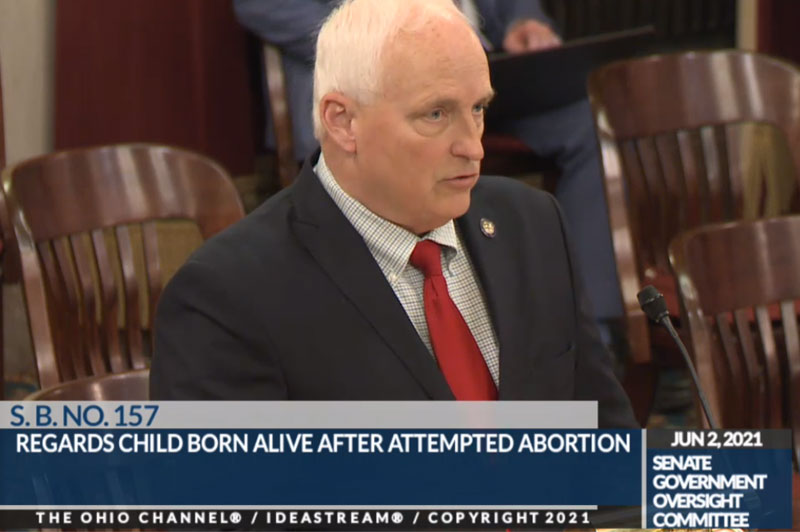
    State Sen. Terry Johnson, R-McDermott, testifies on a new bill regarding “born alive” abortions (Photo by The Ohio Channel)

    By Susan Tebben and Ohio Capital Journal

    Two medical professionals in the Ohio Senate reintroduced a bill that would criminalize physician inaction in “botched abortions,” but say the bill is more about having a reporting system, something that already exists in state law.

    The bill is sponsored by state Sen. Terry Johnson, R-McDermott, who currently works as a drug addiction treatment physician, and former ER doctor Sen. Steve Huffman, R-Tipp City, who still appears to work in a physicians group.

    Johnson said while the bill has punitive aspects for physicians, it is primarily a measure to “provide a reporting system” for abortion procedures in which the baby is born alive after a “failed abortion,” which research shows could only happen closer to the full term of a pregnancy. Full term is considered 40 weeks gestation.

    In Ohio, abortion is legal up to 20 weeks gestation.

    While he said data has settled the dispute in the General Assembly last year that cases of “born alive abortions” were rare or non-existent across the country, Johnson also said the new bill was necessary to find out if it occurred in the state.

    “We don’t want to overlook the fact that we would like Ohio to determine whether this actually happens in Ohio or not, and if it does, we can record it and we can take a cold, hard look at the results of that,” Johnson told the Senate Government Oversight & Reform Committee.

    When asked about current law on infant death, Johnson acknowledged that federal law already makes infant homicide a criminal offense. But when asked to provide an example of occurrences in Ohio, Johnson said the state doesn’t collect that data.

    “In states where they do have a reporting form and where they do pay attention to this, they can gather data and they prove that it happens,” Johnson said. “How would we know in Ohio? We don’t check it.”

    Source: Ohio Department of Health

    State law already requires information about abortions to be reported to the Ohio Department of Health by the physician who performs the abortion, using forms that don’t include identification of the person receiving the abortion. The forms are used to create a yearly abortion report.

    In compliance with current state law, physicians also have to report post-abortion complications, including the number and type of complications and the treatment for those complications, along with the gestational age for each procedure.

    The 2019 state abortion report — the most recent data from the state — said more than half of all abortions in Ohio happened at less than nine weeks gestation, and 26% happened nine to 12 weeks into pregnancy.

    Under the category of “failed abortions” in “post-abortion care for complications” data included in the report, 27 happened at less than nine weeks gestation, and the other 21 happened at nine to 12 weeks.

    None were reported in gestation higher than 12 weeks.

    Of the 356 abortions reported at 19 weeks or more gestation, only one pregnancy was found to be viable, with the majority of viability testing done through ultrasound.

    The CDC considers “early preterm” birth to be less than 34 completed weeks of gestation, and a women’s health webpage for the University of Utah Health says infants are not considered to be viable until after 24 weeks gestation, with the chance of survival before 24 weeks at less than 50%.

    Johnson said Senate Bill 157 is identical to Senate Bill 208, which he brought to the last General Assembly. That bill passed through the Senate but never received a committee hearing in the House before the GA ended at the end of 2020.

    In his testimony along with his cosponsor, state Sen. Huffman pointed to a report from the nationwide anti-abortion organization Family Research Council, citing CDC data of 143 occurrences of live births following abortion procedures between 2003 and 2014, amounting to about 13 per year.

    That report also cited a 2018 study that found the median survival time for those born after the termination of a pregnancy between 20 and 24 weeks gestation was only 32 minutes.

  • Chances for Ohio death penalty repeal appear to be growing

    Chances for Ohio death penalty repeal appear to be growing

    By Marty Schladen and Ohio Capital Journal

    The biggest-ever bipartisan coalition on Thursday announced a renewed effort to repeal the death penalty in Ohio.

    State Sen. Nickie Antonio, D-Lakewood, and Sen. Steve Huffman, R-Tipp City, hosted a virtual press conference to announce that they and three other Republican and four Democratic senators so far have said they will co-sponsor the repeal legislation. The measure also has bipartisan support in the House.

    Antonio has long advocated to end Ohio’s troubled death penalty. But Huffman, a physician, is new to the cause. He explained that he still believed in stiff penalties for “the worst of the worst,” but replacing death sentences with life in prison without the possibility of parole would fulfill that goal.

    “Like so many in Ohio, I once supported capital punishment,” he said. “But through prayer and reflection I’ve come to believe that it is the wrong policy for the state of Ohio. I’ve been heading in this direction for decades. Life is precious.”

    Public opinion has been shifting as well. In 2014, 68% of Ohioans supported the death penalty, but a poll conducted late last year indicated that the number had almost flipped. Now, 60% of Ohioans support a repeal.

    Traditionally a state with a relatively large number of executions, there haven’t been any in Ohio since July 2018. Since he took office in early 2019, Gov. Mike DeWine has stayed all scheduled deaths, first because a federal judge likened the state’s execution method to torture, and then because the makers of the intravenous drugs have refused to supply them.

    More recently, DeWine said lethal injection in Ohio appears to be “impossible from a practical point of view today.”

    Antonio said the practical difficulties, and changing public opinion, make this an opportune time to repeal the death penalty.

    “I think that there’s a shift in the country that we’re also seeing reflected in the state,” she said. “We also have a governor who has put a moratorium on executions right now. There’s more difficulty to — I think it’s an oxymoron — ‘humanely’ execute someone… so there’s all these things.”

    In addition to Antonio and Huffman, Sens. Niraj Antani, R-Miamisburg, and Sandra Williams, D-Cleveland, joined the press conference. Also joining were Reps. Jean Schmidt, R-Loveland, Bride Rose Sweeney, D-Cleveland, Adam Miller, D-Columbus and Kristina Roegner, R-Hudson.

    In the face of the growing momentum, DeWine, a Republican, was asked later in the day if he’d sign a repeal bill in the event that one made it to his desk. He didn’t commit himself, but he seemed open to it.

    “My thinking on the death penalty has certainly evolved,” DeWine said. “But it is the law and as long as the law stays on the books it is something I would expect the General Assembly at some point to take up and I’ll certainly weigh in as they move a bill forward.”

    Antani described how he was a Republican outlier when he signed onto the anti-death penalty cause six years ago, but he was confident more GOP colleagues would join up as they came to see that it was consistent with conservative principles. He said he predicted, “Our party will see that this is a pro-life issue. Our party will see this as (an anti-) big-government issue.”

    Addressing the latter issue, Antani and many others cited the growing number of people who have been sent to death row only to be exonerated.

    Also on Thursday, the Death Penalty Information Center added 11 people to its list of people who have been exonerated after being sent to death row. 

    “The data now show that for every eight people who have been put to death in the U.S. since executions resumed in the 1970s, one person who had been wrongfully convicted and sentenced to death has been exonerated,” the group said in a statement.

    Hannah Kubbins, executive director of Ohioans to Stop Executions, said that in the Buckeye State, the ratio is one exoneration for every five executions.

    Williams noted that in addition to wrongful convictions, the death penalty is disproportionately applied to people of color. Ohio has prohibited using the penalty against people with mental disabilities, but that’s not enough, she said.

    “Instead of piecemealing the state’s policy on the death penalty, we should really end it all,” she said.

    Schmidt said meeting people who were wrongfully sent to death row is what reshaped her thinking.

    “This has been a long journey for me,” she said. “Twenty years ago I served in this very Statehouse as a state legislator and I fought to keep the death penalty, but I evolved.”

    That thinking could be widespread. Antonio said that as she talks about repeal with colleagues of both parties, she’s “gotten very little pushback” and expects to sign up many more sponsors.

    Huffman said it might take time for some of his colleagues, but he expects they’ll get there.

    “I think there’s a lot of people that are continuing to think about it and, especially in the Senate, they know that it’s out there and they know that public opinion is to get rid of it,” he said. “I think that they’re continuing to form their thoughts, but I believe that the majority are leaning toward getting rid of the death penalty.”