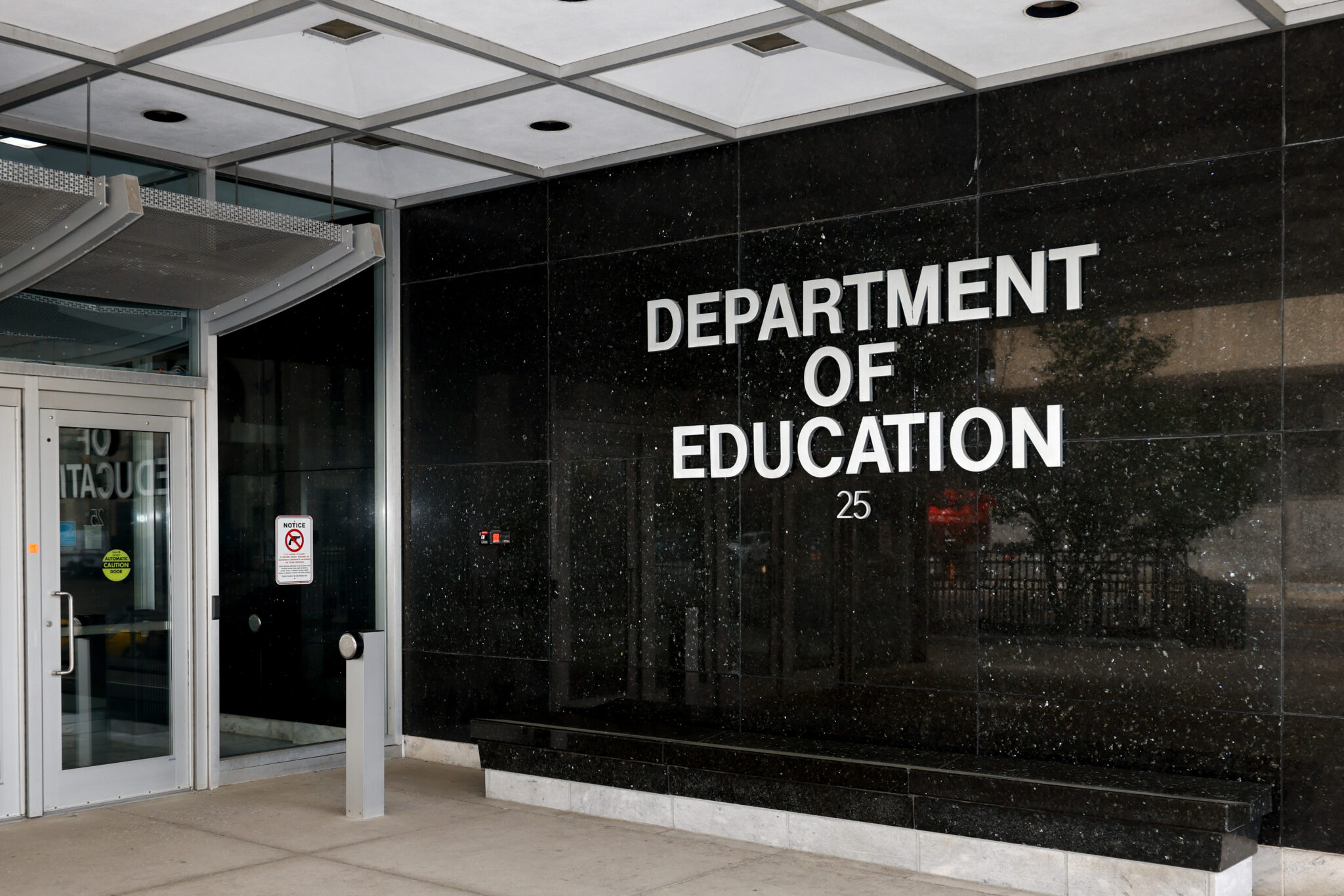
Members of the Ohio Student Association held a mock funeral for the death of higher education on March 31
Photo by Megan Henry, Ohio Capital Journal
The Ohio Student Association organized the mock funeral, which took place Monday afternoon in the Ohio Statehouse Rotunda, days after DeWine signed Senate Bill
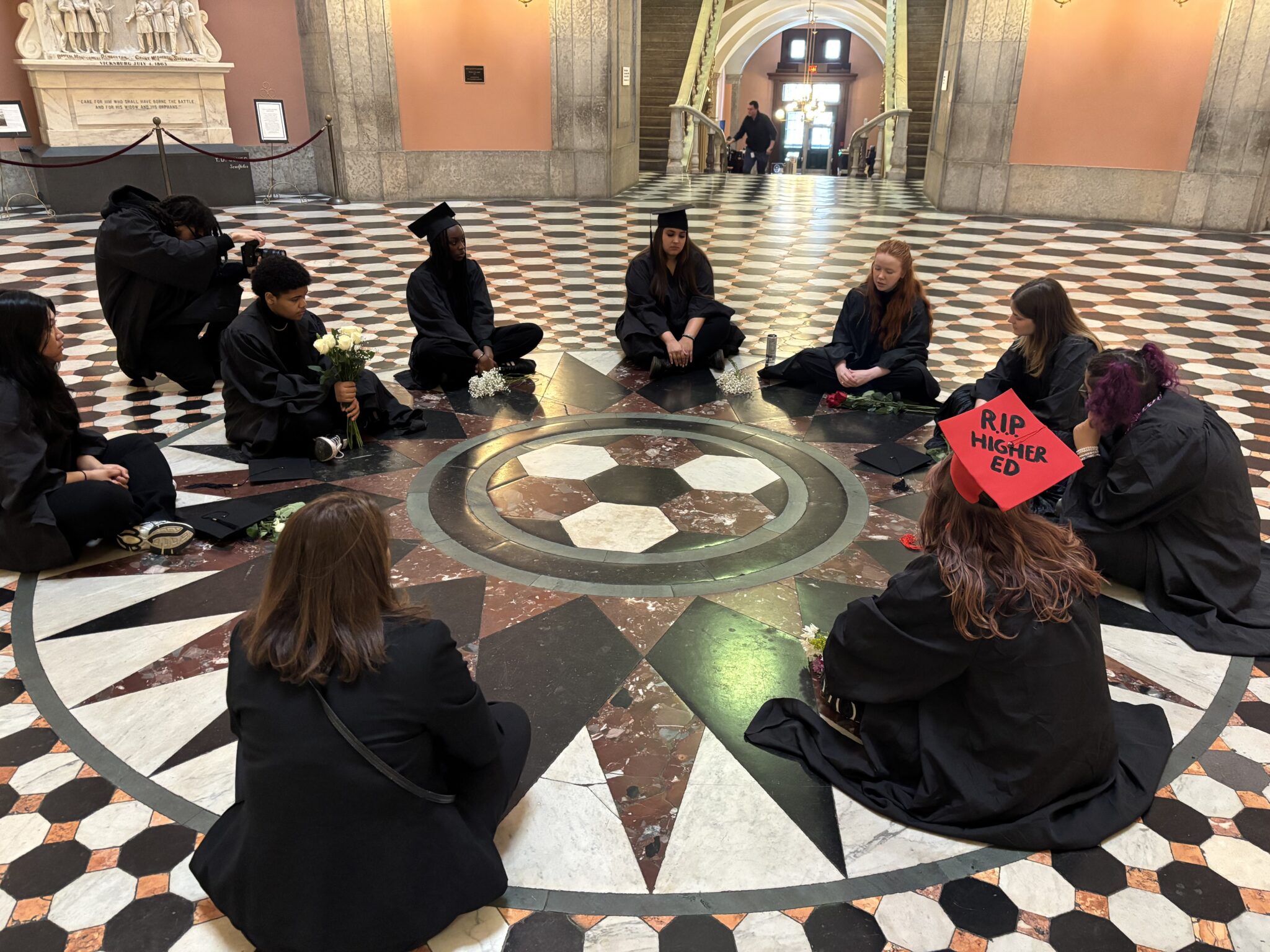
Students donning black graduation robes held a mock funeral for the death of higher education after Ohio Gov. Mike DeWine signed a bill into law that will overhaul the state’s public universities.
The Ohio Student Association organized the event, which took place Monday afternoon in the Statehouse Rotunda, days after DeWine signed Ohio Senate Bill 1.
S.B. 1 will ban diversity efforts, prohibit faculty strikes, regulate classroom discussion of “controversial” topics, create post-tenure reviews, put diversity scholarships at risk, create a retrenchment provision that block unions from negotiating on tenure, shorten university board of trustees terms from nine years down to six years, and require students take an American history course, among other things.
GET THE MORNING HEADLINES.
For classroom discussion, the bill will set rules around topics involving “controversial beliefs” such as climate policies, electoral politics, foreign policy, diversity and inclusion programs, immigration policy, marriage, or abortion. It prohibits professors from “indoctrination,” and while it doesn’t define that, it allows complaints to be filed against professors for review by the Chancellor of the Ohio Department of Higher Education. S.B. 1 will only affect Ohio’s public universities and community colleges.
“It was really surprising, the quickness that it was signed,” said Ohio State University junior Brielle Shorter. “I think signing it at such a time was really interesting as well, but it was truly heartbreaking.”
DeWine got the bill Wednesday — the same day the Ohio Senate concurred with changes to the bill made by the Ohio House — and he signed it Friday.
“As a Black student on campus, our spaces have already been slowly getting demolished,” Shorter said. “I believe that with this bill there’s going to be more changes like that.”
Ohio State recently closed its Office of Diversity and Inclusion and the Office of Student Life’s Center for Belonging and Social Change in response to the U.S. Department of Education’s Dear Colleague letter that threatened to rescind federal funds for schools that use race-conscious practices in admissions, programming, training, hiring, scholarships, and other aspects of student life.
Shorter said she has seen Ohio high school students post on social media how they are no longer interested in attending Ohio universities and instead plan to go to school out of state.
Scott DiMauro, president of the Ohio Education Association, said it is unfortunate DeWine signed S.B. 1 into law.
“It’s disappointing to see that he did that, even though the overwhelming amount of opposition that was expressed on the bill from faculty and from students and from concerned citizens was strongly against it,” he said. “I think it’s unfortunate to see collective bargaining rights of people who work in higher education diminished.”
Pranav Jani, president of Ohio State’s American Association of University Professors chapter, said they will fight the impact of the bill as it becomes law.
“We know that we stand with thousands of educators, students, and parents, who are disgusted by this naked display of governmental repression of higher education,” he said in a statement.
State Sen. Jerry Cirino, R-Kirtland, introduced S.B. 1, which took just over two months to pass both chambers and be signed into law.
“I believe this is monumentally significant legislation that will allow Ohio’s public universities and community colleges to deal with looming enrollment challenges and usher in a renaissance of academic excellence,” Cirino said in a statement.
Megan Henry is a reporter for the Ohio Capital Journal and has spent the past five years reporting in Ohio on various topics including education, healthcare, business and crime. She previously worked at The Columbus Dispatch, part of the USA Today Network.
Ohio Capital Journal is part of States Newsroom, the nation’s largest state-focused nonprofit news organization.
Ohio Democrats peppered Republican state Sen. Jerry Cirino with questions over his higher education overhaul bill this week. The bill would ban faculty strikes and diversity efforts on campus, as well as set rules around classroom discussion.
One Democratic lawmaker called the bill racist.
Cirino gave sponsor testimony on Senate Bill 1 Tuesday afternoon during the Ohio House Higher Education and Workforce Committee meeting.
State Sen. Jerry C. Cirino, R-Lake County. (Photo from Ohio Senate website.)
“S.B. 1 is about more speech, not less,” he said. “It is about creating an environment of continuous improvement. It is about the core value that students come first; they are the customers of these institutions.”
Senate Bill 1 would ban diversity and inclusion efforts, block faculty from striking, set rules around classroom discussion, put diversity scholarships at risk, shorten university board of trustees terms from nine years to six, and require students take an American history course, among other things.
Regarding classroom discussion, it would set rules around topics involving “controversial beliefs” such as climate policies, electoral politics, foreign policy, diversity and inclusion programs, immigration policy, marriage, or abortion.
S.B. 1, which only applies to public colleges, stipulates classroom discussion allows students to “reach their own conclusions about all controversial beliefs or policies and shall not seek to indoctrinate any social, political, or religious point of view.”
State Rep. Desiree Tims, D-Dayton. (Photo from Ballotpedia.)
“I think the bill is very racist,” state Rep. Desiree Tims, D-Dayton, said during Tuesday’s committee meeting.
Tims asked Cirino why he was interested in getting rid of diversity scholarships and Cirino responded by saying Ohio Attorney General Dave Yost addressed race-based scholarships last year.
“We have guidance from the attorney general that we cannot do those,” Cirino said. “Our institutions may not do those things based on race.”
In 2023, the U.S. Supreme Court ruled that Harvard and the University of North Carolina violated the Equal Protection clause of the 14th Amendment by using race as a factor in applications. The days after the ruling, Yost sent a letter to Ohio colleges and universities saying his office won’t legally protect someone at a college or university who uses race as a factor.
“How is it that you want diversity of thought, but not diversity of people at these public institutions that would bring that diversity?” state Rep. Joe Miller, D-Amherst, asked.
Cirino responded by saying diversity of thought and programs that promote diversity and inclusion are not comparable.
“You cannot discriminate against one group to make up for discrimination of another group,” Cirino said.
Miller also asked about whether limiting speech through legislation, such as this bill, is a slippery slope.
“There’s absolutely not one limitation of what can be talked about in the classroom,” Cirino said in his response. “What we say very specifically and explicitly in the bill is that there has to be an openness to looking at other opinions and welcoming diverse opinions as well.”
State Rep. Beryl Brown Piccolantonio, D-Gahanna, asked about the retrenchment and collective bargaining parts of the bill.
GET THE MORNING HEADLINES.
“We need to treat our institutions of higher learning a little bit more like a business,” Cirino said. “If we don’t help (university presidents and boards of trustees) with these management tools, we’re going to find a real disadvantage for the state of Ohio.”
Piccolantonio questioned if this bill is giving lawmakers more control over public universities.
“It is clearly not the legislature trying to step in and operate the college or university,” Cirino said. “It’s about empowering the boards of trustees, the governing board and the presidents.”
Piccolantonio also asked if Cirino would be open to making any changes to the bill and he said no, reminding committee members that this bill went through 11 revisions in the last General Assembly.
“This bill is matured and it’s ready to go,” Cirino said. In the version of the bill passed last month by the Ohio Senate, most of the changes made in the last General Assembly were rolled back.
More than 800 people submitted opponent testimony against the bill — significantly outweighing the amount of supporter testimony the bill has received. Several students have said they would leave Ohio if this bill passed.
When state Rep. Munira Abdullahi, D-Columbus, asked about so many students opposing the bill, Cirino said legislation is not developed based on how many people come to testify.
“If we started doing that, it would be a popularity contest, and we should all take a huge pay cut because we’re getting paid, in my view, to make policies sometimes, whether it’s popular or not, if we think it is the right thing to do and good for the state of Ohio,” Cirino said.
Abdullahi also asked why the bill would ban higher education faculty from striking.
“Simply because higher education, all postsecondary education, is absolutely critical to us in Ohio if we’re going to maintain a strong economy in the future and meet the workforce requirements that we need to meet in order to employ people and to provide the workers that our companies are looking for,” Cirino said.
Megan Henry is a reporter for the Ohio Capital Journal and has spent the past five years reporting in Ohio on various topics including education, healthcare, business and crime. She previously worked at The Columbus Dispatch, part of the USA Today Network.
Ohio Capital Journal is part of States Newsroom, the nation’s largest state-focused nonprofit news organization.
Brielle Shorter, a 20-year-old Ohio State University student, protests against Senate Bill 1 on Jan. 22, 2025. (Photo by Megan Henry, Ohio Capital Journal).
Senate Bill 1 was passed by a 21-11 vote. All nine democrats and two republicans — Bill Blessing and Tom Patton — voted against the bill.
The Ohio Senate passed a controversial higher education bill that would overhaul the state’s public universities during Wednesday’s session. This came one day after more than 800 Ohioans submitted testimony against it. Fourteen people provided supporter testimony. The sponsor of the bill called those numbers “irrelevant.”
Ohio Senate Bill 1 was passed by a 21-11 vote. All nine democrats and two republicans — Bill Blessing and Tom Patton — voted against the bill, which will go to the Ohio House for consideration.
_____________
For Background:
Senate Bill 1 will ban diversity and inclusion efforts, prevent faculty from striking, set rules around classroom discussion, put diversity scholarships at risk, shorten university board of trustees terms from nine years down to six years, and require students take an American history course, among other things.
Regarding classroom discussion, it would set rules around topics involving “controversial beliefs” such as climate policies, electoral politics, foreign policy, diversity and inclusion programs, immigration policy, marriage, or abortion.
“This is needed reform to enhance and make higher education in Ohio better,” Cirino said. “We have to constantly be moving the goal line here for us to be better, to respond to the changes demographically and in the workforce demands for the jobs that our graduates are taking.”
Protester opposing S.B. 1 erupted in chants moments after the bill passed, shouting, among other things, “Who killed higher ed? The Ohio Senate did! Who killed higher ed? Senator Cirino did!”
The protesters continued their chants with the names of different lawmakers as they exited the Senate chamber.
GET THE MORNING HEADLINES.
When asked why this bill was fast-tracked through the Senate, Senate President Rob McColley, R-Napoleon, said the Senate passed a nearly identical bill that Cirino put forward during the last General Assembly.
“Everybody’s minds are pretty much made up as to what we should do in this regard, so we didn’t see the reason to delay this process any further,” he said.
What is in Senate Bill 1?
S.B. 1 would ban diversity and inclusion efforts, prevent faculty from striking, set rules around classroom discussion, put diversity scholarships at risk, shorten university board of trustees terms from nine years down to six years, and require students take an American history course, among other things.
Regarding classroom discussion, it would set rules around topics involving “controversial beliefs” such as climate policies, electoral politics, foreign policy, diversity and inclusion programs, immigration policy, marriage, or abortion.
The bill stipulates classroom discussion allows students to “reach their own conclusions about all controversial beliefs or policies and shall not seek to indoctrinate any social, political, or religious point of view.”
“A lot of it is related to making sure that diversity of thought is practiced as a policy in our universities and community colleges,” Cirino said.
S.B. 1 would affect Ohio’s public universities and community colleges, not private universities.
Senate Democrats tried to make several amendments to S.B. 1 during Wednesday’s Senate Session, but none of the amendments were adopted.
“I wouldn’t view that as a scientific measure of the general support statewide or opposition statewide, to what this actually is,” McColley said when asked about the overwhelming opposition to S.B. 1.
Senate discussion
COLUMBUS, Ohio — JUNE 15: State Sen. Jerry Cirino, R-Kirtland, speaks during the Ohio Senate session, June 15, 2023, at the Statehouse in Columbus, Ohio. (Photo by Graham Stokes for Ohio Capital Journal)
There was two hours of discussion about the bill during Wednesday’s Senate session before the vote took place. All nine Senate democrats spoke against the bill while four Republicans voiced their support of the bill.
“Students are going to leave the state and go somewhere else where their abilities to learn and express free speech aren’t subject to this law,” said state Sen. Bill DeMora, D-Columbus. “This bill is the worst bill.”
The quality of education suffers when legislators gain the authority to control what is taught in universities, said state Sen. Casey Weinstein, D-Hudson.
“This bill invites political interference into academic matters,” he said.
Minority Senate Leader Nickie J. Antonio, D-Lakewood, said S.B. 1 is a detriment to Ohio’s higher education.
“The premise of the bill is that somehow public universities are bastions of liberalism trying to indoctrinate our children,” she said. “I think it will make the state of Ohio universities not favorable to students, especially students with diverse backgrounds that are looking for places to be their full, complete selves.”
State Sen. Kristina Roegner, R-Hudson, spoke in favor of the bill.
“We want Ohio’s colleges and universities to be places where students reach their full intellectual potential, where research and critical thinking are promoted, where free speech is encouraged and where innovation is nurtured and performance is rewarded to be the best, we must be a meritocracy,” she said.
Many college students and faculty have said they would leave Ohio if S.B. 1 passed, but Cirino said he doesn’t believe there is going to be a mass migration out of the state.
“I believe that the better we enhance higher education in Ohio, the more attractive we’re going to be to students of all types,” he said. “I would never participate in anything that destroyed higher ed.”
Megan Henry is a reporter for the Ohio Capital Journal and has spent the past five years reporting in Ohio on various topics including education, healthcare, business and crime. She previously worked at The Columbus Dispatch, part of the USA Today Network.
Ohio Capital Journal is part of States Newsroom, the nation’s largest state-focused nonprofit news organization.
Ohio State Sen. Jerry Cirino, R-Kirtland, introduced Senate Bill 1 on Jan. 22, 2025. (Photo by Megan Henry, Ohio Capital Journal).
Cirino’s proposed overhaul failed to move forward under previous Ohio House Speaker Jason Stephens, but has new potential life under Speaker Matt Huffman
A Republican state senator has reintroduced a controversial proposal to massively overhaul higher education in Ohio, including a ban on diversity and inclusion efforts as well as a ban on labor strikes by faculty and staff.
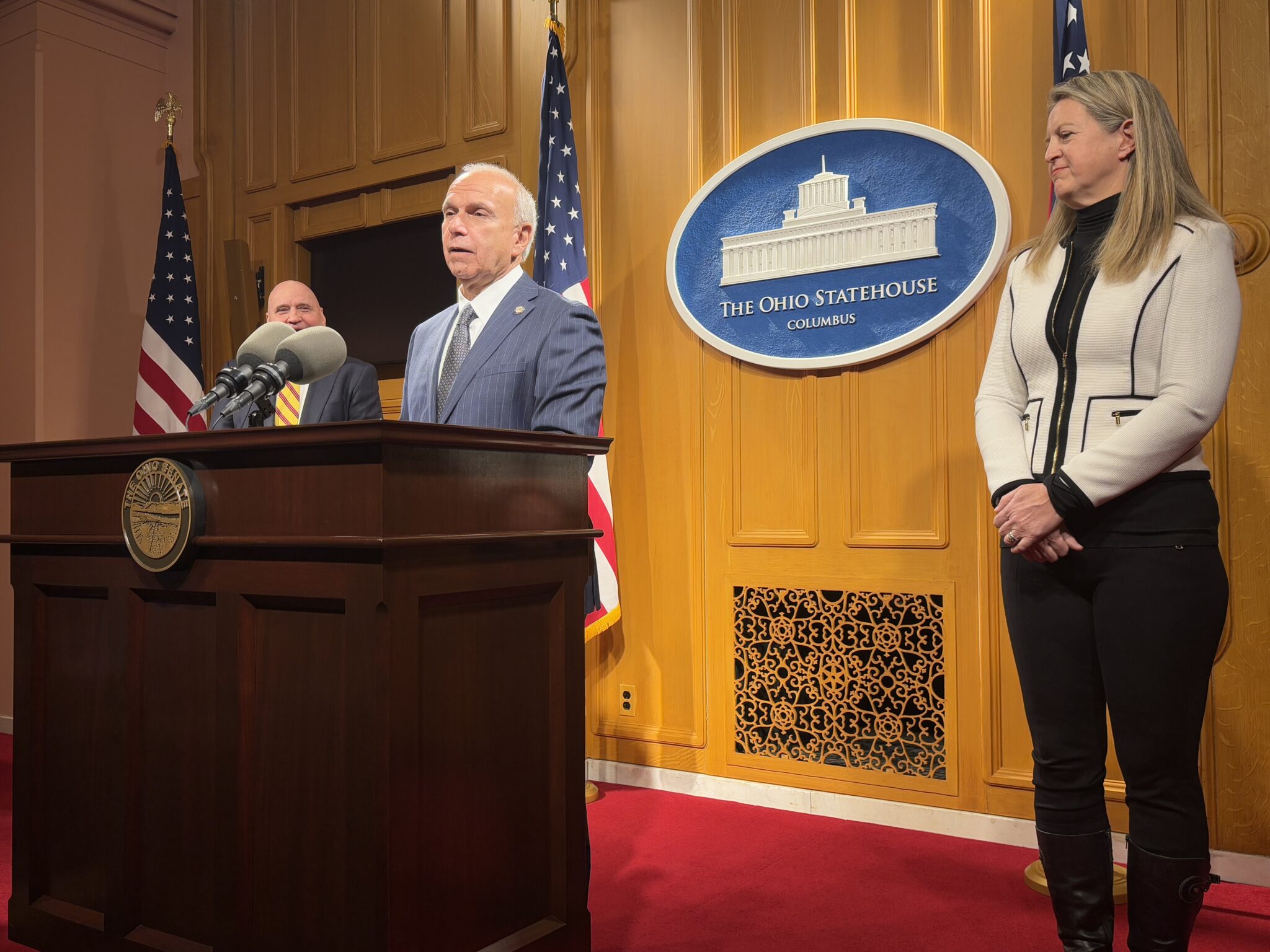
Kirtland Republican state Sen. Jerry Cirino’s proposed Senate Bill 1 — the Advance Ohio Higher Education Act — was introduced during a press conference Wednesday and is similar to the bill Cirino introduced during the last General Assembly, with some additions.
“It’s called Senate Bill 1 for a reason,” Cirino said. “It is our top priority, and we’re going to move this along quickly. … We’ve already had a lot of hearings on Senate Bill 83.”
He said the bill is going to be on a fast track and Senate Higher Education Committee Chair Kristina Roegner said hearings on the bill will likely start next week.
“We are promoting more speech, not less speech, as some of our opponents have said, more discussion and debate on all topics, less indoctrination, institutional support by trustee actions and policy moves that we’re requiring the trustees to make, to support an environment of diversity of thought,” Cirino claimed.
S.B. 1 includes “virtually everything from Senate Bill 83,” said Cirino, who is the vice chair of the Ohio Senate Higher Education Committee.
GET THE MORNING HEADLINES.
Cirino’s former higher education bill, Senate Bill 83, was unable to make it across the finish line during the previous General Assembly. It passed in the Senate and in the House committee, but former Ohio House Speaker Jason Stephens, R-Kitt Hill, never brought it to the House floor for a vote. The previous bill underwent 11 revisions.
Cirino made good on his promise to reintroduce a similar bill in January and the bill could have an easier time in the House now that Matt Huffman, R-Lima, is the House Speaker. Lawmakers in the Ohio House plan on introducing a companion bill.
What is in S.B. 1?
S.B. 1 has yet to be posted online, but Cirino said the bill includes a post-tenure review, annual performance reviews of faculty, a retrenchment provision that would block unions from negotiating on tenure and public syllabuses. The bill would prohibit political and ideological litmus tests in hiring, promotion, and admissions decisions.
A big change with S.B. 1 is banning diversity, equity and inclusion courses in addition to the trainings. The former bill would have banned mandatory diversity, equity and inclusion training unless it is required to comply with state and federal law, professional licensure requirements or receiving accreditation or grants.
“(DEI) has become institutionalized discrimination paid for by the taxpayers,” Cirino said.
Ohio House Rep. Bob Young, R-Dayton, said the focus of the bill shouldn’t be the DEI ban.
“Let’s truly focus on why we’re here and who we are in higher education, and that is to educate a workforce to compete globally and grow Ohio and jobs and families and attract more people to come in,” Young said.
The on faculty and staff’s ability to strike is back in the bill, something Cirino claimed was not an anti-labor issue.
“When a student signs up for instruction for a semester, they pay in advance, or they can’t go into the class,” Cirino said. “That represents a contract between the students and the institution, and because there are public institutions, therefore a contract with the state, they have to deliver that instruction and trade for the dollars per pen.”
Youngstown State University workers went on strike for a few days in 2020 over pay disputes, and Wright State University went on strike for almost three weeks in January 2019 over pay disputes and health care.
“The threat of (a strike) is what is used, and the students are being used as pawns in order to get better working hours, a better dental plan, or whatever the case may be,” Cirino said. “If we value higher education the way we do, we should also value the fact that that contract needs to be fulfilled, and nothing except force majeure should ever get in the way of students getting what they have paid in advance for.”
S.B. 1 would shorten university board of trustees terms from nine years down to six years.
“It’s been difficult to find trustees willing to make nine year commitments and the governor agrees with this,” Cirino said. “We’re talking about not just changing their terms, but also requiring new trustee training programs that would be adjudicated through the Chancellor’s Office.”
Requiring students to take an American history course is also back in the bill.
“I have become more and more convinced of that necessity over time now, since we first wrote the bill, as I’ve talked with more and more young people who have no clue about so many important things about our history and our founding documents and so on,” Cirino said.
Opposition to S.B. 1
Cirino acknowledged there will be lots of opposition with S.B. 1, just as there was with his previous bill.
“Senate Bill 1 is a misguided attempt to micromanage higher education in Ohio, imposing unnecessary restrictions on our universities, faculty, and students,” state Sen. Casey Weinstein, D-Hudson, said in a statement.
More than a dozen students from the Ohio Student Association protested S.B. 1 with chants of “When Black studies are under attack, what do we do? Stand up, fight,” and “Higher ed will be dead,” among others.
“The students that were out here protesting are probably getting extra credit for being here,” Cirino said. “I don’t believe that they have studied the bill and all the implications of this legislation and the impact on higher education in Ohio. I believe that they were asked to be here by their professors.”
Brielle Shorter, a 20-year-old Ohio State University student, protests against Senate Bill 1 on Jan. 22, 2025. (Photo by Megan Henry, Ohio Capital Journal).
Brielle Shorter, a 20-year-old Ohio State University student, was among the students who protested against the bill Wednesday.
“No, we are not here for extra credit,” she said. “That’s not how this works. I believe that this bill is being pushed very fast and very rapidly.”
Pranav Jani, president of the Ohio State University chapter of the American Association of University Professors and an English professor, said Cirino’s quip about students protesting for extra credit is “one of the most insulting things I’ve ever heard said about students.”
“It shows how out of touch he is with what happens in the classroom,” Jani said.
If this bill is signed into law, Shorter — who is from Cincinnati and wants to be a psychiatrist — said she would go out-of-state to continue her education.
“I fear that I can no longer call Ohio my home,” Shorter said. “It feels like students are being pushed out, and it feels like I might be one of them.”
Many college students have said they would move out of Ohio if this bill was signed into law, but Cirino called that “a red herring” during Wednesday’s press conference.
Education organizations were quick to oppose S.B. 1.
“(S.B. 1) uses culture war politics to attack workers’ rights and turn campuses into hostile environments for people of color, immigrants, and other marginalized communities,” Ohio Federation of Teachers President Melissa Cropper said in a statement.
Ohio Conference of the American Association of University Professors Executive Director Sara Kilpatrick hopes Cirino will listen to the students’ concerns with this bill.
“He’s not interested in hearing opposing views, which shows that this bill isn’t about intellectual diversity, but is actually about pushing a partisan agenda,” Kilpatrick said in a statement.
Megan Henry is a reporter for the Ohio Capital Journal and has spent the past five years reporting in Ohio on various topics including education, healthcare, business and crime. She previously worked at The Columbus Dispatch, part of the USA Today Network.
Ohio Capital Journal is part of States Newsroom, the nation’s largest state-focused nonprofit news organization.
Christina Collins’ journey to become an educator started when she helped her grandfather read his mail.
He had dropped out in middle school, and had trouble with reading and understanding words, even ones specifically written for him.
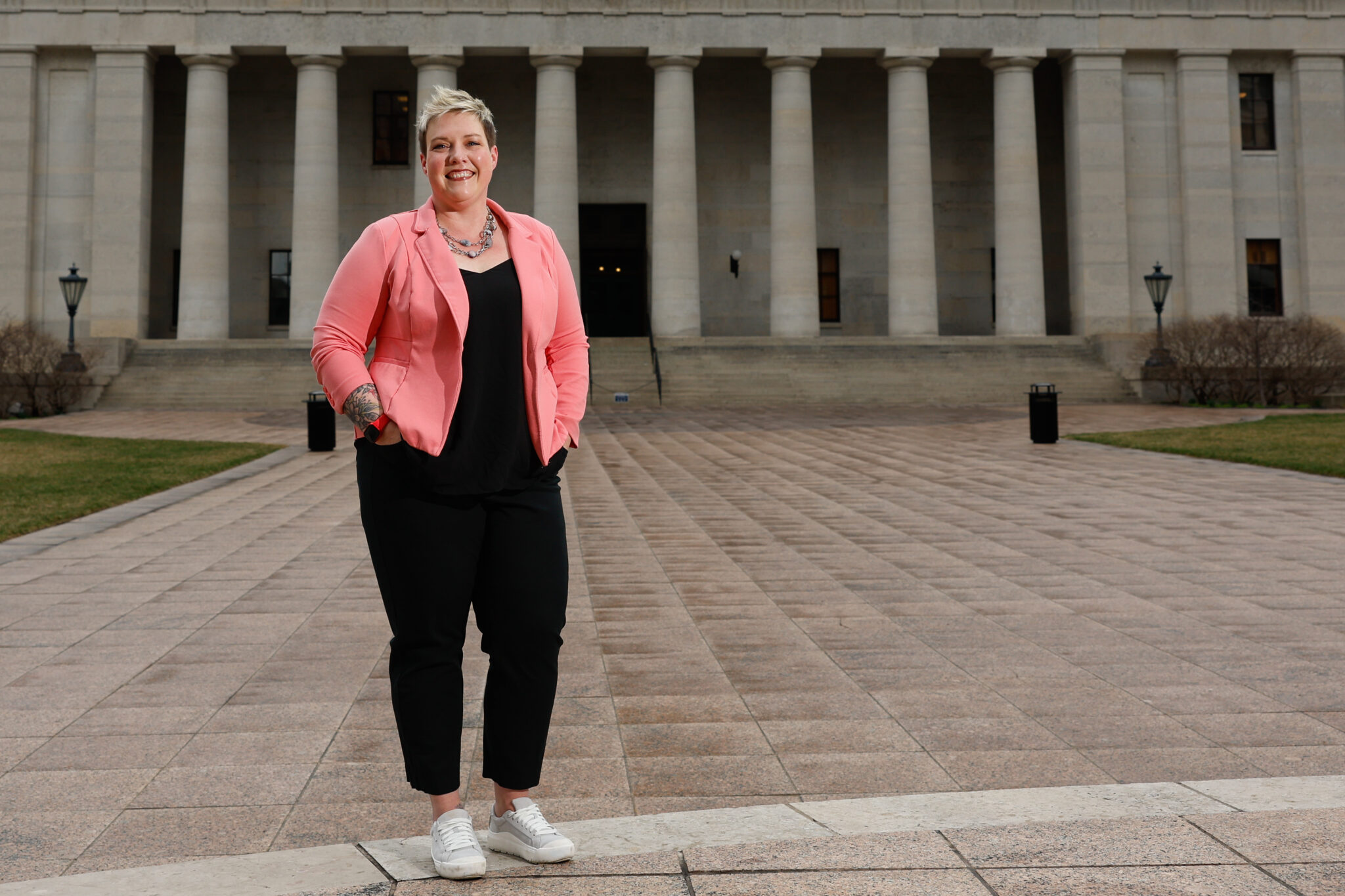
Collins’ dad and brother both struggled in school as well, and it was through their struggles that she saw “how hard it was for some people to be successful.”
“So, those moments all kind of led to, for me, believing that literacy is a key civil rights issue,” Collins told the Capital Journal. “I mean, the ability to participate in the world around you is to be a literate human being.”
The Gahanna native became a high school English teacher, and cherished the interactions she’d have with students, the kids who seemed to be doing fine and the kids who struggled or made trouble.
“I was always very driven about recognizing every student, and getting other people to recognize every student to help support every student,” Collins said.
To this day, she gets messages from students who have moved on to become educators themselves.
That new generation of teachers is facing a whole host of new challenges, from culture war battles to ever-changing education standards, and Collins sees the developments in education statewide and nationally as a departure from the true aims of the field.
“Our pendulum has swung way too far over to seeing kids as test scores,” she said. “We should be finding every kid’s talents and getting them going in the right direction.”
Joining the board
While Collins was an educator, she taught her classes, kept up with the curriculum and all the other everyday roles of a high school teacher.
But she realized that, for other teachers, those roles didn’t include staying up all night reading legislation.
“I thought that was just a thing all teachers did,” she said. “I thought ‘well this is part of education, everybody’s reading legislation.’”
When her colleagues dispelled that belief, she realized perhaps her next move might be toward honing the policy that came from the statehouse into local school districts.
She became an administrator with the purpose of “being a filter for the noise” coming out of Columbus via policy mandates and standard changes, from Race to the Top and performance evaluations to the third-grade reading guarantee.
“There was a time when I was in a district as curriculum director where in five years there were four different sets of graduation requirements,” Collins said.
Feeling the impact of constant and rapid changes coming from legislative bodies who included many non-educators compelled Collins to run for a spot on the Ohio State Board of Education. She took her spot on the board right as one of the biggest level-sets ever to happen to Ohio education unfolded: the COVID-19 pandemic.
The pandemic brought school closures, virtual learning, a scramble to decide whether testing made sense among uncertain learning environments, and a reckoning when it came to what kids really needed from their educational facilities.
Amid the stress of teachers learning new roles, and parents learning what it takes to be a teacher, Collins saw the era as a point of hope, as a needed reflection period for policymakers and districts alike.
“I saw it as a key moment where we could just blank-slate reset and think differently about our education system,” she said.
Surely, she thought, the adaptation that students had gone through in their methods of socialization and learning will lead to changes in the way education is conducted. Surely things like student hunger and poverty that were so starkly spotlighted amid a global pandemic would stay at the forefront of the minds of leadership as they move forward.
“My experience on the board, especially that first year, I was like ‘can we think differently, can we think about competency-based learning models, how can we meet their needs?’”
As a member of the board, she was part of many discussions when it came to coming out of the pandemic and the needs of the education system. But those discussions didn’t go the way she’d hoped.
“It was like the rush to return to normal was the sole focus, and that was coming straight from the statehouse,” she said.
She wasn’t naive to the fact that the state Board of Education, whose candidates appear on nonpartisan ballots, had its conservative and liberal members. But discussions during the pandemic were markedly bipartisan, with some “more known conservative members” hearing the ideas of education reform related to pandemic-era impacts and thinking “maybe we should think differently,” according to Collins.
“Coming out of the pandemic, this culture of kids has changed, and I don’t think that we’re focused on the right things to meet their needs,” she said.
The tune coming to Collins and the rest of the board was the return of state testing and the return of “normal” in-person instruction, despite a years-long pivot to learning alternatives.
“At no point did (the state) slow down and address how we’re throwing (the students) all back together,” Collins said.
The legislature paused testing amid the pandemic, and policymakers sought to allow schools to move forward without reflection on the tests that were conducted, some through federal mandate, at least for a while. But as 2022 rolled around, the restart of testing became a discussion at the legislative level again, a decision Collins thinks should have been put on the back-burner a little longer.
“That was a moment where we should have delayed, there should have been a bit longer before that happened again,” she said.
Culture wars over change
When the pandemic seemed to be in the rearview mirror, the board’s work didn’t slow down, instead shifting to an area Collins wasn’t quite expecting: culture wars.
She hadn’t been fully caught off-guard when anti-racism resolutions brought white-hot debate to the board’s door, or when proposed Title IX language changes brought along talk of transgender rights in schools. Her seat on the board was barely warm when she started receiving emails accusing her of being anti-American and even socialist, all based purely on the fact that she was an educator, she said.
“I think I’m still a little shocked that in Ohio we’re at a point where we’ve had those kinds of culture war issues,” Collins said. “I don’t believe the majority of Ohioans want those issues to be at the forefront.”
COLUMBUS, OH — MARCH 05: Christina Collins, former State Board of Education member and currently the head of Honesty for Ohio Education a pro-public schools organization that testifies in favor of fair school funding, March 5, 2024, outside the Statehouse in Columbus, Ohio. (Photo by Graham Stokes for Ohio Capital Journal. Republish photo only with original article.)
Having those issues, which Collins acknowledged weren’t necessarily within the board’s purview, become months-long debates with resolution approval, then reversal, meant other things that the board could have been doing within the education space weren’t seeing the light of day.
“All of that was happening at the same time, which I think is how we lost that potential for change,” she said.
A bigger change was headed for the board, that would remove many of its responsibilities, and cause a shift that would eventually convince Collins to move on.
A bill had been floating in the Ohio legislature for more than a year. The more than 2,000-page policy would not only change the name of the Ohio Department of Education to the Ohio Department of Education and Workforce, but it would restructure the department to have two leaders under the umbrella of the governor’s cabinet, one for education and another for workforce.
The ODEW would still include the State Board of Education, but board members would be mainly focused on teacher licensure, educator disciplinary actions and district territory disputes.
State Sen. Andrew Brenner, R-Delaware, an ex-officio member of the board of education, was not the main sponsor of the bill, but pushed hard for it as chairman of the Ohio Senate Education Committee.
Arguments were made that the board was ineffectual and inefficient. Collins sees no reason to place blame for the way the board has worked, but from her perspective, the board filters legislative measures to the local districts as another cog in a wheel that needs improvement.
“The board’s seeming inability to get things done – which I don’t believe, but the rhetoric around it – I think that’s a reflection of what our local districts are dealing with because they are struggling to implement all of the things,” Collins said.
During committee hearings on the bill, members of the state board, including Collins, submitted testimony against the changes, saying putting the leaders under the governor’s cabinet would decrease the level of accountability they could have to districts and voters.
Collins brought up the many mandates under which the board had guided local districts, and the source of any and all of those mandates.
“These were all legislated efforts, but you’re still saying our schools are failing,” she wrote in her testimony. “I ask, who holds this (General) Assembly accountable when the unending educational initiatives it doles out do not work?”
The overhaul of the ODE did not play out in the first General Assembly in which it was introduced, but shortly after a new General Assembly came to work, the push for Senate Bill 1 and the changes to the department were introduced again.
Teachers unions, board of education members and advocacy groups alike all came out in opposition to the bill, representing hours of testimony in committee. Supporters of the bill included the Ohio Chamber of Commerce.
The bill passed the Senate last March, but it wasn’t until it was inserted into the state budget in the summer of 2023 that it saw full passage.
Collins was one of a number of board members who signed a letter asking Gov. Mike DeWine to line-item veto the changes to the state board’s roles in the budget document.
“From my experience being on the board, I think the way that (SB 1) was shoved through and how it was shoved through and when it was shoved through was a little bit unbelievable,” Collins told the Capital Journal. “Something that had essentially stalled in process was added (to the budget) and pushed through the way it was, and then that quickly it was (passed).”
Honesty for Ohio Education
As the board faced drastic legislative changes and a significant reduction in the authority it held, Collins started to wonder if being a member would help her make the most change, something she says she looks for in any career move she makes.
Armed with a superintendent’s license, she debated going back into schools. Ultimately, the departure of Honesty for Ohio Education’s executive director at the end of 2023, and the fact that she’d just had a baby that November made Collins reflect on all the aspects of education and the changes needed.
“It’s a scary time as a parent, it’s a scary time for education,” she said. “I’m worried about my own kids, I’m worried about everyone else’s kids.”
As a staunch supporter of public education, the changes being made on a state level with the transformation of the ODEW and the implementation of near-universal private school vouchers made her nervous about the future of her chosen field.
But like the times with her grandfather years ago, the connection between education and civic duty floated to the top of her mind.
“On a grander scale, I’m really, really, really worried that we’re losing our democracy, and for me education and democracy are in this reciprocal relationship,” Collins said.
Honesty for Ohio Education started in 2021 as a reaction to “critical race theory” bills that sought to keep children from learning the connection between race and American history, with claims that the bills would protect children from feeling guilt for history.
The group started small, but as they began testifying against CRT bills, among others, the group’s numbers grew, and now the coalition “has outgrown itself” from its nascent days, according to Collins.
“That’s a response to the attacks on education, it’s the attacks on LGBTQ+ kids, it’s the attacks on multi-racial education, it’s the attacks on honest history,” she said. “All of that … has created this avalanche with Honesty where we’re at this influx, where we have to decide how we step into adulthood, essentially.”
But as the coalition makes its next moves, Collins said it plans to stay focused on things like state curriculum, fights against book bans and how schools can work better, even for the 10% of students outside of the public school system.
“It’s not just public education … it’s about the kids everywhere in any educational environment who deserve to be safe and have honest and diverse, inclusive education,” Collins told the Capital Journal.
The coalition focuses on content in schools, but Collins said the ability for school districts to succeed certainly comes down to how well they’re funded and supported by state and local sources.
Public education is a “common good” for Collins, and that means the 90% of Ohio children in public education should be taken care of in the way the Ohio Constitution dictates. For public education unions, advocacy groups and for Collins, that includes full implementation of the Fair School Funding Plan.
That reform of the state’s public school funding model emphasizes a formula based around the needs of individual school districts, to allow schools who have more need than others to build up their performance.
The plan as it is now began it’s push through the legislature in August 2020 but negotiations and the hesitance of legislative leaders like Senate President Matt Huffman to push out the entire $10 billion per year plan in one shot led to a six-year phase-in. The plan is currently up to about 66% implementation.
Meanwhile, however, the General Assembly fully funded what amounts to a near-universal private school voucher program in the last budget cycle, allowing students in what are considered under-performing public school districts to leave and take state-funded scholarships with them to nearby private schools if their household income is up to 450% of the federal poverty level, or $135,000 for a family of four.
“When we pass universal voucher bills that give more money to students when they leave the school than a lot of the schools receive for that student, that’s a sign of the value that at least our legislature places on public education kids,” Collins said.
SUSAN TEBBEN
Susan Tebben is an award-winning journalist with a decade of experience covering Ohio news, including courts and crime, Appalachian social issues, government, education, diversity and culture. She has worked for The Newark Advocate, The Glasgow (KY) Daily Times, The Athens Messenger, and WOUB Public Media. She has also had work featured on National Public Radio.
In their first meeting since the state budget was approved with sweeping changes to Ohio’s State Board of Education, the group discussed the impacts it will face.
“This is going to be another chapter here and I want to be as proactive and on top of this chapter as I can, and as we can,” said Paul LaRue, president of the board.
Among the billions of dollars and hundreds of things approved by Gov. Mike DeWine last week were the provisions previously contained in Senate Bill 1, which transfer most of the powers away from the board and into the executive branch.
The changes would rename the department overseeing the board to the Ohio Department of Education and Workforce and create a cabinet-level position that would direct the department. Two deputy directors would also be a part of the new department, one for primary and secondary education and another for workforce.
“The board needs to be thinking about in the upcoming months, about what these things look like,” said Chris Woolard, interim superintendent of public instruction.
Woolard’s job will change as well, though he will remain the secretary of the board and serve as the board’s “executive officer,” conducting policy and administrative functions of the board and staff of the board, according to Tony Palmer, chief legal counsel for the ODE.
“Most of the responsibilities that are currently with the superintendent are transferred under the budget bill to the director of the Department of Education and Workforce,” Palmer told the board.
As for the board, it will retain powers related to educator licensure, discipline, teacher evaluation systems, and appointment of the superintendent. They can also make recommendations to the DEW directors regarding priorities for education, according to Palmer.
Several board members wrote to DeWine prior to his signing of the budget to ask him to remove the SB 1 provisions, calling the changing of the roles a “power grab.”
At this week’s board of ed meetings, members continued to criticize the move, questioning the enforcement measures to make sure the new oversight is the right move and truly improves the state of student test scores and education in general.
“What we kept hearing was that they needed to get rid of the state board because somebody was not being held accountable, but they never defined what that meant,” said board member Antoinette Miranda. “I’m just wondering if (the DEW directors) are going to get fired when the scores come back the same.”
Miranda’s fellow board member Diana Fessler claimed Pearson Education, a company who creates student assessment tests, would help with the change “by changing the test questions, and they can change the scores and the cutoff scores besides.”
“I think the kids are going to be doing amazingly well in no time at all,” Fessler said. “But it’ll be a lie from the pit of hell.”
Jessica Voltolini, chief of staff for the ODE, said officials are still reviewing all of the provisions of the budget and the changeover, working on a 180-day timeline: 90 days preparing before the October effective date of the bill, and the 90 days following, when implementation of all of the changes will be made.
But Voltolini said the “very high-level overview” the department has taken so far hasn’t shown any additional level of accountability for the directors, other than that they would need to confirmed by the Ohio Senate.
Teresa Fedor, one of the most recently elected board members and a former state senator, accused the governor of going against a constitutional amendment passed in 1953, in which voters moved the ODE into its own department.
“Not some of it, all of it,” Fedor said. “And (DeWine) is breaking the constitutional intent and message right now, so we need to have clarification on how decisions are going to be made by this group.”
The board may face further changes if just-introduced legislation makes its way through the General Assembly. Former board member, now state Rep. Sarah Fowler Arthur, R-Ashtabula, introduced a measure this month that would eliminate governor-appointed positions on the board and reduce the group to 15 elected-only positions.
That measure will be assigned to a committee for consideration before it can move for a full vote of the House and Senate.
SUSAN TEBBEN
Susan Tebben is an award-winning journalist with a decade of experience covering Ohio news, including courts and crime, Appalachian social issues, government, education, diversity and culture. She has worked for The Newark Advocate, The Glasgow (KY) Daily Times, The Athens Messenger, and WOUB Public Media. She has also had work featured on National Public Radio.
Columbus, Ohio – The 133rd Ohio General Assembly wrapped up its term with a flurry of lame-duck activity last week, closing out a challenging year of legislating amid a global pandemic.
Lawmakers hurried to get priority bills passed and sent to Gov. Mike DeWine’s desk for a signature before the two-year term ended. There were, however, a number of major legislative projects that did not get passed.
Here are some of the priorities falling to the 134th General Assembly, which starts in January:
What to do with House Bill 6?
After months of deliberation about House Bill 6, lawmakers have decided to punt any repeal or replacement effort to 2021.
HB 6 is the $1.3 billion nuclear bailout bill at the center of what has been called the largest corruption scheme in state history.
In the days after Speaker Larry Householder and four other political operatives were arrested in July, one thing was clear: Ohio lawmakers needed to do something about the tainted bill.
DeWine, who signed the bill into law in 2019, called for its repeal. Householder was removed as House Speaker. His replacement, Rep. Robert Cupp, R-Lima, said one of the first priorities of his speakership would be addressing HB 6.
Davis Bees Nuclear Power Station with electricity pylons, Ohio. Getty images.
Cupp did create a new “House Select Committee on Energy Policy and Oversight,” which met nine times between September and December to hear testimony on various attempts to repeal HB 6.
Members could not come to an agreement on how to best approach HB 6; some wanted a full repeal, others wanted only certain portions replaced and a few defended the whole bill as being good public policy, even if it did come about through sordid means.
Two of those involved have already pleaded guilty in federal court; the cases against Householder and two others are ongoing.
Householder was reelected to another term and it remains to be seen if the chamber will take a vote in 2021 to expel him. When Cupp was elected as speaker in July, he indicated such a vote would wait until after the new term starts.
School spending reform will take more time
The Ohio Supreme Court ruled the state’s school funding model was unconstitutional back in 1997. Decades later, lawmakers are still working to figure out a constitutional and equitable substitute.
A bipartisan funding overhaul passed the House in early December, but did not make it through the Senate.
Sen. Matt Dolan, R-Chagrin Falls, who chairs the Senate Finance Committee, wrote in a December letter “there is not enough time in the legislative session for the Senate to have the in-depth hearings this bill deserves.” Dolan suggested the new formula could be passed as a piece of the next state budget, which will be decided in the first half of 2021.
Republicans still concerned about pandemic authority
For all the condemnation leveled against Ohio’s pandemic response by Republican lawmakers in 2020, the legislature achieved little this year in the way of curbing the government’s executive powers.
Between May and December, Republicans introduced numerous bills targeting the pandemic authority of the governor and the Ohio Department of Health (ODH). Only a few of them passed, and DeWine followed through on a pledge to veto any bill restricting ODH’s ability to issue health orders meant to stem the spread of COVID-19.
DeWine vetoed a bill over the summer which would have reduced the penalties for violating a public health order. Lawmakers did not seek a veto override.
Gov. Mike DeWine is pictured during his statewide address on Wednesday, Nov. 11. Photo courtesy Ohio Channel.
More recently, DeWine vetoed a bill to prevent ODH from issuing widespread quarantine orders (it also would’ve given lawmakers authority to vote down any public health orders). Despite protests and pressure from conservative lawmakers to override the veto, such a vote was not taken during the lame-duck session.
Late in the term, lawmakers debated efforts to make future health orders more fair to business owners, should they be necessary. At other points this year, legislators said they wanted to address the state’s pandemic authority for future crises beyond the coronavirus. Those efforts may come up again in 2021.
Campaign finance and election reform
These were two hotly-debated topics this year in large part because of the presidential election cycle and the House Bill 6 scandal.
As the Ohio Capital Journal has reported, lawmakers proposed a wide array of improvements to the state’s election system over the past term — from automated voter registration to online absentee ballot requests. Some legislators expressed worry about approving reforms during an election year, which may provide an opportunity for reforms to be heard during an “off year” like 2021.
The HB6 scandal involved allegations of bribery money being funneled through “dark money” groups in order to influence Ohio elections and public policy. These groups are registered nonprofits which are not required to disclose who funds them.
Ohio Secretary of State Frank LaRose, whose office oversees campaign finance in the state, came out in favor of improved transparency when it comes to “dark money groups.” He supported legislative efforts which followed Householder’s arrests to require such groups to publicly disclose their financial activity.
Secretary of State Frank LaRose is flanked by state Reps. Gayle Manning and Jessica Miranda during a press conference in support of HB 737.
A bipartisan bill proposing reforms to the state’s campaign finance system did not receive a hearing in 2020, but these efforts may carry over to the new term.
Split opinions on criminal justice reform
There was much attention paid to the legislature’s work to reform the Ohio criminal justice system, with plenty of disagreements leading to mixed results.
Lawmakers passed Senate Bill 1, which expands access to drug treatment programs in lieu of convictions and broadens the description for criminal records that may be sealed.
A separate bill to reclassify low-level drug offenses from felonies to misdemeanors passed the Senate last June, but was not taken up for a vote during the House’s lame-duck session. The bill sought to divert drug offenders into treatment rather than criminal punishment.
Despite bipartisan support in the Statehouse and among civil rights groups, the bill remained controversial among law enforcement groups and prosecutors. The Ohio State Bar Association came out against the bill, arguing in testimony that some drug offenders “must have serious consequences hanging over their heads like the threat of a felony and prison time” in order to commit to a treatment program.
Rep. Bill Seitz, R-Green Twp., a supporter of the bill who will serve as Majority Floor Leader next term, told The Cincinnati Enquirer that work will continue in 2021 on criminal justice reform.









 Collins’ dad and brother both struggled in school as well, and it was through their struggles that she saw “how hard it was for some people to be successful.”