Tag: Senate Bill 157

  • Ohio clinics sue to bar new abortion bill

    Ohio clinics sue to bar new abortion bill

    Protesters of a bill to promote a total abortion ban with the overturning of Roe v. Wade demonstrate outside the Ohio Statehouse in September. Photo by Susan Tebben

    BY: SUSAN TEBBEN – Oho Capital Journal

    A lawsuit has been filed against the newest state abortion restriction and its regulation of doctors’ ability to practice medicine.

    The ACLU, Planned Parenthood Southwest Ohio Region and Women’s Med Dayton are asking a Hamilton County Common Pleas Court to keep the state from enforcing a law to create “onerous and unwarranted” restrictions to health care in Southwest Ohio in particular.

    The Ohio General Assembly passed Senate Bill 157 in December, and the law is set to be effective March 23, if the court doesn’t fulfill the lawsuit’s request.

    If the law goes into effect, doctors who work with state public universities or medical centers will not be allowed to also be affiliated with abortion clinics in the state.

    Abortion clinics that conduct surgical abortions are considered “ambulatory surgical facilities,” also the name of other outpatient facilities where procedures can be done.

    Clinics who conduct abortions are required to have a “written transfer agreement” with a local hospital to which a patient can be transferred should medical care “beyond the care that can be provided at the ambulatory surgical facility” is needed.

    Those hospitals need to be within 30 miles of the facility.

    To obtain a variance to the written transfer agreements, doctors are required to have hospital admitting privileges within those 30 miles. But these variance agreements could be made more complicated by this new law, originally pushed by bill sponsors as a way for the Ohio Department of Health to track so-called “failed abortions,” which the state already defines as abortion procedures in which the child is alive when removed from the pregnant person’s body.

    So-called “failed abortions” are rare, and state data shows none of the abortions conducted after 19 weeks – still not considered a gestation period when a baby would survive outside of the womb – were on viable pregnancies.

    In the new lawsuit, doctors argue not only would the law create constitutional conflicts by singling out abortion providers, but it would also keep physicians from being able to “operate their businesses and pursue their professions,” including caring for their patients.

    “Because of SB 157, many patients seeking procedural abortions will be significantly delayed in accessing this vital, time-sensitive and constitutionally-protected health care until later in pregnancy, when the procedure not only carries greater health risks, but is also more expensive,” the lawsuit states.

    The Ohio Department of Health already requires abortion clinics to have at least four backup physicians to obtain the medical variance agreement, something that’s been in place since 2015.

    That, alone, is a problem when there aren’t enough doctors to allow for four backup doctors.

    “The hostile climate in Southwest Ohio makes it extremely difficult to find even one backup doctor to support a variance,” the lawsuit states. “There has been a national campaign to harass and shame the Dayton doctors who provide backup services to patients of WMD.”

    If variances are lost, licenses to practice as an ambulatory surgical facility are lost. That would mean a lose of health care services in Southwest Ohio, meaning the patients would be the ones suffering.

    “If plaintiffs’ ASF licenses are revoked, people needing procedural abortions would be forced to travel hundreds of miles round-trip to the next closest procedural abortion providers, and, due to a statutory waiting period, make that trip twice, or stay overnight, in order to access procedural abortion,” the clinics wrote in the lawsuit.

    The fact that the lawsuit has been assigned to Judge Alison Hatheway could mean good things for abortion clinics. Hatheway has been the judge on two other lawsuits fighting against state abortion restrictions, and in both cases Hatheway has ruled in favor of temporary stops to state legislation clinics said hampered their right to provide care.

    Most recently, Hatheway stopped a fetal tissue disposal law for a second time, saying clinics are “substantially likely to succeed” in their suit against an Ohio law that would require clinics to pay for burial or cremation of fetal tissue resulting from an abortion.

    In April of last year, the judge blocked a law restricting telemedicine abortions in the state.

  • DeWine signs abortion restriction likely to close SW Ohio clinics

    DeWine signs abortion restriction likely to close SW Ohio clinics

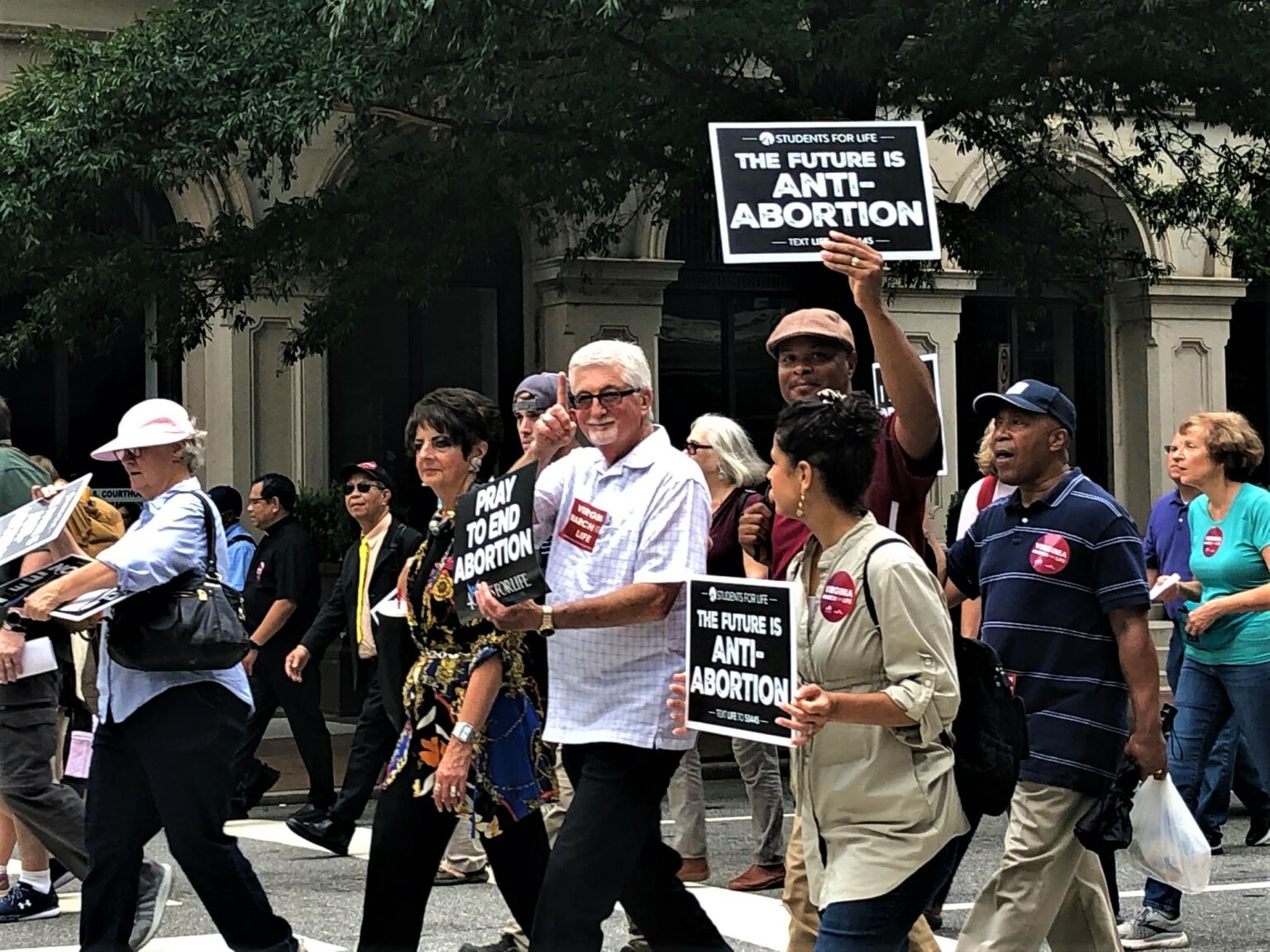
    Anti-abortion demonstrators march. (Photo by Robert Zullo/ States Newsroom).

    BY: SUSAN TEBBEN – Ohio Capital Journal

    Ohio Gov. Mike DeWine signed a new abortion law on Wednesday that looks likely to close Southwest Ohio abortion clinics.

    DeWine signed Senate Bill 157 without further comment, along with several other bills that passed through the legislature in their last work week before the holidays.

    The bill was condemned by abortion providers, who said not only that portions of the bill that direct doctors on the amount of care they should give babies born as a result of a “failed abortion” are already part of medical oaths and Ohio law, but that the bill would impact wanted pregnancies in which complications become a factor.

    “At this moment, we’re at a crisis point for abortion access in Ohio and across the country,” said Kersha Deibel, CEO of Planned Parenthood Southwest Ohio. “…Stripping abortion care from Southwest Ohio will cause havoc that disproportionately impacts our communities.”

    The Southwest Ohio region of Planned Parenthood also opposes the legislation because of changes to hospital transfer variance agreements between abortion providers and physicians, prohibiting for doctors who are funded by Ohio’s public medical schools from participating.

    “There is no medical justification for disallowing qualified, experienced physicians from agreeing to provide backup coverage for abortion providers under a variance,” said Dr. Adarsh Krishen, chief medical officer for Planned Parenthood of Greater Ohio. “In fact, if the state was genuinely concerned for patient safety, such physicians would be ideal. Instead, this provision is only meant to make it more challenging for abortion providers to remain licensed and operational.”

    The religious policy lobby Center for Christian Virtue praised the law and the potential shut down of Women’s Med Center in Dayton and Planned Parenthood of Southwest Ohio’s clinic, saying the state “has made a bold statement about where our values lie.”

    DeWine did not comment on the bill with his announcement that the bill had been signed.

    The bill is one of a few pieces of abortion legislation brought by the legislature this year. Another measure would make abortion illegal with the rollback of the U.S. Supreme Court decision in Roe v. Wade.

  • Abortion bill passage could bring clinic closures in Cincinnati and Southwest Ohio

    Abortion bill passage could bring clinic closures in Cincinnati and Southwest Ohio

    BY: SUSAN TEBBEN Ohio Capital Journal DECEMBER 9, 2021 12:50 AM

    The newest abortion bill to pass the Ohio House could spell the closure of Southwest Ohio clinics and the criminalization of doctors.

    Despite multiple Democrat attempts to amend the bill and remove the language that would affect doctors’ ability to transfer patients from abortion facilities, Senate Bill 157 passed Wednesday afternoon along party lines, 59-33.

    State Rep. Allison Russo, D-Upper Arlington, attempted to bring in the same amendment she tried to include in committee hearings on the bill, to remove the bill’s provision prohibiting physicians who are affiliated with and funded by public medical schools and institutions from having transfer agreement variances with abortion clinics.

    This would effectively close clinics in Southwest Ohio, Russo emphasized in Wednesday’s House session.

    “As a reminder to my colleagues, these consulting physicians that are required in order to get a variance from these transfer agreements, do not actually perform abortion services,” Russo said. “They are only consulted by the facility in the very rare case when there is an emergency and the need to transfer a patient to the hospital.”

    After the bill was passed, Planned Parenthood’s Southwest Ohio region confirmed this would in fact be true, and is something they plan to fight against.

    “Stripping abortion care from Southwest Ohio will cause havoc that disproportionately impacts our communities,” said Kersha Deibel, CEO of Planned Parenthood Southwest Ohio. “This isn’t the end, and we will continue to fight — abortion is still legal in Ohio.”

    The organization said the closure of Planned Parenthood and Women’s Med of Dayton through this bill “would make Cincinnati the biggest metropolitan (area) in Ohio without an abortion provider.”

    The bill was originally slated by sponsors to prevent doctors from allowing a fetus born alive after an attempted abortion to die without medical intervention, and to create another reporting system for “failed abortion” cases.

    The chairman of the House committee that passed SB 157, state Rep. Susan Manchester, R-Waynesfield, stood in support of the bill on the House floor on Wednesday.

    “This is an important piece of legislation that provides a system to protect infants that are born alive after an abortion by enforcing the administration of prevailing standards of care that apply to every child,” Manchester said.

    Testimony made throughout the Senate and House committee process by abortion and pro-choice advocates focused on current law that already prohibits doctors from failing to provide care in a life-saving situation, and reporting requirements already in place by the Ohio Department of Health.

    Opponents of the bill also said “failed abortions” are a rare occurrence, as shown by state data.

    The bill became more controversial once the amendment on physician variance agreements was added, after which abortion advocates called the bill “dangerous,” even saying the bill would impact complicated pregnancies in hospitals, not just abortions in surgical facilities.

    Another amendment tabled by the GOP majority attempted to remove the criminal charges physicians face for not following documentation procedure created in the bill. State Rep. Beth Liston, D-Dublin, presented the amendment just as she did in the previous House committee.

    In the bill, doctors could face felony charges for failing to provide care to infants after an attempted abortion (something that is already a part of Ohio law), and for failing to file the proper paperwork on “failed abortions” as prescribed in the bill.

    Liston said the bill impacts “futile” medical situations in which resuscitation of the baby isn’t scientifically possible and keeping the parent from holding the child only adds to the trauma of the situation.

    “The only situations this bill impacts are those emergency circumstances where the woman’s life is at risk or there is a serious complication with the fetus,” Liston said. “These are desired pregnancies and devastating situations to all involved.”

    State Rep. Kristen Boggs, D-Columbus, tried to add an amendment for workplace protection for pregnant Ohioans, and state Rep. Stephanie Howse, D-Cleveland, also tried to amend the bill to make workplace accommodations for pregnancies. Also attempted as an amendment was the inclusion of paid family leave, which has been a measure state Rep. Janine Boyd, D-Cleveland Heights, has championed for multiple general assemblies.

    All amendments were tabled along party lines.

    The bill is headed to conference committee because of a technical change added during hearings in the House Families, Aging & Human Services Committee, and could head to Gov. Mike DeWine’s desk in the next week.

    DeWine has consistently approved of anti-abortion legislation, so it seems unlikely he will veto the bill.

    Abortion is legal up to 22 weeks gestation in Ohio.

  • Newest abortion restricting bill heading to full House vote after committee approval

    Newest abortion restricting bill heading to full House vote after committee approval

    BY: SUSAN TEBBEN – Ohio Capital Journal DECEMBER 8, 2021 12:55 AM

    Anti-abortion demonstrators march. (Photo by Robert Zullo/ States Newsroom).

    The Ohio House will consider a new abortion regulation that would keep some doctors from being able to work with abortion clinics and could cause felony charges for doctors working on complicated pregnancies.

    Russo furthered an argument made by abortion rights proponents in previous testimony against the bill by saying the regulation “effectively bans and removes access to abortion,” particularly in Southwest Ohio, where two abortion clinics are located.

    Senate Bill 157 passed through the House Families, Aging and Human Services Committee on Tuesday, approved along party lines. It has already been approved in the Ohio Senate.

    The bill would expand the charge of abortion manslaughter, already on the books in Ohio, to include a physicians’ failure to “take measures to preserve the health of a child born alive after abortion,” according to the bill documents.

    Under the legislation, a physician who conducts an abortion but finds the fetus is still alive after the abortion to provide life-preserving care, something that opponents of the bill have said is already a part of state law and medical procedure.

    There is also a provision in the bill that requires the Ohio Department of Health to develop a “child survival form” for a physician to complete if a child is born alive after an attempted abortion, and for ambulatory surgical facilities to submit monthly and annual reports to the ODH.

    The ODH already compiles an annual abortion report based on medical reports signed by physicians of abortions conducted in the state. The report also includes complications, including “failed abortions” that happen in the state and a narrative on the complications.

    The bill’s sponsors referred to an abortion in which a child is born alive as a “botched abortion,” but state data shows the occurrence as a “failed abortion.” According to the most recent years of data on abortions in the state, “failed abortions” are rare, and did not happen in any pregnancies that were viable.

    An amendment made while the bill was in the Ohio Senate prohibits physicians who are funded through a public institution’s medical school from being a part of abortion clinics written transfer agreement variances, which allow a patient to be transferred to a hospital where the physician practices in the case of emergencies.

    Physicians who teach at public medical schools are also not allowed to serve as a consulting physician for abortion-related surgical facility, or the variance can be rescinded, according to the bill.

    Democrats attempted to insert amendments into the bill, including one from state Rep. Allison Russo, D-Upper Arlington, that would remove the transfer agreements variance regulation. Russo furthered an argument made by abortion rights proponents in previous testimony against the bill by saying the regulation “effectively bans and removes access to abortion,” particularly in Southwest Ohio, where two abortion clinics are located.

    “These are medically unnecessary agreements, but on top of that, because of the broad language, this does ban and remove abortion access for one part of the state in Southwest Ohio,” Russo said.

    State Rep. Beth Liston, D-Dublin, introduced an amendment that would take away the word “health” from the bill, leaving the bill to involve a baby’s “life,” which Liston said gives doctors more freedom to do what they feel is best in complicated births and pregnancy plans. Her amendment also sought to remove a requirement that a physician be charged with a third-degree felony for failing to file forms.

    “I think that these changes would minimize the downstream impacts and harm that we might see from this legislation in some small ways,” Liston said.

    Both amendments were quickly voted down along party lines without further discussion.

    The bill now heads for full House consideration, scheduled for 1 p.m. Wednesday.

    Abortion is legal in the state of Ohio up to 22 weeks gestation.

  • “Born alive” abortion bill introduced again, despite current law, low statistics

    “Born alive” abortion bill introduced again, despite current law, low statistics

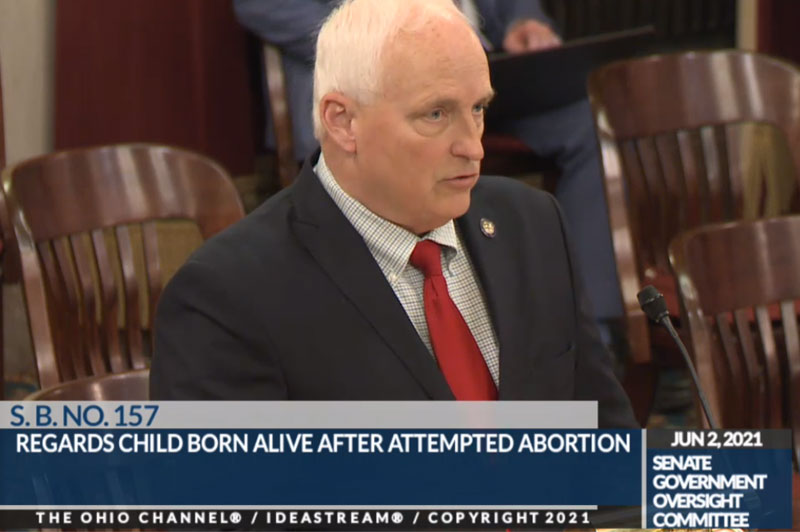
    State Sen. Terry Johnson, R-McDermott, testifies on a new bill regarding “born alive” abortions (Photo by The Ohio Channel)

    By Susan Tebben and Ohio Capital Journal

    Two medical professionals in the Ohio Senate reintroduced a bill that would criminalize physician inaction in “botched abortions,” but say the bill is more about having a reporting system, something that already exists in state law.

    The bill is sponsored by state Sen. Terry Johnson, R-McDermott, who currently works as a drug addiction treatment physician, and former ER doctor Sen. Steve Huffman, R-Tipp City, who still appears to work in a physicians group.

    Johnson said while the bill has punitive aspects for physicians, it is primarily a measure to “provide a reporting system” for abortion procedures in which the baby is born alive after a “failed abortion,” which research shows could only happen closer to the full term of a pregnancy. Full term is considered 40 weeks gestation.

    In Ohio, abortion is legal up to 20 weeks gestation.

    While he said data has settled the dispute in the General Assembly last year that cases of “born alive abortions” were rare or non-existent across the country, Johnson also said the new bill was necessary to find out if it occurred in the state.

    “We don’t want to overlook the fact that we would like Ohio to determine whether this actually happens in Ohio or not, and if it does, we can record it and we can take a cold, hard look at the results of that,” Johnson told the Senate Government Oversight & Reform Committee.

    When asked about current law on infant death, Johnson acknowledged that federal law already makes infant homicide a criminal offense. But when asked to provide an example of occurrences in Ohio, Johnson said the state doesn’t collect that data.

    “In states where they do have a reporting form and where they do pay attention to this, they can gather data and they prove that it happens,” Johnson said. “How would we know in Ohio? We don’t check it.”

    Source: Ohio Department of Health

    State law already requires information about abortions to be reported to the Ohio Department of Health by the physician who performs the abortion, using forms that don’t include identification of the person receiving the abortion. The forms are used to create a yearly abortion report.

    In compliance with current state law, physicians also have to report post-abortion complications, including the number and type of complications and the treatment for those complications, along with the gestational age for each procedure.

    The 2019 state abortion report — the most recent data from the state — said more than half of all abortions in Ohio happened at less than nine weeks gestation, and 26% happened nine to 12 weeks into pregnancy.

    Under the category of “failed abortions” in “post-abortion care for complications” data included in the report, 27 happened at less than nine weeks gestation, and the other 21 happened at nine to 12 weeks.

    None were reported in gestation higher than 12 weeks.

    Of the 356 abortions reported at 19 weeks or more gestation, only one pregnancy was found to be viable, with the majority of viability testing done through ultrasound.

    The CDC considers “early preterm” birth to be less than 34 completed weeks of gestation, and a women’s health webpage for the University of Utah Health says infants are not considered to be viable until after 24 weeks gestation, with the chance of survival before 24 weeks at less than 50%.

    Johnson said Senate Bill 157 is identical to Senate Bill 208, which he brought to the last General Assembly. That bill passed through the Senate but never received a committee hearing in the House before the GA ended at the end of 2020.

    In his testimony along with his cosponsor, state Sen. Huffman pointed to a report from the nationwide anti-abortion organization Family Research Council, citing CDC data of 143 occurrences of live births following abortion procedures between 2003 and 2014, amounting to about 13 per year.

    That report also cited a 2018 study that found the median survival time for those born after the termination of a pregnancy between 20 and 24 weeks gestation was only 32 minutes.