Tag: Senate Bill 23

  • Ohio legislative committee passes rule defining fetal heartbeat

    Ohio legislative committee passes rule defining fetal heartbeat

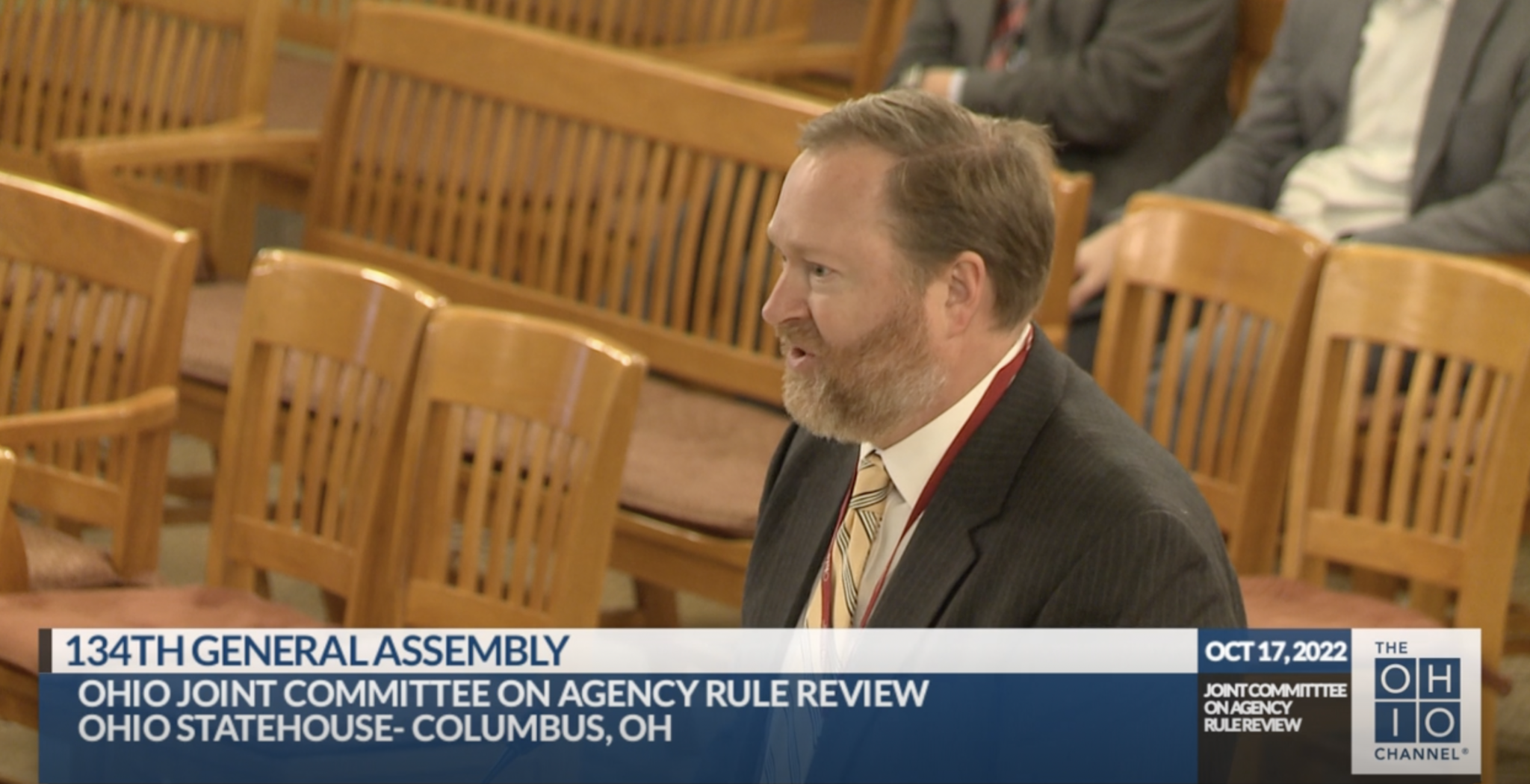
    Ohio Department of Health Assistant Director Lance Himes answers questions from the Joint Committee on Agency Rule Review. Photo courtesy of The Ohio Channel

    Rule passes despite court case holding back abortion ban and Dem objections

    BY: SUSAN TEBBEN – Ohio Capital Journal


    An Ohio legislative committee passed a rule on methods of identifying a fetal heartbeat that matched language in a previously passed abortion law, despite the fact that the law can’t currently be enforced.

    The Joint Committee on Agency Rule Review passed an administration rule from the Ohio Department of Health entitled “appropriate methods for determining presence of fetal heartbeat,” despite Democratic efforts to invalidate the rule.

    Democrats on the committee objected to the rule, saying it violated not only existing state rules for medical care related to abortions, but also case law about how a rule is passed.

    In the rule, a fetal heartbeat is defined as “cardiac activity or the steady and repetitive rhythmic contraction of the fetal heart with the gestational sac.”

    ODH Assistant Director Lance Himes said the definition of cardiac activity was taken “verbatim from Senate Bill 23.”

    A physician should determine the presence of a fetal heartbeat in a method “consistent with the person’s good faith understanding of standard medical practice,” according to the rule.

    This includes ultrasound equipment which allows the physician “to give the pregnant woman the option to view or hear the fetal heartbeat.”

    What isn’t defined in the rule is when a “medical emergency exception” applies, a concern doctors have expressed with regard to the abortion law, even testifying to that effect in court hearings on the law.

    “I would defer to the physicians who are interpreting this law and rule to determine, in their judgment, which is standard medical practices as defined in the statute and rule, for their determination as to whether it would be a medical emergency,” ODH Assistant Director Lance Himes told JCARR.

    In writing this rule, Himes said the ODH was “not tasked with further defining medical emergency.”

    The passage by JCARR this week represents the official passage of the rule, which was previously just an emergency rule put in place when Senate Bill 23 was implemented, hours after the U.S. Supreme Court decision in Dobbs, that overturned Roe v. Wade.

    State Rep. Kristin Boggs, D-Columbus, took issue with the rule being passed without public input and said the passage of the rule as an emergency, then “stacking” the non-emergency rule on top was “in violation of our JCARR standards and in violation of (Ohio Revised Code).”

    Himes acknowledged that no public hearing was held on the rule, but said Ohio Revised Code does not require one and “we did not have a stakeholder request out there for input.”

    “The regular rule filing does offer forums like JCARR for individuals to come and make public comment … but a public hearing was not required,” Himes said.

    Boggs also said the fact that SB 23 is currently unenforceable – a Hamilton County judge blocked the law indefinitely as the ACLU and Planned Parenthood clinics attempt to get the law thrown out – means there’s “no statutory authority to put forward this rule at this time.”

    “So right now, as I see it, there are two reasons that have merit that would suggest that even passing this rule today would invalidate it in the future,” Boggs said.

    State Sen. Andrew Brenner, R-Delaware, pushed back against the idea that the rule did not follow JCARR processes.

    “This actually is going through the JCARR process, because that’s what we’re doing right now,” Brenner said. “So I don’t know how that would be a violation of doing something right now that we’re doing.”

    State Rep. Michael Skindell, D-Lakewood, said the new rule conflicts with a Medicaid rule allowing for reimbursement of services if an abortion is the result of rape or incest and one from the Department of Veterans Services regarding abortion services when a pregnant person’s life is in danger or in the case of rape or incest. He argued the six-week ban would create a situation in which those services could not take place, therefore violating the Medicaid and Veterans Services rules.

    “This (ODH) rule violates it once there’s a detectable heartbeat,” Skindell said.

    Himes did not speak to the Medicaid rule, but said the ODH administrative rule “only sets forth the appropriate methods for determining a heartbeat. It does not speak to the legality of abortion related to rape or incest.”

    Skindell entered a motion to invalidate the rule, which was defeated on a 5-4 vote along party lines.


  • Despite reports of harm, DeWine refuses comment on abortion ban law

    Despite reports of harm, DeWine refuses comment on abortion ban law

    BY: MARTY SCHLADEN – Ohio Capital Journal

    With Gov. Mike DeWine’s blessing, Ohio is in court, fighting to reimpose strict abortion regulations under a law he signed in 2019. But he’s refusing to publicly comment on the numerous stories of suffering it caused during the 11 weeks it was enforced.

    The law DeWine signed, Senate Bill 23, bans abortion after fetal cardiac activity can be detected. That’s about five or six weeks into a pregnancy — a point so early that many women and girls don’t yet know they’re pregnant.

    The law makes no exceptions for rape and incest. It includes some protections for the life and health of the mother, but doctors — who can be charged with felonies under the law — say they’re too vague to be workable.

    SB 23 was unenforceable until June 24 because it violated the 1973 U.S.  Supreme Court decision in Roe v Wade. But then the U.S. Supreme Court conservative majority handed down its decision in Dobbs v Jackson Women’s Health, overturning Roe and its protections of the right to an abortion.

    Almost immediately, SB 23 went into effect and just a week later, the Indianapolis Star reported that the law had forced a 10-year-old rape victim from Columbus to travel there for an abortion. The incident made for international news, but DeWine refused to comment on it, other than to say child rape is “gut wrenching.”

    After that, more horror stories came in the form of sworn affidavits filed by doctors and other workers in Ohio abortion clinics. 

    They included two more minors who had been impregnated by rapists and cancer patients who couldn’t get abortions needed for treatment because their doctors were afraid of being charged with crimes and losing their medical licenses. 

    Other women were diagnosed with fetal abnormalities so severe that their pregnancies couldn’t be successful. Under SB 23 they had to leave Ohio for abortions if they didn’t want to carry those fetuses for months.

    On Sept. 14, enforcement of SB 23 was paused when a Cincinnati judge granted a temporary restraining order against it and then later issued a preliminary injunction. The case is expected to make its way to the Ohio Supreme Court, on which DeWine’s son, Pat, sits as a justice.

    In the face of news of medical and emotional problems caused by SB 23, Gov. DeWine has been steadfastly silent. 

    “Our office has no new comments on the issue or the ongoing litigation at this time,” Press Secretary Dan Tierney said in an email Monday. He said something similar 10 days earlier.

    Also, some of the governor’s recent conduct might be seen partly as an attempt to avoid questions about the impact the abortion law he signed is having on some women and girls. 

    He has refused to debate his Democratic challenger in the Nov. 8 election, Nan Whaley. Also in recent weeks, DeWine has made few appearances in central Ohio, where he’d be likely to face the Capitol press corps.

    At the same time, he may be quietly signaling his support for even more sweeping abortion measures.

    After the Dobbs decision, state Rep. Jean Schmidt, R-Cincinnati, introduced a bill that would ban abortions at any point in a pregnancy with only narrow exceptions to protect the life and health of the mother. She said she had the governor’s support.

    DeWine apparently hasn’t spoken publicly about the measure, House Bill 598. But a spokesman didn’t dispute Schmidt’s claims.

    Follow Marty Schladen on Twitter.

  • Pro-abortion groups seek to bypass supreme court in abortion ban lawsuit

    Pro-abortion groups seek to bypass supreme court in abortion ban lawsuit

    BY: SUSAN TEBBEN – Ohio Capital Journal

    The groups hoping to put a stop to a six-week abortion ban in Ohio say the Ohio Supreme Court’s inaction forced them to move on to a different court.

    In a recent court filing, the ACLU of Ohio and Planned Parenthood asked the state’s highest court to dismiss their case in favor of separate litigation in the Hamilton County Court of Common Pleas.

    The court filing claimed Planned Parenthood has suffered “irreparable harm which has increased to become intolerable” since filing the lawsuit at the end of June, causing a separate lawsuit to request “immediate relief from the ongoing irreparable harm to the clinics and their patients.”

    Jessie Hill, counsel of record representing the ACLU of Ohio and Planned Parenthood, said the move was spurred by not only the overturning of Roe v. Wade by the U.S. Supreme Court, but also the impending closure of Women’s Med Center of Dayton and clinics in surrounding states like Kentucky and Indiana.

    “Ohioans’ access to abortion care is becoming more and more restricted,” Hill told the OCJ. “Since the situation is so dire and the Ohio Supreme Court has not acted, we needed to pursue an alternative path that could lead to quicker relief.”

    The new lawsuit has been filed, with the added support of law firm WilmerHale, challenging the constitutionality of Senate Bill 23, the bill that is called the “Heartbeat Bill” by supporters, because the bill’s ban hinges on the presence of fetal “cardiac activity.”

    Opponents of the law say banning abortion at six weeks could close out options to women before they are aware of the pregnancy and have unintended consequences for other fetal medicine fields, such as in-vitro fertilization and miscarriages. Meanwhile, Ohio doctors are describing scenes of almost unimaginable anguish — and increased risks to women and girls who become pregnant, in the months since the Dobbs decision.

    “Ohioans deserve the information and resources to make the best decisions for themselves and their families,” said Lauren Blauvelt-Copelin, Vice President of Government Affairs and Public Advocacy at Planned Parenthood of Greater Ohio, in a statement announcing the Hamilton County Court case.

    The groups have already asked the court to implement a temporary restraining order, keeping the state from enforcing the law until the court case has been resolved. The Ohio Supreme Court had previously rejected a request to do so in the case in their court.

    The court has not scheduled any hearings on the matter, or made any decisions on the temporary restraining order.

    Follow OCJ Reporter Susan Tebben on Twitter.

  • Ohio Supreme Court denies attempt to stop abortion ban

    Ohio Supreme Court denies attempt to stop abortion ban

    BY: SUSAN TEBBEN – Ohio Capital Journal

     Protesters gathered at the statehouse to voice opposition to the Dobbs decision overturning Roe v. Wade. (photo by Nick Evans)

    The Ohio Supreme Court has denied an attempt by abortion clinics to stop a six-week abortion ban from being enforced.

    In a Friday ruling, the court denied a motion for an emergency stay of Senate Bill 23, legislation signed into law in 2019 that banned abortion up to six-weeks gestation.

    The lawsuit is still ongoing, but denial of the emergency stay means abortion clinics won’t be able to conduct abortions past six weeks as the case continues. The announcement did not indicate whether the denial was unanimous.

    The court asked for responses by Thursday to the lawsuit’s request to stay the law, and received briefs from state officials, prosecutors and academics.

    In a “friend of the court brief” filed Thursday, professors of public health, sociology, epidemiology and public affairs from The Ohio State University and the University of Cincinnati joined with the ACLU and Planned Parenthood in pushing for an end to Senate Bill 23, which was implemented on Friday, hours after the U.S. Supreme Court overturned Roe v. Wade.

    “Instead of reflecting the Ohioan majority view that supports abortion rights, SB 23 caters to the minority fraction of Ohioans that are unsupportive of these rights,” the brief states.

    The researchers cite polling data on support of abortion rights from three different universities: Suffolk University, Baldwin Wallace University and Quinnipiac University. All of the surveys found a majority of survey-takers supported abortion rights, and the professors argued that the polls proved that public opinion is on the side of abortion rights.

    “While abortion attitudes arise out of complex combination of interlocking feelings toward gender, religion, politics, morality, science and many other facets, SB 23 allows from none of this nuance,” the professors wrote.

    Prosecutors from Cuyahoga County and Franklin County aren’t going to stand in the way of the lawsuit. Both Michael O’Malley and Gary Tyack filed documents with the court saying they “do not oppose” granting an emergency stay of the law.

    O’Malley previously signed on to a letter with other national prosecutors and attorneys pledging not to enforce abortion bans following the Supreme Court decision.

    Attorney General Dave Yost also responded to the lawsuit, calling the request for emergency stay of the law “substantively and procedurally flawed,” citing the Roe v. Wade ruling last week in Dobbs v. Jackson Women’s Health Org.

    “With this holding, the court extricated itself from having to repeatedly decide policy matters that the Constitution leaves to the states and the political branches,” Yost wrote.

    Any contention that Ohio’s constitution holds the right to abortion is “indefensible,” the attorney general stated, “no matter the theory of constitutional interpretation one might embrace.”

    Follow OCJ Reporter Susan Tebben on Twitter.