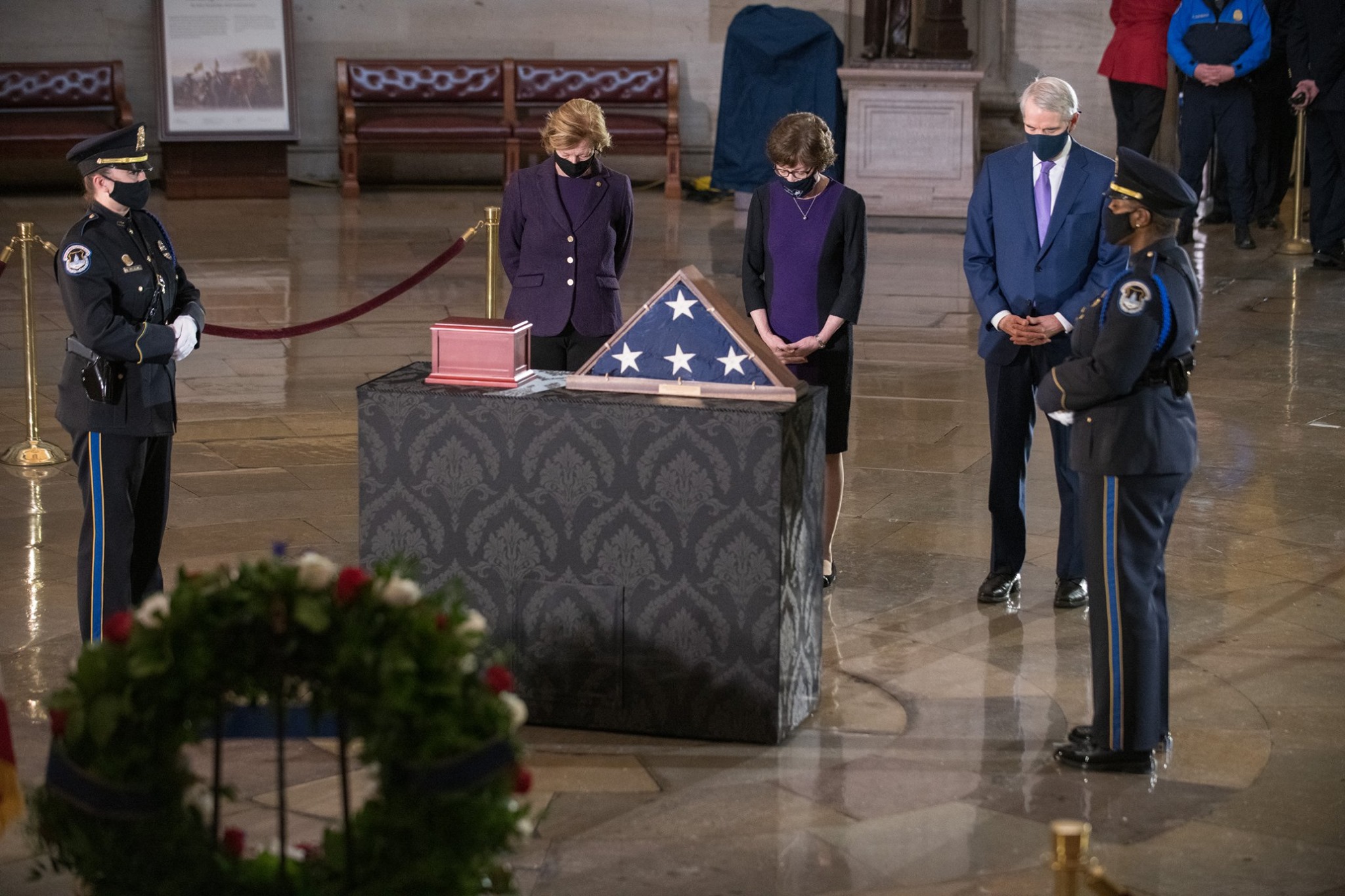
The photo above was posted to U.S Senator Rob Portman’s Facebook page on February 3 with the following statement:
“Blessed are the peacemakers, for they will be called children of God.”
This morning I had a chance to pay my respects to USCP officer Brian Sicknick who lost his life in defense of the U.S. Capitol on January 6th. We will never forget his service and sacrifice. May he Rest In Peace.
Below is Portman’s statement issued 10-days later after voting to acquit former President Donald Trump on a charge of inciting the deadly January 6 insurrectionist attack on the U.S. Capitol, concluding his second impeachment trial with the same verdict as his first impeachment.
In the 57-43 vote, seven Republicans joined every Senate Democrat and independent in support of convicting Trump. Ohio Republican U.S. Sen. Rob Portman voted to acquit Trump. Ohio Democratic U.S. Sen. Sherrod Brown voted to convict.
Portman has announced that he will not run for re-election in 2022.
The siege of the U.S. Capitol on January 6 was an attack on democracy itself. That night, shortly after the rioters had been cleared from the Senate floor, I spoke to urge my colleagues to support the state certifications of the election results as our constitutional duty, and as a signal that ‘we will not be intimidated’ and that ‘mob rule is not going to prevail here.
I have said that what President Trump did that day was inexcusable because in his speech he encouraged the mob, and that he bears some responsibility for the tragic violence that occurred. I have also criticized his slow response as the mob stormed the U.S. Capitol, putting at risk the safety of Vice President Pence, law enforcement officers, and others who work in the Capitol. Even after the attack, some of the language in his tweets and in a video showed sympathy for the violent mob. In response, I called on President Trump to ‘explicitly urge his supporters to remain peaceful and refrain from violence.
But the question I must answer is not whether President Trump said and did things that were reckless and encouraged the mob. I believe that happened. The threshold question I must answer is whether a former president can be convicted by the Senate in the context of an impeachment. This would be unprecedented. Consistent with the two votes I have already taken in this process, I believe the Constitution reserves the narrow tool of impeachment and conviction for removal of current officeholders and current presidents, and does not apply to former officeholders or former presidents. Impeachment in the Constitution is fundamentally about removing someone from office.
I think the Framers of the Constitution understood that it would be inappropriate to allow Congress – an inherently political body – to convict former presidents. Instead, the appropriate place to address former officials’ conduct is the criminal justice system. In fact, the Constitution makes clear that former presidents are subject to the criminal justice system. That is where the issues raised by the president’s inexcusable actions and words must be addressed. I have a duty to uphold my oath to the Constitution and that’s why I voted as I did, on the state certifications of the election on January 6, on the jurisdictional issue earlier this week, and on the final vote on conviction today. My decision today in no way condones the president’s conduct. On the contrary, it is keeping an oath to the Constitution, that I believe the president did not keep on January 6.
Our country is already deeply divided. My decision was based on my reading of the Constitution, but I believe the Framers understood that convicting a former president and disqualifying him or her from running again pulls people further apart. Instead, our task should be to help bridge the growing gaps that separate us. President Biden said in his inaugural address, ‘This is our historic moment of crisis and challenge, and unity is the path forward.’ I agree, and will continue to do my part to try to find that common ground to bring our country together to address the many challenges we face.
After he was acquitted, the former president issued a statement that said in part, “Our historic, patriotic and beautiful movement to Make America Great Again has only just begun.”
Washington, D.C. – Wednesday, U.S. Sen. Sherrod Brown (D-OH) continued pushing for what he calls “meaningful police reform” as he voted against proceeding to debate the GOP-led Justice Act, legislation that he called a “check in the box” and would do very little to reform policing.
Brown took to the Senate floor to call for passage instead the Justice in Policing Act, what he says is a “Comprehensive package.” He helped introduced the bill earlier this month, “To put important policing reforms into place, help end racial profiling in the criminal justice system and work to improve police-community relations.”
“I’m not willing to stand here and participate in a political charade – to vote on something that won’t lead to real change, just to check a box and provide politicians with a talking point. It’s an insult to Black families who have been fed empty promise after empty promise for generations,” said Brown. “The Justice in Policing Act would create real change in our justice system, and communities across the country can’t afford us to not act on this meaningful legislation. We need to listen to the Black voices leading these calls for justice, and take real action.”
Democrats on Wednesday denied Republicans the votes needed to pass the Senate GOP’s policing reform bill and send it to the House. Sixty votes were needed. The vote was 55-45.
Ohio Senator Rob Portman (Provided by Portman office)
Senator Rob Portman (R-OH), a co-sponsor of the Justice act released a statement saying, “The fact that Senate Democrats voted to block debate and an open amendment process on meaningful police reforms is outrageous and unacceptable. Over the last month we’ve continued to see egregious examples of injustice and violence against people of color. Americans want to see progress on meaningful police reform.”
Brown says the Justice in Policing Act which he supports would:
Ban chokeholds, carotid holds, and no-knock warrants at the federal level and limits the transfer of military-grade equipment to state and local law enforcement.
Establish a National Police Misconduct Registry to prevent problematic officers who are fired or leave an agency from moving to another jurisdiction without any accountability.
Mandate the use of dashboard cameras and body cameras for federal officers and requires state and local law enforcement to use existing federal funds to ensure the use of police body cameras.
Create law enforcement development and training programs to develop best practices and requires the creation of law enforcement accreditation standard recommendations based on President Obama’s Task force on 21st Century policing.
Make important legal reforms to increase police accountability and transparency.
The package also includes Brown’s End Racial and Religious Profiling Act, which hs said would better enforce equal protection laws and work to end racial profiling in the criminal justice system.
Brown took to the Senate floor earlier this month, condemning what he characterized as President Trump’s “violent response” to protests of the murders of Breonna Taylor, George Floyd, Ahmaud Arbery, and countless other victims of racist police brutality and systemic injustice. Brown pointed out that Black and Brown communities have been and remain marginalized and targeted and that protests sweeping Ohio and the nation are calling for an end to systemic racism.
Portman’s statement also said, “The JUSTICE Act takes responsible steps toward improving the collection of data on violence by and against law enforcement, providing funding to increase the use of body cameras, and increasing transparency and accountability while strengthening and reforming police training methods and hiring practices. I hope my Democratic colleagues will reconsider their decision and join us in working towards real reform on this issue.”
Brown’s remarks on the Senate Floor, as prepared for delivery, are below:
Thousands of Americans are peacefully protesting in communities all across the country, demanding our country do better.
The protests are an expression of grief, for Breonna Taylor and George Floyd and Ahmaud Arbery and Rayshard Brooks and so many other Black Americans murdered by the people who were supposed to protect them.
They’re an expression of frustration and anger, that it’s 2020 – a century and a half after the official end of slavery, 55 years after the passage of the Civil Rights Act – and still Black people are fighting the same fight.
And they’re also an expression of hope and patriotism. Demanding our country do better, demanding we live up to our founding ideals is one of the most patriotic things anyone can do.
We need to listen to the Black voices leading these calls for justice, and take real action.
That’s what Democrats want to do. My colleagues Senator Harris and Senator Booker in the Senate, and the CBC in the House, have led our bicameral efforts, and have a serious plan: the Justice in Policing Act.
It would implement real, meaningful reforms and actually hold police accountable. It makes it clear:
No more chokeholds. No more unchecked police misconduct. No more militarization of police misconduct.
Of course we know this isn’t the only thing we need to do – policing didn’t create institutional racism, it’s a product of it and often reinforces it, and we have a lot of work to do beyond this. But these reforms are an important start to making policing in our country more just.
The Justice in Policing Act would create real change in our justice system, and communities across the country can’t afford us to not act on this meaningful legislation.
What we cannot do, is pass something called “Police Reform” that does very little to actually reform policing – and then turn around and tell Black mothers and fathers whose children have been slain, “we solved it, our work here is done.”
I respect Senator Scott and I appreciate him coming to the table, and taking on this issue. I know he is fighting an uphill battle within his own caucus.
I want to work with him, and with anyone of either party on real solutions.
But I’m not willing to stand here and participate in a political charade – to vote on something that won’t lead to real change, just to check a box and provide politicians with a talking point.
It’s an insult to Black families who have been fed empty promise after empty promise for generations.
We need to listen to the communities that suffer the most at the hands of police violence, and they all agree: the Senate Republican bill is simply not serious.
It won’t fix the problems, and we’ll be right back here, sooner rather than later.
Major civil rights groups all oppose this bill – the NAACP Legal Defense Fund, the Urban Leagues, the Leadership Conference on Civil and Human Rights.
It doesn’t ban no-knock warrants. The Justice in Policing Act does.
It doesn’t stop the militarization of police departments. The Justice in Policing Act does.
It doesn’t create a national misconduct registry. The Justice in Policing Act does.
It doesn’t ban chokeholds. The Justice in Policing Act does.
These are all steps that civil rights groups have said are critical to any reform effort. This is the bare minimum we should be doing.
Really all this bill offers is more studies of questions we already know the answers to.
We don’t need more studies, more task forces, more delaying tactics.
We need real accountability.
The Justice Act could even put us in danger of moving in the opposite direction, by providing more funding for policing without adequate strings attached and without a similar investment in community supports.
The NAACP says this bill, quote, “ignores the public demands to reimagine public safety by shrinking the purview of law enforcement and providing better funding to agencies equipped to address the critical needs of communities such as social services, mental health services, and education.”
The Urban League says this bill, “dances around the edges in a show of political posturing.”
We refuse to engage in that political posturing.
We refuse to act like this is just a box we can check, so we can move on.
We refuse to insult Black Americans by pretending this is a serious effort.
People have suffered too long for that.
We have been here before. This isn’t the first wave of protests, or the second.
In 2014, after the murders of Tamir Rice in my city, in Cleveland, and Michael Brown in Ferguson, President Obama and his administration laid important groundwork for reform.
They studied what reforms would be most effective, they instituted consent decrees with cities to hold departments accountable, and they created a roadmap we could follow.
But President Trump undid much of the progress the Obama Administration made.
The Urban League put out a plan for reform in 2014, after Michael Brown’s murder.
Since then, nearly 1,300 Black men and women have been fatally shot by police.
This bill does nothing to stop the practices that killed them.
Black Americans know their lives are put in danger by policing every day. Let’s listen to them. People all around the country – Black and white and brown, in small towns and big cities, young and old – are all listening, waking up, and joining the calls for change.
Let’s follow their lead. Let’s actually hear the voices that have been silenced for too long.
I urge my colleagues to vote “no,” and instead work with us on real, meaningful reform to transform our public safety system into one that actually keeps people safe.
If you have any questions, contact Senator Brown’s Academy Coordinator at 216-522-7272.
Beginning today, Senator Portman we will be accepting applications for those candidates who would enter into the academy in June of 2021. If you have any questions, contact my academy coordinators in Columbus at (614) 469-6774 or 1-800-205-OHIO.
Dates and Deadlines
March 1, 2020
Applications Available Online
July 1, 2020 – September 18, 2020
Completed Applications Accepted
October 2020 – November 2020
Candidate Interviews Conducted
January, 2021
Nominations Announced
Links
Prior to applying for a nomination from either Senator, contact your academy or academies of choice to begin that school’s application process. Each academy will apprise you of any special physical, medical or academic requirements specific to that school.
The United States Coast Guard Academy does not require Congressional nominations. If you are interested in attending the Coast Guard Academy, you should contact the academy directly. Coast Guard »
FAQS
Am I qualified to be considered for a nomination to a military service academy?
To qualify, you must be a United States citizen and a resident of the State of Ohio. In addition, the service academies require the following:
For West Point, Annapolis and the Air Force Academy, you must be at least 17 years old, but not yet 23 years old on July 1, 2021. The Merchant Marine Academy has the same minimum age requirement but accepts students who are not yet 25 years old on July 1, 2021.
You must not be married, pregnant or have any legal obligation to support children or other dependents.
When should I request an application for nomination?
You may request an application through Senator Brown’s website or Portman’s website during the spring of your high school junior year or any time thereafter.
To apply through Senator Brown’s office:
If you are a high school freshman, sophomore or junior in your first semester, you may call Senator Brown’s Academy Coordinator, Sue Klein at the Cleveland office (216-522-7272) to obtain information and ask questions about the application and nominations process.
To apply through Senator Rob Portman’s office:
If you are interested in learning more about the application process for the Air Force, Military, Naval, and Merchant Marine Academies, join us at one of our informational sessions held across Ohio. Email Suzanne Cox to RSVP.
Can I only be considered for one academy?
You may ask to be considered for any or all of the academies; however, you can only receive a nomination to one academy. The application asks you to rank your academies of choice by order of preference.
When is the application packet due?
The application packet must be delivered between July 1, 2020 and September 18, 2020. The packet must include the following:
The completed five-page application.
Two one-page essays.
Two letters of recommendation from individuals who are not members of your family. One letter should be from an adult. The other from a peer (friend, classmate or teammate). These recommendations must be included with your packet. Late letters of recommendation and additional letters of recommendation will not be considered.
An official or unofficial high school transcript.
Your most recent SAT/ACT scorces (copies or original scorce sheets are acceptable).
Senator Brown’s SAT code is 1333 and his ACT code is 7170.
Senator Portman’s SAT code is: email to Suzanne Cox
Must I meet certain medical requirements to receive a nomination?
A service academy medical examination must be passed before a candidate can receive an appointment. The examination is scheduled by the Department of Defense Medical Examination Review Board (DODMERB). Carefully review the medical information on the academy websites and contact the academies directly if you have any questions or concerns about disqualifying medical conditions.
If I’ve applied before and was not selected, can I apply again?
Yes. Those not selected for a nomination last year may reapply as long as they still meet the age requirements. Applicants may use old recommendations and essays but should complete a new application.
How is a candidate selected for a nomination?
Prior to applying for a nomination contact your academy or academies of choice to start the application process. Each academy will apprise you of any special physical, medical or academic requirements specific to that institution.
Each Member of Congress and U.S. Senator may have no more than five appointees in each of the service academies. Senator Brown uses the competitive process which permits him to nominate ten students for each appointment available. A nomination does not guarantee acceptance to a service academy. The Academy’s Admissions Board ultimately decides who receives an appointment. You are encouraged to also seek a nomination from as many sources as possible, including the Vice-President, Senator Portman and your Member of Congress, and for certain candidates, the President.
Senator Brown will appoint a Service Academy Selection Advisory Committee which will be comprised of volunteers who are former and active members of the military and/or local community leaders. All applications will be reviewed to determine which students are most qualified for consideration. Those students who are deemed “highly- qualified” will be interviewed by Advisory Committee members or their designees. Those who receive nominations will be notified by mail before January 31, 2021.
Interested in learning more about the application process for the Air Force, Military, Naval, and Merchant Marine Academies? Join us at one of our informational sessions held across Ohio. Email Suzanne_cox@portman.senate.gov to RSVP.
UNITED STATES SERVICE ACADEMY SEMINAR AT SYMMES TOWNSHIP LIBRARY
Sponsored by:
UNITED STATES SENATOR SHERROD BROWN & UNITED STATES SENATOR ROB PORTMAN
WASHINGTON, D.C. – U.S. Senator Rob Portman (R-OH) issued the following statement regarding the joint news conference today by President Donald Trump and Russian President Vladimir Putin at the Helsinki Summit:
“The president’s comments in today’s press conference were troubling. He failed to stand up to Vladimir Putin on some of the most critical security issues facing our country and our allies. There is a consensus in the intelligence community that Russia meddled in our elections and continues to try to destabilize democracies around the world. Both the House and Senate Intelligence Committees have concluded that Russia interfered in the 2016 elections. When given the opportunity, President Trump did not hold President Putin to task for election meddling, for the illegal annexation of Crimea, or for the continued aggression in Eastern Ukraine.
“I believe the United States must be matter of fact and transparent. We all want to see a better relationship between our two countries, but we must make clear directly to President Putin and to the world that Russia’s actions on the world stage are unacceptable and a change in their behavior is necessary in order to improve relations. I will continue to work with my colleagues in Congress and with this administration to do so.”


![[VIDEO] Brown condemns GOP-led Justice Act as ‘CHECK IN THE BOX’](https://lovelandmagazine.com/wp-content/uploads/2015/02/sherrod_brown_feature-unage-100x65.jpg)





 get to decide whether it is appropriate to play Bruno Mars at my daughter’s funeral.
 Sincerely,