Washington D.C. – U.S. Senator Sherrod Brown (D-OH) joined U.S Senators Catherine Cortez Masto (D-NV), Sheldon Whitehouse (D-RI), Patty Murray (D-WA), Kirsten Gillibrand (D-NY), and 29 of their Senate colleagues in introducing theFreedom to Travel for Health Care Act of 2022. This legislation would make it crystal clear that it is illegal for anti-choice states to limit travel for abortion services and would empower the Attorney General and impacted individuals to bring civil action against those who restrict a woman’s right to cross state lines to receive legal reproductive care.
“Just a few weeks ago, the Supreme Court took us back nearly 50 years and is currently threatening other decisions that undermine our freedom to decide when, whether, and how we have a family,” said Brown. “We’ve already seen how this is putting the health of Ohioans at risk as they are forced to travel around the country to get vital, sometimes lifesaving care. The Senate must pass the Freedom to Travel for Health Care Act to protect Ohio women and girls and the health care professionals who serve them.”
A press release today from Brown’s office said, “Legislation introduced in Missouri and draft legislation proposed by anti-choice extremists make clear that interstate travel for reproductive health care is under attack. The Freedom to Travel for Health Care Act of 2022 underscores the Constitutional protections for interstate travel and provides redress for women whose rights are violated. The legislation would also protect health care providers from prosecution and lawsuits for serving individuals traveling from other states.”
On Friday, Brown joined advocates and providers at Trinity Commons in Cleveland for a roundtable discussion on reproductive rights less than three weeks after Roe v. Wade was overturned and Ohio’s six-week abortion ban law went into effect. Brown heard from those caregivers about how he can support them, and Ohioans who can no longer access essential health care in Ohio. In June, Brown joined 33 of his Senate colleagues sent a letter to President Joe Biden urging “bold action” to protect the right to abortion after the conservative wing of the Supreme Court overturned Roe v. Wade. In May, Brown voted in support of the Women’s Health Protection Act (WHPA), which would protect women’s freedom to make their own health care decisions. Brown has supported the legislation since 2013 and joined 47 of his colleagues in the Senate in reintroducing this legislation in 2021.
In addition to Senators Brown, Cortez Masto, Whitehouse, Murray, and Gillibrand, the legislation is also cosponsored by Senators Dick Durbin (D-IL), Chuck Schumer (D-NY), Richard Blumenthal (D-CT), John Hickenlooper (D-CO), Alex Padilla (D-CA), Maria Cantwell (D-WA), Amy Klobuchar (D-MN), Robert Menendez (D-NJ), Debbie Stabenow (D-MI), Jack Reed (D-RI), Tammy Duckworth (D-IL), Dianne Feinstein (D-CA), Chris Murphy (D-CT), Mazie Hirono (D-HI), Tina Smith (D-MN), Michael Bennet (D-CO), Tammy Baldwin (D-WI), Chris Coons (D-DE), Ed Markey (D-MA), Reverend Raphael Warnock (D-GA), Chris Van Hollen (D-MD), Ron Wyden (D-OR), Tim Kaine (D-VA), Elizabeth Warren (D-MA), Ben Ray Lujan (D-NM), Cory Booker (D-NJ), Jacky Rosen (D-NV), Bernie Sanders (I-VT), and Jon Tester (D-MT).
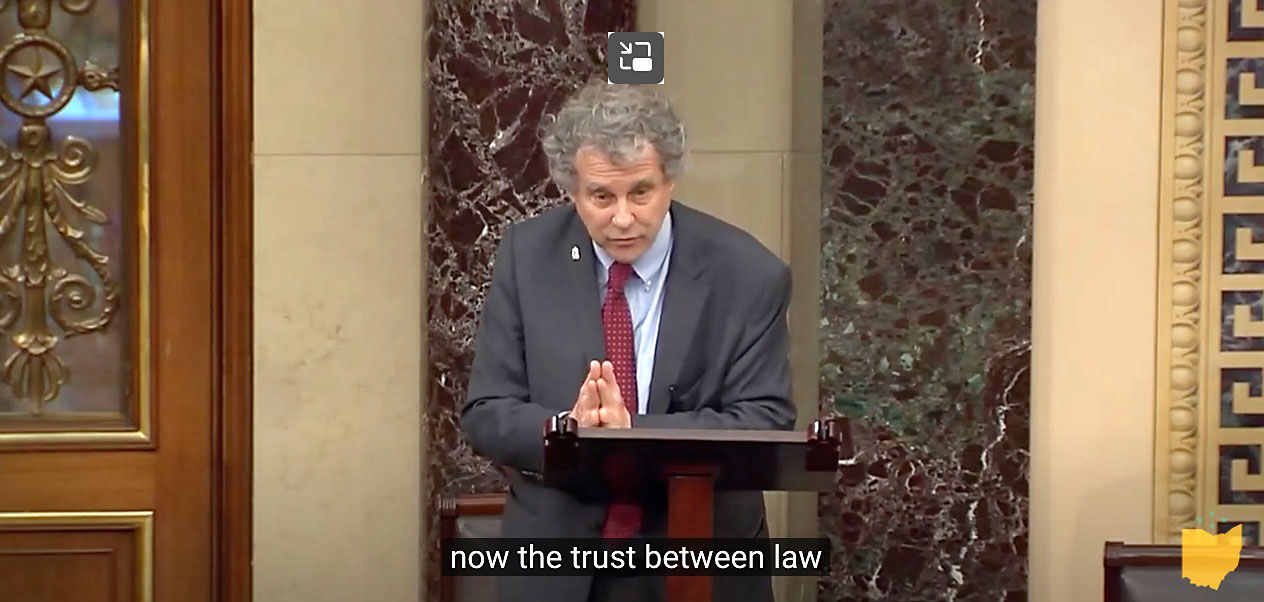
Yesterday, on the Senate Floor, U.S. Senator Sherrod Brown (D-OH) commemorated Police Week and honored Ohio’s fallen officers who made the ultimate sacrifice for their communities last year.
Loveland, Ohio – To supplement the story below (4 Ohio Republicans join House Dems to pass bill to boost post office funding by $25B) from the Ohio Capital Journal, Loveland Magazine visited two of the closest local U.S. Post Offices to document the number of mailboxes placed outside the buildings. We also documented the days and hours of operation of each.
While unlikely that the Trump Administration would attempt to interfere with the delivery of election-related mail in our heavily Republican voting area, nearly all Loveland mail does go to or from the Dalton Street processing center in Cincinnati. Interfering with mail delivery in the heavily Democratic voting urban areas of Cincinnati’s urban core is not beyond reasonable suspicion. And, the President may use mail problems in any part of the country to delegitimize and dispute the November election results.
One day ago the President tweeted, “The greatest Election Fraud in our history is about to happen. This may top the Democrats illegally spying on my campaign!”
On August 20 the President tweeted this, “They are sending out 51,000,000 Ballots to people who haven’t even requested a Ballot. Many of those people don’t even exist. They are trying to STEAL this election. This should not be allowed!”
Trump said last week on Fox News that he opposes some funding because he doesn’t want it used for mail-in votes, repeating his claim that it would lead to “fraudulent” election results.
WCPO has reported that processing machines from Cincinnati’s Dalton Street post office have been removed and remain offline and unusable.
The Cincinnati Enquirer recently reported that according to Jim Sizemore, president of the American Postal Workers Union in Cincinnati that in May and June, the USPS “pulled the plug on eight mail processing machines in Cincinnati, accounting for 19% of the processing center’s capacity.” The eight machines could process collectively 243,000 pieces of mail an hour according to the Enquirer. Mail is piling up on the floor at the Queensgate facility according to Sizemore.
WCPO’s John Matarese says the VA is now notifying veterans that they should order their medicine earlier than usual because at this time it cannot guarantee on-time delivery. And, by law, it cannot ship medication via private services.
Sen. Rob Portman said on August 21 on his FaceBook page, “A number of veterans have reached out to my office recently expressing concern about delays in the USPS delivery of their critical prescription medications. This is not acceptable. This morning I pressed Postmaster General DeJoy for answers.” And on August 19 Portman said, “We must protect Ohioans right to vote during to the ongoing COVID-19 pandemic. That’s why I sent a letter to the Postmaster General with Congressman Bob Latta calling on the USPS to ensure the timely & accurate delivery of election-related materials in Ohio.”
Rep. Brad Wenstrup told constituents in an email on Monday that the postal service has enough money on hand, “$14 billion cash” and that he voted to “open a $10 billion line of credit through the CARES Act” to help with any COVID-19 issues. Wenstrup said the USPS has enough money on hand to remain “fully function” until August of next year and that Speaker Pelosi has “manufactured a crisis and rushed the House back to vote on an irresponsible and unneeded amount of money on a problem that does not currently exist.”
Paige Pfleger reported in a Cincinnati Public Radio story on August 20 that, “Since the pandemic, even more Ohioans have opted to receive their medications by mail, to avoid possible exposure or to save money.”
Antonio Ciaccia of the Ohio Pharmacists Association is quoted in the story, “We have heard some extreme anecdotes over the last couple weeks where patients are waiting one, two, three weeks for their medications,” and adds that he’s never heard so many complaints about delivery delays.
On August 18, Senator Sherrod Brown is quoted in a Cleveland.com article about mail sorting equipment being dismantled in Cleveland. Brown said, “As the U.S. Postal Service has warned Ohio and other states that it may not be able to meet mail-voting deadlines this November, the visibly idle equipment along with mail delays and post office budget shortfalls have fueled fears that the upcoming election will be undermined.”
Reporter Sabrina Eaton writes in the Cleveland.com article:
President Donald Trump’s assaults on mail-in balloting, even as he has requested an absentee ballot to vote from his new residence in Florida, have raised questions over whether he’s deliberately trying to sabotage an election that will likely have more mail-in ballots than ever because of reluctance to vote in person during the coronavirus pandemic.
In a news conference over the weekend, Trump said universal mail-in voting would be “catastrophic. It’s going to make our country a laughingstock all over the world.”
“The ballots are lost, there’s fraud, there’s theft, it’s happening all over the place,” said Trump. “Now we’re going to do it with this whole, vast, big section of the country? It’s crazy.
Check out these two voter guides recently published by Loveland Magazine with information about requesting absentee ballots. Keep in mind that Ohio officials are recommending you stay ahead of these absolute dates to ensure your mail coming to and from the post office is delivered in time for your vote to count.
Loveland Magazine is interested in hearing from readers if they have experienced any delays in receiving mail (timely delivery of medicine, paychecks and other essentials) or about concerns they may have about receiving absent ballot requests or sending their ballot back to the local Boards of Elections. Please send us your thoughts.
These photos were taken on the evening of August 16 at the Loveland and Symmes post offices. We do not know if any additional boxes were recently removed but is does not appear so. Although the quantity of mailboxes and hours of operation at these locations would not necessarily reflect current delays in mail delivery, we did want to document current conditions in advance of the November 3rd Presidential Election.
Mail boxes at the Symmes Township Post Office at 9370 Fields Ertel Road
Mail boxes at the Loveland Post Office at 200 Loveland Madeira Road
Loveland Post Office at 200 Loveland Madeira Road
Collection times on the mailboxes at the Loveland Post Office at 200 Loveland Madeira Road
Service times at the Symmes Township Post Office at 9370 Fields Ertel Road
Service times at the Loveland Post Office
4 Ohio Republicans join House Dems to pass bill to boost post office funding by $25B
House Speaker Nancy Pelosi said Saturday that mail delays are depriving Americans of timely delivery of medicine, paychecks and other essentials. Photo by Justin Sullivan | Getty Images
WASHINGTON — The U.S. House convened a rare weekend session Saturday in an attempt to stop the U.S. Postal Service from allegedly disrupting mail service to sabotage the November elections.
The Democratic-led chamber passed a bill 257-150 that would infuse $25 billion into the agency as it prepares for a surge in mail-in ballots and bar it from changing operations or service levels in place at the beginning of the year.
The prohibition would remain in effect through January 2021 or for the duration of the coronavirus crisis — whichever is later.
The bill passed largely along party lines, though more than two dozen Republicans joined Democrats in backing the legislation, including four Ohio Republicans: Reps. Troy Balderson (12th District), David Joyce (14th District), Steve Stivers (15th District) and Mike Turner (10th District). Rep. Bob Gibbs (R-7th District) did not vote. No Democrats voted against the bill.
One Republican in favor was Rep. Brian Fitzpatrick of Pennsylvania, who said the post office needed to be funded so his constituents could get their mail delivered on time. “Republicans and Democrats must come together and address the serious challenges that USPS has been facing for some time now,” he said.
Senate Majority Leader Mitch McConnell (R-Ky.) is not expected to take up the measure. He told his hometown paper Tuesday that he doesn’t think a stand-alone bill funding the postal service would pass the chamber.
The White House threatened Friday to veto the post office boost, calling it “an overreaction to sensationalized media reports that have made evidence-free accusations that USPS has undertaken reforms to achieve political rather than operational objectives.”
But House Speaker Nancy Pelosi (D-Calif.) maintains that the administration is trying to suppress votes as the nation heads into a fraught election season in which the postal service will serve as “election central.”
In addition to undermining the integrity of the elections, the delays are depriving Americans of timely delivery of medicine, paychecks and other essentials, Pelosi said at a press conference Saturday.
Democratic lawmakers made similar allegations on the House floor.
The administration has mounted a “sabotage campaign” to manipulate the vote, Rep. Debbie Dingell, a Michigan Democrat, said Saturday morning.
Democratic Rep. Brenda Lawrence of Michigan and a member of the House Oversight and Reform Committee, said the bill would prohibit the postmaster general from making any changes that would undermine the post office. She said the postmaster general has “tried to rip it apart from the inside” and “our democracy is hinging” on delivery of the mail.
“Don’t mess with the USPS,” said Rep. Debbie Wasserman Schultz (D-Fla.).
Republicans charged Democrats with ginning up a manufactured crisis intended to deny the president a second term. House Minority Leader Kevin McCarthy (R-Calif.) said postal problems predate 2020 and the Trump administration.
GOP Rep. Rob Woodall of Georgia called Saturday’s vote a “punctuation mark” at the close of last week’s Democratic National Convention. This “wasteful partisan exercise” will “go nowhere” in the GOP-controlled Senate and “help no one,” he added.
Rep. Debbie Lesko, a Republican from Arizona, echoed the sentiment, calling the controversy “phony political theater.” Pelosi has gone “politically postal,” she said, quoting a recent Wall Street Journaleditorial.
The House approved $25 billion for the postal service in a $3 trillion coronavirus relief package approved in May. Pelosi pointed out Saturday that the USPS board of governors — a bipartisan group of members appointed by Trump — backs the funding.
Trump said last week on Fox News that he opposes some funding because he doesn’t want it used for mail-in votes, repeating his claim that it would lead to “fraudulent” election results.
He said changes to overtime, retail hours and the location of mail processing machines and blue mailboxes were made to save costs and streamline operations but said earlier this week he would suspend some of his moves until after the elections to avoid the appearance of impropriety. He also said he wouldn’t close existing mail processing facilities and would use “standby” resources in October to meet mail surges.
On Friday, he insisted that secure elections are his “sacred duty” and top priority this fall.
But Pelosi on Saturday called DeJoy’s promise into question, pointing to his decision not to replace mail infrastructure that has already been removed. She also pointed to Trump’s comment earlier this week calling for law enforcement officers at polling places.
“It is all designed to suppress the vote,” Pelosi said.
DeJoy is slated to testify again on Monday in a hearing before the Democratic-led House Oversight and Reform Committee, where he is expected to face more withering questioning. Robert Duncan, chair of the U.S. Postal Service Board of Governors, will also appear before the committee.
Allison Stevens is a Washington D.C. reporter for States Newsroom, a network of state-based nonprofit news outlets that includes the Ohio Capital Journal.
If you have any questions, contact Senator Brown’s Academy Coordinator at 216-522-7272.
Beginning today, Senator Portman we will be accepting applications for those candidates who would enter into the academy in June of 2021. If you have any questions, contact my academy coordinators in Columbus at (614) 469-6774 or 1-800-205-OHIO.
Dates and Deadlines
March 1, 2020
Applications Available Online
July 1, 2020 – September 18, 2020
Completed Applications Accepted
October 2020 – November 2020
Candidate Interviews Conducted
January, 2021
Nominations Announced
Links
Prior to applying for a nomination from either Senator, contact your academy or academies of choice to begin that school’s application process. Each academy will apprise you of any special physical, medical or academic requirements specific to that school.
The United States Coast Guard Academy does not require Congressional nominations. If you are interested in attending the Coast Guard Academy, you should contact the academy directly. Coast Guard »
FAQS
Am I qualified to be considered for a nomination to a military service academy?
To qualify, you must be a United States citizen and a resident of the State of Ohio. In addition, the service academies require the following:
For West Point, Annapolis and the Air Force Academy, you must be at least 17 years old, but not yet 23 years old on July 1, 2021. The Merchant Marine Academy has the same minimum age requirement but accepts students who are not yet 25 years old on July 1, 2021.
You must not be married, pregnant or have any legal obligation to support children or other dependents.
When should I request an application for nomination?
You may request an application through Senator Brown’s website or Portman’s website during the spring of your high school junior year or any time thereafter.
To apply through Senator Brown’s office:
If you are a high school freshman, sophomore or junior in your first semester, you may call Senator Brown’s Academy Coordinator, Sue Klein at the Cleveland office (216-522-7272) to obtain information and ask questions about the application and nominations process.
To apply through Senator Rob Portman’s office:
If you are interested in learning more about the application process for the Air Force, Military, Naval, and Merchant Marine Academies, join us at one of our informational sessions held across Ohio. Email Suzanne Cox to RSVP.
Can I only be considered for one academy?
You may ask to be considered for any or all of the academies; however, you can only receive a nomination to one academy. The application asks you to rank your academies of choice by order of preference.
When is the application packet due?
The application packet must be delivered between July 1, 2020 and September 18, 2020. The packet must include the following:
The completed five-page application.
Two one-page essays.
Two letters of recommendation from individuals who are not members of your family. One letter should be from an adult. The other from a peer (friend, classmate or teammate). These recommendations must be included with your packet. Late letters of recommendation and additional letters of recommendation will not be considered.
An official or unofficial high school transcript.
Your most recent SAT/ACT scorces (copies or original scorce sheets are acceptable).
Senator Brown’s SAT code is 1333 and his ACT code is 7170.
Senator Portman’s SAT code is: email to Suzanne Cox
Must I meet certain medical requirements to receive a nomination?
A service academy medical examination must be passed before a candidate can receive an appointment. The examination is scheduled by the Department of Defense Medical Examination Review Board (DODMERB). Carefully review the medical information on the academy websites and contact the academies directly if you have any questions or concerns about disqualifying medical conditions.
If I’ve applied before and was not selected, can I apply again?
Yes. Those not selected for a nomination last year may reapply as long as they still meet the age requirements. Applicants may use old recommendations and essays but should complete a new application.
How is a candidate selected for a nomination?
Prior to applying for a nomination contact your academy or academies of choice to start the application process. Each academy will apprise you of any special physical, medical or academic requirements specific to that institution.
Each Member of Congress and U.S. Senator may have no more than five appointees in each of the service academies. Senator Brown uses the competitive process which permits him to nominate ten students for each appointment available. A nomination does not guarantee acceptance to a service academy. The Academy’s Admissions Board ultimately decides who receives an appointment. You are encouraged to also seek a nomination from as many sources as possible, including the Vice-President, Senator Portman and your Member of Congress, and for certain candidates, the President.
Senator Brown will appoint a Service Academy Selection Advisory Committee which will be comprised of volunteers who are former and active members of the military and/or local community leaders. All applications will be reviewed to determine which students are most qualified for consideration. Those students who are deemed “highly- qualified” will be interviewed by Advisory Committee members or their designees. Those who receive nominations will be notified by mail before January 31, 2021.
Interested in learning more about the application process for the Air Force, Military, Naval, and Merchant Marine Academies? Join us at one of our informational sessions held across Ohio. Email Suzanne_cox@portman.senate.gov to RSVP.
UNITED STATES SERVICE ACADEMY SEMINAR AT SYMMES TOWNSHIP LIBRARY
Sponsored by:
UNITED STATES SENATOR SHERROD BROWN & UNITED STATES SENATOR ROB PORTMAN
Proposed Rule Falls Short of Necessary Measures to Protect Seniors from Unexpected Bills after Colonoscopies
WASHINGTON, D.C. – Today, Senator Sherrod Brown (D-OH) urged the Centers for Medicare and Medicaid Services (CMS) to take the necessary steps to protect seniors from unexpected, out-of-pocket costs following preventive colonoscopies as the Agency considers its annual rule changes. Currently, Medicare charges seniors a twenty percent
Private insurers cannot impose cost-sharing for a screening that leads to polyp removal, but Medicare can charge fees if a polyp is removed.
coinsurance for colonoscopies when a polyp is removed during the procedure even though colorectal cancer screenings are promoted as a free service under Medicare. In December 2018, Brown led 51 of his Senate colleagues in writing to CMS, urging the Agency to act to protect older Americans from out-of-pocket costs for preventive colonoscopies as part of the 2019 updates to the Medicare program.
Each year, CMS makes updates to the Medicare program through notice and comment rulemaking, in which CMS proposes updates to the program, solicits comments from stakeholders, and then finalizes policy changes in a final rule to take effect the following year. CMS released its proposed updates to the program earlier this week, part of which relates to colorectal cancer screenings. In its proposed rule, CMS agreed with Brown’s assertion that these unexpected out-of-pocket costs after a preventive colonoscopy can be “surprise bills” for beneficiaries and solicited comment on ways to improve notice for beneficiaries. However, the proposed rule fell short of taking the necessary steps to protect seniors from these costs. Today, Brown again urged the agency to address this issue in its final rule.
“The most effective preventive action against colorectal cancer is a screening colonoscopy,”Brown said. “Unfortunately, many seniors choose not to undergo this lifesaving procedure because they don’t know if the procedure will be covered by their insurance. I’m urging CMS to update their final rule and ensure all Medicare beneficiaries are protected from unexpected bills after these screenings.”
Brown has also introduced bipartisan legislation to protect seniors from these unexpected costs. In March, Brown, along with Sens. Roger Wicker (R-MS), Ben Cardin (D-MD), and Susan Collins (R-ME), reintroduced bipartisan legislation to protect seniors from out-of-pocket costs for preventive colonoscopies. The Removing Barriers to Colorectal Cancer Screening Act make a long-overdue fix to Medicare to ensure seniors aren’t charged for a colonoscopy – regardless of whether or not a polyp or tissue is removed. Removing harmful tissue during these procedures is key to preventing cancer, yet the fear of having to pay unexpectedly could prevent Medicare recipients from getting these important screenings.
Colonoscopies allow for the detection and removal of polyps that could become cancerous, as well as for the early detection of colorectal cancer when treatment can be most effective. Under current law, seniors covered by Medicare are eligible for colorectal cancer screenings without out-of-pocket costs. However, if a physician takes a further preventive action – like removing a polyp – during the screening while the patient is under anesthesia, the patient is billed as if the procedure was treatment rather than prevention.
Because there is no way of knowing whether a polyp will be removed during a screening colonoscopy in advance, Medicare beneficiaries do not know whether or not their screening colonoscopy will be fully covered until after the procedure is over. This potential cost could lead to Medicare beneficiaries electing to forgo this important preventive screening, even though colorectal cancer screening is promoted as a service without cost-sharing under Medicare. Private insurers cannot impose cost-sharing for a screening that leads to polyp removal, but Medicare can charge fees if a polyp is removed. The Removing Barriers to Colorectal Cancer Screening Act would correct this discrepancy by waiving cost-sharing under Medicare for preventive colonoscopies, even if a polyp or tissue is removed.
Colorectal cancer is the second leading cause of cancer death in the United States for both men and women combined. However, when caught early, it is curable and can even be prevented.
WASHINGTON, D.C. – U.S. Senator Sherrod Brown (D-OH) today released the following statement on President Trump’s meeting with Russian President Vladimir Putin. During that meeting, President Trump refused to publically condemn Moscow’s interference in the 2016 elections – despite the U.S. intelligence community’s resounding agreement that Russia continues to attack America’s critical infrastructure.
“The intelligence experts we trust to keep America safe have said that Russia continues to threaten our democracy and our critical infrastructure, and the President missed an opportunity to do something about it,” Brown said. “The Ukrainian community in Ohio knows all too well the dangers of unchecked Russian aggression. We must demand Russia turn over the spies who hacked our election and show Putin we will not put up with threats to our infrastructure that undercut our democratic institutions.”
Loveland Sweets is a purveyor of hand-crafted chocolates, caramels, marshmallows, and ice creams. Our house-made candies are prepared in small batches.
Otto Warmbier graduated from Wyoming High School in Ohio in 2013
Washington, DC– U.S. Senator Sherrod Brown (D-OH) released the following statement in response to news that Cincinnatian, Otto Warmbier, has been released by North Korea. The State Department informed Brown – who has been in close communication with the State Department and Otto’s family since he was first detained – of Otto’s release.
“My first priority will be continuing to support Otto, his parents and family, whose strength and love of family inspire me every time I speak with them. I ask everyone to please respect their privacy in the weeks and months ahead,” Brown said. “North Korea’s despicable actions in detaining and holding Otto were unacceptable and must be condemned. We must continue working to free all Americans who are being held by North Korea.”