

Tag: service members

  • DeWine Announces Program Providing Hiring Bonus for Military Members and Spouses to Work in Schools

    DeWine Announces Program Providing Hiring Bonus for Military Members and Spouses to Work in Schools

    Ohio Governor Mike DeWine, Ohio Department of Education and Workforce (DEW) Director Stephen Dackin, and Ohio Department of Veterans Services (ODVS) Director Maj. Gen. (U.S. Army, retired) Deborah Ashenhurst today introduced an initiative to encourage military members to continue their call to service by working in Ohio schools.

    Through the new Military Recruit Award program, schools can now offer a $3,000 hiring bonus for service members, veterans, and their spouses to join the education workforce in Ohio.

    “In Ohio, we are proud to support members of the military and their families,” said Governor DeWine. “This program is not only a win for our service members, but also for our students. What they will gain from these heroes goes beyond textbooks. They will have a front row seat to learn about important life values like duty, integrity, respect, and courage. I look forward to seeing the positive benefits our Military Recruit Award will bring to entire communities.”

    The Military Recruit Award is designed to support public school districts, community schools, independent STEM schools, and joint vocational school districts in their efforts to recruit Ohioans involved in the military. This includes eligible service members, veterans, and their spouses.

    DEW will reimburse districts or schools that provide a $3,000 hiring bonus to military individuals who remain employed with the school for at least one year.

    DEW will offer a $1,500 bonus to the school or the district for hiring and recruiting an eligible military individual.

    Click here to learn more about the award and eligibility requirements

    “Individuals from our military exemplify service, leadership, collaboration, and many other skills that translate to and strengthen the education profession,” said Director Dackin. “The Military Recruit Award will boost Ohio’s education communities by attracting and retaining these revered individuals to careers in education.”

    “I am grateful for the Military Recruit Award, which is yet another example of how Ohio values military service and the unique skillsets of veterans and those currently serving,” added Director Ashenhurst. “A strong sense of values, discipline, and teamwork make veterans and military members ideal for influencing the development and education of Ohio’s children. This program will be a path to a successful career transition for many Ohio veterans.” 

    Award applications are now being accepted. For more information, visit DEW’s Ohio Military Veteran Educators Program Recruiting Initiative webpage.
  • U.S. House passes bill expanding health care, benefits for veterans exposed to burn pits

    U.S. House passes bill expanding health care, benefits for veterans exposed to burn pits

    BY: JENNIFER SHUTT – Ohio Capital Journal

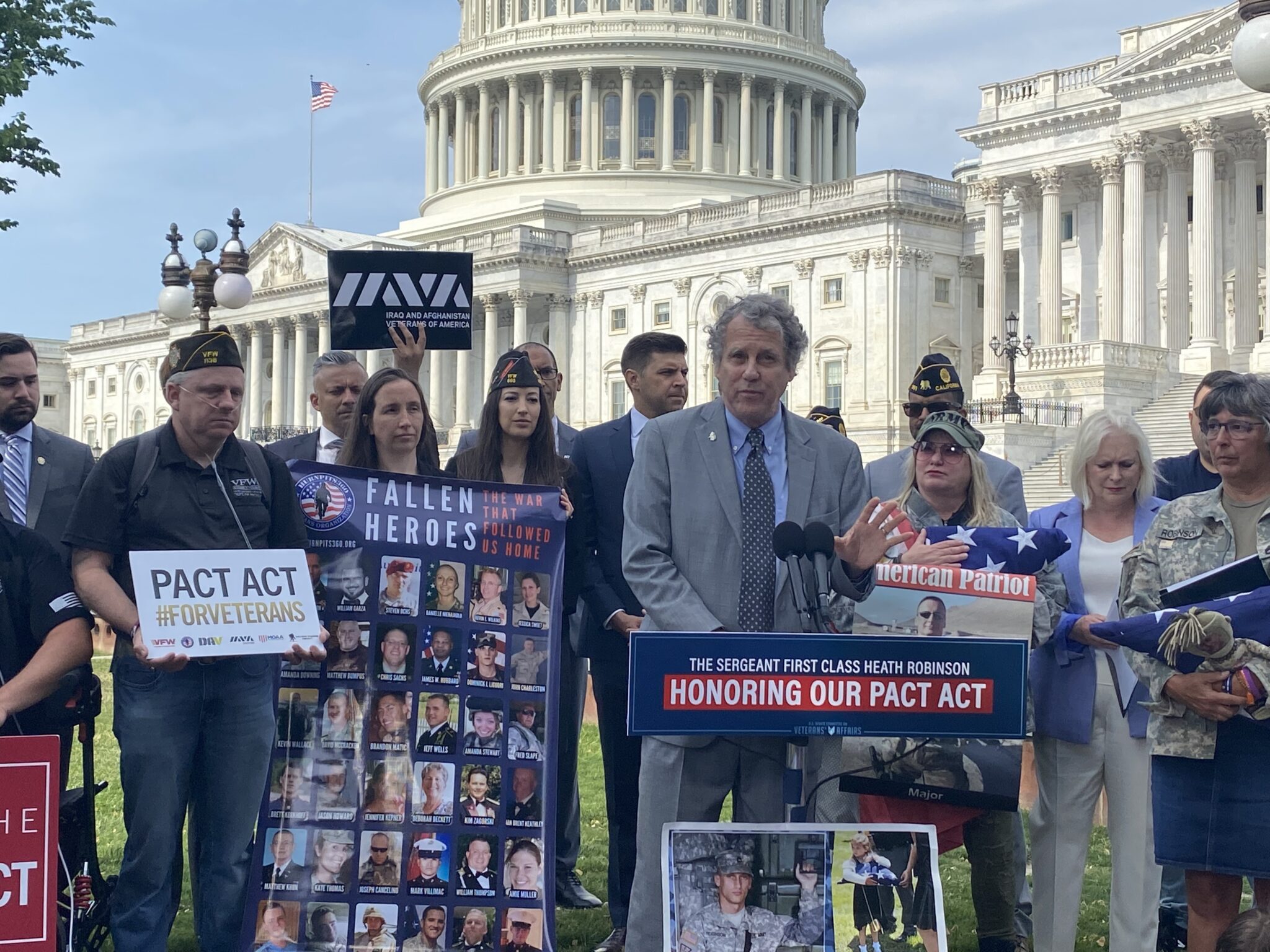
    Ohio Democratic Sen. Sherrod Brown speaks at a press conference on legislation to provide health care for veterans exposed to burn pits on June 7, 2022. Susan Weber Zeier of Sandusky is on the far right of the photo. Photo by Jennifer Shutt, States Newsroom.

    WASHINGTON — The U.S. House overwhelmingly approved a bipartisan bill Wednesday to expand health care and benefits for veterans exposed to burn pits overseas, sending the package back to the U.S. Senate after making a minor change.

    Senators, who broadly support the landmark package led by Montana Sen. Jon Tester and Kansas Sen. Jerry Moran, are expected to quickly clear the measure for President Joe Biden’s signature. The House vote was 342-88.

    Biden, who has linked his son Beau’s death from a brain tumor in 2015 to exposure to burn pits, has repeatedly called on Congress to address the illnesses and deaths linked to toxic exposure.

    “What I found with my son, what I found with my friends, what I found with the generation of Vietnam: There’s this notion that you shouldn’t ask for anything,” Biden said in March while at a resource center in Fort Worth, Texas.

    “You should be asking. You should be letting us know. You should let us know what is bothering you, what is the problem, because we owe it to you,” Biden continued.

    Delayed by dispute

    The Senate approved the legislation last month following an 84-14 vote, but House approval was delayed while members of the Veterans’ Affairs Committees worked out a dispute over a provision designed to boost staff in rural areas.

    The language would have allowed the U.S. Veterans Affairs Department to buy certain health care providers out of their contracts if they took offers to work for at least four years at “rural or highly rural facilities.” The provision also said that the money for the buyouts “shall not be considered a taxable benefit or event for the covered health care professional.”

    Lawmakers on the U.S. House Ways and Means Committee cited a so-called blue slip issue, since a tax provision cannot originate in the Senate.

    After substantial back-and-forth about how to fix the problem, the House Rules Committee opted to remove the provision this week, before sending a new, slightly altered bill to the floor.

    Bipartisan acclaim

    House debate on the legislation Wednesday was broadly bipartisan, with the vast majority of lawmakers speaking in support of the package.

    Rep. Mariannette Miller-Meeks, an Iowa Republican, said she has “seen firsthand the effects that toxic exposure has had” on her fellow service members following her 24-year military career.

    “Exposure to these substances can lead to severe, life-altering disease,” Miller-Meeks said.

    “However, under the current system at the VA it can be extraordinarily costly, time-consuming and in some cases impossible for a sick or disabled veteran to prove that their condition is related to the toxins to which they were exposed during their military service.”

    The bill the House passed Wednesday, she said, would help to end that by requiring the VA to deliver health care and benefits to veterans exposed to toxins “in a responsible, fair way.”

    Arizona Democratic Rep. Ruben Gallego, a Marine Corps infantryman who deployed to Iraq in 2005, said the legislation was overdue and desperately needed.

    “Too many veterans live in fear that their next doctor’s appointment will reveal an illness that in addition to harming their health could drive them into bankruptcy because the VA refuses to care for them,” Gallego said. “I am one of those people that does have that fear.”

    The legislation, named for deceased Sergeant First Class Heath Robinson of the Ohio National Guard, would expand eligibility for VA health care to more than 3.5 million veterans exposed to burn pits since 9/11.

    It would add 23 illnesses to the list of toxic-exposure-related ailments presumed to be connected to military service, ending the need for veterans with those conditions to try to prove to the VA their illnesses were linked to their deployments.

    The package would direct more resources to VA health care centers, employees and claims processing as well as federal research on toxic exposure.

    The measure would also expand presumptions for veterans exposed to Agent Orange, a chemical the U.S. military used during the Vietnam War. American Samoa, Cambodia, Guam, Johnston Atoll, Laos and Thailand would all be added to the list of locations where veterans are presumed to have been exposed to the chemical.