Tag: slavery

  • Honoring Black history and fighting for the future of education in Ohio

    Honoring Black history and fighting for the future of education in Ohio

    A Guest Column by Melissa Cropper and Ohio Capital Journal

    On Feb. 1, as Black History Month began in Ohio’s classrooms and virtual classrooms, Gov. Mike DeWine unveiled his proposed budget for the next two years, which continues the education funding policies that systematically underfund public schools that educate Black students and even shift some of that funding away toward unaccountable, for-profit private schools. 

    Black History Month is an important time for our nation’s educators to focus their curriculum around the contributions that African Americans have made in government, industry, art, science, literature, and every field of human endeavor. However, we do a disservice to our students if we don’t also teach about the harder, more painful history of slavery, segregation, disenfranchisement, and racist violence, and if we do not weave it into our everyday curriculum as deeply as it is woven into the fabric of our country.

    Even then, we are not telling the full story if we teach about these topics as relics of the past, as dark chapters of our country’s past that have ended. Racist structures in our society didn’t cease to exist when the Thirteenth, Fourteenth and Fifteenth Amendments were ratified following the Civil War, or after Brown vs. the Board of Education desegregated schools, or after the 1964 Civil Rights Act, or even after Barack Obama’s historic election. 

    Each of those events has been an important step along the way, but as we are reminded all too often, the vestiges of white supremacy live on in our current institutions. We see it in the over-policing and incarceration of Black, brown, and immigrant communities, we see it in our city neighborhoods that were shaped by redlining, and we see it in Ohio’s school funding system. 

    When we teach Black history, educators can make the connections about how the racial injustices of the past have turned into the systemic racial disparities of the present, and how we can demolish the underpinnings of injustice. There is no better place to start than with our broken school funding policies which underfund and segregate schools with large populations of Black students.

    In Ohio, we underfund schools in Black communities with a school funding formula that was found unconstitutional by the Ohio Supreme Court more than 20 years ago because it relied so heavily on local property taxes that it denied an equitable and adequate education to students in low-income areas. 

    We segregate schools in Black communities with voucher and charter policies that divert students and drain funding from local public schools. Often cloaked in the language of racial justice, vouchers and charter schools have the opposite effect when put into practice. The NAACP has often opposed these policies because they “divert much needed funding for public education to private or charter schools, thereby further dismantling the viability of the public education system and limiting the number of children who would be afforded the opportunity of an adequate and effective education.”

    This vicious cycle of underfunding schools in communities of color, and then punishing them for not being able to meet their students’ needs by underfunding them further, must end. We must stop pitting parents and communities against one another, and instead renew our commitment for high quality public schools for all Ohio students. 

    Last year, the Ohio House passed the Fair School Funding Plan with an overwhelming bipartisan majority, yet the Senate refused to take the issue up. The Plan would have put Ohio on a six-year path toward equitable funding of public schools in Ohio, and would have immediately ended punitive and harmful deductions for vouchers and charter schools from local public school funds. 

    This would ensure that public school districts receive money only for the students who are enrolled to attend but without the added penalty of deducting money due to students opting for private or charter schools. These changes would strengthen schools in Ohio’s cities and in our rural areas, giving students from all backgrounds increased opportunities. Despite the Fair School Funding Plan receiving an 84-8 vote in the House, the Ohio Senate allowed the bill to die without even receiving a vote. 

    DeWine had the opportunity to take the hard work and bipartisan agreement for this new school funding formula and insert it as a framework into his budget proposal. Instead, his proposal continues the status quo which is actively undermining our ability to provide an equitable education.  

    As educators, we can not teach Black History without also being activists in our own realm, fighting for an education system that gives every child, no matter their race or where they live, equal access to a high quality, free public education.

  • Part II: Butterworth Station of Loveland and the Underground Railroad: Further Recollections

    Part II: Butterworth Station of Loveland and the Underground Railroad: Further Recollections

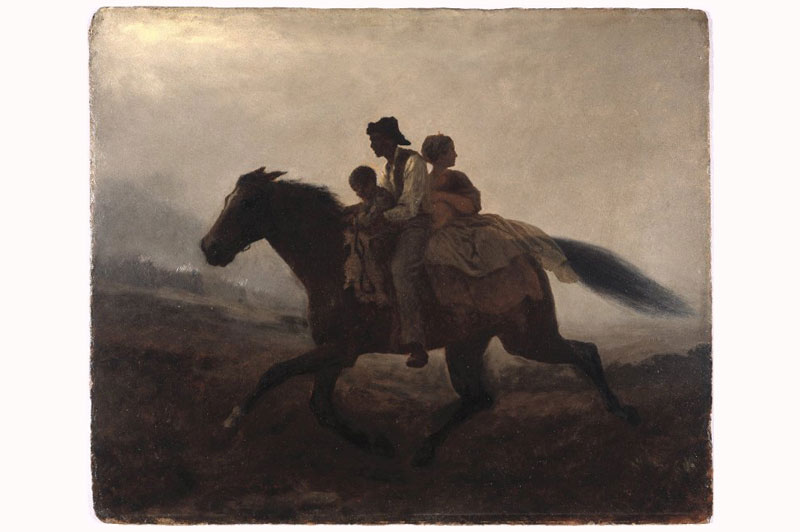
    The Fugitive Slaves, oil on paperboard, circa 1862, Brooklyn Museum

    (Read Part 1: Further Recollections of Butterworth Station)

    The following is an excerpt from Chapter Seven of The Search for the Underground Railroad in South-Central Ohio by Tom Calarco, scheduled for publication in late October by History Press. It is being published with permission from History Press.

    Tom Calarco is a resident of Historic Downtown Loveland, Ohio.

    By Tom Calarco

    Part Two of Two

    Butterworth Station of Loveland and the Underground Railroad: Further Recollections

    In 1894, Robert Carroll provided the Cincinnati Times-Star with his account of the assistance he gave the Butterworths in their work along the Underground Railroad.

    Often, in this wild flight for freedom, the master, with his unhuman helpers was in close pursuit, armed … devoid of mercy, protected by the law, and supported by a public sentiment that was respectable … Whether the pursuit was or was not immediate and pressing, it was always probable and expected, so that the runaway was in the condition of the hunted . . . . 


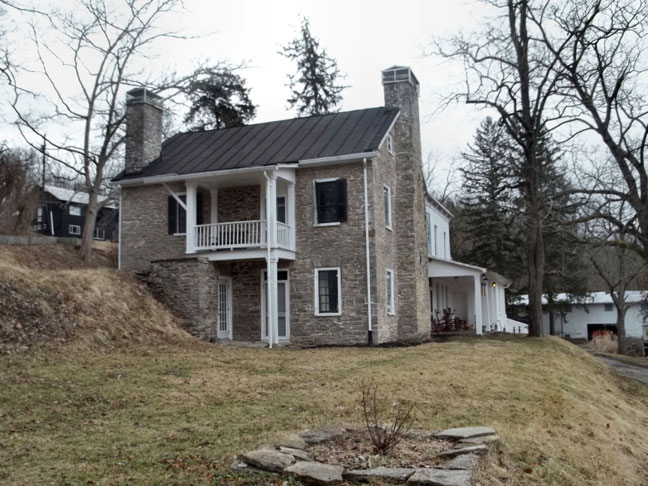
    By 1820, the old stone house overlooked the fields as it does today along the Little Miami Bike Trail just outside of Loveland in Hamilton Township.

    Along the banks of the Little Miami River in the hilly countryside north of Cincinnati, stands an old stone house, a relic of slower days, when there was lots of land and few people. It is not lived in much these days, but a big family of Quakers lived there for many years. Their forefather, Benjamin Butterworth was a six-foot six inch pioneer, a giant of a man who was said to have weighed 300 pounds. His roots in America dated back before the 1700s. Born in Virginia, he fought in the Revolution and was entitled to purchase a grant of land in the Northwest Territory, in the Virginia Military District, of which much of Ohio was part. This land and his inheritance provided him with substantial wealth. He was like many future Ohioans who would settle the new state: a slaveholder who freed his slaves and took them along to where there was no slavery.

    The people that helped [fugitives] . . . had no rational hope of compensation. On the contrary, they gave aid, with the certainly of the loss of time and money, and with the possibility of fines and imprisonment.

    One early morning I was told to go up in the haymow. On doing so I was somewhat startled to see half a dozen black persons hidden away. That day they lay hid and their food was carried to them with secrecy. About 9 o’clock that evening we hitched up, [and] cautiously loaded the vehicle with its human freight, and carefully fastened down the curtains.

    Thomas Butterworth

    Thomas Butterworth was there and assisted. It was raining; the sky was still clouded and the roads wet and muddy. We went at first by a lane, across the farm of Butterworth, another of the brothers … We soon struck the main road and turned our course towards the North Star . . . . We drove along at a round pace, always on the lookout for pursuers, and it must be confessed, somewhat nervous. Now and then we stopped, and by the struggling moonbeam’s misty light, carefully scanned the road in both directions. We crossed Todd’s Fork near the site of Morrow; drove past Rochester and Clarksville and on through the night to Harveysburg, where we arrived just after daylight. As we traveled along the stories of the blacks were told.

    We soon struck the main road and turned our course towards the North Star. Now and then we stopped, and by the struggling moonbeam’s misty light, carefully scanned the road in both directions.

    In one, a slave trader had come to their plantation which meant the possibility of being sold to the Deep South where they would be overworked in brutal conditions with the likelihood of dying an early death. Another was family of three, whose twelve-year-old daughter was under consideration of being sold away. They stole a skiff and rowed down the Licking River to Cincinnati. A third told of a man who contracted out to work and earn money which he was using to pay for both the freedom of himself and his wife. Unfortunately, his wife was owned by a different master, a Baptist minister in fact, who sold her away to the Deep South.

    Unfortunately, his wife was owned by a different master, a Baptist minister in fact, who sold her away to the Deep South.

    “Scruples of conscience at violating the Fugitive Slave Law readily vanished before such narrative[s],” Carroll said.

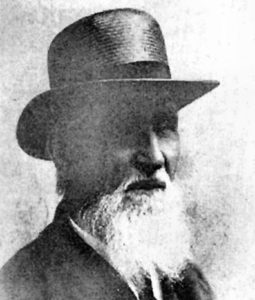
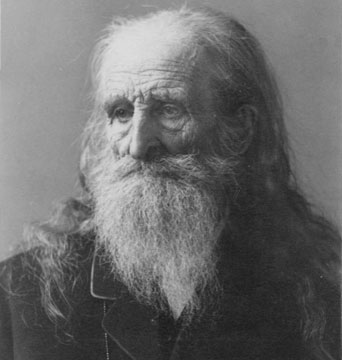
    Ready to vanquish any such scruples was an eccentric and intensely intellectual abolitionist and free thinker, Orson S. Murray who moved into the Butterworth neighborhood sometime in the early 1840s. Long hair, scraggy beard, he was an unappealing, atheistic version of Jesus Christ. He had come from Vermont, where he’d been a fiery antislavery speaker who antagonized the already angry mobs gathering at antislavery lectures all over the North. Here in remote Ohio he found some solitude, a haven for his ideas, and people who would tolerate him. 

    Orson S. Murray who moved into the Butterworth neighborhood sometime in the early 1840s. Long hair, scraggy beard, he was an unappealing, atheistic version of Jesus Christ.

    Murray already had done some writing in metaphysical journals of the day and had published his own newspaper in Vermont, The Telegraph. He started another newspaper, the Regenerator, not far from the Butterworth backyard. Its motto: ignorance was evil and knowledge its remedy. 

    Here’s what William Burleigh, the brother of eccentric antislavery speaker, Charles Burleigh, whom Murray named one of his children after, wrote about the Regenerator: “Mr. Murray appears to be a benevolent and self-denying man–is very eccentric in his appearance–very wild in many of his notions–and a very unsafe leader, for he leads into the mazes of skepticism and infidelity.”

    And here’s what Murray had to say about the Regenerator himself: “If the Regenerator has helped to dispel and disperse the delusion, that that book [the Bible] is the voice of a god–and to show that it is only the words of men–men, some of them, in profound ignorance and darkness on the subjects they were pretending to elucidate–it has done something towards accomplishing one of the principal objects which have impelled me to do the very unpopular work of publishing it.”

    Legends say he might’ve helped some fugitives too. He lived until 1885, dying at the age of 78. 

    Butterworth’s daughter Jane also wrote to Siebert, of her memories when she was about six or seven years old:

    I saw no people of color, heard no words, but I was sure there was such in our wagon.

    Among my earliest recollections, I was awakened about sunrise by the stopping of my father’s large wagon and two horse, and [him] handing me a little child 5 or 6 years old over to the care of a thrifty woman [who had come] out of a well-kept farmhouse, while he gave a shrill whistle for the men to come up from the field. I was taken into the house and seated in a small chair. The woman then gave me some freshly baked ginger bread while father talked with the man. I did not understand so unusual a visit at that place and time of my life for nothing was explained to me and I saw no people of color, heard no words, but I was sure there was such in our wagon. But as I grew older and learned about the Underground R.R, I knew that we were in that business then. [After] that time I [went] with my father on this said business when I was old enough to know about it. Several times I remember mother coming to our bedroom late at night and getting [us] all up in a hurry and putting us in bed elsewhere to give our bed to a lot of fugitives who come weary and tired, and our grandmother [Rachel who died in 1848] would tell them to “go to sleep, you will be safe in that room, nobody will get you there.”

    Several times I remember mother coming to our bedroom late at night and getting [us] all up in a hurry and putting us in bed elsewhere to give our bed to a lot of fugitives who come weary and tired.

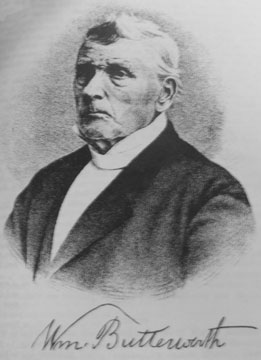
    William Butterworth

    Thomas said his brother, William, who lived a few miles north in Maineville, probably helped twice as many as him. How many is not known though Thomas said he probably helped as many as one hundred. Family anecdotes, however, suggest more, including stories of single parties numbering as many as 26 belying Thomas’s count. The important thing though was that all were brought safely to freedom.

    “I can say in truth that such was our success that I do not believe a single one was ever re-captured and taken back to slavery,” he said.


    Read Part 1: Further Recollections of Butterworth Station


     1. Robert W. Carroll, “An Underground Railway: Fugitive Slaves and the Butterworths,” Cincinnati Times-Star, August 19, 1896, Siebert Collection.

    2. Review of The Regenerator by William H. Burleigh, editor of the Christian Freeman, Jan. 22, 1844: 14 < https://popularfreethought.wordpress.com/browse-by-title/regenerator-1844-1854/ >

    3. Extract from a Letter.” 175 (Jan. 1854): 353 < https://popularfreethought.wordpress.com/browse-by-title/regenerator-1844-1854/ >

    4. Henry T. Butterworth to Wilbur Siebert, June 9, 1892, includes recollection of Jane.