Back by popular demand, civil war buff Rick Roesel returns to the Loveland Museum to share insights on the life experiences of General’s Grant and Lee, that made them great leaders during the turbulent times of the Civil War.
This event is scheduled for Wednesday, Oct. 7th at 10:30am. The cost is $15 for non-museum members, and $10 for members. Reserve your space today by contacting the Loveland Museum Center. You won’t want to miss this!
Pay with PayPal or send check and name(s) to LMC; 201 Riverside Ave.; Loveland, OH 45140.
Pay with PayPal
You can now pay for events and donations with PayPal! See the PayPal section on our Support page.
Christopher Ball is a longtime Loveland resident and an attorney
by Chris Ball
Ruth Bader Ginsburg sat on the United States Supreme Court for 27 years. She authored countless judicial opinions on issues ranging from abortion rights, gender discrimination, and the landmark 2000 case of Bush v. Gore where she penned her now-famous line, “I dissent.” Justice Ginsburg passed away on September 18 from complications of pancreatic cancer. Her death lead to an outpouring of sadness, grief, and celebration of her icon status as a pioneer for the advancement of women’s rights and a brilliant jurist and lawyer.
As difficult as it is to do, the American political system must now decide how to proceed in the wake of the vacancy that now sits at the heart of the United States Supreme Court. Republicans and Democrats are forming the battle lines already, in advance of the election on November 3rd. The opening salvos have already gone out. The first one began even before Ruth Bader Ginsburg passed away.
According to Ginsburg’s granddaughter Clara Spera, the Justice dictated a statement to her that read: “My most fervent wish is that I will not be replaced until a new president is installed.” The fact that Ginsburg felt the need to utter these words when she knew she was in the last days of her life tell us all that we need to know about the importance with which she viewed the role of the Supreme Court in the coming years.
If the 2020 election is indeed a battle for the very future of this country, Ginsburg’s dying wish represents a call to arms in a battle to replace her in the country’s highest court, whose ability to shape law, policy, and affect the everyday lives of the American people has grown exponentially in the past half decade.
After initially stating that he would nominate Ginsburg’s replacement the week of September 21st, President Donald Trump pushed back the announcement out of respect for the former Supreme Court Justice’s family.
On Saturday Trump announced that he will nominate Amy Coney Barrett. Judge Barrett currently serves on the U.S. Court of Appeals for the Seventh Circuit, a position she was appointed to by none other than Trump himself.
Trump’s announcement that he would quickly push ahead and nominate a replacement sent Democrats into a frenzy of fervent anger and has kickstarted a non-stop news cycle that may even come dwarf coverage of the Coronavirus.
The questions are, how did we come to this, and what could happen if Trump’s nominee is appointed to the Supreme Court?
How we got here is harder to explain. Concerns about the power of the Supreme Court and the judges that comprise it have been hotly debated since it was created in 1789. However, the nomination process itself has often been something that gets overlooked when compared to the decisions that the Supreme Court hands down and the way it functions.
This all began to change in the late 1980s. In 1986 Antonin Scalia was confirmed in the Senate by a vote of 98-0. However, the failed nomination of Robert Bork in 1987 and the contentious confirmation of Clarence Thomas in 1991 changed the political landscape for Supreme Court nominees irrevocably. Of note, Joe Biden was the Chair of the Senate Judiciary Committee for both Bork’s and Thomas’ confirmation hearings and, as some argue, is the architect behind the transformation of the hearings into a “game of political revenge.”
Things only worsened in 2000. That election was so close that the Supreme Court was called upon to weigh in on Florida’s recount. In a razor-thin 5-4 decision the Supreme Court essentially held that George Bush was the victor in Florida, whose electoral votes were enough to win the day and the Electoral College, despite losing the popular vote by nearly half a million ballots. Polls at the time showed that the large swaths of the American people did not lose confidence in the Supreme Court after it decided Bush v. Gore. For their part, Democrats seemed more focused on the Electoral College and George Bush’s ability to win the Presidency despite losing the popular vote.
Another important development came about in 2013 and involved the “Nuclear Option” in the Senate. For decades, voting on Presidential judicial appointments (at any level) was by a super-majority in the Senate, or 60 votes. However, in 2013, Democrat Harry Reid invoked what was dubbed the “Nuclear Option” and lowered the threshold for approving Barack Obama’s appointments to a simple majority of 51 votes. Then, in 2017, Mitch McConnell had the votes to extend this “Nuclear Option” to the confirmation of Supreme Court Justices to confirm Neil Gorsuch’s appointment. Going forward, a nominee for the Supreme Court needed only 51 Senate votes for confirmation.
The Supreme Court and the confirmation process again came to national attention in 2016 when Mitch McConnell refused to even allow the Senate to consider Merrick Garland, Barack Obama’s nominee to replace the deceased Scalia. In a 2016 Opinion piece in the Washington Post, McConnell stated:
“Given that we are in the midst of the presidential election process, we believe that the American people should seize the opportunity to weigh in on whom they trust to nominate the next person for a lifetime appointment to the Supreme Court.”
He later went on to claim that the Senate had the power, under Article II, Section II of the Constitution to withhold its consent on the nomination. In his view, the Senate was right to do so since Barack Obama was in the final year of his second term, and 2017 would see a new President sworn in. Though Democrats were extremely unhappy with this act, there was little they could do to stop it.
Hillary Clinton’s 2016 loss to Donald Trump only cemented the belief in some Democrats’ minds that the very systems of elections and government in the United States were flawed on a fundamental level. The focus again centered on the Electoral College that allowed Trump to secure the Presidency despite losing the popular vote by 2.87 million votes. However, this time there was something else.
After Trump’s election, the American people seemed to pay more attention to politics and the national media scrutinized his every decision, tweet, and rally. This included his nomination of Brett Kavanaugh in 2018. More than 20 million people watched Kavanaugh’s confirmation hearing, which was “an audience size similar to that for a playoff football game or the Academy Awards.” His life and confirmation hearing were the focus of at least two books that were published in what seemed like real-time, as well as countless articles, opinion pieces, and more television panels than anyone can reckon. This was no doubt due to a confluence of the MeToo Movement, the allegations leveled against him, and the fact that Donald Trump was about to nominate his second Supreme Court Justice (after Neil Gorsuch in 2017). But with Kavanaugh, perhaps more than any other nominee in recent memory, there was a real argument about the fundamental function of the Supreme Court and the process that the President and Senate go through to appoint its Justices. Kavanaugh’s confirmation incited more than just ire from the Democrats, it only further confirmed their belief that now the Supreme Court, too, had become irrevocably corrupted.
Now, with the passing of Ruth Bader Ginsburg and the vacancy it leaves in the Supreme Court, in an election year, the political firestorm of judicial appointments and confirmation will again be at the center of our discourse.
But this time it will be different.
This is due largely to the confluence of several key factors, which include the Democrats’ disillusionment with the Supreme Court, the Electoral College, the recent contentious nomination proceedings in the Senate, and McConnell’s alleged hypocrisy in blocking a vote on Merrick Garland’s appointment while allowing one on Trump’s pick to proceed.
So what can the Democrats do if Trump’s nominee is confirmed?
While the Electoral College is frequent fodder for angry Op-Eds and it makes a nice sound bite for talking heads on television, the truth is that it is not going anywhere anytime soon. According to the American Bar Association and The National Archives, “over the past 200 years more than 700 proposals have been introduced in Congress to reform or eliminate the Electoral College” but none have been successful, for one simple reason. To eliminate the Electoral College would require amending the United States Constitution. Since this is unlikely to happen, there is one Constitutionally-recognized way that the Democrats could punish McConnell, Trump, and the Republicans.
Court packing.
Though the name sounds ominous and illegal, if the Democrats manage to win back the Senate, keep control in the House, and vote Joe Biden into office, it is a term that Americans should begin to get very familiar with.
The amount of justices on the United States Supreme Court isn’t fixed by the Constitution. All that Article III, Section I states is that “The judicial Power of the United States, shall be vested in one supreme Court, and in such inferior Courts as the Congress may from time to time ordain and establish.” This provision makes it clear that Congress is the branch of government that is to fix the number of justices on the Supreme Court.
The Supreme Court began with just six justices. Through various acts of Congress, the number has grown to as many as ten before settling to the current total of nine. History is replete with examples of how legislative acts have influenced the makeup of the nation’s highest court.
And that’s just what Democrats have threatened to do if Biden is victorious and they gain control of all branches of government in November. If Democrats control both houses and the Presidency, it is within their power under the Constitution to expand the number of Justices on the Supreme Court, just as Mitch McConnell has consistently stated that his efforts to block a vote on Merrick Garland and to obtain a vote on Trump’s replacement for Ginsburg are Constitutionally supported.
This is why McConnell, Trump, and other Republicans must be very wary of the way in which the voting public (especially independent and undecided voters) view their tactical decisions on this appointment. Current polls show that a plurality of Republicans actually favor waiting until after the election to replace the vacant Supreme Court seat. Susan Collins, a Republican facing a very tough re-election bid in Maine, issued a statement urging the same. Some Never-Trump Republican writers have advised cutting a deal with Democrats wherein Republicans would agree to hold off on naming a replacement in exchange for a promise that Democrats won’t add additional justices should they take the reigns of government in 2021.
However, with the recent announcement that Republican Senator Mitt Romney would, indeed, support a vote on Trump’s nominee, McConnell has likely secured all of the Senate votes he needs to push the process forward, and dashed the hopes of any kind of compromise on the issue.
As if the November election wasn’t already polarizing enough, the appointment and confirmation of Amy Coney Barrett could play a significant role in mobilizing voter turnout for Democrats. Their donors gave 42 million dollars in a single day following Ginsburg’s passing.
All signs point to Trump and McConnell successfully nominating a replacement for Ruth Bader Ginsburg, but they should be prepared for the potential fallout from Democrat and independent voters as well as for an expanded United States Supreme Court if they do.
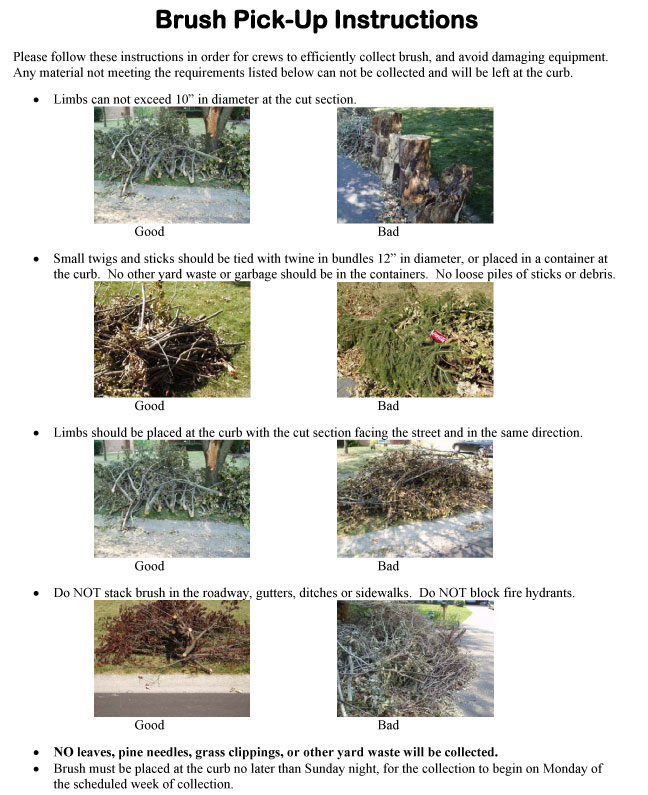
Loveland, Ohio – The 2020 fall brush pickup program will begin on Monday, November 9. Brush must be placed at the curb no later than Sunday night, November 8.
Guidelines
The following are guidelines established for the brush pick-up program:
Brush must be placed at the curb or edge of roadway. Do not place brush in the roadway, gutter, ditches, or on sidewalks. Do not block fire hydrants.
Limbs cannot exceed 10 inches in diameter at the cut section.
Limbs should be placed at the curb with the cut section facing the street and all limbs should be facing the same direction. This makes it easier and faster to handle.
No leaves, pine needles, grass clippings, or other yard waste will be collected.
Small twigs and sticks should be bundled with twine in bundles 12 inches in diameter. Twigs or sticks can also be placed in a container at the curb, but no other yard waste should be in the containers. Please, no loose piles of sticks and debris.
Please Note
The 2021 spring brush pickup program will begin on Monday, March 22.
Any material not meeting these requirements cannot be collected and will be left at the curb.
Outside the regular pick-up schedule, residents are encouraged to come to City Hall to get a free voucher to drop off any yard waste to Evans Landscaping.
Wood chips will be available again this year. Anyone in the City who would like a full load of wood chips should call 513-707-6115.
Loveland, Ohio – The 2020 Captain Seth Mitchell Hero 5K originally scheduled for October 10 is now be a VIRTUAL event taking place throughout the month of October and throughout the world.
Our local team of Damien Cook, Marisa Sobb, Mollie Schrichten and Greg Carpinello (recently moved to Portland, OR) have developed an event that should be fun for all. Additionally they have a new website and link to the event.
Jordan Collins (above left) is the 2020 recipient and she has a spirit similar to Seth. She was/is involved in many theatrical and musical productions, is a National Honor Society member, volunteers through Mom’s Hope and works part time. Jordan will be paying a large part of her college costs. She has a “do something” attitude, a strong work ethic and knows no stranger, being kind to all. She is not afraid to fail in the pursuit of her dreams and is strong in the face of adversity. She hopes to pursue her theatrical dreams at Syracuse University.
Caroline Ginder (above right) is the 2020 recipient of the Memorial Scholarship. Caroline was described by one of her references a “being self motivated and goal oriented…and a fine example of caring more about their teammate than herself”. She participated in many school events such as Tiger’s Inc., soccer, NEST and is a National Honor Society member. Caroline will attend Ohio State University where she will pursue medicine. She hopes to someday be a part of Doctors Without Borders. Like Jordan, Caroline is paying a share of her college costs.
About Seth Mitchell
Captain and pilot in the United States Marine Corps and a 1997 Loveland High School graduate, was killed in action in Afghanistan in October 2009. Seth contributed greatly to the Loveland community in his youth… he served as a leader and role model on the varsity football team, was voted to be Class President his senior year, and was named “Mr. Personality” by his peers. He was well loved here. After graduating, he took that same sense of service and loyalty into all that he did: as a son, a brother, a friend, a leader in the Marines.
In other words, Seth was a hero for all.
We are a group of Seth Mitchell’s high school classmates, who miss our friend and want to keep his memory alive. We represent the many people who Seth made an impression on with his sense of humor, kind heart, and loyal friendship. As we organize this 5k Race and the scholarship memorial fund, we are motivated by one enduring inspiration: to live each day a little more honorably, kindly, and humbly… just like Seth.
What Loveland community members need to know about Loveland City Schools’ COVID numbers as they begin week four of hybrid learning
by Hannah Roberts Gwynne
As reported Friday September 18 on the LCS database, one bus driver was confirmed to have tested positive with one close student-contact reported. Additionally, there are two “community cases” reported on their site. These cases include Loveland residents who have reported a positive case to LCS. Students and staff who are isolated or quarantined will also be considered “community cases,” according to Dr. Amy Crouse, superintendent. “If isolation or quarantine has ended and individuals have returned to school, they will no longer be reported as a community case,” says Crouse.
In August, two unnamed Loveland High School student athletes tested positive for COVID-19 resulting in 136 people self-quarantining, according to Dr. Crouse. An official report of this incident was never sent out to the public. The two teams were the high school men’s football and women’s soccer teams. A total 23 staff members and 113 students were involved and required to quarantine. This data was made available on the Loveland City Schools (LCS) page around two months later in September right before Labor Day weekend. The school alerted the families involved at the time of the reported cases. Since classes were not in session in August, LCS only sent the information to the people who needed it, according to Crouse.
The amount of time that students and staff must quarantine depends on whether they have tested positive or just had exposure to a sick person, according to new health protocols listed on the Loveland Schools site. If a positive case were reported to an administrator at LCS, the required self-quarantine would only be 10 days, according to the protocols. However, if a person had been confirmed to be in contact (within six feet for 15 minutes or more), they must self-quarantine for 14 days. “Those are Hamilton County rules,” said Dr. Amy Crouse. “It’s not my decision, but it’s my understanding that it can take up to 14 days to show symptoms if you’re in close contact. Those are protocols developed by Hamilton County.” These rules correspond with CDC guidelines.
LCS plans on returning to full-capacity schooling in October. Students will return to five days a week.
In order to find the school’s COVID-19 data, go to Loveland City Schools home page, click the tab “Reopening Plan.” On the left-hand side, it will say “COVID-19 Data Update.” Click there. At the very bottom of that page, click the link to their document that tracks the numbers.
Loveland, Ohio – The City’s Fall Leaf Collection schedule will begin on October 12 this year. Leaf collection during this period will be done by a City crew using mechanical equipment similar to a vacuum cleaner. Residents are instructed to rake leaves to a place near the street or curb. Do not place leaf piles on the sidewalk, gutters, ditches, roads, or blocking fire hydrants.
You can print the schedule to hang on your refrigerator or bulletin board using this .pdf: Fall Leaf Collection Schedule
Loveland, Ohio – After watching The Pursuit of Happyness with his dad, Ryan found $200 worth of change around the house. Ryan decided he wanted to use it shop for food for the L.I.F.E. food pantry to help those in need, especially those who are homeless.
The pantry and also the Loveland Magazine staff say. “Thank you Ryan, for your generous heart!”
Photos and story from the FaceBook page of the L.I.F.E. food pantry –
-This story has been corrected to reflect that Halloween is on Saturday October 31.
Loveland Police Chief Sean Rahe
Loveland, Ohio – City Manager Dave Kennedy announced at last night’s council meeting that Halloween Trick or Treating in Loveland is a go. He said that Police Chief Sean Rahe is reviewing an advisory that was issued by the Ohio Department of health and the City will issue a statement after it has been reviewed.
Kennedy said, “We hope to move forward full steam and certainly encourage people to follow the rules. We are not going to mess with changing times or dates.”
Although not announced at the meeting, Trick or Treating hours in Loveland have been between 6 and 8 PM for many consecutive years.
Halloween is on Saturday October 31.
DeWine recommends children wear masks on Halloween!
In Ohio Governor Mike DeWine’s announcement of the health department orders he reminded parents that Halloween activities will be different this year than in years past. He encouraged, “parents and children to wear a mask, practice social distancing, avoid large groups, and to stay home if sick.” Dewine also said, “Final decisions on whether to hold or participate in trick-or-treating or other events should be made by local communities, individuals, and parents.”
The state has developed guidance for Halloween and it can be found at coronavirus.ohio.gov.
Celebrating Halloween at Re-Start Ohio
Amid the COVID-19 pandemic, it is important to use caution and plan ahead for Halloween festivities. Decisions on whether to participate should be made by local communities, individuals, and parents/ guardians.
Always follow current state public health orders and rules/regulations established by your local community, and check the Ohio Public Health Advisory System to determine COVID-19 risk levels in your county before making decisions about Halloween activities. Some communities may choose to cancel Halloween events, so check with local sources before making plans.
This guidance is designed to help curb the spread of COVID-19. It will be reassessed and updated as the situation evolves and we learn more in the weeks leading up to Halloween.
Recommended Best Practices
General Guidance
• It is strongly recommended that hayrides and haunted houses be canceled/avoided.
• It is strongly recommended that Ohioans exercise caution when deciding to participate in trick-or-treating and events that put them in close contact with people outside their households. To lower risk, consider safer, socially distant ways to celebrate, such as:
• Holding a drive-through or drive-in trick-or-treat event, with children in costume and face coverings staying in cars and collecting treats from individuals spaced at least 6 feet apart.
• Holding drive-by costume or car-decorating contests with judges who are physically distanced.
• Leaving treats for friends and neighbors.
• Decorating your home and hide treats as an alternative to trick-or-treating.
• Holding costume parties or pumpkin carving events or contests online, such as by video conference.
• Do not hold large in-person Halloween parties. If holding smaller parties, limit attendance to 10 or fewer people and hold the event in an outdoor area where social distancing is possible. Avoid activities, such as bobbing for apples, that foster the spread of infection.
• Always wear a face covering and stay 6 feet away from people who are not from your household, whether trick-or- treating, passing out treats, or attending attractions or events. Stay home if you are sick. (NOTE: Face coverings should never be placed on children younger than 2 or anyone who cannot easily remove them.)
• Carry hand sanitizer and use it often, especially after coming into contact with frequently touched surfaces and before eating candy.
• Select events/attractions that are held outdoors and allow attendees to stay in their cars (such as drive-through event with displays) or socially distance. Avoid events that involve being crowded in a small area or coming into contact with/being touched by others.
• Consider the people in your household who may be at greater risk of complications if COVID-19 is brought into the home, such as those with certain health conditions, women who are pregnant, or older family members.
For Parents/ Guardians
• If taking your children trick-or-treating, limit the number of houses you visit and ask your children to stay as far from treat-givers as possible. For small children, consider holding the bag for them.
• Wipe off candy wrappers with sanitizing wipes when you arrive home. (NOTE: Never wipe unpackaged food with wipes.) • Allow children to eat only factory-wrapped treats. Avoid homemade treats made by strangers.
• If your child is at greater risk of complications from COVID-19, contact your doctor before allowing participation in Halloween activities.
For Community Members
For trick-or-treating, reach out to neighbors to discuss ways to ensure 6-foot social distancing, how candy can most safely be distributed, and the need for face coverings.
Refrain from having children select their own treats from a bowl/common container or set up a hand-sanitizing station. Consider placing treats on porch steps or a table in the driveway with a sign asking children to take only one. Or use other creative ways to distribute treats, such as using a candy “slide” made of PVC pipe, or hanging treats from a wall or fence.
Loveland, Ohio – The Loveland City School District Board of Education approved a resolution Tuesday night with a schedule for 5-day full capacity learning.
The vote was Board President Dr. Kathy Lorenz, Vice President Michele Pettit, and Dr. Eric Schwetschenau voting to make the change and members Kevin Dougherty andEileen Washburn voting, “No”.
PreK through 4th grade will begin 5-day full capacity on October 5.
Grades 5 through 8 will begin 5-day full capacity on October 12.
Loveland High School will begin 5-day full capacity on October 26.
Currently, the schools are on a combination of a blended attendance model for in-person learning and many students attending the District’s Remote Online Academy.*
The decision the Board made on Tuesday does not affect the Remote Online Academy students.
In the video below you can watch the Board discussion on the resolution beginning at the 1:10:48 minute mark. The Board paused the discussion and resumed at the 4:25:18 Minute mark. The District may not allow this video to play here on Loveland Magazine, so if this video does not play, go HERE to watch it.
*The plans the Loveland Schools are currently operating under:
A group representing small pharmacists says large chains, especially CVS, are moving patients’ prescriptions to their own stores without consent. CVS adamantly denies that. Photo by Marty Schladen, Ohio Capital Journal.
A huge majority of community pharmacists have lost patients in the last six months due to unfair practices by much larger competitors, an industry group that represents small pharmacists said last week.
They accuse CVS Health — which operates as an insurer, claims administrator and pharmacy retailer — as being the company responsible for the most abuses. CVS denies the claim.
The National Community Pharmacy Association (NCPA) said that between Sept. 8-11, it collected 412 responses to a survey about a practice known as “patient steering.”
In addition to being the nation’s largest pharmacy retailer, CVS is now also the largest pharmacy benefit manager, which charges insurers, pays pharmacists, decides which drugs get favorable treatment and collects rebates from manufacturers. The company has said it maintains a strict firewall between the businesses, but critics have accused the company of using one business to advantage the others.
For example, in the fall of 2017, Ohio community pharmacists complained Medicaid reimbursements from CVS’s pharmacy benefit manager, CVS Caremark, had dropped so low that they were having a hard time staying in business. At the same time the pharmacists they were receiving letters from from another arm of CVS acknowledging that reimbursements were low and that CVS was willing to buy out the community pharmacists.
That made pharmacists suspicious that the part of the corporation that acquires pharmacies was using CVS Caremark’s reimbursement data to determine which independent pharmacies were most likely to be struggling and vulnerable to a buyout offer. CVS denied that.
Some observers feared such concerns would only get worse when a federal judge last year allowed CVS to merge with Aetna, the country’s third-largest health insurer.
Now the NCPA, the group representing small pharmacists, says things are getting worse.
One method of patient steering is to transfer their prescriptions to another pharmacy without their knowledge, much less their consent.
According to the NCPA survey, 79% of community pharmacists said that had happened with one or more of their patients in the past six months. Almost 78% of respondents said some of the patients thus steered saw their prescriptions moved to CVS.
“That’s a big red flag,” NCPA CEO B. Douglas Hoey said in a statement. “The pharmacy sector is very competitive, and most big chains have aggressive marketing schemes aimed at taking patients from rivals. CVS Health not only owns brick-and-mortar stores, but it also owns its own insurance companies, Aetna and Caremark. That information allows it to eavesdrop on when and where patients are getting their prescriptions and, as the survey reported, coerce unknowing patients into CVS stores.”
In an email, CVS Senior Director of Corporate Communications Michael DeAngelis said the NCPA claims were patently false.
“Our pharmacies only initiate prescription transfers when requested by a patient,” he said. “Also, CVS Caremark members have access to our broad network of more than 60,000 pharmacies, including most independent pharmacies and chain pharmacies, in addition to CVS Pharmacy. In fact, more than 40% of the pharmacies in our network are independently owned. If a plan sponsor chooses a particular network design that includes specific pharmacies, their members are notified in advance.”
DeAngelis also panned the process behind the NCPA survey.
“The ‘survey’ conducted by the business trade association, NCPA, of its own members has no basis in fact and is nothing but a self-serving attempt to disparage CVS Health,” he said. “Accusations that we transferred patients’ prescriptions to our own pharmacies without their knowledge or consent are simply not true.”
One Ohio pharmacist said he doesn’t know why he’s losing patients, but he knows he’s been losing them.
“We’re down 300 or 400 patients a month” compared to last year, said Barry Klein, owner of Klein’s Pharmacy in Cuyahoga Falls. “It’s hard to say what was the cause of it, but definitely our patient count is down.”
Marty Schladen has been a reporter for decades, working in Indiana, Texas and other places before returning to his native Ohio to work at The Columbus Dispatch in 2017. He’s won state and national journalism awards for investigations into utility regulation, public corruption, the environment, prescription drug spending and other matters.






 Please Note

 Captain and pilot in the United States Marine Corps and a 1997 Loveland High School graduate, was killed in action in Afghanistan in October 2009. Seth contributed greatly to the Loveland community in his youth… he served as a leader and role model on the varsity football team, was voted to be Class President his senior year, and was named “Mr. Personality” by his peers. He was well loved here. After graduating, he took that same sense of service and loyalty into all that he did: as a son, a brother, a friend, a leader in the Marines.


 by Hannah Roberts Gwynne


 Loveland, Ohio – After watching The Pursuit of Happyness with his dad, Ryan found $200 worth of change around the house. Ryan decided he wanted to use it shop for food for the L.I.F.E. food pantry to help those in need, especially those who are homeless.
 .
.