Tag: Springfield

  • Older women front and center in ‘No Kings’ pro-democracy movement

    Older women front and center in ‘No Kings’ pro-democracy movement

    A woman joins the No Kings protests near the Philadelphia Museum of Art on June 14, 2025. (Tara Pixley for The 19th)

    by Amanda Becker


    Read Amanda Becker’s Loveland, Ohio connection in her Bio below.

    This story was originally reported by Amanda Becker of The 19thMeet Amanda and read more of her reporting on gender, politics and policy.

    _____________

    Americans in their 60s, 70s and beyond showed up in force at this weekend’s protests, drawn by the Trump’s dismantling of public institutions and government programs.

    SPRINGFIELD, OHIO — The 2017 Women’s March was Barbara Hartwick’s first-ever political protest. She drove from the exurban community where she lived at the time to downtown Cincinnati, a left-leaning city of 300,000 people that anchors the otherwise conservative region. Still, Hartwick said, she felt too nervous to carry a sign or join in most of the crowd’s chants.

    Eight years later, having watched President Donald Trump’s political ascent, Hartwick, 63, has gone from a “hesitant” to an enthusiastic protester. When she joined the several hundred people outside Springfield’s city hall on Saturday — among them many retirees who, like her, took to the streets to oppose Trump’s agenda — she held up a sign that read: “Let the wild rumpus start!” She was inspired by the crown-wearing young boy in Maurice Sendak’s children’s book, “Where the Wild Things Are.” It was, she said, a nod to the “No Kings” nationwide rallies.

    Hartwick, a retired teacher, said she had “misconceptions” back in 2017 about what protests were like; she had never been politically active beyond voting. The march revealed to her “the camaraderie, the community of people there.” The crowd was “generally peaceful and positive” as they protested and it helped Hartwick realize that other women like her were also frustrated and disappointed with the direction of the country. She discovered that community spirit again Saturday in Springfield, the conservative-leaning city that Vice President JD Vance put on the map during the presidential campaign, when he made false accusations against the Haitian migrants legally living there to make the case for today’s militaristic immigration crackdown.

    Papas Coming Home 970x250

    Protests, Hartwick said, “give people hope.”

    Women led prominent protests during Trump’s first term against his presidency writ large, his treatment of women, his now-fulfilled pledge to appoint Supreme Court justices that would overturn the federal right to abortion, his family separations policy at the U.S. border and more. But while Black women have voted against the president in every election, White women voted for Trump in 2016, backed him again at the ballot box in 2020 and then a third time in 2024, according to exit polls. Democratic former Vice President Kamala Harris actually lost support from women overall last year as compared to 2020 across all age groups except one: those over 65.

    Headed into Saturday’s protests, the only age group across all genders and races with a lower opinion of Trump than 65+ voters was voters under the age of 30, according to a weekly tracking poll conducted by YouGov for the Economist magazine.

    Rural America is older than urban America, so in Saturday’s small-town and suburban protests, the graying nature of the coalition in the streets protesting Trump was visible enough that it caught the attention of local news outlets. The St. Louis Post-Dispatch posted a video of “senior citizens and others” at a protest in the moneyed suburb of Clayton, Missouri. West Virginia Public Radio reported that at a demonstration in Charleston, the state capital, “all ages were represented, but a large contingent of older West Virginians braved the sun and humidity to attend.” Trump had a higher margin of victory in the largely rural state than nearly any other.

    Longtime climate activist Bill McKibben, who founded the Third Act organization several years ago to build a community of Americans 60 and older to fight climate change and protect democracy, wrote a recent Los Angeles Times op-ed with Akaya Windwood, an adviser for the group, under the title: “Why older Americans are Trump’s biggest nightmare.”

    A research team led by American University’s Dana R. Fisher surveyed the host organizers of Saturday’s events and found that “consistent with the Resistance to the Trump administration during its first term, the majority of hosts and participants were female, predominantly White, and highly educated.” What has changed since the president’s first term, Fisher told The 19th, is that “the people in the streets are older than they were back in the first administration.”

    Fisher’s team’s preliminary findings showed that the median age on Saturday for participants in Philadelphia was 36 years old while the median age for protest event hosts nationwide was 67. Their field research in the first months of Trump’s second term shows that participants and organizers protesting the president are more likely to be women, more likely to be older and more likely to be White than participants and organizers of other recent protest movements.

    The 2017 Women’s March, held the day after Trump’s first inauguration, was, at the time, the largest single-day protest in U.S. history — between 3.2 million and 5.2 million people, or 1 to 2 percent of the country’s population, participated in more than 400 demonstrations nationwide. Saturday’s “No Kings” protests aimed for the lofty goal of about 12 million people, or about 3.5 percent of the country’s population, a number that reflects the level of participation that political scientists say is necessary to overcome a dictator or authoritarian leader.

    Organizers sought to do that by dispersing protests across more than 2,000 locations, many in places where public demonstrations are rare. Cities like Philadelphia and Chicago reported some of the largest crowds, but there were also well-attended events in small towns and mid-sized cities in politically conservative states like Ohio, Missouri, Tennessee and West Virginia.

    Jeremy Pressman, co-director of the Crowd Counting Consortium, a joint project of Harvard Kennedy School and the University of Connecticut, said it would be weeks before they can fully tally nationwide attendance. But, he told The 19th by email, it “looks very likely it was one of the largest days of protest in U.S. history.”

    It didn’t surprise Hartwick that older Americans, and especially older women, are souring on the president, whose administration has fired tens of thousands of federal workers and shuttered federal programs under the banner of anti-diversity equity and inclusion efforts. Plus, Republicans in Congress are debating legislation that would finance tax breaks for the wealthy by making deep cuts to the Medicaid health insurance program for lower-income Americans and nutrition programs on which many seniors rely.

    An aphorism in U.S. politics is that Americans become more conservative as they age; many older women who spoke to The 19th on Saturday noted that it isn’t a conservative approach, in the “small-c” sense of the word, to dismantle government programs and institutions and to upend democratic norms.

    “We don’t want to go back. It took a movement to get the right to vote. It took a movement to get Civil Rights. I’ve never in my lifetime lived when rights are taken away — until now,” Hartwick said, lamenting that to younger Americans, Trump’s policies and intensely divided politics likely seem normal.

    Also at the Springfield protest was Joan Justice, 84, holding a sign that said: “If there’s money for a parade? Then there’s money for Medicaid!” “I have friends who are in nursing homes and I know the money is running out and it really scares me,” Justice, also a retired educator, told The 19th of the program that covers long-term residential care for lower-income seniors because Medicare, the health insurance program for elderly Americans at all income levels, does not.

    Another “No Kings” protest in nearby Middletown, Ohio, a deeply conservative town of about 50,000 where Vance was raised by his grandparents, drew more than 400 and skewed older than Springfield. Among the people gathered at a busy intersection near a large supermarket, hardware store and a panoply of national restaurant chains was a 64-year-old woman who asked to be identified by her first name only, Rebecca, because, she said, she knows Trump opponents who have faced harassment. She was attending her first protest and said, “I want to start getting more active, I want to start writing my congressmen. My parents were Republicans and they would be appalled.”

    Standing nearby was Nannette, 74, who requested her surname be withheld for the same reason. She said that “Middletown is a small town, but I’m doing everything I can think of,” attending the April protests against cuts to the federal government that preceded those held on Saturday. “I was a lifelong Republican, and I tried to hold on, but January 6th was the end,” she said. When she sends mail, she puts her stamps with the American flag upside down as a subtle signal of distress.

    Hartwick said she sees a recent version of her past self in these older women who are overcoming fears about public demonstrations to protest the president, so she is “finding little opportunities to let people know it’s okay to not like what’s going on right now.”

    Just last week, Hartwick said, she was buying posterboard at her local Kroger supermarket when a woman in her late 60s or early 70s asked if she was making signs for a garage sale. “I said ‘no’ and she said ‘oh, what is it for?’ I said: ‘A protest.’ And she whispered: ‘The No Kings protest?’ I said ‘yes.’ And then she said: ‘Good luck.’”

    “People might be looking for someone else who feels the way they do because they don’t see it in their own community,” Hartwick said.

     

    https://19thnews.org/membership/

  • Trump’s words changed Springfield, Ohio. Its Haitian community is bracing for what’s next.

    Trump’s words changed Springfield, Ohio. Its Haitian community is bracing for what’s next.

    (Emily Scherer for The 19th; Getty Images; AP)

    Originally published by The 19th

    Read Amanda Becker’s Loveland connection in her Bio below.

    by Amanda Becker

    SPRINGFIELD, OHIO — Several minutes into President Donald Trump’s inauguration speech on Monday, as he began talking about immigration, Yvena Jean François dug through a desk drawer for a notebook and pen.

    “We now have a government that cannot manage even a simple crisis at home … it fails to protect our magnificent law-abiding American citizens but provides sanctuary and protection for dangerous criminals, many from prisons and mental institutions that have illegally entered our country from all over the world,” Trump said, repeating a frequent 2024 campaign claim for which he has not offered evidence.

    Jean François jotted down a thought in the notebook on her lap, the words “FUN STUFF” printed on its colorful cover.

    Trump carried on: “I will declare a national emergency at our southern border. All illegal entry will immediately be halted and we will begin the process of returning millions and millions of criminal aliens back to the places from which they came.”

    Jean François wrote some more.

    Once Trump finished speaking, Jean François went over the main takeaways she planned to share on an upcoming episode of the podcast she hosts out of her home studio in Springfield, Ohio, a city of roughly 60,000 residents that became a household name during the 2024 presidential campaign as misinformation and lies spread about its Haitian residents.

    “The illegal people will be first to go in mass deportations,” she said.

    The exact words Trump used were important to Jean François, who is also a member of Springfield’s Haitian community. She heard “dangerous criminals,” “entering illegally,” “prisons and mental institutions” and “criminal aliens” — and she started to relax. “The president said the first people they’re going to put out are the criminal people who already have deportation papers,” she noted. And that, she said, does not describe her or most other Haitians she knows in this southwestern Ohio city between Dayton and Columbus.

    Like Jean François, Springfield’s Haitian migrants were drawn here by the potential for good-paying jobs in a place that had more jobs than workers who were able to do them. Many of these migrants have what’s called Temporary Protected Status, or TPS, which gives them the right to live and work in the United States legally and shields them from deportation for a set period of time. They arrived in Springfield as the country emerged from the worst of the COVID-19 pandemic, from states like Florida and New York, which are home to the largest communities of Haitian Americans in the United States.

    Yvena Jean François sits at her desk in her podcasting studio on Inauguration Day, January 20, 2024, in Springfield, Ohio. She wears a colorful patterned jacket and headphones while seated in front of a microphone and soundboard, with a vibrant studio backdrop featuring the logo of Radio Yvena TV.
    Yvena Jean François sits at her desk in her podcasting studio on Inauguration Day, January 20, 2024, in Springfield, Ohio.
    (Amanda Becker for The 19th)


    Established in 1990, TPS is a temporary status available to immigrants who come from countries facing exceptional circumstances, like environmental disasters, armed conflict and civil war. TPS was approved for Haitians in 2010 after a major earthquake decimated a large swath of the country. The Biden administration extended it last year until February 2026 amid an ongoing gang war that has cut off access to basic necessities like food and clean water for much of the island.

    Haitians are also eligible to ask for humanitarian parole, another temporary legal status available to citizens from certain countries and approved on a case-by-case basis. Some apply for asylum, which, when granted, allows them to remain in the United States indefinitely, become permanent legal residents and, sometimes, citizens. Unlike asylum, neither TPS nor humanitarian parole offers a path to citizenship, so Haitians and other immigrants living in the country under these designations cannot vote.

    The 2020 Census put the population of Springfield at 68 percent White, 18 percent Black and 5 percent Latinx, but by some estimates, Haitians now make up as much as a quarter of the city’s population. Many, like Jean François, have arrived since the census, lured by opportunity. While her twin brother moved to Chicago, she came to Springfield. A photographer and broadcast journalist in Haiti, she found work at an Amazon warehouse and saved up to open her in-home studio; she’ll soon move it to a new, professional space, she said.

    Jean François sees herself as an important part of a revival in this post-industrial, quintessentially American city, where recent Haitian arrivals have opened at least 10 new businesses — restaurants, groceries and a food truck. The creators of “The Simpsons” set the show in a fictional “Springfield” because there are at least 34 states with a Springfield, each of them in some way representative of “Anywhere, USA.” In Springfield, Ohio, the population dwindled for decades as auto and farm equipment manufacturers closed and jobs evaporated. Between 1999 and 2014, the city’s median income dropped 27 percent — more than any other metropolitan area in the country, according to analysis by the nonpartisan Pew Research Center. In 2012, the polling firm Gallup reported that Springfield was the country’s unhappiest city.

    Just over a decade ago, city officials and business leaders launched a campaign to recruit employers in the manufacturing, insurance and health care sectors, to inject new life into a sputtering economy. Soon, they started to see results. Between February 2020 and March 2024, Springfield reported the second-highest employment growth rate in Ohio, behind only the much larger Cincinnati, according to the Federal Reserve Bank of Cleveland. The rapid influx of Haitians, though a boon for employers who needed workers, also brought its own set of problems. Rental homes became harder to find and more expensive, classrooms got crowded and wait times for a doctor or an appointment at the motor vehicles office became longer.

    Then in July, with the 2024 elections underway, JD Vance, then a Republican senator for Ohio vying to be Donald Trump’s running mate, asked Federal Reserve Chair Jerome Powell in a banking panel hearing, “What role do you see illegal immigration driving up housing costs?” Vance continued: “In my conversations with folks in Springfield it’s not just housing.” Springfield Mayor Rob Rue and City Manager Bryan Heck, both fellow Republicans, fanned the flames when they went on the television program Fox & Friends to discuss Biden administration immigration policies. “It’s setting communities like Springfield up to fail,” Heck said, asking for additional federal support. As he spoke, footage played of a chaotic scene from a place thousands of miles away: the U.S.-Mexico border.

    Several days later, Trump picked Vance to join him on the GOP ticket, thrusting Springfield — and its Haitian community — squarely into the glare of an increasingly contentious presidential race and a national debate about who deserves to stay in the country.

    Trump, whose punitive and restrictive immigration stances have fueled his political rise, spread misinformation from social media accounts that said Haitian migrants were eating people’s pets in Springfield. In a high-profile presidential debate, he repeated the claims. Vance did, too, despite city officials saying there was no evidence to back them up. Trump promised to deport Haitian migrants with legal status. During a September news conference, he said, “They’ve destroyed the place.”

    Neo-Nazis and white supremacist groups amplified the lies about pet-eating and descended on Springfield. There were bomb threats. Employers of Haitian workers were harassed. The woman who initially spread the rumor recanted, horrified by what she had wrought. Still, the Trump-Vance ticket kept leaning on the Springfield fable to bolster their immigration stances. “If I have to create stories so that the American media actually pays attention to the suffering of the American people, then that’s what I’m going to do,” Vance told CNN.

    Republican local and state elected officials like Rue and Heck tried to quell the chaos. Ohio Gov. Mike DeWine, who was born in Springfield, implored: “Everybody needs to lower the rhetoric.” Meanwhile, the community rallied behind Haitian businesses and local law enforcement talked about Haitians as more likely to be victims than perpetrators of crime. A previously informal Haitian Community Alliance cemented its status as a legal nonprofit.

    Trump went on to win Clark County, where Springfield is the county seat, with more than 64 percent of the vote.

    In the two months since Trump’s victory, some Haitians have left Springfield, according to interviews with residents and community organizations there. They’ve returned to New York or Florida or moved to larger cities in Ohio like nearby Dayton or Columbus, where they might be less conspicuous — but where they lack the community they created in Springfield. Jean François knows some who tested the waters elsewhere only to return.

    Jean François sees little reason to leave; the same Trump administration immigration policies would apply anywhere else in the country, she said, because, “Florida, New York — you’re still in America.” Her goal is to continue using her podcast to urge fellow Haitians to stay calm, stay in Springfield and “do the best things for this city.”

    “I know Springfield, I love Springfield. Stay, stay here with me,” she told The 19th from her home studio. “Like the president said, ‘Make America Great Again.’ Make Springfield great.”

    Hours later, Trump terminated the humanitarian parole program that Biden launched, one that allowed more than half a million migrants from four countries to remain legally in the United States for a two-year period. One of the countries was Haiti.

  • New mobile health clinic to expand access to primary care in Springfield

    New mobile health clinic to expand access to primary care in Springfield

    Springfield, Ohio – Ohio Governor Mike DeWine and First Lady Fran DeWine today introduced a new mobile health clinic in Springfield that will make healthcare services more accessible for all residents throughout the community.

    “The mobile clinic will supplement and expand many of the primary healthcare services that are already available here in Springfield and throughout Clark County,” said Governor DeWine. “Our mission is clear: we will eliminate the backlogs and reduce the wait times for everyone who needs care.”

    Governor DeWine hosted a press conference Thursday to announce the arrival of the mobile health clinic at the Clark County Combined Health District

    The new mobile health clinic arrived in Springfield this morning and began serving community members this afternoon – exactly one week after Governor DeWine announced he was directing the Ohio Department of Health (ODH) to work alongside the Clark County Combined Health District (CCCHD) to acquire and operationalize a mobile health clinic to better manage the demand for healthcare services in the area.

    Springfield’s healthcare system has been under significant pressure due to the influx of thousands of Haitian migrants over the past several years, resulting in longer wait times for appointments and delayed care. State and local health leaders fear it has discouraged some residents from seeking care at all.

    The mobile health clinic will begin by targeting the pressure points currently causing the greatest backlogs, initially offering seasonal vaccinations, vaccines for COVID, flu, and RSV, as well as blood pressure screenings.

    Appointments are already being booked for the new mobile health clinic, which will serve all members of the community.

    “It’s imperative that the residents of this community – adults and children alike – receive services that prevent and treat illness and chronic conditions,” said ODH Director Bruce Vanderhoff, M.D., MBA. “I can’t stress enough the importance of vaccines; our strongest weapons in preventing flu, respiratory illness, COVID-19, and other diseases like measles and whooping cough. The less people that are vaccinated, the more we run the risk of these contagious diseases being spread throughout the community. This mobile unit being brought to Springfield so quickly under the leadership and vision of Governor DeWine is going to be a game-changer for Springfield to be able to deliver efficient healthcare services to more people.”

    The mobile health clinic will initially be stationed at Clark County Combined Health District and operated by local health district staff, with additional support from ODH.

    “Before the mobile health clinic arrived in Springfield, the wait time for immunizations at our local health district offices has been two months. With this new resource now in place, we anticipate quickly being able to reduce rates to two weeks, and eventually same-week or even walk-in visits for seasonal vaccines,” said Chris Cook, MPH, REHS, Clark County Health Commissioner. “I’d like to see this mobile health clinic inspire people in our community who have not seen a doctor in awhile to reenter the healthcare system. We want to be a bridge that gets people in the routine of checking in on themselves so they can be healthy for a long time.”

    APPOINTMENT INFORMATION

    Members of the community can make an appointment today by visiting https://mobile.clark.health or by calling CCCHD at 937-390-5600.

    Appointments are currently available on the following schedule:

    • Monday: 8:30 a.m. – 6 p.m.
    • Tuesday: 8:30 a.m. – 5 p.m.
    • Wednesday: 8:30 a.m. – 5 p.m.
    • Thursday: 8:30 a.m. – 5 p.m.
    • Friday: 8:30 a.m. – 2 p.m.
    Appointments: https://mobile.clark.health

    After relieving the primary pressure points, ODH and CCCHD plan to make additional healthcare services available, including more primary health services, plus maternal health services, infant health and wellness, and more. Additionally, over the coming weeks, CCCHD will begin driving the mobile health clinic to various other locations throughout the community to provide proactive healthcare support in high-need areas.

    In the coming months, ODH and CCCHD will also work together to transition from the mobile health clinic unit to a more permanent health clinic. The location and timeline of this transition is still to be determined.

    “My commitment to the county and to the City of Springfield is that we, as a state, will not allow either the new mobile clinic or the permanent clinic to fail,” added Governor DeWine.

    Earlier this month, Governor DeWine pledged that the state would dedicate $2.5 million toward expanding primary care access for all Springfield residents, as well as support for local public safety efforts through the Ohio State Highway Patrol. This is in addition to other support that the state has already provided to Springfield to aid in addressing the increase in the area’s Haitian population, including the addition of a school-based health center for Springfield City Schools, providing driving simulators and driver’s education classes for the Haitian community, English education and translation services, and more.

    Watch Governor’s Press Conference (via Facebook)

    Governor DeWine hosted a press conference Thursday to announce the arrival of the mobile health clinic at the Clark County Combined Health District

  • Springfield’s Haitian community ready for attention to move elsewhere

    Springfield’s Haitian community ready for attention to move elsewhere

    Philomene Philostin in her recording studio at Creations Market in Springfield, Ohio. (Photo by Nick Evans, Ohio Capital Journal.)

    By:  Ohio Capital Journal

    Resources are flowing into Springfield, Ohio, after weeks of negative attention fueled by Donald Trump’s presidential campaign and right-wing social media influencers.

    Ohio state troopers are posted at schools, state health officials are opening clinics to assist over-stretched local providers, and civic organizations are raising money.

    Springfield’s Haitian community, the subject of repeated smears, is exhausted and ready for the country’s attention to move somewhere else. But while they’re frustrated, they say they see the furor for what it is — manufactured, fanciful, political.

    Community reaction

    At the Haitian restaurant Rose Goute Creole, the line was long and the tables were packed. Many of the customers had made the trip from outlying cities like Columbus, looking to show support for the community in whatever small way they could.

    Over a plate of spaghetti with chicken and hard-boiled eggs, Daniel Geffrard spoke with pride about his heritage.

    “We know who we are. Haiti is the first Black republic. It is the second independent country (in the Americas) after USA,” he said. “We know that we are a great people, and the world knows who we are.”

     Customers picking up food at Rose Goute Creole in Springfield, OH. (Photo by Nick Evans, Ohio Capital Journal) 

    Geffrard has been living in Springfield for three years. He works with Amazon and drives for Lyft as well. Geffrard stressed that he and others like him aren’t there to be a burden — they just want to work.

    “We know,” he said again, jamming a finger into his chest for emphasis, “We know who we are, and we know why they say what they say.”

    A couple miles away on the north side of town Philomene Philostin runs Creations Market. The shelves are packed with big sacks of rice and beans, dried jute leaves called lalo and bottled fruit juice or malt drinks.

    “I heard a lot of people said they’re gonna leave,” she said.

    Philostin described one customer whose husband has been living in the city since 2017.

    “She have all those memories,” Philostin said, but their place in town suddenly feels tenuous.

    “She have kids in school here, she have a newborn gonna be coming soon, and she want to leave Springfield,” she said.

    If people feel threatened or endangered enough to want to leave, Philostin said she can’t blame them.

    But she was clear-eyed about the purpose of the rhetoric and argued it will disappear once the election has passed. Donald Trump recently floated the idea of holding a rally in Springfield — Philostin said go ahead.

    “He’s a former president,” she said, “He have right to come in whatever he want to come, whatever state he want to visit, because he have his people here. Who knows, I may be his people, too.”

    Rinaldi Dessalines speaks four languages and works in Springfield as a translator.

    “It’s because I’ve been in different places,” he explained.

    Growing up in Haiti, he spoke French and Haitian Creole. He picked up Spanish after living in the Dominican Republic, and English here in the United States.

    He said life was pretty nice in Springfield before it became the subject of baseless rumors.

    “Everything was okay for me,” he said. “I can say my experience was amazing.”

    But since then, “it’s like an earthquake, not only for the Haitian community, it’s for everybody.”

    The experience has been rattling, and now residents are second-guessing the world around them as if questioning the ground beneath their feet. Dessalines said he’s frustrated at having his culture tarred for political gain.

    “When you attack a culture of someone, it’s normal you’re gonna feel this kind of thing, you know, frustration when someone accused of something that you don’t do in your culture,” he said. “It’s not only about Haitian. It’s about everybody.”

    Dessalines hasn’t been personally targeted, but he’s spoken to others who feel scared. He described how being forced into the national spotlight is strange and a bit eerie. Between bomb threats and reporters crawling all over the place, there’s a kind of nebulous threat hanging in the air.

    “So when, in the atmosphere, even (if) the person doesn’t feel attacked or striked or targeted, it’s like this is a sign something not good is going on in your environment,” he said.


    State support

    Ohio Gov. Mike DeWine has forcefully rejected former President Trump and U.S. Sen. J.D. Vance’s false assertions about Haitian migrants eating domestic animals. He has dismissed the claims as “garbage,” and in a New York Times op-ed he insisted that rhetoric “hurts the city and its people.”

    At the same time, DeWine finds himself walking a familiar tightrope — for all his frustration with what the former president says, he’s been reticent to make a break with the candidate himself.

    Even as he criticized Trump and Vance’s repeated, baseless claims, DeWine’s op-ed reiterated his support for the GOP presidential ticket. He argued frustration with the Biden administration’s immigration policy is justified, but that anger is misplaced when it’s directed at the Haitian community.

    While the governor attempts to thread the needle politically, he’s been far more direct when it comes to support.

    Following more than 30 bomb threats that shuttered schools, hospitals and city hall, the governor dispatched the Ohio Highway Patrol. DeWine said they’d be present and visible for as long as necessary. Friday, a trooper was posted in the shade out front of Perrin Woods Elementary on Springfield’s south side.

    As claims about eating pets have been debunked, Vance has reached for other negative impacts including rising rates of HIV and tuberculosis.

    According to the Clark County Health Department, cases have gone up — but the numbers aren’t dramatic. In 2018, there were 10 new HIV diagnoses, in 2022, there were 13. Clark County has more recent data for tuberculosis. Between 2013 and 2019, the county reported one case or none each year. In 2023, there were four cases.


    Still, the local health system is struggling to manage an increasing population, and to help meet those needs, state and county officials are setting up a mobile clinic this week.

    In a press release, DeWine explained, “Our goal is to reduce wait times and to be able to provide the necessary health care services for everyone – whether you’ve lived in this community your whole life or you’ve just come into the community recently.”

    The plan is to eventually transition that mobile clinic to a permanent site, but the location and timeline for that effort is still up in the air. According to the governor, the clinic will deliver primary care, vaccinations, lab testing and maternal and infant health services. DeWine’s administration has also committed to direct $2.5 million to expand access to primary healthcare in the city.

    State Rep. Bernie Willis, R-Springfield, pinned the blame for stretched local resources on the Biden administration.

    “There was no communication from the federal government that they were going to start sending migrants to Springfield and there also has been no support,” he said in a statement. “Springfield has been left on its own to figure out these problems.”

    The federal government has not “sent” migrants to Springfield. By and large, the Haitian people living in Springfield have what’s known as Temporary Protected Status, or TPS. The program gives people whose home country is facing armed conflict or a natural disaster the right to remain in the U.S. and work temporarily. With that status they are free to find a home in the country where they like.

    Willis added the greatest challenge presented by the arrival of Haitian residents is the language barrier.

    “This is creating challenges for educators, law enforcement, health care professionals, and other service providers,” he said. “Translators are needed at public service departments and these additional costs are straining already stretched resources.”

    The DeWine administration is working with federal officials to secure additional support. A spokesman noted part of the problem is federal resources follow people with different immigration statuses, like refugees, but not those on TPS.

    Meanwhile the United Way of Clark, Champaign and Madison Counties has set up a fund for people who want to support the community.

    “The Springfield Unity Fund will allow people across the nation to quickly and effectively provide targeted support to our Haitian families as we work together to ensure our neighbors feel welcomed, supported, and empowered to thrive,” executive director Kerry Lee Pedraza said.

    The organization is putting donations toward services like early childhood education, English courses and driving instruction as well as employment and health care assistance.

    Follow Ohio Capital Journal Reporter Nick Evans on Twitter.


    Nick Evans
    Nick Evans

    Nick Evans has spent the past seven years reporting for NPR member stations in Florida and Ohio. He got his start in Tallahassee, covering issues like redistricting, same sex marriage and medical marijuana. Since arriving in Columbus in 2018, he has covered everything from city council to football. His work on Ohio politics and local policing have been featured numerous times on NPR.

    Ohio Capital Journal is part of States Newsroom, the nation’s largest state-focused nonprofit news organization.

    MORE FROM AUTHOR

  • [Video] Hope, the Ohio State Highway Patrol Therapy dog, went with the Governor as he visited Springfield City Schools

    [Video] Hope, the Ohio State Highway Patrol Therapy dog, went with the Governor as he visited Springfield City Schools

    Hope, the Ohio State Highway Patrol Therapy dog

    Springfield, Ohio – Today, on the first day the Ohio State Highway Patrol’s Mobile Field Force provided added security to the Springfield City School District’s 18 school buildings, Governor DeWine visited patrol staff, as well as students and teachers at Simon Kenton Elementary School in Springfield.


    Hope, the Ohio State Highway Patrol Therapy dog, went with the Governor as he visited kindergarten, first grade, sixth grade, and gym classes. Hope is a female 10-month-old English Yellow Lab who provides affection, comfort, and support and can help lower anxiety. Hope visited Springfield City Hall employees yesterday.

    “While none of the threats – including one today – has been legitimate, we want to reassure Springfield students, parents, and staff that we are here to support them and help keep our school communities safe,” said Ohio Governor Mike DeWine. “We are doing the physical security with support from our troopers and Ohio Homeland Security and the emotional security with help from Hope, the therapy dog.”

    As Governor DeWine announced on Monday, 36 troopers are stationed throughout the Springfield City School District. Daily, troopers are sweeping each building for threats before students and faculty arrive and stay on-site to provide security throughout the school day and during dismissal.

    Ohio Homeland Security is also conducting vulnerability assessments on critical infrastructure in Springfield and continues to provide various tower cameras for use by the Springfield Police Department to enhance situational awareness. In addition, the Ohio Department of Public Safety has bomb detection dogs stationed in Springfield each day.

  • Amid ongoing threats, Ohio GOP US Senate candidate calls for deporting Springfield legal immigrants

    Amid ongoing threats, Ohio GOP US Senate candidate calls for deporting Springfield legal immigrants

     U.S. Senator J.D. Vance (R-OH) and Ohio Republican candidate for US Senate Bernie Moreno listen as Republican presidential candidate former President Donald Trump speaks during a rally at the Dayton International Airport on March 16, 2024 in Vandalia, Ohio. (Photo by Scott Olson/Getty Images.)

    By:  Ohio Capital Journal

    Terroristic threats continued against Springfield officials and public buildings over the weekend and into Monday. In the midst of them, Republican U.S. Senate candidate Bernie Moreno called for the protected status of legal Haitian migrants in Springfield to be revoked and for them to be deported back to their violence-riven country.

     The Republican presidential nominee, former President Donald Trump, debates the Democratic presidential nominee, Vice President Kamala Harris, for the first time during the presidential election campaign at The National Constitution Center on Sept. 10, 2024 in Philadelphia, Pennsylvania. (Photo by Win McNamee/Getty Images) 

    The city in southwestern Ohio has been the center of a national political firestorm after former president Donald Trump in last Tuesday’s debate repeated a debunked claim that Haitian immigrants who have flocked to the community over the past five years were stealing neighbors’ pets and eating them.

    The claim has been debunked by public safety officials, Gov. Mike DeWine, and even one of the first people to post it on Facebook. She said she misunderstood what a neighbor told her about “an acquaintance of a friend” whose cat was missing.

    Other GOP officials, including Ohio Attorney General Dave Yost, have amplified rumors that Black immigrants to Springfield have been killing and eating geese. Officials said there was no evidence to support that claim, either.

    Springfield’s health and education infrastructure has been strained as 12,000 to 15,000 Haitians fleeing chaos in their country have moved over the past five years to what had been a shrinking community. A big reason was the availability of warehouse and manufacturing jobs.

    The strains and the influx of immigrants of color has sparked a wave of hatred. An armed neo-Nazi group marched through the city last month, and over the weekend, Ku Klux Klan fliers appeared in Springfield neighborhoods, saying, “Foreigners and Haitians Out.”

    Schools, City Hall and other public buildings were evacuated and closed every day since Thursday due to bomb threats, some explicitly tied to the Haitian immigrants. Most recently, two elementary schools were evacuated on Monday after receiving bomb threats, WKEF reported. DeWine said Monday that “at least 33” bomb threats have been made.

    Public officials have received death threats, and Mayor Rob Rue, Republican, on Friday blamed Trump and his running mate, Ohio U.S. Sen. J.D. Vance for the strife.

    “All these federal politicians that have negatively spun our city, they need to know they’re hurting our city, and it was their words that did it,” Rue told Columbus TV station WSYX.

    Despite Rue’s plea, Trump on Friday falsely claimed Springfield had been destroyed by the immigrants, who are in the United States legally, and promised to deport them.

    On Sunday, Vance appeared on CNN and defended his false statements about Springfield.

    If I have to create stories so that the American media actually pays attention to the suffering of the American people, then that’s what I’m going to do,” he said, then adding that he was “creating the American media focusing on it.”

    Moreno, a Cleveland car dealer who is challenging Democratic Ohio U.S. Sen. Sherrod Brown, went to Springfield on Saturday and called for the legal immigrants’ deportation.

    “What’s happened is that Sherrod Brown and Kamala Harris have waved the magic wand, corrupted our immigration system and shielded them through Temporary Protected Status and asylum — two loopholes in our immigration system that were corrupted by corrupt politicians,” Moreno said, according to the Springfield News-Sun.

    Asked on Monday if Moreno was concerned that such comments would encourage more hate and further threats, his spokeswoman took umbrage at the suggestion. Despite the Republican mayor’s admonishment, she attacked the press and linked the matter to an apparent assassination attempt Sunday against Trump at one of his South Florida golf courses.

    “It is vile that the liberal media is blaming Republicans for these threats in Springfield — with no evidence — when a leftwing lunatic who echoed talking points from Joe Biden and Kamala Harris attempted to assassinate President Trump just yesterday,” the spokeswoman, Reagan McCarthy, said in an email.

    The man who allegedly wanted to shoot Trump, Ryan Wesley Routh, wrote that he voted for Trump, soured on him and then encouraged the Iranian government to assassinate the former president, the Associated Press reported.

    Meanwhile, the situation in Springfield continues to be tense.

    In addition to bomb threats leveled at schools, government buildings and health care facilities, Rue, city commissioners and staffers have received multiple death threats, WSYX reporter Darrel Rowland posted on X.

    In midst of the tension, Rue discouraged a possible visit from Trump, which he is reportedly considering, and one from Vice President Kamala Harris, which hasn’t been mentioned, Rowland also posted.

    Spectrum News’s Taylor Popielarz posted a list of public buildings that had been “placed on lockdown, evacuated, closed, or searched at some point over the last week due to threats.” There were 21 facilities, including eight educational institutions, four county buildings, three related to car and driver licensing, two health facilities, and two municipal government buildings.

    For his part, Moreno, the Senate candidate, blames problems in Springfield not on false claims by Trump, Vance or himself, but on their political opponents.

    “Kamala Harris and Sherrod Brown wreaked havoc on Springfield with their reckless decision to extend (temporary protected status) and allow thousands of unvetted migrants to resettle in Springfield, with no regard for the devastating effects it would have on the citizens of that community,” McCarthy, Moreno’s spokeswoman, said.

    Brown isn’t part of the executive branch and the Department of Homeland Security determines whom to grant temporary protected status. So Brown wasn’t involved in that determination for the Haitians in Springfield.

    It’s also false that the migrants there are unvetted. The U.S. Citizenship and Immigration Services last month posted a document entitled “Processes for Cubans, Haitians, Nicaraguans, and Venezuelans.” It says that people from those counties receiving temporary protected status must “Undergo and clear robust security vetting.”

    For his part, Brown, the senator whom Moreno is challenging, said it’s time to stop politicizing what’s happening in Springfield.

    “Springfield reminds me of Mansfield, my hometown,” he said in a Monday post on X. “It’s a proud city with a rich manufacturing history. This community deserves better than to be used as a political pawn. We must work together to keep everyone safe & address the city’s challenges. That’s what I’ll keep doing.”

    Moreno is himself an immigrant, moving with his family from Colombia to South Florida in the early 1970s. His father was a politically connected surgeon. Unlike the often-impoverished undocumented, Moreno says, his family came to the United States the right way.

    McCarthy didn’t respond to a question asking whether, now that Moreno wants to deport refugees who are here legally, he believes only the wealthy and well-connected should be the only ones eligible to immigrate.

    Moreno has claimed that immigrants have “destroyed” Ohio cities. Such rhetoric, along with claims of an immigrant “invasion” and the “great replacement theory” have helped motivate racist massacres over the past six years in El PasoBuffalo, and Pittsburgh.

    Lynn Tramonte, director of the Ohio Immigrant Alliance, urged public figures to think about the consequences their rhetoric might have.

    “I don’t know how the people peddling lies about immigrants can live with themselves,” she said. “Most Ohioans are horrified at their behavior and its consequences. We choose love, not hate.”


    Marty Schladen
    Marty Schladen

    Marty Schladen has been a reporter for decades, working in Indiana, Texas and other places before returning to his native Ohio to work at The Columbus Dispatch in 2017. He’s won state and national journalism awards for investigations into utility regulation, public corruption, the environment, prescription drug spending and other matters.

    Ohio Capital Journal is part of States Newsroom, the nation’s largest state-focused nonprofit news organization.

    MORE FROM AUTHOR

  • [Guest Opinion] Springfield Community Needs Help, Not Hate

    [Guest Opinion] Springfield Community Needs Help, Not Hate

    Guest Opinion

    AFT President Randi Weingarten and Ohio Federation of Teachers President Melissa Cropper respond to the continued lies and political vitriol directed at the Haitian community in Springfield, Ohio

    “The Springfield community needs help, not hate. Instead of working with city leaders to address issues like affordable housing, healthcare access, education and transportation, divisive politicians like JD Vance, Donald Trump and Senate candidate Bernie Moreno have been spreading hatred in a cynical attempt to score political points.

    “There is no place in a civilized nation for conduct like Vance’s bald-faced admission that he is telling lies to fuel bigotry, and Trump’s planned visit to Springfield to fan the flames. The candidates’ deeply racist remarks are unacceptable on their face, but the consequences are real: They have incited bomb threats and led to an influx of white supremacist groups.

    “We stand with the Springfield community—including educators, healthcare workers, migrant advocates, and city and state officials—as they work constructively to address their city’s growing pains while remaining a welcoming home for Haitian migrants, many of whom have fled violence. We commend Ohio Gov. Mike DeWine for correctly labeling these stories as ‘garbage that was simply not true’ and for denouncing the hate groups that are descending on Springfield.

    “The United States was built on immigration. We look after our neighbors and believe in a shared future. We stand with all of Springfield’s residents as they resist the forces of darkness and demagoguery determined to exploit their city for rank political gain.”

    The American Federation of Teachers is a union of 1.8 million professionals that champions fairness; democracy; economic opportunity; and high-quality public education, healthcare and public services for our students, their families and our communities. We are committed to advancing these principles through community engagement, organizing, collective bargaining and political activism, and especially through the work our members do.

  • Governor DeWine Sends Ohio State Highway Patrol to Provide Added Security in Springfield City School District

    Governor DeWine Sends Ohio State Highway Patrol to Provide Added Security in Springfield City School District

    Springfield, Ohio – Following a series of unfounded bomb threats made to schools within the Springfield City School District, Ohio Governor Mike DeWine announced today that he has authorized a contingent of troopers from the Ohio State Highway Patrol’s Mobile Field Force to provide added security at each of the district’s 18 school buildings.

    “Many of these threats are coming in from overseas, made by those who want to fuel the current discord surrounding Springfield. We cannot let the bad guys win,” said Governor DeWine. “We must take every threat seriously, but children deserve to be in school, and parents deserve to know that their kids are safe. The added security will help ease some of the fears caused by these hoaxes.”

    Beginning tomorrow and continuing for the foreseeable future, 36 troopers will be stationed throughout the Springfield City School District. Troopers will sweep each building for threats before students and faculty arrive and will stay on-site to provide security throughout the school day and during dismissal.

    “None of the threats that have come in to Springfield to date have been legitimate. We’re doing this purely as a precaution to prevent further disruption within the Springfield City School District,” said Governor DeWine.

    Governor DeWine also directed Ohio Homeland Security to begin conducting vulnerability assessments on critical infrastructure in Springfield and to provide various tower cameras for use by the Springfield Police Department to enhance situational awareness. The Ohio Department of Public Safety has also arranged for bomb detection dogs to be stationed in Springfield each day.

    Due to the recent influx of Haitian migrants to Springfield, Governor DeWine last week dedicated $2.5 million toward expanding primary healthcare access in Springfield and directed the Ohio State Highway Patrol to support the local police with traffic enforcement.

  • Amid two days of Springfield bomb threats, Ohio’s Lieutenant Governor Jon Husted posts a joke

    Amid two days of Springfield bomb threats, Ohio’s Lieutenant Governor Jon Husted posts a joke

    By:  Ohio Capital Journal

    A social media post by Ohio Lt. Gov. Jon Husted on Friday appeared to joke about a racist conspiracy theory that continues to rock an Ohio community.

    A day after a Springfield school and other public buildings were evacuated and closed due to bomb threats, and the same day that two other Springfield elementary schools were evacuated and one middle school closed due to a new, separate bomb threat, Husted posted a photo of two geese on X Friday morning with the comment, “Most Americans agree that these migrants should be deported.”

    That was an obvious reference to a conspiracy theory about Haitian immigrants in Springfield. It was made three days after former President Donald Trump amplified the claim that Haitian immigrants who are legally in Springfield are stealing their neighbors’ pets and eating them.

    They’re eating the dogs. They’re eating the cats. They’re eating the pets of the people that live there,” an angry Trump said during Tuesday’s debate with Vice President Kamala Harris.

    A day earlier, on Monday, Trump’s running mate, Ohio Sen. J.D. Vance, posted on X that “Reports now show that people have had their pets abducted and eaten by people who shouldn’t be in this country.”

    The Springfield mayorcity manager and chief of police, as well Ohio Gov. Mike DeWine, have all debunked the claims.

    Springfield City Hall, a school and county buildings were closed Thursday after bomb threats related to the influx of Haitian immigrants to the community. In addition, there have been reports of vandalism of immigrant property and widespread fear among the Haitian community.

    On Friday, two more Springfield elementary schools were evacuated due to a bomb threat, the city manager’s office has confirmed, Cleveland.com reported. A middle school was also closed Friday before school started. Police didn’t provide more details but said the Friday threats were separate from the Thursday ones.

    Springfield Mayor Bob Rue confirmed that at least one of the bomb threats also disparaged Haitian immigrants, WSYX reported Friday.

    In the absence of any evidence that dogs and cats have been stolen and eaten, figures such as Ohio Attorney General Dave Yost and Fox News personality Jesse Watters have focused on unverified reports that Haitians in Springfield are hunting and eating wild geese.

    With a population of 58,000, Springfield has been strained by the influx of 15,000 to 20,000 Haitian immigrants, most of whom have come over the past five years under temporary protective status due to the chaos in their home country. Schools, health care facilities and other resources have been swamped by the rapid population growth.

    Earlier this week, Gov. DeWine announced he would send state highway patrol troopers to Springfield to help, as well as $2.5 million to help with health care resources.

    But on the other hand, the influx has been credited with revitalizing a community which has been declining in population at least since 1990.

    Anti-immigrant rhetoric has been linked to mass violence. Experts say that whipping up fears of an “immigrant invasion” and “terror” and conspiracy theories of a “great replacement” have helped motivate racist massacres over the past six years in El PasoBuffalo, and Pittsburgh.

    Husted, the lieutenant governor who joked about the situation in Springfield, is expected to vie with Yost, the attorney general, for the Republican gubernatorial nomination in 2026.

    His spokeswoman, Hayley Carducci, was asked Friday if Husted had any evidence that Haitian immigrants in Springfield were eating pets or geese, and if he didn’t, did he think it was a funny thing to joke about. She was also asked if Husted was concerned that amplifying the conspiracy theory will make a target of yet another vulnerable population, one in the state he wants to govern.

    “I don’t have an additional comment,” Carducci said.


    Marty Schladen
    Marty Schladen

    Marty Schladen has been a reporter for decades, working in Indiana, Texas and other places before returning to his native Ohio to work at The Columbus Dispatch in 2017. He’s won state and national journalism awards for investigations into utility regulation, public corruption, the environment, prescription drug spending and other matters.

    Ohio Capital Journal is part of States Newsroom, the nation’s largest state-focused nonprofit news organization.

    MORE FROM AUTHOR


  • Ohioan reports being recruited for plot targeting Gov. DeWine at his home

    Ohioan reports being recruited for plot targeting Gov. DeWine at his home

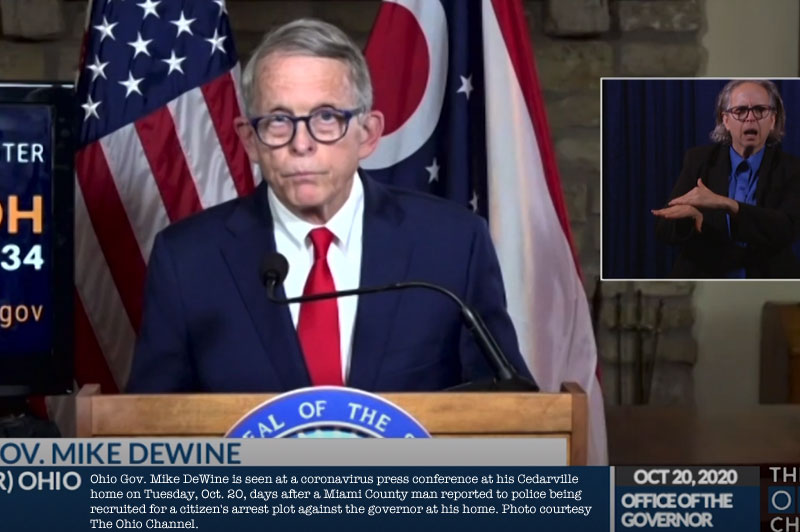
    Piqua, Ohio – A Miami County resident reported to police being recruited to take part in a citizen’s arrest of Gov. Mike DeWine at his Cedarville home a week ago, but the plot evidently never materialized.

    The plot is alleged to have involved Renea Turner, a former write-in candidate for governor who ran against DeWine in 2018. A state representative says he recently met with Turner prior to the alleged call and she inquired about the governor’s home, the Ohio Capital Journal has learned. 

    The Ohio State Highway Patrol, which handles security for the governor and his residences, was notified of the report by local law enforcement and is investigating. 

    At a press conference Friday afternoon to discuss allocation of CARES Act funding in Ohio, DeWine told reporters he was unaware of the alleged plot and had not been briefed on it to that point.

    This report to police came just a week after 13 men were arrested for reportedly planning to kidnap Michigan Gov. Gretchen Whitmer and it follows months of protests against DeWine and state health officials. 

    According to a Piqua Police Department report from Oct. 16, a citizen told an officer about being called earlier that morning by Turner, a Springfield native who is an outspoken critic of DeWine. Turner reportedly asked if they wanted to take part in an attempt to arrest the governor at his home later that weekend and try him for allegations of tyranny.

    The Ohio Capital Journal initially declined to identify Turner as the alleged caller, as law enforcement would not confirm if she had been under investigation or charged with a crime and she could not be reached by the Ohio Capital Journal for comment.

    The Ohio State Highway Patrol has been made aware of the police report but would not say if an investigation has been launched.

    Since the original publication of this story, Turner has spoken on the record with cleveland.com about the call, which she confirmed took place. She told the outlet that she did speak to the Miami County person about placing DeWine under house arrest, but reportedly denied discussing any specific plans. 

    The Capital Journal is not identifying the person who reported the incident to police after the person asked to remain anonymous for safety reasons, having already followed up with Piqua law enforcement about a threat made against them online.

    The person who reported the call told Ohio Capital News that the plot stemmed from anger toward the governor’s response to the COVID-19 pandemic. The person said they too are a critic of DeWine and claimed to have recently filed a citizen affidavit seeking criminal charges against the governor. State Rep. John Becker, R-Union Twp., who has led an impeachment effort against DeWine in the Statehouse, has urged Ohioans to submit such affidavits about the governor.

    “Do I think (DeWine) needs to be arrested? Absolutely,” the person said. “But all that needs to happen within the confines of the law.”

    They claimed they were initially excited when receiving the call last Friday, thinking the conversation would be about the ongoing search from DeWine critics to find a prosecutor willing to bring charges against him.

    “(The caller) said ‘no, we the people, we’re going to arrest him,’” the source said.

    According to this person, the caller described several supposed penalties for a citizen’s trial on tyranny — permanent exile or execution.

    According to this person, the caller described several supposed penalties for a citizen’s trial on tyranny — permanent exile or execution.

    Soon after the call, they decided to contact the police.

    “If I don’t do something about this and something happens, I’m either legally culpable or at least I’m going to feel bad,” they said. “Not that I have any love lost between me and Gov. Mike DeWine. Again, I think he needs to be in prison. But again, if (the caller) had done something … I would have felt ethically responsible, right?”

    State legislator says Turner recently asked about DeWine’s home in private chat

    Becker told the Capital Journal he met with Turner a few weeks ago in Columbus at her request to speak about theoretical criminal charges against the governor. While his focus has been on locating a willing prosecutor, he said Turner spoke about finding a county sheriff to make the arrest.

    “I just kind of shrugged my shoulders and said, ‘good luck with that,’” Becker recalled.

    Then came an unusual change in subject: Turner wanted to know more about the governor’s residence in Cedarville. Becker said Turner asked whether the personal residence constituted public property during DeWine’s term as governor.

    “It was kind of a strange question,” Becker said.

    John Becker aided Turner by providing information about DeWine’s residence and if it constituted public property.

    After the conversation ended, Becker asked Turner’s question to the Legislative Service Commission, a nonpartisan group which gives private law research to lawmakers. He learned the home remains a private residence, and passed that information along to her.

    Becker did not hear again from Turner after that. Earlier this week, he heard from the Miami County resident about the alleged plot. The person told him about Turner and Becker recognized her name from their recent meeting.

    Becker said he informed the Statehouse’s sergeant at arms about the situation when returning to work earlier this week. He later posted a YouTube video about the incident, referring to the person who reported the call to police as a “hero.”

    Becker confirmed to the Capital Journal he was contacted by the Ohio State Highway Patrol on Friday. The lawmaker said he described to the Patrol his interactions with Turner and the Miami County resident.

    Piqua Police Chief Rick Byron told the Capital Journal on Thursday the citizen’s report was turned over to the Patrol.

    “At this point, we have not followed up with them and have no plans to do so,” Byron said, noting the alleged caller is not from Piqua and therefore his department does not have jurisdiction. “We’re pretty confident that (the Patrol is) going to handle this situation.”

    Dan Tierney, a spokesperson for the governor’s office, referred questions about the situation to the Patrol.

    In a brief statement on Thursday, Lt. Tiffany Meeks told the Capital Journal: “For security, the Patrol does not discuss threats or security operations involving the governor.” The Patrol later confirmed to the Dayton Daily News it was “currently investigating the incident.”

    Cleveland.com quoted Turner on Friday as saying officials with the Patrol came to her home that morning “to check out my temperament and what my plans are.”

    Since the report was made on Oct. 16, the governor has hosted three press conferences at his Cedarville home: his traditional virus-related updates on Oct. 20 and 22, and the CARES Act press conference with legislative leaders on Friday.

    After this story was first published, reporters asked DeWine during his CARES Act press conference about his reaction to the alleged plot.

    “I don’t know the details of the so-called plan,” he said. “I can’t really comment on that.”

    Asked if he was shocked to learn about such a plot, DeWine answered: “No. I’m not shocked by it. At this point in my life, not much shocks me anymore. It’s a sad thing.”

    This is the latest in a series of alleged plots targeting political leaders in 2020 for their responses to the pandemic. In Michigan, state and federal law enforcement foiled a plot to kidnap and try Gov. Whitmer, with seven of the men being charged under the state’s anti-terrorism law. 

    Police in that case have alleged the Whitmer plot was hatched in a meeting held in Dublin, Ohio this summer. The same groupof men also hoped to target Virginia Gov. Ralph Northam. 

    There is no known connection between these plots and the one reported in Piqua.

    Turner is former governor candidate

    Turner, of Springfield in Clark County, campaigned for governor as a write-in candidate in 2018. 

    Turner encountered DeWine on the campaign trail, later posting a picture of themselves together to social media. A post on her Facebook page claims she pretended to be a supporter of DeWine’s, then told him after the picture was taken she was actually campaigning against him.

    Turner received 185 votes in the 2018 general election, including one from the person who later reported her call to Piqua police. 

    Turner has shared several posts from state Rep. Nino Vitale, R-Urbana, who has made headlines throughout 2020 for posting falsehoods about the virus — such as an April claim that it may have been created by Bill Gates. 

    Turner received 128 more votes as a write-in candidate for Springfield mayor in 2019 before turning her attention back to DeWine amid the coronavirus pandemic. 

    Her social media pages are littered with conspiracy theories involving the virus, government microchips and vaccine mandates. Many of the posts have been flagged by Facebook as spreading misinformation.

    Turner has shared several posts from state Rep. Nino Vitale, R-Urbana, who has made headlines throughout 2020 for posting falsehoods about the virus such as an April claim that it may have been created by Bill Gates. 

    Turner shared one post by Vitale from May 18, in which he accused DeWine of “giving himself total dictatorial power.” Vitale also falsely suggested the governor knew about the virus in March 2019, many months before the novel coronavirus was ever discovered. 

    In July, Turner posted photos of herself protesting health orders at the Ohio Statehouse with a signs referring to the governor as Hitler. 

    Turner took to the Statehouse again on Thursday, proclaiming she had removed the governor from office through a self-issued declaration. A video shared to Facebook shows Turner taking an oath of office, with a signed sheet of paper claiming her to be the next governor of Ohio. 

    Turner did not address the Thursday incident in her interview with cleveland.com.

    ‘It’s wrong morally, it’s wrong legally’

    DeWine reiterated on Friday that the plot against Whitmer was “despicable” and added he denounced any effort by people to subvert the legal system and target public officials.

    “We are seeing people out there who believe that,” the governor said. “We have an obligation, each one of us as elected officials, opinion leaders, to denounce that and say ‘that is wrong.’ It’s wrong morally, it’s wrong legally, it’s anti-democratic, it’s anti-everything this country stands for.”

    While DeWine has enjoyed widespread, bipartisan support throughout 2020 for his response to the pandemic, his administration has also been the subject of intense condemnation. Four legislators have endorsed his impeachment, and dozens of others have supported various bills seeking to limit the executive’s power to handle an infectious disease.

    Ohio Gov. Mike DeWine in a Zoom call with reporters in August outside his Cedarville home. Screenshot by Marty Schladen, Ohio Capital Journal.

    Repeated protests at the Statehouse led DeWine to move his press conferences from Capitol Square to a government building elsewhere due to “security reasons,” WKYC reported in April.

    That same month, Cleveland.com reported that Ohioans protesting the state’s public health orders were seen “driving by DeWine’s Greene County house, filming it and counting cars.” The outlet quoted a DeWine spokesperson as saying security officials were aware of this surveillance but could not comment further.

    In May, protesters repeatedly targeted the home of Dr. Amy Acton, who was then serving as director of the Ohio Department of Health. There were reports that some of the protesters were armed with guns, and one person was photographed carrying an anti-Semitic sign. Not long after, Acton resigned as state health director.

    In May, protesters repeatedly targeted the home of Dr. Amy Acton, who was then serving as director of the Ohio Department of Health. There were reports that some of the protesters were armed with guns, and one person was photographed carrying an anti-Semitic sign. Not long after, Acton resigned as state health director.

    The state has been without a permanent health director in the months since. A replacement was announced in September, but the person selected withdrew from consideration after learning of the harassment leveled against Acton. The Ohio Department of Health continues to be led by an interim director.

    Also in May, Democratic House Minority Leader Emilia Sykes reported a phone call to police threatening to kill her father, state Sen. Vernon Sykes, if she did not “step aside” politically.


    (This story was edited by Loveland Magazine)


    Tyler Buchanan

    Tyler Buchanan is an award-winning journalist who has covered Ohio politics and government for the past decade. A Bellevue native and graduate of Bowling Green State University, he most recently spent 6 1/2 years as a reporter and editor of The Athens Messenger and Vinton-Jackson Courier newspapers. He is a member of the BG News Alumni Society Board and was a 2019 fellow in the Kiplinger Program in Public Affairs Journalism.