Tag: state budget

  • [WATCH] Loveland Schools State Budget Town Hall

    [WATCH] Loveland Schools State Budget Town Hall

    Loveland, Ohio – This LOVELAND MAGAZINE TV video is of the Loveland Schools State Budget Town Hall that was held at the media center of the Loveland Middle School on Wednesday evening. The state budget that will determine spending for the next two years in Ohio is making its way through the Ohio General Assembly. Governor Mike DeWine’s budget proposal could cut funding for the Loveland City School District and many other public schools. The District says that their five-year forecast is that the district could receive $2.5 million less in state funding.

    Since the Ohio House has already passed their proposed spending bill, attention is now focused on what the Senate will propose, and thus the District has now amended  their lobbying priorities and what they are asking the public to do that might influence the State House decisions. You can read their amended lobbying priorities HERE.

    The District is asking the Loveland community to continue reaching out to state lawmakers. They say, “It’s important lawmakers and Governor DeWine receive messages from as many people in our community as possible, and that they receive repeated messages throughout the budget process from now until the budget bill is signed at the end of June.”

    Loveland’s Lobbying Priorities:

    • Protect the “Guarantee” – if the guarantee were to be eliminated, Loveland would suffer a catastrophic loss of $25 million in state funding over the next four years. The governor’s suggested reductions in the guarantee will mean a loss of about $2.5 million.
    • Ensure state funding keeps pace with inflation – Inflation is projected at 2.3% and we are requesting that state funding increase at or near the same rate during the two-year budget. Failure to increase state funding in line with inflation shifts more of the burden for public education to local taxpayers.
    • Remove the cash balance provision – Limits on carry-over balances will have unintended consequences for school districts and create more confusion for local taxpayers. We request that the state study the issue and consider separate legislation regarding cash balances.

    [pdf-embedder url=”https://lovelandmagazine.com/wp-content/uploads/2025/04/LovelandLobbyingFlyer.pdf”]

  • State Board of Education of Ohio discusses changes coming with budget approval

    State Board of Education of Ohio discusses changes coming with budget approval

    BY:  Ohio Capital Journal

    In their first meeting since the state budget was approved with sweeping changes to Ohio’s State Board of Education, the group discussed the impacts it will face.

    “This is going to be another chapter here and I want to be as proactive and on top of this chapter as I can, and as we can,” said Paul LaRue, president of the board.

    Among the billions of dollars and hundreds of things approved by Gov. Mike DeWine last week were the provisions previously contained in Senate Bill 1, which transfer most of the powers away from the board and into the executive branch.

    The changes would rename the department overseeing the board to the Ohio Department of Education and Workforce and create a cabinet-level position that would direct the department. Two deputy directors would also be a part of the new department, one for primary and secondary education and another for workforce.

    “The board needs to be thinking about in the upcoming months, about what these things look like,” said Chris Woolard, interim superintendent of public instruction.

    Woolard’s job will change as well, though he will remain the secretary of the board and serve as the board’s “executive officer,” conducting policy and administrative functions of the board and staff of the board, according to Tony Palmer, chief legal counsel for the ODE.

    “Most of the responsibilities that are currently with the superintendent are transferred under the budget bill to the director of the Department of Education and Workforce,” Palmer told the board.

    As for the board, it will retain powers related to educator licensure, discipline, teacher evaluation systems, and appointment of the superintendent. They can also make recommendations to the DEW directors regarding priorities for education, according to Palmer.

    Several board members wrote to DeWine prior to his signing of the budget to ask him to remove the SB 1 provisions, calling the changing of the roles a “power grab.”

    At this week’s board of ed meetings, members continued to criticize the move, questioning the enforcement measures to make sure the new oversight is the right move and truly improves the state of student test scores and education in general.

    “What we kept hearing was that they needed to get rid of the state board because somebody was not being held accountable, but they never defined what that meant,” said board member Antoinette Miranda. “I’m just wondering if (the DEW directors) are going to get fired when the scores come back the same.”

    Miranda’s fellow board member Diana Fessler claimed Pearson Education, a company who creates student assessment tests, would help with the change “by changing the test questions, and they can change the scores and the cutoff scores besides.”

    “I think the kids are going to be doing amazingly well in no time at all,” Fessler said. “But it’ll be a lie from the pit of hell.”

    Jessica Voltolini, chief of staff for the ODE, said officials are still reviewing all of the provisions of the budget and the changeover, working on a 180-day timeline: 90 days preparing before the October effective date of the bill, and the 90 days following, when implementation of all of the changes will be made.

    But Voltolini said the “very high-level overview” the department has taken so far hasn’t shown any additional level of accountability for the directors, other than that they would need to confirmed by the Ohio Senate.

    Teresa Fedor, one of the most recently elected board members and a former state senator, accused the governor of going against a constitutional amendment passed in 1953, in which voters moved the ODE into its own department.

    “Not some of it, all of it,” Fedor said. “And (DeWine) is breaking the constitutional intent and message right now, so we need to have clarification on how decisions are going to be made by this group.”

    The board may face further changes if just-introduced legislation makes its way through the General Assembly. Former board member, now state Rep. Sarah Fowler Arthur, R-Ashtabula, introduced a measure this month that would eliminate governor-appointed positions on the board and reduce the group to 15 elected-only positions.

    That measure will be assigned to a committee for consideration before it can move for a full vote of the House and Senate.


    Susan Tebben
    SUSAN TEBBEN

    Susan Tebben is an award-winning journalist with a decade of experience covering Ohio news, including courts and crime, Appalachian social issues, government, education, diversity and culture. She has worked for The Newark Advocate, The Glasgow (KY) Daily Times, The Athens Messenger, and WOUB Public Media. She has also had work featured on National Public Radio.

    MORE FROM AUTHOR

  • DeWine signs budget, blocks erasure of COVID-19 health violations

    DeWine signs budget, blocks erasure of COVID-19 health violations

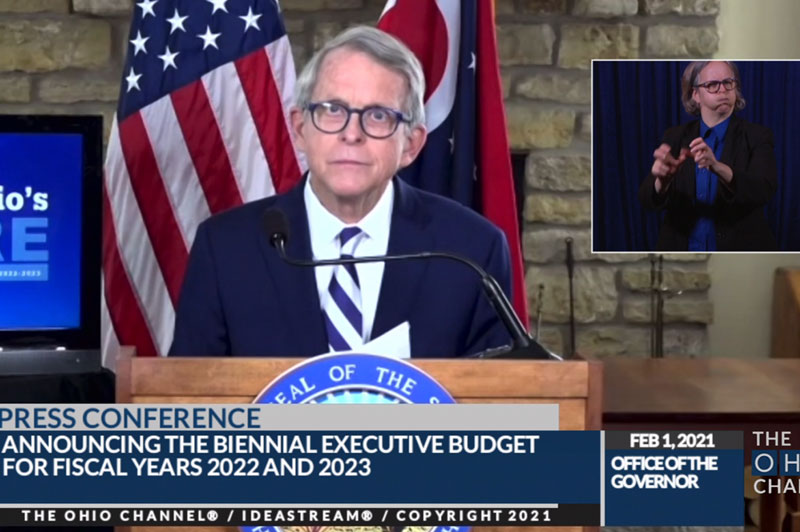
    Gov. Mike DeWine outlined his state budget proposal for fiscal years 2022 and 2023 in a February press conference.

    By Tyler Buchanan and Ohio Capital Journal

    Gov. Mike DeWine signed the $74 billion, two-year state budget into law, keeping in place nearly all of its signature policy positions and spending priorities while once again nixing an effort by Republican lawmakers to counter his administration’s methods of handling the deadly COVID-19 pandemic.

    The governor also vetoed an attempt by Republican lawmakers to give their party’s legislative leaders sole power to intervene in any potential redistricting lawsuits. The governor wrote in his veto message that this removal came at the request of Attorney General Dave Yost; voter rights groups and Democrats had also urged for the veto of this provision.

    As governor, DeWine has the power to issue “line-item vetoes” blocking specific provisions of the budget while signing his approval to the rest.

    In total, DeWine issued 14 such line-item vetoes among the more than 2,400-page budget bill. Lawmakers have the power to override any of these vetoes.

    Among the vetoes: A provision to vacate public health violations from businesses that were issued over the course of the pandemic. The budget item would have expunged all COVID-19 health violations, ended disciplinary actions in progress and ordered the state to repay any fines collected. Bars and restaurants which had their liquor licenses revoked — in some cases due to flagrant and repeated violations of the public health orders — would’ve had it reinstated.

    Gov. Mike DeWine signed the $74 billion, two-year state budget on Wednesday evening. Photo courtesy the governor’s office.

    In his veto statement, DeWine wrote that “Ohio law should not reward businesses and individuals that violated orders and rules adopted to protect Ohioans from the spread of COVID-19 by excusing their actions.”

    DeWine vetoed a provision which would have changed the state’s contracting process for a Medicaid managed care system.

    DeWine also vetoed provisions related to Medicaid program rates; an exemption of private schools from College Credit Plus laws; and quality controls of community schools.

    Unanswered veto requests

    While voter rights organizations scored a victory with the veto of the redistricting lawsuits provision, they were unsuccessful in pushing for vetoes of several other budget items condemned as being “anti-democratic.”

    This includes the budget eliminating the Citizen’s Education Fund and instituting a prohibition on elections officials collaborating with any “nongovernmental” entity for voter education purposes.

    There were other veto wishes that went unfulfilled. Democrats in the Ohio Senate wanted to see the governor remove the elimination of a cap on the number of EdChoice income-based vouchers awarded in Ohio and an income tax credit for private school tuition.

    Democrats in the Ohio House of Representatives, meanwhile, joined the Ohio Environmental Council in sharing concerns about budget language they fear would lead to oil and gas drilling in public park lands.

    Reproductive rights groups wanted to see DeWine take out provisions threatening the future of two Ohio abortion clinics. Innovation Ohio, a left-leaning policy group, was among the organizations drawing attention to the budget’s “medical practitioner conscience clause” allowing medical professionals to refuse treatment of patients if doing so would violate their personal moral or religious beliefs. Advocates believe this could lead to LGBTQ+ Ohioans being refused treatment.

    Policy Matters Ohio, a left-leaning think tank, called on the governor to remove proposed tax cuts that research has shown will largely benefit the state’s wealthiest earners.

    However, DeWine championed the 3% income tax cut in a news release announcing the budget signing.

    The Ohio Capital Journal will continue to provide coverage on the two-year state budget and the governor’s vetoes.

  • Groups ramp up work on budget agenda for Ohio children

    Groups ramp up work on budget agenda for Ohio children

    by Mary Schuermann Kuhlman, Public News Service – OH

    Columbus, Ohio – More than a dozen groups are banding together to make sure Ohio does right by its children in the next state budget cycle.

    The Ohio Children’s Budget Coalition is ramping up efforts to maintain, protect and strengthen public resources that support children.

    The Coalition on Homelessness and Housing in Ohio is among the organizations involved.

    Gina Wilt, advocacy director for the housing group, said they’ll use their collective voice to outline policy priorities in the coming months.

    Gina Wilt is Advocacy Director for the Coalition on Homelessness and Housing in Ohio

    “All of our issues intersect,” Wilt noted. “And sometimes we get into these silos, and we can’t afford to be in silos right now. There’s a potential $2 billion shortfall. The governor, he’s going to have a lot to look through, and we must be in sync.”

    Wilt said they hope to build on their success of the last budget cycle, when funding was increased for seven of 11 issues in the coalition’s agenda for children.

    Specifically, Wilt said the last budget improved support for evidence-based home visiting, for mitigating children’s lead exposure, and for wrap-around support in schools. 

    “Really being able to focus on families and children is a top priority,” Wilt explained. “That’s something that we think Gov. DeWine can get on board with. And he has shown that this is a top priority in work that he’s already done. We need to make sure that that’s continued.”

    Wilt added longstanding structural barriers and public-policy choices have created an uneven playing field for Ohio children. She noted the economic downturn has disproportionately affected children and families of color. 

    “We have seen huge gaps in our safety net for children and families of color,” Wilt contended. “That will definitely be a priority as we talk about all of these issues; child health, child care, education, justice issues related to our youth, housing and homelessness, and food security.”

    Gov. Mike DeWine is expected to release his budget recommendations for Fiscal Years 2022 to 2023 by mid-March, and the budget bill must be signed by June 30 to take effect July 1.