


Tag: state legislature

  • Education sees some funding boosts, some missed opportunities in 2022

    Education sees some funding boosts, some missed opportunities in 2022

    BY: SUSAN TEBBEN – Ohio Capital Journal

    Next year is sure to be a busy one when it comes to education in Ohio, with potential state agency overhauls and funding changes still on the agenda for the state legislature.

    The end of 2022 was capped by an 11th-hour push and ultimately failure for an attempted overhaul of the Ohio Department of Education and the state Board of Education. Senate Bill 178 was never passed in an Ohio House committee, so it was folded into another bill with controversial provisions, House Bill 151.

    House Bill 151 included bans for trans youth in participating in sports based on their gender identity, and after SB 178 was included, the bill came in at more than 2,000 pages. But despite delaying the vote until after 2 a.m. on the last day of the legislative session, the bill and its many provisions failed to garner enough votes in the House.

    LGBTQ advocates hailed the failure of House Bill 151, which still would have required the use of birth certificates to prove a student’s gender, despite the elimination of a provision that would have required a genital exam.

    “I can not begin to express my gratitude to the hundreds of community members and advocates who stood up for the rights of all transgender youth to participate in all parts of life as whole people, including sports, just like everyone else,” said Alana Jochum, executive director of Equality Ohio, after the bill failed to pass.

    Dr. Rhea Debussy, director of external affairs for Equitas Health and former facilitator for the NCAA’s Division III LGBTQ OneTeam Program, said the thrill of seeing the legislation voted down was tempered by concern that the bill even existed.

    “It’s very alarming that a group of legislators thought bullying gender expansive and intersex youth was an urgent need for the final hours of Ohio’s 134th General Assembly,” Debussy said in a statement.

    Senate Bill 178

    Education officials not only celebrated the failure of HB 151’s anti-trans legislation, but the downfall of the rapid-fire education overhaul they overwhelmingly said needed more time and more vetting.

    “OEA believes it is worth taking a hard look at how Ohio’s schools are governed and supported at the state level,” said OEA President Scott DiMauro in a statement. “However, collaboration is key.”

    Senate President Matt Huffman said he was “disappointed that our school reform bill and our attempt to do something about girls’ sports … I’m disappointed that those things failed.”

    But Huffman maintained the stance he took after the Senate passed HB 151 on to the House for a vote earlier this month, that if the education overhaul part of the bill didn’t pass during the 134th GA, it would move on to the 135th.

    “I’m glad we took the vote because we kind of have on the record who’s where, and there probably is a lot more due diligence that needs to be done on that issue,” Huffman said.

    Some ups, more downs

    While some funding changes were implemented — such as $56 million in state funding for Disadvantaged Pupil Impact Aid, increases in Elementary and Secondary School Emergency Relief funds and federal monies for school security and safety — public schools are still looking for full funding of the Fair School Funding Plan (formerly called the Cupp-Patterson plan, after Speaker Bob Cupp and former state Rep. John Patterson, the legislators who created it). The plan was previously funded for the two years of the current General Assembly, but needs another four-year commitment of funds to be fully phased in.

    That plan, according to the OEA, “represents the first constitutional school funding system in the state in decades.”

    The effort for better public school funding is flanked by a lawsuit moving forward in Franklin County Common Pleas Court that seeks to nullify the EdChoice private school voucher system in the state. A coalition of school districts and individuals joined together to file the lawsuit, and Franklin County Judge Jaiza Page recently ruled against the Ohio Attorney General’s Office, who argued the lawsuit should not be allowed to continue.

    “This means we will put vouchers on trial in a court of law,” the coalition behind the lawsuit, Vouchers Hurt Ohio, wrote in an email newsletter, though the timeline for the court case could go on for some time.

    Private school vouchers are on the minds of congressional Ohioans as well, with U.S. Sen. Sherrod Brown pushing for more investment in federal Head Start programs and more funding for public schools.

    “We have a state government, one of whose major aims seems to be to privatize public schools,” Brown said in a press call. “They have moved more and more money out of public education into religious schools and other private schools … and really undermined what state government should be doing and that is funding public education for the great majority of students in our state.”

    Teachers unions and public officials alike wanted to see efforts to stem the state’s teacher shortage, a rise in the teacher wages that have stagnated over the last 25 years and changes to the third-grade reading guarantee, both of which saw action in the legislature, but did not come to fruition.

    As the state’s Board of Education awaits the fate of the department and the board itself, they still have a decision to make: the search for a superintendent of public instruction.

    The board spent months on issues such as a resolution condemning racism in education, then a resolution repealing that racism measure, and finally a resolution urging the federal government not to include gender identity in anti-discrimination language that would impact education policy.

    But in their December meeting, they decided to punt on the issue of hiring a search firm to select candidates to fill the open position that heads the department.

    The board voted to wait until SB 178 was passed or rejected by the legislature, for fear that candidates for the position might change their minds once they found out how the roles of superintendent would change under the new bill.
  • What’s next for congressional redistricting

    What’s next for congressional redistricting

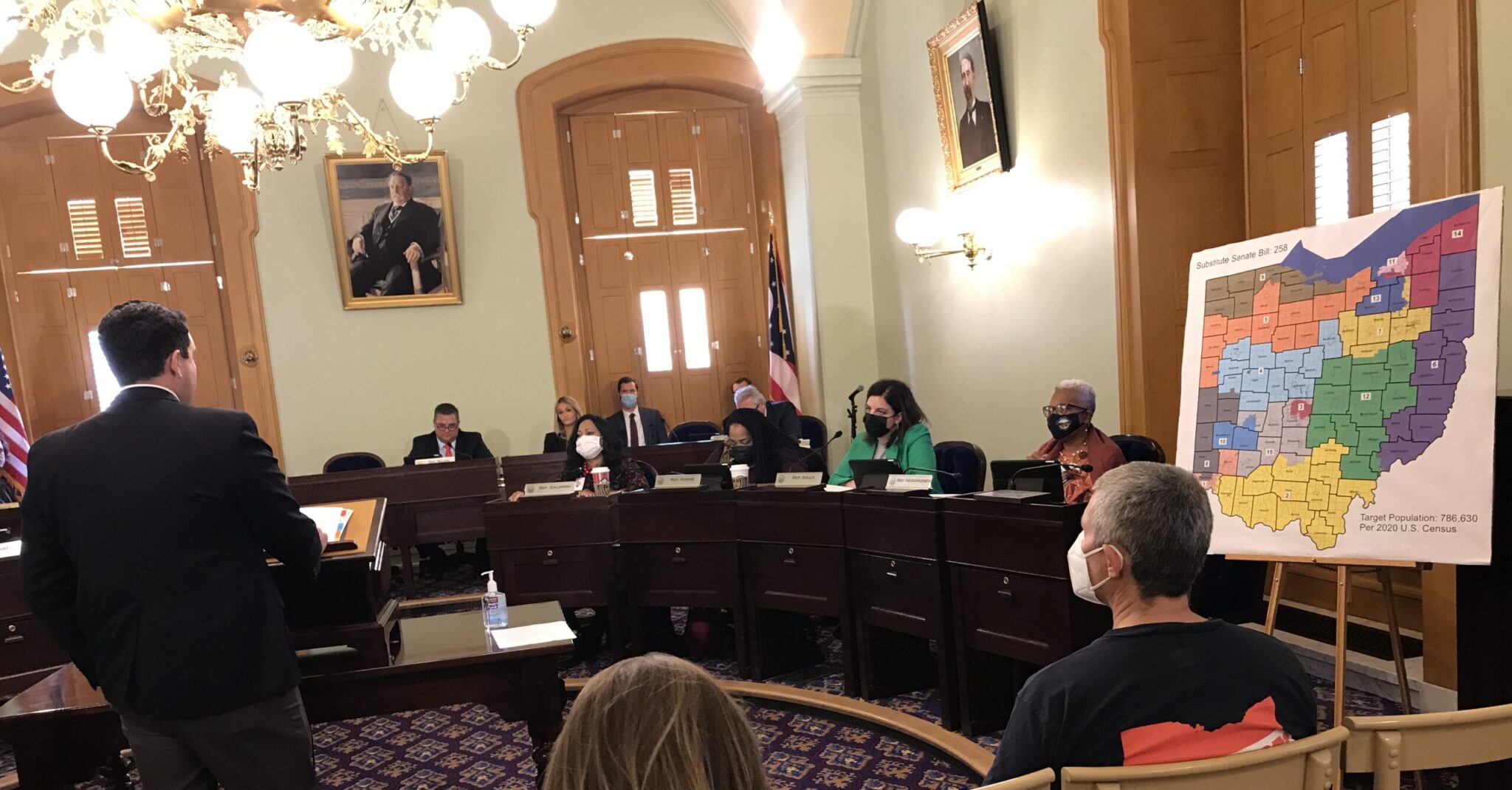
    State Sen. Rob McColley, R-Napoleon, presents congressional redistricting maps to the House Government Oversight Committee on November 17. (Photo: Susan Tebben, OCJ)

    BY: SUSAN TEBBEN –  Ohio Capital Journal

    This week the process begins again of trying to draw congressional districting lines in Ohio.

    The Ohio Supreme Court started its year sending the state legislature back to the drawing board on congressional redistricting, after rejecting the map passed in November by the GOP supermajority.

    With a one-week timeline for the legislature to come up with a plan, committees are convening with that specific purpose.

    Starting Tuesday morning in the Ohio House’s Government Oversight Committee, representatives will hear about House Bill 479, a bill led by state Rep. Scott Oelslager, R-North Canton, which is up for a possible substitution, meaning it could include the new House proposal for congressional districts.

    That bill was the vehicle for the House’s proposal last time around, but it was overtaken by the GOP’s Senate Bill 258, which was quickly adopted by the legislature as the official redistricting plan.

    The same day the House considers its own redistricting effort, the Senate General Government Budget Committee will be looking at Senate Bill 286, state Sen. Rob McColley’s bill for congressional redistricting.

    McColley, R-Napoleon, was the lead on SB 258, the map that would eventually be rejected as unconstitutional by the state’s high court.

    The senate committee accepted testimony on the bill for its first hearing on Tuesday, and a possible vote is indicated for Wednesday’s meeting of the General Government Committee. No testimony or vote is indicated for the House Bill, and the committee is not set to meet again this week.

    If either of the bills pass through committee, it would move on for a full House and/or Senate vote. Both chambers are scheduled to have sessions on Wednesday, with the House set to meet at 1 p.m. and the Senate to meet at 1:30 p.m.

    The House has an “if-needed” session on the calendar for 1 p.m. on Thursday, which could mean the Senate will pass a redistricting plan on Wednesday and send it to the House for agreement on Thursday.

    The legislature has until Feb. 13 to pass a plan. In order for the plan to take effect for 10 years, bipartisan support is needed, which would have to include 33% of Democrats in both the House and Senate. If the legislature can’t get bipartisan support, the map would be in place for four years, pending supreme court approval.

    A new plan from the legislature would have to have an emergency clause attached to it in order to take effect before the May 30 primary. Typically, without an emergency clause, a bill passed by the General Assembly goes into effect 90 days after the governor signs it.

    If the legislature doesn’t bring a plan to a vote by the deadline, the process heads back to the Ohio Redistricting Commission, who would have another 30 days to come up with a plan.

    The ORC just finished revising legislative maps, which were once again invalidated in a Monday ruling by the supreme court.

    The 4-3 decision by the court found the revised maps had similar violations as the original maps, with the court still finding issues with the revised maps in terms of partisan favoritism.

    The ORC now has until February 17 to revise the legislative maps for a third time.

  • Ohio Republicans go full Calhoun on nullification. Never go full Calhoun

    Ohio Republicans go full Calhoun on nullification. Never go full Calhoun

    Commentary by David C. DeWitt from Ohio Capital Journal


    Ohio Republicans in the state legislature have apparently decided to go full Calhoun with a proposed bill attempting to nullify not only any federal gun laws they don’t like but also any court rulings related to gun laws with which they disagree.

    They do not possess the power to do this under the U.S. Constitution, the Ohio Constitution, or precedent set by the U.S. Supreme Court, the highest court in the land that some Ohio Republicans seemingly believe they have the power to flout. Again, they do not.

    As they’ve spent much of the COVID-19 pandemic wailing ignorantly in misunderstanding about the separation of powers in the Constitution and the checks and balances among government branches, they’ve turned most recently to proposing and passing laws defying these elemental aspects of American civics.

    Take first Ohio Senate Bill 22, which bestowed upon the state legislature veto authority over executive branch emergency and public health orders by concurrent resolution. Statehouse Republicans declared this was a response to the executive branch allegedly overstepping its authority — the authority the legislative branch itself gave the executive branch through law more than a hundred years ago — and their solution was to overstep their own authority.

    You see, the Ohio Constitution requires the General Assembly to actually pass law to exercise the power of law, not resolution. Laws must be signed by a governor, or a governor’s veto overridden by the legislature, in order to be enacted. This is an intentionally cumbersome process. A resolution requires neither. So simply ignoring the Ohio Constitution relieves them of this constitutional burden. The non-partisan Legislative Services Commission warned Republicans of the unconstitutionality of their proposal, and they ignored the LSC too.

    This middle finger in the face of the Ohio Constitution was even shepherded through the Ohio House by current speaker and former Ohio Supreme Court Justice Bob Cupp, who should definitely know better.

    Why did they do this? They do have the authority to rewrite law if they so wish. They could rewrite Ohio Revised Code and override the governor’s veto in doing so just as well. But apparently ignoring constitutionality was easier. This middle finger in the face of the Ohio Constitution was even shepherded through the Ohio House by current speaker and former Ohio Supreme Court Justice Bob Cupp, who should definitely know better.

    Now comes House Bill 62 that seeks to declare any federal law, executive order, administrative action, or court ruling to be “null, void, and of no effect in this state” if it infringes upon the Second Amendment. This attempt by a state legislature to overrule federal law and courts is called nullification, and as a concept, it has never once been upheld in federal court in American history. Its most ignominious test came when the state of South Carolina attempted to nullify federal tariff law in 1832-33, led by slaver and slavery advocate John C. Calhoun.

    Courts at the state and federal level, including the U.S. Supreme Court, repeatedly have declared that under the Supremacy Clause of the U.S. Constitution, federal law is superior to state law, and that under Article III of the U.S. Constitution, the federal judiciary has the final power to interpret the Constitution. Ohio even lost its own fight over nullification in a battle against the Bank of the United States in 1824.

    But Ohio Statehouse Republicans’ self-contradictory views of home rule and local control appear to be based exclusively on their own political whims and no discernable standards or principles for the exercise of self-government.

    Plastic bags? According to the General Assembly, local government has no right to home rule or local control in regulating them. Nor, say Ohio Republicans, can locals decide against allowing the fossil fuel industry to run amok in their communities, injecting waste into their land while these fracking wells provide zero economic benefit to the area affected. But sustainable energy is a severe threat to home rule, the foulest tyranny, according to the Ohio General Assembly and its blissful lack of self-awareness.

    And how can we forget the gun issue itself? Ohio Statehouse Republicans appear to believe that the state can trump federal laws relating to guns and ignore any and all courts, but Ohio cities have stepped high above their station indeed for attempting to regulate guns themselves without the General Assembly’s approval.

    Power for me and not for thee appears to be Statehouse Republicans’ only real governmental operating ethos.

    Power for me and not for thee appears to be Statehouse Republicans’ only real governmental operating ethos.

    While the self-contradictions on the roles of levels of government show a political agenda with no consistent civic principles behind it, the real failure here is to take any sort of thoughtful long-view. I can only imagine their caterwauling if Statehouse Republicans were the victims of this kind of power grab instead of the perpetrators. I don’t even have to imagine it. Former Ohio Gov. John Kasich ate Statehouse Republicans’ lunch by using executive power to expand Medicaid in Ohio under the Affordable Care Act against their wishes.

    But let’s say Ohio Republicans don’t manage a permanent supermajority in the Statehouse, and that some day, perhaps decades from now, a Democratic General Assembly declares itself above the authority of the courts to decide issues of religious freedom, or abortion rights, or LGBTQ rights, or gun rights. Do you think Ohio Republicans would humbly accept the consequences of the path they’ve endorsed and chosen, or do you think they’d play the shameless hypocrite and contradict themselves entirely? I know my bet.

    It’s hard to take people seriously who do not take themselves nor the basics of American civics seriously.

    Due to extreme gerrymandering and the extremist and corrupt politics it breeds, however, Ohioans will be forced to continue to endure for some time longer a General Assembly that sees a radical faction of one political party and high-dollar donor special interests as their only true constituencies.

    The rest of us and our pesky constitutions, judicial precedents, rule of law, checks and balances, and separation of powers be damned.