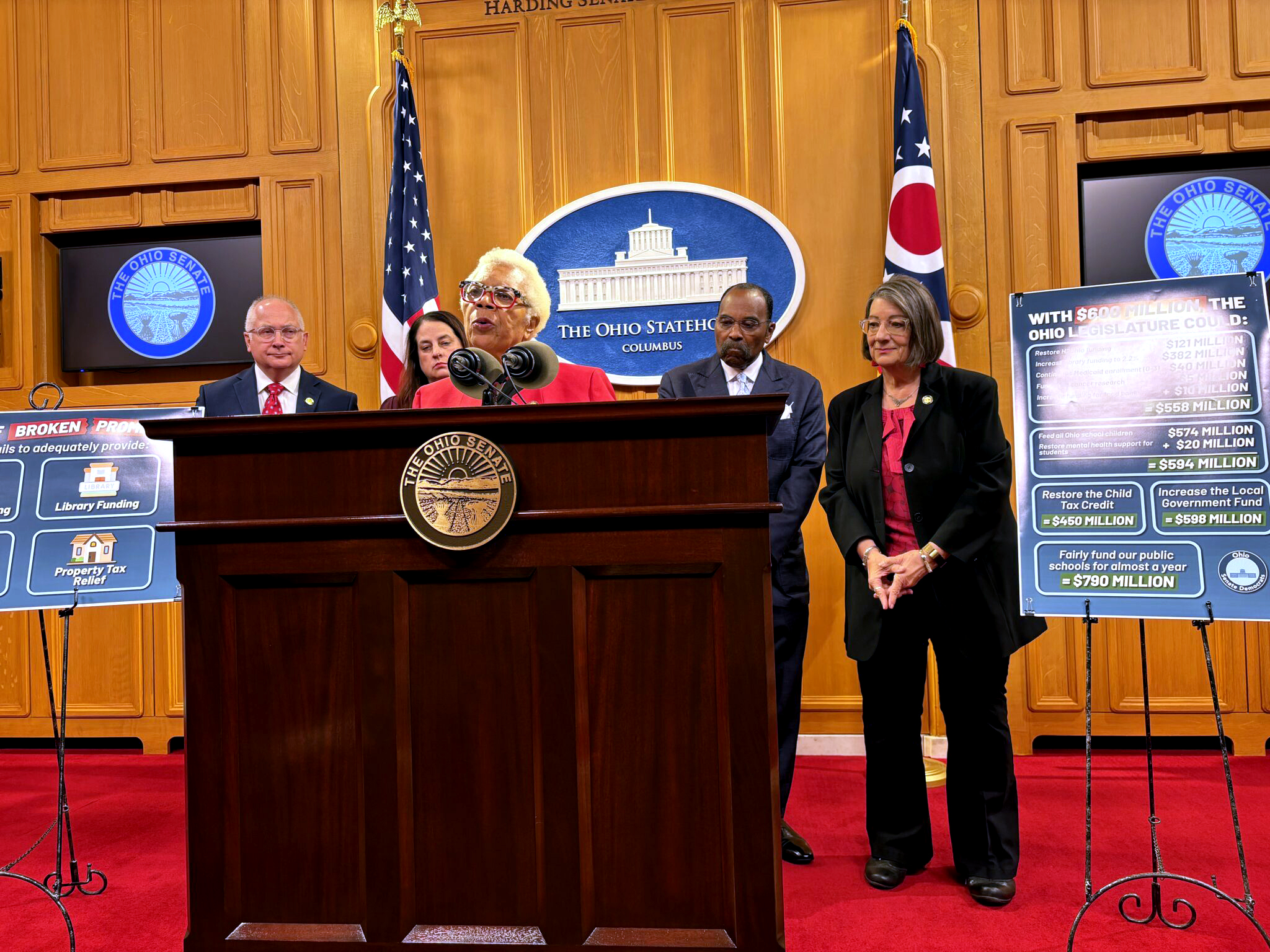
Ohio state Sen. Paula Hicks-Hudson, D-Toledo, and other members of the Senate Democratic Caucus discuss the amendments they submitted to the state’s two-year operating budget. (Photo by Megan Henry, Ohio Capital Journal).
Ohio Senate Democrats have submitted 423 amendments to the two-year state operating budget — including one removing the $600 million bond package for a new Cleveland Browns stadium in Brook Park, and one to fully fund public schools.
The Ohio House passed their version of the budget last month and the Senate is currently working on the budget, which Ohio Gov. Mike DeWine must sign into law by June 30.
GET THE MORNING HEADLINES.
“This budget steals from our children by defunding public schools, transfers money for health care and libraries to rich benefactors, all the while failing to address the needs of hard working everyday Ohioans,” Senate Minority Leader Nickie J. Antonio, D-Lakewood, said Tuesday during a press conference.
“This Republican budget prioritizes partisan agendas and handouts to the wealthy and well-connected, also through vouchers, tax breaks, and a stadium giveaway to the tune of more than half a billion dollars, all paid for by the working class,” she said.
The Senate Democrats had a few different ideas for how $600 million can be spent — a direct shot at how the Ohio House Republicans added a bond package for a new Cleveland Browns stadium for that same amount in their version of the budget.
Republicans hold a 24-9 supermajority in the Ohio Senate, giving Democrats very little power to enact any of their priorities. Nevertheless, Democratic lawmakers laid out their vision of what the state could be doing differently.
The Ohio legislature could restore H2Ohio funding for $121 million, increase library funding to 2.2% for $382 million, offer continuous Medicaid expansion enrollment for $40 million, fund child cancer research for $5 million, and increase funding for food banks for $10 million (which totals to $558 million), Antonio said.
Or lawmakers could feed all Ohio school children for $574 million and restore mental health support for students for $20 million, Antonio said.
The legislature could restore the Child Tax Credit for $450 million, increase the Local Government Fund by $598 million, and fairly fund public schools for almost a year for $790 million, Antonio said.
“If I were queen of the world, all these things would be part of our general fund budget,” she said.
If $600 million is bonded out for a sports franchise, “Ohioans are still on the hook for that money in the long run,” Antonio said.
DeWine originally proposed doubling the tax on sports betting from 20% to 40% with proceeds going to fund professional sports stadiums and Ohio youth sports.
“I thought what the governor proposed originally was actually a better way to go because the funds were coming from outside entities,” Antonio said. “It has the whole state in mind, not just one group in one part of the state.”
She said she would “be much more supportive” of an amendment along those lines.
School funding
To fully fund public schools based on statistics from the Fair School Funding Plan from 2021, schools would need an additional $666 million in funding (more now with inflation), but the proposed budget only gives them about $226 million.
“It breaks the promise we’ve made for our children in public schools by abandoning fully funding the Fair School Funding Plan,” Antonio said.
The Cupp-Paterson Fair School Funding Plan from 2021 was supposed to take six years and was meant to change how public dollars are provided to K-12 schools by giving additional support to local districts so they can rely less on property taxes.
The first two years were partially fully funded and the second two years were fully funded. There are two more years left.
“Our caucus has submitted amendments that would fully fund the fair school funding plan,” Antonio said.
The Senate Democratic amendments would also increase the state minimum teacher salary from $35,000 to $50,000, she said.
Additional amendments
Ohio Senate Democrats added an amendment to restore DeWine’s proposed $1,000 child care tax credit and another that would remove the language the Ohio House added to the budget that would make changes to the Ohio Housing Trust Fund.
The Housing Trust is funded by a portion of the fees collected by county recorders, with half of the fees staying with the county and the other half going back to the fund — which requires at least 50% of the funds be spent in non-urban areas.
The House budget proposal would remove the requirement for county recorders to send the state Department of Development money to reallocate the funds — something housing advocates say make it less effective across the state.
“Rural areas would also be most impacted by the potential blocks of housing services as well, but all Ohio communities will see service disruption and increases in homelessness and decrease in access to affordable housing,” said Ohio state Sen. Paula Hicks-Hudson, D-Toledo.
Ohioans deserve better from the state budget, Antonio said.
“I think a whole lot of everyday Ohioans are going to be very surprised and have a whole lot of buyer’s remorse when they find out what it is that these people are doing on their behalf,” Antonio said when asked about the Republican supermajority in the Statehouse.
Follow Capital Journal Reporter Megan Henry on Bluesky.