

Tag: statewide voter preferences

  • Ohio Supreme Court allows Dems’ redistricting objection

    Ohio Supreme Court allows Dems’ redistricting objection

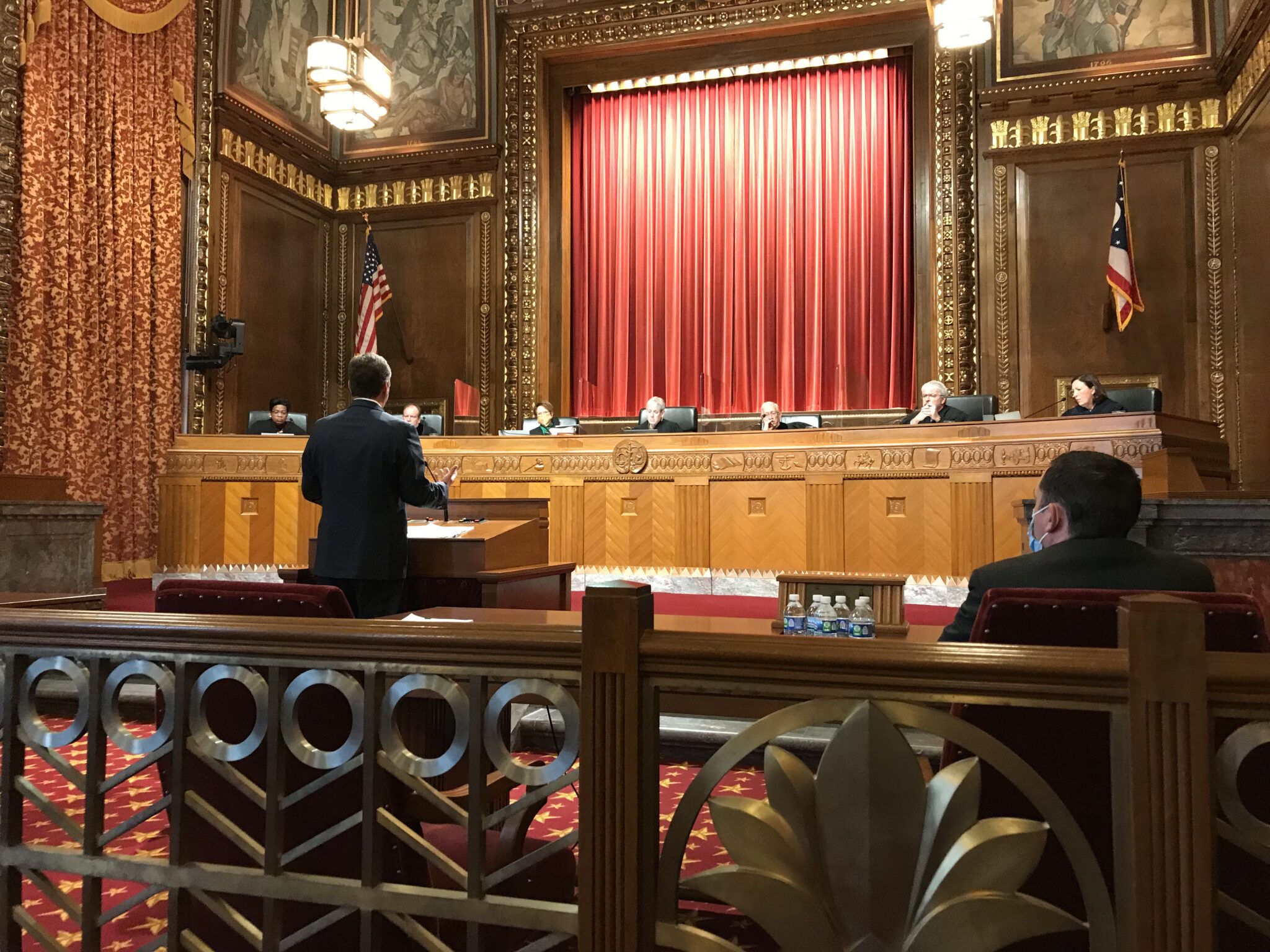
    Attorney Phillip Strach speaks before the Ohio Supreme Court, arguing for the constitutionality of legislative district maps. The court heard arguments on three cases asking it to reject the maps approved in September. (Photo: Susan Tebben, OCJ)

    BY: SUSAN TEBBEN – Ohio Capital Journal

    The Ohio Supreme Court has rejected a request by the state’s Attorney General to reduce Democratic redistricting leaders’ court filing to a “friends of the court” brief.

    In a short ruling released Friday evening, the court denied a motion to convert the brief, filed by Ohio Redistricting Commission co-chair state Sen. Vernon Sykes, D-Akron, and House Minority Leader and commission member Allison Russo, D-Upper Arlington.

    Russo and Sykes filed the objection to the newest legislative redistricting maps without an attorney, which they said was the fault of Attorney General Dave Yost. The Democrats say he refused to allow them to consult attorneys for the Ice Miller law firm.

    Yost asked that the brief be considered amicus of “friend of the court” brief rather than an official response by state officials. “Friend of the court” briefs are typically filed by non-parties in lawsuits, who want to provide the court input but aren’t necessarily connected to the case.

    The ruling by the supreme court did grant Yost’s motion for “limited intervention” in the case, meaning he maintains his position as a legal representative for all state officials in the lawsuits. Yost told the court the limited intervention was needed “to protect his powers as Chief Law Officer of the State of Ohio.”

    He said Russo and Sykes are being sued in their official capacities, therefore filing court documents saying they don’t have an attorney undermines his authority.

    Russo and Sykes are both mentioned in the lawsuit as members of the Ohio Redistricting Commission, along with Governor Mike DeWine, Senate President Matt Huffman, House Speaker (and commission co-chair) Bob Cupp, Secretary of State Frank LaRose and Auditor Keith Faber.

    Chief Justice Maureen O’Connor was the only justice to differ from the majority in the ruling. O’Connor, it was noted, would have denied the motion for Yost to intervene in addition to denying the conversion of the Democratic brief.

    Russo released a statement saying she was “relieved to see that a fair process is continuing in the courts.”

    “Now, we wait the Court’s decision on the submitted maps and let the process play out with greater transparency,” Russo said in the statement.

    The Ohio Redistricting Commission revised the legislative maps with a 5-2 vote along party lines in January after the court sent them back to the drawing board, calling their original plan unconstitutional.

    Republicans commission members responded to objections made by the League of Women Voters, the Ohio Organizing Collaborative and a group of Ohio residents. They said they made appropriate attempts to get to the court’s desired 54% GOP to 46% Dem split, based on statewide voter preferences for the last 10 years.

    The maps sent back to the court have a 57-42 split.
  • Ohio Redistricting Commission begins again after court order

    Ohio Redistricting Commission begins again after court order

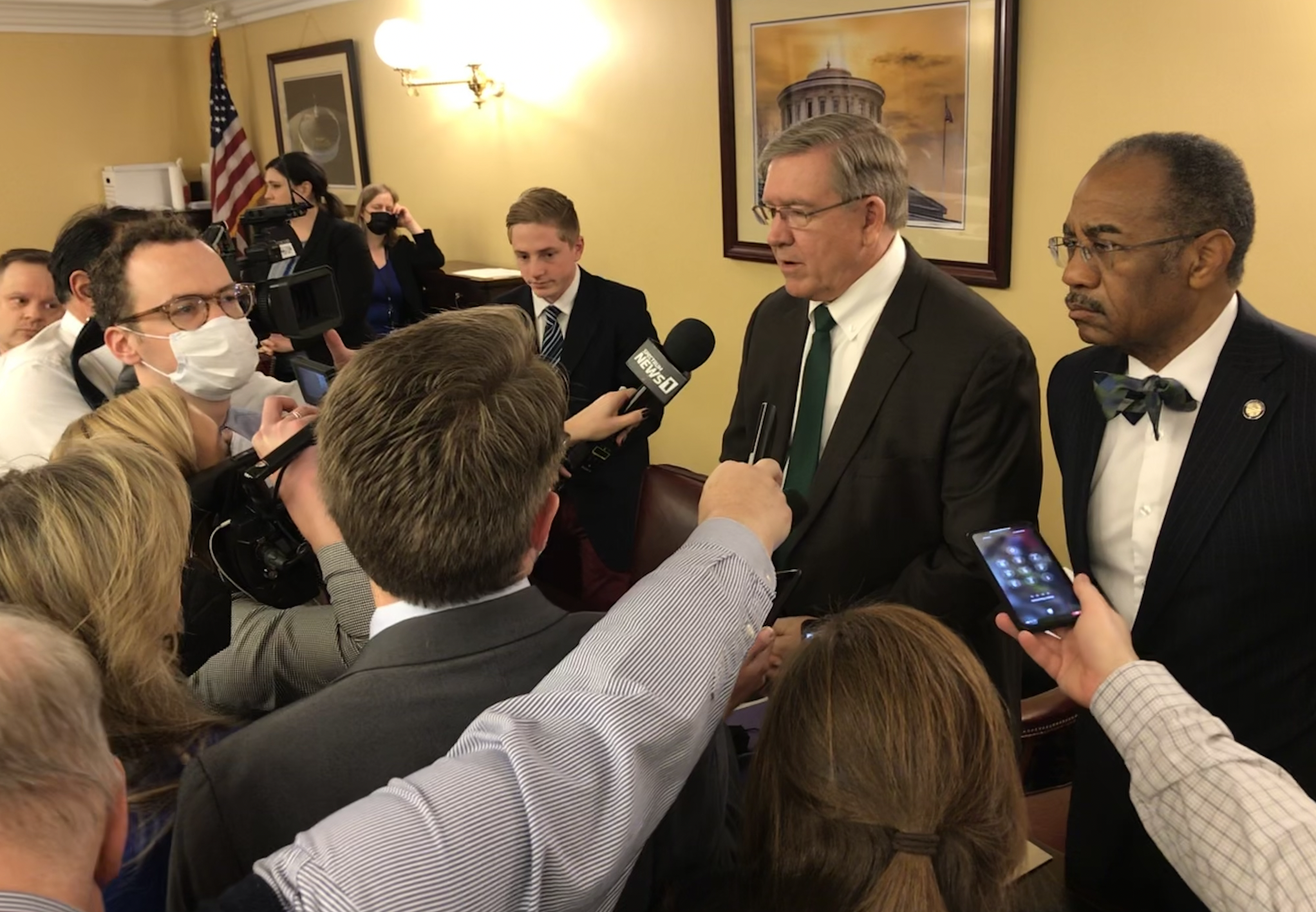
    House Speaker Bob Cupp, center right, and state Sen. Vernon Sykes, far right, co-chairs of the Ohio Redistricting Commission, speak to media after Tuesday’s meeting to restart the legislative redistricting process. (Photo: Susan Tebben, OCJ)

    BY: SUSAN TEBBEN – Ohio Capital Journal

    The Ohio Redistricting Commission began anew on Tuesday, though the details of their newest legislative mapping process are still up in the air.

    In its Tuesday meeting of the ORC, commission co-chairs House Speaker Bob Cupp and state Sen. Vernon Sykes said work to correct problems identified by the Ohio Supreme Court with legislative district maps has already begun between the Democratic and Republican caucuses.

    The commission is working on a deadline of Saturday, which is 10 days from the date the supreme court made their decision. Cupp said the commission is keeping in mind meeting the deadline so that the maps can be considered for any objections, which have to be submitted within three days of map approval.

    “This is a very time-sensitive matter, and we’re well aware of that,” Cupp said.

    Secretary of State (and ORC member) Frank LaRose said more than one deadline needs to be met in the process.

    “The General Assembly has ordered me to conduct an election on May 3, and I am committed to making sure that that happens,” LaRose told the commission. “But without finality on maps, that starts to become mechanically impossible very soon.”

    Some deadlines are already doomed because of how much time the redistricting process has taken, LaRose said. This weekend is the deadline for the state to submit the Federal Write-In Absentee Ballot forms for the next election.

    “That’s not going to be met because we’re not going to be ready to do that this weekend,” LaRose said.

    Because of the timeline, LaRose said he’s asked the legislature for temporary authority to adjust the administrative deadlines between the candidate filing deadline at the beginning of February and the May primary.

    The request is similar to the one approved under Senate Bill 258, the bill that approved the congressional district lines in November, that moved deadlines for the congressional elections.

    However, Cupp said he doesn’t sense “any appetite to change either the filing deadline or the primary election,” even if administrative deadlines change.

    The commission has about a week to come up with new maps that follow all constitutional regulations for redistricting, and aim for a 54% Republican/46% Democratic balance in the state aligned with statewide voter preferences. Sykes said the commission has agreed and shared data to be used in the mapmaking process, which will be the 2016 to 2020 statewide election data.

    Cupp said the commission is committed to working toward that 54-46 ratio.

    “(The supreme court has) determined that that needs to be closely followed,” Cupp said.

    Last week, in a 4-3 decision, the state’s highest court rejected maps approved by the commission in September 2021. Justices in the majority vote said the commission did not even attempt to meet constitutional standards to create a map that doesn’t favor or disfavor one political party over another, or use the proper data to calculate the statewide voter preferences.

    The court found that Cupp and Senate President Matt Huffman were the only two commission members “involved when the plan that was ultimately adopted was drawn,” and the principal mapmakers were not asked to comply with Section 6 of the constitution, which prohibits partisanship.

    At the Tuesday meeting, Gov. Mike DeWine – father of Supreme Court Justice Patrick DeWine and dissenter in the redistricting ruling – took time to read over the court’s decision on legislative redistricting and level-set the commission on the task at hand. He said the commission should “take affirmative steps” to comply with the constitutional standards, and make certain everyone from commission members to staffers know they need to comply.

    “So, anybody who is drawing a map, anybody who works with any members of this commission should be instructed by the individual commission members to do that,” DeWine said.

    The newest member of the commission, newly minted Democratic Ohio House leader state Rep. Allison Russo, D-Upper Arlington, was sworn in to fill the position left vacant by former House Minority Leader Emilia Sykes. She said the commission should take its second chance at the maps “to do what is right by Ohioans and deliver bipartisan 10-year maps.”

    “We should start with the assumption that it is absolutely possible, and move forward,” Russo said after the meeting.

    Russo told commission members during the meeting and the press afterward that she is pushing for public meetings to be scheduled quickly before the ORC loses the opportunity.

    The commission did not set up any future meetings or give any indication of how the map-making process is going during Tuesday’s meeting. Cupp said he and Sykes will be meeting to discuss a schedule for future meetings “as business would warrant us to.”

    “Obviously this is a little uncertain process, it’s new,” Cupp said. “We’re kind of feeling our way as we go.”

    Anti-gerrymandering advocates attended the meeting and said they were encouraged to hear the court’s expectations playing into the first meeting, but saw a lack of public input as the process started.

    “It would be better to have an understanding of what maps they’re starting with, when hearings will be, how the public can participate, and so it’s my hope that even within the next 24 hours we get a lot more information,” said Jen Miller, executive director of the League of Women Voters of Ohio.