Tag: Stephanie McCloud

  • Amended health order reopening food service stations signed

    Amended health order reopening food service stations signed

    Ohio Governor Mike DeWine today announced that Ohio Department of Health Director Stephanie McCloud signed the Addendum to Director’s Third Amended Order that Reopens Restaurants, Bars, Banquet and Catering Facilities and Services to Dine-In Service, with Exceptions.

    This amended order, reopens self-service food stations in restaurants, bars, banquet and catering facilities, and services, as long as the following conditions are met:

    • Customers must wear facial coverings while using self-service food stations or in line for self-service food stations. Those unable to wear a facial covering must be served by an employee.
    • Buffet tables/salad bars must be spaced a minimum of 6 feet away from customer seating/tables, and lines must not extend into seating areas.
    • Customer flow at buffet tables/salad bars must move in one direction with a beginning point and ending point, and customers must maintain at least 6 feet of social distancing while in line. Directional signage must be posted indicating where the customer line begins.
    • Hand sanitizer must be placed at self-serve food stations, including at the front of the line and end of the line of buffet tables/salad bars, and used by customers prior to, and after, serving themselves.
    • At least 6 feet of social distancing must be maintained between seated customers and customers in line for a buffet/salad bar and monitored by employees.
    • Serving utensils must be replaced or cleaned and sanitized at least hourly. It is recommended that customers use disposable napkins, tissues, wax paper, etc., when handling serving utensils, and operators of self-service food stations are encouraged to make them available. A trash receptacle should be conveniently located.
    • Use of individually packaged condiments is recommended instead of shared or bulk condiment dispensers.
    • Commonly touched surfaces must be cleaned and sanitized frequently.
    • While in operation, self-serve areas must be continually monitored by staff who are trained in food safety, including monitoring customer hand sanitizing practices at the self-service food station.
    • Food must be protected from contamination, including sneeze guards on self-serve equipment.
    • Signage must be placed at self-service food stations requiring customers to use hand sanitizer before and after serving themselves, and to maintain at least 6 feet of social distancing while in line. The signage should recommend that customers use disposable napkins, tissues, wax paper, etc., when handling serving utensils. A sample sign is available on Ohio’s coronavirus website at https://coronavirus.ohio.gov/wps/portal/gov/covid-19/responsible-restart-ohio/Posters-and-Signs (food service operations and retail food establishments may choose to develop their own signage).

    The order goes into effect on February 11, 2021 at 11:59 p.m.
  • DeWine hires attorney with thin public health background to lead health department

    DeWine hires attorney with thin public health background to lead health department

    By Jake Zuckerman

    Columbus, Ohio – Gov. Mike DeWine hired an attorney to lead the Ohio Department of Health on Thursday, a position that has remained vacant for the past five months of the pandemic.

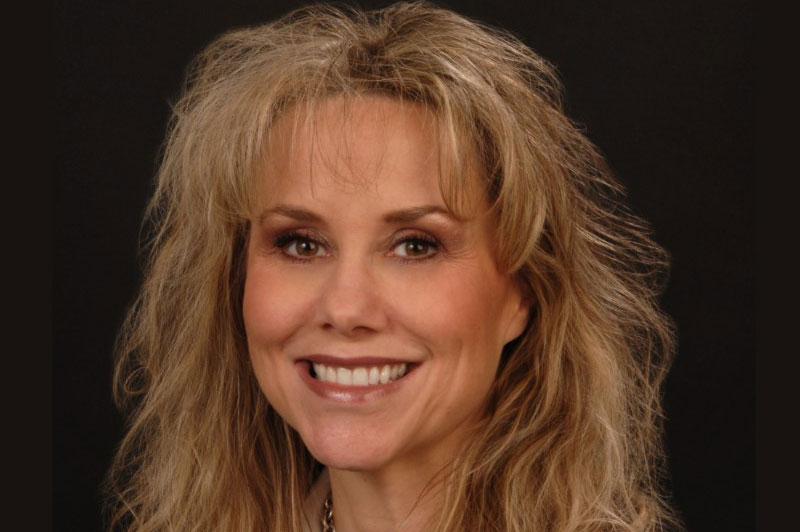
    Stephanie McCloud, who currently runs the Ohio Bureau of Workers’ Compensation, will take over a position that has been filled on only an interim basis since Dr. Amy Acton stepped down in June.

    She will now oversee the quickly worsening COVID-19 pandemic, as measured by spiking case counts, rising positivity rates, a swelling active hospitalization count, and an ever-ascending death toll.

    McCloud’s hire is a pivot from the physicians who previously held the post like Acton or Dr. Joan Duwve, who was set to replace Acton but quit the job in September before she officially started. DeWine has said in the past he specifically wanted a medical doctor to fill the post.

    “When I was elected governor, I knew that I wanted a Director of Health with a strong public health background, someone who had a passion for public health, and someone who could talk to Ohio citizens in a candid way about health issues,” DeWine said in June.

    An about page on the BWC website lists McCloud’s backgrounds in insurance administration and the law, but nothing specifically relating to public health or infectious disease control.

    1993 state law requires the ODH director to be either a physician or a person who has had “significant experience in the public health profession.”

    Dan Tierney, a DeWine spokesman, said McCloud’s work at BWC, which consists in part of evaluating claims of work-related health care claims and finding ways to prevent workplace health issues, meets the terms of the statute.

    He also emphasized DeWine’s related announcement of hiring a new chief medical officer, Dr. Bruce Vanderhoff, and related moves from lower-profile COVID-19 response staff.

    “There’s multiple people who need to lead on this,” he said.

    McCloud has valuable experience in management but nothing as it relates to public health, according to Micah Berman, a professor of public Health Law at Ohio State University.

    “To me, this is indicative of the lack of respect — or understanding — of public health as a field of expertise,” he said. “The Director of Health should have expertise in public health — not just in health care or another health related field.”

    The position has proven difficult to fill since Acton left. Acton had been the public face of Ohio’s public COVID-19 response to the newly emergent coronavirus, which included delaying a primary election, closing schools and businesses, and beginning to phase in a mask mandate.

    However, Acton faced tremendous public backlash. Protesters gathered and called her out by name in rallies in front of the Capitol and outside her Franklin County home. Some of them carried guns. At least two people hoisted anti-Semitic signs at both locations.

    Even after she stepped down, businesses and individuals challenging various COVID-19 health orders have named Acton as a defendant and issued summons seeking to drag her back into the fights. She described to The New Yorker hearing a conservative talk radio host in Ohio say if his key adviser quit during a crisis, he’d want to punch him in the face.

    In September, DeWine announced that Duwve would fill in where Acton left off. However, just hours after DeWine announced her hiring, Duwve declined the job.

    Duwve cited harassment of Acton as a reason for turning it down.

    Announcing Duwve’s hire, DeWine boasted of her “extensive experience in public health” in both government service and academia.

    The medical community has started to shine light on increasing backlash against public health officials navigating pandemics with no fixed playbook.

    An August viewpoint article with the Journal of American Medicine cited Acton and dog-whistle anti-Semitic remarks thrown her way by a state politician in its argument for more cover for health officials from political leaders.

    “The present harassment of health officials for proposing or taking steps to protect communities from COVID-19 is extraordinary in its scope and nature, use of social media, and danger to the ongoing pandemic response,” it states. “It reflects misunderstanding of the pandemic, biases in human risk perception, and a general decline in public civility.”

    Pages: 1 2

  • Record-Breaking Cases & Hospitalizations, Statewide High Incidence

    Record-Breaking Cases & Hospitalizations, Statewide High Incidence

    CURRENT COVID-19 DATA
    There are 235,170 confirmed and probable cases of COVID-19 in Ohio and 5,461 confirmed and probable COVID-19 deaths. A total of 20,015 people have been hospitalized, including 3,969 admissions to intensive care units. In-depth data can be accessed by visiting coronavirus.ohio.gov.  Video of today’s full update, including versions with foreign language translation, can be viewed on the Ohio Channel’s YouTube page.  For more information on Ohio’s response to COVID-19, visit coronavirus.ohio.gov or call 1-833-4-ASK-ODH.

    Columbus, Ohio – Ohio Governor Mike DeWine and Lt. Governor Jon Husted today provided the following updates on Ohio’s response to the COVID-19 pandemic. 

    RECORD-BREAKING CASES & HOSPITALIZATIONS
    DeWine announced today that Ohio is once again breaking records in regard to COVID-19 cases and hospitalizations.

    • Between yesterday and today, health officials have reported a total of 4,961 new positive coronavirus cases in Ohio, the highest number of new cases in a 24-hour period to date.

    • There are currently 2,075 patients hospitalized with COVID-19 which is a 55 percent increase in hospitalized patients compared to two weeks ago. 

    • Of the hospitalized patients, 541 people are in intensive care. The previous record for intensive care admissions was 533 in April. 


    “This virus is flaring up, and we have to push it down – the economy depends on it,” said Governor DeWine. “If the virus continues to aggressively spread, people will lose confidence in their ability to safely go to stores, restaurants, and other businesses. If we want to keep our economy moving, we must all live with this virus and we must all be more careful.”

    Governor DeWine stressed that the new record number of cases is not due to increased testing capacity in the state. Since September 24, the total number of tests in Ohio has increased by approximately 44 percent, but positive cases have increased 280 percent in the same time period. If a person is tested multiple times, they are only counted once.

    STATEWIDE HIGH INCIDENCE 

    New health data compiled by the Ohio Department of Health revealed today that all 88 counties in Ohio are now considered “high incidence” as defined by the Centers for Disease Control and Prevention. 

    “There have been so many cases in the past two weeks that the risk of catching this virus in every county of this state is very real and very concerning,” said Governor DeWine. “Again, I ask everyone to recognize their personal responsibility in slowing the spread of this deadly disease. It’s up to every citizen in Ohio to choose to slow the spread by wearing masks, distancing, and making overall smart decisions.”

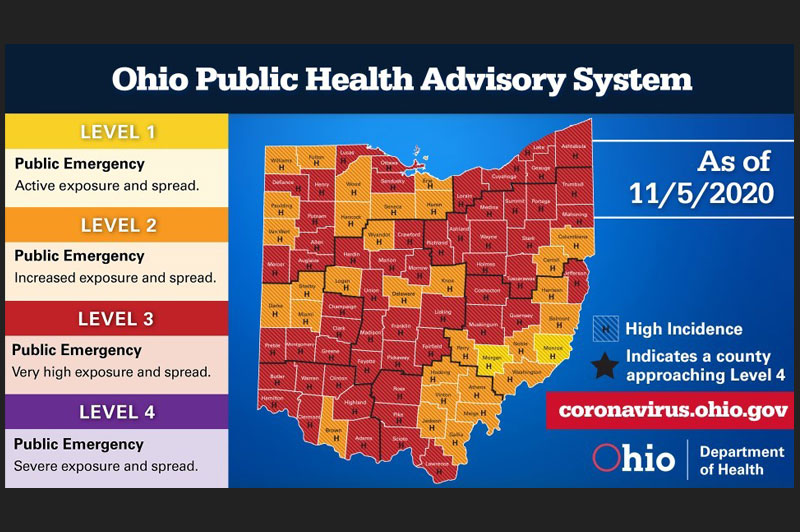
    According to today’s updated Ohio Public Health Advisory System map, 56 counties are currently rated as having a very high risk of exposure and spread (Red Level 3), up from 43 counties last week. This represents the highest number of Red Level 3 counties since the launch of the advisory system in July. As of today, 86 percent of Ohioans are living in a Red Level 3 county. 

    A county-by-county breakdown outlining the presence of COVID-19 in all of Ohio’s 88 counties can be found on the Ohio Public Health Advisory System’s website.


    NEW OHIO DEPARTMENT OF HEALTH STRUCTURE

    Governor DeWine announced multiple key additions to the existing administration at the Ohio Department of Health (ODH). 


    Chief Medical Officer Dr. Bruce Vanderhoff: 
    Dr. Vanderhoff previously served for more than a decade as a Senior Vice President and as the Chief Medical Officer at OhioHealth. He has years of experience leading large teams in successfully dealing with important healthcare issues in Ohio and prepared OhioHealth to deal with the threat of Ebola and the H1N1 flu pandemic.  

    Director Stephanie McCloud: 
    Director McCloud previously served as Governor DeWine’s administrator of the Ohio Bureau of Workers’ Compensation, managing an agency of 1,800 colleagues and over $28 billion in assets. She has considerable experience in the area of mental health and addiction treatment which is a priority in Ohio’s health improvement plan. 

    Senior Deputy Lance Himes: 
    Himes had previously served as the interim director of ODH where he has played an integral role in running and managing many aspects of the pandemic response operation. He will lead the coordination of the state’s vaccine distribution plan and will continue to work directly with Ohio’s local health commissioners.

    Chief of Staff Kathleen Madden: 
    Madden had previously served as Assistant Director at the Ohio Office of Budget and Management and will now play a key role in keeping ODH’s pandemic and non-pandemic programs and operations on track. She will work to prioritize and resolve critical issues, provide oversight and guidance to ODH staff, and ensure that ODH funds are spent responsibly and strategically. Other key members of the ongoing COVID-19 response who will continue their roles in assisting ODH are: 

    Adjutant General Maj. Gen. John Harris, Ohio National Guard: 
    Maj. Gen. Harris will continue work to ensure complex operations, such as COVID testing and contact tracing, are well-coordinated, monitored, and improved when necessary.  He will also work directly with Senior Deputy Himes on the planning and logistics of the forthcoming vaccine distribution program.  

    Director Ursel McElroy, Ohio Department of Aging: 
    Director McElroy will continue to direct virus prevention efforts for older adults in the community and in long-term settings, including nursing homes and assisted living facilities.  

    Director Lori Criss, Ohio Department of Mental Health and Addiction Services: 
    Director Criss will continue to lead efforts to address the increasing mental health needs of citizens during the pandemic.

    NEW OHIO BWC ADMINISTRATOR
    Governor DeWine announced that John Logue, the Ohio Bureau of Workers’ Compensation’s (BWC) Chief of Strategic Direction, will become the new administrator of Ohio BWC effective on November 16. Logue has worked for 26 years in the industry. Before returning to BWC in 2019, he most recently served as the vice president of client services for International Absence Management Company where he focused on Ohio workers’ compensation.