Tag: Stephen McClanahan

  • Angry Earth

    Angry Earth

    The earth is angry, and rightly so.

    Columnist Stephen McClanahan is retired from P&G and now active in environmental advocacy, search/rescue and emergency medical/disaster response.

    How much destruction do you have to see before you have seen enough? How angry does the earth need to be before we pay attention? How many lives must be ruined before it’s too many? As these words emerge on my computer screen, I can’t help but recall the lyrics to the folk ballad, and I pray the answers are not “Blowin’ in the wind”.

    In the past few months, I took the opportunity to spend some time in eastern North Carolina and the northern panhandle of Florida; in both places, I was there as part of Team Rubicon to help people try to put their lives back together following hurricanes Florence and Michael, respectively. Team Rubicon is a volunteer disaster recovery organization, mainly but not completely composed of military veterans. Hurricanes (or tropical cyclones as they’re called) are natural storms. We pay attention to the ones coming in off the Atlantic ocean. Pushed along by easterly trade winds in the tropics, warm, moist air near the ocean’s surface naturally rises and is replaced by cooler air aloft. With enough heat at the surface, the process

    Learn more about Team Rubicon

    continues. Throw in the rotation of the earth that induces a spin (counterclockwise in the northern hemisphere). As these get pushed along over the open ocean, they draw energy from the heat of the surface waters. The warmer the surface waters of the oceans, the more energy these storms have available. If atmospheric conditions are favorable for their large-scale formation, a storm emerges. As it grows, we give it names like tropical depression, then a category one hurricane and on up the line. I think one would have to be numb not to stand in awe at the fury and strength of such natural phenomena. Monster storms as these can make one feel very small; their scale and power are enormous. Magnificent, global forces are at play here. And yet, as tiny as we are in comparison, you and I (and many more of us) have a direct and measurable impact on them, because, you see, we’re pretty good at warming the oceans over which they pass. And with that, let me say welcome to global warming.

    Monster storms as these can make one feel very small; their scale and power are enormous.

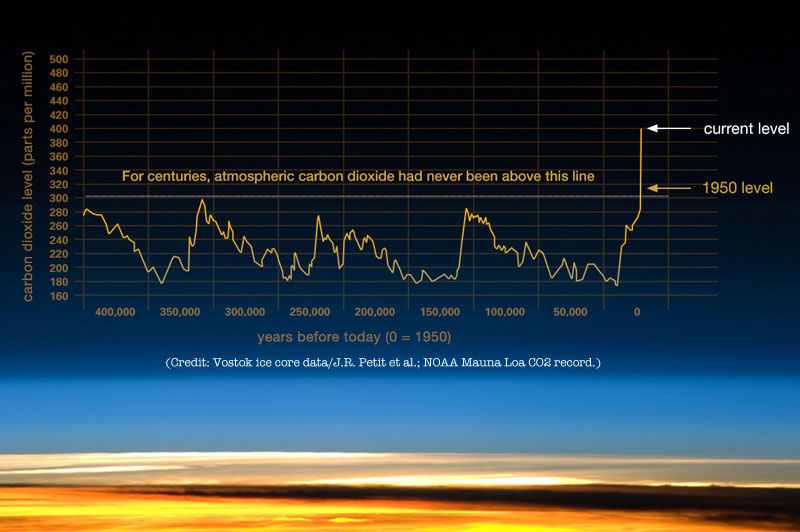
    We are probably familiar with the story by now. The sun heats our earth during daylight hours and at night, the earth cools by radiating some of that heat back into space. We all know that the earth does not cool as much during those nights with cloud cover, since the clouds act as a blanket. Clouds have an immediate and temporary effect; these impact our weather. It turns out that the carbon dioxide we emit into our atmosphere from our consumption of fossil fuels has been building up for decades (look at the graph to see for yourself); it too, acts as a kind of blanket but its impact is long-term. This CO2 blanket has a much slower build time but also a much longer lasting impact on our climate. CO2 traps some of the energy that would normally be radiated into space and holds it close to the earth. And, as we know, water is a great heat sink; it takes a lot of energy to heat water but once warmed, it retains that heat very well. Most (about 95%) of the excess heat that CO2 has trapped is in our oceans. Ergo, charged up hurricanes…natural storms made stronger by human impact on our planet.

    Its easy to read this kind of stuff and have it remain abstract, lifeless with no human touch. So, let’s go to North Carolina and Florida.

    Its easy to read this kind of stuff and have it remain abstract, lifeless with no human touch. So, let’s go to North Carolina and Florida.

    Burgaw sits in the Cape Fear river basin, about 40 miles inland from the Atlantic in eastern North Carolina. I spent a week there helping to muck-out homes in the flood zone of Hurricane Florence that went through in September of last year. One of those homes belongs to 80-year old Robert Ramsey; he lost everything, and I mean everything. Even though he’s 40 miles from the ocean, Florence came in and ever so slowly moved up the river valley; for days, it dumped unbelievable amounts of rain. The river flooded, to put it mildly.

    All but 2 feet of the roof line of Robert’s single-story house disappeared under the waters.

    All but 2 feet of the roof line of Robert’s single-story house disappeared under the waters. The water line was clearly visible on his metal roof. When I arrived, it had been well over a month since his house re-emerged from the flood waters. But his home was still a disaster; the destruction was so wide spread, all the emergency recovery resources that could be mustered were simply too inadequate to fix everyone straight away. I looked into Robert’s eyes as he stood in front of his home and I began to grasp the impacts. You could feel the hole in his heart; it was palpable. The damage to his home was enormous; there was nothing that was not ruined. Stench and mold were in abundant supply and growing worse by the day. Anything not washed away was rotting before your eyes. Everything in his humble home was totally destroyed. The only cure for his and about 4,000 other homes in this area was to gut

    I looked into Robert’s eyes as he stood in front of his home and I began to grasp the impacts. You could feel the hole in his heart; it was palpable. The damage to his home was enormous; there was nothing that was not ruined. Stench and mold were in abundant supply and growing worse by the day.

    them to the frame and try to dry out the bones of the structure. Everything inside is now in a landfill. Imagine, everything in your home being hauled to be buried. And while it has long faded from the news, the impacts of this storm ever present for those who lived it. One thing I heard time and again from the residents in the area was that this was not the first time their homes had been flooded; they do live in a river basin. But for thousands upon thousands of our fellow citizens, Florence was different; its waters were simply too much. And while it was water that Robert had to contend with, for folks in Mexico Beach, Florida, it was Michael’s winds that proved too much.

    Mexico Beach is was your quintessential beach-front tourist community. It sits directly on the Gulf of Mexico. Not far from Tyndall Air Force Base or Panama City, the land is flat and low, just feet about sea level. There is nothing to protect it from storms off the Gulf. 

    With little time for people to prepare, Michael slammed the upper peninsula of Florida near Mexico Beach on October 10 as a high-end category 4 hurricane; 150+ mph winds literally raked the community. Precious little remained standing when it was done.

    Hurricane Michael was kind of a sneaker; it showed up in the Caribbean as low-pressure disturbance. For almost a full week, it only slowly grew to a tropical depression. On October 8, it finally attained category 1 (the lowest) hurricane status. Then it moved northward over the warm waters of the Gulf of Mexico and as it did so, it became super-charged. With little time for people to prepare, Michael slammed the upper peninsula of Florida near Mexico Beach on October 10 as a high-end category 4 hurricane; 150+ mph winds literally raked the community. Precious little remained standing when it was done.

    The place still looked like a nuclear bomb had exploded.

    Team Rubicon volunteers come in for week-long waves; my assignment was for week 9 after Michael and the place still looked like a nuclear bomb had exploded. It’s kind of eerie to see a driveway lead up where a house once stood and literally, the only thing remaining is the concrete slab on which the home once stood; the winds took the rest. Our base of operations was an old warehouse in Panama City; Mexico Beach is about 20 miles down the coast to the southeast. To get there, you drive past Tyndall AFB which is well off the highway.  So mainly, you’re driving through a beautiful pine forest, or I should say, once was a pine forest. Thousands upon thousands now stand like twigs, all completely snapped off about 20 feet off the ground and all laying dead in the same wind-blown direction.

    Increasing the intensity and the patterns of naturally occurring storms are some of the many impacts of a warming world. For any one storm, it’s hard to parse out the exact contribution that a warming planet has had on a naturally-occurring weather event. Keep in mind that altering hurricanes is only one of many changes taking place. What is clear, in the long view of measuring climate, is that things are changing. To quote from NASA: “Global climate change has already had observable effects on the environment. Glaciers have shrunk, ice on rivers and lakes is breaking up earlier, plant and animal ranges have shifted and trees are flowering sooner.” And things will continue

    Keep in mind that altering hurricanes is only one of many changes taking place.

    to change for the worse simply due to the amount of CO2 in the air right now. But we can stop the worse of it, if we act…with urgency. Scientific modeling of future changes very clearly shows that we must stop adding CO2 to the air (i.e., get off fossil fuels). If we don’t, starting in a little over a decade from now, we’re going to be in serious trouble. (Read the latest report from Intergovernmental Panel on Climate Change if you’re into the details.)

    Encouragingly, there are signs that we’re beginning to take this seriously; average citizens and political/community leaders are raising this issue and debating options. And not a minute too soon. The earth is angry, and rightly so. And nature will have the final say in all this. We need bold action and we need it now; otherwise, we’re blowin’ in the wind.


  • Glacier and Grizzly Pooh

    Glacier and Grizzly Pooh

    Columnist Stephen McClanahan is retired from P&G and now active in environmental advocacy, search/rescue and emergency medical/disaster response.

    Glacier National Park sits in northern Montana; it runs contiguous with Waterton Lakes National Park of Canada to create a large, magnificent wilderness. If you ever have the opportunity to really experience the area, don’t pass it by. Glacier was set aside as a national park in 1910 by Cincinnati-borne President William Howard Taft. The park is named for the numerous glaciers that are there (or at least used to be but more on that in a bit).   

    Several years ago, I had the opportunity to spend a week backpacking in Glacier with some friends. During the time of our adventure, the country was celebrating the bicentennial anniversary of the Lewis and Clark expedition. It so happened that during the week we choose, we were about 20 miles from their location exactly 200 years earlier. That was kind of cool.

    Our hike took us across the southern portion of the Park, away from the popular tourist areas. We followed trails through the Nyack creek and Two Medicine Pass areas. We went through some remarkably remote wilderness that, as the rangers were keen to remind us, is home to the grizzly bear. Now, before you can get a backpack permit, you must watch a short film that reminds you that,

    Relative to the bear, you are lunch.

    relative to the bear, you are lunch. And to avoid such a fate, you are advised to hike a monster-sized canister of bear spray that you can fire once the grizzly is within 30 feet of eating you. Being that this is kind of a last resort tactic, you are also advised to hike with bear bells dangling from your pack. The tingling of the bell is to alert the predator, thereby avoiding a surprise lunch date. Sounds easy enough; the bear spray secures nicely to your pack and is largely out of the way but after a few days of tingling of the bells, you just about lose your mind and being eaten by a bear no longer seems the worse fate you are facing.  

    After a few days of tingling of the bells, you just about lose your mind and being eaten by a bear no longer seems the worse fate you are facing. 

    Strange things can happen in the deep wood. One late afternoon when the sun had sat, and night was falling, a solo hiker wandered into our camp. Mind you, we were probably 30 miles from the nearest point of civilization in a less frequented section of a large national park, deep in remote wilderness. The young man was wet, hungry and lost but in surprisingly high spirits; after feeding him and consulting our maps, we discovered he missed a turn several miles back. Astonishingly, we learned the lad was from basically the same home town in Kentucky as my wife; it is a small world. By sunrise the next morning, he was gone, leaving only a note of thanks for food and companionship.

    Conversation that alternated between discussions on theology and scatology.

    A member of our team happened to be a pastor. One afternoon, we were thoughtfully engaged in conversation that alternated between discussions on theology and scatology (if you don’t know that one, it’s the study of animal pooh – kind of important to know if grizzlies or other unfriendly creatures are about since you’ve canned the bells). 

    Some may find it irreverent to think of holding together these two conversation topics; I think they are all part of the same fabric – creation and Creator. Did you know there are amazingly interesting processes (intricate, complex and interdependent) by which nature takes that pooh and recycles it back into the web of life?  Without the creatures that perform these miracles, life would not be possible; you and I wouldn’t exist. So, in a profound way, theology and thoughts of pooh do belong together. 

    We are so deeply connected to the earth and, when in remote places, it’s natural to reflect on such things. I find nature to be a great teacher if I’m willing to become the student. I, like many others, find nature to fully reflect the Creator.


  • Stephen McClanahan – “Caves… all are dark, really, really dark.”

    Stephen McClanahan – “Caves… all are dark, really, really dark.”

    Columnist Stephen McClanahan is retired from P&G and now active in environmental advocacy, search/rescue and emergency medical/disaster response.

    In younger days, when my body didn’t complain as often or loudly, I was into caving, along with a few of my friends. Amateur spelunkers with no formal training and homemade, improvised equipment. A dangerous combination for sure, but the allure of exploring dark, foreboding holes in the ground proved overwhelming and so caution was thrown to the wind. We all grew up in Kentucky and thanks to its geology, caves are in abundance, particularly across the southern part of the state. Whenever the opportunity arose, we’d grab our gear and head out, camping and caving for 2 or 3 days at a time. For a few years running, we found ourselves on such adventures between Christmas and New Year’s. Of course, it’s frequently cold during that time of year and so, we’d end up camping inside the cave since it’s

    Mr. Ranger invited us into the back of his cruiser, gave us a free ride to the county seat and showed us a nice little room to sit.

    considerably warmer there. We once made the ill-advised choice of executing such a strategy at Carter Caves State Park. It turns out that Park Rangers frown on camping inside their caves, even when there’s no one else around; who knew? When we exited the caves, Mr. Ranger invited us into the back of his cruiser, gave us a free ride to the county seat and showed us a nice little room to sit. Fortunately for us, cooler heads prevailed and after a few hours, we were asked to leave…quickly.  I think we hitch hiked (also sort of illegal) back to our camp before packing for home. Ah, the indiscretions of youth.

    It’s highly unlikely to collapse when you’re inside.

    But I digress. I really want to tell you about caves and caving. If you can put up with the crawling, climbing, wiggling, wading and all manner of body contortions needed to navigate what nature has made, you are in for some truly amazing experiences. Of course, you need to get beyond the notion that the earth is going to fall on you; nature has taken a long, long time to build the cave and it’s highly unlikely to collapse when you’re inside. In my experiences, caves come in all shapes and sizes; some consist of a single passage way, others have more branches than you can count (and you had better pay attention on the way in, so you can find your way out). Some are easy; most are not. Some are almost dry; others require you to wade or crawl through water if you want to keep going. Some come to abrupt ends; some seem to go on forever. Some have large passageways; others make you squeeze if you want through. All are dark, really, really dark.

    There are a few safety rules you just don’t want to break.

    There are a few safety rules you just don’t want to break. The first is to let someone know you’re inside and it’s your intention to come out. The second is to carry lots of sources of light. Cell phones don’t count. I grew up using carbide lamps (the kind miners used) but today’s LED headlamps are far superior. The third is never go in alone; caving is a team affair. And just ask the boys from Thailand, don’t go into a cave if it’s raining somewhere close by as mother nature likes to use them for drainage. One of pleasant surprises you’ll likely encounter if you join a caving group is the spirit-de-corps that ensues from the adventure; there’s a coziness that comes from everyone stripping out of their wet, muddy clothes into something dry and warm at the end of a trip that’s hard to beat.

    I vividly recall once crawling into a small chamber, maybe 18 inches high (I remember being on my belly) and several feet wide, only to find literally hundreds of highly crystalline, pencil-thin, delicate, sparkling white columns spanning floor to ceiling within the entire chamber.

    One of many enjoyments of caving is experiencing various rock formations that exist in these environments. Variety and creativity are abundant. Not to get too much in the weeds, but caves in Kentucky form in limestones underneath sandstones. The sandstones are largely resistant to water whereas the limestone is not. Over time, bit by infinitesimally small bit, limestones can dissolve, leaving behind what we call a cave. But limestones are dynamic; they can also reform mineral when calcium carbonate is precipitated. A slow drip can form a crystalline mineral that emerges from the ceiling (a stalactite) or can grow one from the floor onto which it is falling (stalagmite). Lots of other formations occur, such as flowstones, large columns, deep pits, waterfalls and more. Many of these formations are brilliantly white and reflect light like a diamond. I vividly recall once crawling into a small chamber, maybe 18 inches high (I remember being on my belly) and several feet wide, only to find literally hundreds of highly crystalline, pencil-thin, delicate, sparkling white columns spanning floor to ceiling within the entire chamber. What I was seeing had taken millions of years to form. Not many people experience that kind of treat.

    Did I mention that some caves are large? I’ve had personal experience with at least one of these that is somewhere in southeastern Kentucky (and I’m not referring to Mammoth Cave). My friends and I made a couple of attempts to penetrate this one, but it got the better of us each time. I remember the first long section was easy, requiring only a crawl for a quarter of a mile or so. Kind a singular tube, nothing too special. But then, the crawl tube abruptly emptied into an enormous

    It was like a giant sports stadium deep inside the earth, only pitch dark with the haunting echoes of water falling somewhere.

    chamber, wide and deep. It was like a giant sports stadium deep inside the earth, only pitch dark with the haunting echoes of water falling somewhere. And to make it far more challenging, our passage way entered this chamber at least 100 feet off its floor (remember the old trick of tossing a small rock and counting the time for it to strike bottom, then trying to remember your high school physics so you can

    Otherwise we’d probably still be there.

    calculate the distance it traveled?). We foolishly attempted to drop ropes and descend, but fortunately we lacked the needed length to even reach bottom, otherwise we’d probably still be there. We really hadn’t given much thought to ascending, only descending (maybe that ought to be added to the set of rules above).

    My son is a caver and, as part of the hydrogeology department of Western Kentucky University in Bowling Green and sometimes gives guided tours through parts of Mammoth Cave to various geology field teams. I tagged along on one of these recently, for old times’ sake.  I had not been in a cave in many years, but the spirit of adventure and exploration instantly returned. It’s an enchanted world down under and I highly recommend getting in on the action.  And it’s still really, really dark.


    Loveland Sweets is a purveyor of hand-crafted chocolates, caramels, marshmallows, and ice creams. Our house-made candies are prepared in small batches.


  • [Stephen McClanahan] It’s all my son’s fault

    [Stephen McClanahan] It’s all my son’s fault

    Meet Loveland Magazine’s newest columnist. A long-time resident of Miami Township, Stephen McClanahan is retired from P&G and now active in environmental advocacy, search/rescue and emergency medical/disaster response. The title of his column will be Love-the Land.

    It’s all my son’s fault that I became interested in adventure motorcycling.  When my friends ask me what this is, I tell them it’s kind of like backpacking down remote roads but with a motorbike under me.  I try to get away to experience places I’ve never seen yet at the same time, I strive to move in a way that leaves no trace of me having been there as well as minimizing my presence in the moment.

    A few years ago, my son and I took a couple of weeks and traveled some of the incredible lands in the western US.  One afternoon when we were on a backcountry road in Colorado, we stopped due to some road work.  As I grew impatient, I looked to my side; there was a peculiar rock sticking up from the ground, probably 30-40 feet into the air.  I surveyed the area; there were several of these formations.  It turns out that it’s a good thing to take trips like this with my son who happens to have majored in the geological sciences; since I’m his father, I get to ask as many questions, intelligent or otherwise, as I wish, and he must answer.  (Simple rules to my advantage; what’s not to like?)  

    Since I’m his father, I get to ask as many questions, intelligent or otherwise, as I wish, and he must answer.

    I asked about the rocks sticking out of the ground and after a few moments, his answer arrived.  And I literally spend the next several hours of motorcycling contemplating what I heard.  The rocks didn’t stick up out of the ground; they formed within the earth and over time, the ground eroded away leaving the rock exposed.  It turns out that the rock is of a mineral that is more weather and erosion resistant than its surroundings, so it survived the rains, the winds, the heat, cold.  I’m a chemist; I understood this piece; some chemical bonds are stronger than others.  But the question that left me dazed followed; how long has this been going on?  My son commented that it was likely somewhere in the ballpark of 300-400 million years. 

    So here I am, sitting on my bike, impatient over the few minutes needed for new asphalt to be smoothed.  And sitting next to me is rock that is in the process of being exposed for more than 300 million years.

    So here I am, sitting on my bike, impatient over the few minutes needed for new asphalt to be smoothed.  And sitting next to me is rock that is in the process of being exposed for more than 300 million years. Three hundred million years!  I tried to contemplate the juxtaposition of these two points in time, of me and this rock. My focus was so small – the minutes I had to wait before continuing to ride.  The rock has been waiting on me for hundreds of millions of years. I tried to seriously understand 300 million years and not just let it pass as another number.  I started small.  What does 10 years feel like?  I could put my head around that.  What about 100; could I really imagine what a century was like?  Maybe.  Moving on, I tried to understand 1000 years, a millennium.  I lost it here; I couldn’t honestly say I fully understood what 1000 years was really like. Yet the rock next to me was 300,000 millennia old! And compared to many other objects in the world, the exposed rock was young.  

    l find there is always ample evidence of something much larger at work than me.

    My experience is that the world is full of these kinds of intense places that shape me if I immerse myself in them.  And l find there is always ample evidence of something much larger at work than me. In this case, I was reminded that, compared to the vastness of time from which our natural world emerged, I am a mere fleeting mist.


    Wildflower House — where women & girls bloom!


  • Love-the-Land by Stephen McClanahan

    Love-the-Land by Stephen McClanahan

    Meet Loveland Magazine’s newest columnist. A long-time resident of Miami Township, Stephen McClanahan is retired from P&G and now active in environmental advocacy, search/rescue and emergency medical/disaster response. The title of his column will be Love-the Land.

    It’s interesting how experiences come into your life that forever alter who you are. Years ago, a group of friends backpacked the Elizabeth Pass trail in Sequoia National Park, about a 50-mile loop. One day when we decided we had found a good place for camp, John and I went for an early evening scramble up a nearby boulder-strewn hill. It was good to move without packs and we were enjoying the climb over chunks of rock the size of cars.

    When we summited, we discovered that we had stumbled upon a sizeable alpine lake, completely still in the fading sunlight of the cloudless day.

    We sat and tried to absorb the mirrored water that was in front of us, but the silence was overwhelming, crushing us in its utter tranquility. Nothing moved, absolutely nothing. No wind, bird in flight or ripple on the water existed, a lake as quiet as the boulders that rimmed it. The complete stillness washed over us, and we too became totally silent, trying to not to disturb the beautiful, holy moment in which we were immersed. No doubt that we were on sacred ground and were deeply blessed for being in its presence. 

    Twenty years in the passing and I remember that time as if it were now. It is seared into my brain. When I read ‘be still and know I am God’, I begin to have a deeper understanding of what it means. Nature has a way of doing that to you, if you will let yourself be exposed.  

    I certainly have not had every adventure that I dream of, but I cherish every one that has come my way. Each has taught me something about life and my place in it.

    In the coming weeks and months, I hope to share thoughts, experiences and moments with you that derive from my journeys out there.

    In the coming weeks and months, I hope to share thoughts, experiences and moments with you that derive from my journeys out there. I hope to paint pictures for you of what lies in store for those willing to experience what is sometimes referred to as the back country. Yes, it costs some creature comforts and demands some efforts to venture into the wilderness, but what it gives in return is priceless. 

    As you can probably surmise from my words, I am at home in the wild; it is so utterly beautiful and majestic, and I cannot help but want to share it. By doing so, I hope to create and embolden your desire to immerse yourself in a bit of the world out there.  So, let’s journey together.