Tag: STRS

  • Gov. signals looming scandal at teachers’ pension fund

    Gov. signals looming scandal at teachers’ pension fund

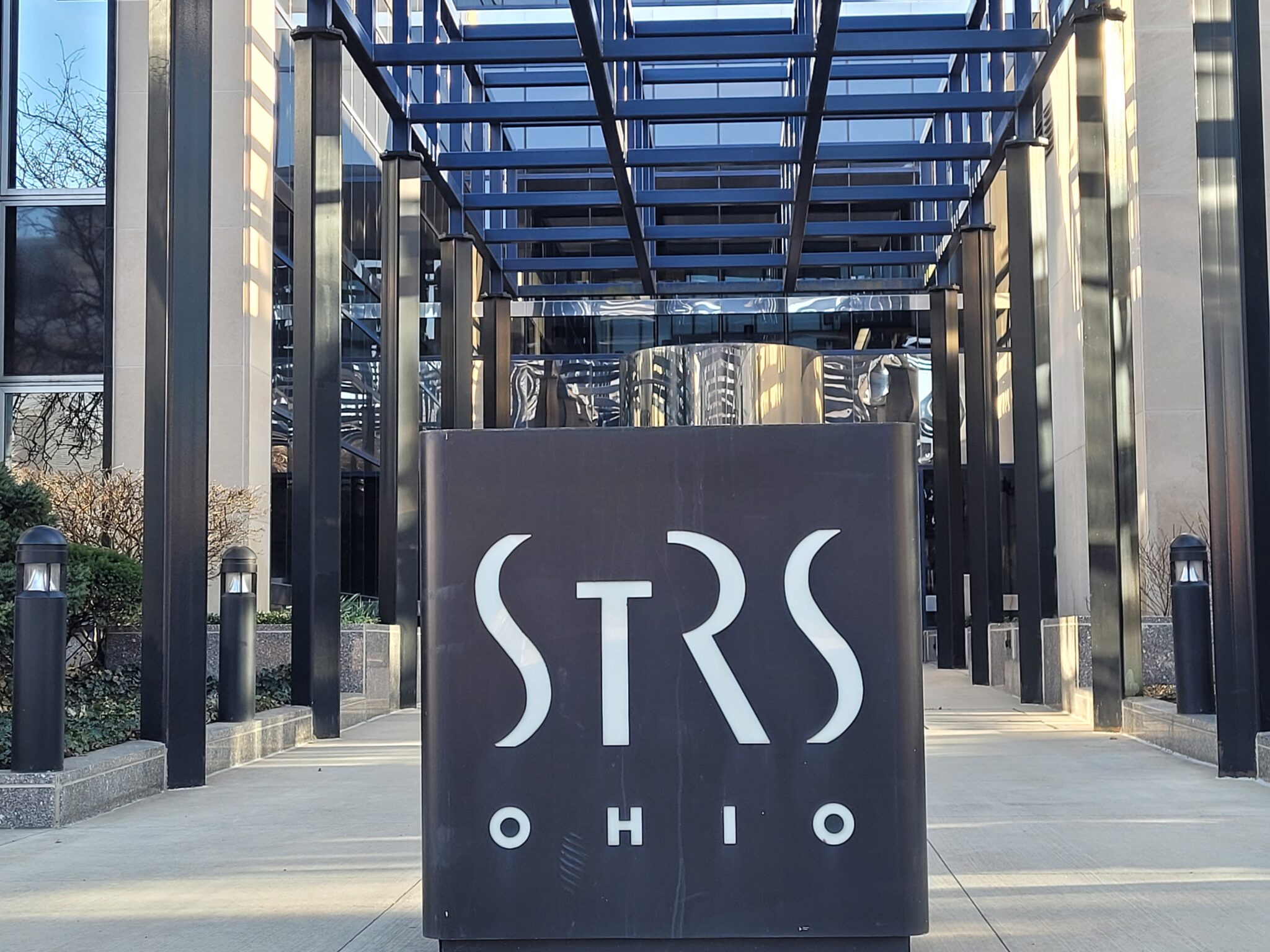
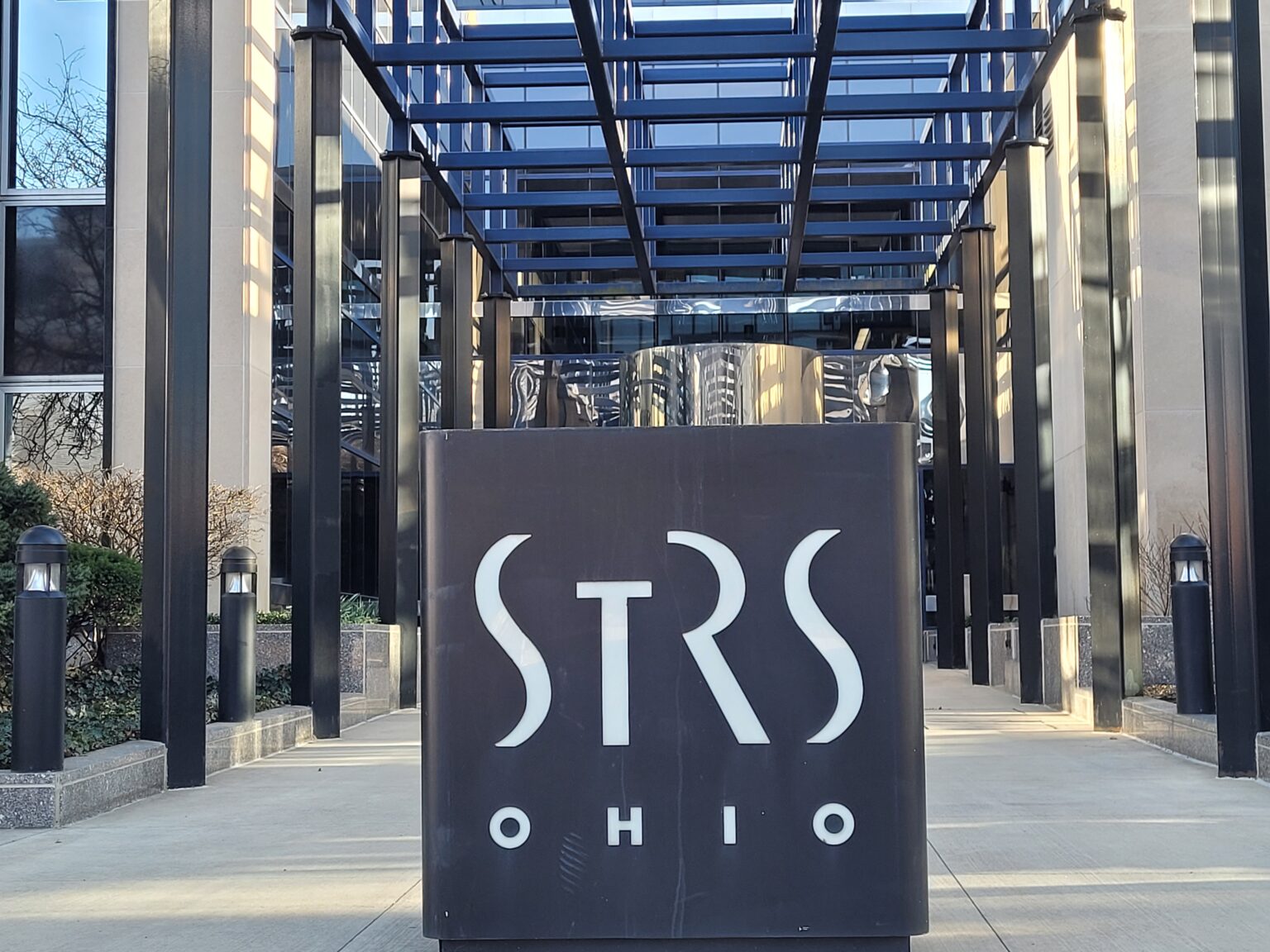
    The entrance to the Ohio State Teachers Retirement System headquarters in Columbus. Photo by Marty Schladen, Ohio Capital Journal.

    BY:  Ohio Capital Journal

    After years of complaints about gold-plated salaries, billions in investment fees and lackluster returns, things seem poised to hit the fan at Ohio’s State Teachers Retirement System.

    Gov. Mike DeWine on Wednesday issued a press release saying that he was alarmed at the news that a consultant for the $90 billion retirement plan, Aon, was severing its contract.

    “This is a huge red flag, calling into question how STRS is operating and providing oversight,” the press release said. “The unstated implication is that the governance issues at STRS are so concerning that Aon could not continue its contract in good faith. STRS may now be out of compliance with portions of audit recommendations due to Aon ending the contract.”

    The statement also cited unspecified allegations against members of the pension fund’s board, to which the governor appoints some members.

    “Additionally, my office has received documents containing some other disturbing allegations regarding the STRS board,” the statement said. “I have directed my staff to forward these documents to a number of relevant offices, including the Ohio Ethics Commission, the Ohio Retirement Study Council, Attorney General Yost, Auditor Faber, Treasurer Sprague, Secretary of State LaRose, and relevant members of the Ohio General Assembly. I encourage them to review the document and take any action that may be appropriate under any jurisdiction they may have.”

    Retirees have long complained of rarely getting cost-of-living increases while the retirement system awarded huge bonuses to already well-paid investment managers. For example, the system in 2022 handed out $10 million in bonuses just before announcing that the system’s investments  lost $5.3 billion that year.

    Last November, the system’s executive director, Bill Neville, was suspended amid employee complaints of inappropriate behavior.

    DeWine himself has fueled some of the controversy at the retirement system. Exactly a year ago, just as reformers were about to achieve a majority on the board, DeWine terminated a reform member.

    DeWine said the member, Wade Steen, didn’t attend board meetings regularly enough. But Steen countered that the charge was trumped up. The Ohio 10th District Court of Appeals said DeWine’s termination of Steen was unlawful and ordered that Steen be restored to his position.

    The turmoil at the teachers’ pension fund isn’t the only controversy facing the DeWine administration.

    DeWine and his lieutenant governor, Jon Hustedhaven’t explained their and their staffs’ involvement in an epic utility scandal that featured $61 million in bribes and a $1.3 billion ratepayer bailout as the payoff. A former house speaker and a former state GOP chairman are serving lengthy federal prison sentences in the scandal, which has also resulted in two suicides.


    Marty Schladen
    MARTY SCHLADEN

    Marty Schladen has been a reporter for decades, working in Indiana, Texas and other places before returning to his native Ohio to work at The Columbus Dispatch in 2017. He’s won state and national journalism awards for investigations into utility regulation, public corruption, the environment, prescription drug spending and other matters.

    Ohio Capital Journal is part of States Newsroom, the nation’s largest state-focused nonprofit news organization.

    MORE FROM AUTHOR

  • After other risky investments, Ohio pension system won’t say what it lost on failed bank

    After other risky investments, Ohio pension system won’t say what it lost on failed bank

    BY: MARTY SCHLADEN –  Ohio Capital Journal

    The entrance to the Ohio State Teachers Retirement System headquarters in Columbus. Photo by Marty Schladen, Ohio Capital Journal.

    The Ohio State Teachers Retirement System still hasn’t said exactly how much of its members’ money it lost when Silicon Valley Bank failed last weekend.

    The system is already under fire for big salaries and for paying $10 million in bonuses last August — two months before actual losses of $5.3 billion came in for the prior year. That was  77% higher than some of the employees receiving bonuses estimated. And many of those paying into the system are rankled because the big money is going out to system employees while retirees have gotten only one, 3% cost-of-living increase since 2017.

    The federal government and banks around the world have been scrambling to maintain investor confidence since last week, when Silicon Valley Bank made a series of desperate moves to shore up its balance sheet. That prompted a run on its deposits and ultimately its failure.

    The bank’s leaders pushed for deregulation, which the Trump administration granted in 2018. Then it made a number of risky investments that allowed it to grow rapidly — and then to implode.

    The Ohio State Teachers Retirement System, or STRS, manages much of the $90 billion it controls in-house instead of farming it out to big firms. The system has already lost big on other investments that on the surface looked risky.

    When news of the Silicon Valley Bank, or SVB, failure broke, the teachers retirement system put out a statement that might have sought to minimize its loss.

    “As of last Wednesday, STRS Ohio held shares of Silicon Valley Bank (SVB) worth $27.2 million or 0.03% of STRS Ohio’s total fund,” the statement, issued on Tuesday, said. “Many other public pension funds held shares of SVB, the nation’s 16th largest bank and a component of both the S&P 500 and Russell 3000 indices.”

    It also noted investments the system didn’t make.

    “STRS Ohio did not own shares of Signature or Silvergate — two other financial institutions involved in the current crisis,” the statement said.

    The figure reported by STRS might be far less than its actual losses. Wednesday of last week was when SVB went into free fall, meaning that the value of its stock was likely much lower than when STRS bought it.

    In a tweet on Monday, the executive director of a public pension watchdog said STRS owned 171,000 shares worth almost $40 million, which would have made it the largest such loss by a public pension system in the United States.

    In an article published on Wednesday, the watchdog, Anthony Randazzo, updated his list using the $27.2 figure stated by STRS as the value of the stock in SVB as of last Wednesday. That put it at No. 2 on the list and far behind the California Public Employees Retirement Fund, which reported an updated number of $67 million.

    Also on the list were the Ohio Public Employees Retirement System, with a $7 million investment in SVB, and the Ohio School Employees Retirement System, with an updated amount of $421,000.

    But it’s still not publicly known how much STRS actually lost in the fiasco. In other words, what were the shares worth when the system bought them?

    STRS spokesman Dan Minnich was asked on Wednesday morning and again on Thursday morning for that figure.

    “As with your previous questions, I will forward these to the appropriate persons,” he replied on Thursday. “When I receive information back, I will provide it to you.”

    STRS also didn’t answer questions about $10 million it lost last year when the cryptocurrency platform FDX imploded. Crypto investments are uninsured and largely unregulated, so it’s perhaps unsurprising that at least one company involved with it failed. On Thursday, there were reports that the company’s founder plundered the company of more than $2 billion in investors’ money

    In 2021, the Dayton Daily News reported on another STRS investment that lost far more teacher money than the SVB and FTX investments combined. It lost $525 million on Panda Power Investments, a private equity firm.

    It was one of the system’s high-fee “alternative” investments that are riskier than its traditional investments. In addition, they have performed almost three percentage points worse over the previous decade, spokesman Nick Treneff said last summer.

    Asked in 2021 by the Daily News about STRS’s giant loss in Panda, Treneff responded by pointing out that 85% of the system’s alternative investments make money.

  • Teachers’ pension system touts clean audit. Retirees unimpressed

    Teachers’ pension system touts clean audit. Retirees unimpressed

    BY: MARTY SCHLADEN – Ohio Capital Journal

    The State Teachers Retirement System of Ohio has been flagging the results of a special audit conducted in response to complaints from some teachers and retirees. But for its part, the group representing the state’s retired teachers isn’t backing down from its critiques of the system.

    The examination, conducted by state Auditor Keith Faber, was prompted by retirees who have received few cost-of-living adjustments in recent years while retirement system employees have gotten big salaries and bonuses. And, in the most recent fiscal year, they did so as their investments lost billions.

    In a Dec. 29 statement, the retirement system noted that the probe found no evidence of illegal conduct.

    “The special audit found no evidence of fraud, illegal acts or data manipulation related to the funds held in trust by STRS Ohio for its members,” the statement said. 

    It added, “The special audit’s findings include, ‘STRS’ organizational structure, control environment and operations are suitably designed and well monitored, both internally and by independent experts. These experts help assure that STRS follows applicable asset and liability measurement, reporting, investing and cash management laws, professional standards, and best practices. Our conclusions are consistent with the findings of these independent firms.’” 

    The same statement quoted STRS Executive Director Bill Neville as saying, “It is noteworthy that the special audit’s findings refute much of the inaccurate information circulated about STRS Ohio over the past two years, and the report provides extensive detail and analysis in support of its conclusions.”

    However, at least some of the complaints retirees have been raising don’t involve claims of criminality.

    At least 200 of the retirement system’s 500 employees make more than $100,000 a year. And, with bonuses, in the 2021-2022 fiscal year 33 of the system’s employees made more than $300,000. Nine made more than $500,000. 

    Meanwhile, the average public teacher salary in 2022 is $67,000 a year, according to the Ohio Department of Education.

    The retirement system manages about $90 million in teachers’ assets. The system makes traditional investments, while also putting money into high-fee “alternative” investments such as private equity and hedge funds. 

    In making such investments, the system is effectively trying to beat the stock market. STRS spokesman Nick Treneff has said alternative investments also allow for a more diversified portfolio, which can help to manage risk.

    But over at least the medium term, the stock market has proven to be the better investment.

    Over the past decade, it has provided a 14.8% return on investments, while the system’s alternative investments have provided 11.84% once fees are subtracted, Treneff said in July.

    Retirement system salaries and bonuses have grown large as retiree benefits have stagnated. 

    The latter group got a 3% cost-of-living bump in their benefits last year — their first since 2017. Treneff has explained that the freeze was due to new rules set down by the legislature in 2012. State and local governments were still reeling from the Great Recession and there were nationwide concerns about unfunded pension liabilities.

    In addition, the General Assembly hasn’t increased its contribution rate to the pension fund in 38 years.

    But what really has retirees incensed is the way the STRS board handled staff bonuses last year. In August, it awarded $10 million in bonuses even though it estimated that it would lose $3 billion in an environment that was brutal for investors. 

    Then in October, the actual numbers for alternative investments came in. System losses were 77% higher than original estimates — $5.3 billion

    For perspective, the losses follow $22.3 billion in gains a year earlier, according to the system’s financial statements. 

    However, the retired teachers union argued, if staffers are going to do well in times of plenty, they shouldn’t do so well when times are bad. Also, the group argued, the system’s board should have delayed awarding bonuses until after the actual loss figures came in instead of using a big underestimate.

    In light of those occurrences, the Ohio Retired Teachers Association wasn’t mollified by a clean audit

    “As expected, the State Auditor confirmed that a broken system yields broken results,” ORTA’s Executive Director Robin Rayfield said in a statement. “Although finding no direct evidence of criminal activity, the Auditor confirmed that the board allowed the staff to use an accounting gimmick to pay themselves $10 million in bonuses despite losing $5.3 billion last year. For years, the board’s bad policies have yielded bad results for teachers, who are working longer and paying more for less, while enriching STRS staff. The only way to change bad policies is to change the STRS board, which teachers will do in this Spring’s election.”

  • Retired teachers go to court for Ohio pension records

    Retired teachers go to court for Ohio pension records

    BY: MARTY SCHLADEN – Ohio Capital Journal

    An analyst working for Ohio retired teachers went to court last week seeking records relating to the state pension funds. 

    The analyst is trying to determine whether teachers’ pension money is being squandered on high-fee “alternative” investments such as private equity and hedge funds. He is also investigating whether external consultants directing such investments are also being paid by the firms in which retirement system money is being invested.

    Edward Siedle is president of Benchmark Financial Services, which investigates pension funds on behalf of their members. Last week, former Ohio Attorney General Marc Dann filed for a writ of mandamus on Siedle’s behalf to get records from the State Teachers Retirement System. 

    If successful, Ohio’s 10th District Court of Appeals will order the teachers retirement system, or STRS, to turn over a boatload of documents relating to its investments.

    In an interview, Dann said Siedle has been seeking the records since last year.

    “We’re not some gadfly trying to throw a wrench in the operation of STRS,” Dann said. “These are members of STRS who hired a professional to analyze the work that STRS is doing on their behalf. We want documents that will help that expert give an honest and accurate analysis.”

    He added, “To the extent that they say our requests are trade secrets or are too voluminous, it makes you think maybe they don’t want us to look so closely at this.”

    However, STRS spokesman Nick Treneff said that his agency has been working with Siedle and has already turned over many records.

    “We did try to work with Siedle on his request,” Treneff said.

    In a report last year, STRS said it had already turned over a boatload of information.

    “Over a period of three months, from February to May 2021, STRS Ohio sent 24 emails and a thumb drive to counsel, amounting to 812 documents and over 22,000 pages,” it said, adding that remaining requests are “overly broad.”

    Lawyers for Ohio state agencies commonly use such language in response to records requests. It will be up to the court to determine whether in this case STRS is using it, as Dann says, to stonewall. 

    But the stakes are pretty high.

    STRS is managing $92 billion on behalf of 166,000 active members. And, as benefits have become stingier, some of those members have become suspicious that the agency is making dubious investments through politically connected entities.

    The governor and the leaders of the General Assembly appoint “investment experts” to the STRS board of directors, and many of the state’s retired teachers believed the investments made on their behalf have underperformed.

    The distrust was evident in a newsletter written last August by Robin Rayfield, executive director of the Ohio Retired Teachers Association.

    “STRS has overstated investment returns while under-reporting the fees and costs associated with those investments,” he said.

    Part of the distrust surely stems from the fact that the pension fund stopped paying cost-of-living increases in 2017 — although it is planning a 3% increase this year.

    Treneff, the STRS spokesman, said the freeze was due to new rules set down by the legislature in 2012. State and local governments were still reeling from the Great Recession and there were nationwide concerns about unfunded pension liabilities.

    The retired teachers association points out that the General Assembly hasn’t increased its contribution rate to the pension fund in 38 years.

    But it did act to shore STRS up by cutting benefits. The cost-of-living hike was cut from 3% to 2% and teachers were made ineligible for any increases until they’ve been retired for five years. 

    The General Assembly also required that the system have enough assets to pay off any liabilities within 30 years. In 2017, when the fund didn’t appear likely to meet that requirement, the living increase was suspended. 

    Treneff said it was due to reduced investment-return assumptions, longer lifespans and lower-than-expected payroll growth.

    “That was painful for sure,” he said. “It wasn’t an easy decision.”

    But with five STRS employees making salaries and bonuses totaling more than $500,000 in 2020 — and with 64 making more than $200,000 the same year —  frustration and suspicion among Ohio teachers and retirees was perhaps predictable.

    And, with the U.S. Securities and Exchange Commission in January finding a raft of problems with the transparency and honesty of private equity funds, it’s also probably understandable that pension fund members have turned their suspicions on its alternative investments.

    Treneff, the system spokesman, was quick to point out that those investments are providing the system’s second-best returns. 

    The best? The American stock market. 

    Over the past decade, it has provided a 14.8% return on investments, while the system’s alternative investments have provided 11.84% once fees are subtracted, Treneff said.

    So why make a substantially worse-performing investment with teachers’ money? To avoid putting too many eggs in one basket, Treneff said.

    “The goal is to build this (pension) fund as fast as you can without taking wild risks,” he said, adding, “you don’t want one downturn in the stock market to destroy you.”