Tag: The 19th

  • ‘It’s proof of our existence:’ This Cincinnati lesbian archive is recording history as it’s erased

    ‘It’s proof of our existence:’ This Cincinnati lesbian archive is recording history as it’s erased

    Crazy Ladies Bookstore in Northside was once brushed off as “crazy”.

    by Amanda Becker

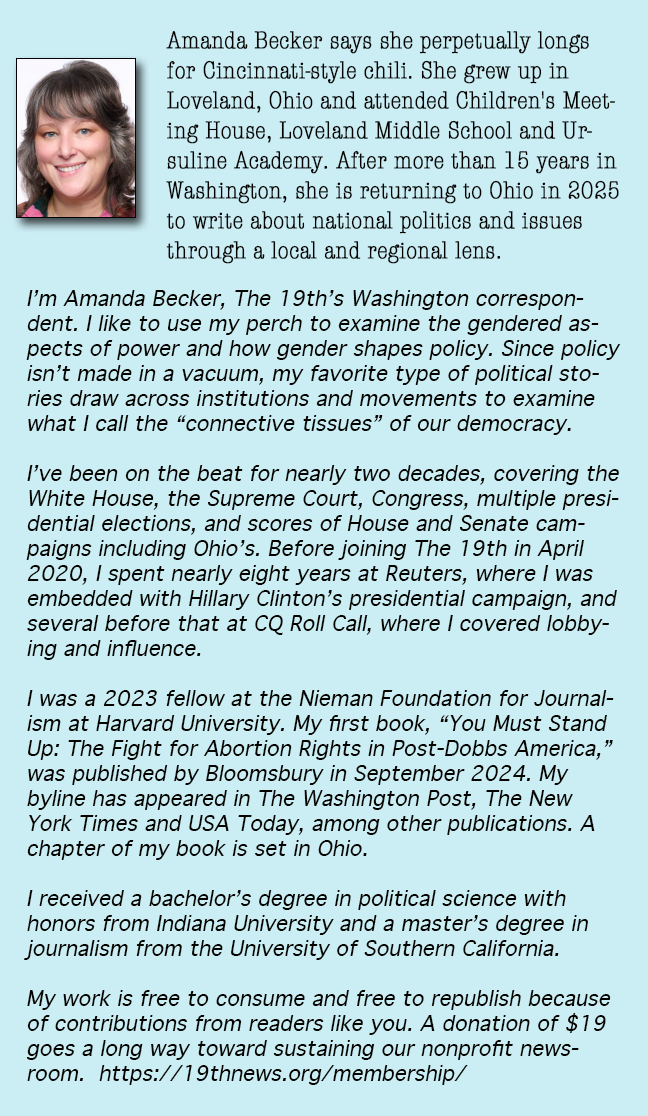
    Read Amanda Becker’s Loveland, Ohio connection in her Bio below.

    This story was originally reported by Amanda Becker of The 19thMeet Amanda and read more of her reporting on gender, politics and policy.

    ___________

    As programs recognizing LGBTQ+ people are cut, an Ohio archive is doing what queer Americans always have: preserving their own history.


    Cincinnati, Ohio – The Ohio Lesbian Archives in Cincinnati’s Over-the-Rhine neighborhood started with a friendship.

    Phebe Beiser said that when she and co-founder Victoria “Vic” Ramstetter met in the 1970s, they bonded over being “hidden, secret, teenage lesbians,” growing up in what was then a conservative city and region where there were few gay role models. For a time in their 20s, they shared group houses in Clifton, where they now joke that they “survived the lesbian commune together.” They were young and idealistic. They wanted to “turn being an activist lesbian into something fun and interesting, and maybe help change the world.” Beiser, now in her mid 70s, told The 19th that they had a mantra: “We never wanted to be invisible again.”

    When the Crazy Ladies Bookstore, named for the women who history brushed off as “crazy,” opened in Northside in 1979, it became the center of gravity in the Cincinnati lesbian community of which Beiser and Ramstetter were a part. Women bought homes in the neighborhood, gathering at the feminist bookstore for coffee, tea and conversation about being women, and about being gay. In 1989, the Archives opened on an upper floor.
    POGO 970x250

    It seemed that the visibility of the Crazy Ladies Bookstore and the Ohio Lesbian Archives — and of the women who made them happen — would be cemented in history in 2023, when the Ohio History Connection, the state’s nonprofit historical society, “embarked on a three-year project to diversify Ohio’s historical markers to include ten new stories of LGBTQ+ Ohioans” via its Gay Ohio History Initiative, or GOHI. At the time, there were roughly 1,800 historical markers in Ohio’s program, but only two commemorated places, events or people from the state’s queer history. A third, recognizing Summit Station, a lesbian bar in Columbus that operated from 1970 to 2008, was dedicated during Pride Month that year. The Archives and bookstore were selected for joint recognition.

    That long-overdue acknowledgement has been derailed by the Trump administration’s sweeping war on DEI, which extends beyond diversity, equity and inclusion programs to seemingly include anything that acknowledges the country’s diversity of experience. But the archives — and the volunteers who sustain it — are undeterred, carrying on as the queer community has throughout history, documenting their existence.

    “We never wanted to be invisible again.”

    Phebe Beiser

    Archival image of filing cabinets and boxes
    The Ohio Lesbian Archives first began in 1989 in a small room on the third floor above the Crazy Ladies Bookstore in Cincinnati, Ohio. (Cincinnati & Hamilton County Public Library)


    The Marking Diverse Ohio program was financed by a $250,000 grant from the Institute of Museum and Library Services, an independent agency created by a Republican-led Congress in 1996 that is the main source of federal funding for libraries and museums. Beiser and Branstetter were interviewed for an oral history. Ohio History Connection researchers visited the Archives to peruse the collection. A location was secured in a city park near where the since-shuttered Crazy Ladies Bookstore once was. By early this year, preparations to forever commemorate the Archives and bookstore with a plaque were all but complete. Its installation was expected in June, Pride Month.

    Then, in late March, President Donald Trump issued an executive order regarding “The Continuing Reduction of the Federal Bureaucracy,” singling out seven agencies for elimination — including the Institute of Museum and Library Services, or IMLS. Nearly all of its employees were put on leave and their emails were disconnected. Days later, his administration’s Department of Government Efficiency, or DOGE, canceled $25 million worth of  already-awarded IMLS grants, including the $250,000 for Ohio History Connection’s Marking Diverse Ohio program. The federal agency’s seemingly final Instagram post stated: “The era of using your taxpayer dollars to fund DEI grants is OVER.” The last photo listed erecting “LGBTQIA+ historical markers across Ohio” among the alleged government excesses that would be cut.


    A portrait of Jim Obergefell
    Read Next: 10 years after winning marriage equality, Jim Obergefell wants to aim higher

    Svetlana Harlan, a former project coordinator for Marking Diverse Ohio, recalled that when she looked at the list, and saw the program with other projects she admired,  “it almost seemed like a positive thing, I was like, ‘Oh yeah, these are nice initiatives!’”

    “And it turns out that [DOGE] was just taking over the account. So then I was like, ‘Oh, they’re cutting those. Oh, our name is on the list,’” she said.

    DOGE’s cancellation of the $250,000 IMLS grant to Ohio History Connection threw into question the future of the markers that were supposed to ensure that Ohio’s public displays of its history include LGBTQ+ people. Along with the Ohio Lesbian Archives and the Crazy Ladies Bookstore, there were markers in the works for an LGBTQ+ district in Akron; the first professor of gay and lesbian studies at Kent State University; 19th-century sculptor Edmonia “Wildfire” Lewis; LGBTQ+ journalism in Ohio; Toledo’s first LGBTQ+ member of city council; a Columbus hospice care center for HIV and AIDs patients; an open lesbian pastor in Athens; the screen-printing company Nightsweats and T-Cells in Lakewood; and the Rubi Girls, a Dayton-area drag group that has raised more than $3 million for HIV/AIDs and LGBTQ+ causes since the 1980s.
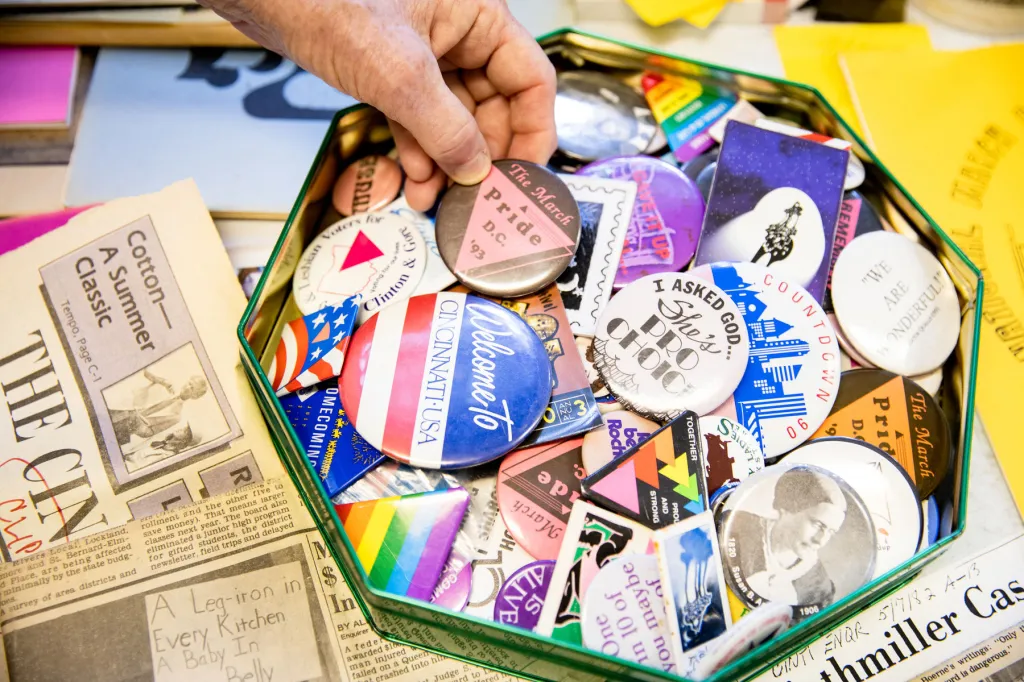
    Buttons and other archival materials spread out.
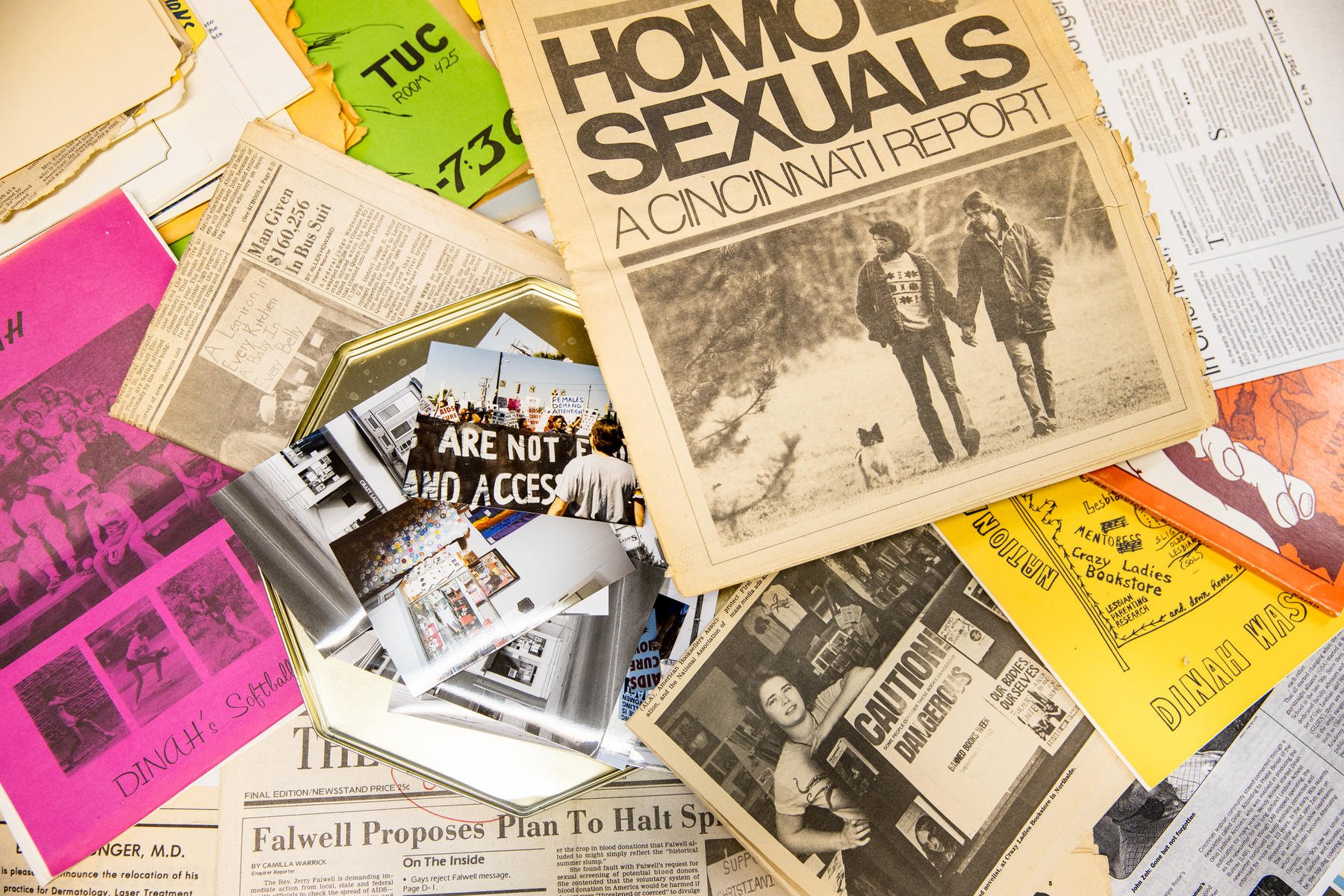
    Ephemera collected at the Ohio Lesbian Archives include buttons from past Pride marches, political campaigns and other symbols of lesbian life.
    (Courtesy Ohio Lesbian Archives)

    Preservation on hold

    Marking Diverse Ohio and other programs recognizing specific communities weren’t the only programs impacted in the state when DOGE cut IMLS grants and the federal agency essentially shuttered. And, given that more than $250 million is granted annually to libraries and museums nationally, the economic chaos at the country’s museums, libraries and historical institutions wasn’t confined to Ohio.

    In Ohio, other entities that received recent IMLS funding include the Frank Lloyd Wright-designed Westcott House in Springfield, for post-pandemic, on-site programming; the Cincinnati Zoo for a big cat breeding program; Dayton Metro Library programs that helped low-income Ohioans secure Internet access; and Cincinnati’s Contemporary Arts Center, which lost $175,000 slated for programming aimed at the 3,000 or more teens it serves each year.

    Institutions in Pennsylvania warned the economic upheaval could scuttle the digitization of The Rosenbach museum’s collection of rare books and manuscripts; the Woodmere Art Museum was mid renovation on a building to house its collection and expected to be reimbursed. In Wisconsin, small-town libraries said without the $3 million from the IMLS they’d received the year before they would have to reduce staff and therefore services. The American Library Association, or ALA, and the American Federation of State, County and Municipal Employees, or AFSCME, the labor union representing government workers, sued the Trump administration. ALA President Cindy Hohl said at the time that, “Libraries play an important role in our democracy, from preserving history to … offering access to a variety of perspectives.” AFSCME President Lee Saunders added: “Libraries and museums contain our collective history and knowledge.”

    Earlier this month, a federal judge ruled that the Trump administration could continue dismantling the Institute of Museum and Library Services as the case continues.

    People dance and laugh together at an outdoor day party.
    Read Next: A look inside the pop-up parties reimagining queer joy

    For now, Ohioans who want LGBTQ+ history represented among the 1,800 markers in the state will not get the federal funding that was granted and must search for alternative resources in their communities. A couple of the markers look poised to move forward with outside funding from community foundations and other organizations. Others, like the Ohio Lesbian Archives and the Crazy Ladies Bookstore, are still waiting. The remaining cost to install the marker would likely be $3,000-$5,000.

    When The 19th reached out to Ohio History Connection to ask if any alternative funding sources were being explored to install the Archives’ marker, spokesperson Neil Thompson said that he was “not able to provide any additional information for an Ohio Historical Marker application that is not in the public domain” and that it is only considered in the public domain once “the markers are finalized, cast and ready to be installed and dedicated.”

    A row of people lean into each other while seating on the floor in front of stacks of books.
    Phebe Beiser (far left), who co-founded the Ohio Lesbian Archives with her longtime friend Victoria ‘Vic’ Ramstetter, with Janice Uhlman, Elizabeth Van Dyke, Cathy McEneny, Morgan Kronenberger, and Ruth Rowan (left to right) at the Ohio Lesbian Archives in 1989. (Cincinnati & Hamilton County Public Library)

    ‘A reflection of themselves’

    The Ohio Lesbian Archives has always been a DIY endeavor, powered by a group of passionate volunteers.

    When the Crazy Ladies Bookstore’s founder, Carolyn Dellenbach, moved out of the area, she handed it over to its patrons to be run as a feminist collective. A lesbian newsletter called Dinah operated out of the upper floor — they referred to the National Organization for Women’s Task Force on Sexuality and Lesbianism, established in 1973, as FOSAL, or fossil, and Dinah was a play on dinosaur. Beiser laughed explaining the name: It was the 1970s; maybe there were drugs involved. For a time she wrote for Dinah and loved interviewing famous arrivals from the “women’s music circuit” when they came to town.

    At some point, the women working shifts at the bookstore, writing for Dinah and organizing talks and other events related to feminist and lesbian issues, realized that the community they had built, and the ephemera they were collecting and creating, were an important part of history — theirs, lesbians,’ Ohioans,’ and women’s.

    “We held on to them because we knew they could not be replaced,” Beiser said of the collection. “It’s proof of our existence …  so we held on to these things to never be invisible again.”

    We held on to them because we knew they could not be replaced. It’s proof of our existence.”

    Phebe Beiser

    Bookshelves crammed with books
    Books on lesbian history line the shelves of the Ohio Lesbian Archives. (Courtesy Ohio Lesbian Archives)


    In a 1991 issue of Dinah, letters to the editor included one from “Ma” who updated the “wimmin” in the community — they often spelled variations of their gender in ways that did not include “man” — that she was homesteading outside the city with her partner and building a log cabin. Another was from a woman who said she was “shocked” to find out that her being fired for being a lesbian was not a violation of civil rights laws and she was disappointed that the LGBTQ+ community did not come out to support her recent picket, writing: “I hope that in my lifetime I will see the gay and lesbian community get off their asses and together start fighting for their rights.”

    Across from the metal filing cabinet at the Archives that houses the Dinah issues, a modern-looking poster from before the Supreme Court decided Bostock v. Clayton County in 2020, which extended employment protections to LGBTQ+ Americans, reminded Ohioans that it was still legal for them to be fired for their sexual orientation or gender identity. Today, Trump’s Equal Employment Opportunity Commission is aiming to curtail those hard-won workplace protections established by Bostock.

    Lüdi Rich, a 27-year-old librarian, was working a recent Sunday afternoon at the Archives’ twice-weekly open hours, organizing books and research materials while the space was open to members of the community to drop in.

    Illustration of a couple in a shopping mall in progress and transgender Pride flag colored shirts. Behind them, other people shop, some wearing pride shirts.

    Read Next: How the ‘Everywhere is Queer’ app is helping LGBTQ+ people find queer-owned businesses

    When Rich moved to Cincinnati nearly two years ago, she didn’t know anyone in the area, so she looked online for queer spaces so she could start building her community. When she attended a panel on local queer history, one of the speakers was Beiser, a longtime librarian herself in the country’s second-largest public library system.

    Beiser mentioned at the panel that the Ohio Lesbian Archives would be having an open house that night at its new location next to Over-the-Rhine’s Washington Square Park, where Beiser was among those who met to march in Cincinnati’s first Pride Parade in April 1973. Rich asked Beiser how she could volunteer.

    A couple months later, Rich showed up for her first shift, “And I’ve been here working ever since,” she said.

    Nancy Yerian, the 34-year-old president of the Archives’ board, said that when she graduated from college in Massachusetts, she didn’t know if she could return to Cincinnati, where she grew up — until she discovered the Archives. “I thought that to live the kind of life I wanted to lead, I had to get out of what I thought was a very conservative place,” said Yerian, who has been volunteering at the Archives in some capacity since shortly after she finished school.

    “Finding the Archives and the people I’ve met through the organization and the community we’re creating, as well as the history we’re preserving — it gave me a lot of hope that I could create a life for myself here,” she added.

    It really is just us, preserving our history.”

    Lüdi Rich
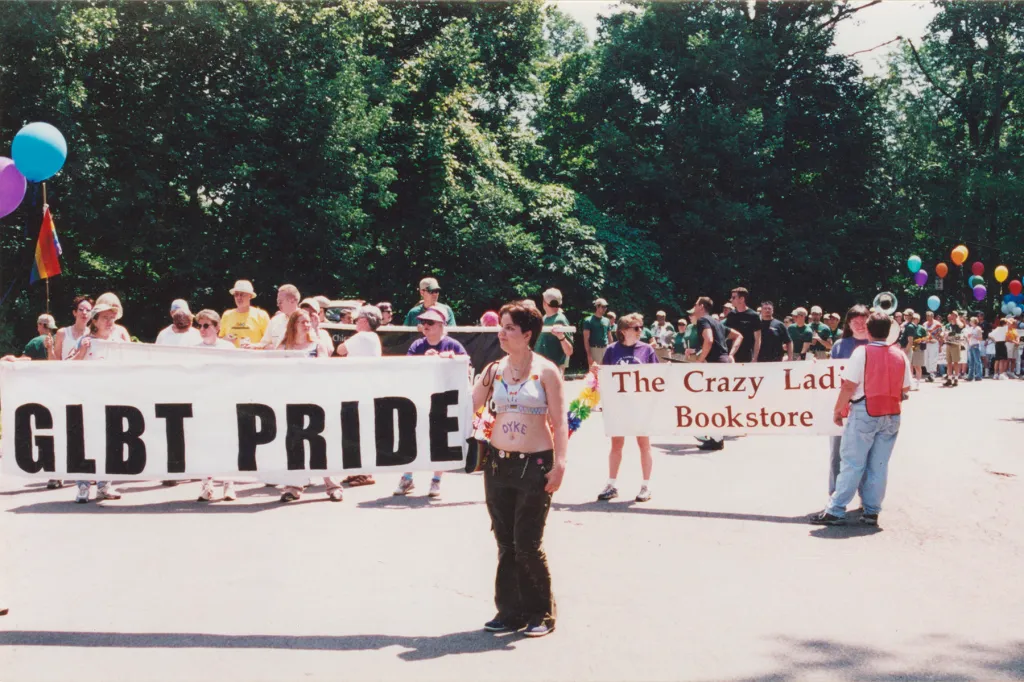
    Archival image of people marching down the street for Pride.
    The Crazy Ladies Bookstore marched in a Cincinnati, Ohio Pride parade. (Cincinnati & Hamilton County Public Library)


    The Archives’ volunteers have helped digitize old photos, some of which are now in a collection at the Cincinnati Public Library. They organize the books, arranged by first names instead of last, since so many women, especially in those early years, published works after taking on their husbands’ surnames. There are filing folders of Dinah newsletters. A cabinet holds multiple VHS and DVD copies of the early aughts television drama “The L Word.” A collection of buttons includes those from past Pride marches; supporting Hillary Clinton’s presidential campaigns; and one with “REMEMBER” and an inverted pink triangle, the Nazi symbol that Adolf Hitler used to identify gay and trans people. There is also one with the logo of the Crazy Ladies Bookstore, the silhouette of a woman reading while reclined in a chair, a cat by her side.

    “Many people who are coming to the archives are looking for a reflection of themselves and in many ways that’s why Vic and Phebe started it. It shows models of ways to be in the world and a feeling of not being alone and not being the first queer person or lesbian,” Yerian said.

    The Ohio Lesbian Archives, marker or not, is and will keep doing what it always has: making sure that lesbian Americans are visible in the country’s historical record.

    “It really is just us, preserving our history,” Rich said.

    Feeling overwhelmed by the news? The 19th is considering new ways to keep you informed. But we need your input! Fill out this quick survey to share your thoughts.
    https://19thnews.org/membership/

  • Older women front and center in ‘No Kings’ pro-democracy movement

    Older women front and center in ‘No Kings’ pro-democracy movement

    A woman joins the No Kings protests near the Philadelphia Museum of Art on June 14, 2025. (Tara Pixley for The 19th)

    by Amanda Becker


    Read Amanda Becker’s Loveland, Ohio connection in her Bio below.

    This story was originally reported by Amanda Becker of The 19thMeet Amanda and read more of her reporting on gender, politics and policy.

    _____________

    Americans in their 60s, 70s and beyond showed up in force at this weekend’s protests, drawn by the Trump’s dismantling of public institutions and government programs.

    SPRINGFIELD, OHIO — The 2017 Women’s March was Barbara Hartwick’s first-ever political protest. She drove from the exurban community where she lived at the time to downtown Cincinnati, a left-leaning city of 300,000 people that anchors the otherwise conservative region. Still, Hartwick said, she felt too nervous to carry a sign or join in most of the crowd’s chants.

    Eight years later, having watched President Donald Trump’s political ascent, Hartwick, 63, has gone from a “hesitant” to an enthusiastic protester. When she joined the several hundred people outside Springfield’s city hall on Saturday — among them many retirees who, like her, took to the streets to oppose Trump’s agenda — she held up a sign that read: “Let the wild rumpus start!” She was inspired by the crown-wearing young boy in Maurice Sendak’s children’s book, “Where the Wild Things Are.” It was, she said, a nod to the “No Kings” nationwide rallies.

    Hartwick, a retired teacher, said she had “misconceptions” back in 2017 about what protests were like; she had never been politically active beyond voting. The march revealed to her “the camaraderie, the community of people there.” The crowd was “generally peaceful and positive” as they protested and it helped Hartwick realize that other women like her were also frustrated and disappointed with the direction of the country. She discovered that community spirit again Saturday in Springfield, the conservative-leaning city that Vice President JD Vance put on the map during the presidential campaign, when he made false accusations against the Haitian migrants legally living there to make the case for today’s militaristic immigration crackdown.

    Papas Coming Home 970x250

    Protests, Hartwick said, “give people hope.”

    Women led prominent protests during Trump’s first term against his presidency writ large, his treatment of women, his now-fulfilled pledge to appoint Supreme Court justices that would overturn the federal right to abortion, his family separations policy at the U.S. border and more. But while Black women have voted against the president in every election, White women voted for Trump in 2016, backed him again at the ballot box in 2020 and then a third time in 2024, according to exit polls. Democratic former Vice President Kamala Harris actually lost support from women overall last year as compared to 2020 across all age groups except one: those over 65.

    Headed into Saturday’s protests, the only age group across all genders and races with a lower opinion of Trump than 65+ voters was voters under the age of 30, according to a weekly tracking poll conducted by YouGov for the Economist magazine.

    Rural America is older than urban America, so in Saturday’s small-town and suburban protests, the graying nature of the coalition in the streets protesting Trump was visible enough that it caught the attention of local news outlets. The St. Louis Post-Dispatch posted a video of “senior citizens and others” at a protest in the moneyed suburb of Clayton, Missouri. West Virginia Public Radio reported that at a demonstration in Charleston, the state capital, “all ages were represented, but a large contingent of older West Virginians braved the sun and humidity to attend.” Trump had a higher margin of victory in the largely rural state than nearly any other.

    Longtime climate activist Bill McKibben, who founded the Third Act organization several years ago to build a community of Americans 60 and older to fight climate change and protect democracy, wrote a recent Los Angeles Times op-ed with Akaya Windwood, an adviser for the group, under the title: “Why older Americans are Trump’s biggest nightmare.”

    A research team led by American University’s Dana R. Fisher surveyed the host organizers of Saturday’s events and found that “consistent with the Resistance to the Trump administration during its first term, the majority of hosts and participants were female, predominantly White, and highly educated.” What has changed since the president’s first term, Fisher told The 19th, is that “the people in the streets are older than they were back in the first administration.”

    Fisher’s team’s preliminary findings showed that the median age on Saturday for participants in Philadelphia was 36 years old while the median age for protest event hosts nationwide was 67. Their field research in the first months of Trump’s second term shows that participants and organizers protesting the president are more likely to be women, more likely to be older and more likely to be White than participants and organizers of other recent protest movements.

    The 2017 Women’s March, held the day after Trump’s first inauguration, was, at the time, the largest single-day protest in U.S. history — between 3.2 million and 5.2 million people, or 1 to 2 percent of the country’s population, participated in more than 400 demonstrations nationwide. Saturday’s “No Kings” protests aimed for the lofty goal of about 12 million people, or about 3.5 percent of the country’s population, a number that reflects the level of participation that political scientists say is necessary to overcome a dictator or authoritarian leader.

    Organizers sought to do that by dispersing protests across more than 2,000 locations, many in places where public demonstrations are rare. Cities like Philadelphia and Chicago reported some of the largest crowds, but there were also well-attended events in small towns and mid-sized cities in politically conservative states like Ohio, Missouri, Tennessee and West Virginia.

    Jeremy Pressman, co-director of the Crowd Counting Consortium, a joint project of Harvard Kennedy School and the University of Connecticut, said it would be weeks before they can fully tally nationwide attendance. But, he told The 19th by email, it “looks very likely it was one of the largest days of protest in U.S. history.”

    It didn’t surprise Hartwick that older Americans, and especially older women, are souring on the president, whose administration has fired tens of thousands of federal workers and shuttered federal programs under the banner of anti-diversity equity and inclusion efforts. Plus, Republicans in Congress are debating legislation that would finance tax breaks for the wealthy by making deep cuts to the Medicaid health insurance program for lower-income Americans and nutrition programs on which many seniors rely.

    An aphorism in U.S. politics is that Americans become more conservative as they age; many older women who spoke to The 19th on Saturday noted that it isn’t a conservative approach, in the “small-c” sense of the word, to dismantle government programs and institutions and to upend democratic norms.

    “We don’t want to go back. It took a movement to get the right to vote. It took a movement to get Civil Rights. I’ve never in my lifetime lived when rights are taken away — until now,” Hartwick said, lamenting that to younger Americans, Trump’s policies and intensely divided politics likely seem normal.

    Also at the Springfield protest was Joan Justice, 84, holding a sign that said: “If there’s money for a parade? Then there’s money for Medicaid!” “I have friends who are in nursing homes and I know the money is running out and it really scares me,” Justice, also a retired educator, told The 19th of the program that covers long-term residential care for lower-income seniors because Medicare, the health insurance program for elderly Americans at all income levels, does not.

    Another “No Kings” protest in nearby Middletown, Ohio, a deeply conservative town of about 50,000 where Vance was raised by his grandparents, drew more than 400 and skewed older than Springfield. Among the people gathered at a busy intersection near a large supermarket, hardware store and a panoply of national restaurant chains was a 64-year-old woman who asked to be identified by her first name only, Rebecca, because, she said, she knows Trump opponents who have faced harassment. She was attending her first protest and said, “I want to start getting more active, I want to start writing my congressmen. My parents were Republicans and they would be appalled.”

    Standing nearby was Nannette, 74, who requested her surname be withheld for the same reason. She said that “Middletown is a small town, but I’m doing everything I can think of,” attending the April protests against cuts to the federal government that preceded those held on Saturday. “I was a lifelong Republican, and I tried to hold on, but January 6th was the end,” she said. When she sends mail, she puts her stamps with the American flag upside down as a subtle signal of distress.

    Hartwick said she sees a recent version of her past self in these older women who are overcoming fears about public demonstrations to protest the president, so she is “finding little opportunities to let people know it’s okay to not like what’s going on right now.”

    Just last week, Hartwick said, she was buying posterboard at her local Kroger supermarket when a woman in her late 60s or early 70s asked if she was making signs for a garage sale. “I said ‘no’ and she said ‘oh, what is it for?’ I said: ‘A protest.’ And she whispered: ‘The No Kings protest?’ I said ‘yes.’ And then she said: ‘Good luck.’”

    “People might be looking for someone else who feels the way they do because they don’t see it in their own community,” Hartwick said.


    https://19thnews.org/membership/

  • How Trump’s ‘one, big, beautiful’ tax bill could impact programs for women and children

    How Trump’s ‘one, big, beautiful’ tax bill could impact programs for women and children

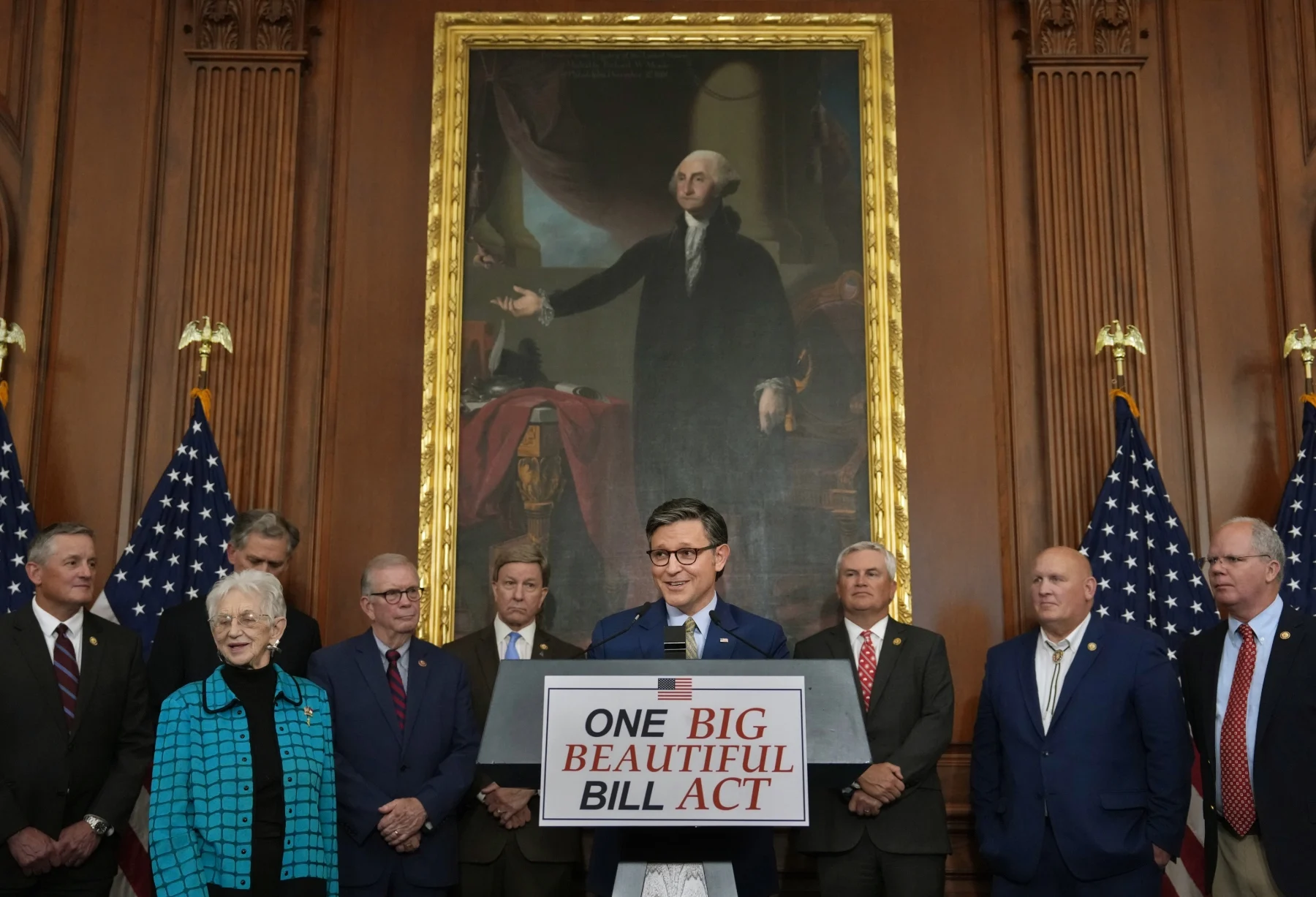
    U.S. Speaker of the House Mike Johnson (R-LA) speaks to the media after the House narrowly passed a bill forwarding President Donald Trump’s agenda at the U.S. Capitol on May 22, 2025 in Washington, DC. The tax and spending legislation, called the “One, Big, Beautiful Bill” Act, redirects money to the military and border security and includes cuts to Medicaid, education and other domestic programs. (Kevin Dietsch/Getty Images)

    House Republicans approved a sweeping package early Thursday morning that contained deep cuts to programs assisting low-income Americans, including Medicaid and SNAP food stamp eligibility.

    by Amanda Becker Washington Correspondent

    Read Amanda Becker’s Loveland, Ohio connection in her Bio below.

    Republicans in the U.S. House of Representatives approved a sweeping package early Thursday morning that contains what advocates call “historic” cuts to government health insurance and nutrition programs that serve lower-income Americans.

    President Donald Trump wanted “one, big, beautiful bill” and GOP Speaker Mike Johnson pushed to get the package through the House before the Memorial Day recess. The bill now moves to the Senate, where it is expected to undergo significant changes.

    The proposal approved in the House would slash $1.7 trillion in government spending to pay for the renewal of the tax cuts from Trump’s first term, which largely benefited corporations and the wealthy. Some of the largest cuts would come from Medicaid, the popular government health insurance program that covers more than 70 million lower-income Americans. House Republicans also agreed on significant changes in eligibility to the Supplemental Nutrition Assistance Program (SNAP), commonly known as food stamps, which helps more than 40 million Americans buy groceries every month. Both programs are disproportionately used by women and children.

    Defend Federal Agencies 970x250 - ROS

    Democrats have been largely on the sidelines because Republicans in the Senate will use a process called reconciliation, which allows the majority party to bypass the 60-vote filibuster requirement and approve legislation by a simple majority vote. There are 53 Republicans in the 100-seat Senate.

    It has become common for both parties to take advantage of reconciliation when they control the White House and both chambers of Congress. Republicans used reconciliation to enact the 2017 Trump tax cuts that they are now attempting to renew. Democrats used it to enact President Joe Biden’s COVID-19 stimulus bill and the Inflation Reduction Act.

    Here are the programs serving women and children that House Republicans’ bill would change:

    Medicaid

    House Republicans’ proposal aims to slash $625 billion from Medicaid over the next decade, leading to an enrollment drop of more than 10 million people, according to KFF, a nonpartisan health organization.

    The federal-state health insurance program covers more than 40 percent of all births in the country, and about 37 percent of those enrolled are children. Three million Americans enrolled in Medicaid report that they are unable to work due to caregiving responsibilities, according to an AARP analysis.

    The legislation approved by the House would cut Medicaid spending in part by imposing a strict 80-hours-a-month work requirement for adults without children or disabilities. The 19th has reported on how these stepped-up work requirements would disproportionately impact middle-aged and older women.

    The bill also would make it easier for states to cancel Medicaid coverage if recipients do not provide additional paperwork to show they meet eligibility requirements; force states to require co-payments for some types of care for Medicaid enrollees who live above the federal poverty threshold; and reduce the reimbursement rate for states that use their own funds to cover immigrants not lawfully in the country, according to a detailed analysis by KFF.

    The version of the bill passed by the House would prohibit Medicaid from covering care for non-abortion services provided by Planned Parenthood clinics, which are already banned from using federal funds to pay for abortions. It also would limit coverage of gender-affirming care as an essential benefit under Affordable Care Act plans and prohibits Medicaid and the Children’s Health Insurance Program (CHIP) from covering the treatment. Earlier drafts limited this prohibition to care for minors; the approved bill extends it to care for all ages.

    SNAP

    The package passed by House Republicans would require more SNAP recipients in their 50s and 60s to work and provide fewer exemptions for parents.

    The proposal would lower the age at which work requirements end by a decade, to 54. Right now, parents with dependent children under 18 are exempt from working; the bill lowers that age to 7.

    Additionally, the Republican-approved legislation would require states to take on more of the costs of administering SNAP and limit the ability of future administrations to raise benefit amounts.

    Changes to SNAP could affect school nutrition programs, as many students qualify for free meals based on whether they and their families are eligible for food stamps.

    The Congressional Budget Office has not yet evaluated the SNAP provisions in the reconciliation bill. Their analysis of past similar legislation adding new work requirements showed that it could result in more than 3 million fewer people participating in the federal nutrition program.

    Child tax credit

    The House Republicans’ tax bill would increase the amount of the child tax credit to $2,500 from $2,000 through 2028, the last year of Trump’s term. The tax credit would then drop back down and be indexed to inflation.

    Another provision in the approved House version would require a child’s parents to have a Social Security Number to access the credit, even if the child also has a Social Security Number.

    The intent is to block immigrant parents in the country illegally and without work authorization from claiming the benefit; these parents are already typically excluded from accessing the credit. In mixed immigration status households, where one parent has a Social Security Number and the other does not, the child would still be ineligible for the credit.

    The House version of the tax bill also caps the refundable portion of the child tax credit at $1,400 per qualifying child, down from $1,700. This change would limit the ability of the country’s lowest-income parents to access the credit.

  • Did politics kill Women’s History Month at Ohio University?

    Did politics kill Women’s History Month at Ohio University?

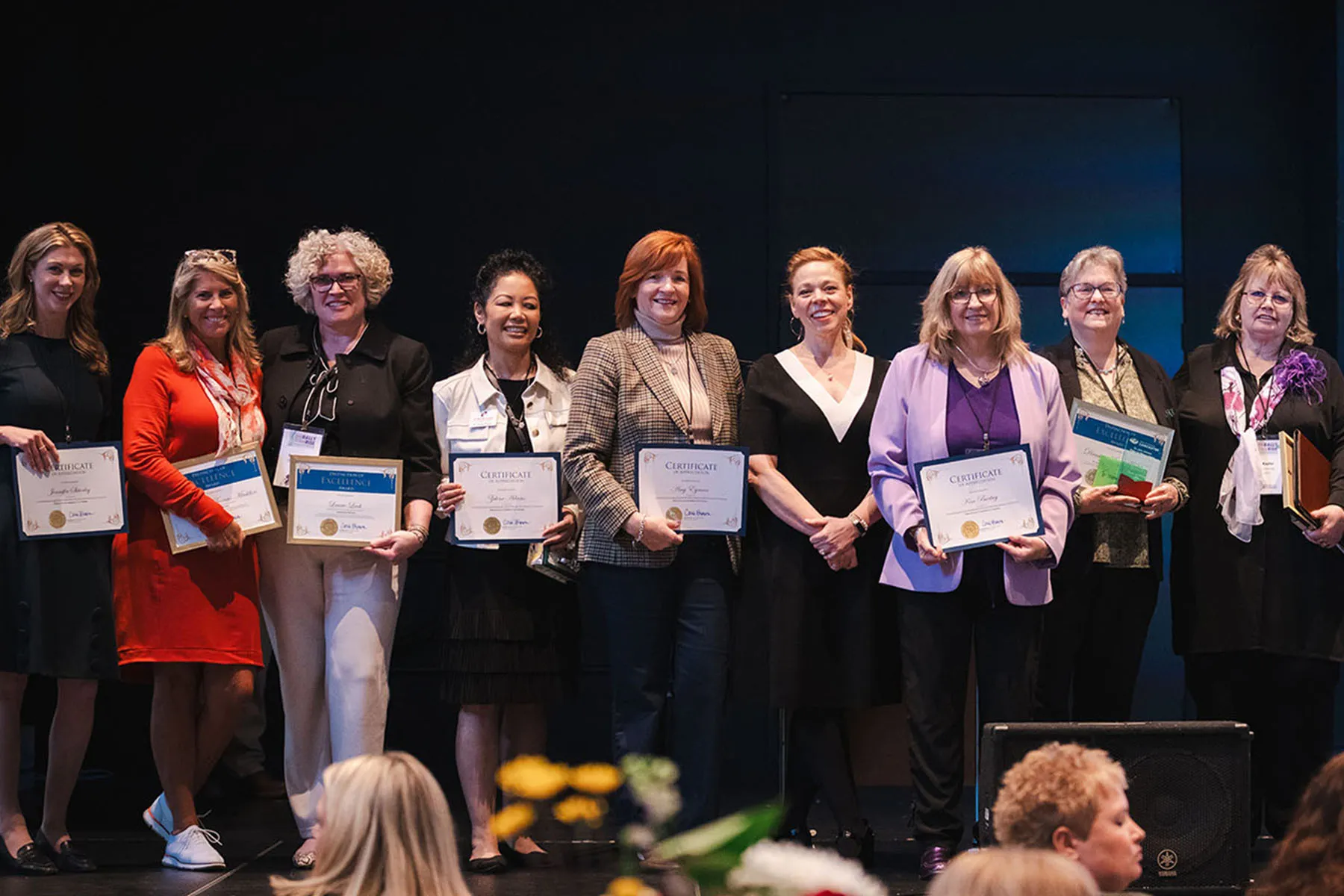
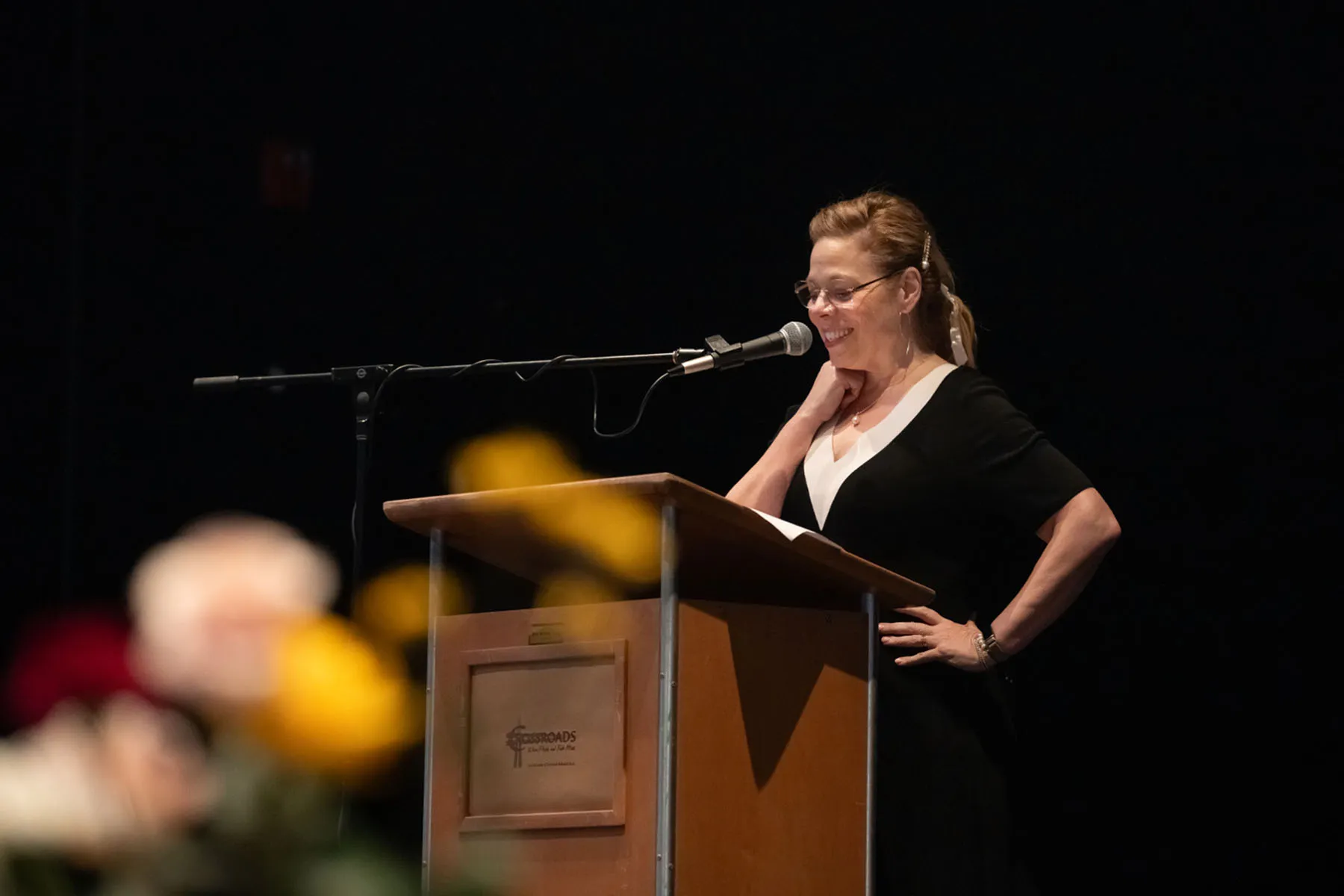
    Honorees at the We Rally & We Rise Women’s Conference pose for a group photo in Lancaster, Ohio, on March 21, 2025. Kim Barlag, third from right in a purple suit, helped organize the independent event after Ohio University canceled its longtime Women’s History Month celebration following new federal guidance on anti-discrimination policies. (Megan Cardenas/OH Creative Studios for We Rally We Rise)

    Amanda Becker

    Read Amanda Becker’s Loveland connection in her Bio below.

    This story was originally reported by Amanda Becker of The 19th. Meet Amanda and read more of her reporting on gender, politics and policy.

    Lancaster, Ohio –  Kim Barlag knew she couldn’t let women be canceled.

    For nearly two decades, Ohio University’s Lancaster campus hosted an annual conference to “promote and advance gender equity by recognizing the past, present, and future achievements of women from diverse ages and backgrounds.” Known as Celebrate Women, it featured awards honoring women in leadership, panels on business and civic engagement and service opportunities. The plan for this year was to collect food and school supplies for university students facing financial hardship.

    Celebrate Women became a much-anticipated Women’s History Month tradition in this central Ohio city of 40,000, just 30 miles southeast of Columbus, the state capital. But then, on the eve of its 19th year, politics intervened.

    On March 6, two weeks and a day before the event, Ohio University announced that the conference had been “placed on hold … in light of recent guidance from the Department of Education’s Office for Civil Rights,” which threatened to withhold federal funding to institutions that do not conform to the Trump administration’s notion of anti-discrimination. The university’s decision followed the cancellation of a reunion for Black alumni, another regular occurrence in previous years.

    When she heard the news about the women’s conference, Barlag, herself an alumnus and the president of the Chamber of Commerce in nearby Pickering, cycled through a series of emotions: disappointment, sadness, anger, resolve.

    “I guess I should have seen it coming after that happened, but I was still surprised,” she told The 19th. “I was pretty devastated. I shed a few tears. Then I thought: Action makes people feel better. How can we save this event? We needed to act fast.”

    She called and emailed other women leaders in the area — including some who, like her, had been scheduled to participate in Celebrate Women panels — to gauge their interest in reviving the conference as a non-university event. Their response, Barlag said, was “gung ho.” The plans for the new event came together quicker than Pam Kaylor, a communications professor who organized Celebrate Women for the university, was able to notify participants of the previous one’s cancellation.

    The independent event had a new name, We Rally & We Rise Women’s Conference, and it brought together some 300 women at the Crossroads Event Center in Lancaster last week. Many Celebrate Women sponsors shifted their support and some new sponsors signed on, angry about the cancellation — Barlag took to calling it “mad money.” Organizers handed out branded tote bags and notebooks. The event raised money for local nonprofit organizations. Speakers shared strategies to conquer anxiety and impostor syndrome. The boxed lunches were made by a nonprofit caterer that employs survivors of sex trafficking. The writing on the back of attendees’ name tags captured the vibe: “Welcome All BABS!!! BAD ASS BITCHES. Yes, you read that correctly.”

    As Barlag opened the conference, the audience’s enthusiastic response “set me off my game there for a minute” because “it was so powerful and inspiring,” she later said.

    “The energy was great — people were grateful to have a conference to attend, to be together, a show of force in support,” she added.

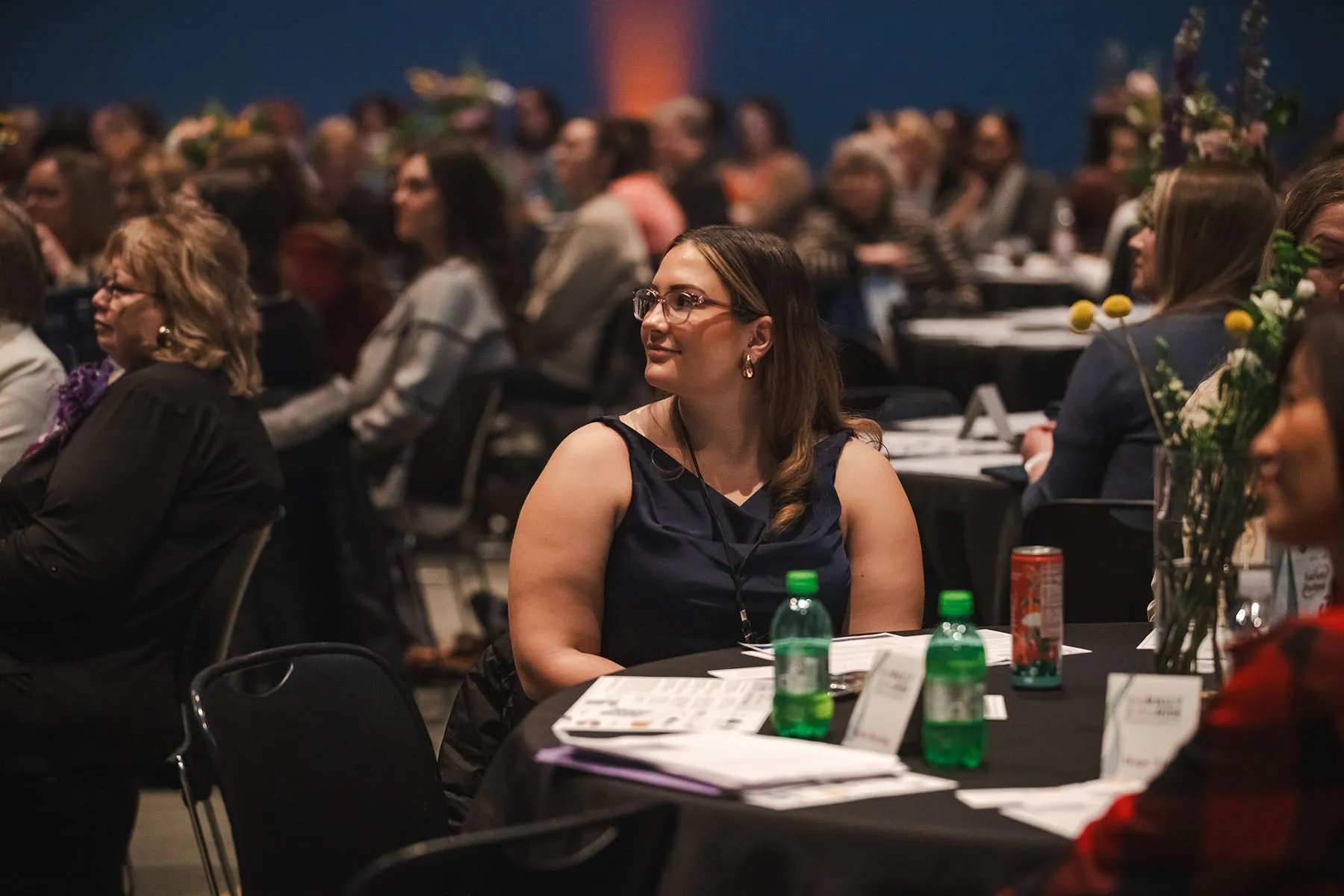
    A woman seated at a table smiles as she listens to speakers during the We Rally & We Rise Women’s Conference.
    A woman listens during the We Rally & We Rise Women’s Conference in Lancaster, Ohio, on March 21, 2025. Hundreds gathered at the independently organized event after the university-backed celebration was canceled. (Megan Cardenas/OH Creative Studios for We Rally We Rise)


    Lancaster may be close to the state’s capital, but it’s the county seat in an agricultural region of pig and cattle farms. Lancaster itself is known for its glassware — the hometown company, Anchor Hocking, is named for the Hocking River, which snakes through the city. Once one of the world’s largest manufacturers of glassware, Anchor Hocking went through a merger, then a bankruptcy. Like in so many small cities and towns, Lancaster’s historic downtown became a symbol of economic decline in the post-industrial Rust Belt. In recent years, though, Lancaster’s population began to tick up again.

    Fairfield County is a Republican stronghold in presidential elections. President Lyndon Johnson, in 1968, is the only Democrat who has won there since 1944. Republican President Donald Trump’s America-first economic message resonated with voters who have watched Lancaster struggle, then rebound. In 2024, close to 62 percent of the county’s voters cast ballots for Trump and Vice President JD Vance, who was then one of the U.S. senators for Ohio. The state, a one-time presidential bellwether that has in recent cycles grown more conservative, backed Trump over Democratic Vice President Kamala Harris by 55-to-44 percent.

    In this slice of Trump Country, personal interpretations of the reasons for the cancellation of Celebrate Women are a sort of political Rorschach test. Some left-leaning voters believe it was the inevitable result of Trump’s assault on diversity, equity and inclusion, or DEI, a broad concept that his administration has deployed to challenge and threaten institutions deemed too liberal. Some conservative-leaning voters believe the cancellation to be an overly cautious move by the university — and potentially a way to make the new administration look bad.

    One thing on which women on both sides agree is that they should not be silenced.

    “There is dissent about how we came to this place,” Fairfield County Auditor Carri Brown, an elected Republican, acknowledged during her opening remarks. But “when we’re told we cannot celebrate women, we’ll respond by saying, ‘Yes we can’ … and we’ll rally and we’ll rise!”

    When she described diversity as “not a bad word” but a “blessing,” the crowd applauded and some rose to their feet. “I have a very strong faith in America,” Brown said.

    Fairfield County Auditor Carri Brown delivers opening remarks on stage at the We Rally & We Rise Women’s Conference.
    Fairfield County Auditor Carri Brown delivers opening remarks during the We Rally & We Rise Women’s Conference.
    (Megan Cardenas/OH Creative Studios for We Rally We Rise)


    Ohio University’s decision to cancel the Celebrate Women event is the latest skirmish between conservative politicians and the elite institutions of higher education that they have long charged with being hostile to their political viewpoints, with so-called DEI efforts at colleges and universities now front and center to their case.

    A February 14 “dear colleague” letter from the civil rights office of Trump’s Department of Education to colleges and universities alleged an “embrace of pervasive and repugnant race-based preferences and other forms of racial discrimination” at the expense of White students. It noted that federal law “prohibits covered entities from using race in decisions pertaining to admissions, hiring, promotion, compensation, financial aid, scholarships, prizes, administrative support, discipline, housing, graduation ceremonies, and all other aspects of student, academic, and campus life.” Noncompliance would risk the federal funding that nearly all colleges and universities receive.

    Though the letter made no direct mention of gender, it put university administrators on alert as they sought to identify any programming that could jeopardize their funding. When the Department of Education, which Trump now seeks to dismantle, launched investigations against more than 50 education institutions, it included two in Ohio: the University of Cincinnati and the Ohio State University.

    Judith Cosgray, a librarian and leader of an arts nonprofit who has attended Celebrate Women on and off for the past 15 years, described its cancellation as a balloon deflating when its attendees most needed a lift.

    “I understand that they’re afraid of losing their funding, I understand that, but sometimes you’ve got to stand up, too,” Cosgray said in between conference sessions.

    In addition to the various executive orders and directives that Trump has made about DEI, the Ohio legislature, where Republicans hold a veto-proof majority in part due to unconstitutional gerrymandering, recently approved a higher education bill that bans DEI training, scholarships and offices, and contains admonitions about teaching “controversial” topics. It is expected to be sent to GOP Gov. Mike DeWine for his signature as early as this week.

    A spokesperson for DeWine did not respond to a request to comment on whether he will sign the anti-DEI legislation or if, by his estimation, events like Celebrate Women would fall under its purview. The office of GOP state House Speaker Matt Huffman likewise did not respond to the same question by publication time.

    Mike DeWine speaks to the press at the Republican National Convention.
    Ohio governor Mike DeWine speaks to the press on the first day of the Republican National Convention on July 15, 2024 in Milwaukee, Wisconsin.
    (Andrew Harnik/Getty Images)


    Celebrate Women isn’t the only recent example of how the assault on DEI across public life has led to a seeming prohibition on celebrating the accomplishments of women, with many actions taken during March, the month specifically earmarked to remember such events.

    Information about the first woman to pass Marine infantry training was among some 26,000 photos and online posts marked for deletion as part of a DEI purge at the Defense Department, the Associated Press reported. A page about Golden Girls actor Bea Arthur, one of the first to serve in the Marine Corps Women’s Reserve, also disappeared. There are reports that Arlington National Cemetery scrubbed its website of references related to notable women veterans.

    It isn’t limited to women. A Defense Department webpage that described the military service of Black civil rights icon and baseball player Jackie Robinson disappeared — and then reappeared. Information about the Tuskegee Airmen, the first Black military pilots who served in World War II, when the U.S. military was still segregated, has also vanished. Outcry over the removal of webpages about the Navajo Code Talkers who served during the same war led to their restoration. “History is not DEI,” Pentagon spokesperson Sean Parnell said as the department scrambled to respond.

    Tabitha Stover, a financial adviser who describes herself as liberal, attended Celebrate Women for the first time last year. Despite spending most of her life in Lancaster, she didn’t know anyone at the event, but found the group kind and inviting. She was disappointed to hear this year’s conference would not move forward, then heartened when We Rally & We Rise took its place. She has vacillated about who was to blame, but described it as an event that brings people together instead of driving them apart.

    Stover shared a table with a group of colleagues from the area branch of a national nonprofit organization focused on youth mentorship. Several of them are friends of hers on Facebook; she knows the women have what she called “very different” politics from one another.

    “And yet we’re all here sitting at the same table,” Stover said.

  • Trump disbands health equity panel examining Medicare and Medicaid

    Trump disbands health equity panel examining Medicare and Medicaid

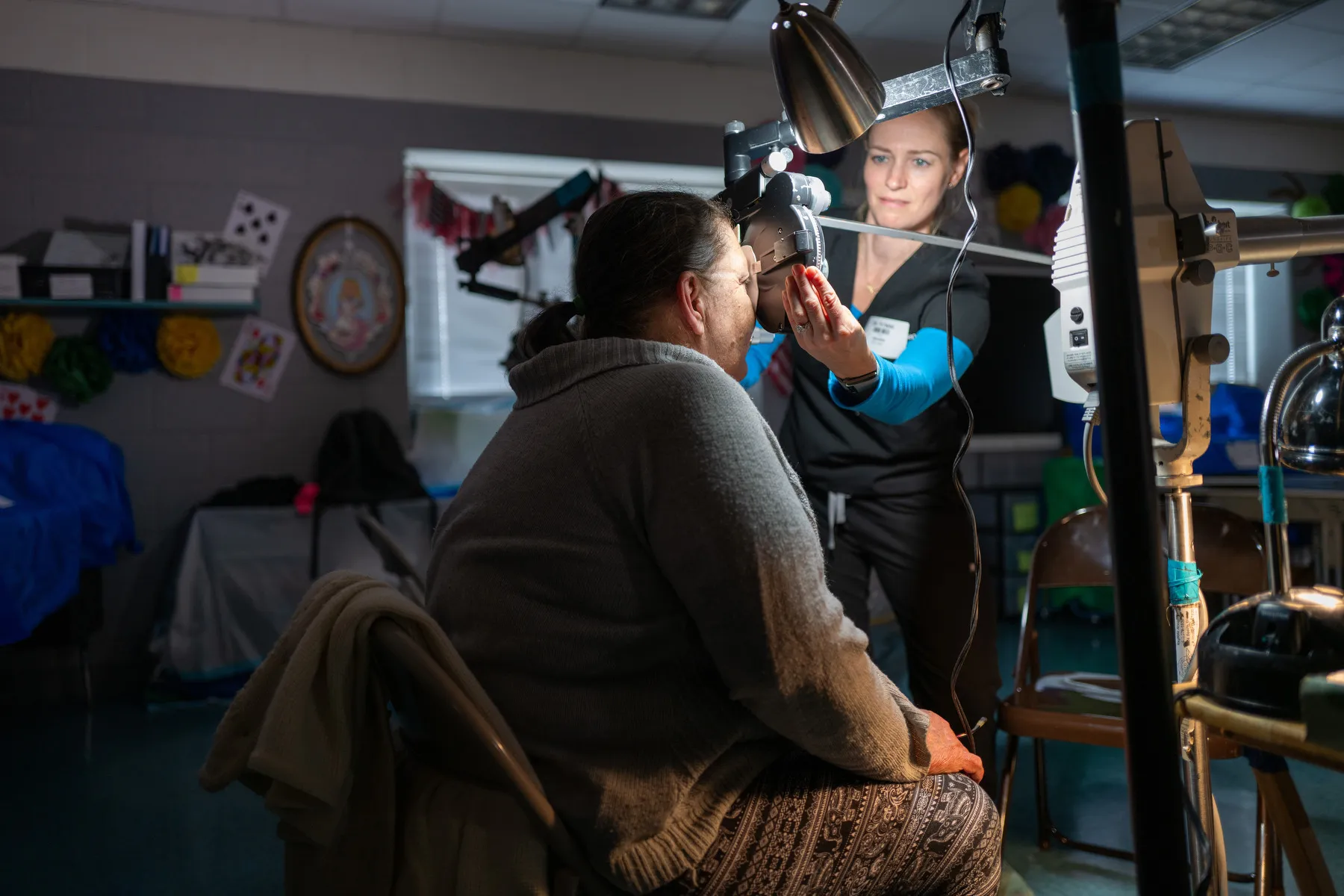
    A patient takes a vision test at a Remote Area Medical (RAM) mobile clinic in Virginia on October 7, 2023. (Spencer Platt/Getty Images)

    Read Amanda Becker’s Loveland connection in her Bio below.

    This story was originally reported by Amanda Becker of The 19th. Meet Amanda and read more of her reporting on gender, politics and policy.

    ________________

    The committee was designed to reduce barriers to care for people of color, LGBTQ+ people and rural Americans.  A new executive order deemed it “unnecessary.”

    President Donald Trump has directed the Centers for Medicare and Medicaid Services (CMS) to disband a committee to identify and reduce systemic barriers that people of color, LGBTQ+ people and rural Americans encounter when trying to access government health care programs.

    The directive came as part of an executive order on “commencing the reduction of the federal bureaucracy.”

    Trump directed the heads of relevant agencies to disband within two weeks entities that include the Health Equity Advisory Committee at CMS, the Advisory Committee on Voluntary Foreign Aid at the U.S. Agency for International Development, the Community Bank Advisory Council at the Federal Deposit Insurance Corporation, and Secretary’s Advisory Committee on Long COVID at the Department of Health and Human Services.

    “It is the policy of my Administration to dramatically reduce the size of the Federal Government,” Trump wrote in the order. “This order commences a reduction in the elements of the Federal bureaucracy that the President has determined are unnecessary.”

    The establishment of the CMS Health Equity Advisory Committee was prompted by an executive order “On Advancing Racial Equity and Support for Underserved Communities Through the Federal Government” that Democratic President Joe Biden signed on his first day in office.

    Xavier Becerra, the head of the Department of Health and Human Services under Biden, published the committee’s charter in July 2024, with the stated goal of making “recommendations on the identification and resolution of systemic barriers in the CMS programs that hinder access and quality for beneficiaries and consumers.”

    The committee’s purview included Medicare, the government health insurance program for the elderly and disabled; Medicaid, the government health insurance program for lower-income Americans; the Children’s Health Insurance Program (CHIP) for children from low-income families; and the marketplace of health insurance programs established by the Affordable Care Act. Its mandate included addressing systemic barriers to access that included structural racism, which Trump labeled a “divisive concept” during his first administration.

    A December 2024 notice in the Federal Register soliciting nominations for committee members said that the panel would, “focus on health disparities in underserved communities … such as but not limited to Black, Latino, and Indigenous and Native American persons, Asian Americans and Pacific Islanders and other persons of color; members of religious minorities; lesbian, gay, bisexual, transgender, and queer persons; persons with disabilities; persons who live in rural areas; and persons otherwise adversely affected by persistent poverty or inequality.”

    Health disparities in underserved communities are well documented, as are disparities in accessing medical care.

    Research shows that Type 2 diabetes, a condition that often worsens with age and requires frequent doctor’s visits, impacts Black and Latinx Americans at higher rates than White Americans. Rates are also higher in rural areas, with Alabama, Kentucky, Georgia and West Virginia reporting some of the highest. An April 2024 CMS report showed that Indigenous and Black Americans in particular faced barriers to accessing care for diabetes and related conditions.

    Non-White Americans with kidney failure are referred for transplants at lower rates and wait longer for them when they are. A November 2024 CMS report showed that rural patients were at a particular disadvantage when trying to access medical care for kidney disease.

    In the first month of his second presidency, Trump has focused on reducing the size of the federal government and dismantling diversity, equity and inclusion (DEI) and accessibility (DEIA) efforts within federal agencies. Civil rights groups on Wednesday sued the Trump administration over a series of DEI-related executive orders, arguing they were unconstitutional because Trump both exceeded his presidential authority and because the orders discriminated against Black and transgender Americans.

    Researchers have warned that the DEI orders are so broad that they could hamper efforts to study race- and gender-identity-related disparities across a variety of subjects, including health care.

    A list of diversity-related words that are allegedly banned from being used by federal agencies has been circulating in Washington. Reuters reported Thursday that some scientists at the Food and Drug Administration (FDA) had been told to stop using the words “woman,” “disabled” and “elderly” in external communications. The White House told the newswire that the agency had misinterpreted Trump’s executive orders.

    Trump said in an interview with Fox News this week that “Medicare, Medicaid, none of that stuff is going to be touched.” Hours later, he endorsed a GOP budget proposal in the House of Representatives that would gut Medicaid funding. A White House spokesperson told Politico that “the Trump administration is committed to protecting Medicare and Medicaid while slashing the waste, fraud, and abuse within those programs.”

  • Senate confirms Project 2025 architect to head OMB

    Senate confirms Project 2025 architect to head OMB

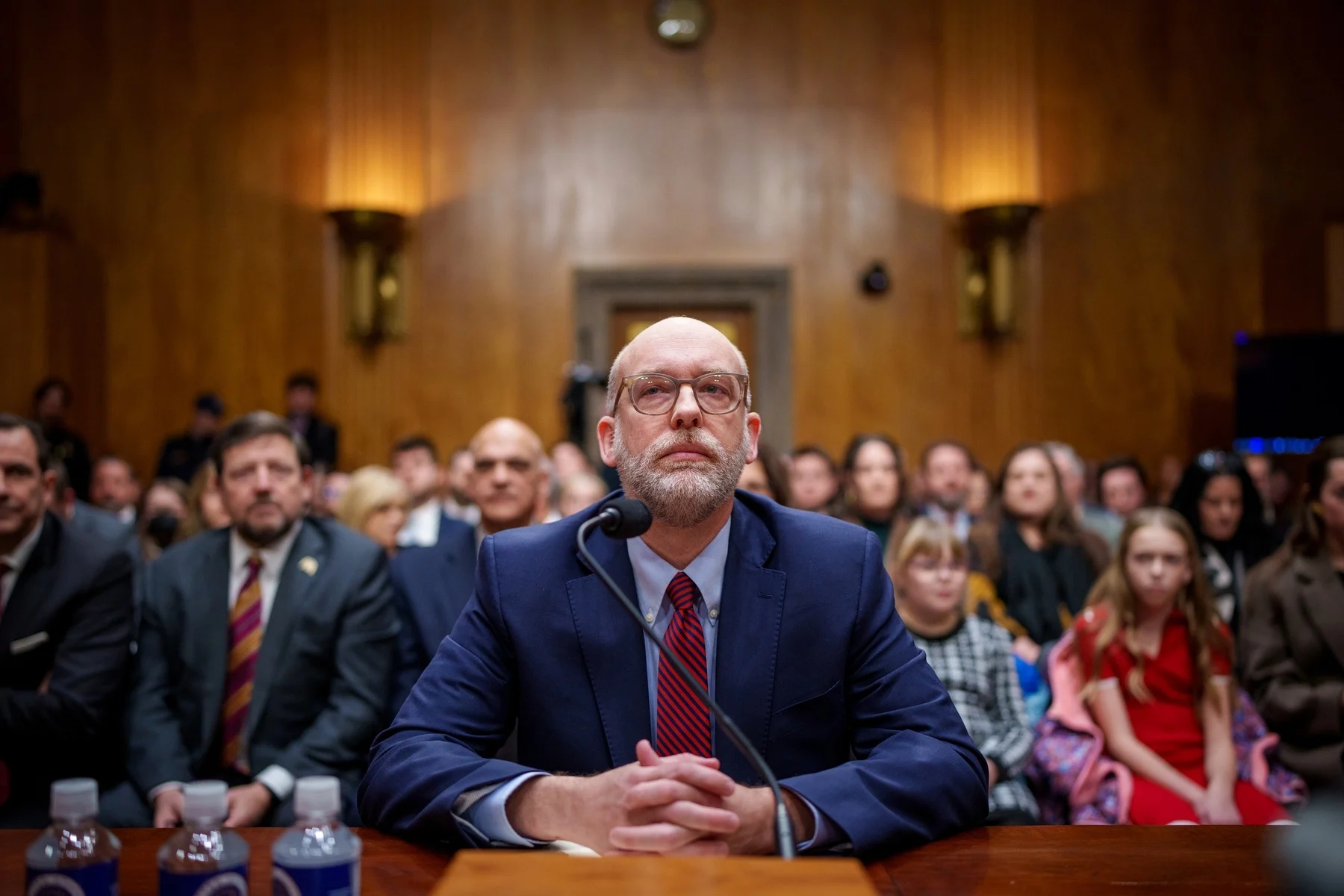
    Russell Vought sees the Office of Management and Budget as a “nerve center” that can be used to curtail DEI programs and purge the federal workforce of Trump’s perceived enemies.

    Read Amanda Becker’s Loveland connection in her Bio below.

    This story was originally reported by Amanda Becker of The 19th. Meet Amanda and read more of her reporting on gender, politics and policy.

    ________________

    The U.S. Senate on Thursday approved Project 2025 architect Russell Vought to lead the Office of Management and Budget (OMB) on a party-line vote after Democrats held the floor overnight in an attempt to delay the confirmation since they did not have the numbers to block it.

    Vought was confirmed by a vote of 53-47.

    For 30 hours, starting on Wednesday afternoon and into Thursday evening, Democrats took turns on the Senate floor to protest Republican President Donald Trump’s nomination of Vought, who also led OMB at the tail end of Trump’s first administration.

    “This is really important, that we raise the alarm as to what is happening,” said Sen. Chris Murphy of Connecticut, who spoke from 2-5 a.m., longer than most of his colleagues.

    During his first stint at OMB, an under-the-radar entity that wields immense influence over the federal government by crafting the president’s budget, Vought helped Trump come up with a plan to jettison job protections for thousands of federal workers and assisted with a legally ambiguous effort to redirect congressionally appropriated foreign aid for Ukraine. In the years since, Vought founded two pro-Trump groups whose work has focused on discrediting structural racism and curtailing diversity, equity and inclusion (DEI) programs. The chapter that Vought wrote for Project 2025 detailed how the budget agency could be used to withhold money appropriated by Congress and eliminate dissent within agencies by purging them of employees.

    Trump said repeatedly during his campaign that he had not read Project 2025 and did not know its authors, though at least 60 percent of its more than 350 contributors were linked to the president. These include appointees and nominees from his first administration, members of his prior transition team and unofficial advisers.

    Project 2025 is a 920-page roadmap from the conservative Heritage Foundation about how Trump’s second administration could use the federal government to enact a far-right Christian agenda. If implemented — and some of the Trump administration’s earliest moves track the blueprint’s objectives — it has the potential to redefine rights long held by all Americans, with disproportionate impacts for women, LGBTQ+ people, people of color and vulnerable populations like the elderly and disabled.

    “What was in Project 2025 that made it so widely hated across the political spectrum? A few things: firing civil servants, weaponizing the Department of Justice and the Federal Bureau of Investigation, unleashing force onto protestors, and targeting political opponents, restricting abortion nationwide, ripping retirement and health care benefits from seniors, dismantling public education,” Sen. Elizabeth Warren said Wednesday evening on the Senate floor in a speech opposing Vought’s nomination.

    Warren noted that Vought has called on Congress to outlaw medication abortion and encouraged discrimination against transgender people in the workplace. She continued: “Now, Donald Trump has named the lead architect of Project 2025, Russ Vought, to oversee the federal government’s entire budget office … to carry out the Republican blueprint to make our government force people to live in the image that Russ Vought and other extremist Republicans approve of.”

    Last week an OMB letter sent by acting director Matthew Vaeth instructing federal agencies to pause “all activities related to obligation or disbursement of all Federal financial assistance” sent shock waves across Washington. The White House moved to quell the backlash. A federal judge earlier this week issued a temporary restraining order, extending a pause on implementing the directive.

    Vought, in an interview with conservative activist Tucker Carlson shortly after Trump’s reelection, discussed how the incoming administration could force federal agencies to “come to heel and do what the president has been telling them to do.” He likened OMB to the “nerve center” through which Trump could ensure his policy directives trickle down through the federal agencies that employ more than 2 million Americans.

    Many of these federal workers received an email last week from the Office of Personnel Management (OPM), which acts as the federal government’s human resources department, with the subject line “Fork in the Road.” The email offered them a chance to opt into a “deferred resignation” program intended to trim the federal workforce and set an acceptance deadline of February 6. Already, federal employees identified as working on DEI programs had received letters notifying them that they were placed on leave and could be fired. Some have sued the administration.

    Labor unions representing federal employees also sued over the resignation offer and deadline, and a federal judge on Thursday blocked OPM from enforcing it. White House press secretary Karoline Leavitt said that about 40,000 workers had already accepted the offer and the White House expected that number to grow. Leavitt said she was not part of discussions about next steps or whether layoffs would follow if enough employees did not resign.

    “Americans need to know that OMB is extremely powerful, with oversight over the president’s budget and functionally all federal agency actions, including regulatory decisions,” Democratic Sen. Mazie Hirono of Hawaii said Thursday.

    “With such responsibility, the person leading this office needs to be level-headed and impartial. They need to put loyalty to the Constitution above loyalty to the President,” she added. “Mr. Vought, however, is the ultimate yes-man.”

    Read Project 25
    [pdf-embedder url=”https://lovelandmagazine.com/wp-content/uploads/2025/02/project-2025.pdf”]

  • Federal Office on Violence Against Women removes funding opportunities from website

    Federal Office on Violence Against Women removes funding opportunities from website

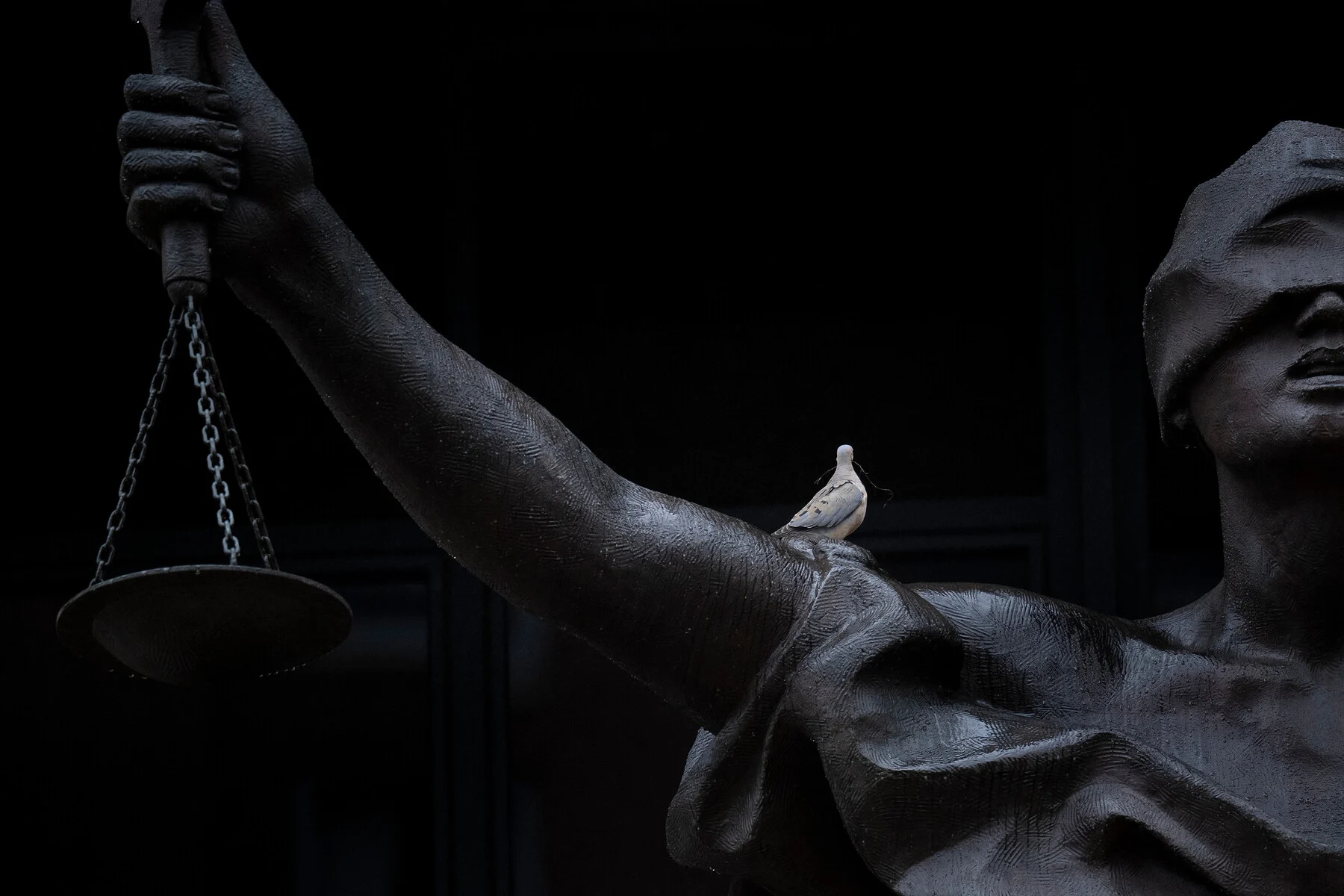
    A bird rests on a statue of Justice at the US District Court for the Eastern District of Virginia April 7, 2022, in Alexandria, Virginia. (Brendan Smialowski/AFP/Getty Images)

    This story was originally reported by Jasmine Mithani of The 19th. Meet Jasmine and read more of her reporting on gender, politics and policy.

    The Department of Justice Office on Violence Against Women (OVW) has removed from its website all information on current funding opportunities and directs visitors not to finalize any applications. This adds to the fear of nonprofits that work to help victims of gender-based violence that a major funding source may dry up.

    It is unclear whether this pause is temporary. OVW did not return a request for comment on Friday afternoon.

    Last week, the Centers for Disease Control and Prevention took parts of its website down for several days to check for compliance with President Donald Trump’s executive orders.

    Users looking for information about funding from OVW are directed to the homepage, which on Friday showed a message to grantees saying that a funding freeze announced January 27 by the Office of Management and Budget (OMB) was not in effect due to a judge’s restraining order. OMB had directed agencies to pause funds pending a review of their compatibility with executive orders related to immigration, “illegal DEI” and “woke gender ideology.”

    The notice of the court order says “agencies may exercise their own authority to pause awards or obligations, provided agencies do so purely based on their own discretion” and in accordance with agreements and not solely due to the rescinded OMB memo or the executive orders.

    An archived version of the OVW funding opportunities webpage from January 24, and viewable on the Internet Archive, shows 10 grants open for applications, with deadlines varying from January to May 2025. The update about withdrawing grant opportunities is dated February 6. Grants previously listed included ones aimed at ending abuse later in life, providing housing for victims of domestic violence and helping local law enforcement stop cybercrimes.

    Websites for other Justice Department offices, including Community Oriented Policing Services and Office of Justice Programs, continue to show available funding opportunities.

    OVW is one of largest funders of programs for survivors of gender-based and domestic violence.

    Many nonprofits that work with victims of domestic or intimate partner violence edited their websites in the wake of the funding freeze, providing static pages with just phone numbers or removing resources for LGBTQ+ people.

  • The 19th Explains: Can Trump eliminate the Department of Education?

    The 19th Explains: Can Trump eliminate the Department of Education?

    (File photo by Elaine S. Povich/Stateline.)

    The president can’t eliminate a federal agency with an executive order lawfully. But he can undermine its functions and redistribute duties.

    This story was originally reported by Nadra Nittle of The 19th. Meet Nadra and read more of their reporting on gender, politics and policy.

    President Donald Trump reportedly plans to fulfill a campaign promise aimed at sweeping changes for public schools: closing the Department of Education.

    An executive order from the White House outlining this goal is expected imminently, sources close to the matter told news organizations including NBC News, The Washington Post and The Wall Street Journal this week. The placement of multiple Department of Education employees on administrative leave and a probe of the agency by the Elon Musk-led Department of Government Efficiency have lent credibility to the claims. So has Trump.

    Asked by a reporter Tuesday why he was nominating Linda McMahon education secretary if he plans to scrap the department, the president said, “I told Linda — ‘Linda, I hope you do a great job and put yourself out of a job.’ I want her to put herself out of a job [in the] Education Department.”

    In a 2023 campaign video, Trump shared his vision for education, expressing his intention for local school boards and parents to control their children’s education, incorporate prayer into schools and expand school choice — or options for families to choose the public, private or religious school they prefer.

    “One other thing I’ll be doing very early in the administration is closing up the Department of Education in Washington, D.C., and sending all education and education work and needs back to the states,” he said, disregarding that states and school districts already run public schools.

    The prospect of the agency closing has sparked outcry from education leaders, elected officials and families with vulnerable children. Eliminating the Department of Education, they say, could have a ripple effect across the country — with particular consequences for children with disabilities, youth from low-income households and student loan borrowers, most of whom are women.

    “Students across the country benefit from programs run by the Department of Education, especially lower-income students in rural, suburban and urban communities, students who qualify for federal grants or loans to receive career training or attend 2- and 4-year colleges, and students with disabilities,” Becky Pringle, president of the National Education Association (NEA), said in a statement Monday. The nation’s largest labor union, the NEA represents over 3 million educators and other school stakeholders.

    Shuttering the Department of Education would adversely affect nearly all of the nation’s students, Pringle said, as 90 percent of students overall and 95 percent of students with disabilities are educated in public schools. “Trump’s power grab would steal resources for our most vulnerable students, explode class sizes, cut job training programs, make higher education more expensive and out of reach for middle class families, take away special education services for students with disabilities, and gut student civil rights protections.”

    As alarm grows over the Department of Education’s possible elimination, questions are also mounting — namely if an executive order is all it takes to axe the federal agency.

    Can a president shut down the Department of Education?

    The president cannot close a federal agency with an executive order lawfully.

    “But what I think is important to remember here is that you don’t have to dismantle the Department of Education to really, really limit its reach and its effectiveness,” said Jasmine Bolton, who served as senior counsel in the Department of Education’s Office for Civil Rights from 2021 to 2023. “Although it is less likely that they are able to fully dismantle the Department of Education, they could very easily limit its ability to do a lot of things. They could also really take a look at its grant making, its funding — who it’s funding, what it’s funding and really strike at the heart of some of those provisions.”

    Bolton said that it’s not inconceivable that the Trump administration would dial back some of the large funding grants that school districts in blue and red states rely on to serve their students.

    “We have to be vigilant and aware of all possibilities,” she said.

    The Department of Education dates back to former President Jimmy Carter’s administration. In 1979, Congress passed legislation to create the agency. To dismantle the Department of Education, Congress would have to approve its abolishment. Rep. Thomas Massie of Kentucky on January 31 reintroduced legislation to dissolve the agency, a goal shared by the Republican Party and conservative think tank the Heritage Foundation, which wrote Project 2025, its blueprint for Trump’s return to the White House. But the chance of such a bill surviving is a long shot, experts say, especially in the Senate.

    “I think it’d be very challenging to do because you’d have to overcome the filibuster in the Senate,” said Wil Del Pilar, senior vice president of the Education Trust, a nonprofit advocating for equity in education. “They don’t have 60 votes in the Senate unless they disband the filibuster. So, it’s possible, but I think it’s highly unlikely.”

    Most of Congress, including 60 House Republicans, opposed legislation to eliminate the department last session. Del Pilar said that abolishing the agency would prevent Republicans from pursuing some of their objectives.

    “Given all the things that they want to do in terms of what I would call a deregulatory agenda, what I expect them to come in and want to do is undo all of the Biden-era regulations that were put in place through negotiated rule making,” he said.

    Pedro Noguera, dean of the Rossier School of Education at the University of Southern California, said the Trump administration needs the Department of Education to carry out goals like withholding funding from education institutions that practice DEI (diversity, equity and inclusion) or teach critical race theory.

    “I don’t know how he does that without using the powers of the Department of Education,” Noguera said. “On the other hand, if he wants to redistribute the duties that are present in the Department of Education into other departments, that’s kind of a rebranding. I could see them doing that.”

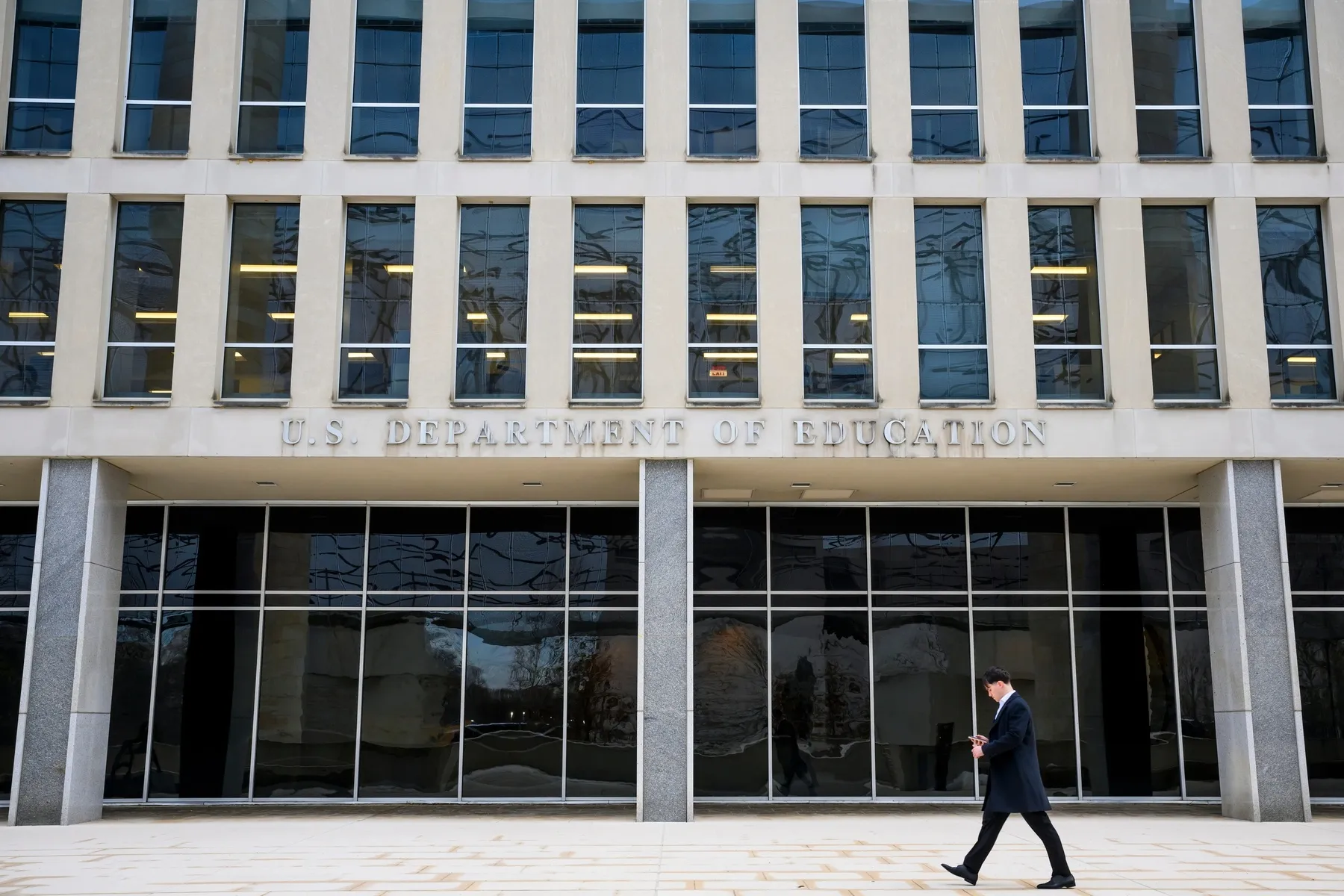
    A pedestrian walks by The Lyndon Baines Johnson Department of Education Building.
    A pedestrian walks by The Lyndon Baines Johnson Department of Education Building on February 3, 2025 in Washington, DC.
    (Pete Kiehart/The Washington Post/Getty Images

    What does the Department of Education do?

    Ensuring that all students have equal access to education is the agency’s overarching responsibility. It includes a civil rights division that investigates allegations of discrimination related to factors such as sex, race and disability.

    Trump can’t close the Department of Education with the sweep of a pen, but he can drive out its senior personnel or issue an executive order instructing the agency to severely reorganize, both of which would render it largely ineffectual. Placing dozens of the department’s employees on unexplained leave on Friday has already prompted a letter from a lawyer representing some of the staffers; it accuses the agency of retaliating against them for attending a DEI training. Should it be dismantled, the Department of Education’s key functions are expected to go to other federal agencies. Congressional approval, though, would be needed to transfer many of those duties.

    While states, by far, provide most of the money public schools need to operate, the Department of Education, which has a $79 billion annual budget, disperses billions of dollars in federal funding. This includes to the Title I program, which gives supplemental funding to schools that primarily serve economically disadvantaged students. The agency also directs funding toward students with disabilities in line with the Individuals with Disabilities Education Act (IDEA), federal legislation that guarantees this population an education appropriate for their needs. Both IDEA and Title I, created in 1975 and 1965, respectively, predate the Department of Education and can be dissolved only by an act of Congress.

    “I’m not sure what it accomplishes if they try to go after programs like Title I,” Noguera said. “They’re going to get a lot of opposition, not just from blue areas, but from red areas as well, and from Congress, because people tend to support the public schools.”

    Like Title I and IDEA, the National Assessment of Educational Progress (NAEP) also predates the agency, which administers the test today. Known as the “Nation’s Report Card,” the results of the assessment provide the department with a baseline of how well students are doing in reading, math and other areas.

    Upon last week’s release of NAEP scores showing that students’ reading scores had worsened and math scores had stalled, the Department of Education issued a statement unveiling the Trump administration’s plans to upend public schools and give states more control, a deceptive remark since states and school districts already have authority over what students learn. The federal government does not shape local curriculum.

    But the Department of Education does track the academic progress of K-12 and college students. At the higher education level, the agency monitors how well institutions serve students by compiling data about admissions numbers and graduation rates. It also oversees funding for the federal student loan program and the Free Application for Federal Student Aid (FAFSA), which students complete to receive financial assistance for college. This aid includes the Pell Grants that supplement higher education costs for students from low-income households.

    Braxton Brewington, a spokesperson for the Debt Collective, which works to abolish debt and transform how public goods and services are distributed, said that he’s concerned about how marginalized students will fare under an Education Department run by the Trump administration, though the Debt Collective also criticized Biden officials for not overhauling the student loan system.

    “We are expecting the Trump administration to carry out a deeply catastrophic agenda,” Brewington said. “So that will look like privatizing education — K-12 to higher education — incentivizing private loans to pay for college, rolling back repayment plans like Public Service Loan Forgiveness and other types of safety nets. These plans are not ideal, but to the extent that they’ve helped borrowers, we’re expecting a Trump administration to roll those back.”

    Does the public support closing the department?

    Surveys of the public have found different attitudes about the Department of Education. A new poll released Tuesday by Data for Progress, a progressive think tank and polling firm, found that likely voters oppose eliminating the federal agency by about a two-to-one margin. Data for Progress conducted the poll of 1,294 likely voters from January 31 to February 2 on behalf of the Student Borrower Protection Center, which works to improve the student loan system, and Groundwork Collaborative, which advocates for an equitable economy.

    Fifty-two percent of likely voters under age 45 strongly oppose closing the agency compared with 13 percent of this demographic who strongly support such a move. Forty-six percent of likely voters over 45 strongly oppose elimination, while 19 percent strongly support it. College-educated likely voters object to slashing the agency the most, with 55 percent strongly opposing this effort and 14 percent strongly supporting it.

    A 2024 survey of Americans by the Pew Research Center found that partisanship shaped opinions about the federal agency, with 64 percent of Republican and Republican-leaning respondents holding an unfavorable view of the department. Just 26 percent of Democrats and Democratic-leaning voters felt the same. Overall, 44 percent of respondents had a favorable opinion of the agency and 45 percent had the opposite view.

    Beyond partisanship, attitudes about the Department of Education may depend on whether people feel the agency plays a key role in their lives. Advocates for students with disabilities and student loan borrowers are among the loudest raising concerns about its potential dismantling or diminishment.

    “The last time Trump was in office, he significantly understaffed the Office for Civil Rights,” Del Pilar said. “So I do think we should be concerned about what this potentially means for students with disabilities, for English language learners, for immigrant students, because if they don’t staff up and investigate, then we’re not going to see institutions, schools and districts’ feet held to the fire around the inequities that are being placed on our students.”

    Why do Republicans want to kill this federal agency?

    Republicans have wanted to eliminate the federal agency since its launch.

    “Some of it was the old Republican focus on smaller government,” Noguera said. “They’re just shrinking the size of government and seeing the department as largely regulatory, but what they don’t understand is that many of the functions that are now within the U.S. Department of Education, such as funding Pell Grants, are essential to higher ed and access to higher ed for all kinds of Americans across the country. You can’t just get rid of that without a lot of resistance.”

    Without congressional support, Noguera continued, the Trump administration will find it difficult to achieve its goals for the nation’s schools. Many of them, such as implementing school prayer, expanding voucher programs and limiting what students can learn and read in class, directly clash with the public education system.

    On January 29, the White House issued an executive order asking the Department of Education to spend the next two months developing guidance to help states apply federal funding to school choice initiatives, mirroring a trend that’s been unfolding at the state level. For years, billionaires have collaborated with conservative lawmakers to route funding away from public schools and send it to private schools through voucher programs, according to a 2024 report by the Senate Committee on Health, Education, Labor and Pensions (HELP). Billionaires have funneled their financial resources into the School Freedom Fund, a political action committee that attempts to remove state lawmakers who oppose private school vouchers from office.

    Billionaires have a vested interest in privatized education because they can cash in on it through voucher tax credits and federal business expense deductions, the HELP report posits. For example, over 20 states provide voucher tax credits to companies that make contributions to pay students’ private school tuition. Moreover, vouchers overwhelmingly benefit students from high-income families since they typically cover just part of tuition costs. Lower-income families can’t afford to make up the difference. The effort to defund the nation’s public schools, the study contends, is ultimately one to make the elite class even wealthier.

    Vouchers harm communities that are already vulnerable due to systemic underfunding and disinvestment, Bolton said.

    “By pulling out this money and constantly pulling the rug out under schools, folks who support vouchers, particularly in this administration, are really intentionally undermining the schools that will continue to serve the majority of our students,” said Bolton, who is now policy director at the Partnership for the Future of Learning, a network of organizations fighting for high-quality public schools. “It’s incredibly frustrating that this administration seems to want to pour into a federal voucher program that doesn’t serve us and isn’t really responsive to what people are telling our leadership.”

  • ‘The power of showing up’: What this Black History Month means to 19th staff

    ‘The power of showing up’: What this Black History Month means to 19th staff

    This year’s celebration of our history and culture feels even more pressing, present and vital to many of us.

    This story was originally reported by The 19th. Meet the team and read more of The 19th’s reporting on gender, politics and policy.

    For the third year, a handful of Black staffers at The 19th have come together to reflect on what Black History Month means to us.

    For too many reasons to count, this year’s celebration of our history and culture feels even more pressing, present and vital to many of us.

    These feelings are represented in words and phrases that dot these powerful essays: unapologetically Black, rebellion, uplifting others, collective excellence, hope, motivation, nurturing and holding our ground.


    ‘Every month felt like Black History Month’

    Growing up, every month felt like Black History Month. Within our four walls, the Bunting household was unapologetically Black.

    It was required that my siblings and I understood our history — not just the highlights, but the depths. As Parliament-Funkadelic blasted through the house, my parents passionately explained why funk and soul were more than music — they were lifelines of culture, identity and rebellion. And, through their work and service, they showed us the power of showing up for our people and our community.

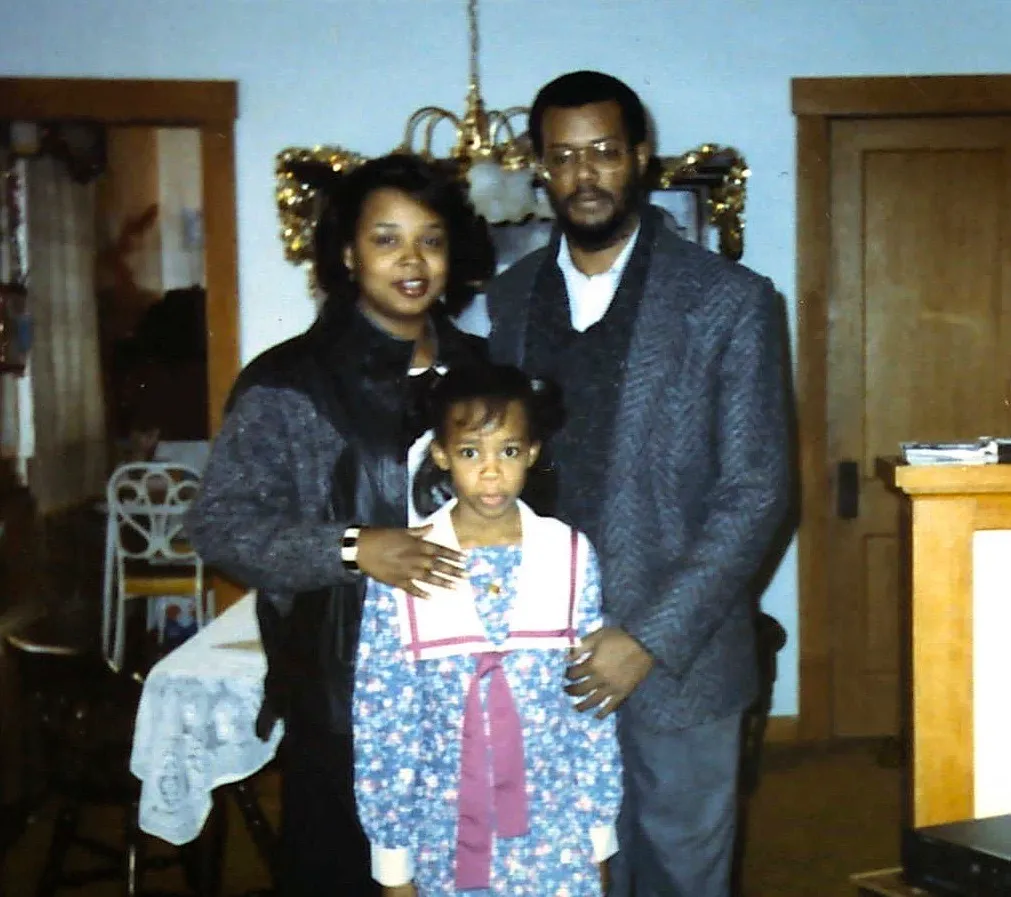
    A family of three poses together for a photo.
    (Courtesy of LaSharah S. Bunting)

    Yet it was the quiet, powerful way my mother and father carried themselves, with unwavering strength and dignity, that made the most impact. They instilled a deep level of pride and resilience that still lives with me every day.

    Today, at a time when our very existence as Black people feels like an act of defiance, I hold tight to those values and my parents’ belief in the beauty of who we are. Those lessons are my armor. My parents’ love is my legacy. And their hope is the fire that keeps me going. — LaSharah S. Bunting, vice president


    ‘Creating paths where none existed’

    Leadership has always been a lens through which I view the world, shaped by the extraordinary examples of my parents. As the child of two veterans, leadership wasn’t something pushed onto me but rather modeled with quiet consistency and purpose. My parents taught us to give our best in everything we did, to show up for others and to do so with integrity. I didn’t fully grasp the depth of these daily lessons until I watched my dad, 25 years older than my mom, set aside his passions and routines to support her career overseas.

    A portrait of a Navy seaman.
    (Courtesy of Clarice Bajkowski)

    Recently, as I’ve reflected on his life and sifted through his personal effects, I’ve come to understand the profound depth of his leadership during his service in the U.S. Navy during World War II. He served with distinction, bravery and valor aboard ships like the U.S.S. Polana, U.S.S. General E.T. Collins and the USS Franklin, where he earned a Purple Heart for his courageous service on the most heavily damaged U.S. Navy vessel to survive the war. But his contributions extended far beyond his bravery in battle. He laid the groundwork for equity, advocating for wage and rank corrections for Black sailors, and worked to ensure that Black men and women could be seen and valued beyond the roles they were historically confined to, creating opportunities for those who came after him.

    Though he never sought leadership, it always found him. He lived it by standing up for others and creating paths where none existed. That same spirit carried into how he raised our family, showing up with resilience, purpose and quiet strength. His legacy, combined with my mother’s determination, shaped my understanding of leadership as service, advocacy and a commitment to uplifting others. My brother and I are the realization of their wildest dreams — a testament to their vision, sacrifice, and unwavering belief in our collective excellence. — Clarice Bajkowski, chief creative officer


    ‘They were determined to know freedom’

    I’m an Alabamian and my folks are from Montgomery and Lowndes counties, epicenters for the Civil Rights and Black Power Movements. I grew up listening to stories of my relatives, their childhood friends and neighbors committing acts of resistance in the Jim Crow South.

    Whether it was hosting civil rights leaders in their homes as they passed through town or integrating high school or sneaking out to march for justice or simply living full, beautiful lives in spite of such ugliness, they were determined to know freedom.

    Through direct action or through small acts of defiance, they resisted oppression at great personal risk and rebelled against laws that didn’t respect their dignity. They resisted the temptation to be completely consumed by fear and despair.

    I am shaped by their determination to find a way to live abundant lives in spite of the dangerous forces trying to derail their destiny. I carry that same courageous and resilient spirit. — Amethyst Holmes, product fellow


    ‘Continue to nurture our country for the better’

    I was not sure if I could write a Black History Month reflection this year. I didn’t think I would have anything interesting or inspiring to say less than two weeks after watching a U.S. president be inaugurated on Martin Luther King Jr. Day, and then hours later issue an executive order calling diversity, equity and inclusion work “illegal discrimination.”

    But, the same week as the inauguration, a trend started on TikTok with a group of (mostly Black women) professors and professionals teaching online courses about their areas of expertise. It began inadvertently when Dr. Leah Barlow at North Carolina Agricultural and Technical State University posted a now-viral video that was originally meant for students in her Intro to African American Studies class.

    A black and white image of a group of teachers smiling in a classroom.
    (Afro American Newspapers/Gado/Getty Images)

    Now, other professors are offering courses on racial disparities in health care, managing implicit biases, the history of U.S. education, constitutional law and more. I am personally “enrolled” in a course analyzing the works of Octavia Butler taught by Dr. Briana Whiteside.

    During such a politically tumultuous time, it gives me hope and motivation to see the ways that Black women in particular continue to nurture our country for the better. — Candice Norwood, general assignment reporter


    ‘What happens when people aren’t curious about what they don’t know’

    No offense, Dorothy Hamill, but you weren’t my first choice.

    I was the only Black kid in advanced English in sixth grade. We were assigned to choose a famous person to profile, and I picked Billie Holiday. My father and uncle were musicians, and my grandfather had jazz on heavy rotation.

    I’ll never forget the blank look and dismissive shake of the head from my teacher in response. “Billie Holiday? I don’t know who that is.”

    So I slunk back to my desk, eventually picking the very White, very acceptable (to her) Hamill instead.

    A portrait of Billie Holiday.
    (Heritage Art/Heritage Images/Getty Images)

    This is what happens when people aren’t curious about what they don’t know. My teacher assumed that because she hadn’t heard of someone being mentioned by a little Black girl, the person wasn’t worthwhile.

    That memory has surfaced for me this Black History Month as we face the erasure of our stories and the weaponization of our identities. As people who think only their heroes matter amass power to make decisions for all of us.

    I gave in on Hamill, but I’ve held my ground ever since. And this month I’m putting Holiday back on heavy rotation. — Karen Hawkins, story editor

  • Trump’s ‘pause’ on government assistance could put early learning and nutrition programs in danger

    Trump’s ‘pause’ on government assistance could put early learning and nutrition programs in danger

    (Photo by Anna Moneymaker/Getty Images)

    Originally published by The 19th

    As widespread confusion continues over the funding freezes, programs serving women and children could be hit particularly hard.

    Read Amanda Becker’s Loveland connection in her Bio below.

    by Amanda Becker

    Editor’s note: The Office of Management and Budget on Wednesday rescinded its memo directing a freeze on federal grants and loans, one day after a federal judge temporarily blocked it. White House Press Secretary Karoline Leavitt said on X of Wednesday’s OMB memo: “This is NOT a rescission of the federal funding freeze. It is simply a recession of the OMB memo. Why? To end any confusion created by the court’s injunction. The President’s EO’s on federal funding remain in full force and effect, and will be rigorously implemented.”

    The Trump administration tried to quell backlash on Tuesday to a directive that all federal agencies should “temporarily pause” all federal assistance, which advocates worried would hit social safety net programs like early learning and nutrition assistance programs.

    Programs serving women and children would be hit particularly hard by a funding pause, advocates said, since nearly all of them are part of the government’s discretionary spending and are frequently put on the chopping block by fiscal conservatives.

    Trump’s Office of Management and Budget (OMB) sent a letter Monday to federal agencies directing them to pause “all activities related to obligation or disbursement of all Federal financial assistance” by 5 p.m. Tuesday. The pause, the letter continued, “will provide the Administration time to review agency programs and determine the best uses of the funding for those programs consistent with the law and the President’s priorities,” specifically President Donald Trump’s initial executive orders, including those related to diversity, equity and inclusion (DEI) and “woke gender ideology.”

    6 ways you can positively impact your community. Read it now -->


    The OMB letter, which was first reported by independent journalist Marisa Kabas and later reviewed by The 19th, unleashed chaos across Washington. Calls flooded into Capitol Hill offices from both constituents and federal workers as agencies tried to sort out what the totality of its impacts might be in the coming weeks. On Tuesday, a second OMB memo, obtained by The Washington Post, attempted to clarify Monday’s letter but did little to reduce confusion.

    Tuesday’s memo stated that “the pause does not apply across the board. It is expressly limited to programs, projects and activities implicated by the President’s Executive Orders.” It stated that the Supplemental Nutrition Assistance Program  (SNAP), colloquially known as food stamps, will not be paused, nor will Medicaid, the government’s health insurance program for low-income people. The Tuesday memo was not signed, however, and experts told The 19th that agencies were still operating with a high degree of uncertainty, given that it also stated that “funds for small business, farmers, Pell grants, Head Start, rental assistance and other similar programs will not be paused” unless they related to Trump’s executive orders, which have wide-ranging application.

    Specifically, programs “implicated by the executive orders, including, but not limited to, financial assistance for foreign aid, nongovernmental organizations, DEI, woke gender ideology, and the green new deal,” according to Monday’s letter.

    The White House did not respond to a request to discuss which programs will be most affected by the pause or to confirm that Tuesday’s unsigned directive superseded Monday’s, which was signed by OMB’s acting director, Matthew Vaeth.

    Democrats are already preparing to challenge the pause directive in court. A coalition of nonprofit organizations that includes the American Public Health Association and SAGE, which advocates for older LGBTQ+ people, filed for a temporary restraining order.

    Any pause could have outsized impacts on some initiatives. Nutrition programs for women and kids, SNAP and WIC, are likely to run into funding issues within 60 to 90 days if subjected to the pause, experts said.

    Another program that could potentially be immediately impacted is Head Start, the early learning program for children from birth to age 5, experts said Tuesday.

    Federal funds go directly to specific Head Start programs, which provide early childhood education via public preschool programs, as well as at home by offering support for expectant parents. These programs are funded for a year at a time but staggered, typically tied to the start of each school year in a given state. If a program received its year’s worth of funding on January 1, it is good for 11 more months, but if a program is due to receive its yearly funding on February 1, that money will likely be delayed or not show up if there are funding pauses.

    At this point in the calendar year, states are also reporting back to the federal government, which partially funds the Head Start program, to balance their books by refunding unspent money or requesting reimbursement. A pause could impact those reimbursements, according to those familiar with the funding process. It is also the time of year when programs begin budgeting and hiring for the next school year, and having unfunded programs could lead to problems recruiting and retaining both educators and students.

    “Some facilities will be fine, others will have to shutter — unless a billionaire comes forward to help them out,” said Bobby Kogan, a senior director of federal budget policy at the liberal-leaning Center for American Progress, who worked at the OMB during the Biden administration.

    Amid the Trump administration’s attempt to clarify the scope of impact, Democratic Sen. Chris Murphy claimed the reimbursement system for the Head Start program in his home state of Connecticut had been shut down.

    “Preschools cannot pay staff and will need to start laying off staff very soon and sending little kids home,” he wrote on X.

    Some grantees under the federal Title X program, which supports family planning clinics that serve low-income people, are already preparing for a possible lapse in funding. Title X was created under President Richard Nixon and disburses hundreds of millions of dollars each year to fund clinics reaching millions of Americans, largely women.

    “We will rely on private resources for the time being, but this is not a long-term solution,” said George Hill, president of Maine Family Planning, the state’s sole Title X grantee. “If there is litigation on this matter, we will collaborate in whatever useful way we can.”

    Senate Minority Leader Chuck Schumer and other Democratic leaders called for their Republican colleagues in the Senate to hit pause on confirmation proceedings for OMB nominee Russell Vought, who helped Trump withhold congressionally appropriated funds during the Republican president’s first term. Vought has taken the position that presidents have the authority to redirect or refuse to spend funds appropriated by Congress, which under the Constitution holds the power of the purse.

    White House press secretary Karoline Leavitt said during a briefing Tuesday with reporters that she had spoken with Vought, “and he told me to tell all of you that the line to his office is open for other federal government agencies across the board, and if they feel that programs are necessary and in line with the president’s agenda, then the Office of Management and Budget will review those policies.”

    When a reporter at the briefing asked if any Medicaid recipient would see a cutoff because of the funding pause, Leavitt said: “I’ll check back on that and get back to you.”

    Medicaid was not expected to be immediately affected by the pause, even before Tuesday’s follow-up memo, because its funding mechanism makes it a de facto entitlement program like Social Security or Medicare, though the long-term impacts of the pause are unknown, experts said.

    Even still, Democratic Sen. Ron Wyden said that his staff had confirmed that Medicaid portals were down in all 50 states following the Monday night pause directive. The White House said they were aware of the outage and the portals should be back online shortly.

    “This is funding that communities are expecting and this memo is creating chaos and confusion about whether these resources will be available to them,” Democratic Sen. Patty Murray said during the news conference. “Entire budgets and payrolls across the country are carefully hinging on these resources, we’re talking about our small towns, our cities, our school districts, our universities and a lot more: Will local Head Start facilities get their funding?”

    Additional reporting by Shefali Luthra