Tag: Tom Scovanner

  • Grailville Land Preservation Group asks you to imagine the hopefull future

    Grailville Land Preservation Group asks you to imagine the hopefull future

    by Tom Scovanner – On behalf of the Grailville Land Preservation Group

    Imagine a place just outside of Loveland Ohio that serves as a foundation for an economy powered by outdoor recreation.  Loveland has an opportunity to create a place that will be a beacon of hope and peace, a place where everyone in the community feels welcome and connected, coupled with the opportunity to experience the mental and physical health benefits of being in nature and the sacredness of the land.  According to the Trust for Public Land, ‘Quality parks and green space are a fundamental requirement for sustaining healthy, equitable, resilient communities.’ 

    Drees Homes had hoped to develop 111 acres owned by The Grail since the early 1940’s into a 209-unit housing development.  This rural oasis just outside of Loveland has been a ‘sacred space for women who value peace and care of the earth’ according to The Grail’s website.  

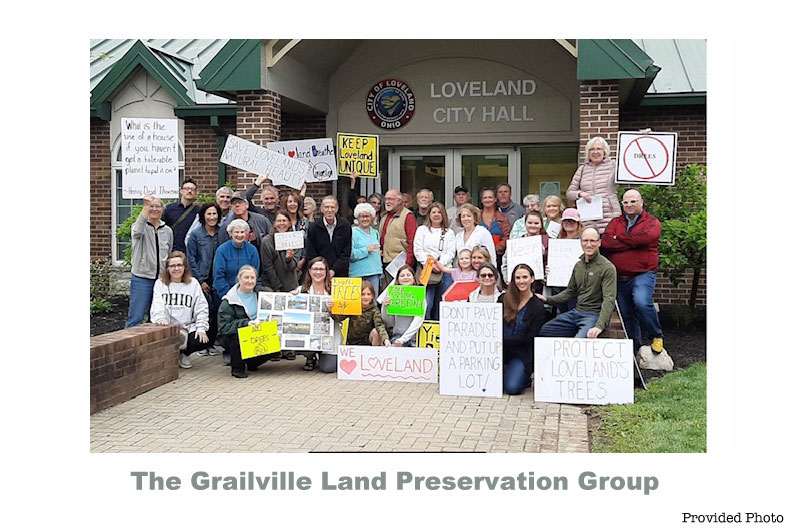
    When members of the community learned of the Drees proposal, an organic, grassroots organization of smart, engaged, well informed and dedicated people went to work to protect the land.  We, the Grailville Land Preservation Group are environmentalists, naturalists, neighbors, lawyers, mothers, fathers and children, Grail members, community leaders and organizers, farmers, business owners, people of faith, historians, and past Grail participants.  While our group is diverse, what brings us together is a visceral desire to protect the land from development.

    We first needed to prevent Drees from getting a zoning change from the current zoning of Residential Low-Density, 1 acre lots.  While Drees states that they intended to “maximize green space” in actuality, Drees’ objective was to build as many houses as possible on the land.  Looking at the topography, some 37 acres are undevelopable; Add in roads and other infrastructure, less than 70 acres are developable for housing.  On those 70 acres, Drees wanted to build 209 houses, more than triple the density currently allowed. 

    The standing room only crowds at the two Planning and Zoning meetings saw over 20 people speaking against the proposal at each meeting and only one person speaking in favor.  Many issues were presented by those who spoke, including the need to maintain greenspace, preserving the unique historic site, demolition of historic buildings, concerns about increased traffic, demands on Loveland’s infrastructure and the costs of the necessary improvements.  Others spoke about the negative revenue stream to the city caused by the increased populations and adding students to the school district already using portable classrooms. 

    Loveland is on the verge of approving a new comprehensive master plan for the city which stipulates it should ‘continue to aggressively preserve land for open space to ensure that our community remains a green haven for our residents and wildlife.’ We agree and desire to partner with like-minded people to accomplish this goal.  

    Yes, Corporate Grail and Drees wanted to change the zoning to build a large compressed housing development because they would both make more money, but the community said no and many individual members of the Grail agreed.

    The members of the Grailville Land Preservation Group have no motives other than honoring the legacy of the Grail and stewarding this land into the future in a way that preserves it for the benefit of all.  We hope to have the opportunity to partner with the Grail to find an alternate path for the Grail land, one that incorporates many of the values that the Grail taught.

    The real story that needs to be told is that everyday citizens living in and around Loveland spoke up to preserve the land and at least for now, preservation triumphed over development.

    Tom Scovanner

    On behalf of the Grailville Land Preservation Group


    To reach out to help protect this sacred land, you can contact us on the Nextdoor app under the group ‘Grailville Land Preservation Group’ or follow our blog at grailvillesacredpathways.substack.com


    EDITOR’S NOTE: After the Loveland Planning and Zoning Commission denied the request by Drees to rezone the property they were going to buy from the Grail the contract between the two parties was not extended. ([Complete Video] Rezoning of Grailville denied)


  • Questions arise about possible Native American remains and “Mound” at site of proposed Parking Garage in the Historic District

    Questions arise about possible Native American remains and “Mound” at site of proposed Parking Garage in the Historic District

    *Please read this CORRECTION to this story.

    The hillside in Loveland’s downtown where a highly contested proposed parking garage may be built

    “It is not known whether the ‘mound’ remains or is an Indian mound, but it is possible.” – Hamilton County Community Development

    David Miller is the Publisher and Editor of Loveland Magazine

    by David Miller

    Loveland, Ohio – The possibility of Native Americans’ remains under the site of a proposed parking garage on a hill in “Historic Downtown” may give a new connotation beyond the history of White settlers and developers of the area.

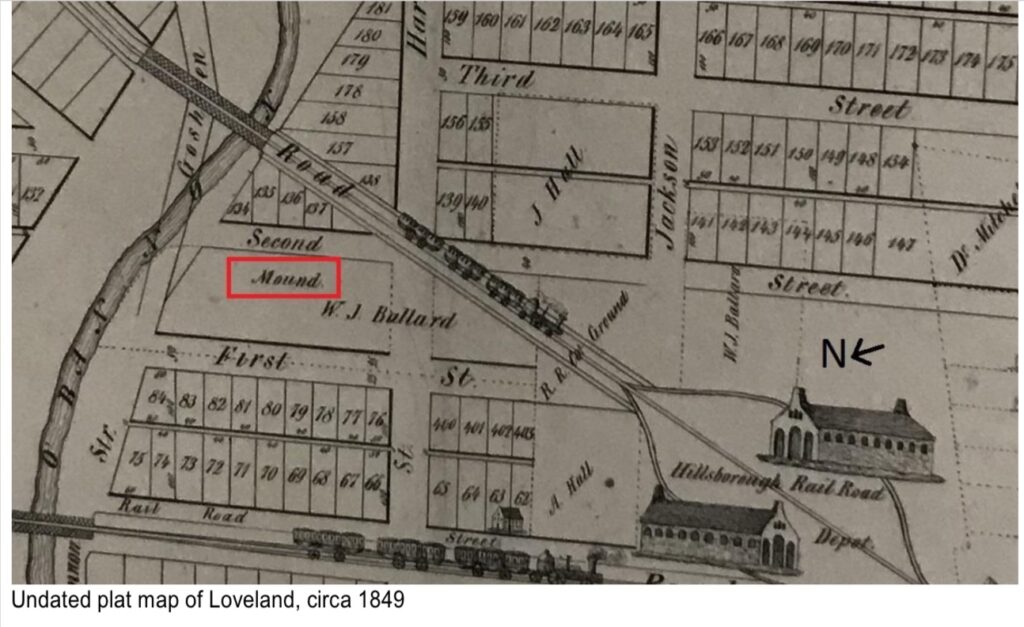
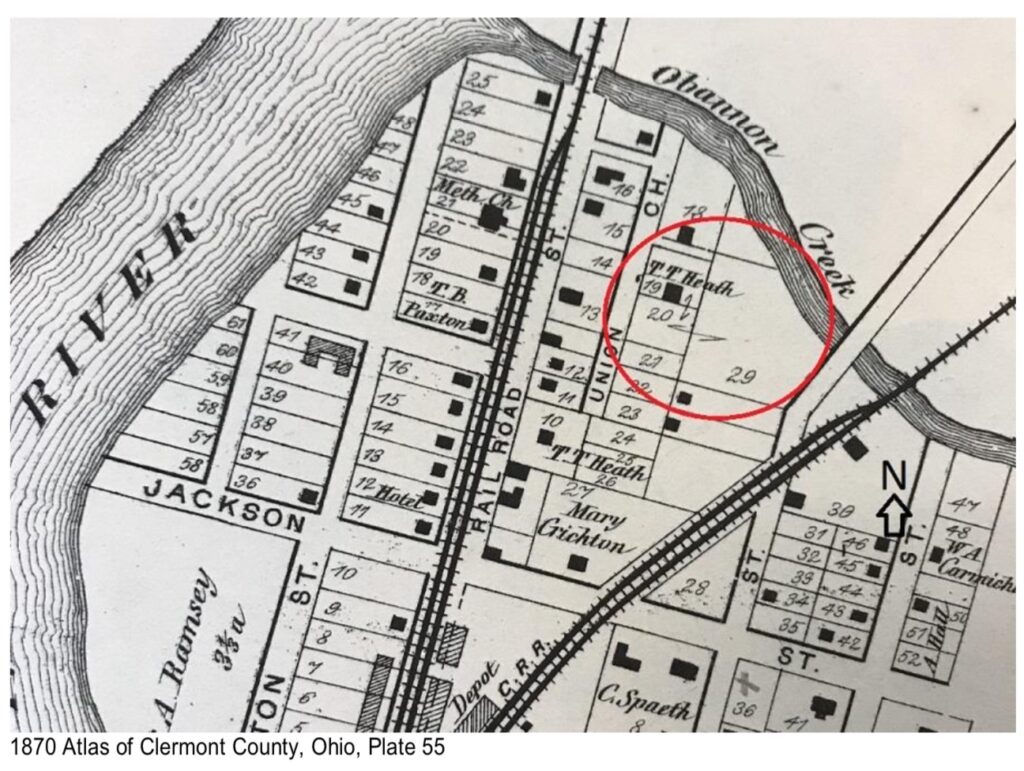
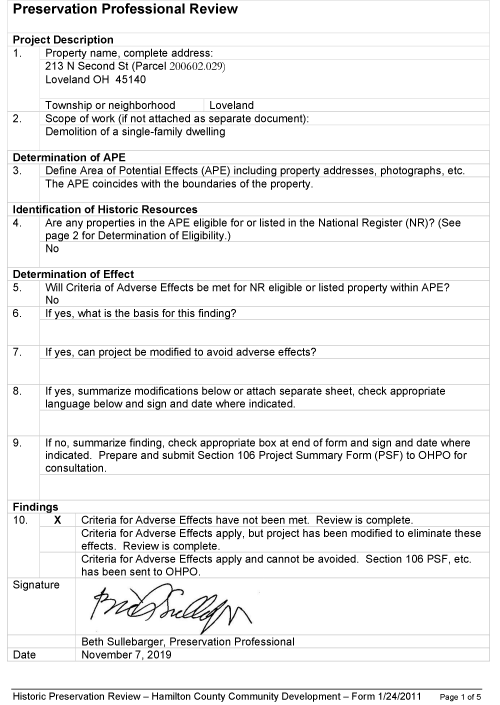
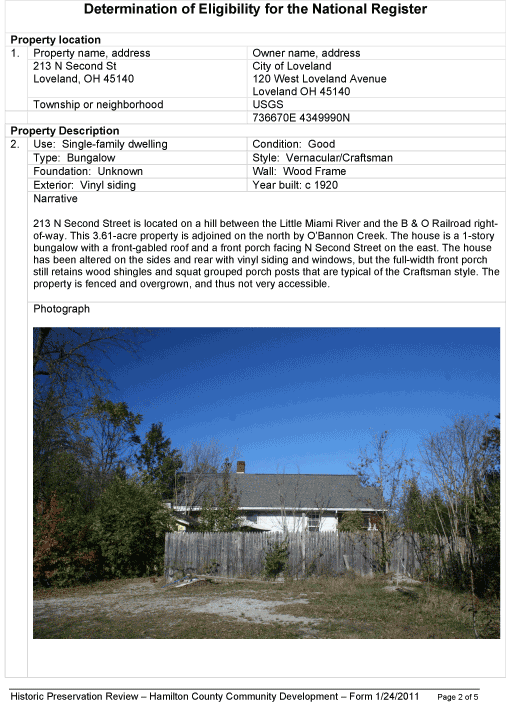
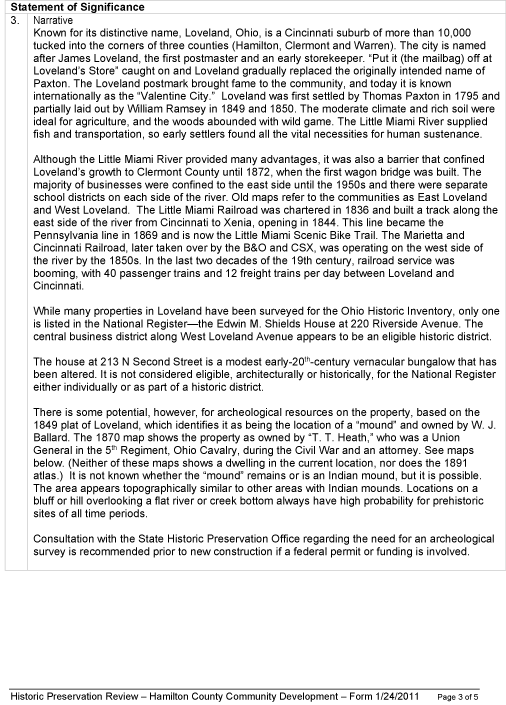
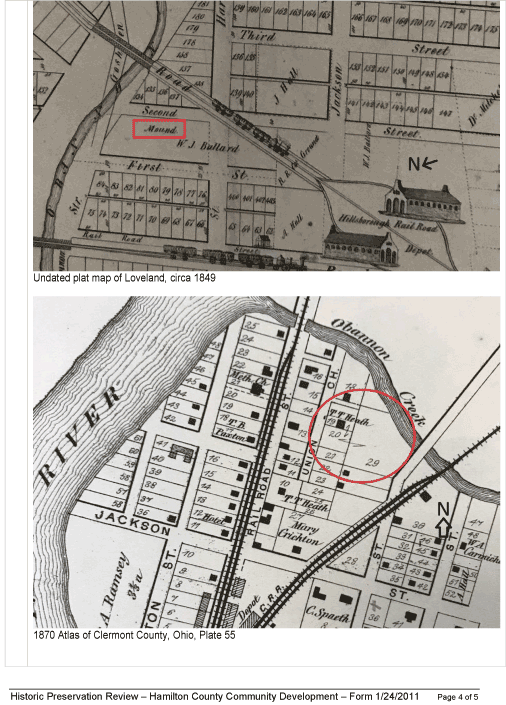
    At Monday’s City Council meeting, both Lauren Enda and Tom Scovanner reported that they have come into possession of a 2019 report by a preservation consultant that was commissioned by Hamilton County. The report says there is some potential for “archaeological resources” on the property. The report was based on an 1848 map of Loveland. The consultant said the map identifies a “mound” at the location. The report was commissioned because Loveland was seeking federal dollars to demolish two houses on the site and the money Loveland was seeking, was ultimately federal dollars. According to Enda and Scovanner, the report concluded that there was no historical significance to the houses so the City was given a green light to proceed with removing them.

    However, after the houses were removed, the City proceeded to do excavation on the hillside to make a temporary overflow parking lot to mitigate parking congestion in “Historic” downtown apparently without the knowledge of the reported mound that may contain the remains of American Indians who once lived on the bank of O’Bannon Creek which abuts the hillside. O’Bannon Creek enters the Little Miami River a few hundred feet downstream.

    The proposed garage site is 213 North Second Street (Parcel 200602.029).

    Enda says that as soon as she received the report she immediately put in a call to City Manager Dave Kennedy who could not be reached. She then sent the report to both Kennedy and Councilmember Andy Bateman on April 8. She sent it to Bateman because he is the council’s representative on the City Historical Preservation and Planning Commission (HPPC). Bateman is a sitting member of the Commission.

    Enda’s presumption was that Bateman would forward the report to all of the HPPC members, however, the report was not brought up or discussed at their next meeting. She had asked Bateman in an email, “Please share with the other members as I do not have their addresses.” She said on Monday that she was surprised that it was not discussed at the HPPC meeting.

    After Enda and Scovanner gave speeches during the open forum at Monday’s council meeting, there was also no discussion between Council and the City Manager. She said on Monday that she did not hear back from either Kennedy or Bateman after she sent them the report. *

    City Manager Kennedy told Loveland Magazine via email that he first knew of the report when Enda sent it to him on April 8 at 2 PM. He said that subsequently, the Ohio Historic Preservation Office contacted him and they are scheduling a time to discuss the matter.

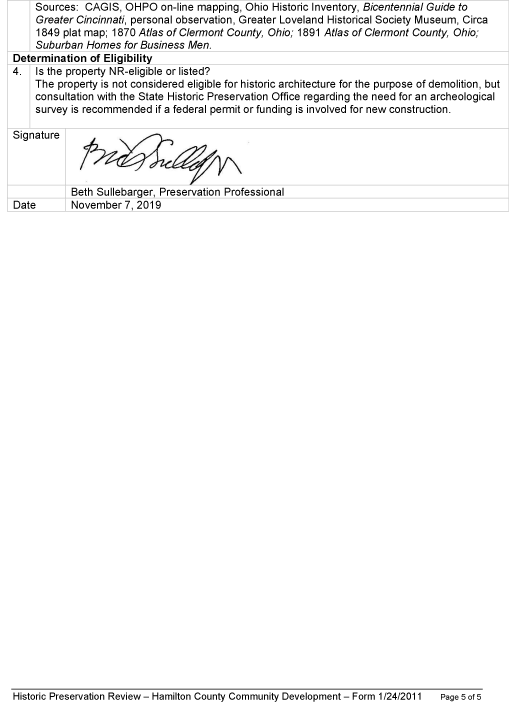
    The Hamilton County Community Development Historic Preservation Review worksheet says, “It is not known whether the ‘mound’ remains or is an Indian mound, but it is possible. The area appears topographically similar to other areas with Indian mounds. Locations on a bluff or hill overlooking a flat river or creek bottom always have high probability for prehistoric sites of all time periods.” It concludes, “The property is not considered eligible for historic architecture for the purpose of demolition, but consultation with the State Historic Preservation Office regarding the need for an archeological survey is recommended if a federal permit or funding is involved for new construction.”

    Enda said at the council meeting that according to Loveland’s Director of Finance, Mark Medlar, Loveland taxpayers have already spent $980,000 on purchasing the site, demolition, and design engineering for the “multi-million dollar” proposed garage.

    Enda wants Council to commission an archaeological survey of the property which she says is the recommendation of the Ohio History Connection. The Ohio History Connection was formerly the Ohio Historical Society and carries out history services for Ohio and its citizens focused on preserving and sharing the state’s history. This includes housing the state historic preservation office, the official state archives, local history office and managing more than 50 sites and museums across Ohio.

    Enda was contacted by the Greater Cincinnati Native American Coalition, who in turn have reached out to other Native American organizations such as the National Congress of the American Indians in Washington, DC. During the council meeting, Scovanner read a letter from the Cincinnati organization.

    Enda has advocated for months for residents to be given the chance to vote the proposed parking garage up or down at the ballot box.

    She says that if there are Indian remains at the site they should be treated with respect and dignity.

  • [Video] Tom Scovanner on leadership and the selection of a new Mayor of Loveland

    [Video] Tom Scovanner on leadership and the selection of a new Mayor of Loveland

    Loveland, Ohio – Resident Tom Scovanner has an Army background teaching leadership skills at the United States General Command and Staff College. He went to the open forum podium at the Loveland Council meeting on Tuesday, October 23 to express his thoughts on leadership and the selection of a new mayor that will be made on December 6.

    He described the job as teaching Majors and Lt. Colonels so they could lead complex organizations.

    Scovanner said that Loveland should move into 2022 with a new Mayor and suggested it should be Tim Butler.

  • [Video] Tom Scovanner says citizen’s do not want groupthink

    [Video] Tom Scovanner says citizen’s do not want groupthink

    This story was updated at 8:19 AM 11-14-21 to reflect that Neal Oury (not Ted Phelps) was not reelected.)

    Loveland, Ohio – Resident Tom Scovanner went to the council meeting on Tuesday, November 9, and talked about the conclusions he reached after researching and analyzing the results of the recent City Council election. He began by thanking all those who ran and thanked the two current members who will not return for another term; Vice-Mayor Rob Weisgerber who chose not to run again, and Neal Oury who did not receive enough votes. He thanked Oury and Weisgerber for their service.

    After studying the election results, Scovanner shared his interpretation and analysis. He said that the number of “under-votes” showed that residents did not like what they were voting for. “It’s the only conclusion you can make,” he said.

    Scovanner said that Loveland voters want independent thinkers, not one size fits all candidates. He said they rejected “block” voting. He said the result of the recent election was a vote of no confidence in the current makeup of the City Council and how it is being led.

    He also spoke about analyzing the campaign literature the candidates passed out to the voters.

    The message of voters according to Tom Scovanner:

  • Tom Scovanner on annexation of Grailville: Loveland taxpayers are being played for fools

    Tom Scovanner on annexation of Grailville: Loveland taxpayers are being played for fools

    by David Miller

    Loveland, Ohio, At Tuesday’s City Council meeting resident Tom Scovanner went to the podium and laid out his reasoning and research into State and Federal law as to why he declares that Loveland residents are being, “played for fools” over the request by the Drees Company to annex Grailville into the City. The Grailville annexation involves 95 acres on O’Bannon Road and Scovanner cited a Drees’ press release that said they intend to build over 200 homes on the site.

    He discussed the zoning the Drees Company expects to receive and the cost to the Loveland taxpayers of providing police, water, sanitary and stormwater sewers, fire and EMS services, street lighting, inspection services, and planning and zoning services. He said that Drees is expecting that City Council will re-zone the property and allow more than double the number of home sites than the land is currently zoned to handle.

    He requested that Council rescind their request of approval to the Clermont County Commissioners until more is known about the impact to the City of the annexation is known.

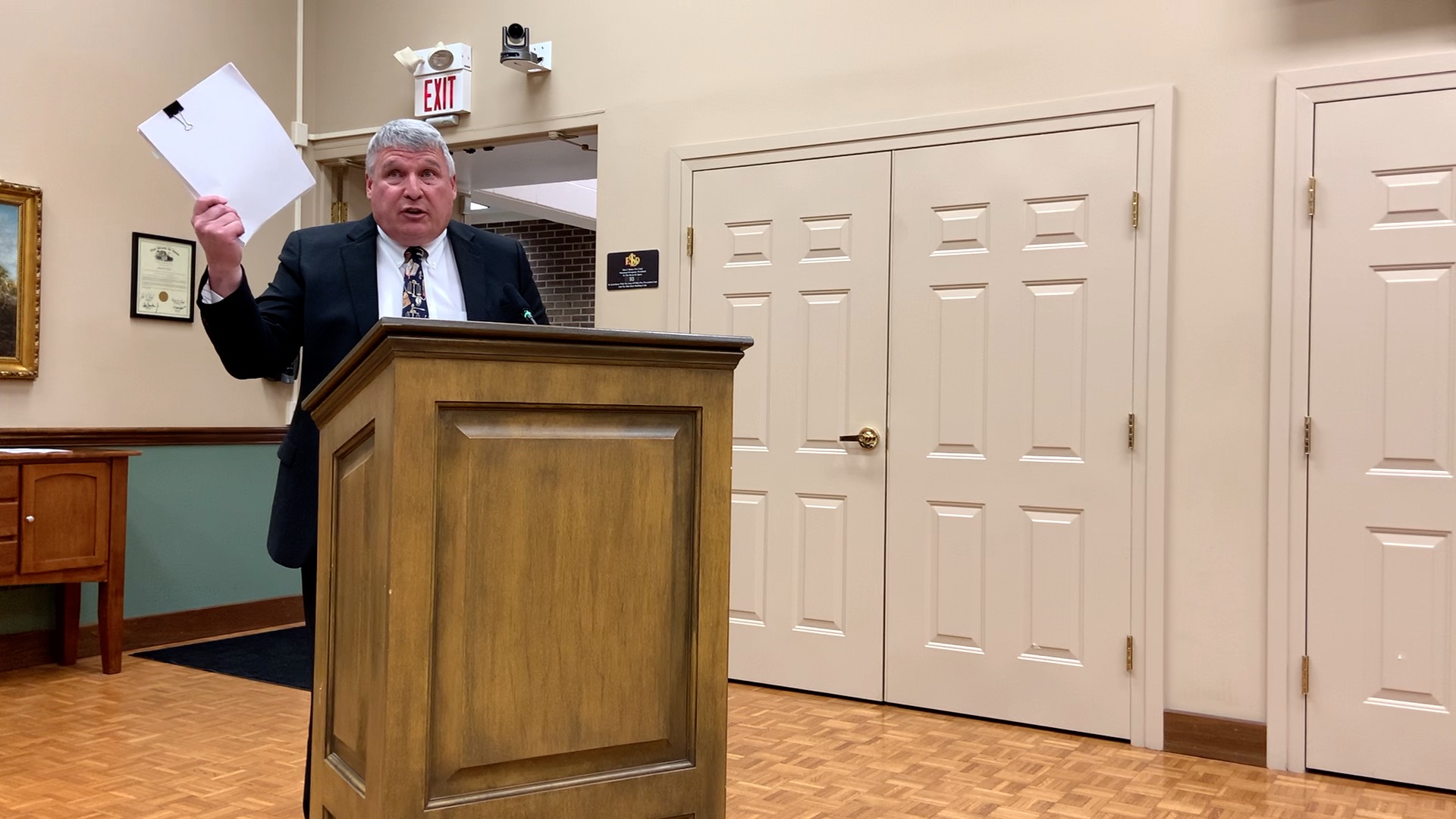
    Scovanner, a lawyer, said while holding up a large set of printed files, that although he has done the legal research, more is needed.

    At press time, it is unknown if the Commissioners signed the paperwork on Wednesday as Scovanner anticipated they might.

    EDITOR’S NOTE: The Clermont County Commission approved the Annexation by unanimous vote on Wednesday, October 27.

  • For 3rd time Zicka is back requesting condo approval

    For 3rd time Zicka is back requesting condo approval

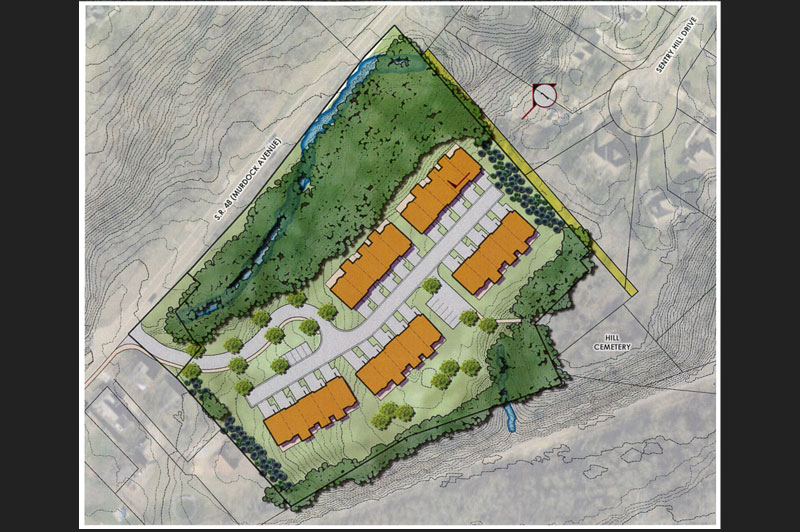
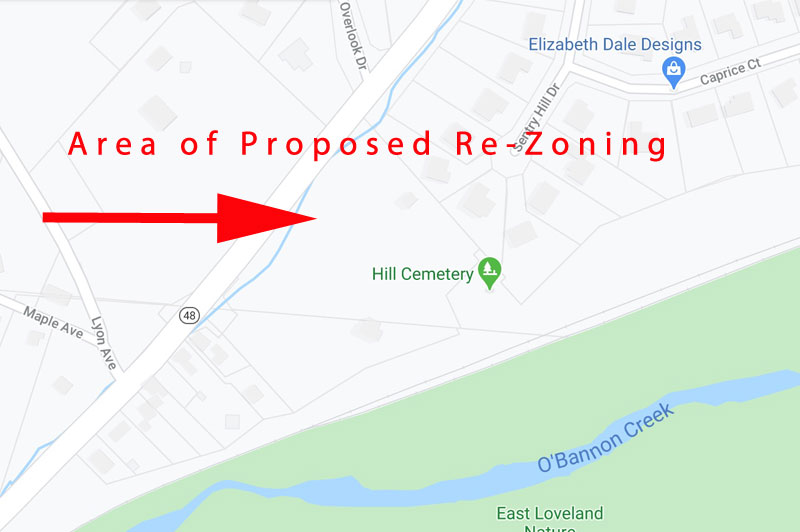
    Loveland, Ohio – Joe Farruggia with Zicka Homes has been trying to rezone property off North Second Street (St. Rt. 48) south of the Sentry Hill subdivision with the potential use to build a 28-unit condominium development called the Blossom Hill Project since the first week in June. He has submitted three variations of the proposal, the latest on October 20. The current proposal is to limit the project to 25 or fewer individual units.

    The site is approximately 5.5 acres on St. Rt. 48 adjacent to the Sentry Hill subdivision and on the opposite side of the street of the Loveland Health Care facility.

    Previously, on June 24th and July 21, the Planning and Zoning Commission held public hearings for the zoning map amendment and recommended approval of the amendment. However, each time, Farruggia chose not to move forward with the processes which would be to have a public hearing before the City Council.

    The latest iteration was also approved by the Planning Commission last week and sent to City Council for their consideration. The recommendation from Assistant City Manager Tom Smith is for Council to schedule a public hearing for the re-zoning on November 24.

    The developer is asking for changes to the Loveland Zoning Map from the current zoning of Medium Density Residential to Residential Multi-Family.

    The recommendation of the Commission according to Smith included the following conditions:

    1. The proposed housing development for the property as submitted o Planning and Zoning Commission must be actively under construction within eighteen (18) months from the date of approval by City Council in order to maintain the zoning;
    2. The approval shall be withdrawn, and the zoning shall revert to Residential Medium Density (R-MD) should the eighteen (18) month condition lapse.
    3. Approval shall be exclusive to this applicant. No transferees or assignees of the applicant are subject to this approval.

    Smith also said the developer agreed to requests made by Sentry Hill resident, Dave Stanton. These items were also part of the Planning and Zoning Commission’s motion for recommendation:

    1. Construct a four to five-inch earth berm, fully landscaped with trees and grass, to be constructed along the property line of the two homes in the Sentry Hill subdivision and maintained by the new subdivision’s HOA.
    2. Street lighting and exterior lighting on the townhomes be designed to prevent light pollution into the Sentry Hill Subdivision.
    3. Townhomes to be constructed, at 40 feet, shall not exceed the height of the referenced home of 214 Sentry Hill Drive.
    4. Limit the number of townhomes to be built at 25 or less.
    5. No dumpsters or centralized garage collection. Individual residential trash and recycling pickup to be consistent with all the residential surrounding areas.
    6. No stand-alone garages or sheds.
    7. Exterior architecture and materials (brick, stone, and Hardie Plank) shall be consistent with the look and feel of neighboring communities.

    Even though there are COVID 19 restrictions for the number of audience members in the hearing chamber, five residents appeared to express their displeasure with the re-zoning. No residents spoke in favor of the rezoning or the condos.

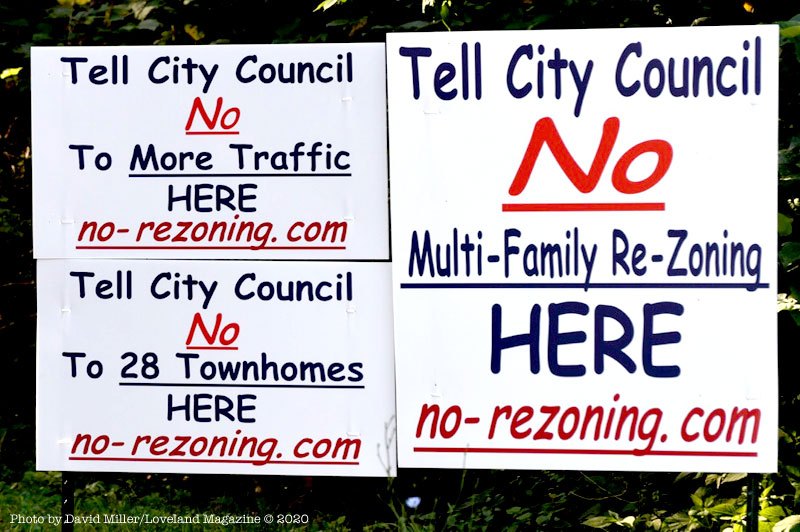
    These signs were erected in July by citizens opposed to multi-family zoning adjacent to their homes on St. Route 48 in North Loveland.

    Residents have pointed out that the proposal must follow the guidance of the City Master Plan specifically for North State Route 48. They say the project must maintain similar development densities, preserve open space, a rural atmosphere, and assure that there is adequate infrastructure to support the development as mandated in the current plan. They cite the current gridlock of Historic Downtown that must be addressed before the development moves forward.

    City Manager Dave Kennedy has argued that the current Comprehensive Strategic Plan (2002) is old and not in line with the current needs of the City. The City is currently rewriting a new master plan for the City. Residents say re-writing the plan is well and good, but until there is a new plan the City and Zicka are governed by the one that exists.

    Residents of South 48 also protest that adding so many residential units will add to their already current traffic nightmares of trying drive into and out of Historic Downtown.

    During the hearing, Tom Scovanner told the Commission they should be skeptical of the studies Zicka presented to them. One presenter represented that they had prepared their study for the Commission, and Scovanner said, “No, they represent Zicka.” He posed the question to the Commission of whether they would have ever seen the study if it did not turn out favorably to the developer.

    Scovanner, a litigator for Clermont County also said in no uncertain terms that the P&Z cannot do anything the Loveland law doesn’t allow them to do. Holding up the code, he said, “You’re bound by these codes. This doesn’t comport with the Comprehensive Master Plan.”

    Tom Scovanner spoke to Planning Commission against the re-zoning for condos on Rt. 48.

    Dave Stanton spoke to Planning Commission against the re-zoning for condos on Rt. 48.

    Sue Ann Walker spoke to Planning Commission against the re-zoning for condos on Rt. 48.

    Allen Brooks spoke to Planning Commission against the re-zoning for condos on Rt. 48.

    Courtney Hauck spoke to Planning Commission against the re-zoning for 28 condos on Rt. 48.

    You can view the application and proposal that is now before City Council in this document and going to page 14 b. 2020-10-27 City Council – Full Agenda-1355