Tag: trans athletes

  • “An attack on all trans people,” transgender youth speak out against Ohio legislation

    “An attack on all trans people,” transgender youth speak out against Ohio legislation

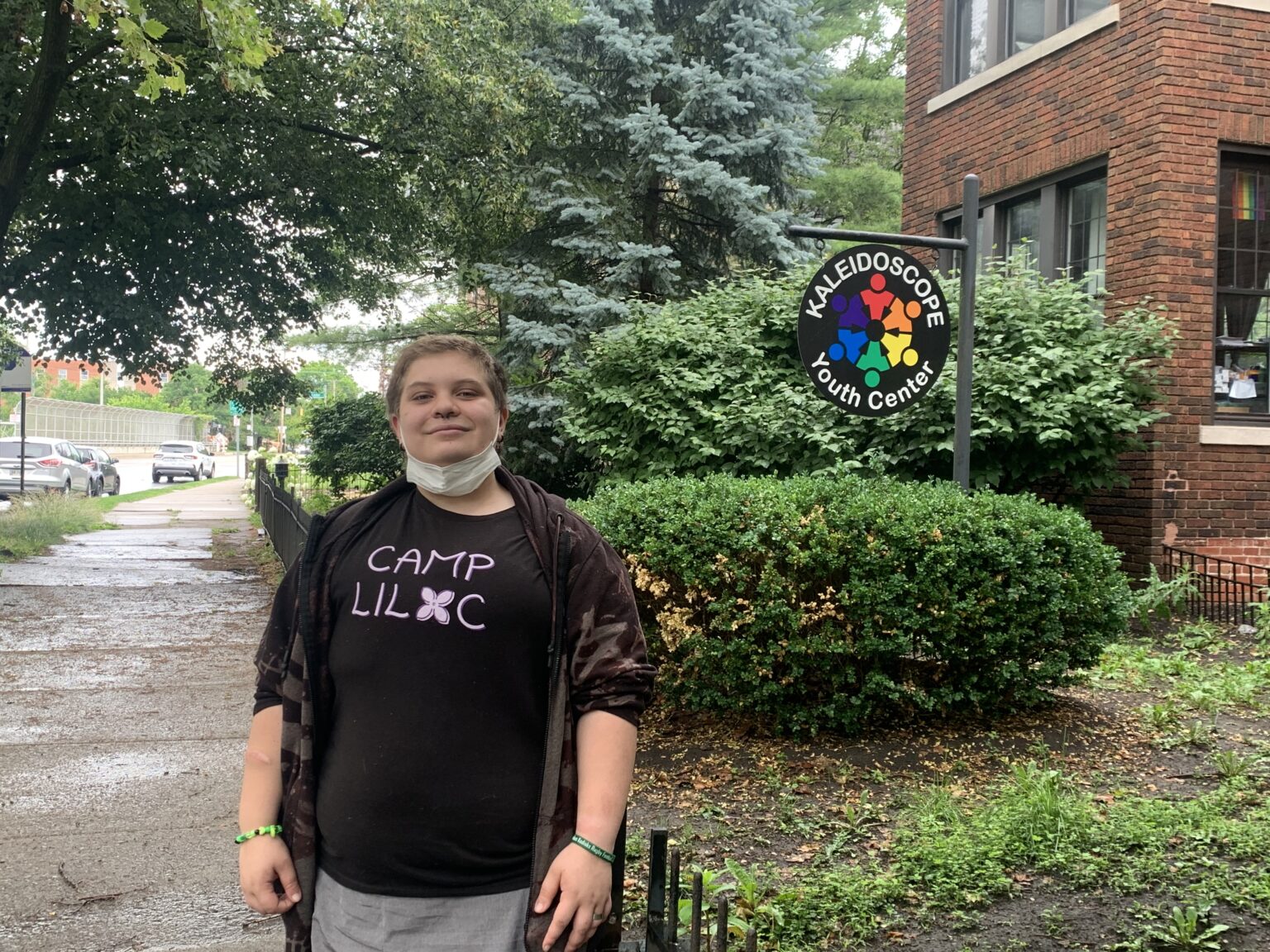
    Nathan Alvarez, 15, stands outside Kaleidoscope Youth Center on June 23. He is worried about a bill that would require K-12 schools and colleges to mandate that students could only use the bathroom or locker room that matches their sex assigned at birth. (Photo by Megan Henry, Ohio Capital Journal) Ohio Capital Journal talked to three transgender youths who are concerned about these bills and their potential implications.

    BY:  – Ohio Capital Journal

    Nathan Alvarez is used to people laughing or snickering at him when he uses the men’s bathroom.

    Despite that, the 15-year-old says his high school is one place he doesn’t have to worry about that happening because they have a couple of gender neutral bathrooms and anyone can use the men and women’s restroom.

    But a bill banning transgender students from being able to use the bathroom and locker room that aligns with their gender identity would change all that.

    State Reps. Beth Lear, R-Galena, and Adam Bird, R-New Richmond, recently introduced House Bill 183 which would require K-12 schools and colleges to mandate that students could only use the bathroom or locker room that matches their sex assigned at birth. HB 183 is still in House committee, awaiting sponsor testimony.

    “It would be hell (if the bill were to pass),” Alvarez said, who uses he/him pronouns. “Hearing about it disgusted me. Like it violently disgusted me.”

    HB 183 is one of a handful of anti-trans bills that have been introduced so far in the Ohio General Assembly.

    Doctors wouldn’t be able to give puberty blockers and hormone therapy to trans youth, trans athletes wouldn’t be able to participate in women’s sports, educators would be forced to out students to their parents and require public schools to give parental notification before teaching “sexuality content” if these various anti-trans bills pass through the Republican-controlled Ohio Statehouse.

    OCJ talked to three transgender youths who are concerned about these bills and their potential implications.

    “It’s an attack on all trans people,” said Ko Rupert, who uses she/it pronouns. “They are all uniquely bad, but their uniqueness is important.”

    And it’s not just happening in Ohio.

    There have been more than 220 bills introduced nationwide specifically targeting transgender and non-binary people, according to the Human Rights Campaign year-to-date snapshot from May 23.

    Fifteen laws have been enacted banning gender affirming care for transgender youth and four additional laws have been passed that censor school curriculum like books, according to HRC.

    “It’s very hard to see what’s been already happening in other states and how the bills that they are trying to pass here in Ohio are not even that different,” Jaylah Hollins, 19 said. “I feel like it’s not really in the interest of Ohioans, but only in the interest of anti-trans lobbyists from out of state.”

    House Bill 8

    Hollins is going to start attending Columbus State Community College this fall for social work and hopes to one day work for an organization that helps transgender people.

    “Hopefully if these bills don’t pass, we can try and make Ohio a place where it can be a refuge for trans kids and trans adults,” Hollins, said, who uses she/her pronouns. “Ensuring that trans kids have access to medical care and that adults have access to the facilities that align with their gender identity shouldn’t be politicized in the first place.”

     An advocate for the rights of trans children and their parents holds up a sign. Photo by Morgan Trau, WEWS. 

    While she said all the anti-trans bills are harmful, House Bill 8 stands out to her as the most damning.

    State Reps. D.J. Swearingen, R-Huron, and Sara Carruthers, R-Hamilton, introduced HB 8 which would require public schools to give parents a heads up before teaching “sexuality content” and school staff would have to out students to their parents. HB 8 recently passed the Ohio House.

    “I feel like they don’t see it as putting children in harm’s way when it most likely is because you can’t expect a parent to be able to deal with knowing that their child is within an LGBT umbrella and not have to try and resort to what they may not see at the time as harmful approaches to their child’s identity,” Hollins said.

    She said these bills would prevent children from learning more about themselves and make them feel as though they deserved to be punished because of how they identify.

    “It won’t allow children to be able to understand others who are maybe different from them,” Hollins said. “It will encourage isolation and I think the most devastating would be suicidal ideation, especially with trans and non-binaries who already know that they are coming from families who are unaccepting of those identities.”

    She’s said she’s still debating if she’ll stay in Ohio after college.

    “It’s still hard for me to think about, but for me, I think I would want to stay in Ohio and fight for trans youth,” Hollins said.

    Rupert, a 20-year-old Ohio State University graduate student, is also worried about HB 8 and the stripping away of youth rights.

    “Young people can make decisions, can know their bodies and understand and have a deep relationship with their gender and sexuality and romantic orientations,” Rupert said.

    Alvarez tries to speak out against the anti-trans bills when he gets the chance and even recently appeared on Good Morning America. But he’s not old enough to vote.

    “It’s upsetting to know that there are adults making choices for people to make choices about me. And I don’t have a choice,” Alvarez, of Reynoldsburg, said. “It’s scary.”

    He hopes to move out of Ohio one day and relocate to Washington.

    Anti-trans and anti-LGBTQ bills

    House Bill 68, also known as the  Save Adolescents from Experimentation Act (SAFE Act), would prevent doctors from giving puberty blockers and hormone therapy to trans youth. It would also ban physicians from performing gender reassignment surgery on a minor.

    Many opponents, however, have testified that no Ohio children’s hospital currently performs gender-affirming surgery on those under 18.

    House Bill 6 would prevent trans athletes from participating in Ohio women’s sports and was woven into HB 68, which recently passed the House and now awaits Senate committee consideration.

    Follow OCJ Reporter Megan Henry on Twitter.

    ______________________

    Megan Henry
    MEGAN HENRY

    Megan Henry is a reporter for the Ohio Capital Journal and has spent the past five years reporting in Ohio on various topics including education, healthcare, business and crime. She previously worked at The Columbus Dispatch, part of the USA Today Network.

    MORE FROM AUTHOR

  • Ohio education overhaul falls short

    Ohio education overhaul falls short

    BY: SUSAN TEBBEN – Ohio Capital Journal

    The Ohio House did not agree to Senate amendments to a bill banning trans athletes from participating in youth sports based on their gender identity, leaving behind more than a thousand pages of state education overhauls loaded in at the last minute.

    House Bill 151, with language from Senate Bill 178 attached to it was voted down in the House by a 46-41 vote after 2 a.m. on Thursday morning following an entire day of hemming and hawing.

    The education overhaul is not completely done yet. Even if lawmakers decline to move forward in the current General Assembly, Senate President Matt Huffman previously pledged to bring the bill back in the new year, with a General Assembly that will have an even larger GOP supermajority.

    The education overhaul part of the bill, which entered the House as a standalone this week after passing the Senate last week, would have restructured the Ohio Department of Education into the Department of Education and Workforce, and reduced the state Board of Education roles down to superintendent searches, teacher conduct and licensure issues.

    “The system is not working, it doesn’t prioritize our students,” said bill sponsor state Rep. Don Jones, R-Freeport.

    The department, and most of the roles currently under the state board of ed and state superintendent’s purview would have been put under the governor’s office umbrella, according to the bill.

    The State Board of Education put off hiring a search firm for the next superintendent due to concerns about budgetary changes SB 178 might bring and fears the legislative uncertainty might “pollute” the marketplace of candidates.

    The bill also received pushback from public school education advocates and some homeschooling groups. The Ohio Education Association and the Ohio Federation of Teachers both spoke against the bill in committee hearings, not only decrying claims that the ODE was unresponsive and inaccessible, but also criticizing the pace at which the bill came through the General Assembly.

    SB 178 sponsor state Sen. Bill Reineke, R-Tiffin, said attempts to redo the state agencies have been years in the making and urgency is needed to help improve student success.

    “I’m not looking at growing an organization; I’m looking at making it more efficient and more structurally purposeful,” Reineke said on Tuesday as he defended his bill in House Primary and Secondary Education Committee.

    It was up to that committee to pass the standalone bill over to the House for a full vote, something that didn’t happen in a Tuesday night committee that went until about 9 p.m., or a Wednesday morning meeting that recessed before the House’s session began, and didn’t return even after multiple recesses in that body.

    When committee chair state Rep. Gayle Manning, R-North Ridgeville, was asked the status of the bill or the committee at about 9 p.m. Wednesday night, she said she was waiting to see what the GOP caucus was thinking on the matter.

    Amidst the day-long discussion, the Senate decided to take matters into its own hands, inserting SB 178 into HB 151, originally meant to be a teacher mentorship bill that was made to include a ban on athletes competing on teams based on their gender identity.

    The Senate also tried to slide in language from a bill that would have banned COVID-19 vaccine mandates for K-12 students.

    After the additions, HB 151 passed on a party-line 23-7 vote in that chamber, moving it back to the House.

    The controversial part of HB 151 was added in another late-night move in June, when HB 151 was up for passage in the House before moving on to the Senate. The trans athletes part of the bill no longer includes a requirement for genital inspections of children suspected of being transgender, something Senate President Matt Huffman previously said he wouldn’t support.

    Verification of a student’s gender will be done using a birth certificate in the new version of the bill.

    The bill’s sponsor, state Rep. Don Jones, R-Freeport, wouldn’t speak on the trans athletes part of the bill when he introduced the bill in the Senate, but on the House floor he stood in support of it.

    “This bill only applies to K-12 education, so our daughters in grades kindergarten through 12 will not have to compete with biological males in primary and secondary schools,” Jones said.

    The bill would impact very few Ohio students and policies are already in place to keep equality in youth sports, causing LGBTQ advocates, education leaders and the Ohio High School Athletic Association to stand against the bill as unnecessary.

    The original language of the bill would make changes to the Ohio Teacher Residency Program and teacher mentorship.

    Democrats pushed hard for the House not to support the bill as amended, saying stakeholders needed to be involved and more time was needed to find out the impact of it.

    State Rep. Phil Robinson, D-Solon, continued an argument made by critics of the bill that the volume of the bill didn’t get the proper review by legislators or individuals in Ohio education.

    “Passing something at 1 o’clock or 2 o’clock in the morning that no one’s read and no one’s seen … is not the way to change education in the state of Ohio,” Robinson said.

    State Rep. Jeff Crossman, D-Parma, said the bill was “moving deck chairs on a sinking ship” by addressing issues that don’t solve the true problems in Ohio education.

    State Rep. Juanita Brent, D-Cleveland, said the bill would impact economic success in Ohio by making conferences question coming to the state and businesses wonder whether or not to bring employees to the state. She also said passage of the bill in the middle of the night would send a message to current Ohio voters as well.

    “We’re telling Ohioans who elected us that they can’t be seen in this process,” Brent said.