Tag: transgender children

  • Ohio’s transgender bathroom ban bill could face legal challenges if it passed, attorney says

    Ohio’s transgender bathroom ban bill could face legal challenges if it passed, attorney says

    Getty Images.

    Bathroom ban laws have been challenged in Florida, Oklahoma, Idaho and Tennessee.

    Jean Schmidt (R) who represents Ohio House District 62 is a co-sponsor of HB 183.
    Jennifer Gross (R) who represents Ohio District 45 is a co-sponsor of HB 183.
    Thomas Hall (R) who represents Ohio District 46 is a co-sponsor of HB 183.

    Bill Seitz (R) who represents Ohio District 30 is a co-sponsor of HB 183.

    Adam C. Bird (R) who represents Ohio District 63 is a Primary Sponsor of HB 183.

    BY:  Ohio Capital Journal

    The Ohio House recently passed a transgender bathroom and locker room ban bill, but states that have passed similar bills have gone on to face legal challenges.

    Arkansas, Idaho, IowaKentuckyOklahoma, Tennessee, AlabamaLouisianaMississippiNorth Dakota, Florida, and Utah all have laws on the books that ban transgender people from using the bathroom that aligns with their gender identity in schools.

    These laws have been challenged in Florida, Oklahoma, Idaho, and Tennessee. The U.S. Court of Appeals for the 9th Circuit blocked Idaho’s law in the fall.

    Ohio’s bill would require K-12 schools and universities to mandate that students only be able to use the bathroom or locker room that matches their gender assigned at birth. It would not prohibit a school from having single-occupancy facilities and it would not apply to someone helping a person with a disability or a child younger than 10 years old being assisted by a parent, guardian, or family member.

    The bathroom ban bill, which was tucked into Senate Bill 104 at the end of a marathon House session, heads back to the Ohio Senate for concurrence. The lawmakers are currently on summer break, so that won’t happen anytime soon.

    Ohio Gov. Mike DeWine has indicated he would sign the bill if it came to his desk.

    “As it stands now, I would sign the bill,” he told reporters on Friday.

    Lawsuits would be filed if Ohio passes the bill, said Cleveland attorney Robert Chaloupka.

    “There’s good reason to believe that if the (Ohio) Attorney General decides to defend this case, they’re going to lose, which means we’re spending taxpayer money on something that we have a good sense of how it’s going to go,” he said.

    Chaloupka sees lots of legal challenges with Ohio’s bill.

    “My most critical point about this is who’s going to police this?” Chaloupka asked.

    He thinks this would be especially challenging in a university setting where there are non-traditional students.

    “You’re going to regulate where a 75 year olds trans individual goes to the bathroom?” Chaloupka said.

    The Supreme Court declined to weigh in earlier this year on whether schools can ban transgender students from using a restroom that reflects their gender identity. That denial left in place a U.S. Court of Appeals for the 7th Circuit decision that allowed a transgender middle school Indiana boy to use the boys’ restroom.

    The American Medical Association officially opposes policies preventing transgender individuals from accessing basic human services and public facilities consistent with gender identity.

    “Banning transgender students from freely and safely accessing public places, like bathrooms and changing rooms, sends the message that transgender children do not belong,” Ash Orr, spokesperson for the National Center for Transgender Equality, said in an email. “Everybody should be able to safely access public places without fear of persecution or harassment.”

    Utah’s bathroom ban law — which went into effect in May— applies to K-12 schools and all government-owned buildings.

    “Using the bathroom is a human function that everybody needs to be able to do, and bathrooms can tend to feel like vulnerable spaces, so I think the real concern is that people will feel uncomfortable in a bathroom setting and choose not to use the bathroom at all, which obviously can lead to health issues,” said Equality Utah’s Policy Director Marina Lowe.

    What happened in North Carolina?

    North Carolina was the first state to limit bathroom access to transgender people in 2016 when they enacted a law that banned transgender people from using the restroom that matched their gender identity in most public spaces.

    The backlash was swift and ended up costing the state hundreds of millions of dollars. The NBA moved its 2017 All-Star game from Charlotte to New Orleans. The ACC’s 2016 championship football game was moved from Charlotte to Orlando. Pearl Jam, Bruce Springsteen and Ringo Starr canceled their North Carolina shows.

    North Carolina’s law was repealed in 2017 and ultimately settled in federal court in 2019.

    Follow OCJ Reporter Megan Henry on Twitter.


    Megan Henry
    MEGAN HENRY

    Megan Henry is a reporter for the Ohio Capital Journal and has spent the past five years reporting in Ohio on various topics including education, healthcare, business and crime. She previously worked at The Columbus Dispatch, part of the USA Today Network.

    Ohio Capital Journal is part of States Newsroom, the nation’s largest state-focused nonprofit news organization.

    MORE FROM AUTHOR

  • Ohio families with transgender children relieved DeWine vetoed HB 68, worry about potential override

    Ohio families with transgender children relieved DeWine vetoed HB 68, worry about potential override

    A transgender Pride flag is covered with the words “Hands Off Trans Youth.” (Photo by Greg LaRose/Louisiana Illuminator/States Newsroom)

    The Ohio House will be in session next Wednesday and the Senate’s next scheduled session is Jan. 24.

    BY:  Ohio Capital Journal

    The Burkle family huddled together to watch last week’s press conference where Ohio Gov. Mike DeWine vetoed a controversial bill that would have banned gender-affirming care for transgender youth.

    “It was a brief sigh of relief,” mom Alicia Burkle said. “We were crying and hugging.”

    Their 10-year-old daughter Astrid has socially transitioned, but has not yet started puberty blockers.

    Ohio House Bill 68 would prevent transgender athletes from playing women’s sports and would ban transgender youth from accessing gender-affirming care, including puberty blockers and hormone therapy. DeWine said during last week’s press conference his focus was on the health care component of the bill.

    The Burkles figured they had a couple of weeks before the lawmakers returned from winter break, but the Ohio House announced they will have session next Wednesday, Jan. 10. The Ohio Senate’s next schedule session is Jan. 24.

    “It’s just so hurtful and it’s exhausting,” Burkle said.

    The Ohio Capital Journal talked to three families with transgender children who were relieved DeWine vetoed HB 68, but are now concerned the legislature could override his veto.

    “We do know that this was a math problem also and that the veto was not necessarily the end,” said Nick Zingarelli, the father of a transgender teenager.

    A three-fifths vote of the members of the House and Senate is necessary to override the governor’s veto — meaning 60 representatives and 20 senators.

    HB 68 passed in December with 24 votes in the Senate and 62 votes in the House. State Sen. Nathan Manning was the lone Republican senator to vote against the bill in December. Republican state Reps. Jamie Callender and Brett Hillyer voted against the bill when it originally passed the House with 64 votes in June.

    Ohio House Speaker Jason Stephens, R-Kitts Hill, said last week he was disappointed in DeWine’s veto.

    “We will certainly discuss as a caucus and take the appropriate next steps,” Stephens said in a statement.

    Burkle family

    When the Ohio House and Senate passed HB 68 on Dec. 13, the Burkles launched into action mode by asking their doctor what next steps they can take as well as emailing and calling DeWine. Astrid even sent DeWine some handwritten letters.

    “We really didn’t get to truly enjoy the holiday because we were just so anxious about what was going to happen,” Alicia Burkle said.

    Astrid is not currently on puberty blockers and wouldn’t be covered under the grandfather clause that would allow doctors who already started treatment on patients to continue.

    “We don’t know that she would be (on puberty blockers) before the bill were to take effect, if it were to pass,” Alicia Burkle said.

    DeWine said he would pursue administrative rules banning gender-affirming surgery on minors, collecting data, and combating clinics that might pop up to try to perform ideologically-driven care. No Ohio children’s hospital currently performs gender-affirming surgery on those under 18.

    “Those are all really reasonable concessions,” Burkle said.

    The Cleveland-area family doesn’t want to move out-of-state, and hopes it doesn’t get to that point.

    “It’s certainly one of the options that we’re keeping open if that’s what we’re forced to do,” Burkle said.

    The Scagliones

    While Kat Scaglione was impressed with DeWine’s veto, she said it feels like sitting in limbo waiting to see what happens next.

    “What if this override happens?” she asked. “It feels like we’ve almost backpedaled and we’re back to where we started.”

    She has a 14-year-old transgender daughter, a 13-year-old cisgender son, and a 10-year-old transgender daughter.

    Amity, 14, is past the point of being able to get puberty blockers and is waiting on hormone treatment.

    “I am supposed to be worrying about the next test I have to study for,” Amity said. “Not whether my rights are going to disappear. …  It’s very scary to have that thought looming over your head, like all the time.”

    Kat said waiting on the governor’s decision overshadowed the holiday season.

    “My kids were sitting there writing Christmas lists and writing letters to send to the governor and to the representatives,” she said. “It didn’t feel like much of a holiday this year.”

    Zingarelli family

    The Zingarelli family celebrated DeWine’s veto.

    “It was we’re going to take the next few days just to savor this victory, because it was a huge victory,” father Nick Zingarelli said.

    His 14-year-old daughter is treated by Cincinnati Children’s Hospital Medical Center, so she would be able to continue receiving care under the grandfather clause but he wants to make sure all Ohio kids would have access to this kind of care.

    He hopes DeWine’s veto will give other Republican lawmakers pause.

    “I would hope that they would listen to the elected leader from their own party, and then consider that and say, ‘Am I on the wrong side of this issue?’ … We’re not gonna roll over on this battle. If they win in the legislature, we will see them in court,” he said.

    Follow OCJ Reporter Megan Henry on X.

    ___________

    Megan Henry
    MEGAN HENRY

    Megan Henry is a reporter for the Ohio Capital Journal and has spent the past five years reporting in Ohio on various topics including education, healthcare, business and crime. She previously worked at The Columbus Dispatch, part of the USA Today Network.

    MORE FROM AUTHOR

  • Parents have no right to allow their children’s gender transition, Republicans say

    Parents have no right to allow their children’s gender transition, Republicans say

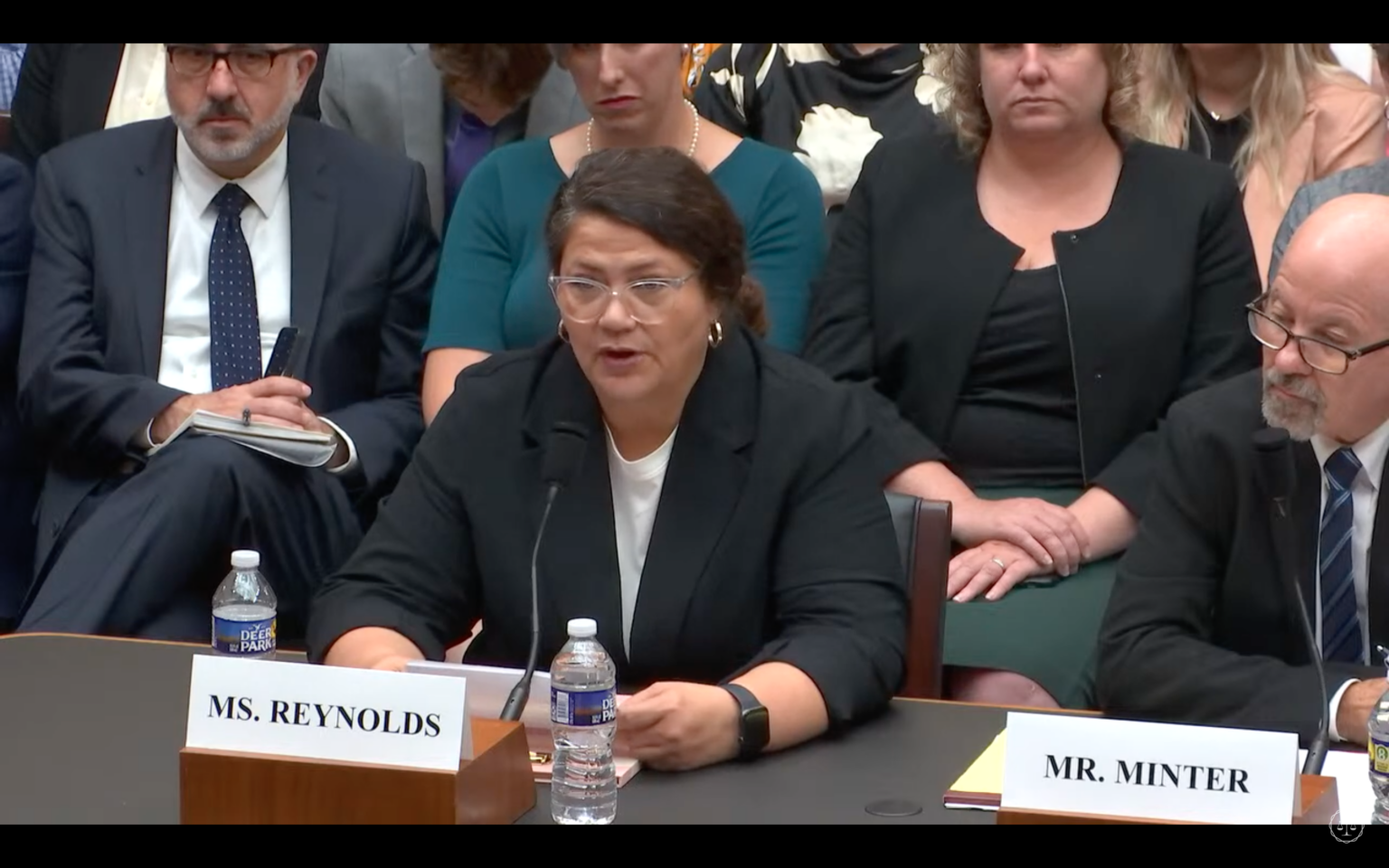
    Myriam Reynolds of Texas, the mother of a transgender son, said before he received care, he was unhappy and she has “no doubt that the health care my son accessed was life-saving.” (Screenshot from committee webcast)


    WASHINGTON — U.S. House Republicans on a panel for limited federal government on Thursday argued that parents should not be allowed to let their transgender children have access to gender-affirming care.

    “A parent has no right to sexually transition a young child,” the chair of the House Judiciary Subcommittee on the Constitution and Limited Government, Rep. Mike Johnson of Louisiana, said at a hearing on transgender youth. “Our American legal system recognizes the important public interest in protecting children from abuse and physical harm. No parent has a constitutional right to injure their children.”

    Johnson, and several other Republicans, floated the idea that the federal government should get involved, but did not offer specifics on potential legislation. They argued that gender-affirming surgery should not be allowed for transgender minors. That type of surgery is rarely performed on patients under 18.

    In Johnson’s home state, the Louisiana Legislature in early July voted to override a veto from Gov. John Bel Edwards, allowing a ban on gender-affirming health care for transgender youth to become law.

    Thursday’s hearing reflects a broader trend. At least 21 Republican-led states have passed laws banning or restricting gender-affirming care for minors, according to the Movement Advancement Project, an organization that tracks LGBTQ+ state policies.

    The wave of legislation has had a chilling effect on health care providers, who are wary of providing other care to transgender youth, such as mental health and other medical care.

    Gender-affirming care can be social affirmations such as adopting a hairstyle or clothes that align with a transgender youth’s gender identity, or the use of puberty blockers and hormone therapy. Typically, in adulthood it can be gender-affirming surgery.

    “When our Republican colleagues allege that gender-affirming care raises particular dangers or due process issues, that is fearmongering at its worst,” the top Democrat on the panel, Rep. Mary Gay Scanlon of Pennsylvania, said. “Picking on already vulnerable kids in order to stir up chaos that they hope to ride to success at the ballot box.”

    Democrats said the hearing is a pattern of GOP lawmakers attacking transgender kids and their families.

    Scanlon said that barring parents from making those decisions would be in violation of their parental rights. Republicans passed legislation for a federal “Parents Bill of Rights” in March pertaining to access to education-related materials.  

    State laws

    Several federal courts have either blocked or struck down state laws banning gender-affirming care for transgender youth, such as in AlabamaArkansasFlorida and Indiana.

    The top Democrat on the House Judiciary Committee, Rep. Jerry Nadler of New York, asked one of the Democratic witnesses, Shannon Minter, an attorney, what the federal courts have concluded about states moving to pass bans on gender-affirming care.

    Minter, who is the legal director of the National Center for Lesbian Rights and is also transgender, said the federal courts have found that those state laws “severely burden parents’ fundamental rights to make medical decisions for their own children.”

    “They’re blatantly discriminatory,” he said. “They violate the guarantee of equal protection because they do something that has just never been done before in this country, which is single out a particular group of people, transgender young people, in order to deny them medical care.”

    Despite the federal court cases, Johnson argued that states have the right to regulate gender-affirming care, such as puberty blockers.

    Puberty blockers were first approved by the Food and Drug Administration in 1993 to temporarily pause puberty in children who were going through it too early. When used in gender-affirming care for transgender youth, those adolescents can choose to start hormone therapy, in which they receive either estrogen or testosterone treatments, whichever one that aligns with their gender identity.

    “We’re limited government conservatives, right,” Johnson said. “We obviously recognize that parents have a natural and fundamental right to the bringing up of their children to make decisions with regard to their care and custody and control. But at the same time, our legal system in this country, our law does not allow a parent to physically or mentally abuse or harm a child.”

    May Mailman a senior legal fellow at the Independent Woman’s Law Center, a conservative advocacy organization, said states should be able to regulate who can have access to transgender health care.

    “Unfortunately, I think you’re seeing this movement that states should not be able to regulate the practice of medicine and somehow federal judges should,” she said.

    Life-saving care

    One of the Democratic witnesses, Myriam Reynolds, is the mother of a transgender son. She said before he received care, he was unhappy and she has “no doubt that the health care my son accessed was life-saving.”

    Reynolds said any health care provided to her son was through slow and careful decisions that were approved by her and her husband and that their son always had the opportunity to stop if he wanted to. He received puberty blockers as well as counseling.

    “When my child came out, as transgender, there was not the hysteria that there is now about this,” she said. “To be looked at as a child abuser, or you know an indoctrinate or something like that, it feels very hateful and divisive.”

    Texas Republican Rep. Wesley Hunt said that instead of parents jumping to gender-affirming care when a child tells them they have gender dysphoria, meaning their gender identity differs from the sex they were assigned at birth, they should instead question “the root cause of that feeling.”

    He compared that decision to his toddlers, whom if they could “have their way, they would have ice cream for breakfast, lunch and dinner and for every single meal in between. Oh, the wisdom of children.”

    “In a sane country, we know that children aren’t mature enough to make adult decisions that will impact the rest of their lives, that’s why we have parents,” he said. “Children cry for ice cream, but as parents, we have the wisdom to know that ice cream is not in their best interests, particularly their long-term interest.”

    He said that in 2024, Republicans will have an opportunity to “stop all this foolishness.”

    Florida Republican Rep. Matt Gaetz, who is not a member of the panel, took aim at a recently passed law in Washington that protects transgender youth seeking gender-affirming care who are estranged from their parents.

    “I am against transitioning children against the will of their parents,” he said.

    Title IX

    Several of the Republican witnesses criticized the Department of Education’s new rule that updates Title IX to allow transgender youth who attend public schools from competing in sports that align with their gender identity.

    The rule came as states with Republican state legislatures have passed laws banning transgender students from competing in sports that align with their gender identity.

    One of the witnesses, Paula Scanlan, is a former NCAA athlete who swam at the University of Pennsylvania and shared a locker room with Lia Thomas, the first openly trans woman to compete in the NCAA women’s division. Scanlan said she opposed the Biden administration’s changes to Title IX and that transgender women should not be allowed to compete in sports that align with their gender identity.

    House Republicans recently passed legislation to ban transgender girls from competing in the sports that align with their gender identity, a move that mirrors legislation passed by Republican-controlled state legislatures.

    Mailman, with the Independent Woman’s Law Center, said that gender ideology has destroyed “women and girls, by dissolving legal protections for women in athletics.”

    Reynolds said as soon as her son came out as transgender, he stopped playing sports because of the rhetoric about transgender athletes competing in sports that align with their gender identity.

    “That left a big hole in his life,” she said.


    Ariana Figueroa
    ARIANA FIGUEROA

    Ariana covers the nation’s capital for States Newsroom. Her areas of coverage include politics and policy, lobbying, elections and campaign finance.

    MORE FROM AUTHOR