The Burkle family huddled together to watch last week’s press conference where Ohio Gov. Mike DeWine vetoed a controversial bill that would have banned gender-affirming care for transgender youth.
“It was a brief sigh of relief,” mom Alicia Burkle said. “We were crying and hugging.”
Their 10-year-old daughter Astrid has socially transitioned, but has not yet started puberty blockers.
Ohio House Bill 68 would prevent transgender athletes from playing women’s sports and would ban transgender youth from accessing gender-affirming care, including puberty blockers and hormone therapy. DeWine said during last week’s press conference his focus was on the health care component of the bill.
The Burkles figured they had a couple of weeks before the lawmakers returned from winter break, but the Ohio House announced they will have session next Wednesday, Jan. 10. The Ohio Senate’s next schedule session is Jan. 24.
“It’s just so hurtful and it’s exhausting,” Burkle said.
The Ohio Capital Journal talked to three families with transgender children who were relieved DeWine vetoed HB 68, but are now concerned the legislature could override his veto.
“We do know that this was a math problem also and that the veto was not necessarily the end,” said Nick Zingarelli, the father of a transgender teenager.
A three-fifths vote of the members of the House and Senate is necessary to override the governor’s veto — meaning 60 representatives and 20 senators.
HB 68 passed in December with 24 votes in the Senate and 62 votes in the House. State Sen. Nathan Manning was the lone Republican senator to vote against the bill in December. Republican state Reps. Jamie Callender and Brett Hillyer voted against the bill when it originally passed the House with 64 votes in June.
Ohio House Speaker Jason Stephens, R-Kitts Hill, said last week he was disappointed in DeWine’s veto.
“We will certainly discuss as a caucus and take the appropriate next steps,” Stephens said in a statement.
Burkle family
When the Ohio House and Senate passed HB 68 on Dec. 13, the Burkles launched into action mode by asking their doctor what next steps they can take as well as emailing and calling DeWine. Astrid even sent DeWine some handwritten letters.
“We really didn’t get to truly enjoy the holiday because we were just so anxious about what was going to happen,” Alicia Burkle said.
Astrid is not currently on puberty blockers and wouldn’t be covered under the grandfather clause that would allow doctors who already started treatment on patients to continue.
“We don’t know that she would be (on puberty blockers) before the bill were to take effect, if it were to pass,” Alicia Burkle said.
DeWine said he would pursue administrative rules banning gender-affirming surgery on minors, collecting data, and combating clinics that might pop up to try to perform ideologically-driven care. No Ohio children’s hospital currently performs gender-affirming surgery on those under 18.
“Those are all really reasonable concessions,” Burkle said.
“It’s certainly one of the options that we’re keeping open if that’s what we’re forced to do,” Burkle said.
The Scagliones
While Kat Scaglione was impressed with DeWine’s veto, she said it feels like sitting in limbo waiting to see what happens next.
“What if this override happens?” she asked. “It feels like we’ve almost backpedaled and we’re back to where we started.”
She has a 14-year-old transgender daughter, a 13-year-old cisgender son, and a 10-year-old transgender daughter.
Amity, 14, is past the point of being able to get puberty blockers and is waiting on hormone treatment.
“I am supposed to be worrying about the next test I have to study for,” Amity said. “Not whether my rights are going to disappear. … It’s very scary to have that thought looming over your head, like all the time.”
Kat said waiting on the governor’s decision overshadowed the holiday season.
“My kids were sitting there writing Christmas lists and writing letters to send to the governor and to the representatives,” she said. “It didn’t feel like much of a holiday this year.”
Zingarelli family
The Zingarelli family celebrated DeWine’s veto.
“It was we’re going to take the next few days just to savor this victory, because it was a huge victory,” father Nick Zingarelli said.
His 14-year-old daughter is treated by Cincinnati Children’s Hospital Medical Center, so she would be able to continue receiving care under the grandfather clause but he wants to make sure all Ohio kids would have access to this kind of care.
He hopes DeWine’s veto will give other Republican lawmakers pause.
“I would hope that they would listen to the elected leader from their own party, and then consider that and say, ‘Am I on the wrong side of this issue?’ … We’re not gonna roll over on this battle. If they win in the legislature, we will see them in court,” he said.
Megan Henry is a reporter for the Ohio Capital Journal and has spent the past five years reporting in Ohio on various topics including education, healthcare, business and crime. She previously worked at The Columbus Dispatch, part of the USA Today Network.
JANUARY 31: Ohio Governor Mike DeWine gives the State of the State Address, January 31, 2023, in the House Chamber at the Statehouse in Columbus, Ohio. (Photo by Graham Stokes for Ohio Capital Journal. Republish photo only with original story.)
Republican Ohio Gov. Mike DeWine has vetoed legislation that would have prohibited transgender youth from accessing gender-affirming care. His veto shoots down the controversial bill, which would also stop middle and high school trans students from participating in athletics with cisgender peers.
He announced the decision in a press conference Friday morning, the last day that he was allowed to veto it.
DeWine said he listened to the bill’s sponsor and also listened to physicians at the five children’s hospitals in Ohio. He said he listened to families of youth, some who had negative experiences and detransitioned, as well as those who said gender-affirming treatment saved their child’s life.
“They told me their child is alive only because they received care,” he said, adding that he thinks people on both sides truly believe they are trying to protect youth.
While the law would impact only a very small number of children, the consequences of the bill would be profound, DeWine said.
“Ultimately, I believe this is about protecting human life,” he said. Both parents of trans kids and adults who received care told him that the care saved their lives.
“These are gut-wrenching decisions that should be made my parents and should be informed by teams of doctors who are advising them. These are parents who have watched their children suffer for years, and have real concerns their children would not survive without it… Families are basing their decisions on the best medical advice they can get.”
While he vetoed the bill, DeWine said he would pursue administrative rules to help address several concerns, including the banning of gender-affirming surgery on minors (which currently is not practiced in Ohio). He also is looking at administrative rules to collect data, and to combat clinics that might pop up to try to perform ideologically-driven care, which he said was a concern from both sides of the issue.
What happens now?
Trans youth, LGBTQ+ rights advocates and doctors are rejoicing at the decision.
However, the lawmakers against the bill have another option to take away rights for trans children: The House and the Senate can override the governor on his veto. There may be an effort to do this, but it is possible it doesn’t have enough votes, according to one Republican lawmaker who originally voted in favor of the bill.
A three-fifths vote of the members of the House and Senate is necessary to override the governor’s veto — meaning 60 representatives and 20 senators. The bill passed forward with 64 representatives originally (62 after amendments) and 24 senators. Only three Republicans have publicly been against the bill. When it was passing the House, Republican state Reps. Jamie Callender and Brett Hillyer voted against it. In the Senate, state Sen. Nathan Manning voted against it. All the GOP no votes came from Northeast Ohio lawmakers.
In a one-on-one interview with Statehouse reporter Morgan Trau just a week before his decision, DeWine explained the research he was doing into H.B. 68.
Morgan Trau: “Are you going to sign [H.B. 68]?”
Governor DeWine: “Well, this is something that I’m really thinking a lot about… So I went to children’s hospital here in Columbus; I went to the children’s hospital in Akron and children’s hospital in Cincinnati — just to see how they do it, what kind of care they give to these young people. But I’ve also talked to opponents who don’t think that kind of care is appropriate… I’ve also talked to families who have told me that care is just vitally important and save their child’s life. So I’m trying to weigh all this and trying to get as much information together.”
Morgan Trau: “You’ve always been somebody to care about children, but also parental rights. How would you reckon with signing this?”
Governor DeWine: “I really don’t want to get too deeply into this… We’ve got to get this — I have to get this right… There’s a lot of testimony in the Statehouse that you covered and I want to look at that testimony — both pro and con.”
MORGAN TRAU
Morgan Trau is a political reporter and multimedia journalist based out of the WEWS Columbus Bureau. A graduate of Syracuse University’s S.I. Newhouse School of Public Communications, Trau has previously worked as an investigative, political and fact-checking reporter in Grand Rapids, Mich. at WZZM-TV; a reporter and MMJ in Spokane, Wash. at KREM-TV and has interned at 60 Minutes and worked for CBS Interactive and PBS NewsHour.
Ohio House lawmakers are running back a fight over trans youth in the state. But this time, instead of focusing on school sports, the proposal would prohibit offering minors any kind of gender affirming treatment — from hormones to surgery. The measure, H.B. 454, puts the onus on health care providers by defining that treatment as “unprofessional conduct” for state licensing boards, and making “actual or threatened violations” of the bill grounds for a lawsuit.
Erin Upchurch, executive director of Columbus’ Kaleidoscope Youth Center, calls the bill dehumanizing.
“I feel frustrated and angry and extremely disappointed that people who were voted into office to protect all Ohioans are using their platform and their power to actually attack a really specific portion of our communities,” she said. “It is a gross misuse of power and completely an overreach.”
The bill’s sponsors, Rep. Gary Click, R-Vickery, and Diane Grendell, R-Chesterland, begin by enumerating a series of legislative findings—a laundry list of dubious assertions meant to cast doubt on trans identities and the safety of medical procedures.
“The risks of gender transition procedures far outweigh any benefit at this stage of clinical study on these procedures,” the legislation claims.
Upchurch disputes that, noting national organizations like the American Academy of Pediatrics support gender affirming care.
In a 2018 policy statement on the issue, the organization’s very first recommendation contends transgender youth should have access, “to comprehensive, gender-affirming, and developmentally appropriate health care that is provided in a safe and inclusive clinical space.”
In addition to punishing providers who offer care, H.B. 454 threatens school workers including teachers, nurses and counselors. The bill says they can’t “withhold” information about a student who is questioning their gender identity from that child’s parent or guardian. But Upchurch, who is a licensed social worker, explained the ethical standard is to maintain confidentiality unless a minor is harming themselves or others.
“Are you withholding or are you protecting the young person’s confidentiality?” Upchurch asked. “So when we look at what’s accurate and what’s in there, language can be used in a lot of ways to serve our agendas.”
The bill’s sponsors did not respond to a request for comment, but Sen. Nickie Antonio, D-Lakewood, was quick to condemn the move.
“I am incredibly frustrated that some members of the General Assembly continue to challenge our most vulnerable children’s right to exist for a political soundbite,” she wrote in a statement.
Antonio argued lawmakers do not have a role in the health care decisions of individual children.
“Those decisions must be made in concert with medical experts and physicians,” Antonio said. “Frankly, it is time for the legislature to stop these unnecessary and hateful attacks on transgender youth once and for all.”
Earlier this year, lawmakers put forward a so-called “Save Women’s Sports Act.” The bill would limit a student’s participation in sports to the team corresponding with the sex they were assigned at birth. Although the proposal got a few hearings, it never passed a committee.
In June, bill sponsor Rep. Jena Powell (R-Arcanum) tried to force the issue by tacking the language onto an unrelated Senate bill dealing with name, image and likeness policy for college athletes. Her move scuttled the bill, and Gov. Mike DeWine instead issued an executive order giving athletes the green light to sign sponsorship deals.
The latest proposal has yet to be assigned to a committee.
Cassie Mattia lives in Historic Downtown Loveland, Ohio.
If we don’t protect our youth who will? In May, Ohio Paul Zeltwanger and Thomas Brinkman proposed House Bill 658, which states:
“If a government agent or entity has knowledge that a child under its care or supervision has exhibited symptoms of gender dysphoria or otherwise demonstrates a desire to be treated in a manner opposite of the child’s biological sex, the government agent or entity with knowledge of that circumstance shall immediately notify, in writing, each of the child’s parents and the child’s guardian or custodian. The notice shall describe the total circumstances with reasonable specificity.”
gen·der dys·pho·ri·a
ˈjendər disˈfôrēə/
noun
MEDICINE
The condition of feeling one’s emotional and psychological identity as male or female to be opposite to one’s biological sex. How to pronounce gender dysphoria.
In plainer language House Bill 658, also known as the “Parent’s Rights Bill,” would make any school administrator or teacher who allows or offers gender dysphoria (the condition of feeling one’s emotional and psychological identity as male or female to be opposite to one’s biological sex) treatment, including resources on sex and gender or counseling, for a minor “without the written, informed consent of each of the child’s parents and the child’s guardian or custodian” they could be charged with a felony in the fourth degree. The parents of the student according to the bill would get the ultimate decision whether their child gets access to treatment, including educational materials, counseling or medical services.
If this House Bill is implemented it could have detrimental consequences for teachers and even more importantly for those students affected. Teachers are there to lend their students a helping hand educationally and emotionally in order to prepare them for what’s to come once they are out on their own, why take this from them?
A teacher’s take on House Bill 658
I spoke to one Loveland teacher who wishes to remain anonymous, a mom of a teenager. I’ll call her Susan. She told me that for many students their home life is a wreck and out of control with issues of poverty, broken families, and domestic abuse. “For many of my students, the only adult in their life that can be trusted may be their teacher. Teachers who lend an ear and can be trusted can be an enormous help that often reflects on their academic achievement. We care for the whole child.”
Susan told me that for many students their home life is a wreck and out of control with issues of poverty, broken families, and domestic abuse. “For many of my students, the only adult in their life that can be trusted may be their teacher.”
Susan told me that she just overheard a conversation between her daughter and a friend about a classmate they thought was transgender. “I wondered, do they know what that means? Are they friends with this young person? How do my kid and others treat her? Because I am a teacher, would I be required to file a report with the District? These are all questions that ran through my head as a mom and a teacher.”
Susan said she wants to protect and support all of her kids, her biological ones and the ones that are “her’s” for a school year. “I want to be able to do that freely and openly and with my heart.” She said that some of her students desperately need someone they can trust in their life and the last thing they need is another person that will let them down because politicians want school staff charged as felons if they don’t report that the student herself, or a classroom teacher, principal, gym teacher, bus driver, or classmate may be questioning her gender identity.
Susan asked, “Just what stereotypes am I going to be expected to police?
HB 658 is a harmful bill that takes aim at some of our most vulnerable — transgender youth — by forcing school officials to serve as ‘gender police’ and out them or risk getting a felony.” – Alana Jochum
LGBTQ advocacy
“HB 658 is a harmful bill that takes aim at some of our most vulnerable — transgender youth — by forcing school officials to serve as ‘gender police’ and out them or risk getting a felony,” said Alana Jochum, executive director of LGBTQ advocacy group Equality Ohio. Jochum told NBC News. “This exposes young people to discrimination, harassment, and bullying.”
Jochum couldn’t be more correct if you really take a look at the alarming statistics. One study done by the Cincinnati Enquirer showed that 64% of LGBTQ youth in Ohio heard “negative comments” about their gender identity or sexual orientation from their family and in result, according to another study done by National Transgender Discrimination, 41% attempted suicide. Though many transgender students
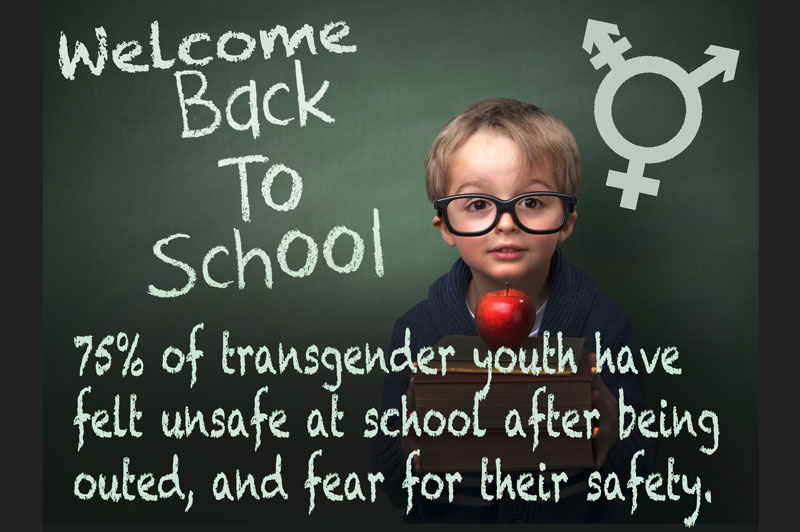
75% of transgender youth have felt unsafe at school after being outed and have lower GPA’s due to missing school in fear of their safety.
have experienced negative comments, violence has become the most popular form of dealing with transgender youth. Disturbingly enough 19% of transgender youth, according to the National Center for Transgender Equality, experience the majority of violent abuse in their home from their own family members. Along with dealing with all the dissension from family members 75% of transgender youth, according to a national survey done by GLSEN (pronounced “glisten”), have felt unsafe at school after being outed and in result have lower GPA’s due to missing school in fear of their safety. With all the facts at hand, The Ohio Education Association who represents 125,000 teachers and support professionals, have openly opposed the bill.
Violence has become the most popular form of dealing with transgender youth.
Kathryn Lorenz is the Loveland Board of Education Vice President
While researching House Bill 658 I managed to only get a response from two local representatives of the Loveland School Board, one being Kathryn Lorenz, the Board Vice President and the other being Loveland School Board Member, Ned Portune. Lorenz’s response was, “In the case of House bill 658, we would have to say that we do not yet have enough information, nor have we met as a board for a few weeks, so we do not yet have a Board statement to make.”
Ned Portune is a member of the Loveland School Board
Portune added that he, “…simply has not been fully informed at this point on HB 658 to have an educated opinion. There are several items in your statement that would certainly give me a gut reaction, and opinion on, if true as presented. But I need time to fully review the Bill, its implications and existing laws to have any formal statement.”
School Superintendent Amy Crouse, High School Principal Peggy Johnson, and assistant principals at the High School did not respond.
Studies show most transgender youth are fully aware of their gender identity by age 4.
After attempting several times to contact both Representatives Paul Zeltwanger and Thomas Brinkman through email and phone about House Bill 658, I, unfortunately, got no response. It wasn’t hard to find Brinkman’s opinion on the issue in several other publications though, voicing to WCPO, “Parents have the right to decide what is best for their children,” and telling WOSU Public Media, “And if somebody doesn’t like it, you’re emancipated at age 18 and you can go do whatever the heck you want.” Seems pretty harsh considering the transgender population represents about 0.3% (700,000) of Americans and studies show most transgender youth are fully aware of their gender identity by age 4. Are we encouraging parents and administrators to discard their students or child’s gender identity in fear of social rejection? Do these children not deserve to live an authentic life?
Fran Hendrick, PCC has offices at Wildflower House in the West Loveland Historic District.
House Bill 658 is expected to be presented to the Ohio General Assembly in the Fall and will be without a doubt one of the most controversial bills to date. Many have opinions on this issue one being Fran Hendrick, a respected and highly educated clinical counselor who specializes in assisting women and girls who are experiencing depression or anxiety triggered by a crisis or major life change. When I presented Fran with House Bill 658 and asked what her opinion was she had a lot to say and rightfully so considering one of her life missions, according to Fran’s website franhendrick.com, is to “gently help you find and shelter your spark (the essence of who you are at your core) and grow it so that it illuminates your person and is radiated through words, actions and decisions, big and small, that make up your daily life.”
In a culture such as ours, it is a matter of life and death for transgender youth to decide if and when to trust another person with their reality. – Fran Hendrick, PCC
“Being a parent takes great courage, even more so when your child presents you with something that you’re unfamiliar with – or even afraid of. In a perfect world, a child who feels somehow ‘different’ from their peers (‘their’ is deliberately gender-neutral), they could consult their parents, who would strive to deeply understand the child’s experience, would provide accurate empathy, and would go on a crash course to learn everything they could about the unfamiliar issue. And, so very fortunate for their children, there are many parents like these.
But in the real world, an adolescent boy saying to his father, ‘Dad, I think I’m a girl’ is very likely to encounter disgust, rejection, rage, or even violence, not empathy and understanding.
While the intent of this bill, giving benefit to grave doubt, could be a deeply uninformed and misguided attempt to protect children, that seems unlikely. My sense is that in truth it is more about attempting to hand parents the power to say no to their child’s gender identity,” Hendrick said, “But gender identity – and sexual orientation, for that matter – are not matters of choice. And in a culture where transgender people are assaulted and even murdered at a rate higher than their cisgender counterparts,where transgender youth are summarily shunned and rejected by their own parents (the rate of homelessness is, not surprisingly, very high), where the suicide rate that results from these atrocious facts is far higher than for other youth – in a culture such as ours, it is a matter of life and death for transgender youth to decide if and when to trust another person with their reality, and, most importantly, whom to trust.
To be “outed” for the choice to trust; or to be prosecuted for trying to be help – these are not protections. Actions like these support bigotry, and increase isolation and despair. – Fran Hendrick, PCC
To be “outed” for the choice to trust; or to be prosecuted for trying to be help – these are not protections. Actions like these support bigotry, and increase isolation and despair. Stopping a teacher from helping such a student, one who is likely alone with the reality of their gender identity, who stands to be emotionally and psychologically rejected, or even physically abused, by their own family is, quite simply, a cruelty. This, I strongly believe, is not what the overwhelming majority of parents want for their own or anyone else’s children. This is bad enough. However, this bill opens the door to much more far-reaching damage than this.”
Is he to be turned in to the gender police?
The talented young male artist who despises sports – is he to be turned in to the gender police? The girl who chooses overalls and a t-shirt rather than a dress and a mani-pedi –what of her? The sponsors of the bill have explicitly said that teachers should be required to inform on them, as well. We have an essential responsibility to ensure that proposed legislation protects vulnerable people from the bigotry endemic in our society.This legislation explicitly deprives them of protection.”
Ultimately what it comes down to is ensuring that our children are and feel safe when going to school. Teachers and administrators are the ones that take on the responsibility of creating that fun, loving and supportive atmosphere so that our children get the best opportunities in life. Passing a bill such as House Bill 658 only presents another obstacle that both teachers and administrators have to overcome. Don’t these professionals have enough obstacles to conquer as is?
Both Justin Haake and Tonya Schaeffer who are Professional Clinical Counselors for Hope Restored Counseling Services in Loveland couldn’t agree more.
Justin Haake is a Licensed Professional Counselor at Hope Restored Counseling Services in Loveland and works primarily with adolescents and adults, specifically during transitional periods in life.
Haake said, “For some, teachers and school administrators may be the only people in schools that feel safe for students to reach out to.Imagine the fear of asking for support, knowing that you’ll either be outed or put the teacher or administrator at risk of a felony.”
Schaeffer said, “From my perspective, this would most likely increase the level of bullying and possible harm to these students.There is already so much shame and stigma attached with Transgender people, and they need as much support as they can get,”
Tonya Schaeffer is a Licensed Professional Clinical Counselor and co-owner of Hope Restored Counseling Services in Loveland.
Schaeffer added, “Support is out there.In fact, we are offering a psycho-educational group starting in September that offers education, support and a safe environment for Transgender students to express themselves.” She said they hope to offer a similar group to parents who are trying to understand what their child is going through, explore what the parents are experiencing and provide support. “We currently serve the LGBTQ community, and we are expanding those services.I recently read a statement that it is estimated that 41% of trans men and women have attempted suicide. I don’t believe this bill would help–it seems like it could only hurt.”
Susan, the mom and teacher said, “I am thankful I live in a community where support services like those provided by Hope Restored, and Fran Hendrick at Wildflower House are nearby for my students and their families.”
Transgender youth have so many mountains to climb within their own scientific makeup and allowing a bill like House Bill 658 to go through in hindsight is taking away their basic rights as Americans and human beings.
“GLSEN (pronounced “glisten”) was founded in 1990 by a small, but dedicated group of teachers in Massachusetts who came together to improve an education system that too frequently allows its lesbian, gay, bisexual, transgender, queer and questioning (LGBTQ) students to be bullied, discriminated against, or fall through the cracks.”










 If you would like to explore the topic of Transgender youth and adults even further please check out “