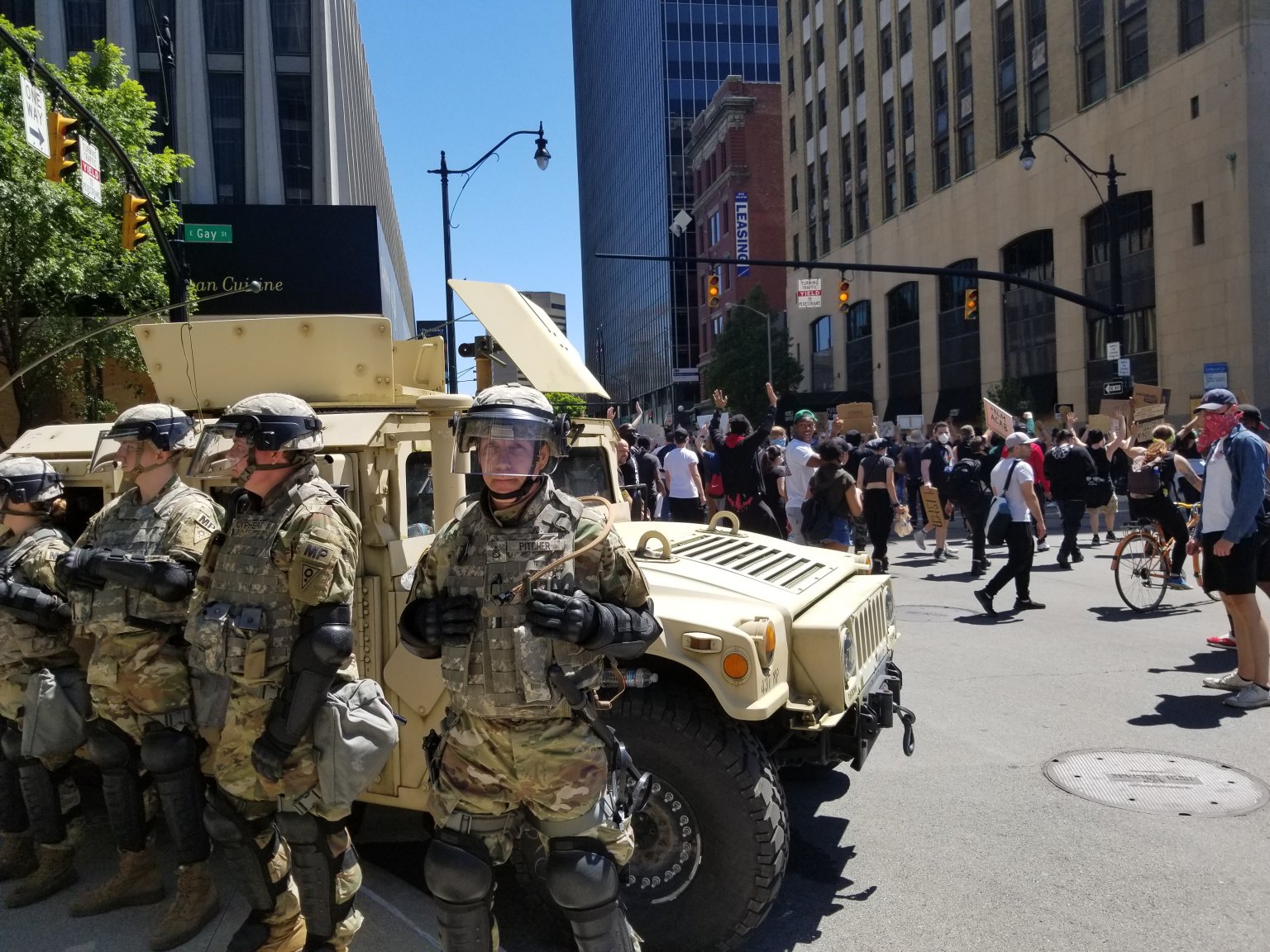
It cost the state of Ohio more than $1 million to send hundreds of troops to the Ohio Statehouse last month to protect against acts of political violence.
All told, taxpayers spent millions of dollars to pay for enhanced security in Columbus and Washington, D.C. following the Jan. 6 events at the U.S. Capitol.
After the deadly insurrection at the nation’s capital, DeWine mobilized around 1,000 troops to D.C. to help with security for President Joe Biden’s inauguration. DeWine also authorized 480 troops to be stationed at the Ohio Statehouse during planned protests on inauguration week.
Military vehicles were placed around the Ohio Statehouse in mid-January. Photo by Jake Zuckerman.
The Ohio State Highway Patrol, normally in charge of protecting the Statehouse grounds, also ramped up security last month.
The cost of stationing troops in Columbus, as approved by the Ohio Controlling Board on Monday, was $1,035,000. Most of this amount ($695,000) went to payroll, with the remainder spent on food, travel costs and other supplies.
The deployment of Ohio troops in D.C. cost more than $2.1 million, but this is paid for by the federal government, according to Stephanie Beougher, the public information officer for the Ohio National Guard.
Public officials had worried about the potential for violence as online extremists turned their attention from the U.S. Capitol to the 50 state capitals. The Ohio Statehouse and other government buildings in downtown Columbus were closed for four days.
Protesters caused more than $150,000 in damage at the Statehouse last May and more than $1 million in damage to nearby businesses and offices. In response, the governor deployed Ohio National Guard troops to Columbus and Cleveland at an eventual cost of $3.2 million.
A Republican state senator recently proposed a bill to install security cameras at the Statehouse and increase the penalties for arson and vandalism.
It was a tumultuous week for our nation. Yet, America has shown her resolve. It is critical that everyone – regardless of political party – work to lower the collective temperature of our political discourse. We must, as Ronald Reagan often said, disagree without being disagreeable. Before any political ideology or persuasion, we are first Americans.
Please join me in praying for our nation and those who lost their lives during the events that unfolded at the Capitol this past week.
I unequivocally condemn the actions of the criminals who broke into the U.S. Capitol, injured law enforcement, and tried to disrupt the constitutional process. No matter what flag one is carrying, people violating the law need to be held accountable. That is not who we are. That is not what this country stands for.
The peaceful transfer of power is enshrined in the fabric of our constitutional republic. It is part of what makes America the greatest country in the world. Without it, we are no better than the banana republics from which we seek to protect ourselves and our allies.
I believe there remain constitutional concerns and actual violations regarding election administration. Understandably, many Americans across the political spectrum have concerns about its fairness and accuracy. Unfairness on the part of the media and big tech only exacerbated these concerns, which have been arising over the last two decades.
I am deeply concerned about state officials making changes to their election laws without the consent of their state legislators. This concern has arisen in states won by each candidate.
That’s why I joined with 125 of my colleagues last month in signing the amicus brief that presented election irregularities and asked the U.S. Supreme Court to rule on whether states should be held accountable to the Constitutional prescriptions. It is the body best suited to make that determination of constitutionality. Unfortunately, it refused to hear the case based on standing, though it never heard the arguments or struck down the merits of the questions. The Court has unfortunately left this issue unresolved.
Article II, Section 1, Clause 2 of the U.S. Constitution grants state legislatures sole authority to direct the manner for how its state’s Electors are appointed to the Electoral College. And yet, judges, governors, and other officials in certain states repeatedly made changes to election laws that circumvented the state legislatures.
The discrepancies in these states must be resolved, and the constitutional questions must be answered. Before the election, state legislatures should have exerted their constitutional role to either object to or codify election administration changes. They did not, and they still have not, sadly. The Supreme Court should have accepted the opportunity to hear and rule on this issue, which is why I joined the amicus brief asking the Court to take up the issue and rule definitively. They did not. Presidential campaigns with constitutional concerns should have brought those forth before Election Day. They did not. We as Congress should weigh these constitutional concerns alongside a state’s constitutional role in appointing and certifying their electors.
Two constitutional issues are hitting each other: The non-constitutionality of non-legislative changes to the election and the constitutionality of states choosing their own electors and certifying them.
Specifically, I joined the petition to object to Pennsylvania’s Electors because of clear discrepancies between Pennsylvania’s own state law and how its election was administered. These include judges unilaterally extending certain election deadlines, election officials not requiring signature checks on mail-in ballots, and inconsistent standards from county officials for “ballot curing.” I believe the changes these Pennsylvania officials made without the consent of their state legislators are unconstitutional. In addition, Pennsylvania’s law – Act 77, which expanded mail-in ballots – violates their own Constitution. These issues need to be heard and debated. Objections in the certification process are not unprecedented.
As I understand it, neither Article II nor the 12th Amendment grants Congress the power to overrule the states’ certification of their own Electors.Article II states, in part, “Each State shall appoint, in such Manner as the Legislature thereof may direct, a Number of Electors,” and the 12th Amendment states, in part, “The President of the Senate shall, in the presence of the Senate and House of Representatives, open all the certificates and the votes shall then be counted; — The person having the greatest number of votes for President, shall be the President.” Historically, a reason the Electoral Counting Act of 1887 included the ability to object to a slate of electors came from the need to resolve disputes arising from when a single state certified multiple slates of electors. That has not happened in this case.
One may not like it right now amidst this election, but we would create a dangerous precedent and do harm to the institution of the Electoral College and election process. If either party were to gain a majority in both chambers of Congress, they could simply reject the will of the voters and select their own President.
This is not a decision I have arrived at lightly, and I understand and respect that many of my colleagues may have reached a different conclusion. Our discussions in the House were spirited and sincere, with both sides legitimately standing firmly on constitutional ground with competing interpretations.
The Electoral College is a critical component of our carefully balanced constitutional republic, and we must protect it. Let me be clear: the issues I’ve raised deal not with the institution of the Electoral College but only with how some states have run their elections and selected their Electors. Ultimately, the individual states should and must decide their Electors.
Where Do We Go from Here?
I pledge to work to ensure that these constitutional questions are answered ahead of the next election so that Americans can have faith in our republic as well as clarity as we work to protect the electoral college, our constitution, and our laws. America remains the greatest country in the world. However, we must settle these unresolved questions and restore faith in our election system if we are to live up to the legacy given to us by past generations and sustain the blessings of our liberties for future generations. I pledge to work to ensure these constitutional questions are answered ahead of the next election so Americans have clarity on and faith in our democracy and the integrity of the Electoral College and our Constitution is protected.
Our government – Congress, the courts, and the states – must work to reach agreed-upon answers to these questions to ensure future integrity of, and faith in, our elections. Ohio has stood as a model in election administration for the 2020 Presidential Election. We did things right.
I am going to fight to make sure the American people are never in this position again. I support efforts by Senator Tim Scott to establish an Election Integrity Commission to formally investigate the missteps from this election and provide guidance for future elections as both sides of the aisle should want clarity and certainty. Undoubtedly, more legislation to safeguard our Electoral College and elections will be needed to prevent future irregularities, discrepancies, and constitutional concerns. The American people deserve it.
We can and we must right these wrongs. Like the song “America the Beautiful” suggests, we ask that “God mend thine every flaw.”
PUBLISHERS NOTE:
President Donald Trump and his allies have baselessly claimed that there was rampant voter fraud in the 2020 Presidential election.
“There’s a great human capacity for inventing things that aren’t true about elections,” said Frank LaRose, a Republican who serves as Ohio’s secretary of state. “The conspiracy theories and rumors and all those things run rampant. For some reason, elections breed that type of mythology.”
Election officials in every state have not reported any major voting issues. Each of the 60 election related lawsuit filed, contesting election processes by either Trump or his supports all failed, and none have proven widespread problems.