Tag: U.S. Department of Agriculture

  • Ohio businesses were promised funding for solar but worry the Trump administration won’t pay

    Ohio businesses were promised funding for solar but worry the Trump administration won’t pay

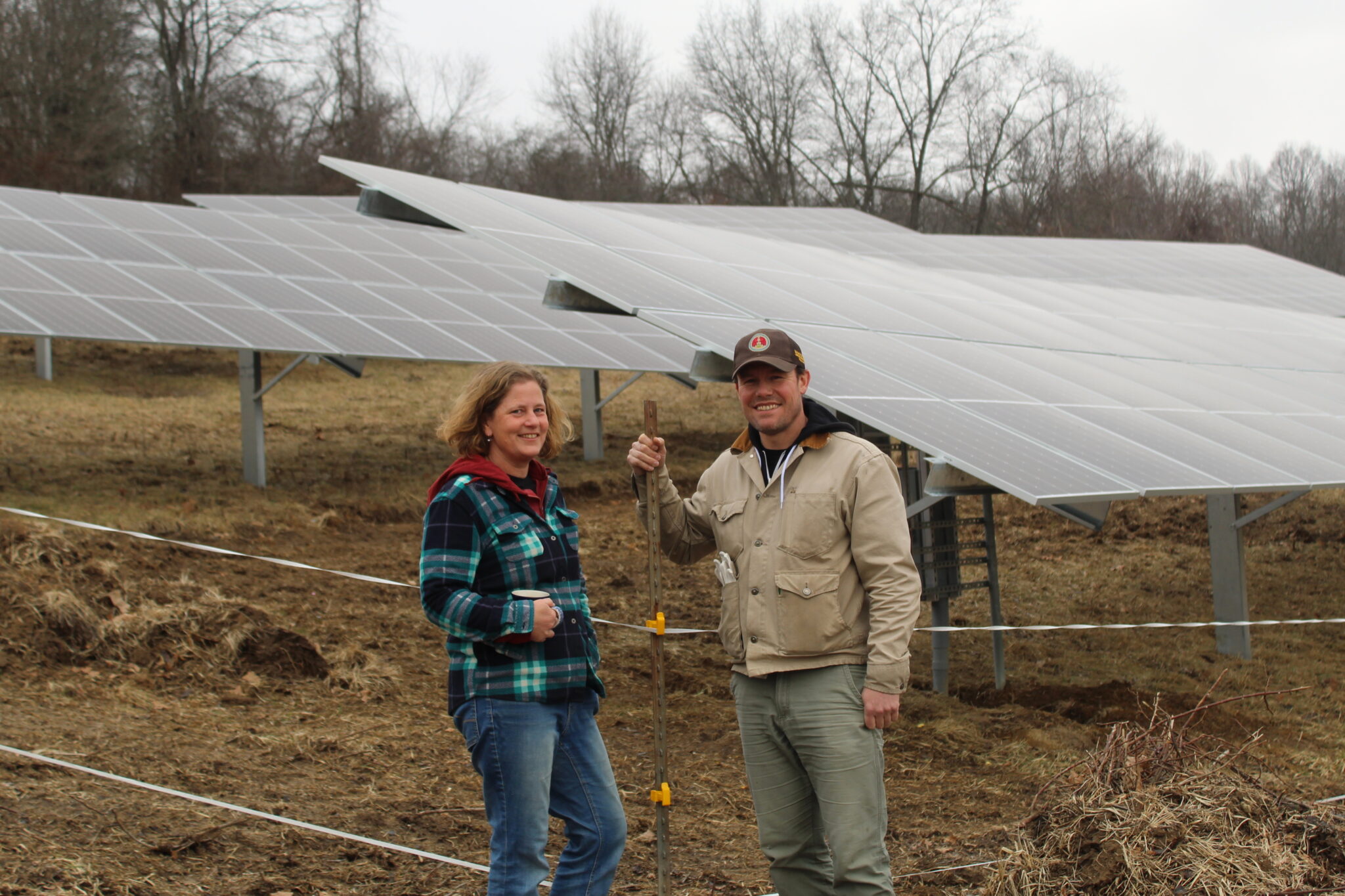
    Jael Malenke (left) and Kevin Ely, standing next to their solar array. They’re supposed to get reimbursed for half of the system’s cost, but that funding is in limbo after USDA halted payments pending review. (Photo by Nick Evans, Ohio Capital Journal.)

    By  Ohio Capital Journal

    Wooly Pig Farm Brewery sits on a gentle rise above Highway 36 and the Tuscarawas River in Fresno, Ohio. It takes its name from the Mangalitsa pigs covered in coats of thick curly wool, that roam the pastures nearby. Kevin Ely and Jael Malenke are the husband-and-wife team that run the brewery — Ely handles the beer and Malenke manages the business. They met in Utah and moved back to the area in 2014 when a farmstead near Malenke’s childhood home went up for sale.

    Ely is a tinkerer. Two work gloves stick out of one coat pocket and the fat carpenter pencil in his chest pocket has left graphite stains where it’s rubbed against the jacket. He’s constantly looking for ways to make the brewery more efficient and even does talks for other brewers looking to streamline their operations.

     Kevin Ely and Jael Malenke with a few of the Mangalista pigs they raise at the Wooly Pig Farm Brewery. (Photo by Nick Evans, Ohio Capital Journal.) 

    From his experience at other breweries, he said, “solar comes last.” There are too many other strategies to reduce energy consumption that are simpler and cheaper. That could be reducing water use or rigging up a cheap DIY system that takes advantage of the steam generated by the brewing process.

    “You can reduce your energy consumption by like, 5, 10, 15, sometimes 20, 25%,” he said.

    “But we’ve done those things,” Malenke cut in.

    So that’s why they were so interested in the Rural Energy for America Program. The initiative, administered by the U.S. Department of Agriculture, offers loan financing or grant funding for farmers and rural businesses that invest in renewable energy projects to improve their energy efficiency.

    At Wooly Pig, that’s a roughly $300,000 solar array on a hill above the brewery. In all, the roughly 100 kilowatt system includes more than 200 panels.

    “They’re ranged in a double row on each of these six arrays — sets of arrays,” Malenke said as half a dozen pigs rooted around in the grass or played with their dogs. “They’re all high enough that we can have sheep grazing underneath them,” she added.

    Under their REAP agreement, Ely and Malenke are expecting federal officials to cover $143,000 of the total investment. “That’s more than we pay in payroll here,” Malenke said, “and that includes what we take home.” But they’re currently in limbo, following the Elon Musk-linked Department of Government Efficiency’s efforts at the USDA.

    For Ely and Malenke, as well as others expecting REAP funding, those dollars are “indefinitely suspended,” and subject to review by USDA Secretary Brooke Rollins.

    “I welcome DOGE’s efforts at USDA because we know that its work makes us better, stronger, faster and more efficient,” Rollins said on her first day in office. “I will expect full access and transparency to DOGE in the days and weeks to come.”

     Jael Malenke and Kevin Ely in the Wooly Pig Farm Brewery tap room. (Photo by Nick Evans, Ohio Capital Journal.) 

    The stakes for the brewery

    Ely and Malenke have apps on their cellphones that monitor the amount of energy their array generates in real time.

    “I’m probably looking, depending on the day, between four and six times a day,” Malenke said with a grin.

    “Yeah, I might be doing — well, I might be eight or 10,” Ely said.

    He’s tracking it closely because he’s looking for ways to stretch that power past sunset. They don’t have a battery system, so Ely said he’s working on running a boiler during the day and then using a heat exchanger to make use of that hot water in the evening.

    Malenke said the brewery spends between $1,500 and $2,500 a month on power. The new solar array is designed to cover half of that, and with a few tweaks here or there, Ely is hoping they can push that to 60%.

    GET THE MORNING HEADLINES.

    Saving about $12,000 a year on energy costs would make a big difference for their business.

    “I mean, that’s pay raises for our employees,” Ely said.

    But losing out on the REAP reimbursement would be a major setback.

    “And that’s it,” Ely explained. “The thing is, is that we probably wouldn’t have built — we would not have built an array for this price. We would have built something half as big or maybe we would have done it ourselves.”

    Although working with a reputable contractor was more expensive, they went forward because it would leave them with a better built and longer lasting system while allowing them to focus on doing their actual jobs.

    “There was very little risk associated with this project,” Ely said.

    “We thought it was a risk-free project,” Malenke cut in.

    “If we knew there was significant risk …” Ely broke off. “I mean, there was no evidence of it being risky.”

     Rich Mushrush, owner of Gemstone Gas & Welding Supplies. (Photo by Nick Evans, Ohio Capital Journal.) 

    Gemstone Gas & Welding Supply

    About half an hour from Wooly Pig in New Philadelphia, Rich Mushrush runs Gemstone Gas and Welding Supplies. In addition to gear for welders, they pump their own gases, “oxygen, argon, nitrogen, CO2, all the mixes,” he said, before his phone started ringing. He’s been calling around, twisting arms, to get a mechanic out to fix the muffler on a delivery truck.

    “We pride ourselves on service,” he explained after securing a visit. “That’s how we kind of get over with the big companies. They can’t do what we do.”

    Mushrush qualified for the REAP program and construction on his solar array started this week. Based on the project plans, he thinks the system will save him about $1,000 on his electric bill each month. If that back of the envelope math holds, the system would pay for itself in about two and a half years. But without the federal subsidy, Mushrush explained, that timeline stretches to more like 12 or 13 years.

    “I thought s—, I might be dead by then,” he chuckled. “I’m 65 years old.”

    Mushrush is frustrated about the financial pinch he’ll feel if the REAP funding doesn’t come through. “It’s a stinger to me,” he acknowledged, “and a lot of other small businesses — farmers.”

    But his biggest objection is a moral one. If the federal government has decided the program is too generous, he argued, there’s nothing wrong with dialing it back going forward. “But the ones that are already in it,” he argued, “I think they should be grandfathered.”

    “I just go from a commonsense standpoint,” Mushrush said. “How can they renege or back-claw on you, on a contract that is signed, sealed and delivered?

    Broader picture

    Both Wooly Pig and Gemstone worked with Paradise Energy Solutions to install their solar arrays, and company CEO Dale Good said their stories aren’t unique. The company operates in eight states and Good said Ohio is getting hit particularly hard by the suspension of REAP funding.

    In an average year, he said, they handle around 40 or so solar projects with REAP contracts, and USDA’s funding halt has affected nearly three quarters of their projects.

    In a written statement, a USDA spokesperson blamed the funding delay on the Biden administration for “exploit(ing) Congressional intent” by misusing funds from the Inflation Reduction Act and Infrastructure and Jobs Act.

    REAP has been around since 2014, preceding both of those pieces of legislation. And far from exceeding congressional intent, the Inflation Reduction Act specifically appropriated additional funding for the program.

    The spokesperson went on to suggest that with a flurry of last-minute funding decisions, the Biden administration was “making promises they knew the department would not be able to keep.”

    But for the Wooly Pig project at least, they submitted their initial application in September 2023 and got notice of their award more than a year ago in February 2024. Gemstone’s application went in last June and got approved in September.

    “Fortunately,” the USDA spokesperson continued, “President Trump is taking strong action to rein in reckless spending, cut needless regulations and make the entire federal government more effective at serving the American people, including our farmers.”

    “As part of this effort,” the spokesperson added, “Secretary Rollins is carefully reviewing this funding and will provide updates as soon as they are made available.”

    For what it’s worth, Rollins has released some of the previously frozen funding. Late last month she cleared $20 million for a trio of conservation programs, but no word yet on REAP funding.

    And at the end of the day, everything might work out fine.  Wooly Pig has had their array up and running for about two weeks, but they need proof of it running for a month to make their final submission to release the funds they’ve been awarded. With the Gemstone array still under construction, Mushrush is a few months behind them.

    But Ely and Malenke are nervous and already working on contingency plans if the funding doesn’t come through.

    “Because, I mean, even if it does,” Ely said, “maybe it’s going to be, like, a lot longer down the road.”

    “Our safety net — our cushion is gone,” he added. “So, right now, like nothing else seriously bad can happen.”

    “Yeah, that’s our other plan,” Malenke laughed. “Have no more bad things happen.”

    YOU MAKE OUR WORK POSSIBLE.

    Follow Ohio Capital Journal Reporter Nick Evans on X or on Bluesky.


    Nick Evans
    Nick Evans

    Nick Evans has spent the past seven years reporting for NPR member stations in Florida and Ohio. He got his start in Tallahassee, covering issues like redistricting, same sex marriage and medical marijuana. Since arriving in Columbus in 2018, he has covered everything from city council to football. His work on Ohio politics and local policing have been featured numerous times on NPR.

    Ohio Capital Journal is part of States Newsroom, the nation’s largest state-focused nonprofit news organization.

    MORE FROM AUTHOR

  • NEA blasts USDA decision to axe programs for feeding hungry students

    NEA blasts USDA decision to axe programs for feeding hungry students

    A news release from the National Education Association President Becky Pringle

    “Trump administration’s move to halt $1 billion in federal funding not only hurts students and their families but also cripples local farmers and ranchers in rural communities who feed America”

    Media outlets have reported that the U.S. Department of Agriculture terminated two programs responsible for providing public schools and food banks money to buy food from local farmers and ranchers, halting more than $1 billion in support for students and their families.

    The following statement can be attributed to NEA President Becky Pringle:

    “All students — no matter where they live or how much money their families make — deserve the resources they need to grow and thrive. To ensure every student can flourish, we must ensure no student goes hungry. No young person in America should ever face the shame or stigma of lunch debt. And yet, we have heard too many stories of students experiencing school lunch debt who have faced public embarrassment and shame, including having their food taken away while in a lunch line because they couldn’t afford it or had an account balance they couldn’t pay for. This directly results in a child going hungry, and it also exposes them to unnecessary shame in front of their peers. Making sure hungry students have healthy school meals is not just the right thing to do morally. It also has a direct connection to students. Ask any educator, and they will tell you that when students can eat healthy and nutritious meals, they are energized, focused, and ready to learn.

    “Trump and Musk’s efforts to deprive students of healthy meals couldn’t come at a worse time. As food prices skyrocket and household budgets are squeezed, more families depend on healthy school meals to be nourished. These popular programs have allowed schools to serve fresh, locally sourced, nutritious foods — at no extra cost. It has been a win-win: students benefit from healthier meals, and schools stretch their limited budgets further. Without this support, schools will struggle to offer meals prepared from fresh ingredients, and many school districts will face widening budget gaps.

    “The ripple effects go beyond the cafeteria. From agricultural croplands in the Columbia Basin of Washington state and farmlands of the Shenandoah Valley in Virginia to the ranchlands in Montana and the rangelands in Texas— and everywhere in between — America’s farmers and ranchers will be deeply impacted. Local farmers and ranchers serving their rural and nearby communities supplying these foods will lose stable, reliable markets on which they depend, and struggling rural schools will lose a lifeline for their students. These funds supported local and rural economies as much as they supported child nutrition. And let’s be clear — those funds won’t be easily replaced, especially as states and counties brace for a potential recession and the impact of the current tariffs. Undermining locally resourced school meals directly harms student health and learning, including learning about and connecting to their food sources. If we care about academic success, cutting food funding is exactly the wrong move for everyone.”

    # # #

    The National Education Association is the nation’s largest professional employee organization, representing more than 3 million elementary and secondary teachers, higher education faculty, education support professionals, school administrators, retired educators, students preparing to become teachers, healthcare workers, and public employees. Learn more at www.nea.org.

  • SNAP benefit will increase beginning on Oct. 1

    SNAP benefit will increase beginning on Oct. 1

    The U.S. Department of Agriculture (USDA) in August released a re-evaluation of the Thrifty Food Plan, used to calculate Supplemental Nutrition Assistance Program (SNAP) benefits. As a result, the average SNAP benefit – excluding additional funds provided as part of pandemic relief – will increase for Fiscal Year 2022 beginning on Oct. 1, 2021.

    “Ensuring low-income families have access to a healthy diet helps prevent disease, supports children in the classroom, reduces health care costs, and more.

    – Agriculture Secretary Tom Vilsack

    As directed by Congress in the 2018 Farm Bill – and with the expressed support of President Biden’s January 22 Executive Order – USDA conducted a data-driven review of the Thrifty Food Plan. The resulting cost adjustment is the first time the purchasing power of the plan has changed since it was first introduced in 1975, reflecting notable shifts in the food marketplace and consumers’ circumstances over the past 45 years.

    “A modernized Thrifty Food Plan is more than a commitment to good nutrition – it’s an investment in our nation’s health, economy, and security,” said Agriculture Secretary Tom Vilsack. “Ensuring low-income families have access to a healthy diet helps prevent disease, supports children in the classroom, reduces health care costs, and more. And the additional money families will spend on groceries helps grow the food economy, creating thousands of new jobs along the way.”

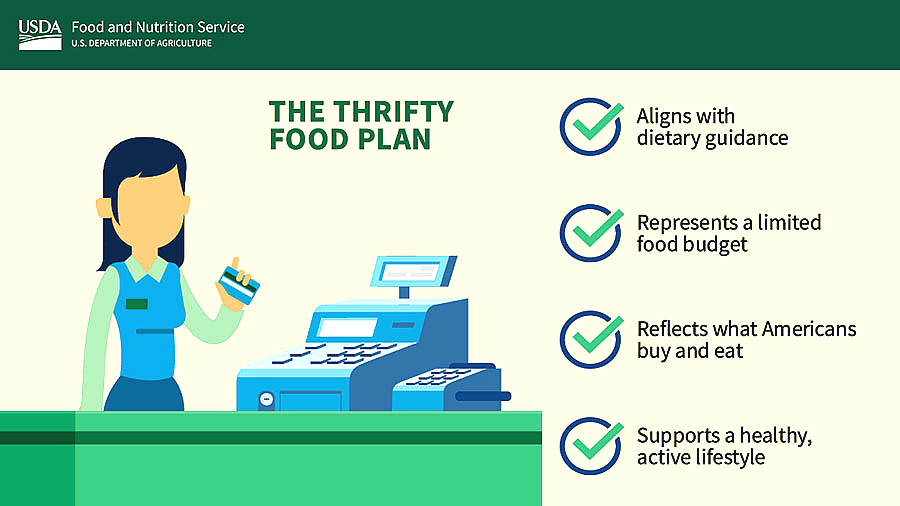
    In its re-evaluation, USDA was driven by the latest available data on the four key factors identified in the 2018 Farm Bill: current food prices, what Americans typically eat, dietary guidance, and the nutrients in food items. For example, the revised plan includes more fish and red and orange vegetables to align with recommendations in the Dietary Guidelines for Americans, 2020-2025. Additionally, the plan was calculated using updated purchasing data – collected from stores versus self-reported by households – to reflect the current price of foods in today’s marketplace. The revised Thrifty Food Plan also includes a modest increase in calories to reflect the latest data and support an active lifestyle.

    The 2021 Thrifty Food Plan puts healthy food in reach for SNAP families. Recent evidence consistently shows that benefit levels are too low to provide for a realistic, healthy diet, even with households contributing their own funds toward groceries. A USDA study published earlier this summer found that nearly nine out of 10 SNAP participants reported facing barriers to achieving a healthy diet, with the most common barrier being the cost of healthy foods. These findings were echoed in listening sessions USDA held with a broad range of Thrifty Food Plan stakeholders.

    Recent evidence consistently shows that benefit levels are too low to provide for a realistic, healthy diet, even with households contributing their own funds toward groceries.

    The reevaluation concluded that the cost of a nutritious, practical, cost effective diet is 21% higher than the current Thrifty Food Plan. As a result, the average SNAP benefit – excluding additional funds provided as part of pandemic relief – will increase by $36.24 per person, per month, or $1.19 per day, for Fiscal Year 2022 beginning on Oct. 1, 2021.

     Changes in Benefits by State 

    To set SNAP families up for success, we need a Thrifty Food Plan that supports current dietary guidance on a budget,” said Stacy Dean, deputy undersecretary for food, nutrition, and consumer services. “Too many of our fellow Americans struggle to afford healthy meals. The revised plan is one step toward getting them the support they need to feed their families.”

    In good times and tough times, SNAP is the most far-reaching, powerful tool available to ensure that all Americans, regardless of background, can afford healthy food. The program helps to feed more than 42  million Americans – 1 in 8 – each month. Evidence is clear that SNAP increases food security, including among households with children who have been disproportionately impacted by hunger during COVID.

    USDA touches the lives of all Americans each day in so many positive ways. In the Biden-Harris Administration, USDA is transforming America’s food system with a greater focus on more resilient local and regional food production, ensuring access to healthy and nutritious food in all communities, building new markets and streams of income for farmers and producers using climate smart food and forestry practices, making historic investments in infrastructure and clean energy capabilities in rural America, and committing to equity across the Department by removing systemic barriers and building a workforce more representative of America. To learn more, visit  www.usda.gov.

    For questions about your SNAP benefits, please contact your SNAP state agency.

    Additional Resources:
    • The Thrifty Food Plan and SNAP Benefits (Website)
    • Changes in Benefits by State (Tables)
    • Thrifty Food Plan Re-evaluation Puts Nutrition in Reach for SNAP Participants (Blog)
    • What is the TFP? (Blog)
    • TFP Listening Sessions (Summary) (Blog)
    • The TFP Re-Evaluation Process (Infographic)
    • SNAP Participants’ Barriers to Healthy Eating (Infographic)
    • Barriers that Constrain the Adequacy of SNAP Allotments (Report)
    • SNAP – Fiscal Year 2022 Cost-of-Living Adjustments (Memo)
  • Natural resources grants available for farmers, forest owners

    Natural resources grants available for farmers, forest owners

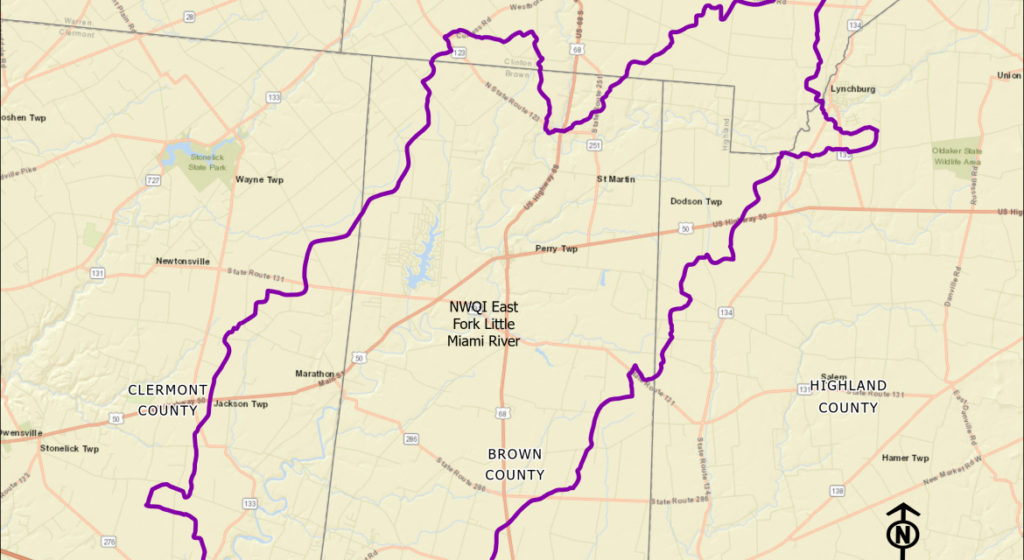
    The U.S. Department of Agriculture’s Natural Resources Conservation Service (NRCS) announced the deadline to submit applications for Ohio’s Environmental Quality Incentives Program (EQIP).  Additionally, NRCS is offering an opportunity for agricultural producers in three watersheds in the East Fork Little Miami River Basin to apply for assistance installing conservation practices that protect water quality through the National Water Quality Initiative (NWQI). The deadline for both applications is Jan. 15.

    The three East Fork watersheds for which the additional NWQI funding is available include:

    • Glady Creek-East Fork Little Miami River
    • Solomon Run-East Fork Little Miami River
    • Five Mile Creek-East Fork Little Miami River

    Together, Ohio NRCS along with the Clermont, Brown, Clinton, and Highland Soil and Water Conservation Districts (SWCDs) will utilize funds to implement core water quality practices in these watersheds. Applicants for the EQIP and NWQI programs should be farmers, or farm or forest landowners and meet eligibility criteria.

    “The additional NWQI funding available is a great opportunity for landowners to implement conservation practices in their operation to help and improve water quality on cropland, forest, pasture, and farmsteads,” said Christina Gates, NRCS district conservationist for Brown and Clermont Counties. “If your property is located within the outlined funding area please contact me prior to Jan. 15 at christina.gates@usda.gov to schedule a field visit and submit an application for funding for 2021.”

    Property owners in Clinton and Highland Counties with land in the funding area should contact their local NRCS office.

    Applications signed and submitted to NRCS by the Jan. 15 deadline will be evaluated for fiscal year 2021 funding. Visit Ohio NRCS website under “EQIP Funding Categories” for more details. To learn more about EQIP or other technical and financial assistance available through NRCS conservation programs, visit Get Started with NRCS or contact your local USDA Service Center.