Tag: U.S. Sen. Rob Portman

  • In top-secret documents case, Portman wants to investigate the investigators

    In top-secret documents case, Portman wants to investigate the investigators

    BY: MARTY SCHLADEN Ohio Capital Journal

    It now appears that secrets of the most sensitive nature were among the documents former President Donald Trump hung onto after more than a year of entreaties by the government to return them. Having to do with another nation’s nuclear-weapons capabilities, one set of documents in Trump’s possession was so sensitive that only a few senior government officials are allowed to see them and only then on a need-to-know basis, the Washington Post reported Tuesday.

    One might think that the most senior Republican on the Senate Homeland Security and Government Affairs Committee would want to know what Trump was doing with those documents and how much his possession of them might have jeopardized national security. But since the Aug. 8 search of Trump’s South Florida club and residence, it appears that the only statement Sen. Rob Portman, R-Ohio, has made about the matter has been to call for a congressional investigation of the FBI.

    “As the Lead Republican on the Senate Homeland & Governmental Affairs Committee, I call on @SenGaryPeters to utilize the broad jurisdiction of the Cmte, which includes jurisdiction over the National Archives & Records Admin, to perform oversight on this issue & ensure transparency,” Portman tweeted on Aug. 14.

    Portman quickly followed that with, “The Attorney General and the FBI should now demonstrate unprecedented transparency and explain to the American people why they authorized the raid.”

    Many other Republicans — eager to stay in Trump’s good graces — were quick to attack the FBI for conducting the court-sanctioned search. They also attacked the Justice Department for seeking it after trying more voluntary methods to get Trump to return the classified documents.

    “I’ve seen enough,” House Minority Leader Kevin McCarthy said in a tweeted statement. “The Justice Department has reached an intolerable state of weaponized politicization.”

    Republicans on the House Judiciary Committee, led by Ohio Republican Rep. Jim Jordan, in two separate tweets said, “This is what happens in third world countries. Not the United States,” and, “If they can do it to a former President, imagine what they can do to you.”

    And Rep. Marjorie Taylor Greene, R-Ga., simply tweeted “DEFUND THE FBI!”

    But unlike those officials, Portman in January announced that he isn’t seeking reelection. Even so, he apparently hasn’t condemned an attack on the FBI office in his hometown of Cincinnati or a rash of threats to the FBI that are thought to partly be a product of the rhetoric by Trump and his supporters.

    Portman’s staff didn’t respond to questions for this story. And some observers are confused as to why Portman wouldn’t speak out against attacks on federal law enforcement or call on Trump to explain his actions as he has called for the FBI and Justice Department to do.

    “He’s been a real puzzle to me,” Paul Beck, a political science professor emeritus at Ohio State, said last week. “You’d think by the time he decided to retire, he’d kind of freed himself from the clutches of Trump. But for some reason or another, he doesn’t feel that way.”

    With his mild, polite demeanor, Portman is far from the Trumpiest member of the Senate. But he has been enthusiastic about some of the former president’s initiatives — particularly the 2017 tax cut.

    “But that’s done,” Beck said. “The question now is, what more does he want from (Trump)? It may well be that what Portman wants is for Republicans to retake the Senate in 2022 and maybe… stymie the Biden administration for the next two years.”

    Similarly to Portman, former Vice President Mike Pence on Aug. 17 said he was “deeply troubled” by the search of Trump’s club and residence. And he called on Attorney General Merrick Garland to explain more about the Justice Department’s reasons for undertaking the search — which the department has done through subsequent court filings.

    But, the Washington Post reported, Pence also called on his fellow Republicans to tone down their rhetoric.

    “These attacks on the FBI must stop,” the paper reported Pence as saying. “Calls to defund the FBI are just as wrong as calls to defund the police.”

    Pence, whom Trump attacked during the Jan. 6 Capitol riot even as rioters were chanting to hang the vice president, is widely believed to be positioning himself for a presidential run. And he’s taken several other steps to distance himself from the former president

    Is it possible that Portman by contrast is considering becoming a lobbyist post-retirement and he doesn’t want to alienate Trumpworld?

    “The question is, where does he want to live?” Beck said. “I don’t know that he’s ready to go back and live in Lebanon, Ohio. Does he want to settle in Washington, D.C. and earn fairly big bucks as a lobbyist? It may well be that to do that he can’t be on the outs with Trump, but he also doesn’t have to be at all aggressive in supporting Trump’s efforts to rescind the results of the 2020 election.” 

    Or Portman could simply be emulating Senate Minority Leader Mitch McConnell, R-Ky., a frequent target of Trump’s ire.

    “You would think that Portman would be distancing himself from Trump,” Beck said. “Maybe he’s doing what Mitch McConnell is doing and that is saying nothing. And McConnell can’t be happy.” 

    Follow Marty Schladen on Twitter.
  • U.S. Senate passes coronavirus relief aid; bill now returns to the House

    U.S. Senate passes coronavirus relief aid; bill now returns to the House

    By Ariana Figueroa and Ohio Capital Journal

    Washington, DC – The U.S. Senate passed President Joe Biden’s nearly $2 trillion stimulus plan Saturday afternoon after wrangling over an amendment to trim unemployment benefits derailed the bill’s passage for nearly an entire day.

    Ohio Democratic U.S. Sen. Sherrod Brown supported the bill while Ohio Republican U.S. Sen. Rob Portman voted against it.

    The Senate version, which does not include a federal minimum wage hike and puts limits on the funding for state and local governments, will now make its way to the House for review. Democrats are rushing to pass the relief package so it reaches the president’s desk before the March 14 deadline for unemployment benefits expire, in order to give states plenty of time to avoid missing those payments.

    No Republicans voted for the House bill last week. The bill passed the Senate along party lines, 50-49. A tie-breaking vote from Vice President Kamala Harris was not needed because Sen. Dan Sullivan (R-Alaska) had to leave the Capitol after a family emergency.

    “This bill will deliver more help to more people than anything the federal government has done in decades,” Senate Majority Leader Sen. Charles Schumer said in a statement on passage of the bill.

    House Majority Leader Rep. Steny Hoyer (D-Md.) said in a statement that the House would take up the bill on Tuesday.

    The Senate version of the relief package earmarks $10 billion of the $350 billion in aid to state, local governments, territories and tribes to go toward a state’s infrastructure projects such as improving broadband access. The Senate also set restrictions on how the money can be used, saying cities and states can’t use it to pay down pension costs or pay for new attempts to cut taxes.

    The bill would provide $130 billion toward helping schools reopen, $14 billion for vaccine distribution and billions more for childcare through a temporary expansion of the child tax credit. The bill also includes a narrower eligibility for individual stimulus checks of $1,400, where individuals making $80,000 and joint tax filers at $160,000 would be phased out.

    The Senate version provides for $300 weekly unemployment benefits — lower than the $400 a week in the House bill — through Sept. 6. It also makes the first $10,200 of unemployment insurance nontaxable for households with incomes under $150,000.

    It was the unemployment benefits package that stalled the Senate on Friday. More than 400 amendments were introduced to the Senate version of the bill, but as lawmakers were preparing to vote on the first — Sen. Bernie Sanders’ (I-Vt.) proposal to increase the federal minimum wage — Sen. Joe Manchin (D-WVa.) raised objections to an unemployment amendment.

    Sen. Tom Carper (D- Del.) had offered an amendment that kept federal unemployment benefits at the current $300 a week but extended the benefits through October, and made the first $10,200 nontaxable.

    A competing amendment from Sen. Rob Portman (R-Ohio) also kept benefits to $300 a week, but also cut off the extension in mid-July.

    Both sides were attempting to win over Manchin, a moderate Democrat and a crucial swing vote in the 50-50 Senate.

    Democrats struck a deal with Manchin after a nine-hour impasse, and passed the amendment 50-49 around 1:30 a.m. Saturday.

    “The President has made it clear we will have enough vaccines for every American by the end of May and I am confident the economic recovery will follow,” Manchin said in a statement.

    “The President supports the compromise agreement, and is grateful to all the Senators who worked so hard to reach this outcome,” White House Press Secretary Jen Psaki said in a statement after the deal. “It extends supplemental unemployment benefit into September, and helps the vast majority of unemployment insurance recipients avoid unanticipated tax bills.”

    Sen. Ben Cardin (D-Md.) told reporters on Capitol Hill Friday that it was  unclear what the House will do.

    “Will the House take it? I don’t have the answer to that,” he said.

    Progressives in the House are already expressing disappointment that the Senate reduced unemployment benefits and stripped out a raise of the federal minimum wage.

    “I’m frankly disgusted with some of my colleagues and question whether I can support this bill,” Rep. Bonnie Watson Coleman (D-N.J.) wrote in a tweet.

    Sanders’ amendment to increase the federal minimum wage to $15 an hour over a five-year period was defeated 42 to 58. The House included the wage hike in its version even after the Senate parliamentarian ruled that including the provision violated procedural rules, which are being used to approve the stimulus package with a simple majority of 51 votes instead of the 60 typically required by the Senate filibuster.

    The current federal minimum wage is $7.25 an hour, for an annual salary of about $15,000, and has not been raised since 2007.

    “The result of that is half of our people are now living paycheck to paycheck and many in fact are working for wages that are much too low in order to take care of their families,” Sanders said.

    Experts and researchers predict that a gradual increase in the federal minimum wage to $15 an hour would help lift nearly a million people out of poverty and benefit low-income workers across the country, particularly in the South.

    Debate over the relief package was also delayed on Thursday by Sen. Ron Johnson (R-Wisc.) who required Senate clerks to read aloud the 628-page bill — a procedure that senators typically waive. Senate clerks started reading the bill Thursday at 3:20 p.m. and finished early Friday morning at 2:04 a.m.

    Johnson told reporters on Capitol Hill Thursday that he planned to have members of his party submit hundreds of amendments to prevent Democrats from rushing to pass the bill in the hopes of wearing them down in order to trim the $1.9 trillion package.

    “All I’m trying to do is make a more deliberative process on this abusive and obscene amount of money,” he said Thursday.

    GOP Senators filed more than 400 amendments. Of those amendments, only three were adopted into the bill. Democrats introduced eight amendments, of which five were passed.

  • Portman says Biden “likely” next president, says Trump’s behavior has been good for democracy

    Portman says Biden “likely” next president, says Trump’s behavior has been good for democracy

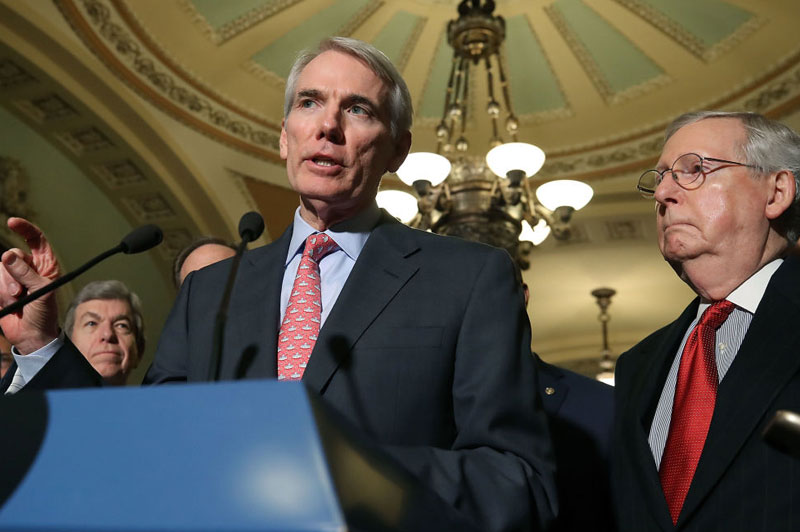
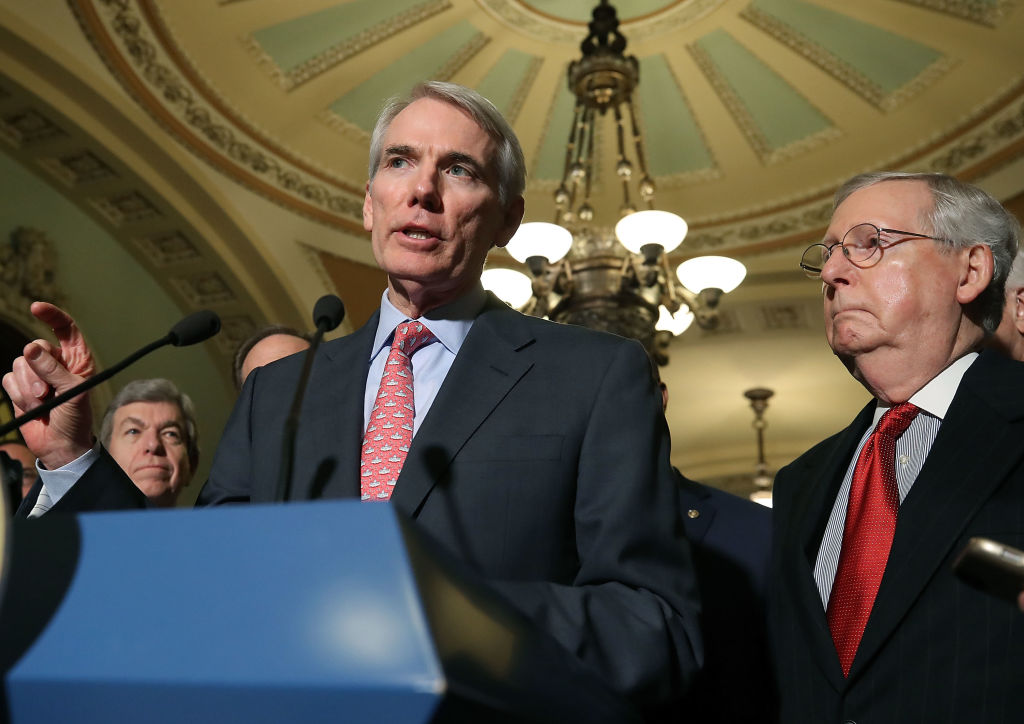
    Ohio U.S. Sen. Rob Portman with Senate Majority Leader Mitch McConnell. Photo by Mark Wilson/Getty Images.

    By Marty Schladen – The Ohio Capital Journal

    Under growing national pressure, U.S. Sen. Rob Portman on Monday conceded that former Vice President Joe Biden is “likely” to be the next president of the United States. 

    But Portman’s office continued to ignore questions about President Donald Trump’s attempts to get Republican-controlled legislatures to throw out votes and reverse the results of the Nov. 3 election, and he suggested that Trump’s spurious legal challenges have actually been good for democracy.

    “Donald Trump is our president until Jan. 20, 2021, but in the likely event that Joe Biden becomes our next president, it is in the national interest that the transition is seamless and that America is ready on day one of a new administration for the challenges we face,” Portman wrote in an op-ed published by the Cincinnati Enquirer.

    Ohio’s junior senator, who is up for reelection in 2022, did not criticize Trump’s legal strategy or his subsequent behavior. 

    Trump and his team have spouted a raft of unsupported conspiracy theories while racking up loss after loss in the courts. According to a New York Times analysis, those theories often have one feature in common: They seek to overturn votes in cities with large Black populations. In other words, at the core of the strategy is disenfranchising Black voters.

    “‘Democrat-led city’ — that’s code for Black,” the Times analysis quoted Rev. William J. Barber II, president of Repairers of the Breach, as saying. “They’re coupling ‘city’ and ‘fraud,’ and those two words have been used throughout the years. This is an old playbook being used in the modern time, and people should be aware of that.”

    Rather than criticize Trump’s legal strategy, Portman’s op-ed praised it

    “The Trump campaign has taken steps to insist that only lawful votes were counted in key states, including filing numerous lawsuits,” it said, explaining that most of those lawsuits have now been resolved. Then it adds, “There were instances of fraud and irregularities in this election, as there have been in every election. It is good that those have been exposed and any fraud or other wrongdoing should be prosecuted to the fullest extent of the law, but there is no evidence as of now of any widespread fraud or irregularities that would change the result in any state.”

    Portman and many other Senate Republicans have come under withering fire for their silence as Trump’s attempts to escape electoral defeat have become increasingly desperate.

    Long before the election, Trump repeatedly refused to say he’d abide by the results if he lost. But most prominent Republicans refused to criticize him.

    On Nov. 5, as Trump’s loss appeared increasingly likely and as he ramped up efforts to throw out votes cast against him, historian Michael Beschloss tweeted that history would be watching how people in power reacted.

    On Thursday, Trump’s legal team held a surreal press conference that was heavy on conspiracy theories but light on evidence. At the same time that Trump’s lawyers were alleging a plot involving a long-dead Venezuelan strongman, Trump was pressuring Michigan lawmakers to throw out votes in heavily Black Detroit.

    Former Republican presidential nominee Mitt Romney obviously had had enough.

    Through the weekend, as observers worried that Trump was breaking down vital norms and profoundly undermining faith in American democracy, Portman’s staff ignored a request for comment on Romney’s tweet.

    Then on Sunday night, legendary reporter Carl Bernstein called Portman out by name, saying he and other GOP senators privately espoused disdain for Trump but avoided crossing him in public — presumably out of fear of getting crosswise with Trump’s base.

    “We have a president of the United States for the first time in our history sabotaging his country,” Bernstein said in a Friday appearance on CNN. “Will these Republicans continue to allow this for another day? Because every day it appears more and more that our system cannot handle, was not designed… to handle an aberrant, mad king.” 

    Bernstein added that he believed the country is in more danger now than it was at the end of the presidency of Richard Nixon, which Bernstein helped to end with his coverage of the Watergate scandal.

    As part of a series of tweets, Bernstein said, “The 21 GOP Senators who have privately expressed their disdain for Trump are: Portman, Alexander, Sasse, Blunt, Collins, Murkowski, Cornyn, Thune, Romney, Braun, Young, Tim Scott, Rick Scott, Rubio, Grassley, Burr, Toomey, McSally, Moran, Roberts, Shelby.”

    Then he added, “With few exceptions, their craven public silence has helped enable Trump’s most grievous conduct—including undermining and discrediting the U.S. electoral system.

    On Monday morning, as Portman was publishing his op-ed, his office ignored questions about Bernstein’s criticism as well.

    And rather than criticizing Trump’s false claims of voter fraud, Portman claimed that the president’s recent behavior has been good for American democracy.

    “Based on polling, a substantial majority of the nearly 74 million Americans who supported President Trump question the legitimacy of the election,” the op-ed said. “I believe going through a fair and transparent process to ensure the election was properly decided is important for our democracy and to help heal our polarized country.”


    Marty Schladen

    Marty Schladen has been a reporter for decades, working in Indiana, Texas and other places before returning to his native Ohio to work at The Columbus Dispatch in 2017. He’s won state and national journalism awards for investigations into utility regulation, public corruption, the environment, prescription drug spending and other matters.