Tag: U.S. Senate

  • Senate confirms Project 2025 architect to head OMB

    Senate confirms Project 2025 architect to head OMB

    Russell Vought sees the Office of Management and Budget as a “nerve center” that can be used to curtail DEI programs and purge the federal workforce of Trump’s perceived enemies.

    Read Amanda Becker’s Loveland connection in her Bio below.

    This story was originally reported by Amanda Becker of The 19th. Meet Amanda and read more of her reporting on gender, politics and policy.

    ________________

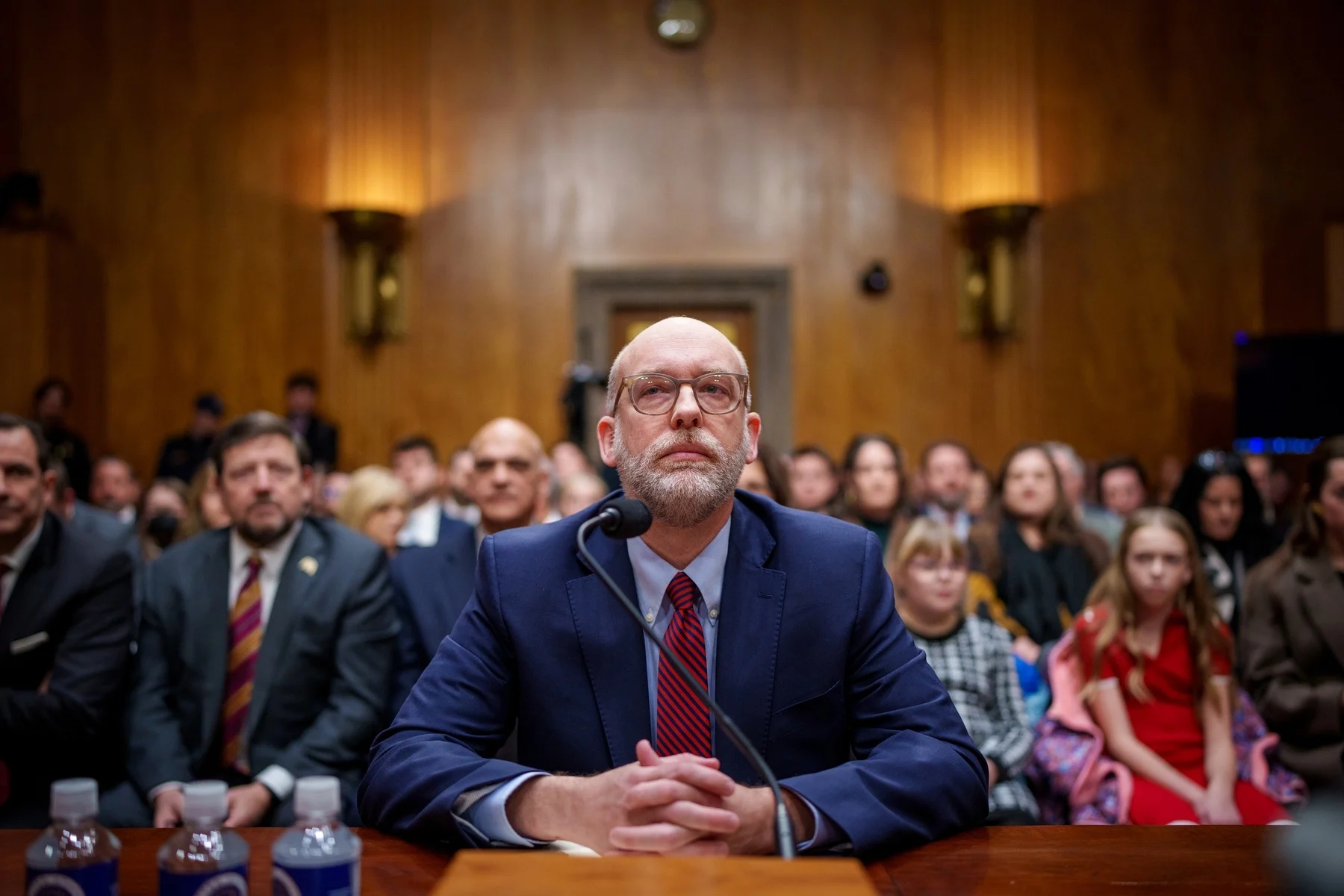
    The U.S. Senate on Thursday approved Project 2025 architect Russell Vought to lead the Office of Management and Budget (OMB) on a party-line vote after Democrats held the floor overnight in an attempt to delay the confirmation since they did not have the numbers to block it.

    Vought was confirmed by a vote of 53-47.

    For 30 hours, starting on Wednesday afternoon and into Thursday evening, Democrats took turns on the Senate floor to protest Republican President Donald Trump’s nomination of Vought, who also led OMB at the tail end of Trump’s first administration.

    “This is really important, that we raise the alarm as to what is happening,” said Sen. Chris Murphy of Connecticut, who spoke from 2-5 a.m., longer than most of his colleagues.

    During his first stint at OMB, an under-the-radar entity that wields immense influence over the federal government by crafting the president’s budget, Vought helped Trump come up with a plan to jettison job protections for thousands of federal workers and assisted with a legally ambiguous effort to redirect congressionally appropriated foreign aid for Ukraine. In the years since, Vought founded two pro-Trump groups whose work has focused on discrediting structural racism and curtailing diversity, equity and inclusion (DEI) programs. The chapter that Vought wrote for Project 2025 detailed how the budget agency could be used to withhold money appropriated by Congress and eliminate dissent within agencies by purging them of employees.

    Trump said repeatedly during his campaign that he had not read Project 2025 and did not know its authors, though at least 60 percent of its more than 350 contributors were linked to the president. These include appointees and nominees from his first administration, members of his prior transition team and unofficial advisers.

    Project 2025 is a 920-page roadmap from the conservative Heritage Foundation about how Trump’s second administration could use the federal government to enact a far-right Christian agenda. If implemented — and some of the Trump administration’s earliest moves track the blueprint’s objectives — it has the potential to redefine rights long held by all Americans, with disproportionate impacts for women, LGBTQ+ people, people of color and vulnerable populations like the elderly and disabled.

    “What was in Project 2025 that made it so widely hated across the political spectrum? A few things: firing civil servants, weaponizing the Department of Justice and the Federal Bureau of Investigation, unleashing force onto protestors, and targeting political opponents, restricting abortion nationwide, ripping retirement and health care benefits from seniors, dismantling public education,” Sen. Elizabeth Warren said Wednesday evening on the Senate floor in a speech opposing Vought’s nomination.

    Warren noted that Vought has called on Congress to outlaw medication abortion and encouraged discrimination against transgender people in the workplace. She continued: “Now, Donald Trump has named the lead architect of Project 2025, Russ Vought, to oversee the federal government’s entire budget office … to carry out the Republican blueprint to make our government force people to live in the image that Russ Vought and other extremist Republicans approve of.”

    Last week an OMB letter sent by acting director Matthew Vaeth instructing federal agencies to pause “all activities related to obligation or disbursement of all Federal financial assistance” sent shock waves across Washington. The White House moved to quell the backlash. A federal judge earlier this week issued a temporary restraining order, extending a pause on implementing the directive.

    Vought, in an interview with conservative activist Tucker Carlson shortly after Trump’s reelection, discussed how the incoming administration could force federal agencies to “come to heel and do what the president has been telling them to do.” He likened OMB to the “nerve center” through which Trump could ensure his policy directives trickle down through the federal agencies that employ more than 2 million Americans.

    Many of these federal workers received an email last week from the Office of Personnel Management (OPM), which acts as the federal government’s human resources department, with the subject line “Fork in the Road.” The email offered them a chance to opt into a “deferred resignation” program intended to trim the federal workforce and set an acceptance deadline of February 6. Already, federal employees identified as working on DEI programs had received letters notifying them that they were placed on leave and could be fired. Some have sued the administration.

    Labor unions representing federal employees also sued over the resignation offer and deadline, and a federal judge on Thursday blocked OPM from enforcing it. White House press secretary Karoline Leavitt said that about 40,000 workers had already accepted the offer and the White House expected that number to grow. Leavitt said she was not part of discussions about next steps or whether layoffs would follow if enough employees did not resign.

    “Americans need to know that OMB is extremely powerful, with oversight over the president’s budget and functionally all federal agency actions, including regulatory decisions,” Democratic Sen. Mazie Hirono of Hawaii said Thursday.

    “With such responsibility, the person leading this office needs to be level-headed and impartial. They need to put loyalty to the Constitution above loyalty to the President,” she added. “Mr. Vought, however, is the ultimate yes-man.”


    Read Project 25
    [pdf-embedder url=”https://lovelandmagazine.com/wp-content/uploads/2025/02/project-2025.pdf”]

  • Ohio Republican group urges GOP, swing voters to reject J.D. Vance

    Ohio Republican group urges GOP, swing voters to reject J.D. Vance

    Former Cincinnati Councilmember and Hamilton County Commissioner Phil Heimlich is part of a coalition of Ohio Republicans encouraging voters to reject Trump-aligned candidates like J.D. Vance.

    BY: NICK EVANS – Ohio Capital Journal

    With November’s election looming, a group of Republicans are hitting the campaign trail this week. But instead of stumping for the GOP, they’ll be encouraging voters to back the Democrat, Tim Ryan, in Ohio’s race for U.S. Senate.

    They’re working with an organization called Welcome PAC which emphasizes Democratic Party outreach to independents and “future former Republicans.” LinkedIn co-founder Reid Hoffman is the group’s primary donor. The PAC contends there’s a large pool of swing voters who reject former President Donald Trump. They’ve made it their mission to encourage those voters to reject Trump allied candidates as well.

    And that’s how Phil Heimlich found himself teaming up with a handful of other Ohio Republicans campaigning for Tim Ryan. Among them are two high level former staffers for outgoing U.S. Sen. Rob Portman — chief of staff John Bridgeland and legislative affairs director Jonathan Petuchowski. Former state Auditor James Petro, former state Rep. Rocky Saxbe, retired Major General Dennis Laich, and former Shelby County GOP chairman Chris Gibbs round out the list.

    There are a lot of “formers” in that lineup, though. While they’re pitching a return to a different era of Republican politics, it’s possible the party has picked up and moved on without them. Vance’s campaign makes no bones about its position on WelcomePAC:

    “Ohioans shouldn’t be fooled: this bogus organization isn’t ‘Republican’ — it’s a Democrat trick funded by a far-left super donor,” campaign spokesman Luke Schroeder said in a statement.

    While Hoffman has donated to plenty of Democrats, he has also contributed the $13,700 legal maximum to Gov. Mike DeWine and Secretary of State Frank LaRose, both of whom are Republicans.

    Vance opposition

    Heimlich himself is a former Cincinnati city councilmember and Hamilton County Commissioner, and he argued his conservative credentials are rock solid.

    “I was never considered a kind of a wishy-washy RINO type,” he said.

    Heimlich continues to describe himself as a loyal Republican, but said he can’t support nominees who deny the 2020 election or countenance the Jan. 6 insurrection.

    “We’re taking a stand against the wing of the Republican Party that engages in crazy conspiracies like Q-Anon, and, most importantly, we are choosing to put country over party,” Heimlich said. “J.D. Vance is lined up with the crazies, with the traitors. He has lined up with the people who tried to overthrow this government, the people who tried to overturn a legitimate election.”

    “We are supporting Tim Ryan because we’re putting country first,” he continued. “Tim Ryan is not only a moderate Democrat, but he is a pro-democracy Democrat and he’s running against an anti-democracy Republican.”

    This isn’t the first time Heimlich has made this sort of pitch. He and some of the same Republicans campaigning against Vance urged voters to reject Donald Trump in 2020. That effort, known as Operation Grant, invoked former president and civil war general Ulysses S. Grant’s role unifying the country.

    Heimlich explained this latest coalition doesn’t oppose Republicans reflexively, but it isn’t just Vance he opposes.

    Heimlich unsuccessfully challenged Ohio Republican U.S. Rep. Warren Davidson in the primary and criticized Davidson’s vote to overturn the 2020 election. He called out Ohio U.S. Rep. Jim Jordan, too, describing him as a Republican who “put party over country.”

    “In fact, they put one particular person, Donald Trump, over the interest of our country,” he added.

    Split-ticket voting

    When it comes to DeWine, Heimlich is more amenable. He expressed disappointment DeWine hasn’t made a more forceful stand against the former president, but credited him for not denying the election or praising insurrectionists.

    “One of the things we’re saying to people is, look, if you’re a patriot, don’t vote the party line, vote the country line,” Heimlich said. “So, if you want to vote for Mike DeWine for governor, fine, but please don’t vote for an election denier like J.D. Vance. Vote for DeWine and then vote for Tim Ryan.”

    Schroeder, with the Vance campaign, questioned the coalition’s Republican credentials. He argued it’s disingenuous to continue presenting themselves as part of the party.

    “(The) individuals involved are donors to Tim Ryan, Pete Buttigieg, Joe Biden, and liberal PACs, and one member even served as a political appointee for President Obama,” Schroeder said. “It’s a shame that these individuals have chosen to lie to Ohioans about who they really are.”

    In 2020, the Operation Grant pitch didn’t move Ohio into the win column for Joe Biden. Trump won the state by a margin nearly identical to his 2016 win. But in the aftermath, the organization argued it forced the Trump campaign to expend resources in Ohio, which they say helped Biden win elsewhere.

    This cycle, with the election limited to Ohio, they won’t have the same leeway. But then again, it’s far from clear Vance commands the same allegiance as the former president.

    Organizers of the group expect to make stops in Youngstown, Toledo, Cleveland, Akron, and Dayton in the coming weeks.

    Follow OCJ Reporter Nick Evans on Twitter.

  • Ohio Republican Senate candidate forum devolves into near fight

    Ohio Republican Senate candidate forum devolves into near fight

    Mike Gibbons, left, and Josh Mandel, right, have a heated exchange. Photo by Nick Evans, OCJ.

    BY: NICK EVANS – Ohio Capital Journal

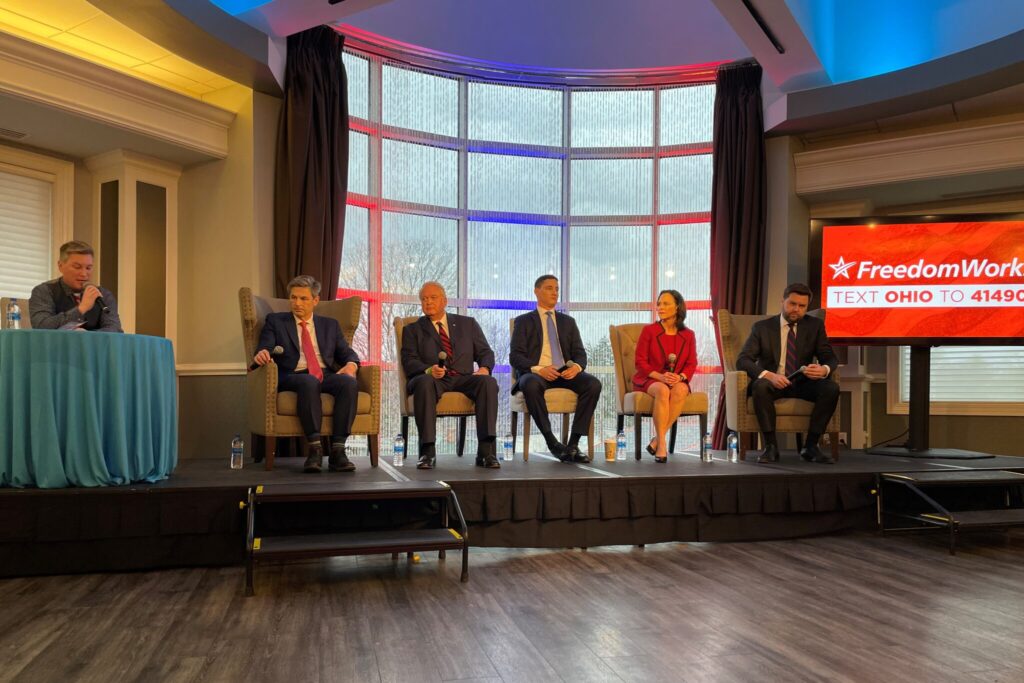
    The leading candidates for the Ohio Republican U.S. Senate nomination met in Gahanna Friday. Two of them nearly came to blows.

    The candidate forum hosted by FreedomWorks didn’t make it through opening statements before former Ohio Treasurer Josh Mandel began attacking investment banker Mike Gibbons. The other candidates, state Sen. Matt Dolan, former GOP chair Jane Timken and author J.D. Vance did their best to avoid the fracas.

    The substance

    The moderator took candidates through foreign policy, big tech “censorship” (twice), critical race theory, the opioid crisis and their feelings on Donald Trump’s presidency. The candidates largely agreed on support for Ukraine, but complained about how Congress approved a nearly $14 billion support package.

    “You can not just put, in the dark of night, all of these spending provisions into a bill, plop it on peoples’ desks and say you’ve got 12 hours to vote for this,” Dolan argued.

    Vance has argued against engaging the Ukraine war — raising eyebrows by saying he didn’t really care what happened. His position hasn’t really changed, but the framing has. Instead of emphasizing neglect, he uses the conflict to criticize establishment Republicans who couldn’t fund Trump’s border wall and to warn against American adventurism.

    “The only thing that will salvage Joe Biden’s presidency is if a bunch of stupid, weak-willed Republicans let this guy bumble us into a war that we have no business fighting,” he told the crowd.

    Biden has, from the outset and repeatedly since, insisted that American troops will not be sent to fight in Ukraine.

    Timken decried big tech as, “the weapon of the cancel culture and the woke left.”

    But beneath the red meat rhetoric, their arguments weren’t that dissimilar from what many on the left have demanded. Break them up, don’t let companies profit on your data, reform or eliminate section 230, the candidates argued.

    “There is no reason that Facebook or Meta as it’s called should be as powerful as it is, and also, meddling in our elections,” Timken said.

    The confrontation

     From left, moderator Brandon Boxer, Matt Dolan, Mike Gibbons, Josh Mandel, Jane Timken and J.D. Vance. Photo by Nick Evans, OCJ.

    Almost immediately, it became clear that Mandel would use the forum to attack Gibbons. In his opening statements Mandel argued the fight for the “soul of the Republican Party” was even more important than the fight against Democrats.

    “Here’s the fork in the roads,” he argued. “Down one path goes these squishy, RINO Republicans many of whom have been pro-China over the years.”

    He rattled off the list of excommunicated Republicans — Liz Cheney, Adam Kinzinger, Mitt Romney — before turning to Gibbons.

    “(He) had all these companies here in America and made money selling them to China,” Mandel said. “That is not the path that we should be taking in this country.”

    Mandel repeatedly steered his answers into Gibbons’ investment holdings criticizing him for shipping Ohio jobs overseas, selling companies “to China,” or simply holding stock in Chinese firms. By the third time he tried it, Mandel’s tactic was met with sustained boos from the crowd.

    “Again Josh is showing his ignorance,” Gibbons said after one critique tied to Lordstown Motors. He then turned to the former state treasurer and asked, “Josh, do you know anything about economics or finance at all?”

    Gibbons also made a dig he uses regularly on the campaign trail — Mandel has “zero” experience in the private sector.

    That’s incorrect. Mandel has served on corporate boards and advised payday lenders since leaving office in 2019. He also served in the military.

    The confrontation between the two became more heated, with Mandel jumping out of his seat after Gibbons told Mandel, “You might not understand this,” about a stock trade.

    “You’ve never been in the private sector in your entire life,” Gibbons insisted. “You don’t know squat.”

    “Two tours in Iraq,” Mandel growled, “don’t tell me I haven’t worked.”

    The other candidates traded uncomfortable laughs as the moderator broke up the incident while the crowd booed.

    “You’re dealing with the wrong guy,” Mandel said returning to his seat. “You watch what happens, p—-, you watch what happens.”

    The incident is in keeping with Mandel’s increasingly belligerent campaign. He’s taken to ending campaign ads with the tag line “send in the marine.”

    A few minutes after the confrontation, Vance, who is also a marine corps veteran, chastised Mandel.

    “I think the way you use the U.S. Marine Corps, Josh, is disgraceful,” Vance said. “It’s not a political football for you to toss around.”

    After the event ended, Gibbons waded out into the crowd to shake hands with attendees, but refused to talk to reporters. Instead, his campaign sent out a press release after the fact calling Mandel “unhinged, unfit and flailing.”

    Mandel handled things differently.

    When the forum concluded, he shook hands with his opponents and rushed off stage. He weaved through attendees and made a beeline for the service kitchen.

    In a straw poll, Mandel got just 4.6%, dead last among the candidates on stage. The winner was J.D. Vance with about 43% of votes.

    Speaking after the event Vance called Mandel’s conduct “embarrassing,” but he didn’t want to belabor it, instead focusing on how the crowd had reacted to the points he made during the evening. But asked about Mandel’s exit, Vance smiled and paused.

    “Well,” he said. “If I’d had his debate I may have run for the kitchen, too.”

  • Sen. Rob Portman announces he will not run for re-election in 2022

    Sen. Rob Portman announces he will not run for re-election in 2022

    By Tyler Buchanan and Ohio Capital Journal

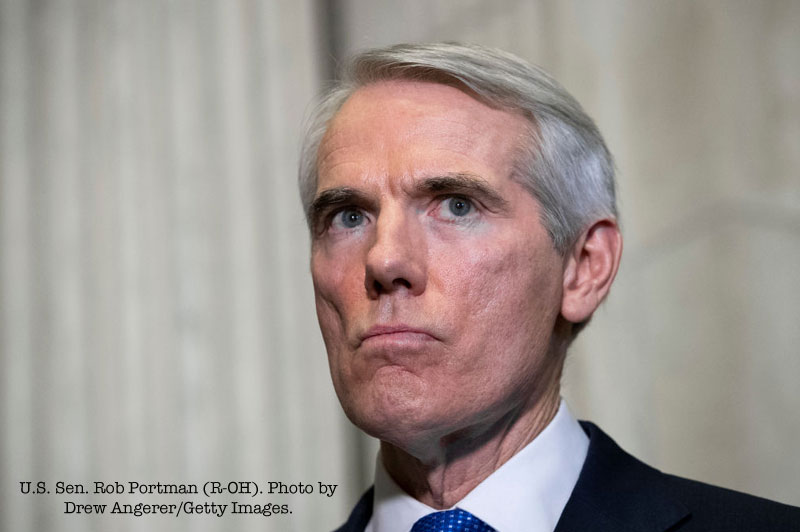
    Sen. Rob Portman announced Monday he would not be running for a third term in the U.S. Senate in 2022.

    The Cincinnati Republican said he intends to use his final two years in public office to “get a lot done,” noting a hopefulness of working with the Biden administration on the COVID-19 pandemic response and other legislative priorities. This would cap off a decades-long career in public service for Portman, 65, who previously served as U.S. Representative as well as budget chief and U.S. trade representative under President George W. Bush. 

    Portman’s announcement opens the door for a Republican primary in 2022 and for Democrats to face another non-incumbent instead of a well-financed incumbent who won his 2010 and 2016 Senate elections comfortably.

    “I feel fortunate to have been entrusted by the people of Ohio to represent them in the US Senate,” Portman said in a statement, calling it “an honor” to have served.

    Various Ohio political figures issued statements Monday in support of Portman. Gov. Mike DeWine called the senator a “key partner” during the pandemic response and Secretary of State Frank LaRose described him as being “what our founders hoped for in a public servant when they wrote our Constitution — a statesman.”

    Sen. Sherrod Brown, an Ohio Democrat who has served alongside Portman since 2011, noted the two have not always agreed with each other on policy but have “always been able to put our differences aside to do what’s best for Ohio.”

    A more detailed report from the Ohio Capital Journal on Sen. Portman’s announcement is forthcoming.

  • Brown votes against funding cuts that threatened jobs at NIOSH construction in Cincinnati

    Brown votes against funding cuts that threatened jobs at NIOSH construction in Cincinnati

    by David Miller,

    Washington, D.C. – The U.S. Senate voted on June 20 against an effort to pass the so-called “rescission package,” which would have slashed the fund that is supposed to pay for construction of Cincinnati’s new NIOSH facility by half. The rescission package would have taken back federal dollars intended for a wide range of projects and programs – including Cincinnati’s NIOSH construction – in order to pay for the $1 trillion deficit created by Republican tax cuts. With U.S. Senator Sherrod Brown’s (D-OH) opposition, the package failed on the floor by a vote of 48-50.

    “We made a commitment to Cincinnati, and we shouldn’t be putting southwest Ohio jobs and economic development at risk to pay for tax cuts that benefit companies shipping American jobs overseas,” said Brown.

    In May, Brown called on the Administration to tell Ohio how it will keep its commitment to move forward with the NIOSH project after the fund is cut.

    In 2015, Brown helped secure $110 million in federal funds to advance construction and site consolidation for NIOSH’s new facility in Cincinnati.That money is supposed to come from the nonrecurring expense fund (NEF) at the Department of Health and Human Services, which currently has about $500 million for NIOSH and other projects.

    Brown’s office said he had worked to protect that fund from cuts for years in order to ensure the NIOSH construction continues moving forward. And up until now, the project had been proceeding on schedule. In fact, the CDC recently solicited bids for a design-build contract. The Administration’s rescission package would take $220 million away from the nonrecurring expense fund – cutting he fund by about half and threatening the future of the project, according to a statement issued by Brown.

    Sen. Rob Portman (R-OH) voted for the rescission package.

    As part of the Centers for Disease Control and Prevention (CDC), NIOSH is responsible for conducting research and making recommendations to prevent work-related injury and illness. The NIOSH facilities in Cincinnati employ more than 500.

    The new construction project is intended to consolidate NIOSH’s Cincinnati facilities into one central location to improve and enhance scientific collaboration, as employees conduct research and make recommendations to prevent work-related injury and illness. The funding will also ensure that there are appropriate and adequate research facilities for NIOSH’s scientific program and will reduce operating costs by consolidating multiple campuses.


  • Tax bill may threaten disability services

    Tax bill may threaten disability services

    A Republican proposal to overhaul the tax code could endanger everything from employment services to health care for people with disabilities, advocates say.

    More than a dozen disability advocacy groups are working furiously to block the U.S. Senate from passing a bill that may bring up to $1.5 trillion in tax cuts, warning that slashing such a huge chunk of federal revenue would spell trouble for programs that Americans with disabilities rely on.  Read on at Disability Scoop…


    513-683-1052
    215 Loveland-Madeira Rd

    Loveland, Ohio 45140