Tag: unconstitutional

  • Ohio anti-gerrymandering leaders say LaRose’s draft ballot text is deceptive and unconstitutional

    Ohio anti-gerrymandering leaders say LaRose’s draft ballot text is deceptive and unconstitutional

    By:  Ohio Capital Journal

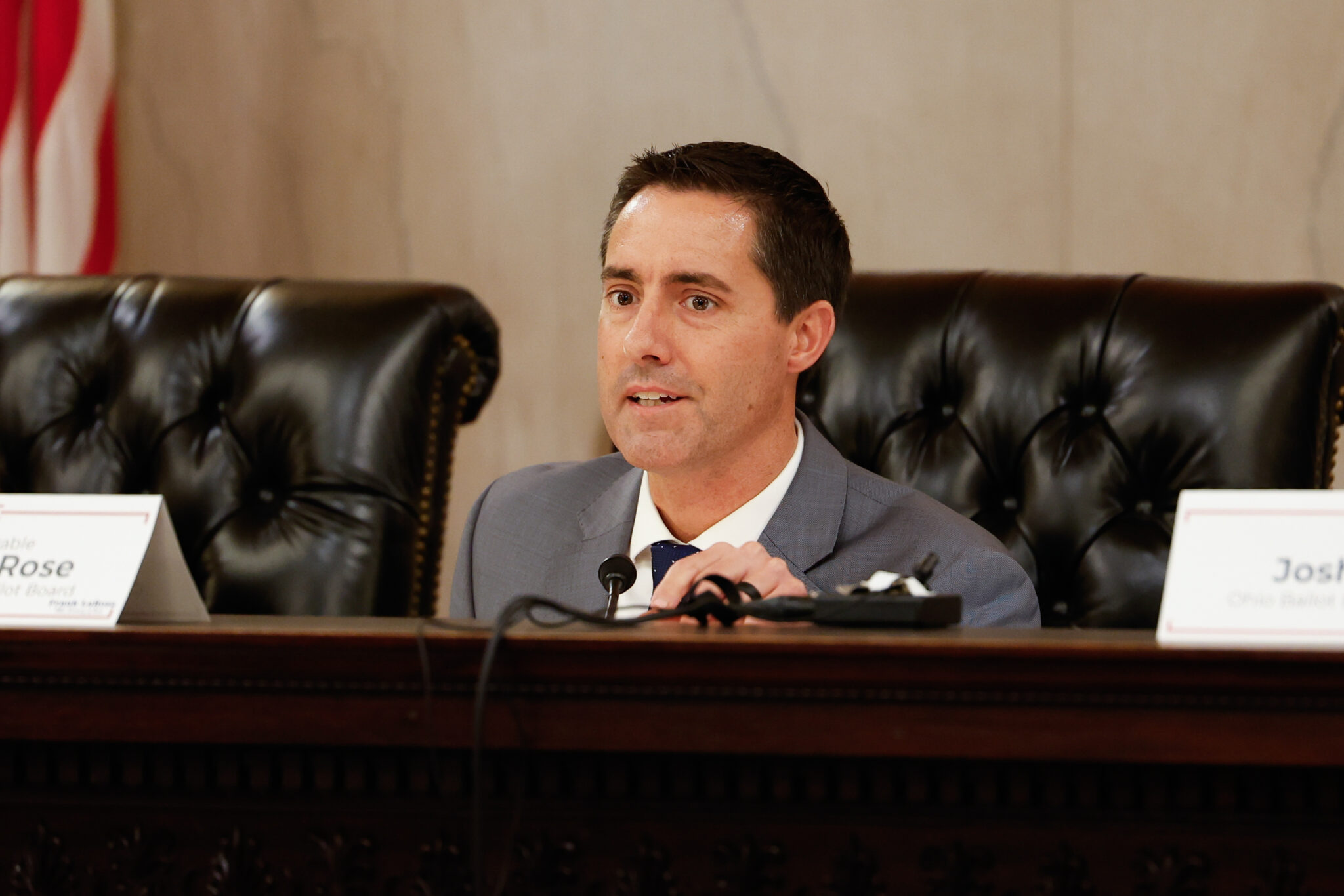
    The office of Ohio Secretary of State Frank LaRose has drafted ballot language for the Ohio Ballot Board to consider Friday that supporters of an anti-gerrymandering amendment say is deceptive and unconstitutional. The Ballot Board decides the text of proposed amendments that voters actually see on their ballots when they vote.

    The anti-gerrymandering amendment before Ohio voters in November, according to the language drafted by LaRose’s office, would “eliminate the longstanding ability of Ohio citizens to hold their representatives accountable for establishing fair state legislative and congressional districts.”

    The Citizens Not Politicians group that authored the ballot initiative and collected more than 535,000 necessary signatures from Ohio voters to get the measure on the ballot, has proposed their own language for the ballot as well, saying it would remove politicians from the redistricting process in favor of a citizen board.

    The group is proposing a redistricting amendment that would replace Ohio’s politician-led redistricting commission with a citizen-led commission made up of Republicans, Democrats and independents. Currently, the Ohio Secretary of State is one of the politicians sitting on Ohio’s redistricting commission, along with the governor, the Ohio Auditor, two lawmakers from the majority party and two lawmakers from the minority party.

    The language drafted by the Secretary of State’s Office claims in its proposed title that the amendment’s purpose is, “To create an appointed redistricting commission not elected by or subject to removal by the voters of the state.”

    Moreover, the draft language says its purpose is to “repeal constitutional protections against gerrymandering approved by nearly three-quarters of Ohio electors participating in the statewide elections of 2015 and 2018.”

    Backers say the amendment is actually intended to protect voters against gerrymandering by removing politicians who stand to benefit from the process, and to not allow them to continue drawing gerrymandered district maps.

    After the 2015 and 2018 reforms were.passed by voters, Republican politicians on the Ohio Redistricting Commission including Ohio Secretary of State LaRose repeatedly voted for Statehouse and U.S. Congressional district maps that were declared unconstitutional gerrymanders by a bipartisan majority on the Ohio Supreme Court. Nevertheless, Ohio voters were forced to use the maps as the politicians refused to produce a maps that reflected voting preferences of Ohioans.

    The Ohio Secretary of State’s Office further claims in its proposed language that the new amendment would also “limit the right of Ohio citizens to freely express their opinions to members of the commission or to commission staff regarding the redistricting process or proposed redistricting plans.”

    It claims the amendment would “prohibit any citizen from filing a lawsuit challenging a redistricting plan in any court, except if the lawsuit challenges the proportionality standard applied by the commission, and then only before the Ohio Supreme Court,” and that new “taxpayer-funded costs” would be imposed by the amendment, with “an unlimited amount for legal expenses incurred by the commission in any related litigation.”

    Ohio Gov. Mike DeWine recently publicly opposed the ballot measure because of its emphasis on proportionality, alleging there was no way the measure could work as written. In opposing the measure, he said whether or not it passes in November, he’s considering going to the legislature to adapt Iowa’s redistricting process for Ohio. Iowa’s process leaves lawmakers with final say over maps.

    The proposed constitutional amendment penned by Citizens Not Politicians calls for a 15-person redistricting commission made up of citizens, rather than the Ohio Redistricting Commission that is currently made up entirely of elected officials.

    The language proposed by Citizens Not Politicians to the ballot board states the proposed amendment would “require that the commission consist of 15 members who have demonstrated the absence of any disqualifying conflicts of interest and who have shown an ability to conduct the redistricting process with impartiality, integrity and fairness.”

    The amendment would “provide that each redistricting plan shall contain single-member districts that are geographically contiguous, comply with federal law, closely correspond to statewide partisan preferences of Ohio voters and preserve communities,” according to the Citizens Not Politicians proposed language.

    The current Ohio Redistricting Commission made up of politicians produced six different Statehouse maps and two congressional maps over the two years it did its work. Five of the Statehouse maps were ruled unconstitutional by the Ohio Supreme Court and neither of the congressional maps passed constitutional muster, according to the state’s highest court. The second of the congressional maps remains the state’s congressional district map, despite being found to be unduly partisan by the state supreme court.

    The redistricting commission was criticized for disregarding hours of testimony from hundreds of Ohio citizens, and numerous citizen and group-proposed maps in favor of maps written by legislative staffers, and disregarding the authority of the Ohio Supreme Court when they were ordered to redraw maps within deadlines and utilize paid independent mapmakers coordinated by the court.

     Retired Republican Chief Justice of the Supreme Court of Ohio, Maureen O’Connor. (Poto by Graham Stokes for Ohio Capital Journal. Republish photo only with original article.) 

    Former Ohio Supreme Court Chief Justice Maureen O’Connor, a leader for Citizens Not Politicians, who has called for reforms to redistricting since she left the bench, said the Secretary of State’s proposed language violates the Ohio Constitution.

    “The self-dealing politicians who have rigged the legislative maps now want to rig the Nov. 5 election by illegally manipulating the ballot language,” O’Connor said in a statement. “We will make our case for fair and accurate language before the Ballot Board and if necessary take it to court.”

    O’Connor’s statement claims the language proposed by the Secretary of State’s Office violates an article of the Ohio Constitution that prohibits ballot language that “is such as to mislead, deceive, or defraud voters,” according to the law.

    Ohio law also states ballot titles “shall give a true and impartial statement of the measures in such language that the ballot title shall not be likely to create prejudice for or against the measure.”

    It’s not the first time even in the last year that ballot language has been criticized as a misleading representation of the proposed initiative. Last year’s reproductive rights ballot measure went through the same process, with language written by Ohio Secretary of State staff approved as the language to appear on the ballots.

    The creators of the ballot measure sued, with the Ohio Supreme Court approving the ballot language, but sending it back to the board for small changes.

    Despite the language, which critics said intentionally misrepresented the reproductive rights amendment, the measure passed with 57% of the vote last November.

    State Secretary of State LaRose is the head of the Ohio Ballot Board that will consider the language on Friday. The board is also made up of Republican state Sen. Theresa Gavarone, Democratic state Sen. Paula Hicks-Hudson, Democratic state Rep. Terrence Upchurch and citizen-member William Morgan.

    A spokesperson for the Secretary of State’s Office did not respond to request for comment on the language Thursday afternoon.

    Susan Tebben
    Susan Tebben

    Susan Tebben is an award-winning journalist with a decade of experience covering Ohio news, including courts and crime, Appalachian social issues, government, education, diversity and culture. She has worked for The Newark Advocate, The Glasgow (KY) Daily Times, The Athens Messenger, and WOUB Public Media. She has also had work featured on National Public Radio.

    Ohio Capital Journal is part of States Newsroom, the nation’s largest state-focused nonprofit news organization.

    MORE FROM AUTHOR

  • As deadline for reform measure nears, advocates look to future of Ohio redistricting

    As deadline for reform measure nears, advocates look to future of Ohio redistricting

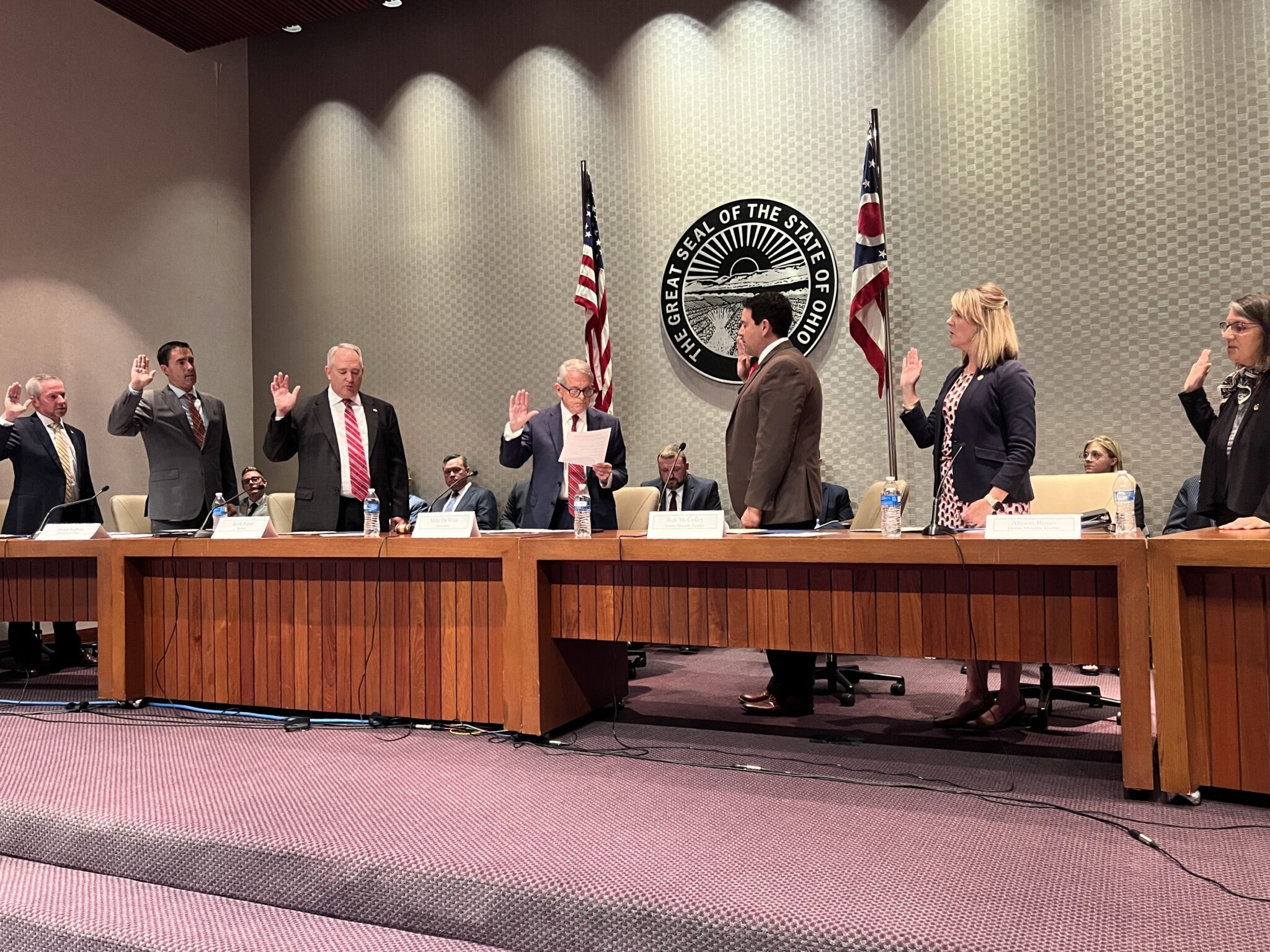
    The members of the Ohio Redistricting Commission are sworn in by Gov. Mike DeWine on Wednesday. Left to right: State Rep. Jeff LaRe, Secretary of State Frank LaRose, Auditor of State Keith Faber, DeWine, Senate Majority Floor Leader Rob McColley, House Minority Leader Allison Russo and Senate Minority Leader Nickie Antonio. (Photo by Susan Tebben, OCJ.)

    BY:  Ohio Capital Journal

    Signature collection continues for an anti-gerrymandering ballot measure in Ohio that would replace politicians on the redistricting commission with citizens. As the July deadline approaches, supporters are pointing to a new study showing how uncompetitive Statehouse races are.

    The Brennan Center for Justice at NYU’s law school analyzed Ohio’s current maps alongside the results of the most recent primary election.

    Authors of the study said the data “reveals one of the tangible ways Ohio’s gerrymandered maps undermine electoral competition, and how the districts leave millions of Ohio voters without a significant voice in the Ohio House elections slated for this November.”

    “An overwhelming majority of Ohioans will cast ballots this November in legislative districts that were drawn to lock in general election outcomes, and few districts featured meaningful primary contests,” the Brennan Center report stated. “These are the predictable consequences of living in a gerrymandered state.”

    One of the authors of the report, released Tuesday, is Yurij Rudensky, who spoke in support of the new ballot initiative proposed to hit voters in November. If it gets on the ballot and is passed by voters, the reforms would replace the current Ohio Redistricting Commission made up of elected officials with a citizen-run, judge-vetted commission to draw the next Statehouse and U.S. Congressional maps.

    Rudensky spoke in a March panel, alongside former Ohio Supreme Court Chief Justice Maureen O’Connor and others, about the difference between the reforms passed in 2015 and 2018 and the proposed amendment that voters may see on their general election ballots.

    At the March panel discussion, Rudensky hesitated to call the last two measures reforms because he argued no changes were made and the previous amendments merely demonstrated that “political insiders have no business being in the process.”

    Since those amendments passed — reforms made through legislative negotiation before hitting the voters — the Ohio Redistricting Commission has been built on a Republican majority, with Gov. Mike DeWine, Senate President Matt Huffman, former House Speaker Bob Cupp, Secretary of State Frank LaRose and Auditor of State Keith Faber all standing on the commission during some or all of the proceedings over the two years it took for the group to pass six Statehouse maps and two congressional maps. State Rep. Jeff LaRe, R-Violet Twp., replaced Cupp and state Sen. Rob McColley, R-Napoleon, came in for Huffman toward the end of the two-year span.

    The Statehouse maps were declared unconstitutionally gerrymandered five times by a bipartisan majority on the Ohio Supreme Court, but voters were forced by federal judges to use them for the 2022 Election.

    Statehouse maps passed by the redistricting commission this past September, and set to be used for this year’s election, were the only to receive bipartisan agreement (with Senate Minority Leader Nickie Antonio and House Minority Leader Allison Russo’s votes), while the state’s Congressional map is still considered unconstitutional under an Ohio Supreme Court ruling.

    In analyzing the current Ohio Statehouse maps, Rudensky and co-author Gina Feliz concluded that about 77% of the state’s population live in “districts where elections for state representatives are not in serious dispute.”

    “That is, these districts are either uncontested, or they give one party a disproportionate advantage in the general election so that the district is uncompetitive, even if it’s formally contested,” the researchers wrote.

    The report defines “uncompetitive” as districts where the partisan draw favors one party by 55% or more.

     Source: Brennan Center analysis of Ohio Secretary of State’s Office Unofficial 2024 Primary Election Results. 

    Nearly half of the districts in the Ohio House didn’t have a primary contest in March to drive a November general election race, the Brennan Center research found, citing data from the Ohio Secretary of State.

    “In all, there are 15 districts (out of 99 total) that will give voters no choice between Democratic and Republican candidates for state representative,” according to the study.

    The report also recognized the low turnout in the state during the primary season, with an average of 18.8% of registered voters casting ballots in districts with competitive primaries.

    Because of that, Rudensky and Feliz counted fewer than 450,000 voters who “all but decided who would serve as state representatives on behalf of more than 2.3 million registered voters and 3.5 million constituents.”

    The report pointed to the proposed ballot initiative led by Citizens Not Politicians as a redistricting reform that could “center community needs and voter preferences rather than the interests of incumbents.”

    Looking to a future that may have an independent redistricting commission, the voting rights group Common Cause put out its own report, a summary of a 2023 conference where members reflected on states who already have such a system in place, and those like Ohio that could see the change come in November.

    “Unsurprisingly, all those who attended the conference believed in the possibilities of fair and representative maps and that independent redistricting commissions were the best strategy to achieve this goal,” Common Cause stated in the new report.

    The “Roadmap for Fair Maps in 2030,” a summary of the 2023 National Citizen Redistricting Commissioners Conference, talked about the need to make redistricting a transparent process that is “responsive to community needs.” At the conference, the report said a “model commission” was organized for Ohio and neighbor state Indiana “to demonstrate how an alternative process based on community input and transparency can work.”

    In a previous report, released shortly after the Ohio Redistricting Commission adopted the current Statehouse district maps, Common Cause gave the state a failing grade, calling the current map-drawing process and the results that came from it “unmitigated disasters.”

    Ideally in redistricting, Common Cause members said the process should “ensure that commissions reflect the diversity of the jurisdiction” and engage community-based organizations and leaders to build resident trust and hold commissions accountable.

    What should not be included in the process, according to the report, are legislature-appointed commissioners or any legislative role in the mapping process.

    “Commission decisions on maps should be final, except for judicial review, with no approval from elected officials required,” the report stated.

    The Citizens Not Politicians initiative was supported in the report as part of strategies to “increase fair representation in 2030,” the next time the process is set to start, though maps in Ohio would need to be redrawn in 2025 if the ballot measure passes in November.

    Opposition to the initiative has been led by Huffman, who helped formulate the previous redistricting reforms. In an Ohio Chamber of Commerce event following the March primaries, he laid out his arguments against the initiative, saying litigation would pile up with the proposed system, and that “when allowed to work,” the current system did its job.

    In order for the measure to appear on Ohio ballots in the general election, supporters must collect 413,487 valid state voter signatures by July 3.


    Susan Tebben
    SUSAN TEBBEN

    Susan Tebben is an award-winning journalist with a decade of experience covering Ohio news, including courts and crime, Appalachian social issues, government, education, diversity and culture. She has worked for The Newark Advocate, The Glasgow (KY) Daily Times, The Athens Messenger, and WOUB Public Media. She has also had work featured on National Public Radio.

    Ohio Capital Journal is part of States Newsroom, the nation’s largest state-focused nonprofit news organization.

    MORE FROM AUTHOR

  • What’s next for congressional redistricting

    What’s next for congressional redistricting

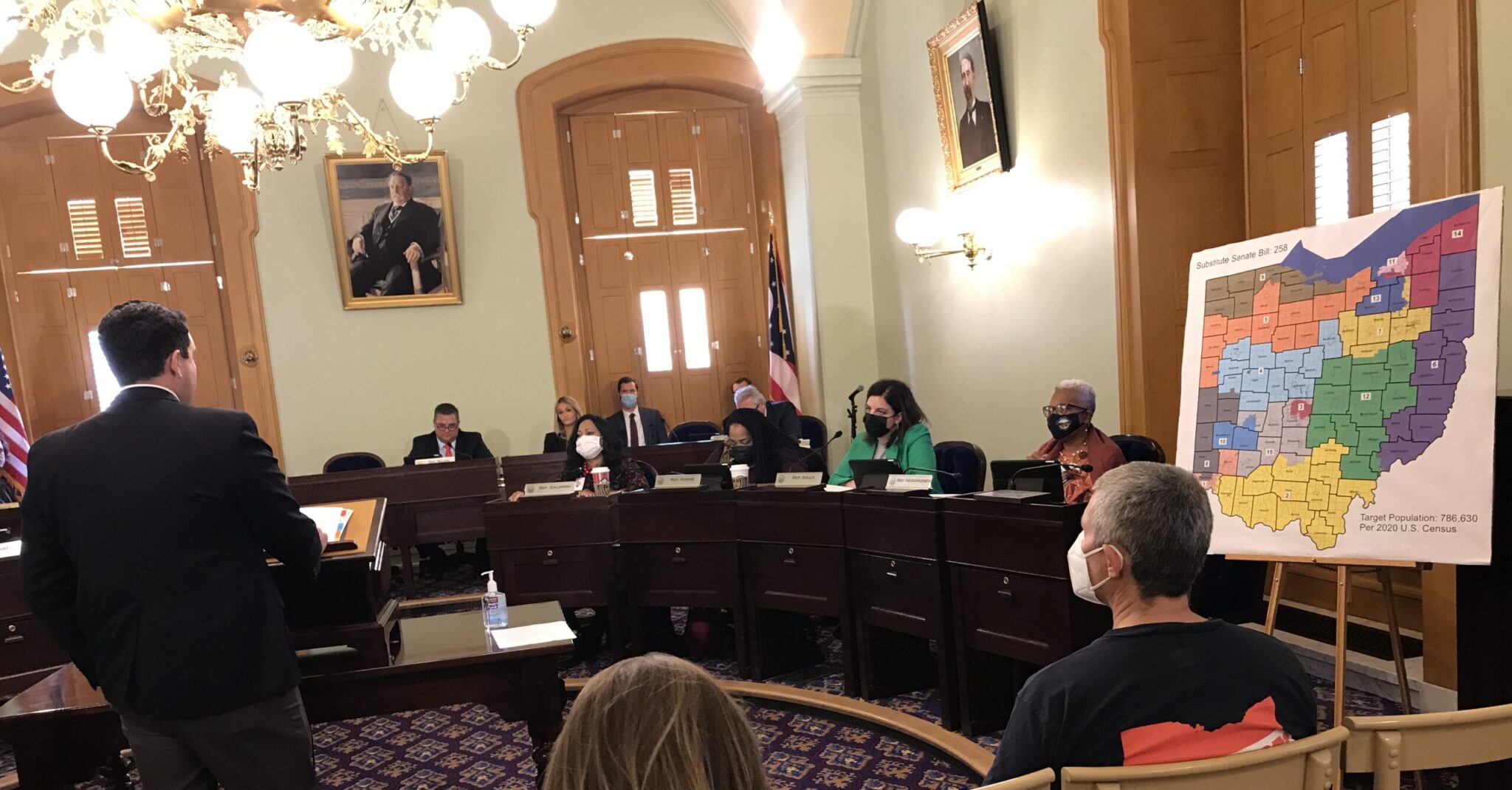
    State Sen. Rob McColley, R-Napoleon, presents congressional redistricting maps to the House Government Oversight Committee on November 17. (Photo: Susan Tebben, OCJ)

    BY: SUSAN TEBBEN –  Ohio Capital Journal

    This week the process begins again of trying to draw congressional districting lines in Ohio.

    The Ohio Supreme Court started its year sending the state legislature back to the drawing board on congressional redistricting, after rejecting the map passed in November by the GOP supermajority.

    With a one-week timeline for the legislature to come up with a plan, committees are convening with that specific purpose.

    Starting Tuesday morning in the Ohio House’s Government Oversight Committee, representatives will hear about House Bill 479, a bill led by state Rep. Scott Oelslager, R-North Canton, which is up for a possible substitution, meaning it could include the new House proposal for congressional districts.

    That bill was the vehicle for the House’s proposal last time around, but it was overtaken by the GOP’s Senate Bill 258, which was quickly adopted by the legislature as the official redistricting plan.

    The same day the House considers its own redistricting effort, the Senate General Government Budget Committee will be looking at Senate Bill 286, state Sen. Rob McColley’s bill for congressional redistricting.

    McColley, R-Napoleon, was the lead on SB 258, the map that would eventually be rejected as unconstitutional by the state’s high court.

    The senate committee accepted testimony on the bill for its first hearing on Tuesday, and a possible vote is indicated for Wednesday’s meeting of the General Government Committee. No testimony or vote is indicated for the House Bill, and the committee is not set to meet again this week.

    If either of the bills pass through committee, it would move on for a full House and/or Senate vote. Both chambers are scheduled to have sessions on Wednesday, with the House set to meet at 1 p.m. and the Senate to meet at 1:30 p.m.

    The House has an “if-needed” session on the calendar for 1 p.m. on Thursday, which could mean the Senate will pass a redistricting plan on Wednesday and send it to the House for agreement on Thursday.

    The legislature has until Feb. 13 to pass a plan. In order for the plan to take effect for 10 years, bipartisan support is needed, which would have to include 33% of Democrats in both the House and Senate. If the legislature can’t get bipartisan support, the map would be in place for four years, pending supreme court approval.

    A new plan from the legislature would have to have an emergency clause attached to it in order to take effect before the May 30 primary. Typically, without an emergency clause, a bill passed by the General Assembly goes into effect 90 days after the governor signs it.

    If the legislature doesn’t bring a plan to a vote by the deadline, the process heads back to the Ohio Redistricting Commission, who would have another 30 days to come up with a plan.

    The ORC just finished revising legislative maps, which were once again invalidated in a Monday ruling by the supreme court.

    The 4-3 decision by the court found the revised maps had similar violations as the original maps, with the court still finding issues with the revised maps in terms of partisan favoritism.

    The ORC now has until February 17 to revise the legislative maps for a third time.