Tag: unvaccinated

  • COVID-19 rises again in an undervaccinated Ohio

    COVID-19 rises again in an undervaccinated Ohio

    Photo by John Moore | Getty Images.

    BY: JAKE ZUCKERMAN – Ohio Capital Journal (Local dated added by Loveland Magazine)

    COVID-19 cases are once again ascendant in the 10th least vaccinated state in the nation.

    State data shows infection rates are climbing and the workloads are reupping at hospitals, where more than 2,700 Ohioans are currently hospitalized with COVID-19.

    An analysis of state data shows that 11 months into the vaccine rollout, the ground is still fertile for outbreaks all around Ohio. Of 88 counties in the Buckeye State, only Delaware (71% vaccinated) surpasses the national vaccination rate of 68.5%. In 58 counties, less than half the population is vaccinated, according to data as of Sunday.

    Ranked by state, Ohio (56% vaccinated) is the 10th least-vaccinated in the country, according to data from The New York Times.

    In Henry County, a rural swath of northwest Ohio, COVID-19 is spreading at more than twice the statewide rate of about 400 infections per 100,0000 residents. About 52% of residents are vaccinated. Health Commissioner Joy Ermie said the spread is not specific to any outbreak or location, it’s just swimming through homes and social events of mostly unvaccinated people.

    “The quicker we turn this around, the quicker we’ll see a decrease in our cases,” she said. “It will be a forever cycle if we cannot increase our overall vaccination rates.”

    Public health workers in coronavirus-sieged counties said in interviews for this article that it’s time to start accepting that COVID-19 is likely here to stay in some form or fashion, absent a paradigm shift on vaccination.

    Several indicated a circular pattern in vaccination; the unvaccinated, by and large, are staying unvaccinated. The vaccinated are fortifying their immune system with booster doses.

    “I would absolutely love to say COVID is over in X [number of] months,” Ermie said. “But I feel much more confident that we should take our energy away from, ‘How is this going to end?’ to ‘How can we learn to live with it?’”

     Gavin Smits receives a first dose of the Pfizer COVID-19 vaccine. (Photo by David Ryder/Getty Images)

    Federal authorities approved the use of vaccines on children aged 5-11 earlier this month, which will likely jumpstart vaccination rates to some extent. In north-central Ohio’s Seneca County, a population of roughly 55,000 people, about 47% of residents are vaccinated. The county’s case rate is nearly twice the statewide average.

    About 20 children were vaccinated at a clinic last Tuesday night, according to county health commissioner Anne Goon. She said there hasn’t been any mad rush on vaccines, but she was happy with Tuesday’s crowd.

    She said adults in the community have bristled with vaccines, masks, and assorted infection control policy responses to the pandemic. Some parents have refused to have their kids tested after they’re exposed to the coronavirus at school, she said, even if it’s required for an after-school sport.

    “We have a portion of our population that just doesn’t think COVID is real,” Goon said. “That it’s just a hoax.”

    To Dr. Bruce Vanderhoff, Ohio’s top doctor and director of the state health department, the state is “approaching” a point in the pandemic where coronavirus becomes more of a nuisance than threat to the public welfare. We’re not there yet though as the extra-transmissible delta variant of the coronavirus “relentlessly” seeks out the unvaccinated, he said.

    “In some circumstances, what is driving what we’re seeing is low vaccination rates in some communities,” he said. “So we have to continue to focus on the importance of vaccination.”

    Vanderhoff, speaking to reporters Friday, offered a more optimistic take on Ohio’s vaccination rate. Among Ohio adults, more than 2 in 3 have now received at least one dose of vaccination. The COVID-19 vaccination rate, he said, has surpassed the rate of Ohioans who get their annual flu shot. It pales in comparison to vaccination against disease like measles or polio, but those vaccines have been around longer and are (mostly) legally required to enroll in school.

    Despite Vanderhoff’s optimism, hospitalizations for COVID-19 have increased across every age group over the last week. For people aged 30-39, who are less vaccinated than their elder counterparts, hospitalizations leapt 48% in that time frame. More than 2,700 Ohioans are currently hospitalized with COVID-19, up from less than 2,200 earlier this month.

    John Palmer, a spokesman for the Ohio Hospital Association, said the statewide COVID-19 patient census has been increasing by about 60 patients daily as of late.

    “Hospitals are operating at high-capacity levels with workforce challenges and any surge will have a devastating impact leading to disruption of health care access for communities,” he said. “Despite three safe, approved and effective vaccines available today to stop this virus we continue to see spread and it’s frustrating to respond to a virus that is preventable.”

    All told over about 20 pandemic months, more than 25,600 Ohioans have died from COVID-19, part of the U.S.’ 762,000 dead. More than 82,000 Ohioans have been hospitalized, including more than 10,000 who required ICU care. A staggering 1.6 million Ohioans have been infected with COVID-19.

    Data on infections that “break through” the vaccines’ protection is limited, but available evidence suggests it’s a rare occurrence. CDC research shows vaccination decreases the risk of infection by a factor of five; the vaccines are between 88% and 93% effective in preventing hospitalization; and months’ worth of data shows there’s no increased risk for mortality among vaccine recipients. Since Jan. 1 in Ohio, fewer than 5% of people hospitalized or dead from COVID-19 were vaccinated.

    Mark Cameron, an immunologist at Case Western Reserve University, is not surprised by COVID-19’s resurgence. Even highly vaccinated states like Vermont (82% vaccine started) are wrestling with outbreaks. In Ohio, cold weather makes respiratory viruses more spreadable and drives humans to gather inside instead of outside.

    “It’s absolutely unacceptable to operate in a space in which 50-60% of the people are unvaccinated,” he said.

    He expressed frustration with a sense of complacency from the public whenever the coronavirus ebbs, and an unwillingness to acknowledge the predictable patterns of disease spread based on low vaccine coverage, weather and human behavior.

    “I don’t know what unique to say at this point,” he said. “Here we are risking another impact on our holiday season through sickness, hospitalization and death.”
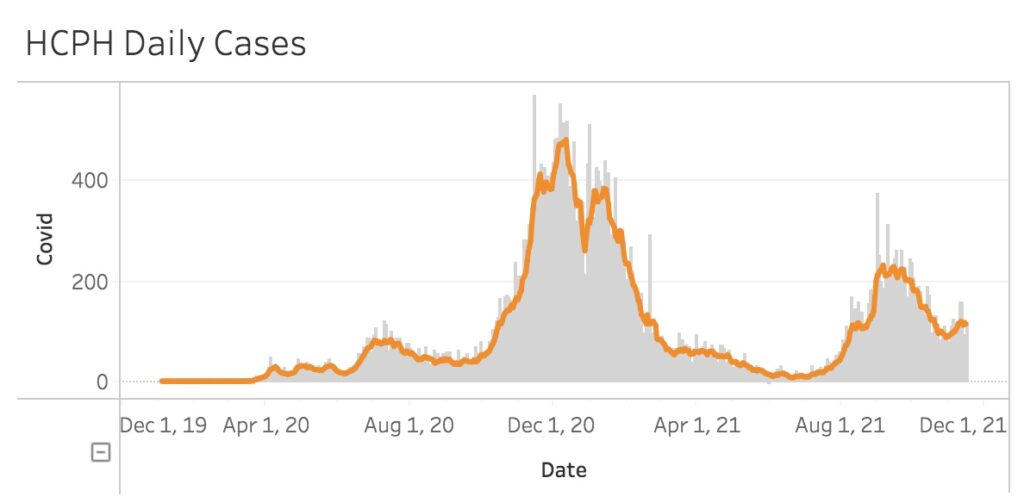

    Hamiolton County Public Health 11-16-2021

    November 16

    Warren County Health Services reported 62 additional COVID-19 cases on Tuesday, along with 60 recoveries. Health Services is monitoring 493 active COVID cases as of Tuesday, 471 of them involving mild illness.

    Thirteen (13) people are hospitalized as of Tuesday, one (1) fewer than Monday. One (1) is critically ill, and the remainder have moderate illness. Nine (9) others are moderately ill outside of the hospital.

    All but two (2) of Tuesday’s cases involved community spread of COVID-19, as two (2) were reported in a skilled nursing facility.

    Warren County Health Services continues to see a significant spike in COVID-19 transmission, with the majority of its new cases arising from workplace exposures, family/household exposures and indoor events/gatherings as the highly transmissible Delta variant remains involved with virtually all local cases.

    Sixteen (16) of Tuesday’s cases involved individuals who had been fully vaccinated. Cumulatively as of Tuesday, 1,086 of 44,513 fully vaccinated Warren County residents have tested positive for COVID-19. To date, 1,027 of 1,086 had mild illness, while 41 became moderately ill, two (2) seriously ill and one (1) critically ill. Fifteen (15) passed away, all of them elderly and/or with extensive health issues, seven (7) of them at nursing homes.

  • [DeWine] COVID-19 Update for Ohio: highest levels ever of hospitalizations among those under 50

    [DeWine] COVID-19 Update for Ohio: highest levels ever of hospitalizations among those under 50

    Around 97 percent of patients of all ages in Ohio hospitals today are unvaccinated.

    When you get COVID-19 without the protection of a vaccine, there is a very real risk you’ll end up in the hospital or the obituary pages.

    Columbus, Ohio – Ohio Governor DeWine today provided an update on the increased impact that COVID-19 is having on Ohio’s younger populations and the stress that the surge of cases is having on hospitals statewide.

    “The bottom line is that we’re seeing our highest levels ever of hospitalizations among those under 50 years old,” said Governor DeWine. “Those who are getting very sick, being hospitalized, and dying of COVID are getting younger and younger. And it is because they are not vaccinated.”

    • Today, there were 459 newly-reported hospitalizations, the highest number of new hospitalizations since January.
    • The number of new hospitalizations for COVID-19 of those under 50, was the highest during the entire pandemic during the week of Sept. 5th, when Ohio hospitals admitted 398 patients under the age of 50.
    • During the most recent completed reporting week (Sept. 5 — Sept. 11), 230 Ohioans 39 and younger were admitted to the hospital, which is the highest number of admissions for COVID in this age group during the entire pandemic, even higher than during the winter surge levels when no one was vaccinated.
    • Around 97 percent of patients of all ages in Ohio hospitals today are unvaccinated.
    • In July, 48 percent of COVID-19 deaths were among those 69 years old and younger. In August, preliminary data shows that an average of two people younger than 50 died of COVID-19 in Ohio every day.

    • Last month, preliminary numbers showed 18 Ohioans 39 and younger died from COVID-19. This is compared to five people in that age range who died in June and two people in that age range who died in July.

    Dr. Bruce Vanderhoff, Director, Ohio Department of Health
    “If you are young and unvaccinated it’s now probably only a question of when, not if, you get COVID-19. When you get COVID-19 without the protection of a vaccine, there is a very real risk you’ll end up in the hospital or the obituary pages. The numbers really tell it all, COVID has changed and is now making younger Ohioans who are not vaccinated very sick. Don’t become a statistic when there is a simple, safe, and effective alternative. Go out today and get vaccinated.”

    Suzanne Bennett, M.D., Extracorporeal Membrane Oxygenation (ECMO) Program Director, University of Cincinnati Health
    “These rising numbers of sick COVID patients places a significant burden on our hospital beds, our medical teams, and worse yet, it creates scenarios that no one wants to think about where we do not have the space for patients who would otherwise benefit from receiving their care at large academic medical centers. We now need the help of the people in our community more than ever so that no one else needs to die from this disease.”

    Alan Rivera, M.D., Hospitalist, Fulton County Health Center
    “We are in a crisis mode. As compared to last year, our nursing staff is down probably 50 percent. We have nurses leaving the field, retiring early, or finding jobs elsewhere because of the long hours and the emotional strain. On top of that, our COVID numbers are now going up. In June and July I didn’t see any COVID patients. Now, the majority of the census in our hospital are COVID patients, and they’re younger, anywhere from 30 to 50.”

    Joe Bates, R.N., B.S.N., Clinical Coordinator, Critical Care Unit, Genesis HealthCare System (Zanesville)
    “We’re seeing the younger population being hit hardest with this right now. Our average age right now that we’re seeing is around 59, with many of them being younger, as compared to last year when the average was about 78 years of age. Of the COVID positives that we currently have in the ICU, none of them are vaccinated who are on the ventilator.”

    Terri Alexander, R.N., P.C.C.N., Summa Health (Akron)
    “It’s just a sad, sad situation that we’re dealing with, and it’s tragic because it’s just so preventable. Please, please, please, get vaccinated. We live in a culture that has never experienced coming to the hospital and getting turned away, and I think people can’t fathom what that’s truly like until its them or their family members who are coming in and getting turned away.”

  • As classes return, 62.5% of eligible 12-18 year-olds unvaccinated

    As classes return, 62.5% of eligible 12-18 year-olds unvaccinated

    BY: JAKE ZUCKERMAN and Ohio Capital Journal

    Nearly two in three age-eligible teenagers remain unvaccinated against COVID-19 as summer ends and the disease looms over its third consecutive school year.

    Spokespersons for the state departments of health and education said they did not know what percentage of students enrolled in public schools are vaccinated.

    However, looking at the total population (which would include homeschooled students), more than 62% remain unvaccinated.

    “As of today, there are 390,903 Ohioans age 12-18 who have started the vaccination process,” said Ohio Department of Health spokeswoman Alicia Shoults. “This represents 37.5% of that age group.”

    Despite plans to attend classes in close contact with their peers several days per week, teenagers are the least vaccinated age cohort — surpassing 20-29-year-olds (44%) and 30-39-year-olds (51%).

    The Pfizer/BioNTech vaccine was authorized for use in people aged 16-and-up in mid-December, though most states restricted access for elder and sicker residents through early 2021. The U.S. Food and Drug Administration authorized its use on children 12-15 on May 11.

    At a press conference last week, Gov. Mike DeWine said a communal goal of keeping students in school for in-person learning is “threatened” by the hyper-transmissible Delta variant of COVID-19. He repeated a recommendation from ODH that students either seek vaccination or wear a mask at school.

    “The best way to make sure a child can stay in school and not have his or her classes interrupted, is for that child to be vaccinated,” he said. “If that child cannot be vaccinated, the best way to ensure a good school year for that child is for that child to wear a mask while in class.”


    See Breaking News Up-Date:

    FDA gives full approval to Pfizer-BioNTech COVID-19 Vaccine

    Loveland Magazine – Aug 23, 2021


  • As in other states, Ohio might be running out of people who want shots

    As in other states, Ohio might be running out of people who want shots

    By Marty Schladen and Ohio Capital Journal

    Some county health departments in Ohio are again telling state officials this week not to send them any more coronavirus vaccines. That’s because they haven’t been able to use up the supplies they already have.

    It might be part of a national phenomenon. The news organization Axios reported this week on a paper by the Kaiser Family Foundation saying that based on its polling, just over 60% of Americans say they’ll get a vaccine.

    “We estimate that across the U.S. as a whole we will likely reach a tipping point on vaccine enthusiasm in the next two to four weeks,” the paper said. “Once this happens, efforts to encourage vaccination will become much harder, presenting a challenge to reaching the levels of herd immunity that are expected to be needed.”

    The paper conceded that the percentage of people willing to get a shot has crept up over time, so “61% may be a floor, not a ceiling.”

    Even so, it portends a struggle to get to the 70% threshold that epidemiologists say is necessary to achieve “herd immunity,” the point at which the virus starts to find it difficult to find new hosts so it can keep spreading and evolving.

    That’s an issue in Ohio.

    Everyone 16 and older has been eligible to get a shot since the beginning of the month. But as of Wednesday just 38% of the state’s population had received a first dose of the vaccine and just 28% had completed it.

    Further complicating the problem is that a fast-spreading variant that has ravaged Michigan has been spreading into Ohio, affecting the state’s northern counties first.

    The presence of that variant and other factors have put the unvaccinated in more peril now than at any other time in the pandemic, Robert M. Wachter, chairman of the department of medicine at the University of California at San Francisco, wrote Monday in a column in the Washington Post.

    Because more people — especially the elderly — have been vaccinated, case numbers, hospitalizations and deaths are far down from their winter peaks. But the numbers that health officials are counting now are affecting a smaller slice of the population: those who haven’t been vaccinated, and particularly those who haven’t survived an infection, Wachter wrote.

    “The problem is that the aggregate numbers — even if they show down-trending test positivity rates, hospitalizations and deaths — may be masking an important duality,” Wachter wrote. “The situation may be getting enormously better in the growing vaccinated population, while at the same time growing somewhat worse in the unvaccinated group.”

    Bruce Vanderhoff, medical director for the Ohio Department of Health, was asked Wednesday about younger Ohioans who might not think they’re particularly at risk if they don’t get vaccinated. 

    Bruce Vanderhoff, medical director for the Ohio Department of Health

    Doctors around the country report more covid hospitalizations and complicationsamong young people, partly as a result of the increasing dominance of the B.1.1.7 variant. Yet just 27% of Ohioans 20 to 29 have received at least a first dose of the vaccine.

    Vanderhoff said the risk extends beyond the individual.

    “People who don’t get the vaccine are not only putting themselves at risk, they’re putting others at risk as well,” he said. “We’re doing a disservice to the people we care about.”

    Gov. Mike DeWine said health officials are doing everything they can think of to make it easier to get a shot, including expanding walk-up vaccination centers, taking shots into neighborhoods and workplaces and offering vaccines to family physicians.

    He’s also trying to convince people that they have a responsibility to family and community.

    “You can’t be sure everybody you come in contact with has been vaccinated,” DeWine said. “We’re not in this separately. This is not a decision that people make and only they live with the consequences.”